The utter failure of the International Monetary Fund, and why it damages the world.

Mitchell’s laws: The more budgets are cut and taxes inceased, the weaker an economy becomes. To survive long term, a monetarily non-sovereign government must have a positive balance of payments. Austerity = poverty and leads to civil disorder. Those, who do not understand the differences between Monetary Sovereignty and monetary non-sovereignty, do not understand economics.
==========================================================================================================================================
While marchers here in Chicago, protest against major, multi-national, public and private organizations, it seems appropriate to mention the International Monetary Fund (IMF)

The (IMF) touts its mission this way: “The International Monetary Fund (IMF) is an organization of 188 countries, working to foster global monetary cooperation, secure financial stability, facilitate international trade, promote high employment and sustainable economic growth, and reduce poverty around the world.”

Mostly, it has done the exact opposite. The fundamental reason is the IMF’s ignorance of Monetary Sovereignty, the basis for all modern economics.

A Monetarily Sovereign government has the power to create unlimited quantities of its own sovereign currency. It is constrained neither by taxes nor by borrowing. Federal taxes and borrowing could fall to $0, and federal spending could double or triple or grow with no limit at all – constrained only by inflation.

So while the U.S. federal government never can be “broke,” as John Boehner famously lied, nor must it live within its “means,” (it has no “means”) as so many pundits falsely claim, there is but one limit to money creation, and that limit is inflation.

Yet, contrary to popular belief, reaching that limit is extremely rare, perhaps one of the rarest events in modern economics.

The International Monetary Fund maintains a website devoted to educating the public about economics. I cannot recommend this site. The IMF lives in a world of obsolete economics, while the rest of us work within the current realities of Monetary Sovereignty.

The sole reason to visit the site is to understand the popular (false) wisdom of the day, and in this way, to understand the failure of the IMF to reach its stated goals. For example, here are excerpts from their site, regarding inflation:

What creates inflation?

Long-lasting episodes of high inflation are often the result of lax monetary policy. If the money supply grows too big relative to the size of an economy, the unit value of the currency diminishes; in other words, its purchasing power falls and prices rise. This relationship between the money supply and the size of the economy is called the quantity theory of money, and is one of the oldest hypotheses in economics.

Yes, this is exactly what the public believes, i.e, when the government “prints” too much money, the U.S. has inflation.

First, the government doesn’t “print” money; money has no physical existence, so it can’t be printed, touched, mailed, smelled, burned, crumpled or stored. No one on earth, ever has seen money.

Money is nothing more than an accounting notation. A dollar bill is not money. It merely is an official statement that the holder owns money.

“Print” is yet another word used incorrectly in economics (along with “debt,” “deficit,” etc.) that misleads, because its popular meaning differs from its economic meaning. In economics, “print” really means “create.”

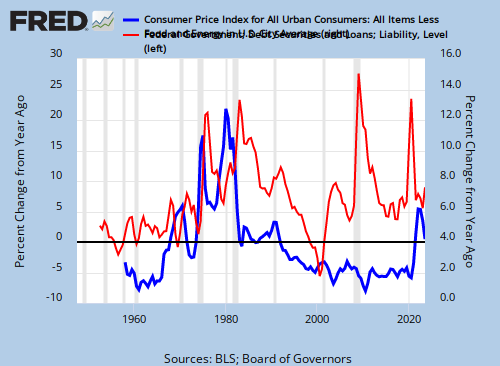
That said, the real question is: Does “printing” or creating money cause inflation? Is inflation really, as the common expression goes, “Too much money chasing too few goods and services?”

The answer is, “Yes and no.” Yes, if the U.S. federal government immediately created (by deficit spending) $900 trillion, I suspect there would be a world-wide inflation. But barring that extreme example, there simply has been no relationship between federal deficit spending and inflation.
Monetary Sovereignty

The inflation fears of the debt hawks have no basis in reality. While “too much money / too few goods” may sound logical, it is not historically factual. It can exist only in some hypothetical, extreme, almost never-seen situation.

The reason has to do with the new, worldwide markets. “Too few goods” seldom can exist, today. If one nation runs short of something, buyers get it from another nation. The world has changed, while IMF economics has not changed with it.

The IMF’s “educational” site also says:

How policymakers deal with inflation

The right set of anti-inflation policies, those aimed at reducing inflation, depends on the causes of inflation. If the economy has overheated, central banks—if they are committed to ensuring price stability—can implement contractionary policies that rein in aggregate demand, usually by raising interest rates.

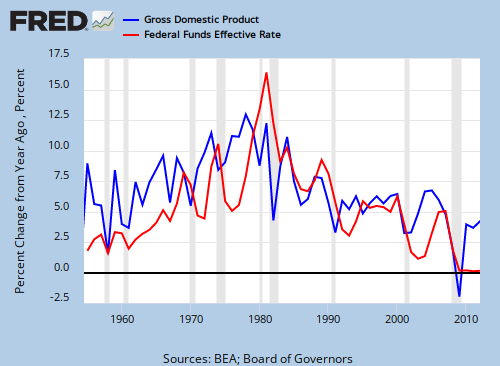
This too is a popular belief, that high interest rates reduce demand, and it too is false. If high rates did inhibit demand, we would expect to see a correspondence between high rates and reduced Gross Domestic Product (GDP).

Yet, we see no such thing. In fact, to a slight degree, we see the opposite: High rates actually stimulate demand:
Monetarily Sovereign

The probable reason: High rates force the federal government to pay more interest, thereby pumping more money into the economy, which is stimulative.

The Fed does raise interest rates too fight inflation, not because they reduce the demand for goods and services but because high rates increase the reward for owning money, thereby increasing the demand for money. Making money more valuable fights inflation.

The bottom line: The IMF subscribes to obsolete bits of popular wisdom about economics, which explains why it tries to solve the indebtedness of monetarily non-sovereign nations by lending them even more money, when these nations cannot service the debt they already have, then demanding that these nations cease stimulative spending and increase anti-stimulative taxing.

The IMF, having learned little about economics during the past 40 years, prescribes leeches to cure anemia, much to the detriment of the world.

Rodger Malcolm Mitchell
http://www.rodgermitchell.com


==========================================================================================================================================
No nation can tax itself into prosperity, nor grow without money growth. Monetary Sovereignty: Cutting federal deficits to grow the economy is like applying leeches to cure anemia. Two key equations in economics:
Federal Deficits – Net Imports = Net Private Savings
Gross Domestic Product = Federal Spending + Private Investment and Consumption + Net exports

#MONETARY SOVEREIGNTY

–How the euro zone would build an airplane

Mitchell’s laws: The more budgets are cut and taxes inceased, the weaker an economy becomes. To survive long term, a monetarily non-sovereign government must have a positive balance of payments. Austerity = poverty and leads to civil disorder. Those, who do not understand the differences between Monetary Sovereignty and monetary non-sovereignty, do not understand economics.
==========================================================================================================================================

Before you read the excerpts from the following article, visualize this scenario:

The eurozone proudly builds an airplane with their own hands. They feel it’s a great achievement.

But unaccountably, they have bolted both wings to the same side of the hull. The plane won’t fly. Rather than admit they did it wrong, and move one wing to the other side of the hull, they install a gyroscope in the plane, to override the imbalance, and force it to fly.

But the gyroscope needs to be heavy — too heavy for the plane to get off the ground. So they insert a huge helium balloon in the hull to make the plane lighter. But the balloon needs to be big. It takes up so much space in the hull, there in no room for passengers. So the eurozone bolts some chairs onto the wings, but the chairs interrupt the aerodynamics.

The eurozone insists everything is O.K., but when they try to fly their plane, it wobbles so much, it almost crashes.

Insight: Greek exit could cost eurozone 100s of billions of euros
Inflation Is Coming
The World’s Financial System Is Crumbling. Here’s The Worst-Case.

Under a scenario described in German weekly Der Spiegel, the euro zone’s EFSF bailout fund could be used in the event of a Greek default to continue funding Greece’s debt obligations to the ECB.

However, this would eat into the resources of the ‘firewall’, eroding its capacity to help other euro zone states which might well need to be protected if a Greek exit sparked contagion.

An alternative scenario could see the national central banks turning to their governments to recapitalize the ECB. But going cap in hand to politicians for money they are desperately short of risks undermining the ECB’s independence.

Or, the EU, being Monetarily Sovereign, simply could pump euros into the ECB, to give to the monetarily non-sovereign euro nations.

ECB loans to Greek banks are another way the central bank is exposed but in this case, although the ECB conducts these lending operations, the funds are distributed via the national central banks and carried on their balance sheets.

A Bank of Greece financial statement showed that as of January 31 it had lent out a total of 73 billion. Berenberg Bank economist Christian Schulz said that in the event of a Greek exit these loans and most of the collateral may be converted into a new Greek currency.

“The ECB/Eurosystem would not bear the risk anymore,” he added, noting that the Bank of Greece would instead be left with the – likely devalued – loans and collateral.

Is he saying that loans to Greece, which Greece has no hope of servicing, are not a risk?

The ECB could monetize any net loss in the event of a Greek euro exit by printing money but that would come with an inflationary effect unpalatable to policymakers in Germany, the bloc’s most powerful player.

Germany still has not recovered from the trauma of the Weimar hyperinflation. Never mind that that inflation lasted only three years, could have been cured even sooner, never was repeated, and immediately preceded the greatest military buildup in history, all paid for by “printing” money — with no hyperinflation.

“If (savers in other periphery countries) see that Greek savers have seen their euro savings overnight being converted into drachma, which could depreciate by 50-70 percent, then it would be a fairly simple hedge strategy for them to take out some of their savings and put them into Luxembourg, or pounds sterling, or Swiss francs,” said Bosomworth.

First, there is nothing to say the drachma will depreciate. Second, if the drachma does depreciate, Greece’s exports will soar and tourists will flock there. Unemployment will disappear and Greece will become one of Europe’s wealthy nations.

That’s the real reason for the EU’s concern — having the world see what a failed plan the euro was.

ECB President Mario Draghi said on Wednesday that “our strong preference is that Greece will continue to stay in the euro zone”.

Translation: If the euro disappears, I, Draghi, will lose my job.

“What they can do is try to prevent contagion – where they have a very significant role – and they will probably also try to convince participants on all sides to keep Greece in the euro area,” said Citigroup economist Juergen Michels.”

Next step the eurozone takes: Attach their plane to an Atlas rocket and shoot it into the stratosphere, from where it can glide down — but the lower pressure causes the helium balloon to inflate, splitting the hull, so the gyroscope falls out, causing the plane to crash, killing all the passengers who still are sitting on the wings.

My advice to passengers: Get off that plane while you still can.

Rodger Malcolm Mitchell
http://www.rodgermitchell.com


==========================================================================================================================================
No nation can tax itself into prosperity, nor grow without money growth. Monetary Sovereignty: Cutting federal deficits to grow the economy is like applying leeches to cure anemia. Two key equations in economics:
Federal Deficits – Net Imports = Net Private Savings
Gross Domestic Product = Federal Spending + Private Investment and Consumption + Net exports

#MONETARY SOVEREIGNTY

–A truly outstanding summary of Monetary Sovereignty for those who want to understand economics

Mitchell’s laws: The more budgets are cut and taxes inceased, the weaker an economy becomes. To survive long term, a monetarily non-sovereign government must have a positive balance of payments. Austerity = poverty and leads to civil disorder. Those, who do not understand the differences between Monetary Sovereignty and monetary non-sovereignty, do not understand economics.
==========================================================================================================================================

A reader directed me to the following site: http://neweconomicperspectives.org/2012/05/playing-monopolis-monopoly-an-inquiry-into-why-we-are-making-ourselves-so-miserable.html

Somehow, through the magic of the Internet, I lost the reader’s comment, but the site he sent me to is so outstanding I ask that everyone read it.

Reader, whoever you are, please accept my apologies and send me another comment, so I can thank you by name.

Oops, just found it. You can to, in the comment section of the previous post.

Rodger Malcolm Mitchell
http://www.rodgermitchell.com


==========================================================================================================================================
No nation can tax itself into prosperity, nor grow without money growth. Monetary Sovereignty: Cutting federal deficits to grow the economy is like applying leeches to cure anemia. Two key equations in economics:
Federal Deficits – Net Imports = Net Private Savings
Gross Domestic Product = Federal Spending + Private Investment and Consumption + Net exports

#MONETARY SOVEREIGNTY

Europe discusses applying leeches to cure anemia, and reducing calories to cure starvation.

Mitchell’s laws: The more budgets are cut and taxes inceased, the weaker an economy becomes. To survive long term, a monetarily non-sovereign government must have a positive balance of payments. Austerity = poverty and leads to civil disorder. Those, who do not understand the differences between Monetary Sovereignty and monetary non-sovereignty, do not understand economics.
==========================================================================================================================================

I continue to be amazed by the Chicago Tribune. Its reporters do some great investigative journalism, possibly the best in the nation. They dig for months into secret files, and bring together data that has been hidden from the public, exposing criminality by public a private officials.

But its editors are completely clueless about data that stares them in the face –even information directly handed to them. Reporters, great. Editors, clueless.

Here are excerpt’s from the latest nonsense editorial.

Is Europe catching?
Hope that the eurozone can survive a Greek collapse

Why would anyone wish the eurozone to survive. It already has shown to be a failed model. Forcing nations to surrender the single most valuable asset they own — their Monetary Sovereignty — is, and has been, the basis for disaster. It’s a disaster I predicted six years ago.

Europe is coming to Chicago in the next few days and the great temptation is to set up a quarantine room at O’Hare International Airport. Our visitors have a bad case of the financial flu. We can only hope it’s not catching.

The euro nations, not being inoculated with Monetary Sovereignty, do not have the ability to fight off recession. Fortunately, the U.S. has that ability (though our politicians don’t understand it), so we can create the dollars necessary to grow our economy.

Greece could collapse in a matter of weeks when its banking system runs out of funds. The tiny Aegean nation’s economic illness could spread to the sickly and much larger economies of Italy and Spain.

That would be disastrous for Europeans and a serious problem for Americans. U.S. economic growth depends on the success of the 27-nation European Union, which, taken together, is America’s biggest trading partner. Eleven of those 27 countries have slipped back into recession.

Exactly! Not being Monetarily Sovereign, these nations cannot create euros. So they cannot prevent their banking system from running out of funds. Eventually, all euro nations will collapse, even Germany.

Here’s a quote from CBS Moneywatch:

U.S. Treasury Secretary Timothy Geithner applauded the softer tone emerging among European leaders. “You are seeing them talk about a better balance between growth and austerity, meaning a somewhat more gradual, softer path toward restoring fiscal sustainability,” Geithner said. The shift shows that European leaders recognize that countries can’t increase their economic growth if they’re forced to focus solely on cutting spending and reducing debts. Geithner said European countries would benefit from investment in public works projects, like roads and schools.

Sadly, Geithner still doesn’t understand the difference between Monetary Sovereignty and monetary non-sovereignty, so he thinks austerity is the same as “fiscal sustainability.” But at least he is does understand a nation cannot recover from a recession but cutting deficit spending (Hello, Tea/Republicans and Democrats, alike).

Back to the Tribune editorial:

Many of them would like to stimulate their way out of recession with government spending. But practically every nation in Europe’s southern tier has piled up way too much debt and cannot afford to keep borrowing. Germany, the strongest economy, has rightly forced austerity measures on its free-spending neighbors as a condition of bailouts.

Change one word and the above paragraph will be accurate. Change “rightly” to “stupidly.” It’s amazing. These people think they can cure starvation by cutting calories.

Greece agreed to slash public spending, rewrite rigid labor rules that throttle its private sector and pay off part of its debt over time. In exchange, its banks got a cash infusion and its creditors agreed to write off more than half its debt.

In the wake of the deal, though, unemployment has gotten worse and money has become more scarce. The Greek economy has shrunk for five consecutive years, with no end in sight.

What a surprise. After they cut spending, unemployment got worse and the economy shrunk. Who could have imagined that?

If a new government rejects austerity and renounces its debt, Greece probably will be forced out of the eurozone, the common currency union.

Long term, this would be the best thing that could happen to Greece and its citizens.

Greece would have to print its own currency, which would be extraordinarily weak because it wouldn’t be backed by wealthier European nations.

So with that “weak” currency, Greek exports would soar, and within two years, Greece would wealthier than any of the euro nations.

With time to prepare, systemic risk has been reduced. Governments have made contingency plans and banks have limited their exposure. Financial firewalls are in place to keep a Greek collapse from spreading to Italy, Spain and other vulnerable countries like Portugal and Ireland.

That’s a shame. But despair not. If they stay with the euro, their economies will collapse, too.

Europe really has no choice but to work off its huge debt over time, though that will hamper economic growth. Its monetary union may wind up losing one or more members. It faces years of slow growth or no growth … or worse.

There are two better choices than applying leeches to cure anemia:

1. Form a republic — a quasi United States of Europe — with the EU supplying its member nations with euros, as needed
or
2. Each euro nation re-adopting its own sovereign currency.

That’s it. There are no other solutions. The so-called “bailouts” merely were loans to countries that cannot service their current debt, let alone trying to service additional debt. This is exactly what the American banks did when giving mortgages to people who couldn’t afford them.

It’s what caused the U.S. recession, which is being ameliorated by federal stimulus spending.

Stimulus today; stimulus tomorrow; austerity never. My question: Why is this so hard to understand?

Rodger Malcolm Mitchell
http://www.rodgermitchell.com


==========================================================================================================================================
No nation can tax itself into prosperity, nor grow without money growth. Monetary Sovereignty: Cutting federal deficits to grow the economy is like applying leeches to cure anemia. Two key equations in economics:
Federal Deficits – Net Imports = Net Private Savings
Gross Domestic Product = Federal Spending + Private Investment and Consumption + Net exports

#MONETARY SOVEREIGNTY