They feed you garbage to improve your health.

Is this article about the meaningless Debt/GDP ratio ignorance or malevolence? I suspect it’s not ignorance. These people should know better. But they keep writing this nonsense. Why?
Bhargavi Sakthivel
I have my suspicions, which I’ll voice later, but first, here are some excerpts from a frightening example.”

A million simulations, one verdict for economy: Debt danger ahead Bhargavi Sakthivel,  Maeva Cousin, and David Wilcox, Bloomberg News 

In its latest projections, the Congressional Budget Office warned that U.S. federal government debt will increase from 97% of GDP last year to 116% by 2034—higher than in World War II. The actual outlook is likely worse.

“Worse”? Why is an increase in the so-called “federal debt” (that isn’t federal and isn’t debt) bad? When you read the article, you’ll find that they never say. They just assume it.

Rosy assumptions underpin the CBO forecasts released earlier this year, covering everything from tax revenue to defense spending and interest rates. When you factor in the market’s current view on interest rates, the debt-to-GDP ratio rises to 123% in 2034.

Then assume — as most in Washington do — that ex-President Donald Trump’s tax cuts mainly stay in place, increasing the burden.

What “burden”? And on whom is the “burden”? Here are seven reasons why the so-called “federal debt” isn’t federal, isn’t debt, and isn’t a burden on anyone. 1. The federal government is Monetarily Sovereign. It has the infinite ability to pay its bills. Even if the government owed the “federal debt,” it instantly could create the dollars to pay it off.

Statement from the St. Louis Fed: “As the sole manufacturer of dollars, whose debt is denominated in dollars, the U.S. government can never become insolvent, i.e., unable to pay its bills. In this sense, the government is not dependent on credit markets to remain operational.”

Quote from former Fed Chairman Ben Bernanke when he was on 60 Minutes: Scott Pelley: “Is that tax money the Fed is spending?” Ben Bernanke: “It’s not tax money… We simply use the computer to mark up the size of the account.”

2. The so-called “federal” debt isn’t federal. It is the total of deposits into Treasury Security accounts, the contents of which are wholly owned by the depositors. The federal government doesn’t use those deposits for spending. They sit in the account, earning interest, until maturity, when the government transfers them to the owners’ checking accounts. Because the government doesn’t take ownership of the dollars, the government doesn’t owe the dollars. These accounts resemble bank safe deposit boxes where the contents are not bank debt. They are merely held for safekeeping. Thus, as with safe deposit boxes, the contents of T-security accounts are neither federal nor debt. Even if the “debt” (deposits) were trillions of dollars, that would mean trillions were sitting in Treasury Security accounts, waiting to be returned, which could be accomplished by the touch of a computer key. 3. The debt does not burden the government (it has the infinite ability to pay) or taxpayers (who are never asked to pay for those deposits). 4. The deposits have nothing to do with Gross Domestic Product (GDP), a federal plus non-federal spending measure. Even if the “Debt”/GDP  ratio were 100, 1000, or 10,000, this would have nothing to do with the government’s ability to return the dollars in T-Security accounts. If you go to the Debt/GDP ratio by country, you will see a long list of nations and their Debt/GDP ratios. Examine those ratios; you cannot tell anything about the nations’ finances. The ratio says nothing about a nation’s ability to pay what it owes, its economic safety, or its money. It tells you nothing about the past, the present, or the future. It is a classic Apples/Audis comparison, signifying nothing. Sadly, even that country comparison website falsely states, “(The ratio) typically determines the stability and health of a nation’s economy and offers an at-a-glance estimate of a country’s ability to pay back its current debts.” Wrong. The ratio does neither of those things. For a Monetarily Sovereign nation like the U.S., UK, Canada, China, Japan, et al., the ratio says nothing about the stability and health of a nation’s economy or its ability to pay its current debt. Whether federal “Debt” (that isn’t debt) grows faster or slower than GDP means nothing.

With uncertainty about so many variables, Bloomberg Economics has run a million simulations to assess the fragility of the debt outlook. In 88% of the simulations, the results show the debt-to-GDP ratio is unsustainable — defined as an increase over the next decade.

A normal human being would define “unsustainable” as something that cannot be continued. Apparently, Bloomberg describes it as an increase. “Unsustainable” is a favorite word for “debt” fear-mongers because it absolves them of the requirement to explain what cannot be sustained. The U.S. federal debt has increased from about $40 billion in 1940 to about $30 trillion this year (an astounding 75,000% increase), and fear-mongers have told you it’s a “ticking time bomb.” It has been ticking for 84 years, and still no problems. The prognosticators seem not to learn from failure.

The Biden administration says its budget, which includes a series of tax hikes on corporations and wealthy Americans, will ensure fiscal sustainability and manageable debt-servicing costs.

Our Monetarily Sovereign government has infinite fiscal sustainability and can manage any debt-serving costs. In fact, the more interest the federal government pays, the more GDP increases.

GDP=Federal Spending + Nonfederal Spending + Net Exports.

Economic growth benefits from federal interest payments.

“I believe we need to reduce deficits and stay on a fiscally sustainable path,” Treasury Secretary Janet Yellen told lawmakers in February. Biden administration proposals offer “substantial deficit reduction that would continue to hold interest expense at comfortable levels.

But we would need to work together to achieve those savings,” she said.

I do not know why Janet Yellen would promulgate such ignorance or lies. The U.S. has infinite fiscal sustainability and can comfortably pay any interest.

Alan Greenspan: “A government cannot become insolvent concerning obligations in its own currency. There is nothing to prevent the federal government from creating as much money as it wants and paying it to somebody. The United States can pay any debt it has because we can always print the money to do that.”

The trouble is that delivering such a plan will require action from a Congress that’s bitterly divided on partisan lines.

Republicans, who control the House, want deep spending cuts to bring down the ballooning deficit without specifying precisely what they’d slash.

Democrats, who oversee the Senate, argue that spending contributes less to debt sustainability deterioration, with interest rates and tax revenues being the key factors.

To paraphrase the old saying, “There are lies, damned lies, and claims about the federal debt.” Here is what deep spending cuts accomplish:

 U.S. depressions to come on the heels of federal surpluses. 1804-1812: U. S. Federal Debt reduced 48%. Depression began in 1807. 1817-1821: U. S. Federal Debt reduced 29%. Depression began in 1819. 1823-1836: U. S. Federal Debt reduced 99%. Depression began in 1837. 1852-1857: U. S. Federal Debt reduced 59%. Depression began in 1857. 1867-1873: U. S. Federal Debt reduced 27%. Depression began in 1873. 1880-1893: U. S. Federal Debt reduced 57%. Depression began in 1893. 1920-1930: U. S. Federal Debt reduced 36%. Depression began in 1929. 1997-2001: U. S. Federal Debt reduced 15%. Recession began 2001.
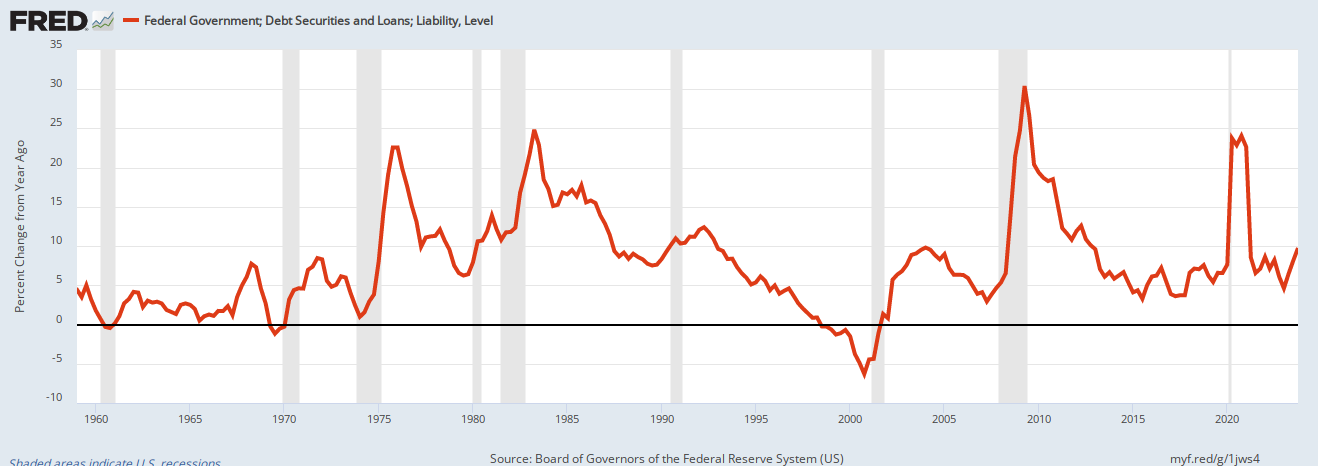
Here is what deficit cuts accomplish:
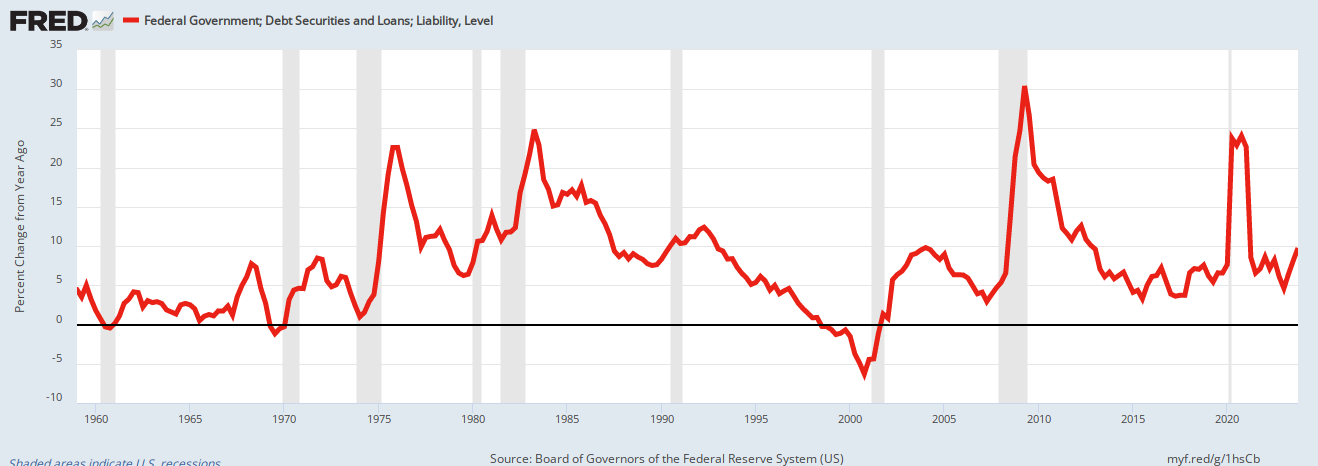
When deficits (red line) decline, we have recessions (vertical gray bars), which are cured by increased federal deficit spending.
Federal surpluses take dollars from the economy. Federal deficits add dollars to the economy. You can review the formula for GDP to see why the above effects occur.

Neither party favors squeezing the benefits provided by significant entitlement programs.

The public understands that federal spending helps the economy. One wonders why the “experts” don’t.

Ultimately, it may take a crisis — perhaps a disorderly rout in the Treasuries market triggered by sovereign U.S. credit-rating downgrades or a panic over the depletion of the Medicare or Social Security trust funds — to force action.

That’s playing with fire.

The credit-rating agencies have downgraded the U.S. credit, not because of high debt but because Congress threatened not to pay its bills with that ridiculous, useless “debt ceiling.” Congress always has the ability to pay its bills by creating dollars ad hoc. However, credit ratings will fall unnecessarily when Congress threatens creditors due to ignorance or political malevolence.

Last summer provided a miniature foretaste of how a crisis might begin. Over two days in August, a Fitch Ratings downgrade of the U.S. credit rating and an increase of long-term Treasury debt issuance focused investor attention on the risks.

Benchmark 10-year yields climbed by a percentage point, hitting 5% in October — the highest level in over a decade.

The federal government had no trouble pressing those computer keys that paid the interest. Further, the government didn’t need to pay higher interest; it set the bottom interest rate, and if there was no threat to paying, that will be the rate. For years following the “Great Recession of 2008, federal deficits increased massively, and interest rates stayed near zero. The government and Federal Reserve have the tools to control spending and interest rates.
The Federal Reserve sets interest rates to control inflation, not to help the government pay interest.

Shaking investor confidence in U.S. Treasury debt as the ultimate safe asset would take a lot.

If it evaporated, though, the erosion of the dollar’s standing would be a watershed moment, with the U.S. losing access to cheap financing and global power and prestige.

Yes, “it would take a lot” — a lot more than deficit spending, which, though massive, has not caused the “unsustainability” that the Henny Pennys fret about.

By law, the CBO is compelled to rely on existing legislation. That means it assumes the 2017 Trump tax cuts will expire in 2025. However, even President Joe Biden wants some of them extended.

According to the Penn Wharton Budget Model, permanently extending the legislation’s revenue provisions would cost about 1.2% of GDP each year starting in the late 2020s.

Hmmm.  Extending tax cuts (which allows the private sector to spend more money) would cost 1.2% of GDP each year—strange mathematics.

The CBO also must assume that discretionary spending, which Congress sets each year, will increase with inflation rather than keep pace with GDP.

What?? Discretionary spending will increase with inflation but not keep pace with GDP. If I read that correctly, the author warns that GDP will grow faster than inflation. And that’s a bad thing??

Market participants aren’t buying the benign rates outlook, with forward markets pointing to borrowing costs markedly higher than the CBO assumes.

Borrowing costs are determined by the Fed, which (wrongly) believes raising interest rates (which increases the prices of everything you buy) is a good way to fight inflation! If you can figure that one out, let me know. I can’t.

Bloomberg Economics has built a forecast model using market pricing for future interest rates and data on the maturity profile of bonds. Keeping all the CBO’s other assumptions in place shows debt equaling 123% of GDP for 2034.

Which is meaningless.

Debt at that level would mean servicing costs reach close to 5.4% of GDP — more than 1.5 times as much as the federal government spent on national defense in 2023, comparable to the entire Social Security budget.

All it means is that our Monetarily Sovereign government will create more growth dollars and add them to GDP. Is that supposed to be a problem? Mathematically, increases in federal spending increase economic growth.

Heavyweights from across the political spectrum agree the long-term outlook is unsettling.

Fed Chair Jerome Powell said earlier this year that it was “probably time—or past time” for politicians to start addressing the “unsustainable” path of borrowing.

The federal government does not borrow. T-bills, T-notes, and T-bonds do not represent borrowing. They represent deposits into Treasury Security accounts — money the federal government neither needs nor touches. The purpose of those accounts is not to provide spending money to a Monetarily Sovereign government but to provide a safe place to store unused dollars. This stabilizes the dollar.

Former Treasury Secretary Robert Rubin said in January that the nation is in a “terrible place” regarding deficits.

From the realm of finance, Citadel founder Ken Griffin told investors in a letter to the hedge fund’s investors Monday that the U.S. national debt is a “growing concern that cannot be overlooked.”

Days earlier, BlackRock Inc. Chief Executive Officer Larry Fink said the U.S. public debt situation “is more urgent than I can ever remember.”

Ex-IMF chief economist Kenneth Rogoff says while an exact “upper limit” for debt is unknowable, challenges will arise as the level keeps going up.

Rogoff’s broader point is well taken: forecasts are uncertain. To mitigate this uncertainty, Bloomberg Economics has run a million simulations on the CBO’s baseline view—an approach economists call stochastic debt sustainability analysis.

Ooooh! “Stochastic sustainability analysis.” And they did it a million times. How many of those times included the fact that the Monetarily Sovereign U.S. government never can run short of dollars to pay its bills and interest? Not yesterday, not today, not tomorrow, not ever? “stochastic” means: “Having a random probability distribution or pattern that may be analyzed statistically but may not be predicted precisely.”

Each simulation forecasts the debt-to-GDP ratio with a different combination of GDP growth, inflation, budget deficits, and interest rates, with variations based on patterns seen in the historical data.

In the worst 5% of outcomes, the debt-to-GDP ratio ends in 2034 above 139%, which means the U.S. would have a higher debt ratio in 2034 than crisis-prone Italy did last year.

But the ratio means nothing. It tells you nothing about “sustainability.” More importantly, the proof of abject ignorance comes with those last few words: “crisis-prone Italy.” OMG. They are too ignorant to understand the differences between a Monetarily Sovereign entity and a monetarily non-sovereign entity. Italy is monetarily non-sovereign. It can run short of euros. The U.S. is Monetarily Sovereign. It cannot run short of dollars (unless Congress continues with the foolish debt-limit nonsense.) It’s like claiming that birds can’t fly because elephants can’t fly.

The Treasury chief herself acknowledged in a Feb. 8 hearing that “in an extreme case,” there could be a possibility of borrowing reaching levels that buyers wouldn’t be willing to purchase everything the government sought to sell. She added that she saw no signs of that now.

I assume she’s talking about buyers of T-securities. Surely she knows that:
  1. The federal government doesn’t need to sell T-securities. They don’t provide the government, as a dollar creator, with anything. They provide dollar users with safe storage.
  2. If the government had a yen to sell more T-securities, it could always raise interest rates.

Getting to a sustainable path will require action from Congress. Precedent isn’t promising. Disagreements over government spending came to a head last summer when a standoff over the debt ceiling brought the U.S. to the brink of default.

The deal to halt the havoc suspended the debt ceiling until Jan. 1, 2025, postponing another clash over borrowing until after the presidential election.

This is what ignorance causes. It is an unnecessary battle over a meaningless number to reach a fruitless conclusion. And these are the geniuses we elect to Congress.

It’s hard to imagine a U.S. debt crisis. The dollar remains the global reserve currency. The annual and unseemly spectacle of government shutdown brinksmanship typically leaves barely a ripple on the Treasury market.

A fictional “debt crisis” (the U.S. federal government unable to create dollars?) has nothing to do with the dollar being the leading “reserve currency.” A reserve currency is just money banks keep in reserve to facilitate international trade. Though the U.S. dollar is a leader, other currencies are reserve currencies, depending on geography: The euro, the Canadian dollar, the Mexican peso, China, Japan, Australia, etc. all produce currencies that banks keep in reserve. There is no magic in being a reserve currency. And it does nothing to prevent a “debt crisis.

Still, the world is changing. China and other emerging markets are eroding the dollar’s role in trade invoicing, cross-border financing, and foreign exchange reserves.

This has nothing to do with any “debt crisis” or the Debt/GDP ratio.

Foreign buyers make up a steadily shrinking share of the U.S. Treasuries market, testing domestic buyers’ appetite for ever-increasing volumes of federal debt.

It’s not federal; it’s not debt, and it’s not a problem.

And while demand for those securities has lately been supported by expectations for the Fed to lower interest rates, that dynamic won’t always be in play.

The federal government doesn’t need to issue T-securities. It creates all its dollars by spending them. The spending comes first, and then it creates dollars.

Herbert Stein, head of the Council of Economic Advisers in the 1970s, observed that “if something cannot go on forever, it will stop.” If the U.S. doesn’t get its fiscal house in order, a future U.S. president will confirm the truth of that maxim. And if confidence in the world’s safest asset evaporates, everyone will suffer the consequences.

Given that the U.S. government has the infinite ability to create dollars, the endless ability to pay interest, the limitless ability to control interest rates paid by Treasuries, and the infinite ability to pay for anything, anytime, that sounds like the fiscal house is in good order. Because the debt-GDP ratio is meaningless, the following paragraphs are purely for entertainment purposes and should not be taken seriously. I have bolded the more humorous parts:

Methodology Bloomberg Economics uses the latest long-term CBO projections’ baseline fiscal and economic outlook—including the effective interest rate, primary budget balance as a percent of GDP, inflation as measured by the GDP deflator, and real GDP growth rate—as a starting point for the analysis. To calculate the debt-to-GDP ratio using market forecasts for rates, we substitute forward rates as of March 25, 2024, and project future effective rates on federal debt based on a detailed bond-by-bond analysis. To forecast the distribution of probabilities around the CBO’s baseline debt-to-GDP view, we conduct a stochastic debt-sustainability analysis: —We estimate a VAR model of short- and long-term interest rates, primary balance-to-GDP ratio, real GDP growth rate, and GDP deflator growth using annual data from 1990 to 2023. The covariance matrix of the estimated residuals is then used to draw one million sequences of shocks. —We use data on the maturities of individual bonds to map short- and long-term interest-rate shocks to the effective interest rate paid on U.S. federal debt. —Using this model, Bloomberg Economics considers two definitions of sustainability. First, we check if the debt-to-GDP ratio increases from 2024 to 2034. Second, we examine if the average inflation-adjusted interest expense, scaled by nominal GDP, over the ten years from 2025-2034 is less than 2%.——— (With assistance from Jamie Rush, Phil Kuntz, and Viktoria Dendrinou.)

Jamie, Phil, and Viktoria have invented two definitions of “sustainability.” One is debt/GDP increases, which have been going on for over 80 years and have caused nothing. The other is interest expense, which the government has the endless ability to pay, is controlled by the Fed, and adds to GDP growth. Apparently, Jamie, Phil, and Viktoria don’t know we’ve passed those road signs, but we are still sustaining. Folks, you have been fed a steady, 80+ years diet of garbage, the purpose being to convince you the government can’t afford to give you benefits. The rich know better, so they get all the tax benefits. The media are bribed to feed you garbage by advertising dollars and ownership. The economists are bribed via contributions to schools and promises of lucrative employment in think tanks. The politicians are bribed by campaign contributions and employment after they leave office. Sadly, the public eats the garbage, so the people struggle while the rich laugh. Ignorance is costly. Rodger Malcolm Mitchell Monetary Sovereignty Twitter: @rodgermitchell Search #monetarysovereignty Facebook: Rodger Malcolm Mitchell

……………………………………………………………………..

The Sole Purpose of Government Is to Improve and Protect the Lives of the People..

MONETARY SOVEREIGNTY

Reawakening the Inflationary Monster: U.S. Monetary Policy and the Federal Reserve

Martin Hutchinson
Author: Martin Hutchinson is a financial journalist based in Vienna, VA, for BreakingViews.com and others with a weekly column, “The Bear’s Lair.”

If you are a hammer, every problem is a nail, and if you are a banker, every problem is a monetary problem.

In a series of papers and speeches in the early millennium years ( 2011, Causes, Consequences, and Our Economic Future), Federal Reserve Governor Ben Bernanke outlined what the Fed might do when faced with near-zero interest rates.

 A distinguished historian of the Great Depression, Dr. Bernanke’s main concern was to ensure that ‘it’ never happened again, and the critical element of his program was to avert a repeat of the damaging deflation of the early 1930s.

We’ll interrupt Martin Hutchinson’s paper by reminding you that almost every recession and depression in U.S. history has been associated with reduced federal deficit spending.

These recessions and depressions were cured by increased federal deficit spending.

Recessions (vertical gray bars” result from federal deficit reductions (red line). Recessions are cured by increased federal deficit spending.

We have depressions when the federal government takes dollars from the economy (i.e., runs a surplus).

Fact: U.S. depressions tend to come on the heels of federal surpluses.

1804-1812: U. S. Federal Debt reduced 48%. Depression began 1807.
1817-1821: U. S. Federal Debt reduced 29%. Depression began 1819.
1823-1836: U. S. Federal Debt reduced 99%. Depression began 1837.
1852-1857: U. S. Federal Debt reduced 59%. Depression began 1857.
1867-1873: U. S. Federal Debt reduced 27%. Depression began 1873.
1880-1893: U. S. Federal Debt reduced 57%. Depression began 1893.
1920-1930: U. S. Federal Debt reduced 36%. Depression began 1929.
1997-2001: U. S. Federal Debt reduced 15%. Recession began 2001.

The way to keep recessions and depressions from happening again is continually to increase federal deficit spending on domestic goods and services, which grows the economy.

GDP = Federal Spending + Nonfederal Spending + Net Exports

 The policies themselves boil down to the Fed throwing everything it has into a desperate battle to avert falling prices – an attack on deflation.

With the specter of looming deflation, they also suggest that this is not a time to worry about inflation. To quote one eminent authority, using another evocative analogy, “Fear of inflation, when viewed in the context of a possible global depression, is like worrying about getting the measles when one is in danger of getting the plague.”

 New conventional wisdom has thus evolved, which maintains that the current major threat is deflation rather than inflation and insists that this threat must be countered by all possible means.

Keep in mind that the paper was written in 2011.

On the contrary, we would argue that this view and its associated policies are fundamentally misconceived; they are also irresponsible and potentially highly dangerous.

First, they miss the main point as a response to the crisis (and to avert worse to come). Resolving the crisis does not require ‘stimulus’ – fiscal or monetary; nor does it require bailouts or near-zero interest rates.

Instead, the crisis can only be resolved by an appropriately radical restructuring of the balance sheets of the major financial institutions.

There it is, the hammer/nail analogy. The author believes deflation is caused by something lacking in major financial institutions’ balance sheets.

Think about it. Deflation is falling prices. What makes prices fall? It’s not “major financial institution balance sheets.” It’s reduced overall demand for goods and services. 

And what reduces the overall demand for goods and services? Lack of money.

Deflation is the opposite of inflation, and what causes inflation? What causes the price of anything to rise? Supply that is less than demand for that thing.

What causes all prices to rise. More less supply than demand for critical products, notably oil and/or food.


Oil prices (red) are a good barometer for excess demand over oil supply. Because oil is the single most price-influential product in the economy, affecting almost every product and service, oil shortages cause overall inflation. 

Increases in oil prices are driven by oil scarcity, which parallels inflation. 

If you want to know inflation, don’t refer to “major financial institution balance sheets.” Refer to oil prices. (Oil prices, and to a lesser degree, food prices = inflation.) Notice anything missing from that equation?

Interest rates.

The Fed raised interest rates to fight inflation. The theory is that raising interest rates “cools” the economy by — by doing what? By making things more expensive.

Houses, cars, transportation- every industry- sees increased costs from higher interest rates, which are passed on to consumers.

Strangely, the Fed (and most economists, politicians, and the media) believe that making things more expensive by raising interest rates is an excellent way to fight inflation. Does that make any sense?

In essence, the Fed tries to cure anemia by applying leeches. 

Yes, raising interest rates increases the exchange value of the U.S. dollar because people need dollars to purchase U.S. bonds, notes, and bills. So, as interest rates rise, the demand for dollars increases. 

But that primarily affects imports and exports — making imports cheaper. 

Raising interest rates makes the dollar more valuable in international trade, thus making imports cheaper when paid for in dollars. 

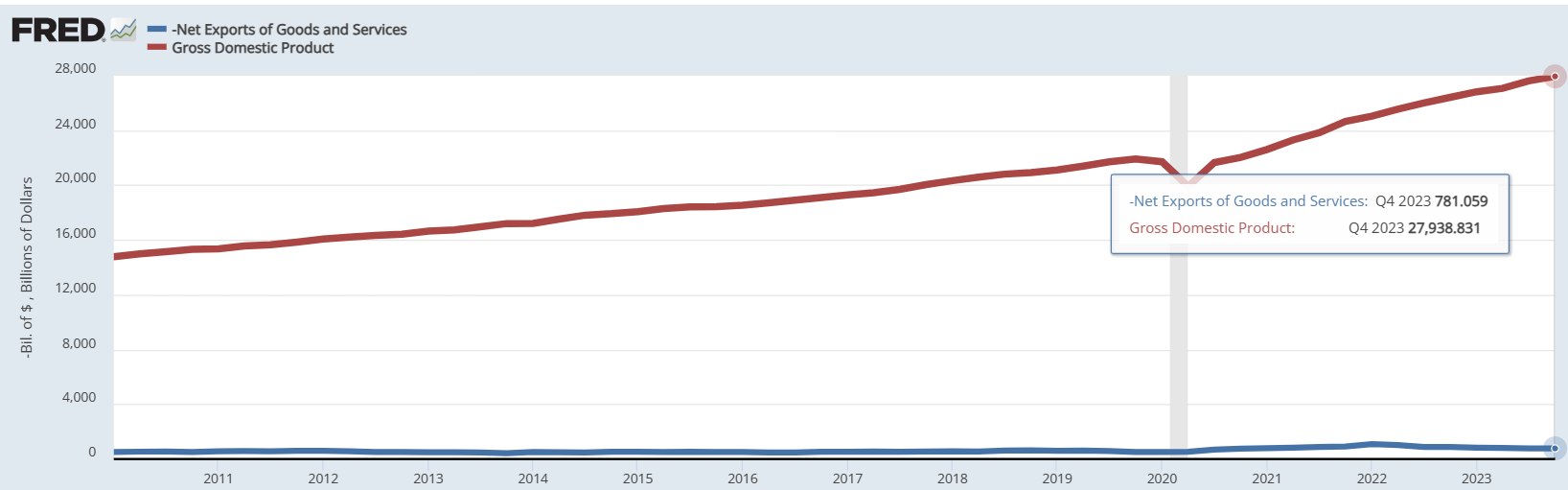
However, net imports (blue line, calculated as the inverse of net exports) are only a tiny fraction of our economy (GDP – red line).

Thus, on balance, raising interest rates increases prices. The Fed does exactly the wrong thing in its fight against inflation.

 Not only is there an obvious and present danger of returning inflation, but there is also a genuine danger that the Federal Reserve will become insolvent and victim of its own policy failures.

Here, the author displays an astounding ignorance of Monetary Sovereignty.

It is impossible for any agency of the U.S. federal government, including the Federal Reserve, to become insolvent unless, for some reason, that is what Congress and the President want.

Quote from former Fed Chairman Ben Bernanke when he was on 60 Minutes:
Scott Pelley: Is that tax money that the Fed is spending?
Ben Bernanke: It’s not tax money… We simply use the computer to mark up the size of the account.

These words should be embedded into the brains of every economist, politician, and media writer: “WE SIMPLY USE THE COMPUTER TO MARK UP THE SIZE OF THE ACCOUNT.”

That is how the federal government creates dollars, which is why the federal government has the infinite ability to create dollars to pay its obligations.

There is no limit on the computer. Send the federal government with a $100 invoice or a $100 trillion invoice, and both could be paid instantly, simply by “using the computer to mark up the account.”

The failure to understand this fact has caused most of the world’s financial problems: Hunger, homelessness, lack of health care, lack of education, poor infrastructure, and delays in scientific innovation. The list goes on and on.

There are so many things the federal government could but doesn’t pay for because of the mistaken belief in unaffordability.

(Since 2006, we have had) an ‘accommodating’ monetary policy and this interpretation has been confirmed by strongly negative interest rates since the summer of 2008.

In the short term, this monetary growth will likely have a limited impact on inflation while the economy remains in deep recession with substantial under-utilization of resources.

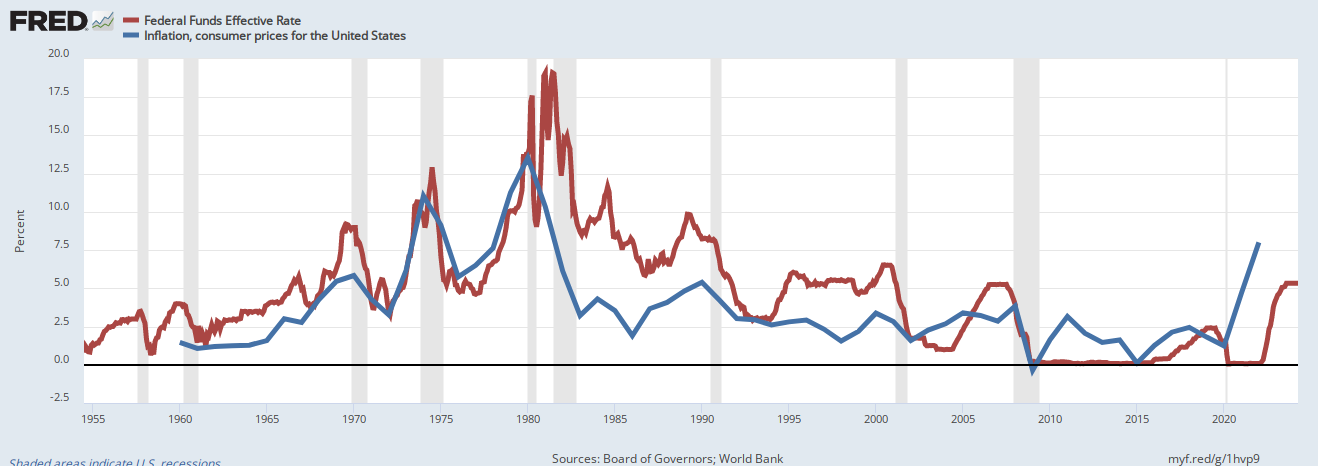
The graph shows how the Fed responds to inflation (blue) by raising interest rates (red). It also shows that low rates don’t cause inflation.

Near zero (negative real) interest rates continued well after the “deep recession,” and there was still no inflation. The reason can be seen in the oil/inflation graph above. 

However, once credit markets begin to ease and confidence returns, monetary velocity will return to normal levels, possibly quite rapidly. We should expect inflation to rise again and perhaps proliferate when this happens.

We didn’t have high inflation because oil was not in short supply. We had inflation only when COVID made oil (and scores of other products and services) scarce.

As always, the bankers view inflation as a monetary problem and wish to apply monetary solutions. But inflation is a goods and services supply problem which requires a goods and services supply solution.

In 1979, there will come a point where the existing policies will be seen to have failed, and the Fed will reluctantly reverse policy – presumably under a new Chairman. The Fed will then sharply raise interest rates and force monetary growth down, and the economy will undergo another painful recession.

Kids Back Seat Car Steering Wheel Toys Driving Game Horn Sounds Electronic  Light | Wish
Fed Chairman Jerome Powell thinks he is driving the anti-inflation car, but the real driver is oil supplies, ruled by Congress and the President.

The Fed’s monetary bent makes for the belief that recessionary action is needed to prevent/cure inflation.

We then get into a careful balancing act in which the Fed tries to set “just enough” recessionary interest rates to cure inflation but not enough to cause a recession.

The scenario reminds one of a child sitting in the back seat of a car, thinking he is steering the vehicle.

The Fed (child) thinks it’s “steering the car,” while in the front seat, the real steering is being done by the (parent) President and Congress.

Increased federal spending to cure oil shortages and other goods and services shortages would cure inflation while preventing recession.

Ultimately, the “child” happily believes he has steered safely, while the “parent” smiles and tells the child what a wonderful job he did.

If the Fed then sticks with such a policy – as it did under Volcker – then it will gradually but painfully grind inflationary forces out of the system; if it gives up, as earlier in the 1970s, then inflation will return again, only to need further harsh monetary medicine further down the road. Welcome back, stagflation.

We didn’t have the predicted stagflation because oil supplies increased, reducing inflation. Meanwhile, the government spent enough to prevent stagnation, though declining deficits ultimately led to the 1990 recession.

Long before all that, higher interest rates would follow naturally from higher inflation expectations and the massive borrowing requirements of the US federal government.

The U.S. federal government does not borrow dollars. Not now. Not ever. Why would it, given its infinite ability to “use the computer to mark up the account,” as Bernanke said.

Former Fed Chair Alan Greenspan: “A government cannot become insolvent with respect to obligations in its own currency. There is nothing to prevent the federal government from creating as much money as it wants and paying it to somebody. The United States can pay any debt it has because we can always print the money to do that.” 

The author thinks Treasury bonds, notes, and bills are “borrowing” because those terms describe private sector borrowing. 

But Treasury bonds, notes, and bills are accounts owned by depositors, not by the government. The accounts resemble safe deposit boxes, the contents of which are owned by account holders, not by the bank.

Upon maturity, the contents of T-security accounts simply are returned to the owners, having never been touched by the federal government. No government money is involved.

The purpose of T-securities is not to provide spending funds to the government. The government has infinite spending funds. Instead, the purposes are:

  1. To provide a safe storage place for unused dollars. This stabilizes the dollar.
  2. To help the Fed control interest rates.

The dollar’s value is determined by relative inflation rates: if the US inflates more than its trading partners – as seems likely – then the dollar must eventually fall.

The Fed’s manipulation of interest rates determines the dollar’s exchange value. The Fed decides what the rate will be. Raising rates increases demand for the dollar, which increases its value.

As described earlier, this exacerbates inflation by raising the price of goods.

The fundamental determinant of inflation is the supply of crucial goods and services, predominantly oil and food.

But there are also substantial speculative dollar holdings. As of May 2009, approximately $3.3 trillion of the $ 6.9 trillion of Treasury securities outstanding were held by foreigners, of which $ 2.3 trillion were held by foreign central banks. 

As the dollar falls, foreign holders of Treasuries are likely to begin selling. These holdings represent a dangerous overhang, the unraveling of which could cause a sharp decline in the dollar’s value once foreign exchange markets start to correct themselves; thus, the ingredients are already in place for a major dollar crisis.

If every single holder of Treasury bonds, notes, and bills sold their holdings, the bonds, notes, and bills would continue to exist, only in different hands.

The Fed could continue to control interest rates by fiat or open market purchases (aka “quantitative easing”). There would be no crisis.

It’s like asking what would happen if every safe deposit box holder sold the contents of his box. The answer: A lot of new people would own those contents.

The bleak prognosis just described amounts to a return to the miseries of stagflation.

This happens when the Fed tries to cure inflation by raising interest rates. The higher interest rates exacerbate inflation and stagnate the economy. 

In principle, of course, such an outcome can be averted (or at least ameliorated) if the Fed moves quickly to claw back the growth in the base before its inflationary potential is fully unleashed.

Still, in practice, this would be very difficult to do.

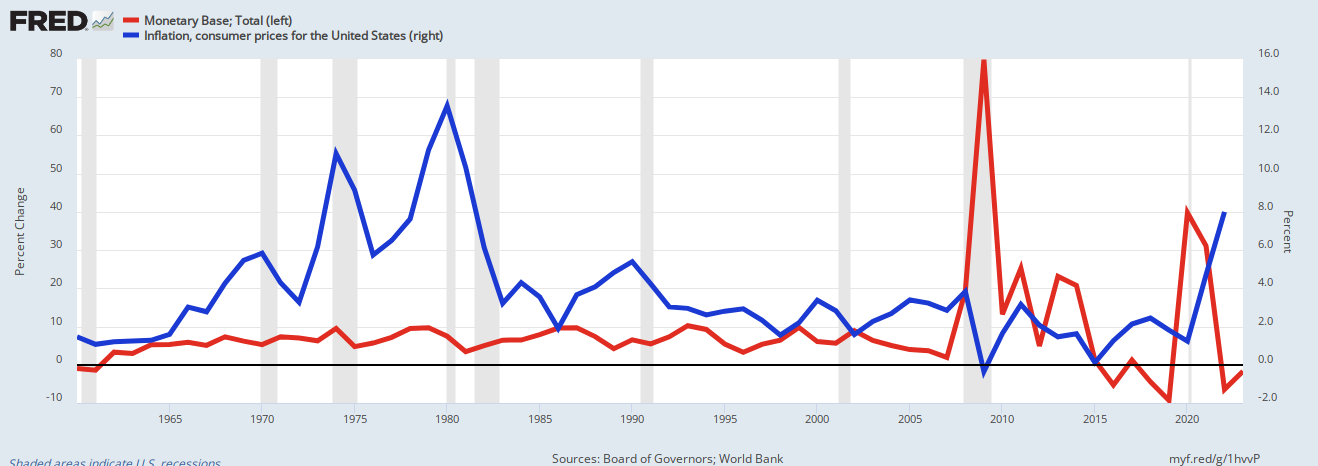
Here, the author claims that growth in the monetary base causes inflation. See the following graph:

Growth in the monetary base (red) does not cause inflation (blue).

As usual, the bankers erroneously believe that inflation is a money supply problem when, in fact, it is a goods/services supply problem.

Traditionally, almost the only assets held by the Fed were US Treasury securities: loans to commercial banks were negligible, and the Fed did not lend at all to other institutions. All this has now completely changed.

The Fed’s equity cushion is now down to just 1.9% of its assets from 3.9% a year before.

The Fed’s equity cushion — the amount of losses the Fed could absorb without defaulting on debts — is infinite. Not 1.9%, not 3.8%, but infinite.

Ben Bernanke: “The U.S. government has a technology, called a printing press (or, today, its electronic equivalent), that allows it to produce as many U.S. dollars as it wishes at essentially no cost.”

The Fed’s leverage ratio has gone up from just under 25 to about over 50 as the quality of its assets has markedly deteriorated.

As Lawrence H. White put it in a recent paper, “The Fed now looks increasingly like a very highly leveraged hedge fund” (White, 2008, p. 11).

The risk to the Fed is zero. Unlike a hedge fund, the Fed has infinite dollars. It can always “use the computer to mark up the size of the account.”

Amazingly, the author and others of similar ilk simply do not understand the basics of Monetary Sovereignty. The Fed cannot become insolvent.

 The only alternative would be sterilizing the monetary base growth through (increased) reserve requirements.

This would, however, choke off the lending that the entire bank recapitalization exercise is intended to revitalize, and, as with selling off the recent Fed acquisitions, this would seriously counter the current stimulus measures.

Such a measure also has ominous historical overtones: the doubling of reserve requirements by the Fed in 1936-37 is commonly held to have been the principal factor behind the 1937-38 recession, itself deeper than any since World War II.

It is virtually inconceivable that the Bernanke Fed would risk a repeat of that debacle. Thus, sterilization would appear, to all intents and purposes, to be out of the question.

Aside from being totally unnecessary, this “sterilization” suggestion leads to another question: Why do banks have reserve requirements. Answer: To protect depositors from bank failures. 

And that leads to the real question. Why do we have private banking? The federal government spends so much time, effort, and money to regulate the banks and to protect the public, that all banks are at least partially run by the regulators.

Why not have the government simply run all banks? Eliminate the profit motive, and banking would be cheaper and safer. See Private Banks, America’s Worst Criminals.

Suppose the Fed starts to print money to cover its losses. In that case, there is a real danger of a vicious cycle taking off in which monetizing the Fed’s losses leads to higher inflation, higher interest rates, more losses, and even more significant inflation.

That would be true if inflation were a money supply problem. But as we have seen, inflation is a goods/service supply problem, not a money supply problem.

Recent US experience is also consistent with the last false deflation scare when then-Governor Bernanke persuaded Alan Greenspan in 2002 that the US was (then also) in imminent danger of deflation.

The Fed responded by pulling interest rates down to about 1% and holding them at that level for a year.

The resulting expansionary monetary policy then fed an unprecedented roller coaster of a boom-bust cycle that ended in the collapse of stock and property markets, the specter of renewed inflation, the destruction of much of the financial system, and a sharp economic downturn.

I believe the author is talking about the 2008 recession, which was not caused by low-interest rates but rather by real estate speculation involving mortgage-backed securities and bad loans. The Fed failed to stop banks and other lenders from giving mortgages to people with bad credit risk.

Low-interest rates were not at fault. On the contrary, when the Fed raised rates, mortgage payments rose beyond borrowers’ ability to pay, so they defaulted. The rising rates precipitated the crash of real estate mortgages and other loans.

Does the Fed draw the lesson that aggressive monetary policy is ultimately destabilizing? Not at all. Instead, it embarks on an even more activist monetary policy that lays the seeds of an even bigger boom-bust cycle.

By “aggressive monetary policy,” the author means lowering interest rates. Also called “expansionary monetary policy.”

 The Fed is thus repeating the same mistakes it made in the mid-90s and then again in the early years of the new millennium – but on a grander scale.

And, in the meantime, there is also that little matter of inflation in the pipeline to worry about …

The Fed’s mistakes are based on erroneous beliefs. The facts are:

  1. Our Monetarily Sovereign federal government and its agencies have unlimited spending money.
  2. Federal taxes and borrowing do not fund federal spending. To pay its bills, the federal government creates new dollars, ad hoc. All federal tax dollars are destroyed upon receipt by the Treasury.
  3. Treasury bonds, notes, and bills (i.e., federal “debt”) are not federal borrowing, The accounts remain the property of the depositors.
  4. The Fed does not control inflation by raising interest rates. Higher rates exacerbate inflation.
  5. Federal deficit spending does not cause inflation. Inflations are caused by critical goods and services shortages, usually oil and/or food. Federal deficit spending cures inflations when the spending cures the shortages that caused the inflation.
  6. Ongoing economic growth requires ongoing increases in federal deficit spending.
  7. Decreases in federal deficit spending lead to inflations and depressions.
  8.  Ongoing federal deficit spending is infinitely sustainable.

Economic growth is controlled by Congress and the President via federal spending, primarily via spending to eliminate shortages of critical goods and services.  Raising interest rates is recessionary and does not control inflation.


Rodger Malcolm Mitchell
Monetary Sovereignty

Twitter: @rodgermitchell Search #monetarysovereignty
Facebook: Rodger Malcolm Mitchell

……………………………………………………………………..

Government’s Sole Purpose is to Improve and Protect People’s Lives.

MONETARY SOVEREIGNTY

Have you heard of “True Cost Accounting”?

An article in the December 2, 2023 New Scientist Magazine has me puzzled.

The article deals with “True Cost Accounting” (TCA), which attempts to account for all the costs associated with the creation of products and services. Most importantly, this includes environmental costs.

While I sympathize with the desire to identify environmental problems and solve environmental needs, I question whether TCA helps or hurts that mission.

Here are some excerpts from that article:

How counting the true cost of cheap food could make a better world,  Graham Lawton

What we pay for food and other goods doesn’t reflect the environmental and social damage they cause. But a radical new approach to economics could change that. By Graham Lawton, 28 November 2023

IN THESE difficult times, it seems utterly bananas to say that food is underpriced. In the UK, average grocery bills have risen by more than 12 per cent in the past year. But it is.

The price tags on food are way lower – by about two-thirds – than what they would be if we were paying the full cost. Don’t worry, though, there are plans to sort this out.

In reality, we already pay the true price, it is just that most of it is stealthily hidden from us. “We pay overall four times for our food,” says Alexander Müller at the sustainability think tank TMG in Berlin.

First, we pay at the checkout.

Then we pay for the health, environmental and social costs of producing that food, mostly though taxes.

Uh oh. My antennae go up when I see the word “taxes.”

Though taxes indeed are a cost to the public, they are not the result of health, environmental or social problems.

The U.S. and UK governments, unlike city, state and county governments, are Monetarily Sovereign (MS). That means they both (and other MS) governments have the infinite ability to create money.

They never unintentionally can run short of their own sovereign currency.

Former Federal Reserve Chairman, Ben Bernanke: “The U.S. government has a technology, called a printing press (or, today, its electronic equivalent), that allows it to produce as many U.S. dollars as it wishes at essentially no cost.”

For that reason, “we” don’t pay for health, environmental, and social costs via taxes. Our central government’s taxes pay for nothing. In fact, U.S. federal taxes are destroyed upon receipt.

One purpose of government taxes is to help our central government control the economy by discouraging what the government doesn’t like and by rewarding what the government likes.

Taxes also assure demand for the U.S. dollar by requiring dollars to be used for tax payments.

And that’s it. Though local taxes fund local government spending, U.S. and UK government taxes do not fund any spending.  

Even if those central governments stopped levying taxes, they still could continue spending indefinitely.

These costs are “externalities” – things that are treated as free even though they aren’t, such as the environmental damage caused by farming or the health costs of obesity.

Right now, producers ignore them and let the rest of us pick up the bill.

What constitutes “the bill” and exactly who are “the rest of us.”? If the soot particles from a coal-fired furnace make you sick, how would you measure the cost? Is your sickness, in of itself, considered a cost, and if so, can it be measured in dollars?

Perhaps, under certain circumstances:

1. You become sick enough to require medical care, the cost for which is borne by you, your insurance company, or the government.

2. You need to stay home from work, which is a cost to your company. If you are docked for being out of work, you bear the cost.

3. Your productivity is affected, which is a cost to the economy as well as your company.

4. You require medicines and healthcare, which are counted as sales to healthcare providers and pharmaceutical companies.

5. And, of course, there is the emotional cost, the lifespan cost, and the lifestyle cost, which are difficult to measure in dollars.

But why would you need to measure the costs? It’s like measuring the cost of being shot in the head. You simply want to avoid it. Are you going to ask, “How much would a grazing wound cost me vs. a direct shot?”

Is belching smoke into the air OK if it only sickens ten percent of the population? 

Economists and accountants have been working on a system called true cost accounting (TCA), which aims to internalize these externalities and upend decades of economic orthodoxy.

For decades, economic success or failure has been measured in purely financial terms. Consider the global yardstick of economic progress, gross domestic product (GDP) – the value of all the goods and services produced in a country.

The concept became the internationally accepted indicator of economic success after the second world war. If GDP grows, the economy is deemed to be healthy, and GDP growth has long been an overriding priority of most governments.

Is the implication that in a healthy economy there’s no need to save the air and water from pollution? Should we worry about pollution only when GDP is down?

GDP contains some glaring absurdities. For example, it omits services provided by the state, such as healthcare.

Really? The formula in the U.S. is:

GDP = Federal Spending + Nonfederal Spending + Net Exports

Every service provided by the government (including state/local governments) is paid for by government spending, which by formula, is part of GDP.

Unpaid work also doesn’t count, even though it often displaces activities that, if paid for, would.

That’s true. If you mow your own lawn, and as a favor mow your neighbor’s lawn, GDP doesn’t reflect either mowing. But, there is a time and effort cost that can’t be measured.

Car accidents boost GDP because they stimulate economic activity in the insurance and repair sectors. Waste contributes to GDP as long as the discarded stuff was bought with money.

Here, the implication is that we worry about car accidents and waste only if they impact GDP. Therefore, to take action against car accidents and waste, we first must measure their social cost as part of an overall economic scale. Huh?

Worst of all, GDP keeps many aspects of economic activity entirely off the books – the aforementioned externalities, which the Organization for Economic Co-operation and Development defines as “situations when the effect of production or consumption of goods and services imposes costs or benefits on others which are not reflected in the prices charged“.

Natural capital, such as trees, is invisible to the GDP system until it is destroyed and turned into products. Ditto environmental degradation, which largely doesn’t attract any financial penalties in calculations of GDP.

In fact, deforestation and pollution can positively contribute to GDP if they generate economic activity. Health and social problems caused by industry are also swept under the carpet, even though somebody will eventually have to pay for them.

Sorry to keep interrupting the narrative, but the implication remains that taking action against deforestation and pollution requires the costs of these problems be part of GDP or a similar measure.

When we buy stuff – food, clothes, energy and so on – the price we pay often fails to reflect the full cost of producing, consuming and disposing of those goods and services across their entire life cycle.

The price of a tank of petrol, for example, doesn’t include the cost of dealing with climate change and the air pollution caused by its combustion products.

The price of a pair of jeans doesn’t reflect the social cost of producing them in a sweatshop and the environmental cost of growing the cotton, transporting the jeans halfway around the world and managing the landfill they will probably end up in.

The price of food doesn’t reflect the social cost of low agricultural wages, the environmental cost of soil erosion, water and pesticide use, and the health costs of obesity and other diet-related conditions.

These externalities are arguably one of the main causes of our myriad environmental and social problems. “Destruction of biodiversity costs nothing, therefore, let’s destroy it,” says Müller, who is a former assistant director-general of the Food and Agriculture Organization of the United Nations (FAO).

“Polluting the atmosphere with CO2 has no cost immediately. These ignored real costs are leading to a global crisis.”

In today’s economy, companies can deplete natural resources, pollute the environment, drive down wages and create harmful products, safe in the knowledge that they will reap the rewards while taxpayers pick up the tab.

True for monetarily non-sovereign governments; not true for Monetarily Sovereign governments, which pay for everything by spending newly created dollars.

This is what is known as “privatized profits and socialized losses”, according to Lauren Baker at the Global Alliance for the Future of Food in Washington DC.

Indeed, companies are incentivised to do so, as those that are more successful at externalising their costs will be more profitable, more competitive and better at raising capital for more of the same, says Baker.

This is where TCA comes in. It aims to capture all of the pluses and minuses that arise from economic activity, not just raw profit and loss. That means tallying up the cost of the environmental, human health and social harms (or benefits) of production and adding them to the balance sheet.

Here is where ignorance of Monetary Sovereignty begins to take its toll.

The spending by MS government is free to taxpayers. If you live in the U.S., the UK, or other MS nations, not one penny of your taxes are spent by your government. Your governments could eliminate tax collection as still spend whatever they wish.

But you do pay for goods and services. So, if environmental costs become business costs, that will increase the price of goods and services, which you will pay. 

In short, if the government pays it costs you nothing. If business pays, you pay.

This is not to say that business should be allowed to pollute at will, and let the government clean it up. The government has the power to pass laws that prohibit degrading the ecology. 

But putting the cost of polluting on business’s balance sheets actually gives tacit approval to pollute so long as polluting is cheaper than not polluting.

Until recently, that was almost impossible. But years of progress on methodologies such as life cycle assessment, which tallies the full social, environmental and economic impact of products from cradle to grave, have made TCA tractable.

Life cycle assessment has been in development for 50 years, but, until now, has been largely non-monetary. TCA is a way of converting life cycle assessment into cold, hard cash, says Ulrike Eberle at sustainability consultancy Corsus in Hamburg, Germany.

Some food companies have embraced it to reduce their negative impacts on society and the environment. One example is Dutch chocolatier Tony’s Chocolonely, which aims to charge the “true price” of its products (see: “Shopping with true costs”).

In essence, Tony’s Chocolonely tells you how much extra you should pay for its products that are having a negative impact on society. Think about that, for a moment.

Insurers are increasingly interested in TCA to assess their clients’ future exposure to climate change and environmental breakdown, says Baker, and financial advisers use it to help socially and environmentally conscious investors.

Translation: TCA will open the door to every business, large or small, being sued for legally polluting the air, water, or land.

Now realize that you yourself pollute the air, water, and land by breathing, creating garbage, having children, and . . . well, existing. So do businesses. 

In short, TCA could become the attorneys’ family enrichment and retirement program, with everybody suing every other body for damaging the environment, based on TCA’s estimates.

It is also attracting interest from other sectors, notably clothing and aquaculture, she says. But TCA must spread further and wider. “The concept needs to be applied to everybody, to all economic activities,” says Müller.

And since all activities are economic, TCA would be applied to you and your family. (Now, what shall I do about my baby’s full diapers?”)

Right now, consumers spend a total of around $9 trillion a year on food. But if they paid for the externalities, that bill would rise to $29 trillion.

Who could resist such a wonderful program?

Around $10 trillion of the extra is the health costs from diet-related cancers, diabetes and cardiovascular disease; most of the rest is from fixing environmental damage. “Cheap food is very expensive if you consider the externalities,” says Müller.

Hendriks emphasizes that the $20 trillion extra cost is only a rough estimate, and also that it is incomplete.

Actually, TCA always will be a rough, incomplete estimate, filled with personal biases.

“It doesn’t include social externalities, such as underpayment of wages and child labour,” she says.

Nor does it include the health costs from obesity, though some of these will be captured by the three conditions in the analysis. When all this is factored in, that vast underpayment is likely to rise even higher.

Encouraging overweight (define?) people sue food companies for selling products that contain calories — what a cheerful future. 

Does that mean we need to pay more for food? This is a misunderstanding that dogs the TCA movement – that it will push up prices at the checkout. “People say, ‘You with your TCA, you want to make food even more expensive’,” says Müller.

“That’s nonsense. We are applying the ‘polluter pays’ principle.”

That means the agribusiness and food companies would foot the bill, incentivizing them to change their business practices so as not to go into the red.

If agribusinesses somehow determine what “the bill” is and are forced to pay it, won’t they simply have to raise prices? The $20 trillion cost doesn’t magically disappear.

Detractors who bleat about hard-pressed consumers having to pay more are simply defending the status quo so they can continue to externalise their costs, says Müller.

See, it’s like this. People who don’t want to pay more for what they buy are “bleating.” 

And in any case, consumers are already paying – or will pay in the future – for those externalities. “Even today, we pay for it,” he says. “Maybe future generations pay for it.

Other regions pay for it, or a combination of everything. It is not that true cost accounting is inventing costs. We are only identifying already existing costs.”

No, you’re not just identifying existing costs. You are arbitrarily defining and assigning costs under the cloak of “do-gooderism.” 

Let’s stop to address some realities:

1. If agribusiness and food companies would foot the bill” that would be part of GDP. It has nothing to do with TCA. That merely has to do with passing laws that charge polluters for cleaning up pollution.

2. That’s the easy part. The hard part is measuring the negative life effect of any industry. What is the TCA effect on one person living one year less than he would have if he had not been breathing certain toxins that are 50% not natural and are spread by thousands of different companies.

Specifically, who is responsible for that and by how much?

Redirecting harmful subsidies would soften the blow. The world currently subsidises agriculture to the tune of $600 billion a year, says Müller, most of which props up unsustainable practices, such as factory farming and excessive use of pesticides.

That money should be redirected to pay for the industry’s externalities, he says.

3. But what is the cost of reduced food production? The cost of starvation? If we eliminate factory farming we will have to use other forms of farming (aka “alternative farming), which includes such efforts as:

-Organic farming, , -Permaculture, -Hydroponics -Agroforestry

All involve more immediate direct production costs along with scarcities due to lower output. This will increase the price of foods and hunger. 

Of course, we aren’t going to transition to a TCA world overnight. “I’m lobbying for a phased approach: try to gain friends, try to win some companies who can benefit from true cost accounting,” says Müller.

It’s difficult to see how companies benefit from true cost accounting. The environment will benefit from ecologically sound practices, but the program will have to be funded by Monetarily Sovereign governments.

(Monetarily Sovereign governments like the U.S. and UK, can spend without taxing. Monetarily non-sovereign governments — Germany, France, Italy et al — would have to increase taxes to fund the ecological effort. So, if food prices were not raised, taxes would be.)

“Otherwise, you’re looking like people who have crazy ideas and will never be successful.”

That is exactly what I see.

Dutch supermarket chain Albert Heijn has launched a True Pricing trial in the coffee bars of three of its To Go supermarkets, to raise awareness about the hidden costs associated with products.

During the trials, grocery shoppers in Groningen, Wageningen and Zaandam are offered the option of paying the normal price, or the so-called “real price.”

The “real price” includes the social and environmental costs throughout the product chain, such as CO2 emissions, consumption of water, use of raw materials and working conditions. 

At some shops, the prices reflect the true cost of making the products.

Translation: Customers of Albert Heijn are given a choice. Pay Albert Heijn more for a product that creates social environmental costs or pay less for the same product. Who could resist such an offer.

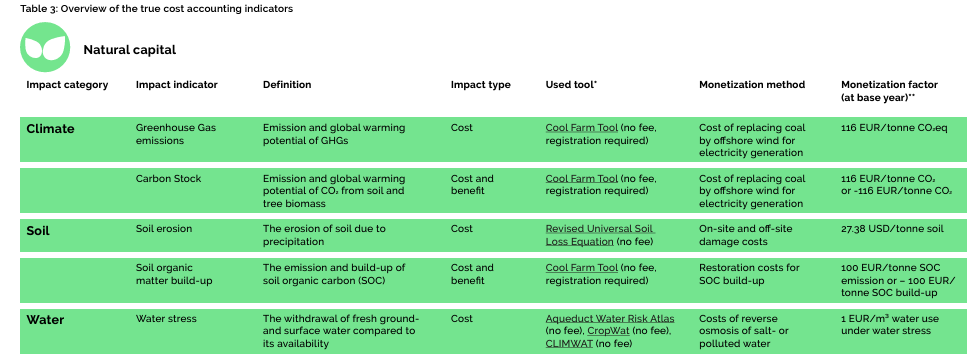
Then we come to the way in which the “True Price” is calculated. Go to The True Cost Accounting Agrifood Handbook for that.  You will find thousands of cost estimates each of which has an impact on TCA. Here is a partial list of notations:

– Collection and adoption of impacts and respective indicators/ metrics: Over 100 indicators and metrics from existing approaches were collected in order to select or create formulars/models to qualitatively assess the impact of agri-food products.

– Identify monetization method and factor corresponding to the indicators: For each indicator a suitable monetization approach was chosen with the preference for prevention cost approach. For the estimation of the true cost of food and agricultural product’s impact, monetization factors were assigned to each indicator in line with the chosen approach. A wide range of monetization approaches and factors exist – those here provided represent one option for monetization estimates.

-Testing: The indicator and the collection of the respective data were tested in two iterative pilot phases and were adjusted according to the feedback and lessons learned. Table 3 provides a summary of the final indicators. Some of the tested indicators (e.g. health impacts from pesticide ingestion) were not included in the final list of indictors because of insufficient performance during the piloting (e.g. lack of accurate impact modelling, insufficient proof of causality).

  For instance, on page 25 you will find this. It contains examples of the millions of calculations to be made:

It is as near to a black box as anyone ever will find. So many arbitrary values, weights and opinions are baked into the process, that TCA makes the calculation of original GDP look precise.

(Our) friends might be companies that have adopted a circular economy approach, where everything is reused, and can showcase their environmental credentials via TCA.

I’ve not seen a company “where everything can be reused.” Does “everything” include shipping, heating, hiring, marketing, etc. — all the things a company does to exist?

Or they might be firms that want to assess their future risks and take pre-emptive action, perhaps on the assumption that consumers will increasingly punish companies engaged in environmentally destructive activities, or that their assets will become less valued as the world transitions away from unsustainability.

Wishful thinking that seldom becomes widespread. There may be some limited cases where consumers are willing to pay a higher price for the ecology, but generally, price, quality, and availability rule.

“I think most of them have realized that they will have to do it sooner or later,” says Müller.

When it comes to increasing costs with no profit results, businesses usually choose “later” rather than “sooner.”

It probably would lead to a finger-pointing contest, with everyone denying culpability.

For example, who is responsible for internal combustion engine air pollution — the farmer driving the tractor? The engine manufacturer. The oil processor? The gas station? The boat owner that brought the oil to the processor? The company making the gas pump?  The pipeline company? The steel mill that rolled the pipe. Etc., etc., etc.

And what is the cost of air pollution? How are the various pollutants evaluated and calculated?

But getting from where we are now to where we need to be will be difficult. “Right now, we have a lot of people on the starting line,” says Baker, “but the short-term incentives aren’t there and you really are penalized in the market right now if you’re an early adopter.”

There needs to be legislation, she says, to force companies to move towards TCA.

Yes, it’s a government job. but rather than forcing companies to increase their own costs, the government must reward companies for adopting ecologically sound management.

In any event the whole process seems like a “do this really difficult thing before we even begin to attempt that other difficult thing.”

Personally, I would immediately, not delay, work on that “other difficult thing” (where feasible, legislating against polluting activities, plus federal government paying for prevention and cures.)

What Is a Rube Goldberg Machine? | Wonderopolis
Rube Goldberg and I want a cup of environmentally friendly coffee and cream, so first we must invent replacements for the coffee tree and the cow.

Expanded government financial support for adopting solar panels is one example of what would be needed.

There also needs to be institutional backing, and it is coming. At last year’s COP27 climate summit in Egypt, Máximo Torero, the chief economist at the FAO, threw his organization’s weight behind TCA.

“FAO is taking this extremely seriously,” he said. “It’s a huge challenge, and we are afraid, like many of you, but we are going to overcome our fear and we are going to do this.”

That could be a catalyst for real change, says Müller. “We will have it in the heart of policies, we will have a debate about the concept. Then the field is prepared for in-depth discussion.”

The drive to internalize externalities seems to be catching on more widely too. The way GDP is calculated changes every 15 years; the next iteration, in 2025, will reportedly include measures of sustainability and well-being.

As you saw with the The True Cost Accounting Agrifood Handbook, sustainability and especially, well-being, are quantified.

Quantified well-being? I question whether it can be done with any meaning.  Combining life expectancy with lifestyle, happiness, health and other well-being factors seems to be a fool’s errand. 

The transition to TCA will be a long, hard slog, however. “The construction of GDP took many, many centuries,” says Müller.

Overturning such entrenched economic orthodoxy is a tough ask. But if we recognize GDP for what it is, the transition will be easier, he says. “GDP is a social construction. It’s not a natural law like the speed of light, it’s an agreement in society.”

It’s not clear why every life experience must be combined into one number. GDP is difficult because of change, but it’s an understandable concept. Blending the emotional with the financial seems a step too far.

In Amsterdam, a pioneering supermarket displays two different prices for its goods. One is the market price, as you would see in regular supermarkets. The other is the “true price”, which factors in the environmental, health and social costs of the creation, consumption and disposal of the product.

Unsurprisingly, the true price is always higher than the market price. Customers can choose which price to pay: if they opt for the true price, the premium goes to environmental and social causes.

In the True Price Supermarket, which opened in 2020, bananas are sold at either the market price of €2.79 per kilo or the true price of €2.94 per kilo – a measly extra 15 cents per kilo to cover the social costs of low-wage farming and impacts on land, water and climate.

But some products have a much bigger mark-up: a hot chocolate rises from €2.79 to €3.70 because of the real price of cocoa and milk.

These premiums reflect the true cost of these products, as evaluated by a methodology called true cost accounting. Even though making the consumer pay the “true price” isn’t the actual goal of this accounting method, the movement is spreading.

True Cost Accounting is a bad idea. It attempts to quantify what cannot be quantified — numerical changes to what affects people emotionally and physically.

Work to accomplish TCA could delay what really needs to be done: Government support for ecologically sound farming, manufacturing, marketing, and research practices.

A Monetarily Sovereign government could set and fund any ground rules it chooses. The most important step requires answering one question: Given infinite money, what should be done to save the world for future generations.

The U.S., UK, and several other governments have infinite supplies of their own sovereign currencies. There remains only the need for these governments to do what needs to be done and/or to reward the private sector for doing them.

When money is no object, there is no need to wait for impossible precision. Spend the money to do the research, fund cleaning the air, water, earth, and do whatever is necessary to help the ecology.

That could begin tomorrow, without the busywork dithering required to reinvent GDP.

And that is the whole point of this post.


Rodger Malcolm Mitchell
Monetary Sovereignty

Twitter: @rodgermitchell Search #monetarysovereignty
Facebook: Rodger Malcolm Mitchell

……………………………………………………………………..

The Sole Purpose of Government Is to Improve and Protect the Lives of the People.

MONETARY SOVEREIGNTY

How can someone understand, but not understand, the same issue?

See related image detail. Opinion: College Rip-Off – John Stossel | Prescott eNews
John Stossel
John Stossel puzzles me. When you first conclude he knows nothing about economics, he writes something spot-on. Then he follows up with ignorance about the same subject. In that, he reminds of Paul Krugman, who alternately understands, then doesn’t understand, Monetary Sovereignty. Stossel can do it in two sentences. Here is an article on Reason.com, the Libertarian version of QAnon. Look at the subhead.

Worry About Budget Deficits, Not Trade Deficits Next year’s $1 trillion federal government budget deficit will bankrupt us. Trade deficits are trivial.

“Federal government’s budget deficit will bankrupt us.”  Suddenly, the U.S. government will go bankrupt? After world wars, numerous recessions and depressions, now, when the economy is growing rapidly, the federal government is going bankrupt??
The blue line is Gross Domestic Product. The red line is federal “debt.” There is no hint that federal “debt” is leading to bankruptcy. Quite the opposite. As “debt” grows, so does the economy.
.
The green line is real (allowing for inflation), per capita GDP. There still is no hint that increasing federal “debt” leads to bankruptcy. Again, quite the opposite.
If Stossel wants to bet that next year’s budget deficit will bankrupt the U.S. government, I will put up every dollar I own that says Stossel is wrong. One wonders why someone, anyone, would make such a foolish statement and expect belief. Being Monetarily Sovereign, the U.S. government cannot run short of U.S. dollars. Increased federal deficit spending is necessary for economic growth. GDP=Federal Spending+Non-federal Spending+Net Exports

Former Federal Reserve Chairman, Alan Greenspan: “A government cannot become insolvent with respect to obligations in its own currency.”

I suspect Stossel knows he’s wrong, so I’m guessing he hasn’t moved to another country or exchanged all his U.S. dollars for another currency in advance of a mythical U.S. bankruptcy. He’s just promulgating the usual Libertarian BS that has been wrong for at least 84+ years and will continue to be incorrect during his lifetime and beyond. But wait. He also says, “Trade deficits are trivial.” In that, he is correct. A trade deficit merely means we give other nations some of the plentiful U.S. dollars we create at the touch of a computer key, and in return, we receive valuable and scarce goods and services. I run trade deficits with my local Costco and with my cleaning lady. I don’t feel bad about it, though I don’t even have the government’s infinite ability to create dollars. The more money I have, the more stuff I can buy. The federal government has infinite money.

Maybe Donald Trump is such a powerful communicator and pot-stirrer that other countries, embarrassed by their own trade barriers, will eliminate them. Then, I will thank the president for the wonderful thing he did. Genuine free trade will be a recipe for wonderful economic growth.

But I fear the opposite: a trade war and stagnation—because much of what Trump and his followers say is economically absurd.

“What Trump and his followers say is economically absurd”? Who could have guessed that MAGAs know so little? Could it be possible that QAnon, Fox, Alex Jones, Marjorie Taylor Greene, Tucker Carlson, and Donald Trump are not reliable sources?

“(If) you don’t have steel, you don’t have a country!” announced the president.

Lots of things are essential to America—and international trade is the best way to make sure we have them. When a storm blocks roads in the Midwest, we get supplies from Canada, Mexico, and China. Why add roadblocks?

Steel is important, but “the choice isn’t between producing 100 percent of our steel (and having a country) or producing no steel (and presumably losing our country),” writes Veronique De Rugy of the Mercatus Center.

Trump uses the “you don’t have a country” meme for everything. “If you don’t have a steel industry, you don’t have a country.” “If you don’t have a border, you don’t have a country.” “If you don’t have a wall, you don’t have a country.” “If you don’t have a military, you don’t have a country.” “If you don’t have a strong military, you don’t have a country.” These are a few of his nonsense statements about the end of America. Ms de Rugy’s response was correct.

Today, most of the steel we use is made in America. Imports come from friendly places like Canada and Europe. Just 3 percent come from China.

Still, insists the president, “Nearly two-thirds of American raw steel companies have gone out of business!”

There’s been consolidation. But so, what? For 30 years, American steel production has stayed about the same. Profits rose from $714 million in 2016 to $2.8 billion last year. And the industry added nearly 8,000 jobs.

Trump loves to cherry-pick, twist, and outright lie about statistics to make his point. A day later, he’ll say the opposite. His followers will swoon at each new version despite its incompatibility with what Trump said yesterday.

Trump says, “Our factories were left to rot and to rust all over the place. Thriving communities turned into ghost towns. You guys know that, right?”

No. Few American communities became ghost towns. More boomed because of cheap imports.

It’s sad when a steelworker loses work, but for every steelworker, 40 Americans work in industries that use steel. They, and we, benefit from lower prices.

Right again, John. Wrong again, Donald.

Trump touts the handful of companies benefiting from his tariffs: “Century Aluminum in Kentucky—Century is a great company—will be investing over $100 million.”

Great. But now we’ll get a feeding frenzy of businesses competing to catch Trump’s ear. Century Aluminum got his attention. Your company better pay lobbyists. Countries, too.

After speaking to Prime Minister Malcolm Turnbull of Australia, Trump tweeted: “We don’t have to impose steel or aluminum tariffs on our ally, the great nation of Australia!”

So, the purpose of tariffs is . . . what? To punish our enemies? To reward our businesses? Or simply increase prices for the American consumer.

Economies thrive when there are clear rules that everyone understands. Now we’ve got “The Art of the Deal,” one company and country at a time.

I understand that Trump, the developer liked to make special deals, but when presidents do that, it’s crony capitalism—crapitalism. You get the deal if you know the right people. That’s what kept most of Africa and South America poor.

But Trump thinks trade itself makes us poorer: “We lose … on trade. Every year, $800 billion.”

Actually, last year’s trade deficit with China was $375 billion. But even if it were $800 billion, who cares? All a trade deficit shows is that a country sells us more than we sell them. We get the better of that deal. They get excess dollar bills, but we get stuff.

Right on, John. We have the infinite ability to create dollars by pressing computer keys. The U.S. government can send dollars into the economy whenever it wants to.

Former Federal Reserve Chairman Ben Bernanke: “The U.S. government has a technology, called a printing press (or, today, its electronic equivalent), that allows it to produce as many U.S. dollars as it wishes at essentially no cost.”

But we don’t have the infinite ability to create stuff. So, trading dollars for stuff is a great deal for us. Sadly, when the U.S. government does it, the Libertarians wrongly complain about federal deficits and debt. I wonder whether Stossel will hear about this from his Libertarian pals. And now we come to the usual Libertarian BS:

Real problems are imbalances like next year’s $1 trillion federal government budget deficit. That will bankrupt us.

It hasn’t happened. It can’t happen. It won’t happen. It’s just that incredible fearmongering by people who know better and should stop now.

Trade deficits are trivial. You run one with your supermarket. Do you worry because you bought more from them than they buy from you? No. The free market sorts it out.

Trump makes commerce sound mysterious: “The action I’m taking today follows a nine-month investigation by the Department of Commerce, Secretary Ross.”

But Wilber Ross is a hustler who phoned Forbes Magazine to lie about how much money he has. Now he goes on TV and claims, “3 cents worth of tin plate steel in this can. So if it goes up 25 percent, that’s a tiny fraction of one penny. Not a noticeable thing.”

Not to him maybe, but Americans buy 2 billion cans of soup.

Political figures like Ross—and Trump—shouldn’t decide what we’re allowed to buy. If they understood markets, they’d know enough to stay out of the way.

Like so many of the people Trump hires, Ross was, shall we say, a questionable character, with many, many claims against his honesty. The combination of Libertarianism and its attendant economic ignorance, together with economic dishonesty leads to bad (for America) decisions. Cut federal spending and we’ll have the bankruptcy Stossel and the Libertarians predict. As for John Stossel, he still puzzles me. Rodger Malcolm Mitchell Monetary Sovereignty Twitter: @rodgermitchell Search #monetarysovereignty Facebook: Rodger Malcolm Mitchell

……………………………………………………………………..

The Sole Purpose of Government Is to Improve and Protect the Lives of the People.

MONETARY SOVEREIGNTY