The “unsustainable,” “ticking time bomb” federal debt isn’t an unsustainable ticking time bomb at all

If you are a regular reader of this blog you may be familiar with this post: Historical claims the Federal Debt is a “ticking time bomb.” It describes the ongoing, relentless claims that the federal debt is “unsustainable and a “ticking time bomb.

The first entry was in 1940, when the so-called “federal debt” was about $40 Billion. Today, it is about $30 Trillion, a monstrous 74,900% increase.

You read that right. The so-called “federal debt” has increased nearly seventy five thousand percent since Robert M. Hanes, president of the American Bankers Association, claimed, the federal budget was a ticking time-bomb which can eventually destroy the American system,”

Now, here we are, 84 years and $30 Trillion dollars later. And still we survive. Not much of a time bomb.

I was reminded yet again, about the absurdity of the debt worries, when I read the following article, Here are some excerpts:

Record-high national debt is fiscal time bomb for US. Congress must defuse it. Founding Father’s fear has come true: Federal debt burden now is the greatest threat to the U.S. economy, national security and social stability. David M. Walker and Mark J. Higgins Opinion contributors

Apparently the “time bomb” still is ticking in the minds of the debt fear mongers.

In the late 1780s, the finances of the United States were in disarray. Revolutionary War debts incurred by the Continental Congress and former colonies were defaulting, and the democratic experiment in the New World was on the brink of failure.

But the nation caught a break when President George Washington appointed Alexander Hamilton as the first secretary of the Treasury.

In 1790 and 1791, Hamilton persuaded a reluctant Congress to establish the nation’s first central bank and consolidate all outstanding state and federal debt.

The federal debt burden after this action was just 30% of gross domestic product. A few years later, President Washington reinforced in his farewell address the need to avoid excessive debt.

We repeatedly have shown that the Debt/GDP ratio signifies nothing. It predicts nothing. It says nothing about a nation’s ability to pay its financial debts. It has no meaning whatsoever.

Yet it is quoted, again and again, by pundits who use it as evidence of . . . whatever they are trying to prove.

What next, Annual Rainfall/Number of Children named “Tom”? Here is the nonsense being peddled by Investopedia:

The debt-to-GDP ratio is the metric comparing a country’s public debt to its gross domestic product (GDP).
By comparing what a country owes with what it produces, the debt-to-GDP ratio reliably indicates that particular country’s ability to pay back its debts.
Often expressed as a percentage, this ratio can also be interpreted as the number of years needed to pay back debt if GDP is dedicated entirely to debt repayment.

Oh, really? The ratio “reliably indicates”?

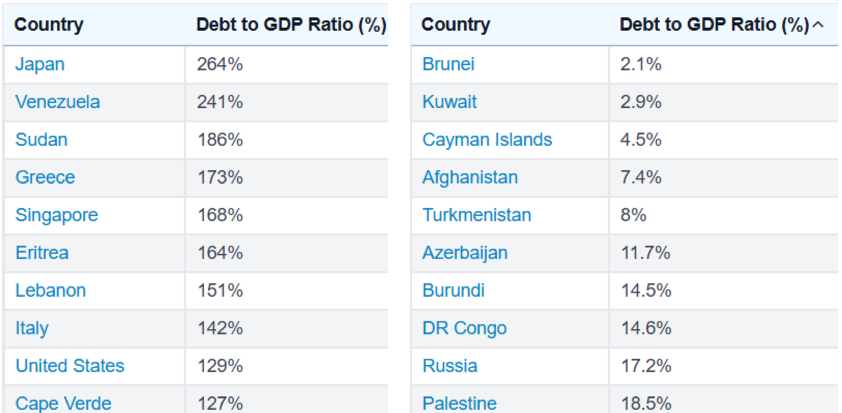
Here are some sample ratios. The nations with the ten highest ratios are shown to the left. The nations with the ten lowest ratios are shown to the right. According to the debt fear-mongers, the most financially secure nations are listed in the right-hand column:

According to the infamous Debt/GDP formula, the U.S. government has less ability to pay its debts than Cape Verde, and every one of the nations in the right-hand column.

And Japan supposedly has less ability to pay its debts than any other nation in the world. Does anyone really believe this nonsense?

But wait. Buried deep in the Investopedia article is this little paragraph:

Economists who adhere to modern monetary theory (MMT) argue that sovereign nations capable of printing their own money cannot ever go bankrupt, because they can simply produce more fiat currency to service debts; however, this rule does not apply to countries that do not control their monetary policies, such as European Union (EU) nations, who must rely on the European Central Bank (ECB) to issue euros.

Thus, the Debt/GDP “rule” does not apply to the United States, Canada, Mexico, China, Australia, the UK, Switzerland, Sweden, Norway, India, South Africa and others. The “rule” doesn’t apply to most of the world’s largest, most significant economies.

Yet, pundits in America insist on using the useless — no harmful — Debt/GDP ratio as a cudgel to ram debt reduction into financial planning.

Never mind that debt reduction causes depressions and recessions:

1804-1812: U. S. Federal Debt reduced 48%. Depression began 1807.
1817-1821: U. S. Federal Debt reduced 29%. Depression began 1819.
1823-1836: U. S. Federal Debt reduced 99%. Depression began 1837.
1852-1857: U. S. Federal Debt reduced 59%. Depression began 1857.
1867-1873: U. S. Federal Debt reduced 27%. Depression began 1873.
1880-1893: U. S. Federal Debt reduced 57%. Depression began 1893.
1920-1930: U. S. Federal Debt reduced 36%. Depression began 1929.
1997-2001: U. S. Federal Debt reduced 15%. Recession began 2001.

Why does that happen? Simple algebra. The formula for Gross Domestic Product is:

GDP = Federal Spending + Nonfederal Spending + Net Exports.

To reduce the so-called federal debt, one must decrease Federal Spending and/or increase federal taxes, which decreases Nonfederal Spending.

To increase real (inflation-adjusted) economic growth, a nation must do the opposite: Increase Federal Spending and/or decrease federal taxes, both of which add to the so-called “federal debt.”

Mathematically, there is no way to grow real GDP without growing “federal debt” enough to overcome inflation. So, if inflation is say, 2% (the Fed’s goal), the debt increase must overcome an annual 2% inflation handicap for GDP just to stay even.

Add to that, the need to overcome a net export figure (which America almost always has) and large annual deficits become vital.

When we have deficits that are too small, we have recessions, which the following graph demonstrates:

When federal debt declines, we experience recessions (vertical gray bars), which are cured by federal debt increases.

Strangely, the “science” of economics, which seems to love mathematical formulas and graphs, ignores the obvious. Growing an economy requires a growing supply of money.

Federal deficits add money to the economy. Federal taxes take money from the economy.

Continuing with the ticking time bomb article:

Over the next 175 years, politicians across the political spectrum largely adhered to Hamiltonian principles to preserve the integrity of the public credit.

The most important principle was that debt should be issued primarily to address emergencies – especially those involving foreign wars – and that debt burdens should be reduced during times of peace.

This changed completely in the 1970’s when President Nixon mandated the end of the dollar “backing” (actually the convertibility) to gold, and made the federal government Monetarily Sovereign in full.

Until then, the federal government’s ability to create dollars was limited by its inventory of gold. When the inventory did not keep up with GDP growth needs, recessions resulted.

Now, with gold no longer a factor, the government’s ability to grow the nation’s money supply also gave the government the ability to grow GDP.

This discipline enabled America to establish and maintain its excellent credit record, which provided ample lending capacity during periodic crises.

As Hamilton predicted, the ability of the nation to borrow proved critical during the War of 1812, the Civil War, World War I and World War II.

The nation now has no need to borrow, a far superior situation. It can create, at will, the growth dollars it needs.

 After World War II, fiscal discipline was temporarily restored, and debt/GDP was reduced by growing the economy much faster than the debt even though the federal government continued to run budget deficits during most years.

Again, there is no magic. GDP still = Federal Spending + Nonfederal Spending + Net Exports.

If the Federal debt is reduced, the growth dollars must come from somewhere. In this case, growth came from Net Exports.

Subsequently, our wealthy economy began buying, buying, buying, which is a good thing. We were exchanging dollars that cost us nothing (We created them by pressing computer keys) for valuable goods and services.

Because the American government has access to infinite dollars, importing goods and services makes economic sense.

The U.S. is the world’s most massive consumer economy. Our Net Exports fell while GDP grew only because of massive federal deficit spending.

The one exception was in 1998-2001, when the federal government ran budget surpluses and even paid down debt in two of these years.

That exception proves the debt reduction is an economic disaster. Here is what happened when we paid down debt: 1997-2001: U. S. Federal Debt reduced 15%. Recession began 2001.

Reduced deficit spending morphed into a surplus in 1998. The result: A recession in 2001, which was cured by increased federal deficit spending.

Since then, the Hamiltonian principle has been decisively abandoned, and the federal government now routinely runs large deficits, resulting in ever-increasing debt burdens. This behavior is projected to worsen in the future.

Translation: The federal government now routinely runs large deficits, which pump growth dollars into the economy, thus growing GDP.

Mounting federal debt burdens now represent the greatest threat to the U.S. economy, national security and social stability.

The federal debt/GDP ratio is 123%. The nonpartisan Congressional Budget Office projects that, under current law, it will increase to 192% by 2053.

The federal government has the infinite ability to create dollars. The major threat to the U.S. economy (i.e. to GDP) is a reduction in federal money creation.

Clearly this is irresponsible, unsustainable and in sharp contrast to Hamilton’s founding principle.

There it is, the word “unsustainable,” to describe what we have been sustaining since 1940. Hamilton did not anticipate the post-1973, Monetarily Sovereign America.

National debt has topped $34 trillion.Does anyone actually have the guts to fix it?

The fastest way to “fix” the national debt would be to stop accepting deposits into T-security accounts (T-bills, T-notes, and T-bonds).

The government doesn’t use those dollars. They remain the property of the depositors. The problem is that those deposits do have two functions (neither of which is to supply the government with dollars):

  1. To provide a safer place to store dollars than bank savings accounts
  2. To help the Fed control interest rates by providing a floor for rates.

Why does the United States continue to behave so irresponsibly? One reason is that U.S. politicians routinely avoid spending cuts and tax increases because they may threaten their reelection prospects.

Voters rightfully don’t want tax increases and they don’t want federal benefit reductions, both of  which take money out of voters’ pockets and lead to recessions.

Another is that, as the issuer of the world’s dominant reserve currency, the United States can run fiscal deficits so long as surplus countries, such as China and Saudi Arabia, continue to purchase U.S. Treasuries.

The U.S. does not need anyone to purchase U.S. Treasuries. The federal government creates all the dollars it needs simply by pressing computer keys. The government does not use the dollars in T-security accounts. They are the property of the depositors.

In fact, proponents of the flawed and failed Modern Monetary Theory implicitly argue that the dollar’s reserve currency status is permanent, which allows deficit spending to continue indefinitely.

The dollar is the world’s leading reserve currency, which is a currency banks keep on reserve to facilitate international commerce. But, other currencies — the British pound, the euro, the Chinese renminbi — also are reserve currencies.

Being a reserve currency has nothing to do with the federal government’s ability to spend indefinitely.

Congress must defuse America’s fiscal time bomb.

Yikes, there it is again, the silly “time bomb” analogy. It’s the time bomb that never explodes.

A debt crisis is not imminent in 2024, but one will occur in the future if the nation’s addiction to deficits and debt persists.

Translation: A debt crisis is not imminent in 2024. We have no idea when if ever it will occur, but it makes us sound smart to threaten it.

The greatest risk is the one that Alexander Hamilton feared most: One day, the United States could face a threat to its very existence – perhaps in the form of a foreign war – and Americans will lack the debt capacity to fund an adequate response.

Lessons from the switch to Bernanke from Greenspan - MarketWatch
Obviously, the government never can run short of dollars. I wonder why they don’t understand that.

Lack the capacity to fund? Utter nonsense. Here are the facts:

Former Fed Chairman, Alan Greenspan: “A government cannot become insolvent with respect to obligations in its own currency. There is nothing to prevent the federal government from creating as much money as it wants and paying it to somebody. The United States can pay any debt it has because we can always print the money to do that.”

Former Fed Chairman, Ben Bernanke: “The U.S. government has a technology, called a printing press (or, today, its electronic equivalent), that allows it to produce as many U.S. dollars as it wishes at essentially no cost. It’s not tax money… We simply use the computer to mark up the size of the account.

Statement from the St. Louis Fed: “As the sole manufacturer of dollars, whose debt is denominated in dollars, the U.S. government can never become insolvent, i.e., unable to pay its bills. In this sense, the government is not dependent on credit markets to remain operational.”

That’s the real capacity.

Fortunately, the future is far from hopeless. America sits on a huge reservoir of natural resources and remains the world’s technological innovation engine.

It also possesses sufficient time to enact fiscal reforms and reestablish fiscal discipline.

Because the authors, David M. Walker and Mark J. Higgins, don’t understand Monetary Sovereignty, they think federal government fiscal discipline is the same a personal fiscal discipline. 

Federal finance is so unlike personal finance that not understanding the difference is like not understanding the difference between butter and a butterfly.

The challenge for Americans today is that the longer we wait to reinstate this principle, the more pain that will be incurred. It is our belief that the solution is in the hands of “We the People.”

The math doesn’t lie.Republicans and Democrats own every missing dollar of our growing national debt crisis.

Politicians have powerful incentives to respond to short-term demands, and if Americans collectively demand that short-term desires must be satisfied at the expense of the nation’s long-term prosperity and solvency, that is what politicians will deliver.

Heaven forbid that Americans demand increases in taxes and cuts to federal spending. The result would be a depression.

On the other hand, if Americans place equal value on the longevity of their country and the prosperity of their children and grandchildren, they will demand that politicians take steps to defuse America’s fiscal “time bomb.”

Oops, more time bomb that never explodes.

Ever notice that the debt worriers never come up with evidence? They say “debt is bad,” but they don’t say,”Here is a graph of what has happened to the economy when federal debt increased and decreased.

Here is one such graph:

As federal debt (red) has grown, the economy (GDP, blue) has grown.

As you can see, there is no sign of a “debt crisis.”

History suggests that Americans will eventually pursue the correct course of action. Our hope is that they embrace it quickly to ensure that America’s future is brighter than its past.

David M. Walker, a former U.S. comptroller general, is also a recipient of the Alexander Hamilton Award for economic and fiscal policy leadership from the Center for the Study of the Presidency and the Congress.

Mark J. Higgins is author of “Investing in U.S. Financial History: Understanding the Past to Forecast the Future,” coming Feb. 27. Connect with Mark on LinkedIn. 

It is frightening that a former U.S. comptroller general and recipient of an award for policy leadership, and the author of a book about U.S. finances can be so clueless about U.S. federal finances. No wonder the public is so ill-informed.


Rodger Malcolm Mitchell
Monetary Sovereignty

Twitter: @rodgermitchell Search #monetarysovereignty
Facebook: Rodger Malcolm Mitchell

……………………………………………………………………..

The Sole Purpose of Government Is to Improve and Protect the Lives of the People.

MONETARY SOVEREIGNTY
When will the U.S. government run out of U.S. dollars?

Seems like a simple question — “When will the U.S. government run out of U.S. dollars?” Sadly, the media writers, economists, and politicians don’t seem to know. Some claim “soon.” Some claim “eventually.” A few say “never.”
Scott Horsley 2010
Scott Horsley
For instance, Scott Horsley:
Scott Horsley is NPR’s Chief Economics Correspondent. He reports on ups and downs in the national economy as well as fault lines between booming and busting communities. Horsley spent a decade on the White House beat, covering both the Trump and Obama administrations. Before that, he was a San Diego-based business reporter for NPR, covering fast food, gasoline prices, and the California electricity crunch of 2000. He also reported from the Pentagon during the early phases of the wars in Iraq and Afghanistan. Horsley earned a bachelor’s degree from Harvard University and an MBA from San Diego State University. 
Mr. Horsley seems to believe the government will run out of money in 2033 or maybe in 2036. I say that because of the article he wrote:

The clock is ticking to fix Social Security as retirees face automatic cut in 9 years MAY 6, 2027:06 PM ET, Scott Horsley

Congress has less than a decade to fix Social Security before the popular program runs short of cash, threatening a sharp cut in benefits for nearly 60 million retirees and family members, according to a government report released Monday.

Social Security (SS) is an agency of the U.S. government. The only two ways SS can run out of dollars are:
  1. If Congress and the President want it to run out, or
  2. If the U.S. government runs out.
Can the government run out of its sovereign currency, which it created from scratch in the 18th century? For millions of years, there was no U.S., no U.S. laws, and no U.S. dollars. Then suddenly, in the late 1780s, a group of men created a government from thin air. This government passed laws, also from thin air. Some of the laws created the U.S. dollar, again from thin air. That government created as many laws as it wished, and those laws created as many dollars as the law-writers wished. It all was arbitrary. So, returning to the question, “When will the U.S. government run out of U.S. dollars?”

The report from Social Security trustees predicts the retirement program’s trust fund will be exhausted in November of 2033.

Despit what you repeatedly have been told, it isn’t a trust fund. It’s just a line item in a balance sheet. (See: “The phony trust fund controversy.“) The government can change those numbers to whatever it chooses at any time it chooses. Congress votes; the President approves; someone presses a computer key; and a one billion dollar “trust fund” instantly becomes a fifty billion dollar “trust fund.”

At that point, benefits would automatically be cut by 21%, unless lawmakers adopt changes before then.

Among the laws the government created were the laws creating Social Security. As an agency of the government, Social Security is funded the same way as every other agency: Congress votes, and the President approves.  Congress and the President have unlimited freedom to decide how much any agency will receive:
  • Mandatory spending – funding for Social Security, Medicare, veterans benefits, and other spending required by law. This typically uses over half of all funding. (Congress and the President make the law)
  • Discretionary spending – federal agency funding. Congress sets funding levels for these each year. This usually accounts for around a third of all funding. (Congress and the President set the levels)
  • Interest on the debt – this usually uses less than 10 percent of all funding. Congress and the President decide how much interest to pay and tax).
In short, every penny of federal spending ultimately is decided by Congress and the President. It all returns to the fundamental question, “When will the U.S. government run out of U.S. dollars?” By now, I’m sure you know the answer: The U.S. government cannot unintentionally run short of U.S. dollars.
Lessons from the switch to Bernanke from Greenspan - MarketWatch
People don’t realize that FICA doesn’t fund Social Security and Medicare and that those trust funds are fictions.
Even if the government had to pay someone a billion, a trillion, or a billion trillion dollars today, it could do so simply by passing a law and pressing a computer key.

Former Federal Reserve Chairman Alan Greenspan: “A government cannot become insolvent with respect to obligations in its own currency. There is nothing to prevent the federal government from creating as much money as it wants and paying it to somebody. The United States can pay any debt it has because we can always print the money to do that.”

Former Federal Reserve Chairman Ben Bernanke: “The U.S. government has a technology, called a printing press (or, today, its electronic equivalent), that allows it to produce as many U.S. dollars as it wishes at essentially no cost. It’s not tax money… We simply use the computer to mark up the size of the account.”

Statement from the St. Louis Fed: “As the sole manufacturer of dollars, whose debt is denominated in dollars, the U.S. government can never become insolvent, i.e., unable to pay its bills. In this sense, the government is not dependent on credit markets to remain operational.”

The answer to the question, “When will the U.S. government run out of U.S. dollars?” is a resounding, NEVER, unless Congress and the President make that arbitrary decision. You and I are limited in our money supply. Your state, county, and city governments are limited. All businesses are limited. Banks are limited. Even euro nations are limited. All are monetarily non-sovereign. They were not the original creators of the U.S. dollar. By contrast, the U.S. government is Monetarily Sovereign. It was the creator of the dollar. It cannot unintentionally run short — not now, not in 2033, not in 2036, not ever. So why do writers like Scott Horsley think SS and Medicare, agencies of the federal government, will run short?

There’s some good news in the new forecast. Thanks to higher-than-expected worker productivity and a decline in expected disabilities, Social Security isn’t burning through cash as fast as trustees predicted a year ago.

Still, the long-term demographic challenges haven’t gone away.

A growing number of baby boomers are collecting benefits, while there are fewer people in the workforce paying taxes for each retiree.

Given today’s low birthrates, that mismatch is not expected to change for decades, although a surge in immigration helps.

Remember what Ben Bernanke said, “It’s not tax money… We simply use the computer to mark up the size of the account.” The federal government does not use your tax dollars to fund its spending. You (and Mr. Horsley) may be shocked to learn that every dollar you send to the U.S. Treasury is destroyed upon receipt. When you pay taxes, the dollars come out of your bank account, where they were part of the “M2 money supply measure.” When the dollars reach the Treasury, they instantly disappear from M2 and are not found in any money supply measure.  They join the Treasury’s infinite money supply. Adding dollars to infinite dollars still yields infinite dollars. These dollars, which are not part of any money supply, no longer can be found. They have been destroyed. Why does the federal government collect taxes if not to fund spending?
  1. To control the economy by taxing what it wishes to discourage and by giving tax breaks to what it wishes to reward.
  2. To assure demand for the U.S. dollar by requiring taxes to be paid in dollars.
  3. To make you believe dollars are limited by taxes, so you will not request benefits. (This doesn’t discourage the rich from requesting and getting tax benefits unavailable to you.)

Proposed Fixes Congress could fix the problem by raising taxes that support Social Security, reducing retirement benefits, or some combination of the two. But a politically palatable solution has been elusive.

Mr. Horsley can think of only two fixes: Raise taxes or cut benefits. Both fixes predictably would impact the middle and lower income groups, thereby widening the income/wealth/power Gap between the rich and the rest. This is exactly what the rich want because the wider the Gap, the richer they are. Increasing your taxes and lowering your benefits makes the rich richer.  And that is precisely what the rich bribe the media, the economists, and the politicians to do. It’s not that Mr. Horsley himself has been bribed. He may simply be following the “party line” created by others who have been bribed — just going with the flow, and not thinking about the reality that the federal government can’t unintentionally run short of dollars.

“When you see the two major candidates running for president tripping over themselves to promise what they won’t do to fix the problem, you have to worry because those kinds of reforms really start at the top,” says Maya Macguineas, president of the Committee for a Responsible Federal Budget.

Ah, yes, the famous Maya Macguineas, who repeatedly implies that the federal government is running out of dollars — now there is a “reliable” source.

The Biden administration has pledged not to touch Social Security benefits.

“Seniors spent a lifetime working to earn the benefits they receive,” Treasury Secretary Janet Yellen, who leads the trustees, said in a statement.

“We are committed to steps that would protect and strengthen these programs that Americans rely on for a secure retirement.”

Yes, yes, blah, blah, blah. “Committed to steps,” “Protect and strengthen.” And more blah, blah, blah. But what exactly are those steps?

Congressional Democrats have proposed higher taxes on the wealthy to support Social Security.

Congressional Republicans have balked at that, instead calling for reducing the benefit formula and raising the retirement age for younger workers.

The classic Democrat/Republican false choices. The Dems want to soak the rich. The GOP wants to soak the rest of us.

“Those who want to cut Social Security couch it in affordability,” says Nancy Altman, who heads the advocacy group Social Security Works.

But of course, there’s no question we can afford it. It’s really a question of values. And as polarized as we are, we’re not polarized over this.”

Altman is confident that lawmakers will find a solution before automatic cuts take effect.

“If they didn’t act, not only would they all be voted out of office,” she says. “They couldn’t even remain in Washington. They’d be chased down the street.”

Why aren’t they already being chased? Because the public has been fed so many lies by so many “reliable sources,” the people don’t realize they are being lied to. On first reading of this post, most people will think, “That can’t be true.” But it’s true. The federal government could fund a comprehensive, no-deductible Medicare for every man, woman, and child in America and a generous Social Security program for everyone, all without collecting a single penny in taxes. Yes, there’s no question we can afford it. So? So? AFFORD IT!

But the clock is ticking, and delay has already been costly.

“Every year the trustees warn us we have to make changes and the sooner we make them, the better and easier it will be,” says Macguineas. “And every year we fail to make those changes.”

Medicare and disability solvency While Social Security’s retirement program is in danger of running short of cash, a separate program that supports disabled people appears to be solvent for the long term, trustees said.

Medicare’s finances have also improved somewhat in the last year, thanks to a strong economy and lower-than-expected spending. Still, the program which provides health care for nearly 67 million people, is expected to face its own cash crunch in 2036.

You have been fed lie after lie after lie. Your information sources wring their hands in mock horror that one day soon, the federal government will run short of dollars, perhaps right after the universe runs short of stars and politicians become honest. Even the densest among us can see the solution: The federal government should pay for Social Security and Medicare, period. Eliminate FICA. It doesn’t fund SS or Medicare. It doesn’t fund anything. Those FICA dollars are destroyed upon receipt. FICA serves only as a convenient excuse (convenient for the rich) to limit and cut your SS and Medicare benefits, thus widening the income/wealth/power Gap and making the rich richer and you poorer. In technical terms, that pisses me off, and it should piss you off, too. What are you going to do about it? Rodger Malcolm Mitchell Monetary Sovereignty Twitter: @rodgermitchell Search #monetarysovereignty Facebook: Rodger Malcolm Mitchell

……………………………………………………………………..

The Sole Purpose of Government Is to Improve and Protect the Lives of the People.

MONETARY SOVEREIGNTY

Why state-funded Social Security or guaranteed income is a colossal mistake. It should be federal.

I long have favored a federal plan in which every man, woman, and child in America would receive a monthly stipend from the federal government. (Some call it UBI—Universal Basic Income. Others call it GI—Guaranteed Income, or Social Security for All.) A federally funded Social Security for All program was described in a post published seven years ago. Today, that post was brought to mind by the following article:

a $1,000 monthly ‘guaranteed income statewideThe proposal would have taxpayers fund statewide, $1,000 monthly ‘guaranteed income.’ A measure creating a task force to look into monthly guaranteed taxpayer-funded “unrestricted cash” subsidies to specific individuals in Illinois is being discussed in the state legislature.

An Illinois Senate appropriations committee would review “the landscape of cash supports available to low-income residents” and identify “populations without significant access to cash supports.”

The bill, as filed, says after the board is dissolved at the end of 2027, DHS would administer the program with monthly cash payments of $1,000 to Illinois residents, regardless of immigration status, who provide care for a child or specified dependent, recently gave birth or adopted a child or is enrolled in an educational or vocational program.

Dollar bills coming out of a horn of plenty.
By law, the Monetarily Sovereign U.S. government is an infinite horn of plenty, capable of creating an unending stream of dollars at the touch of a computer key without collecting a penny in taxes.

Mike Buehler, an opponent of the measure, said it’s irresponsible to discuss such a program without knowing how much it will cost taxpayers.

You may be surprised that I oppose this and other similar plans. Here is why:

1. Local governments are monetarily non-sovereign (unlike the federal government, which being Monetarily Sovereign, has the infinite ability to create dollars).

With few exceptions, local governments get their spending money from taxpayers.

The federal government gets its spending money by creating it ad hoc. The federal government does not spend tax dollars.

That is why it can run trillion-dollar deficits with no funding problem at all.

State, county, or city taxpayers pay for local government-funded UBI programs.

Most local tax dollars come from sales taxes and/or local income taxes, most of which are paid by middle—and lower-income residents. Extracting dollars from middle—and lower-income taxpayers is exactly the opposite of the UBI plan’s basic purpose.

2. While the federal government has unlimited access to dollars, local governments have limited abilities to pay for things. So, the benefits must be limited to local governments’ affordability estimates.

This, in turn, requires limiting benefits to specific groups and denying benefits to other groups, which creates two problems:

A. The government must set up a complex and expensive apparatus for monitoring recipients so that people do not cheat.

B. People just outside the limit of qualifications are unjustly deprived of aid, and/or try to find unanticipated ways to qualify.

“I understand that you would have to be a person with a child, or caring for someone in your home or school to be eligible for the benefits.

A local government would have to hire dozens (or thousands?) of people to monitor these qualifications. (Do you have a child? How old? Are you really “caring for” that boarder? Are you still in school, and exactly what is a “school.” How many days or hours do you attend? Additionally, there would be extensive and expensive paperwork filed, read, and authenticated.

That could be millions of people and the cost could be in the tens of billions of dollars,” Buehler told The Center Square. “And where’s the state going to come up with these funds and the only place to come up with that is to get it from the taxpayers.

Guaranteed income programs in Chicago and the Metro East St. Louis areas are ongoing, costing taxpayers millions. In 2022, the city of Chicago was in line to spend $31.5 million for $500 a month to go to 5,000 low-income residents.

That same year, Illinois legislators approved a pilot program using state taxpayer funds worth $3.6 million for the Metro East St. Louis area.

Inevitably, a state-run, money-restricted program would evolve to a “nanny-state,” where the money only could be used for approved purposes. And that would have to be monitored.

Ameya Pawar with the Economic Security Project said there are 150 different programs across the country. He gave examples of people using the money to buy sports goods for their children or even to take a vacation.

There is widespread belief that the poor who receive money from taxpayers, should be told what to do with the money (the poor supposedly being too ignorant to know what is best for them). Buying sports goods and taking vacations is not “good” for the poor. The nanny preference is only to feed starving children, not just make them happy with toys and entertainment. Note the hinted outrage Ameya Pewar expresses for recipients buying baseballs to entertain their kids.

“And all of this money that goes into the pockets to stabilize households flows through local businesses,” Pawar told the committee. “So you see some of this money back in sales taxes, and other taxes.”

No buying from Amazon allowed??

Buehler said there could be unintended consequences, like reducing work productivity and more.

“For regardless of immigration status, I think an unintended consequence could be a flood of migrants coming to Illinois looking for benefits and not having to work for it,” he said.

3. If one state, county, city, or village offers better benefits than another, people will tend to go where the money is and the taxpayers will pay. This is true for citizens as well as migrants.

And note the common but false belief  that the poor are so lazy and unmotivated, if you give them money, they won’t get jobs.

Pawar said the proposed statewide guaranteed program of “unrestricted cash” should be in addition to other taxpayer-funded safety net programs.

Programs like Supplemental Nutrition Assistance Program funds go to buy food. The Low Income Housing Energy Assistance Program is for heating bills. The Temporary Assistance for Needy Families program provides monthly cash assistance to low-income families with children.

“And to get this income, they may not necessarily spend that in their own best interest or the interest of the citizens at large,” he said.

Again, the taxpayer requirement exacerbated the nanny-state belief that the poor are too stupid to spend in their own best interests. “Why am I, as a taxpayer helping these people to take vacations, if I can’t afford one myself.” All the above-mentioned problems would be addressed by a federally-funded, Social Security program covering every man, woman, and child in America, regardless of income or wealth. The rich, poor, citizens, non-citizens, young, old, married, single, renter, homeowner, in or out of school, etc., all would receive the stated benefits — and unlike with state and local government programs, no one would pay a penny. Federal Social Security payments made to every man, woman, and child, require much less monitoring. Most importantly, affordability would cease to be an issue. The federal government can afford anything, and without collecting taxes. All of the money spent by the federal government would be added to the local economy, increasing everyone’s income.
8 Million Have Slipped Into Poverty Since May as Federal Aid Has Dried Up - The New York Times
8 Million Have Slipped Into Poverty Since May as Federal Aid Has Dried Up, October 15, 2020. (By Leigh Lynes: New studies show the effect of the emergency $2 trillion package known as the Cares Act and what happened when the money ran out.)
Here are excerpts from another article on the subject.

33 basic and guaranteed income programs where cities and states give direct payments to residents, no strings attached The concept of a “universal basic income” has inspired widespread interest in recent years.

Actually, there are “strings,” in the form of qualifications.

More than interest — when former US presidential candidate Andrew Yang announced that a UBI program of $1,000 direct payments to citizens every month would be the keystone policy of his platform, he drew an unexpected amount of grassroots support in a crowded primary year.

Guaranteed income programs have been gaining even more traction during the pandemic, which took a particular toll on low-wage workers and threw many Americans into poverty.

At least 11 direct-cash experiments went into effect this year, Bloomberg estimated in January.

Former Stockton, California mayor Michael Tubbs, took the idea to the next level by launching the Mayors for a Guaranteed Income network. As of this year, there are 60 mayors in the program, advocating — and launching pilot programs for — guaranteed income for their residents.

California recently launched the first statewide guaranteed income program in the US, providing up to $1000 per month to qualifying pregnant people and young adults leaving the foster care system.

“Young adults leaving foster care” and “pregnant people” comprise two, very narrow classes, and $1000 a month is a meager amount. The task of verifying qualifications would be costly. (Imagine trying to verify pregnancy for thousands of people, and who monitors when pregnancies end before birth?)

The basic income program that Tubbs launched in Stockton in 2019, the Stockton Economic Empowerment Demonstration, has been considered the model for other cities that have followed in its footsteps, offering low-income residents hundreds of dollars a month and measuring their job prospects, financial stability, and overall well-being afterward.

It seems like a massive and expensive project for just hundreds of dollars’ worth of benefits.

According to SEED, participants improved in all those metrics.

“Guaranteed income makes a case for investing in our undocumented neighbors and formerly incarcerated residents. In doing so, it addresses the reality of the nation’s fragmented, punitive welfare structure.”

Will taxpayers consider this a reward for being undocumented or incarcerated? (Want to make an easy few hundred dollars a month? Go to jail for some minor charge.)

This kind of program isn’t a new idea, however. The Eastern Band of Cherokee Indians Casino Dividend in North Carolina has been giving tribal members annual funds since 1997, for instance. Alaska has been paying residents out of its oil dividends since 1982.

The Eastern Band of Cherokee Indians Casino Dividend in North Carolina gets its money from casino revenue. Alaska gets its dividend money from oil. Neither collects taxes to pay recipients. That is a major consideration. Here are a few of the 33 examples mentioned in the above article.

Compton, California. Duration: December 2020 to December 2022. Income amount: $1,800 every three months for 2 years. Number of participants: 800

Tacoma, Washington,Duration: December 2021 to December 2o22, Income amount: $500 every month for 1 year, Number of participants: 110

Stockton, California, Duration: February 2019 to February 2021, Income amount: $500 every month for 2 years, Number of participants: 1ount: Based on the annual dividend from state-owned oil companies, ranged from roughly $2,000 per person in 2015 to $800 in years with lower gas prices.

 Oakland Resilient Families, Duration: Summer 2020 to present, Income amount: $500 per month for 18 months, Number of participants: 600

Alaska Permanent Fund , Duration: Annual, Income amount: Based on the annual dividend from state-owned oil companies, ranged from roughly $2,000 per person in 2015 to $800 in years with lower gas prices , Number of participants: Alaska residents

North Carolina, Cherokee Tribe, The Eastern Band of Cherokee Indians Casino Dividend pays every tribe member annually, Duration: Annual, Income amount: $4,000 – $6,000 per year, Number of participants: Every tribal member.

The Alaska and Cherokee programs succeed long term because they are not funded by taxpayers. A federally funded program would succeed for the same reason. Federal spending is not taxpayer funded. When state and local taxpayers fund a spending program, the result is that a large group of middle- and low-income people transfers some of their money to a smaller group of middle- and low-income people. The large group includes all those who pay sales and income taxes. The small group is all those who receive those tax dollars. It’s just dollars rotating within the municipality, enriching some residents at the expense of others. The municipality’s economy receives nothing. By contrast, when the federal government funds a guaranteed income program the government creates new dollars and sends them to the nation’s recipients. The result is that there is no expense to anyone, but the nation’s economy is enriched with net dollars. (GDP = Federal Spending + Nonfederal Spending + Net Exports). Guaranteed income programs help narrow the income/wealth/power Gap between the rich and the poorer. While reducing poverty, in of itself, is a worthwhile goal, narrowing the Gap also helps address related, social problems:

Wide Gaps affect not only poverty itself, but health and longevity, education, housing, law and crime, war, ownership, bigotry, taxation, GDP, scientific advancement, the environment, human motivation and well-being, and virtually every other issue related to economics. 

The most successful guaranteed income programs share several features:
  1. Funded by a Monetarily Sovereign government or by state owned and controlled businesses. This takes taxpayer costs out of the equation.
  2. Minimal requirements for participants achieve voter support by making the plan fairer.
  3. Significant benefits. Trivial payments, i.e. $100 a month, etc. will not generate positive voter sentiment.
  4. Easy entry and supervision. Difficult entry results in negative feelings by voters. Easy supervision lowers costs.
  5. Easily understood goal.
A family -- father, mother, two children -- happily receiving dollars from the federal government
Many good reasons for, and no good reasons why not.
A national Social Security for All plan, with a minimum benefit if $5,000 per year for each adult (18 and over) and $2,500 a year for a child would begin to address the abovementioned social problems. The Cost: The U.S. has about 260 million adults (18+) and about 70 million children. At the $5,000/2,500 level, the benefit cost of the Social Security for All would be $1.3 trillion for adults and $175 billion for children, totaling somewhat south of only $1.5 trillion. Why do I say “only”? By comparison:
    1. In 2023, the federal government spent about $6.2 trillion.
    2. The Gross Domestic Product (GDP) for the year 2023 had a current-dollar value of $27.36 trillion.
    3. In 2023, the U.S. federal government collected a total of approximately $4.71 trillion in tax revenue.
    4. In fiscal year 2023, the federal government’s spending exceeded its revenues, resulting in a deficit of $1.70 trillion
    5. By the end of 2023, the cumulative federal deficit was $26.236 trillion.
    6. The U.S. M2 money supply is about $20 trillion.
Given that:

Alan Greenspan: “A government cannot become insolvent with respect to obligations in its own currency. There is nothing to prevent the federal government from creating as much money as it wants and paying it to somebody. The United States can pay any debt it has because we can always print the money to do that.”

and

Ben Bernanke: “The U.S. government has a technology, called a printing press (or, today, its electronic equivalent), that allows it to produce as many U.S. dollars as it wishes at essentially no cost.”

A Monetarily Sovereign government spending $1.7 trillion to send an additional $5,000 to every adult and $2,500 to every child — and at no cost to anyone — would seem to be a bargain price and a great investment for America. Further, because of the multiplier effect*, that additional $1.7 trillion in federal spending, would increase Gross Domestic Product far more than $1.7 trillion.

*Per Investopedia: A government increases spending or decreases taxes in part to inject more money into the system.

Such fiscal policy has a multiplier effect. That is, every dollar spent can be expected to cause an increase in the gross domestic product (GDP) by more than a dollar.

This is due to the sheer momentum created by the policy. Consumers spend more so businesses produce more goods.

Businesses have to hire more to produce more goods, so more people have more money to spend on goods.

The same phenomenon occurs for both government spending increases and tax cuts. Either tends to increase GDP disproportionately.

A cut in government spending can reduce GDP by a greater degree than the amount saved by the cut.

The expanded Child Tax Credit had a multiplier effect of 1.25 on GDP in the first quarter of 2021, according to an analysis by Moody’s Analytics. The increase in the Supplemental Nutrition Assistance Program boosted GDP by a 1.61 multiplier effect in the same period. Increased defense spending had a 1.24 multiplier effect.

Infinite benefits at no cost to anyone: Can any knowledgeable person object to Social Security for All? Rodger Malcolm Mitchell Monetary Sovereignty Twitter: @rodgermitchell Search #monetarysovereignty Facebook: Rodger Malcolm Mitchell

……………………………………………………………………..

The Sole Purpose of Government Is to Improve and Protect the Lives of the People.

MONETARY SOVEREIGNTY

The rich will try to cut Social Security and Medicare by telling you the Big Lie in economics.

As you read this post, think about these two simple questions. What would happen if your city, county, and state stopped collecting taxes. What would happen if the U.S. government stopped collecting taxes? 

Later, if you’re in school, you can ask your economics professor. See if he/she knows.

—–/////—–

“Rich” is a comparative. A person earning $100,000 is rich if everyone else earns $10,000. But that person earning $10,00 is rich if everyone else earns $1,000.

The income/wealth/power Gap below you and above you determines how rich you are. The average annual income in 1930 was about $4,800. Adjusted for inflation, that’s equivalent to $85,000 today.

Thus, the wealthy need to make you poorer to make themselves richer. Here is how they plan to do it:

In a June 13 Fox Nation debate, Sen. Lindsey Graham said seniors may have to “take a little less” and “pay a little more in” when debating Social Security solvency, reports Knewz via MSN.

Graham commented while debating Sen. Bernie Sanders during a “Senate Project” debate.

There is not one legitimate reason why seniors will “have to” take less or pay more. Not one. The U.S. federal government, being Monetarily Sovereign, cannot run short of dollars.

Alan Greenspan:A government cannot become insolvent with respect to obligations in its own currency. There is nothing to prevent the federal government from creating as much money as it wants and paying it to somebody. The United States can pay any debt it has because we can always print the money to do that.”

And because the federal government cannot become insolvent, no federal government agency can become insolvent unless that is what Congress and the President want.

Social Security and Medicare are not funded by FICA taxes or other taxes. Like every other federal agency, these agencies, including Congress, the Supreme Court, the White House, the armed services, etc., are funded by new dollar creation.

Ben Bernanke: “The U.S. government has a technology, called a printing press (or, today, its electronic equivalent), that allows it to produce as many U.S. dollars as it wishes at essentially no cost.”

Keep these facts in mind as you read the following:

Senator Sanders: Bring your Social Security plan to the floor. All it does is raise taxes. People like me must take a little less and pay a little more to get out of this mess.

Quote from 60 Minutes: Scott Pelley: Is that tax money that the Fed is spending? Ben Bernanke: It’s not tax money… We simply use the computer to mark up the size of the account.

Even Sanders, a proponent of Medicare for All and increased Social Security parrots the Big Lie that federal taxes fund federal spending.

We must adjust the age again like Ronald Reagan and Tip — Tip O’Neil did. There is a bipartisan way forward. You describe problems, but your answer is always the government — it’s always socialism,” Graham said.

Graham deceivingly uses the epithet “socialism.” But it’s not socialism. Socialism is government ownership and control, not government funding.

Strangely, he doesn’t use that word when describing his own salary, which, in fact, is socialism, as is the Veteran’s Administration Hospitals, the military, and the U.S. court system.

The cost of supporting SCOTUS, POTUS, Congress, and many other approximately 1,000 federal agencies has increased, but we don’t hear that spending for those agencies needs to be cut.

Instead, federal spending goes up to accommodate increased needs. In 2023, the federal government spent $1.7 trillion more than it collected in taxes.

The federal government has spent over $33 TRILLION more than it has collected in taxes.

The federal government has spent over $33 TRILLION more than it has collected in taxes. Yet, the government has no problem paying its creditors.

Federal deficits are not a burden or obligation on anyone. A federal deficit is merely the number of growth dollars the government pumps into the economy. You and I don’t owe those dollars. Even the government doesn’t owe those dollars. They have already been paid to creditors.

No one owes the federal deficit or debt. Those are just record-keeping numbers.

Why, then, do people who know better (or should know better) talk about having to raise taxes?

Sanders admitted that Social Security “has a solvency issue,” but his proposal — also backed by Sen. Elizabeth Warren — would extend solvency for 75 years while increasing benefits for recipients by $2,400 per year.

Sanders’s proposal would ostensibly fund this expansion of Social Security via a tax on high-earning households, per CNBC.

While I have no object to a tax on high-earning households, it has several problems:

  1. It would have trouble passing Congress, whose members are bribed by the rich not to tax wealthy folk.
  2. Even if high-income were taxed at higher rates, the rich don’t pay those rates. They slip through tax loopholes Congress has given them.
  3. Most importantly, Social Security does not have a “solvency issue,” nor do taxes fund Social Security.

Social Security has an ignorance issue — Congress, the President, and the public wrongly claim FICA funds Social Security (and Medicare).

President Franklin D. Roosevelt, the originator of Social Security, instituted the FICA tax not to fund Social Security but to protect it. “We put those payroll contributions there to give the contributors a legal, moral, and political right to collect their pensions… With those taxes in there, no damn politician can ever scrap my Social Security program.”

Little did he expect that the “damn politicians” would find a way to kill Social Security by the death of a thousand cuts.

Originally, Social Security benefits were not taxable income. However, This was not a law provision, nor anything that President Roosevelt did or could have “promised.”

It resulted from a series of administrative rulings issued by the Treasury Department in the program’s early years. 

In 1983, GOP President Ronald Reagan and Congress changed the law by explicitly authorizing the taxation of Social Security benefits. This was part of the 1983 Amendments, and this law overrode the earlier administrative rulings from the Treasury Department.

Aside from the fact that federal taxes don’t fund federal spending, the federal government taxing its own benefits — the right hand gives, and the left hand takes away — defies logic.

And here is the ultimate irony. People who earn more receive higher benefits. Why?

Why does a person earning $100,000 a year receive higher Social Security benefits than a person earning $30,000 a year? Shouldn’t it be the other way around?

Federal poverty benefits are based on how little you earn. But Social Security is based on how much you earn. It’s a senseless formula based on the Big Lie that federal taxes fund federal spending.

Federal taxes fund nothing. The purposes of federal taxes are:

  1. To narrow the income/wealth/power Gap between the rich and the rest. (But because of tax loopholes, the rich pay a lower percentage of their income in taxes than the rest of us. Federal taxes actually widen the Gap.)
  2. To assure demand for the U.S. dollar by requiring taxes to be paid in dollars. (But there is no shortage of demand for U.S. dollars. Even people, businesses, and nations that don’t pay taxes want dollars.)
  3. To control the economy by taxing what the government wishes to discourage and giving tax breaks to what the government wishes to reward. (But by bribing Congress, the rich have twisted this purpose to their favor. They are the  ones being rewarded with tax breaks.)
  4. To fool the public into believing that their federal benefits are limited by taxes collected.

Does the White House have a solvency issue? The Supreme Court? Congress? The Army? The Air Force? The Central Intelligence Agency? The U.S. Treasury? The Federal Reserve?

No. These agencies never are said to be in danger of insolvency. Why do we see a special tax, ostensibly to support Social Security and Medicare, but no special taxes to support the White House, the Supreme Court, Congress, et al?

Because the function of FICA is not to fund Social Security and Medicare but to provide political cover for limiting these programs. They are programs supposedly to benefit the powerless. But the federal government neither needs nor uses tax dollars.

In fact, your federal tax payments are destroyed upon receipt by the U.S. Treasury. (See: “Does the U.S. Treasury Really Destroy Your Tax Dollars?”)

Congress and the President claim that taxes fund spending so they can pretend to be “forced” to cut benefits by blaming “insolvency.”

Graham also said that Sanders’ Medicare for All program would eliminate private-sector health care, which would be extremely costly.

“Costly” to whom? Cost means nothing to the federal government, which, being Monetarily Sovereign, has the infinite ability to pay any invoice to any creditor.

A “Medicare for All” would cost consumers nothing. That is the whole point of the program.

So, to whom would it be “costly.” Answer: The health insurance companies would lose all that lucrative income. That’s why every Senator in Congress has received bribes (aka “campaign contributions”) from health insurance companies — every single one.

Knewz reported that Sanders and 14 other senators introduced the Medicare for All plan in May to “guarantee health care in the United States as a fundamental human right to all.”

“There has to be some sense of responsibility here. You just can’t tax people into oblivion and turn every problem over to the government,” Graham said.

You can’t turn “every” problem over to the government. Still, we expect certain basics from our government — Enough food to feed our loved ones and ourselves, a safe place to live, and protection from attack by domestic criminals and foreigners. Education, and healthcare.

If you elected officials can’t provide those basics, who needs you? Get lost. We’ll elect someone who understands the purpose of government.

SUMMARY

The bottom line of this entire article is a straightforward truth. Unlike state/local governments, the U.S. federal government does not pay its bills with tax dollars. It destroys every tax dollar it receives.

State/local governments, being monetarily non-sovereign, survive on tax dollars. But, even if the federal government collected zero taxes, it could continue spending, forever. It cannot become insolvent.

Social Security and Medicare are federal agencies. They cannot become insolvent unless that is what Congress and the President want.

The government has the infinite ability to pay creditors by creating new dollars ad hoc. Having that infinite ability, the federal government does not borrow.

Treasury securities — T-bills, T-notes, and T-bonds– erroneously termed “borrowing” should be called “money storage.” The sole purposes of T-securities are:

  1. To provide a safe place to store unused dollars and
  2. To help the Federal Reserve control interest rates.

Every dollar deposited into T-security accounts remains the property of the depositors. They neither are touched, borrowed, nor owed by the government.  

The federal government pays all its creditors on time and in full. Thus, the federal debt merely is an accounting number that shows how many growth dollars have been pumped into the economy. Increasing the misnamed “debt” increases the growth dollars added to Gross Domestic Product.

Far from being a worrisome burden, the growing federal “deficit” and “debt” are absolutely necessary for a healthy economy.

Why isn’t every economist in America broadcasting this truth? That is a mystery I’ve not been able to solve.

Any ideas?

Rodger Malcolm Mitchell

Monetary Sovereignty

Twitter: @rodgermitchell

Search #monetarysovereignty

Facebook: Rodger Malcolm Mitchell

……………………………………………………………………..

THE SOLE PURPOSE OF GOVERNMENT IS TO IMPROVE AND PROTECT THE LIVES OF THE PEOPLE.