–Today’s ignorant comment, this time from Robert J. Samuelson, Opinion Writer at the Washington Post

Those, who do not understand the differences between Monetary Sovereignty and monetary non-sovereignty, do not understand economics.
=========================================================================================================================================================================

Unfortunately, this blog never will run short of material. With the vast majority of writers, politicians and even old-time economists, not understanding Monetary Sovereignty, and instead parroting today’s popular wisdom that federal government finances resemble personal finances, I have a huge selection of ignorant comments from which to choose.

This time, the myths come to us courtesy of Robert J. Samuelson:

Social Security, Medicare, Medicaid and other retiree programs constitute roughly half of non-interest federal spending.

These transfers have become so huge that, unless checked, they will sabotage America’s future. The facts are known: By 2035, the 65-and-over population will nearly double, and health costs remain uncontrolled; the combination automatically expands federal spending (as a share of the economy) by about one-third from 2005 levels. This tidal wave of spending means one or all of the following: (a) much higher taxes; (b) the gutting of other government services, from the Weather Service to medical research; (c) a partial and dangerous disarmament; (d) large and unstable deficits.

No Mr. Samuelson, it doesn’t mean any of those things. Let me address each:

(a)”. . . much higher taxes. . .”
Federal taxes have nothing whatsoever to do with federal spending. The U.S. is Monetarily Sovereign. It pays its bills by instructing banks to credit bank accounts. Whether taxes fall to $0 or rise to $100 trillion, neither event would change by even $1 the federal government’s ability to instruct banks to credit bank accounts.

In federal financing, there is no functional connection between taxing (or borrowing) and spending. When you and I spend, we transfer money. When the federal government spends, it creates money. Huge difference, that Mr. Samuelson does not understand.

(b)” . . . the gutting of other government services, from the Weather Service to medical research. . . “
This is based on the myth that federal spending is limited. It is, but not by what Mr. Samuelson thinks. It’s not limited by taxes. It’s not limited by borrowing. It’s limited only by Congress and inflation, which today is nowhere near. Remember, we’re in a recession, where the nation is starved for money. Federal spending adds needed money to the economy.

(c)” . . . a partial and dangerous disarmament. . . “
Same as (b)

(d)” . . . large and unstable deficits.”
Yes the deficits will be large. They need to be. This is a large country with large money needs. Deficits are the federal government’s method for adding money to this large country. Without large and growing federal deficits we will not be a large and growing country. And what the heck are “unstable” deficits? Or is “unstable” just a more erudite-sounding word you toss in as a synonym for “bad”?

Like most opinion writers, you do not understand the differences between Monetary Sovereignty and monetary non-sovereignty. Let me summarize our current situation:

Our economy languishes. Unemployment is far too high. We need to stimulate businesses so they will hire more people. You, Mr. Samuelson, are suggesting that the federal government pay less money to Social Security, Medicare, Medicaid and other retiree programs, because you erroneously believe the government does not have the unlimited ability to pay its bills.

If the federal government increases its payments to these programs, the recipients of this money will spend it, which will stimulate business and help reduce the unemployment problem.

Mr. Samuelson has joined the crowd who feels that funding ”. . . other government services, from the Weather Service to medical research” along with the military must be accomplished by reduced funding to our seniors and to our poor. If we follow Mr. Samuelson, America will decline to a mean, harsh, wretched nation, indeed.

Readers of Mr. Samuelson’s columns should drop him a note and suggest he acquaint himself with Monetary Sovereignty, before he spreads any more incorrect and harmful myths.

Rodger Malcolm Mitchell
http://www.rodgermitchell.com


==========================================================================================================================================
No nation can tax itself into prosperity, nor grow without money growth. Monetary Sovereignty: Cutting federal deficits to grow the economy is like applying leeches to cure anemia.

MONETARY SOVEREIGNTY

–The debt clock: A symbol of economic ignorance

Those, who do not understand the differences between Monetary Sovereignty and monetary non-sovereignty, do not understand economics.
===============================================================================================================================================================================================================================

Lately I’ve been seeing this image published more often, in various media.

Debt clock

This surely is the most misleading, downright untruthful sign you ever will have the misfortune to encounter. It’s untruthful because it shows the gross federal debt, which includes money the federal government borrows from itself.

Example: For convenience, my wife and I have separate checking accounts. When we are not together, she can write checks and I can write checks, and it’s easier to balance than if both tried to write checks from the same checkbook. Periodically, if one account is low, we transfer money from one account to the other (the government would call that “borrowing,” but it’s just debiting one account and crediting the other), so both accounts will have positive balances. I don’t feel I’m in debt to my wife, nor she to me. I never would consider these periodic internal transfers to be “debt.”

Similarly, the federal government’s internal “creditors” (i.e. Social Security et al) are not going to dun the federal government for payment of its “debt.”

While the Gross Federal Debt is around $14 trillion, the net debt is only about $8 trillion — well below the debt ceiling (another misleading, untruthful gimmick). Sadly, Congress and the President pretend not to understand that. So they injure our economy about something that isn’t real.

For their own selfish, political reasons, these politicians do more harm to America than al qaeda ever could. (I wish there could be a law precluding these traitors from standing in front of an American flag when they speak.)

The misleading part of the sign has to do with the words, “Your family share.” Most people interpret those words to mean their family owes a share of the gross federal debt, which as we have seen, is a fake number. But worse, your family does not owe a share even of the net federal debt. Your family could more accurately be said to own a share of the debt.

The federal so-called “debt” is the total of outstanding T-securities. When the government “borrows” it debits the “lender’s” checking account and credits the lender’s savings account (aka T-security account) at the Federal Reserve Bank. No dollars are shipped anywhere. It’s just an asset exchange accomplished by a debit and a credit.

When the government pays its “debt,” the process is reversed. The checking account is credited and the savings account is debited. At no time are taxes involved so at no time do you or any other taxpayers owe anything. Whether taxes are $0 or $100 trillion, the federal government’s ability to debit and credit bank accounts does not change.

Buying a T-security is essentially identical with transferring dollars from your checking account to your savings account.

You could be said to own a share of the debt, because federal debt is a measure of money in the economy. You are part of the economy, so that money benefits you. The greater the “debt,” the healthier the economy.

I don’t know whether the Durst family, which owns and maintains the clock, knows what it really means. They may be forerunners of the Tea Party, those clueless folks who hate government but love their Social Security, Medicare and Medicaid checks, their safe food and drugs, their highways, army protection, scientific research, FDIC security, homeland security and the myriad other perks provided by the federal government.

It’s enough you to know that every time you see that sign, you see economic ignorance at work.

Rodger Malcolm Mitchell
http://www.rodgermitchell.com


==========================================================================================================================================
No nation can tax itself into prosperity, nor grow without money growth. Monetary Sovereignty: Cutting federal deficits to grow the economy is like applying leeches to cure anemia.

MONETARY SOVEREIGNTY

–What are the greatest threats to our economy?

Those, who do not understand the differences between Monetary Sovereignty and monetary non-sovereignty, do not understand economics.
==================================================================================================================================================================================================================================================================================================
Here are two brief questions to those who wish to cut the federal debt:
-When do recessions begin?
-What cures them?

Resessions begin with reduced debt growth
Recessions begin with reduced debt growth and are cured by increased debt growth.

=====

The following is a brief message to those who claim federal deficit spending is in danger of causing inflation or hyperinflation.

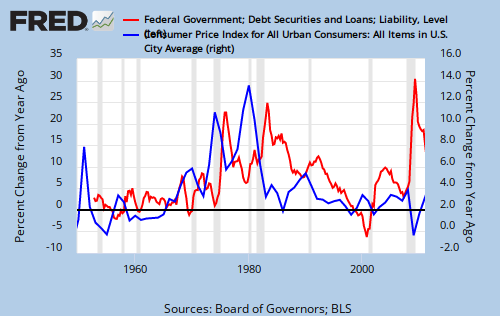
Deficit spending does not cause inflation
In more than 60 years, there has been no relationship between deficit spending and inflation, which today is at a low level.

=====

The following is a brief message to those who claim removing debt from the economy will stimulate economic growth:

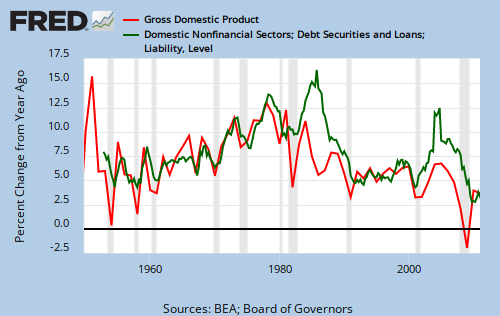
Debt and GDP are parallel
Debt growth and GDP growth parallel.

=====

The following is a brief message to those who feel inflation is a greater, more imminent problem than recession:

Inflation is low; GDP growth is low
Inflation is low; GDP growth is low.

So tell me, what is the greatest threat to our economy?

Rodger Malcolm Mitchell
http://www.rodgermitchell.com


==========================================================================================================================================
No nation can tax itself into prosperity, nor grow without money growth. Monetary Sovereignty: Cutting federal deficits to grow the economy is like applying leeches to cure anemia.

MONETARY SOVEREIGNTY
–Welcome to the United States of Lemming

Those, who do not understand the differences between Monetary Sovereignty and monetary non-sovereignty, do not understand economics.
======================================================================================================================================================================================================================================

Welcome to the United States of Lemming.

Like the proverbial lemmings, who commit suicide by following their leaders off a cliff, our leaders take our nation off an economic cliff and we blindly follow. In the United States of Lemming, there is a myth and there are facts. “Everyone” believes the myth, and “no one” believes the facts.

Here is the myth. The federal deficit and debt are too high, unsustainable, a drag on our economy, a burden on our government and an impediment to economic growth.

Here are the facts:

1. Reduced deficit growth leads to recessions. Look at this graph and tell me when recessions begin and how they are ended:

Recessions begin when deficit growth declines

That’s right. Recessions begin after a series of declines in deficit growth. Recessions end with increases in deficit spending. Now our government again plans to cause the next recession by cutting deficit spending.

Our lemming government leads us over the economic cliff.

2. Federal deficits = net non-federal savings – current account deficit. This is an accounting identity.

The current account = money flowing out the the country. This includes imports above exports (balance of trade), interest paid and foreign aid. For the U.S., the current account almost always is negative, meaning more money flows out of the country than into the country. To keep the domestic money supply from falling, the federal government always must run a deficit.

The rest of the deficit goes to net savings. In simplest terms, net savings are your dollars minus your debt. If you have $1,000 in the bank, but owe $200, your net savings are $800. The only source of net savings is federal government deficits. Without federal deficits, there can be no net savings. This is an accounting fact.

A deficit reduction of $1 trillion = a net savings reduction of $1 trillion for the non-federal sector (you and me). With 300+ million people in America, every $3 trillion in deficit reduction causes a $10,000 loss in each person’s net savings. That’s $10,000 taken out of your pocket, an additional $10,000 taken from your spouse, and $10,000 taken from each of your children. What do you think that will do to our economy and your personal finances?

Our lemming government leads us over the economic cliff.

3. Debt reduction (federal surplus) results in depressions:

1817-1821: U. S. Federal Debt reduced 29%. Depression began 1819.
1823-1836: U. S. Federal Debt reduced 99%. Depression began 1837.
1852-1857: U. S. Federal Debt reduced 59%. Depression began 1857.
1867-1873: U. S. Federal Debt reduced 27%. Depression began 1873.
1880-1893: U. S. Federal Debt reduced 57%. Depression began 1893.
1920-1930: U. S. Federal Debt reduced 36%. Depression began 1929.

The reason is clear. Federal surplus = economic deficit. This too is an accounting identity. Federal debt is a reflection of federal deficits — the amount of money the federal government adds to the economy. For debt to be reduced, not only must deficits be reduced; they must be entirely eliminated. Federal surplus is an extreme form of deficit reduction.

Our current account already draws money from our economy. Combine that draw-down with a federal surplus, which also pulls money from our economy, and you create a massive, economic money loss. Our most recent federal surplus came at the end of the Clinton administration. Because the surplus was brief, it caused only a recession, which was cured by the Bush deficits. Had the surplus lasted longer, it would have caused a depression.

Our lemming government leads us over the economic cliff.

4. In 1971, the U.S. went off the gold standard, and became Monetarily Sovereign.. The purpose and the effect was to give the U.S. the unlimited ability to pay any bills of any size at any time.

To pay a bill, the federal government instructs a creditor’s bank to mark up the creditor’s checking account. This process erroneously is termed “printing money,” but nothing is printed.

When you and I pay a bill, money is transferred from our account to our creditors account. By contrast, when the federal government pays a bill no money is transferred. Instead, the creditor’s checking account is marked up and money is created by the payment of the government’s debt.

Because no money is transferred, no taxes or borrowing are required for the government to send these mark-up instructions. If taxes and borrowing fell to $0 or rose to $100 trillion, neither event would affect by even one penny, the federal government’s ability to pay its bills.

Despite concerns that deficits may cause inflation, historically this has not been the case. The value of money is determined by two factors: supply and demand. Inflation concerns center on increased supply. But increased demand is anti-inflationary. Demand increases when interest rates rise or when the value of goods and services increases. Both effects have been responsible for this graph, showing no relationship between federal deficits and inflation:

Deficits don't cause inflation

Deficit spending has not caused inflation. Yet, for unknown reasons, the federal plan, agreed to by virtually all media, all politicians and all old-line economists, is to cut deficits and reduce the money supply and our savings.

Our lemming government leads us over the economic cliff.

5. “Debt Outstanding Domestic Nonfinancial Sectors” is the measure of all forms of money in the nation. As you can see, this total debt growth parallels Gross Domestic Product, the most commonly used measure of economic growth.

GDP vs debt

By cutting federal deficits, the government will reduce Domestic Nonfinancial Debt which will reduce Gross Domestic Product.

The only way to stop this suicidal march is for each of us to contact the media, contact the politicians, even contact a professor you may know, and give them the facts.

Or, like the mythical lemmings, we can follow the crowd, accept our fate and jump over the recession and depression cliff.

Rodger Malcolm Mitchell
http://www.rodgermitchell.com


==========================================================================================================================================
No nation can tax itself into prosperity, nor grow without money growth. Monetary Sovereignty: Cutting federal deficits to grow the economy is like applying leeches to cure anemia.

MONETARY SOVEREIGNTY