The full text of Adam Schiff’s great speech before the House Intelligence Committee

While Donald Trump was engaged in his usual, grade-school name-calling, by referring to Rep. Adam Schiff as “Little pencil neck Adam Schiff. He has the smallest, thinnest neck I have ever seen.” — and while Trump’s supporters lustily laughed and cheered at that childish reference from the President of the United States —  those same supporters missed hearing one of the great Congressional speeches of our time.

Image result for adam schiff
The day we do think that’s OK, is the day we look back and say, “That is the day America lost its way.”

Long after Trump and his foul-mouthed, lying tirades will be forgotten, Schiff’s speech, before the House Intelligence Committee, will be remembered as a pivotal point in American history, defining a microcosm of where America is today and where America could be tomorrow.

It is a choice between accepting the continuing lying and lawlessness of a President and his criminal associates vs. demanding the constitutional democracy we fought so hard to achieve.

Here is the complete text of Adam Schiff’s marvelous speech, which should be read by every America politician, and every American voter:

My colleagues may think it’s OK that the Russians offered ‘dirt’ on a Democratic candidate for president as part of what was described as the Russian government’s effort to help the Trump campaign. You might think that’s OK.

My colleagues might think it’s OK that when that was offered to the son of the president, who had a pivotal role in the campaign, that the president’s son did not call the FBI, he did not adamantly refuse that foreign help. No, instead that son said that he would ‘love’ the help of the Russians.

You might think it’s OK that he took that meeting.

You might think it’s OK that Paul Manafort, the campaign chair, someone with great experience at running campaigns, also took that meeting. You might think it’s OK that the president’s son-in-law also took that meeting. You might think it’s OK that they concealed it from the public.

You might think it’s OK that their only disappointment after that meeting was that the dirt they received on Hillary Clinton wasn’t better. You might think that’s OK.

You might think it’s OK that when it was discovered, a year later, that they lied about that meeting and said that it was about adoptions. You might think that it’s OK that the president is reported to have helped dictate that lie. You might think that’s OK. I don’t.

You might think it’s OK that the campaign chairman of a presidential campaign would offer information about that campaign to a Russian oligarch in exchange for money or debt forgiveness. You might think that’s OK, I don’t.

You might think it’s OK that that campaign chairman offered polling data to someone linked to Russian intelligence. I don’t think that’s OK.

You might think it’s OK that the president himself called on Russia to hack his opponent’s emails, if they were listening. You might think it’s OK that later that day the Russians, in fact, attempted to hack a server affiliated with that campaign. I don’t think that’s OK.

You might think that it’s OK that the president’s son-in-law attempted to establish a secret back channel of communication with the Russians through a Russian diplomatic facility. I don’t think that’s OK.

You might think it’s OK that an associate of the president made direct contact with the GRU through Guccifer 2.0 and WikiLeaks, that is considered a hostile intelligence agency.

You might think it’s OK that a senior campaign official was instructed to reach that associate and find out what that hostile intelligence agency had to say in terms of dirt on his opponent.

You might think it’s OK that the national security adviser-designate secretly conferred with the Russian ambassador, about undermining U.S. sanctions, and you might think it’s OK that he lied about it to the FBI. You might say that’s all OK. You might say that’s what you need to do to win. But I don’t think it’s OK.

I think it’s immoral. I think it’s unethical. I think it’s unpatriotic. And yes, I think it’s corrupt and evidence of collusion.

Now I have always said that the question of whether this amounts to proof of conspiracy was another matter. Whether the special counsel could prove beyond a reasonable doubt the proof of that crime would be up to the special counsel, and I would accept his decision, and I do.

He is a good and honorable man and a good prosecutor.

But I do not think that conduct, criminal or not, is OK. And the day we do think that’s OK, is the day we look back and say, “That is the day that America lost its way.”

And I will tell you one more thing that is apropos of the hearing today.

I don’t think it’s OK that during the Presidential campaign Mr. Trump sought the Kremlin’s help to consummate a real estate deal in Moscow that would make him a fortune, according to special counsel, hundreds of millions of dollars.

I don’t think it’s OK that he concealed it from the public. I don’t think it’s OK that he advocated a new and more favorable policy toward the Russians even as he was seeking the Russians help – the Kremlin’s help to make money.

I don’t think it’s OK that his attorney lied to our committee.

There’s a different word for that than “collusion,” and it’s called “compromised.”

And that is the subject of our hearing today.

Send a copy to your Senators. Send a copy to your Representative. Send a copy to your friends and relatives. Read it to your children.

It defines what being an American really means.

Rodger Malcolm Mitchell


Trump appointee, Fed Chair Jerome Powell, recommends austerity

It figures.

President Donald J. Trump hired an anti-environment guy to run the Environmental Protection Agency, and an anti-consumer guy to run the Consumer Financial Protection Bureau (followed in that role by an unqualified Peace Corps volunteer), so it figures that he would hire a Fed Chairman who is ignorant about economics.

Here is what Trump’s Fed Chair Jerome Powell told Congress, recently:

The idea that deficits don’t matter for countries that can borrow in their own currency I think is just wrong … U.S. debt is fairly high to the level of GDP — and much more importantly — it’s growing faster than GDP, really significantly faster.

We are going to have to spend less or raise more revenue.

Powell called out “unsustainable” federal debt in his opening remarks. But in response to questions from senators, he emphasized that “decisions about spending and controlling spending and paying for it” are up to Congress, not the Fed.

He didn’t use the word, “austerity,”  but his use of “unsustainable” federal debt, and his comments about, “decisions about spending and controlling spending and paying for it” are right in line with the worst of the austerity sellers.

He apparently is right on board with the Republican “cut-social benefits and raise taxes on the middle-classes” philosophy.

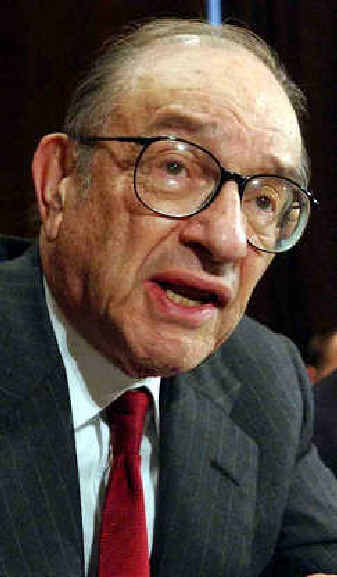
Compare him with previous Chairmen, who though not always stating truth, at least acknowledged it:Image result for greenspan and bernanke

Alan Greenspan: “A government cannot become insolvent with respect to obligations in its own currency.”

Ben Bernanke: “The U.S. government has a technology, called a printing press (or, today, its electronic equivalent), that allows it to produce as many U.S. dollars as it wishes at essentially no cost.”

And as has become the rule with debt nuts, Powell never gives any specific reasons why the deficits are “unsustainable,” or why “controlling and paying for deficits” are necessary. Do you think he learned that at Trump University?

And to top it off, get this:

“Defaulting on these debts—as the hetereodox  macroeconomic theory Modern Monetary Theory (MMT) proposes simply unthinkable,” Powell said.

Oh really? Exactly when did MMT propose defaulting on debts? Not only is that a Trumpian-style lie, but it demonstrates that Powell has no idea what MMT is all about. The man’s ignorance is as shocking as Trump’s.

MMT (like Monetary Sovereignty) specifically says the federal government never will need to default, because it has the unlimited ability to create dollars.

……………………………………………………………………………………………………………………………………………………

And then we come to yet another debt fear-monger, Randy Schultz, a writer for Boca Magazine:

Remember when Republicans cared about budget deficits?

Last week, the government announced that February’s red ink set a monthly record — $234 billion.

In a growing economy, setting an annual deficit record is like having your house go into foreclosure when the family income is $500,000. Something is wrong.

Huh? How is a federal deficit anything “like having your house go into foreclosure”? It’s a completely senseless analogy?

As recently as 2015, the deficit was $438 billion. Yet Republican policies have the deficit on track to be $1.1 trillion for this year. In a growing economy.

For perspective, the deficit was $1.4 trillion in 2009.

Remember, though, that to hold off a second Depression Congress had to pass the $700 billion financial bailout and the $787 billion fiscal stimulus during that budget cycle.

And revenue tanked with the economy. Republicans can’t use calamity as a defense.

Talk about not seeing what is right in front of his nose, Schultz acknowledges that deficit spending — “the $700 billion financial bailout and the $787 billion fiscal stimulus “– held off a second Depression.

Though he admits that deficit spending saved and grew the economy, he decries deficit spending. Amazing.

In fiscal terms, the GOP sinned most notably by passing the 2017 tax cut on a party-line vote in the Senate and a mostly party-line vote in the House. Thirteen GOP House members honorably defected.

Republicans crafted that legislation to please megadonors and corporations.

The plan offered no structural changes to help the economy over time and thus needlessly increased the deficit.

The sin was not the tax cut itself. That is helping to grow the economy. The sin was to cut taxes on the rich, with widened the Gap between the rich and the rest.

President Trump proclaimed that the tax cut would help the middle class. Of course, he also proclaimed that he would lower the trade deficit, which is at a 10-year high.

The president said companies would use tax savings to boost pay and hire more employees. In fact, many large corporations used the money on stock buybacks, which set a record last year after the tax plan became law.

What a surprise. Trump either lied or spoke out of ignorance. Who could have predicted that?

Amid the current fiscal misfeasance, recall that the country ran budget surpluses from 1998 until 2001.

Will someone please mention to Schultz that those budget surpluses led to the recession of 2001?

How austerity kills: Everything below the horizontal black line is a  federal surplus (money flowing out of the economy, i.e austerity). The recession was cured by eliminating the federal surplus (i.e. adding money to the economy). 

Why would a federal budget surplus lead to a recession? Because a federal surplus occurs when the federal government takes more money out of the private sector than it puts in.

One would hope that a Chairman of the Fed would understand that starving the private sector of money leads to recessions. Sadly, one would be disappointed.

In April 2000, Clinton addressed the American Society of Newspaper Editors and mused about the country paying off its debt, which was about $5 trillion. It’s now $22 trillion.

Had the federal government cut spending and increased taxes to take $5 trillion from the economy, we would have slipped into a monster Depression that would have made 1929 look like heaven.

Of course, Schultz doesn’t understand this, but paying off the federal debt need not require a reduction in deficit spending. The government could pay off the debt simply by returning the dollars that are in T-security accounts.

This would not have required deficit reduction, and it actually would have increased liquidity. But why worry about facts?

Deficit reversal began under President George W. Bush. Seeing those surpluses, he proposed a tax cut to “give the people their money back.”

Democrats were complicit in passing that plan, which did no more good than the 2017 tax cut.

No more good” than to increase GDP growth. Otherwise a failure??

For good measure, Republicans in 2003 passed the Medicare prescription drug benefit.

With no payroll taxes or premiums to finance it, Part D adds roughly $100 billion to the deficit.

Part D adds roughly $100 billion to the deficit,” which means the federal government added $100 billion to the nation’s economy. And this is a bad thing??

Last week, Federal Reserve Chairman Lawrence Powell said, “Deficits matter.” But he sounds like the housemother trying to break up the frat party.

No, he sounds like either a damn fool, who doesn’t understand economics, or like a liar who doesn’t want the public to learn the truth.

A few adults are around. Speaker Nancy Pelosi faced down an attempt by young, ultra-liberal Democrats to reject “PAYGO” – offsetting new spending with tax increases or cuts.

House Democrats have presented a sensible plan to shore up Social Security. Some Senate Republicans have offered ideas to reduce the deficit.

In the above two paragraphs, we are told that the “young, ultra-liberal Democrats” understand economics and want to help the economy grow, while the “House Democrats” would rather promulgate the Big Lie, that federal spending is funded by federal taxes.

Though Republicans once chided Democrats as “tax and spend liberals,” they abdicated on fiscal policy years ago.

Now the chaperones outdrink everyone.

More like the debt scare-mongers want everyone to drink the austerity Koolaid.

Pitiful.

Rodger Malcolm Mitchell
Monetary Sovereignty
Twitter: @rodgermitchell
Search #monetarysovereigntyFacebook: Rodger Malcolm Mitchell

…………………………………………………………………………………………………………………………………………………………………………………………………………………………………………………………………………………………..

The most important problems in economics involve the excessive income/wealth/power Gaps between the richer and the poorer.

Wide Gaps negatively affect poverty, health and longevity, education, housing, law and crime, war, leadership, ownership, bigotry, supply and demand, taxation, GDP, international relations, scientific advancement, the environment, human motivation and well-being, and virtually every other issue in economics.

Implementation of The Ten Steps To Prosperity can narrow the Gaps:

Ten Steps To Prosperity:

1. Eliminate FICA

2. Federally funded medicare — parts a, b & d, plus long-term care — for everyone

3. Provide a monthly economic bonus to every man, woman and child in America (similar to social security for all)

4. Free education (including post-grad) for everyone

5. Salary for attending school

6. Eliminate federal taxes on business

7. Increase the standard income tax deduction, annually. 

8. Tax the very rich (the “.1%) more, with higher progressive tax rates on all forms of income.

9. Federal ownership of all banks

10. Increase federal spending on the myriad initiatives that benefit America’s 99.9% 

The Ten Steps will grow the economy, and narrow the income/wealth/power Gap between the rich and you.

MONETARY SOVEREIGNTY


Translating the absurd. Does having less money make the nation wealthier?

The Mueller /Barr report did not cover: Trump’s secret taxes, excusing Nazis and white supremacists, the fake Trump Foundation, the fake Trump University, paying Stormy Daniels et al, groping women, obstruction of justice, loving dictators Putin and Kim, phony loans from Deutsche Bank, Donald Trump, Jr., Jared Kushner, inauguration committee, emoluments, security clearances, 10,000 lies, Trump’s refusal to testify under oath, nepotism, secret Saudi deals, campaign expenses, Trump Tower Moscow, secret meetings with Putin, and the GOP’s trying to keep the “exonerating” report a secret.

So, now that all those things are forgotten by the press, by the public and especially by the GOP, we can return to the federal budget.

……………………………………………………………………………………………………………………………………………………..

Image result for ben bernanke
Ben Bernanke: “The U.S. government has a technology, called a printing press (or, today, its electronic equivalent), that allows it to produce as many U.S. dollars as it wishes at essentially no cost.”

The following is yet another misleading article, meant to make you think the Monetarily Sovereign federal budget is like your monetarily non-sovereign household budget.

(The idea is to get you to accept reductions in such federal benefits as Medicare, Medicaid, Social Security and other aids important to the non-rich.)

A translation of each section follows immediately after the section.

February’s Budget Deficit Was the Largest in American History
The feds are $234 billion in the red. Looking for hope? Sen. Mike Enzi has some ideas.
Eric Boehm, Mar. 25, 2019

The Treasury announced Friday that the federal government spent $234 billion more than it brought in during February, breaking the record for the largest monthly budget deficit.

Translation: In February, the federal government added more stimulus dollars to the U.S. economy than ever — $234 billion in economic stimulus.

Barack Obama’s Treasury Department set the previous record in February 2012 , with a deficit of $231 billion.

At that time, President Obama anticipated $1 trillion annual deficits for the rest of the decade 

Translation: Barack Obama’s government set the previous record in February 2012, by pumping $231 into the economy, which was necessary grow the economy after the Great Recession of 2008.

At that time, President Obama anticipated $1 trillion annual private sector surpluses for the rest of the decade —almost identical to the projections offered by Donald Trump in his 2019 budget proposal, delivered earlier this month..

That Obama budget was roundly criticized by Republicans in Congress, who railed against the president’s “failure to control spending.”

Obama’s record deficit helped organize Republican policymaking around plans to cap spending growth and balance the budget.

The Republican Congress slowed the growth in government spending and as a recovering economy boosted tax returns.

Image result for alan greenspan
Alan Greenspan: “A government cannot become insolvent with respect to obligations in its own currency.”

Translation: That Obama budget was roundly criticized by Republicans in Congress, who railed against the president’s “failure to impose austerity on the economy.” 

Obama’s record money creation helped organize Republican policymaking around plans to cap economic growth by balancing the budget. 

The Republican Congress slowed money growth, which starved the recovering private sector of dollars.

The current record-high deficit is largely the fault of the same Republicans who once attacked Obama for spending too much.

Translation: The current record-high private sector is largely the success of the same Republicans who once attacked Obama for giving the private sector too much.

According to an analysis from the nonpartisan Committee for a Responsible Federal Budget, about 60 percent of this year’s expected deficit is the result of policies—mostly last year’s huge increase in spending that shattered those Obama-era budget caps—put in place by current legislators and signed by the current president.

Translation: According to an analysis from the extremely partisan Committee for a Responsible Federal Budget, about 60 percent of this year’s expected economic growth is the result of policies—mostly last year’s huge increase in spending that shattered those Obama-era growth caps—put in place by current legislators and signed by the current president.

They can’t blame a recession. They can’t blame Obama. After years of solid if not mind-blowing growth, the budget deficit should be shrinking, not expanding.

Failing to fix the budget now will have consequences for years to come.

Over the next 30 years, Social Security and Medicare are expected to run a combined $100 trillion deficit.

Image result for federal reserve bank
St. Louis Federal Reserve: “As the sole manufacturer of dollars, whose debt is denominated in dollars, the U.S. government can never become insolvent, i.e.,unable to pay its bills. In this sense, the government is not dependent on credit markets to remain operational.

Translation: They can’t credit the recession. They won’t credit Obama. After years of solid if not mind-blowing growth, the stimulus should be expanding, not shrinking.

Failing to increase the budget now will have consequences for years to come.

Over the next 30 years, Social Security and Medicare are expected to run a combined $100 trillion deficit, that the federal government can and should pay for.

If you’re looking for a glimmer of hope, it might be found in the budget plan recently released by Senate Budget Committee Chairman Mike Enzi (R–Wyo.).

Translation: If you’re looking for a flash of terror, it might be found in the budget plan recently released by Senate Budget Committee Chairman Mike Enzi (R–Wyo.).

Enzi’s budget is supposed to reduce the deficit by $538 billion over five years by cutting spending—and also, alas, by projecting probably unrealistic economic growth in the next half-decade.

Translation: Enzi’s budget is supposed to reduce the economic stimulus by $538 billion over five years by cutting spending—and also, alas, by projecting probably unrealistic economic growth (because of Enzi’s disastrous austerity) in the next half-decade.

His proposal includes cuts to Medicare and Medicaid, which make up more than 60 percent of the federal budget in a single year.

Enzi’s proposal is a serious attempt to bring the deficit back under control, even though it would not balance the budget.

Translation: His proposal includes cuts to Medicare and Medicaid, which make up more than 60 percent of the federal budget in a single year. The rich always look for ways to cut benefits to the middle classes and the poor.

Enzi’s proposal is a serious attempt to widen the Gap between the rich and the rest, even though it might not completely destroy the middle- and poorer classes. 

…………………………………………………………………………………………………………………………………………………….

In Economics, everything devolves to Monetary Sovereignty and Gap Psychology.

  1. Economics studies the relationships among wealth, money, and human psychology.
  2. Monetary Sovereignty studies a money issuer’s power over the money it issues.
  3. Gap Psychology describes the human desire to widen the Gap below you on any economic or social measure, and to narrow the Gap above you.

The very rich control American politics. They never stop trying to widen the Gap between them and you.

Essential to that effort is convincing you of the lies that federal “debt” (deposits into T-security accounts) and “deficits” (private sector surpluses) are a threat to the U.S. economy and to future taxpayers.

The rich want you to accept the false notion that your federal benefits should be cut.

So long as their misstatements work, they will continue to promulgate those lies, and indeed, your benefits will be cut.

Only when you first understand the facts, and then protest the lies, will you be safe from the rich.

Rodger Malcolm Mitchell
Monetary Sovereignty
Twitter: @rodgermitchell
Search #monetarysovereigntyFacebook: Rodger Malcolm Mitchell

…………………………………………………………………………………………………………………………………………………………………………………………………………………………………………………………………………………………..

The most important problems in economics involve the excessive income/wealth/power Gaps between the richer and the poorer.

Wide Gaps negatively affect poverty, health and longevity, education, housing, law and crime, war, leadership, ownership, bigotry, supply and demand, taxation, GDP, international relations, scientific advancement, the environment, human motivation and well-being, and virtually every other issue in economics.

Implementation of The Ten Steps To Prosperity can narrow the Gaps:

Ten Steps To Prosperity:

1. Eliminate FICA

2. Federally funded medicare — parts a, b & d, plus long-term care — for everyone

3. Provide a monthly economic bonus to every man, woman and child in America (similar to social security for all)

4. Free education (including post-grad) for everyone

5. Salary for attending school

6. Eliminate federal taxes on business

7. Increase the standard income tax deduction, annually. 

8. Tax the very rich (the “.1%) more, with higher progressive tax rates on all forms of income.

9. Federal ownership of all banks

10. Increase federal spending on the myriad initiatives that benefit America’s 99.9% 

The Ten Steps will grow the economy, and narrow the income/wealth/power Gap between the rich and you.

MONETARY SOVEREIGNTY


Irony of ironies: How two Johns saved the Republican Party

Each day, Donald Trump demonstrates his character by disparaging some American, while professing love for a murderous dictator. Recently, the focus of his ire has been Senator John McCain, a man deceased for months, unable to fight back — the perfect victim for a coward.

Though some may debate whether Senator John McCain was, or was not, a “war hero,” there is a certain irony in a “bone-spur,” draft dodger claiming that a fighting soldier is not a hero simply because he was captured and tortured for five years.

Image result for wounded john mccain soldier
John McCain

Clearly, neither Trump nor his followers understand that irony nor the irony of Trump’s other reason for hating the long-deceased McCain:

McCain’s decision to vote down the health care bill sponsored by Trump’s friend Sen. Lindsey Graham, R-S.C. That bill, which would have passed had McCain supported it, would have destroyed the Affordable Care Act (ACA), also known as “Obamacare.”

They do not see the irony of Trump’s claim that McCain “. . . was horrible, what he did with repeal and replace (of Obamacare) . . . what he did to the Republican Party and to the nation and to sick people that could have had great healthcare was not good.”

What Trump and his followers neither understand nor will not admit that with that vote, Republican John McCain saved the Republican Party and Trump’s Presidency.

In similar fashion, right-wing, Chief Justice, John Roberts, did the same:

Roberts had left behind a storm in Washington over his opinion upholding President Barack Obama’s health-care overhaul — the Affordable Care Act — a stunning validation of Obama’s signature domestic achievement that transformed public perceptions of the chief justice.Republicans in Congress had been fighting the law dubbed Obamacare at every turn for two years, and all the GOP presidential candidates in 2012 had vowed to repeal it.And now Roberts, a nominee of President George W. Bush, had saved it.

How did these two men save the Republican Party and Trump’s Presidency by voting against the Republican Party and Trump?

Because in their zeal to repeal all things Obama, the Republicans and Trump neglected to develop a “replace” that reduced or eliminated many of the coverages of the  ACA. For example (from BBC):

  • ObamacareRequires all insurance plans to cover certain health conditions and services, such as emergency room visits, maternity and postnatal care, cancer treatment, annual physical exams, prescription drug costs and mental health counselling.

Republican plan: States may apply for waivers that allow them to end mandatory coverage of certain health conditions, such as vision and dental care for children, hospital care, and outpatient services. States that receive such waivers could allow insurers to set a maximum amount they will pay for an individual’s medical services – a practice that Obamacare had prohibited.

  • ObamacareProhibits insurers from denying coverage or charging more to individuals who have pre-existing medical conditions.

Republican plan: Gives states the ability to opt-out of requirements that insurers charge the same premiums for healthy and sick customers.

  • ObamacareExpanded Medicaid health insurance for the poor to cover more low-income individuals.

Republican plan: “Block grants” that are capped based on a state’s population and whose growth is limited. 34 states would see reduced government support for Medicaid and tax subsidies for individuals purchasing health insurance.

  • Obamacare: Insurers can charge older Americans no more than three times the cost for younger Americans

Republican plan: States can receive waivers to allow them to charge older Americans more.

In short, the Republican plan offered fewer benefits and dumped many of the costs onto the monetarily non-sovereign states, which must increase taxes if they are to afford to improve health care support.

(By contrast, the federal government, being Monetarily Sovereign, has the unlimited ability to create dollars, and can support any health care plan without raising taxes.)

The Republicans actually had years in which to come up with a suitable and superior replacement, and they failed. Trump, of course, did nothing other than to tell the Party that he was waiting “pen in hand.”

Since any replacement would involve more than a single sheet of paper, Trump’s lack of reading, writing, or comprehension skills did not allow him to participate.

So had the Republicans succeeded, they would have failed. That is, by destroying Obamacare, and leaving millions of people without affordable health care, they would have turned the vast majority of the nation against the right-wing.

Today, they are left in the politically enviable political position of being able to stand on the outside and throw rocks, without having done a single positive thing to help the masses receive health care.

And it was the two Johns, McCain and Roberts, who gave them that ironic gift.

Meanwhile, the Democrats failed by succeeding. They receive scant credit for saving Obamacare, and they saved the Republicans from disaster.

Instead, they now must fight the “Medicare for All” battle, and once again the Republicans with throw “socialism” stones without offering a good alternative plan.

Always be careful what you wish for, boys.

Rodger Malcolm Mitchell
Monetary Sovereignty
Twitter: @rodgermitchell
Search #monetarysovereigntyFacebook: Rodger Malcolm Mitchell

…………………………………………………………………………………………………………………………………………………………………………………………………………………………………………………………………………………………..

The most important problems in economics involve the excessive income/wealth/power Gaps between the richer and the poorer.

Wide Gaps negatively affect poverty, health and longevity, education, housing, law and crime, war, leadership, ownership, bigotry, supply and demand, taxation, GDP, international relations, scientific advancement, the environment, human motivation and well-being, and virtually every other issue in economics.

Implementation of The Ten Steps To Prosperity can narrow the Gaps:

Ten Steps To Prosperity:

1. Eliminate FICA

2. Federally funded medicare — parts a, b & d, plus long-term care — for everyone

3. Provide a monthly economic bonus to every man, woman and child in America (similar to social security for all)

4. Free education (including post-grad) for everyone

5. Salary for attending school

6. Eliminate federal taxes on business

7. Increase the standard income tax deduction, annually. 

8. Tax the very rich (the “.1%) more, with higher progressive tax rates on all forms of income.

9. Federal ownership of all banks

10. Increase federal spending on the myriad initiatives that benefit America’s 99.9% 

The Ten Steps will grow the economy, and narrow the income/wealth/power Gap between the rich and you.

MONETARY SOVEREIGNTY