Cameron Craig: “Libertarians are non-interventionists and strong advocates for property rights, free immigration, legalizing all drugs and prostitution.
“Libertarians are against taxes, any form of social benefits and believe everyone must pull themselves up by their own bootstraps.
“The core tenet of libertarianism is that one’s liberty and right to own property should never be infringed upon.
Reason.com, is a voice of Libertarianism. Read what they say about the National “Debt.”

Hey, Nancy Pelosi: ‘National Debt Should Be a Top Priority’
A bipartisan group of lawmakers are calling for two deficit-reduction ideas to be included in this year’s federal budget bill.
ERIC BOEHM | 2.23.2022 2:40 PM
Immediately, you see that Eric Boehm is spouting ignorance, and I’m not referring to his incorrect use of “are” rather than “is.”
The national “debt” isn’t a priority; it shouldn’t even be a mild concern.
In fact,
it’s not “debt.”
It’s the total of
deposits into Treasury security accounts, which resemble interest-paying, bank safe-deposit boxes.
When you invest in a T-bill, T-note, or T-bond, you deposit
your dollars into
your T-security account.
The federal government neither needs, uses, nor touches your dollars, and when your account matures, your dollars are sent back to you.
No tax dollars are involved.
As with the contents of safe-deposit boxes, the government doesn’t owe anyone the deposits in T-security accounts. Neither do you owe them. Nor do your grandchildren owe them. They are not a financial burden on anyone or anything.
So why would a thinking person tell you they are a “priority”?
And as for so-called “deficits,” they represent the net growth dollars our
Monetarily Sovereign government pumps into the economy.
The U.S. government
has infinite dollars to give; the economy
needs growth dollars in order to grow. Without federal “deficits” we have recessions and depressions, all of which are cured by “deficits.”

Recessions (vertical bars) follow REDUCTIONS in deficit growth. Recessions are cured by INCREASES in deficit growth.
Mr. Boehm’s article begins with faulty premises, and only goes downhill from there. He asks:
How are we actually going to pay for all this?
“We” (you, and I, and the government) are not going to pay for “all this.” As each T-security account reaches maturity, the dollars that reside in those accounts will be transferred to the owners’ checking accounts, upon request.
It’s a simple dollar transfer. No new dollars are needed.
And even if the federal government did owe the money, it has infinite dollars with which to pay any financial obligation.
Mr. Boehm’s (and the rest of the Libertarians’) deficit/debt concern is based on
the Big Lie that federal finances resemble state/local government finances and personal finances.
But the federal government uniquely is
Monetarily Sovereign, while you, all local governments and all businesses are monetarily non-sovereign.
The Libertarians don’t want you to understand that a Monetarily Sovereign entity never unintentionally can run short of its own sovereign currency. Even if the federal government collected $0 taxes, it could continue spending, forever.
(The purpose of federal taxes is not to finance spending. The purpose is to control the economy. Taxes discourage what the government doesn’t want, and tax breaks encourage what the government does want.)
The federal government does not borrow dollars. The so-called “national debt” is not a debt to be repaid.
In a letter sent on Tuesday, 24 members of the House of Representatives called on Speaker of the House Nancy Pelosi (D–Calif.) to take some small but important steps to rein in America’s out-of-control national debt.
The misnamed “national debt” (that isn’t a debt), also isn’t “out of control” and doesn’t need to be “reined in.” The federal government controls to the penny, how many T-security dollars to accept
from the public.
To prevent the public’s T-security account deposits from growing higher than desired, the federal government can lower interest rates. That discourages further deposits.
Or the Federal Reserve can use its infinite dollar-creation abilities to take the public’s place (what the uninformed would term “borrowing from itself.”)
Similarly, if in its wisdom, the Federal Reserve decides deposits should be higher, it can increase interest rates, or again, the Federal Reserve can increase deposits.
The source of Mr. Boehm’s disinformation is
the wrongheaded belief that the federal government borrows when its tax income is insufficient to pay its bills.
That “income vs. borrowing” scenario is true of state and local governments. It also is true of businesses. And it is true of you and me. We borrow when cash at hand is insufficient.
It is not true of our Monetarily Sovereign, U.S. federal government. It has infinite cash at hand.
Here is what knowledgeable people say about Monetary Sovereignty:
Alan Greenspan: “A government cannot become insolvent with respect to obligations in its own currency.”
Ben Bernanke: “The U.S. government has a technology, called a printing press (or, today, its electronic equivalent), that allows it to produce as many U.S. dollars as it wishes at essentially no cost.”
Quote from Ben Bernanke when, as Fed chief, he was on 60 Minutes:
Scott Pelley: Is that tax money that the Fed is spending?
Ben Bernanke: It’s not tax money… We simply use the computer to mark up the size of the account.
Statement from the St. Louis Fed:
“As the sole manufacturer of dollars, whose debt is denominated in dollars, the U.S. government can never become insolvent, i.e., unable to pay its bills. In this sense, the government is not dependent on credit markets to remain operational.”
Press Conference: Mario Draghi, President of the ECB, 9 January 2014
Question: I am wondering: can the ECB ever run out of money?
Mario Draghi: Technically, no. We cannot run out of money.
Messrs. Greenspan, Bernanke, and Draghi, and the St. Louis Fed, were describing Monetary Sovereignty, the
unlimited ability of a Monetarily Sovereign entity to create its own sovereign currency.
The U.S. government not only has this unlimited ability, but it also has the unlimited ability to determine, by fiat,
the value of the U.S. dollar, an ability it has exercised many times over the years, when fixing the dollar to varying amounts of silver and gold.
Thus, the U.S. federal government has the
absolute power to control inflation.
So why do T-bills, T-notes, and T-bonds even exist?
The federal government’s spending and income are recorded in what is known as the “
General Fund.”
It’s not really a “fund.” It’s just a bookkeeping record. But for historical reasons, having to do with a young nation needing acceptance for its money, this record is
not allowed to have a negative balance.
It’s an obsolete law. There is no current reason why the General Fund, or any bookkeeping item can’t have a negative balance. But the convoluted workaround for this obsolete law is to pretend to borrow by issuing Treasury securities, and allowing the public to invest in them, with the balance being purchased by the government itself.
It’s all bookkeeping hocus-pocus, to satisfy an obsolete set of rules, originally designed to prevent what mathematically cannot ever happen: Unintended federal insolvency.
Today, the
functional purpose for issuing T-securities is to provide a safe interest-paying parking place for unused dollars, which helps to stabilize the value of the U.S. dollar.
The letter highlights the fact that policies enacted during the past five years—including pandemic relief, but also “Congress’ perennially broken budget process and fiscal policies”—have added $13 trillion to the projected levels of debt in 2031, at the end of the 10-year window Congress uses for budgeting.
Mr. Boehm is referring to $13 trillion federal growth dollars, without which the economy would fall into the deepest depression in world history.
“It has been over a decade since Congress enacted any legislation that significantly addressed these longstanding structural problems or improved the nation’s fiscal outlook,” the lawmakers wrote to Pelosi.
“Our national debt should be a top priority for both parties and addressed on a bipartisan basis.”
The misnamed “debt” neither is a structural problem, nor a “priority,” and it has nothing to do with a “fiscal outlook.” It’s all lies.
Yes, the letter represents the view of just 24 of the House’s 435 members. Still, any discussion of the debt and the need to address it is welcome.
It is encouraging that only 24 of the House’s 435 members are misinformed or dishonest enough to sign such a letter.
The Congressional Budget Office (CBO) now forecasts that the debt will be twice the size of the economy by 2051, while the Government Accountability Office (GAO) predicts that the debt will grow to four times the size of America’s economy before the end of the century.
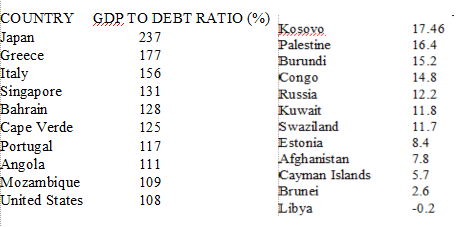
Here, Mr. Boehm referred to the most ridiculous, nonsensical, meaningless ratio in all of economics: The debt/GDP ratio. It is a ratio that says nothing about the health of the economy (see
Debt to GDP Ratio by Country 2022). It is a ratio that predicts nothing.
It isn’t even mathematically logical, because it describes different time sequences. “Debt” is the net accumulation of deficits during the
past two centuries, while GDP refers to
one year.
“U.S. fiscal policy today is not sustainable,” argue Veronique de Rugy and Jack Salmon, researchers at the Mercatus Center, a free market think tank, in a new report published Wednesday.
“Not only is our debt ratio at the highest level in peacetime history, but also our future budgetary outlook is even bleaker.”
The two researchers from the Libertarian Mercatus Center imply that the federal government can run short of its own sovereign currency, a fiscal impossibility. And the
“not sustainable” trope has been disseminated, without evidence, since at least 1940.
See:
“Your periodic reminder. After 80 years, the federal debt still is a ‘ticking time bomb.’
Libertarians were wrong then. They are wrong now. The federal “debt,” far from being a priority, or a problem or a burden on future generations, is an absolute necessity for economic growth — the larger the “debt” (i.e. net deficits), the faster the growth.
Perhaps it was the symbolic $30 trillion debt threshold that has prompted some lawmakers to call on Pelosi to take action.
But another factor is the high levels of inflation America is currently experiencing.
As Reason has previously explained, inflation and high debt create a trap for policymakers: higher inflation could lead the Federal Reserve raise interest rates, which would increase the payments owed on the debt.
Because Libertarians seem to think that
all federal spending is excessive, the notion that the federal government would pay more interest into the economy upsets them.
In reality however,
there is no downside to increased federal interest. The government has infinite dollars, and the economy benefits from additional dollars.
Contrary to the Libertarian philosophy of ignorance, federal spending is stimulative, and also contrary to popular wisdom,
not inflationary.
Inflations never are caused by “too much money.” Inflations
always are caused by shortages of key goods and services. Those shortages, and the resultant inflation, can be cured by
increased federal spending to encourage the availability of the scarce goods and services.
Today’s inflation is an example: Current shortages of oil, computer chips, food, shipping, and lumber can be cured by federal aid to oil production, computer chips, farming, and lumber.
Current shortages of labor can be cured by the elimination of FICA and income taxes, which serve only to reduce the reward for work.
Fighting inflation with deficit reduction, would lead to recession.
Regardless of the reasons, the 24 lawmakers who signed this week’s letter are asking for two policies that are the lowest of low-hanging fruit.
First, they are seeking the creation of a bipartisan debt commission, similar to one implemented during President Barack Obama’s first term that helped trigger modest reductions in annual budget deficits following the Great Recession.
I’m not sure what economy Mr. Boehm lives in, but the Great Recession was cured by
massive increases in federal deficit spending, which then returned to average levels, only to rise again to combat COVID.
Mr. Boehm closes his article with a summary of ignorance and disinformation:
Lawmakers are asking Pelosi to include in the budget changes to how the debt ceiling operates.
The proposed changes would allow the president to unilaterally lift the debt limit as long as Congress has passed a budget resolution that contains certain debt-reduction measures for the current year.
Raising the debt ceiling is not the same as adding to the debt. The debt ceiling merely authorizes the Treasury to borrow funds to pay for spending already approved by Congress.
Objections to increasing the debt ceiling amount to little more than a refusal to pay overdue credit card bills—a temper tantrum that doesn’t address the actual problem of overspending.
Mr. Boehm is correct that the debt ceiling doesn’t address anything, much less the mythical problem of “overspending.” Rather than recommending the end of this laughable anachronism, Mr. Boehm supports Presidential fiddling with the debt ceiling:
“(Deficit cuts) . . . won’t fix America’s fiscal mess, but they are “commonsense ideas” that “would be important steps in the right direction,” according to the Committee for a Responsible Federal Budget, a nonpartisan group that advocates for reducing the deficit.
And they are steps that the country will have to take, sooner or later. “We owe it to our children,”the lawmakers wrote to Pelosi, “to acknowledge our country’s unsustainable fiscal trajectory and work together, across the aisle, to address it over time.”
Yes, Boehm delivers a final dose of utter BS. The ideas neither are
“commonsense” nor are they
“important steps in the right direction.”
Our children do not owe, nor will they pay for the federal “debt.” Instead, if the debt is reduced
our children will be punished by the resultant recessions and depressions.
And, the country’s “fiscal trajectory” (presumably, he means rising “debt”) is not “unsustainable.” It’s necessary. Here is what happens whenever we reduce the “debt.”
1804-1812: U. S. Federal Debt reduced 48%. Depression began 1807.
1817-1821: U. S. Federal Debt reduced 29%. Depression began 1819.
1823-1836: U. S. Federal Debt reduced 99%. Depression began 1837.
1852-1857: U. S. Federal Debt reduced 59%. Depression began 1857.
1867-1873: U. S. Federal Debt reduced 27%. Depression began 1873.
1880-1893: U. S. Federal Debt reduced 57%. Depression began 1893.
1920-1930: U. S. Federal Debt reduced 36%. Depression began 1929.
1997-2001: U. S. Federal Debt reduced 15%. Recession began 2001.
Libertarians are the kissin’ cousins of Republican conservatives. Birds fly. Fish swim. Libertarians lie. Apparently, those are three constants in nature.
Why do the Libertarians lie about the federal “debt”?
Go back to one of the tenets of Liberalism:
“Libertarians are against taxes, any form of social benefits and believe everyone must pull themselves up by their own bootstraps.“
Libertarians want the federal “debt” reduced, and the easiest way to accomplish that is to
cut such social benefits as Medicare, Social Security, Medicaid, poverty aids, etc.
Rather than complain about social benefits, which the populace loves (and the government has the infinite ability to provide), Libertarians find it easier to complain about so-called “debt” and deficits.
By convincing the public that “debt” and deficits must be cut, the Libertarians are able to justify cutting benefits to the middle- and lower-income groups.
It’s the backdoor way of making the rich richer by widening the Gap between the rich and the rest.
Thus,
Libertarians are Republicans in disguise, pretending to be a middle-ground compromise between liberals and conservatives, but in fact, being as right wing, pro-rich, anti-middle, anti-poor as any Republican,
perhaps more so.
[Why would any sane person take dollars from the economy and give them to a federal government that has the infinite ability to create dollars?]
Rodger Malcolm Mitchell
Monetary Sovereignty
Twitter: @rodgermitchell
Search #monetarysovereignty
Facebook: Rodger Malcolm Mitchell
……………………………………………………………………..
THE SOLE PURPOSE OF GOVERNMENT IS TO IMPROVE AND PROTECT THE LIVES OF THE PEOPLE.
The most important problems in economics involve:
- Monetary Sovereignty describes money creation and destruction.
- Gap Psychology describes the common desire to distance oneself from those “below” in any socio-economic ranking, and to come nearer those “above.” The socio-economic distance is referred to as “The Gap.”
Wide Gaps negatively affect poverty, health and longevity, education, housing, law and crime, war, leadership, ownership, bigotry, supply and demand, taxation, GDP, international relations, scientific advancement, the environment, human motivation and well-being, and virtually every other issue in economics. Implementation of Monetary Sovereignty and The Ten Steps To Prosperity can grow the economy and narrow the Gaps:
Ten Steps To Prosperity:
- Eliminate FICA
- Federally funded Medicare — parts A, B & D, plus long-term care — for everyone
- Social Security for all
- Free education (including post-grad) for everyone
- Salary for attending school
- Eliminate federal taxes on business
- Increase the standard income tax deduction, annually.
- Tax the very rich (the “.1%”) more, with higher progressive tax rates on all forms of income.
- Federal ownership of all banks
- Increase federal spending on the myriad initiatives that benefit America’s 99.9%
The Ten Steps will grow the economy and narrow the income/wealth/power Gap between the rich and the rest.
MONETARY SOVEREIGNTY
 Or is the need to cut the federal debt just a Common Myth?
Economics is filled with Common Myths that have no basis in data. For example:
Common Myth: The federal government should handle its finances like you and me.
Reality: In the beginning of the U.S., the federal government created laws from thin air, and some of those laws created the U.S. dollar from thin air.
There was, and remains, no limit to the number of laws the government can create, just as there was, and remains, no limit to the number of dollars the government can create.
This fact is known as “Monetary Sovereignty.“
Unlike state and local governments, unlike businesses, and unlike you, and me, the federal government cannot unintentionally run short of its own sovereign currency, the U.S. dollar. The U.S. federal government has available to it, infinite dollars.
The government creates dollars ad hoc, by paying its bills. The more bills the government pays, the more dollars it creates.
To pay a creditor, the government sends instructions, in the form of checks or wires (“Pay to the order of”), to each creditor’s bank, instructing the bank to increase the balance in the creditor’s checking account.
The instant the creditor’s bank obeys those instructions, new dollars are created and added to the M1 money-supply measure.
Common Myth: The federal debt should be reduced.
Reality: The federal “debt” is not a debt of the federal government or of taxpayers. It is not even a debt. It is the total of deposits into Treasury security accounts.
These accounts resemble safe-deposit accounts, the contents of which our government, being Monetarily Sovereign and having the infinite ability to create its own sovereign currency, never needs or touches.
Just as the contents of your bank safe deposit box are not your bank’s debt, the contents of T-security accounts are not the government’s debts. They are dollars you own in your T-security account that eventually you will transfer to your checking account.
The notion of the government struggling to reduce the debt is ludicrous. Not only does the federal government have absolute control over the amount of deposits in T-security accounts, but there is no reason to reduce these deposits.
They are not a burden on the government or on future taxpayers.
Common Myth: Taxpayers or your grandchildren will be liable for paying off the debt.
Reality: When you invest in a T-bill, T-note, or T-bond, you take dollars from your checking account and deposit them into your Treasury Security account. There your dollars remain, accumulating interest until account maturity, at which time your dollars are returned to you.
The federal government does not remove those dollars for any purposes.
Returning your dollars is no burden on the government or on future taxpayers. No tax dollars are involved. Your grandchildren will not pay for the federal “debt.”
To pay off the “debt,” (which isn’t a debt) the dollars in your T-security accounts simply are returned to you. It is a simple money transfer from your T-security account to your checking account.
Common Myth: When federal taxes are not sufficient to pay for things, the federal government borrows dollars via T-bills, T-notes, and T-bonds.
Reality: The federal government never borrows. The purpose of T-securities is not to provide spending money. Rather, the sole purposes of T-security accounts are to:
1. Provide a safe, interest-paying place to store unused dollars. This helps stabilize the dollar.
2. Help the Fed control interest rates by setting the rates of interest the government pays into T-security accounts.
Common Myth: Reducing the debt would be fiscally prudent.
Reality: By law, the federal “debt” matches the net total of federal deficit spending. Because federal deficits add dollars to the economy, they are economically stimulative.
Or is the need to cut the federal debt just a Common Myth?
Economics is filled with Common Myths that have no basis in data. For example:
Common Myth: The federal government should handle its finances like you and me.
Reality: In the beginning of the U.S., the federal government created laws from thin air, and some of those laws created the U.S. dollar from thin air.
There was, and remains, no limit to the number of laws the government can create, just as there was, and remains, no limit to the number of dollars the government can create.
This fact is known as “Monetary Sovereignty.“
Unlike state and local governments, unlike businesses, and unlike you, and me, the federal government cannot unintentionally run short of its own sovereign currency, the U.S. dollar. The U.S. federal government has available to it, infinite dollars.
The government creates dollars ad hoc, by paying its bills. The more bills the government pays, the more dollars it creates.
To pay a creditor, the government sends instructions, in the form of checks or wires (“Pay to the order of”), to each creditor’s bank, instructing the bank to increase the balance in the creditor’s checking account.
The instant the creditor’s bank obeys those instructions, new dollars are created and added to the M1 money-supply measure.
Common Myth: The federal debt should be reduced.
Reality: The federal “debt” is not a debt of the federal government or of taxpayers. It is not even a debt. It is the total of deposits into Treasury security accounts.
These accounts resemble safe-deposit accounts, the contents of which our government, being Monetarily Sovereign and having the infinite ability to create its own sovereign currency, never needs or touches.
Just as the contents of your bank safe deposit box are not your bank’s debt, the contents of T-security accounts are not the government’s debts. They are dollars you own in your T-security account that eventually you will transfer to your checking account.
The notion of the government struggling to reduce the debt is ludicrous. Not only does the federal government have absolute control over the amount of deposits in T-security accounts, but there is no reason to reduce these deposits.
They are not a burden on the government or on future taxpayers.
Common Myth: Taxpayers or your grandchildren will be liable for paying off the debt.
Reality: When you invest in a T-bill, T-note, or T-bond, you take dollars from your checking account and deposit them into your Treasury Security account. There your dollars remain, accumulating interest until account maturity, at which time your dollars are returned to you.
The federal government does not remove those dollars for any purposes.
Returning your dollars is no burden on the government or on future taxpayers. No tax dollars are involved. Your grandchildren will not pay for the federal “debt.”
To pay off the “debt,” (which isn’t a debt) the dollars in your T-security accounts simply are returned to you. It is a simple money transfer from your T-security account to your checking account.
Common Myth: When federal taxes are not sufficient to pay for things, the federal government borrows dollars via T-bills, T-notes, and T-bonds.
Reality: The federal government never borrows. The purpose of T-securities is not to provide spending money. Rather, the sole purposes of T-security accounts are to:
1. Provide a safe, interest-paying place to store unused dollars. This helps stabilize the dollar.
2. Help the Fed control interest rates by setting the rates of interest the government pays into T-security accounts.
Common Myth: Reducing the debt would be fiscally prudent.
Reality: By law, the federal “debt” matches the net total of federal deficit spending. Because federal deficits add dollars to the economy, they are economically stimulative.



 Slavery was an abomination that was celebrated by statues which, at long last, were pulled down despite claims of “Southern heritage.”
And today, in America, “well-meaning, good citizens,” protest against teaching the parts of our past that shame us. Their stated concern is that such reminders and revelations would make their children “uncomfortable.”
But ignorance is uncomfortable. Bigotry is uncomfortable. Denial does not change reality.
Today, our black families continue to undergo hardship. No, it isn’t of Holocaust levels, but still is terribly destructive and wholly unnecessary in our wealthy nation.
GOP advocated denial is the worst approach because it teaches no lessons. It condemns us to repeat the sins of the past.
Slavery was an abomination that was celebrated by statues which, at long last, were pulled down despite claims of “Southern heritage.”
And today, in America, “well-meaning, good citizens,” protest against teaching the parts of our past that shame us. Their stated concern is that such reminders and revelations would make their children “uncomfortable.”
But ignorance is uncomfortable. Bigotry is uncomfortable. Denial does not change reality.
Today, our black families continue to undergo hardship. No, it isn’t of Holocaust levels, but still is terribly destructive and wholly unnecessary in our wealthy nation.
GOP advocated denial is the worst approach because it teaches no lessons. It condemns us to repeat the sins of the past.

