The irony of Donald Trump’s quasi-patriotic “Make America Great, Again” is that he may be the least patriotic American in history. He has done everything in his power to destroy the basis of American government, our free elections.
Some may have forgotten his sucking up to our enemy, Vladimir Putin (whose efforts got Trump elected) so as to get approval for a Trump Tower Moscow.
And they may have forgotten Trump’s attempts to extort the President of Ukraine into providing damaging information about Joe Biden’s son.
And many self-proclaimed “religious” followers seem to have forgotten Trump admitted to groping women while cheating on all three of his wives.
And others may have forgotten Trump’s 30,000+ lies, including his phony doctor’s report, and the hurricane that never hit Alabama (“Sharpiegate“).
And still others may have forgotten the crimes of Trump University and Trump Foundation, crimes that would have resulted in the incarceration of any other person.
And then there was his promise to reveal his tax returns as every other President has done, a promise that, like so many other promises, he broke.
And unless you live on Mars, you surely remember that his denial of COVID’s seriousness, and his delays in addressing it (hydroxychloroquine, light, and bleach), cost hundreds of thousands of American lives.
And he has poisoned the Republican party to such an extent that once-honorable people now are trying to evict any of their members who dare to speak the truth.
And, of course, he is the only President to have been impeached not just once, but twice.
Any of these should have been a red flag to anyone with the eyes to see and the brain to think. But his latest (and ongoing) treason is too obvious and beyond the pale, even for a psychopath.
He has cast doubt among his followers, on the very foundations of our government, and continues to do so. He even promises more traitorous activity if he is re-elected in 2024.
In case you have forgotten, here is an excellent summary of Trump’s ongoing, attempted coup, which under normal circumstances would have been punishable by death:
By Amber Phillips
He didn’t try to hide his desire to steal the election. But President Donald Trump’s efforts to stay in power in 2020 can be hard to grasp, because they were such a shock to the system and because they happened on so many levels. More than a year later, we keep learning more about how he tried. To put all the news in context, let’s step back to review what we know about Trump and his allies’ efforts to overturn the 2020 election.
He laid the groundwork months ahead of time: Trump claimed early that widespread voting by mail would undoubtedly lead to voter fraud. A BBC review found he started doing this as far back as April.“RIGGED 2020 ELECTION: MILLIONS OF MAIL-IN BALLOTS WILL BE PRINTED BY FOREIGN COUNTRIES, AND OTHERS,”he tweeted in June. “IT WILL BE THE SCANDAL OF OUR TIMES!”Three of Trump’s many conspirators: Guilliani, Lindell, Powell
He set out a legal army to challenge his losses: Trump and his allies lost in the courts resoundingly, including at the Supreme Court. Eighty-six judges across the country and across the political spectrum rather easily batted those cases away. But Republicans still think they have cover to claim there were “questions” about the election.
He pressured state legislators to change the results: Trump urged top Republican legislators in states he lost to somehow vote to void or change the results so that he would have their electoral votes.
He called the governor of Arizona as he was in the middle of certifying results, notes The Post’s Philip Bump. (The governor sent Trump to voice mail.)
He attacked the governor of Georgia.
He hosted top Michigan Republicans at the White House.
He urged local election officials to deny certification of results: The closest he got was in Detroit, where two Republicans initially refused to approve of county election results.
He pressured Georgia’s secretary of state: Specifically in an hour-long phone call to “find” just enough votes so that he would win, long after state officials had certified results for Joe Biden’s win.
His allies set up fake electors in states: And they in some cases baselessly claimed they were the real electors. Counterfeit ballots even were printed to support Trump’s fraudulent claims.
He cheered on Republicans who asked the Supreme Court to overturn his loss: It was a baseless request led by Texas, yet more than half of House Republicans signed on to support it.
He pressured his vice president to overturn the results: We know from the book “Peril” that Mike Pence considered it.
He encouraged his backers to march to the Capitol on Jan. 6 and he waited hours to call off the mob in the ensuing attack: He even called them “special people.”
This weekend he mused about pardoning some of those convictedin the attack if he were president again, something the top Senate Republican didn’t object to outright.
He considered seizing states’ voting machines: The New York Times just reported he was personally involved in asking several federal agencies to do it, with some in his orbit even suggesting the military swoop in to do it.
He entertained people proposing martial law: Specifically MyPillow’s Mike Lindell, who was photographed entering the White House in January with a document that referred to “martial law if necessary.”
He continues to push Republicans to lead audits of election results: And in states as red as Idaho. election officials say these efforts serve only to undermine legitimate results.
It seems as if Trump pulled on every lever that was possibly available to him. His efforts were largely ham-handed, but they were unrelenting.
We could learn much more in the coming months, when the congressional Jan. 6 committee hopes to release a full report on its investigation. Why everyone’s talking about Pence and Jan. 6 all of a sudden: Trump supporters breached the building, some looking for him and threatening his life.
“He could have overturned the Election!” Trump said this weekend of his former vice president — in a statement he kind of tried to walk back today. Trump’s talking so much about this now because Congress is talking about closing any loophole in federal law when it comes to what role the vice president plays in counting up election results.
Actually, there isn’t a loophole — a bipartisan group of senators is just considering making that extra clear with specific changes to the 1880s Electoral Count Act. Senators are talking about that now because Democrats’ efforts to create federal standards for elections failed.
But a year after the attack on the U.S. Capitol, there has been precisely zero legislation in Congress to prevent it from happening again. So, Congress seems open to at least legislating its own role in certifying the elections. “It is flawed and does need to be fixed,” Senate Minority Leader Mitch McConnell (R-Ky.) said today of the stodgy law.
A likely factor in Republicans’ endorsement of this idea: As Congress certifies the winner of the 2024 election, it will be Vice President Harris presiding over things.
If all of this doesn’t add up to traitorous activity, nothing does.
Trump did more to overthrow the U.S governmentthan did convicted traitors Aldrich Ames (life sentence), Julius and Ethel Rosenberg (executed), Robert Hanssen (life sentence without parole), Adam Yahiye Gadahn (killed in an airstrike), John Walker, Jr. (life sentence), and Benedict Arnold (fled the country).
The question is not whether Donald Trump is a traitor. He clearly is. The sole questions are:
Will he be convicted or will right-wing politics prevail?
When convicted, what should his punishment be? Life in prison or execution?
In his never-ending efforts to be America’s dictator, Trump did not reach the levels of Hitler, Stalin, and Mao. Not that he hasn’t been trying. He just doesn’t have the brains or the temperament.
But America has had plenty of time to evaluate this inferior and dangerous man, so there is no excuse for not seeing what he is: A traitor to America.
Convict!
Rodger Malcolm Mitchell
Monetary SovereigntyTwitter: @rodgermitchellSearch #monetarysovereigntyFacebook: Rodger Malcolm Mitchell
……………………………………………………………………..
THE SOLE PURPOSE OF GOVERNMENT IS TO IMPROVE AND PROTECT THE LIVES OF THE PEOPLE.
Gap Psychology describes the common desire to distance oneself from those “below” in any socio-economic ranking, and to come nearer those “above.” The socio-economic distance is referred to as “The Gap.”
Wide Gaps negatively affect poverty, health and longevity, education, housing, law and crime, war, leadership, ownership, bigotry, supply and demand, taxation, GDP, international relations, scientific advancement, the environment, human motivation and well-being, and virtually every other issue in economics.Implementation of Monetary Sovereignty and The Ten Steps To Prosperity can grow the economy and narrow the Gaps:
Ten Steps To Prosperity:
Gap Psychology describes the common desire to distance oneself from those “below” in any socio-economic ranking, and to come nearer those “above.” The socio-economic distance is referred to as “The Gap.”
Wide Gaps negatively affect poverty, health and longevity, education, housing, law and crime, war, leadership, ownership, bigotry, supply and demand, taxation, GDP, international relations, scientific advancement, the environment, human motivation and well-being, and virtually every other issue in economics.Implementation of Monetary Sovereignty and The Ten Steps To Prosperity can grow the economy and narrow the Gaps:
Ten Steps To Prosperity:
The U.S. federal government is Monetarily Sovereign. Even if all federal tax collections fell to $0, and expenses tripled, the government would not unintentionally run short of dollars.
The government unnecessarily charges you for such services as Social Security and Medicare.
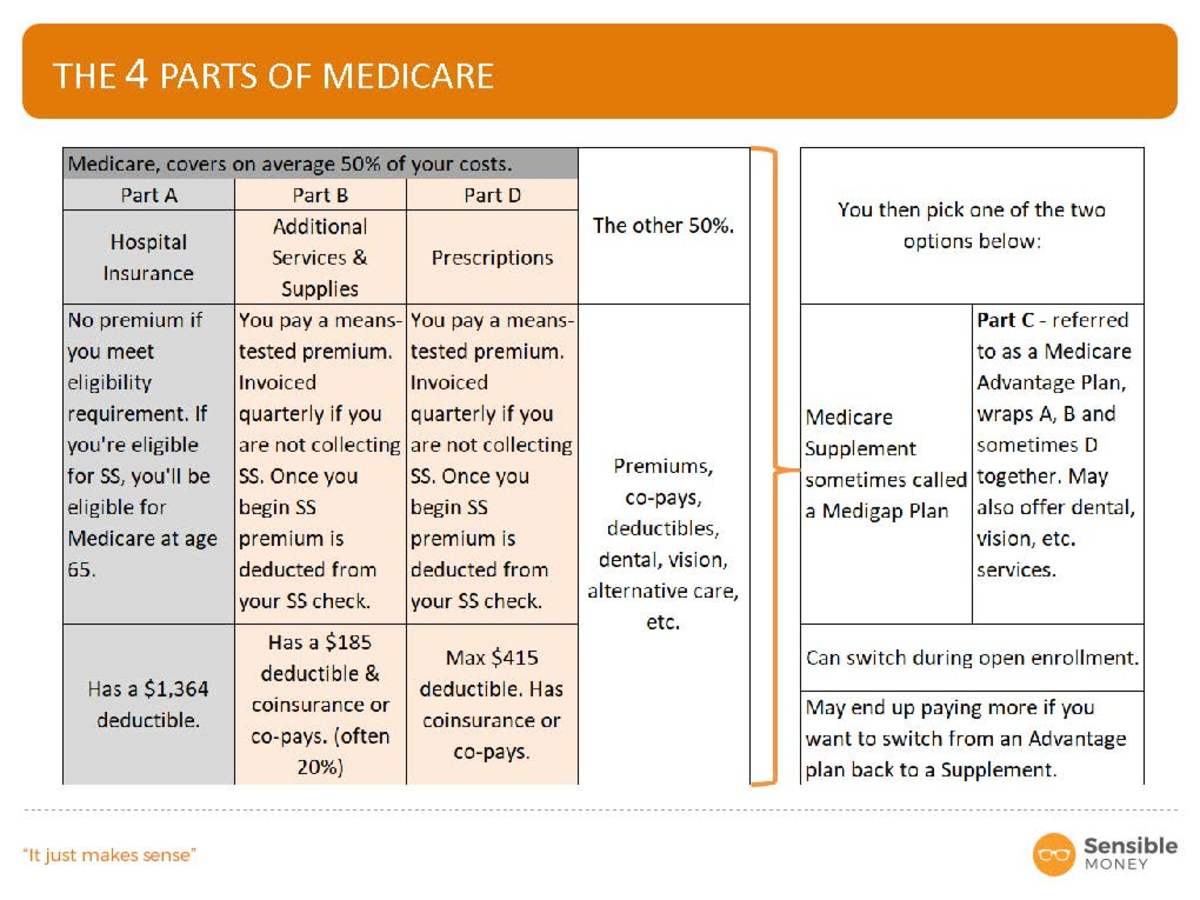
Contrary to popular opinion, Medicare isn’t entirely free.In a video interview, Dana Anspach, the founder and president of Sensible Money, explained the components of Medicare and the costs associated with Part B and Part D.Medicare Part A, often referred to as hospital insurance, is free if you worked enough years in the U.S. to qualify. “Typically, if you’re eligible for Social Security benefits, you’re also eligible for Medicare Part A at no cost,” said Anspach.
This would be true if the federal government hadn’t socked you and your employer for FICA taxes, which purportedly fund Medicare and Social Security.
In reality, these taxes fund nothing. The federal government creates new dollars ad hoc, every time it pays an invoice.
Quote from Ben Bernanke when, as Fed chief, he was on 60 Minutes:Scott Pelley: Is that tax money that the Fed is spending?Ben Bernanke: It’s not tax money… We simply use the computer to mark up the size of the account.
Medicare Part B covers other services and supplies, and it has a monthly cost that varies depending on your income.
The money deducted for Part B, like all other payments to the federal government, pay for nothing. All dollars received by the federal government are destroyed upon receipt.
When you pay federal taxes, dollars come out of your checking account. These dollars come from an money-supply measuren called “M1.”
When the Treasury receives your M1 dollars, they cease to be part of any money-supply measure. The reason: It is impossible to measure the amount of money the Treasury “has,” given that the government has the infinite ability to create its own sovereign currency, the U.S. dollar.
So those M1 dollars effectively are destroyed upon receipt.
And there is Part D, for prescriptions, and it is free if your income is low enough, but it has a cost once your income exceeds various threshold amounts.
The following chart outlines the payments — the unnecessary payments — you are forced to make in order to receive medical benefits from the federal government.
You have been brainwashed into believing the federal government, which created the U.S. dollar from thin air, now somehow can short of the dollars it created.
So, you are led to believe it financially is necessary for the federal government to receive your dollars, to pay for services.
It isn’t. The federal government has neither the need nor the use for your dollars. It has the infinite ability to create new dollars.
That is how it is able to sustain a debt of $25 trillion with no worries at all.
You are swayed by reasonable-sounding complexity:
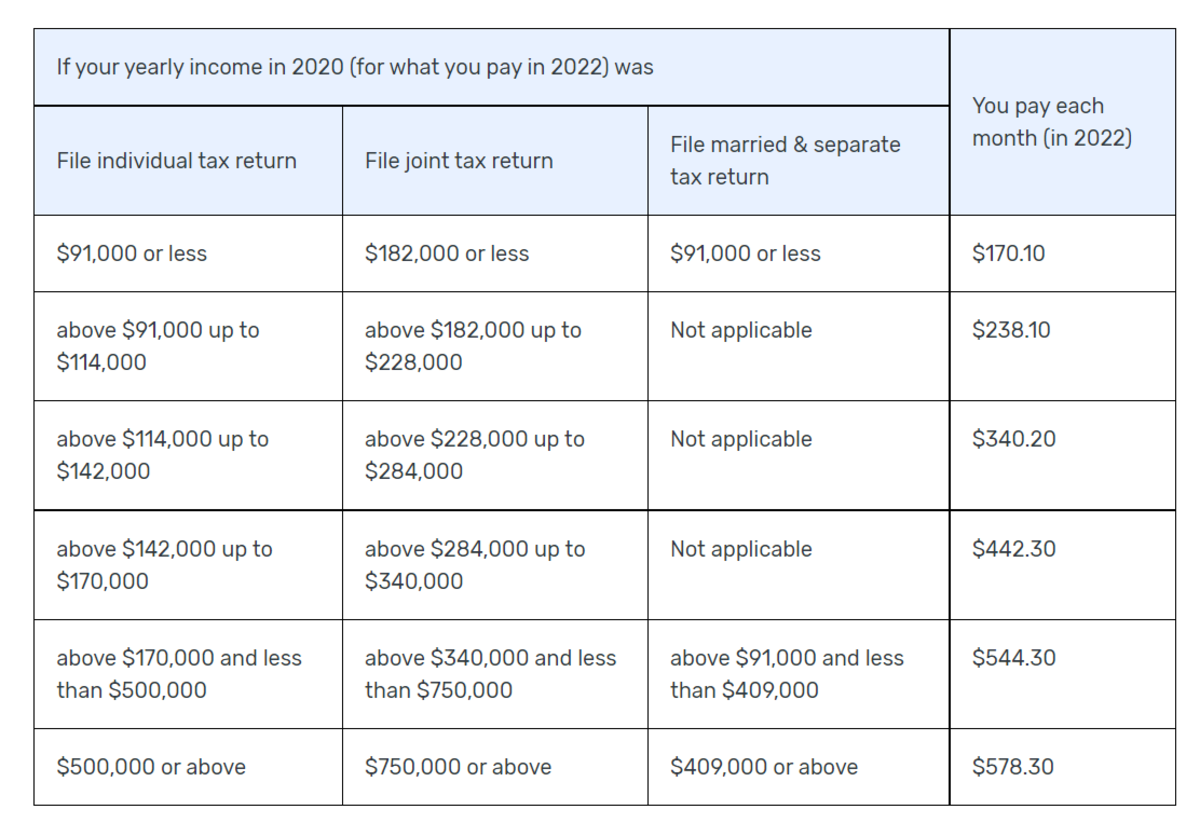
“Like so many things associated with retirement, it’s more complicated than you may think“First, the Social Security office references your tax return data from two years prior to determine your premium level, so if 2022 is your first year enrolling in Medicare, they will use data from your 2020 tax return.”“Let’s assume you are turning 65 in 2022, and your MAGI from 2020 is below $91,000 if single/$182,000 if married filing jointly; in this case, your Part B premiums are $170 per month and Part D will be free. (Your MAGI is calculated by adding back any tax-exempt interest income to your adjusted gross income (AGI).)‘Now, if your MAGI exceeds additional threshold amounts, your premiums will be higher. ‘This is referred to as means testing and is technically called the IRMAA. You are notified of your premium amounts via a letter from the Social Security office called your Initial Determination Letter, said Anspach.The largest premiums of $578 for Part B and $78 for Part D apply to MAGI greater than $500,000 for singles and $750,000 for marrieds.Now if you are not yet enrolled in Social Security, you will receive a quarterly invoice for these premiums, said Anspach. But if you are enrolled in Social Security, the premiums are deducted from your monthly Social Security payment.
So many caveats; so many details. And it’s all a lie. The federal government destroys your FICA dollars and deductions from Social Security the moment they are received.
The federal government easily could and should pay for Medicare Part A, Part B, and Part D without charging you anything.
So why does the government force you to send it dollars that it destroys?
The following chart, from the aforementioned article, contains a hidden clue:
Did you see the clue?
Look at the last line. There is a ceiling on payments above a certain amount of income. That is, the person who makes a half million, or a million, or a hundred million dollars a year pays the same.
The increases in payments stop at a certain level.
This is the same trick the government uses when calculating FICA payments. In 2021, employees pay a 6.2% Social Security tax (with their employer matching that payment) on income up to $142,800. Any earnings above that amount are not subject to FICA tax.
The very rich are never satisfied. They always want to be richer.
“Rich” is a comparative. There are two ways to become richer: Obtain more for yourself or widen the income/wealth/power Gap between you and those below you by forcing them to receive less.
Because the very rich control the U.S. government, Congress and the President are only too happy to oblige by setting a ceiling on payments to the government.
As a share of disposable income, the rich pay far less than do you.
This effectively widens the Gap, thus making the rich richer.
2. It collects an unnecessary and huge FICA tax from salaried employees and their employers, not from dollars earned in non-salaried remunerations — more representative of the rich.
3. Employers count the FICA they pay as being part of salaries, thus reducing paid salaries.
4. Despite the fact that Social Security is quasi-insurance, ostensibly paid for by FICA, the government collects proportionately more taxes from lower-income people.
5. Lower-income people generally work for salaries that are taxed at the highest rates. Other forms of income, more usual for the rich, are taxed at lower rates or not taxed at all.
6. Wealth generally is not taxed.
7. Tax loopholes available primarily to the rich.
7. Tax complexity is intentional. It allows the rich, who can afford expensive tax accountants and lawyers, to take advantage of arcane tax laws, not understood by the general public.
8. Student loans.The rich can pay tuition. The not-rich are burdened by loans.
Keep in mind that all of the above taxation and fees, together with limits on federal benefits, are unnecessary. The federal government neither needs nor uses tax dollars, and its spending is not financially limited.
The rich want you to believe that federal finances, which are Monetarily Sovereign, are the same as state/local government finances, which are monetarily non-sovereign.
The fundamental difference is that the spending by state and local governments is limited by income from tax receipts and borrowing. Federal spending is not limited by any form of income.
The Federal government doesn’t need your hard-earned dollars. Ignorance is expensive.
Gap Psychology describes the common desire to distance oneself from those “below” in any socio-economic ranking, and to come nearer those “above.” The socio-economic distance is referred to as “The Gap.”
Wide Gaps negatively affect poverty, health and longevity, education, housing, law and crime, war, leadership, ownership, bigotry, supply and demand, taxation, GDP, international relations, scientific advancement, the environment, human motivation and well-being, and virtually every other issue in economics.Implementation of Monetary Sovereignty and The Ten Steps To Prosperity can grow the economy and narrow the Gaps:
Ten Steps To Prosperity:
No more, my favorite
Imagine walking into your favorite restaurant — a restaurant you have frequented for many years — only to discover it’s under new management, and the tables are covered with flies, roaches, and filth.
Will you still eat there just because you always have?
I had to answer that question five years ago.
Before that, I mostly had voted Republican.
But then my favorite political party came under new management, and indeed it has become covered with flies, roaches, and filth.
The new Republicans claim to be “conservatives,” with the word “conserve” being in opposition to the word “change.”
What are conservatives? The are many opinions about this. One opinion comes from The Intercollegiate Studies Institute (ISI).
It is a nonprofit educational organization that promotes conservative thought on college campuses.It lists the following six as its core beliefs: limited government, individual liberty, personal responsibility, the rule of law, free-market economics, and traditional Judeo-Christian values.ISI was founded in 1953 by Frank Chodorov with William F. Buckley Jr. as its first president.
Yet, does that Republican Party, led by William Buckley, still exist?
The following article, from Scientific American, describes one aspect of the new Republican Party:
Elected officials who campaigned against critical race theory (CRT) (the study of how social structures perpetuate racial inequality and injustice), are being sworn into office all over the U.S. These candidates captured voters’ attention by vilifying CRT, which has become a catch-all to describe any teaching about racial injustice. Lessons about the genocide of Native Americans, slavery, segregation and systemic racism would harm children, these candidates argued. Calling its inclusion divisive, some states have enacted legislation banning CRT from school curricula altogether.This regressive agenda threatens children’s education by propagating a falsified view of reality in which American history and culture are outcomes of white virtue. It is part of a larger program of avoiding any truths that make some people uncomfortable, which sometimes allows active disinformation, such as creationism. Children are especially susceptible to disinformation, as Melinda Wenner Moyer writes in “Schooled in Lies.”Removing conversations around race and society removes truth and reality from education.This political interference is nothing new—political and cultural ideologues have fought for years to remove subjects such as evolution, Earth history and sex education from classrooms and textbooks.
That is today’s Republican party, preaching “limited government, individual liberty, and personal responsibility“, but voting for government book-burning with regard to racial history.
“Limited government”? “Individual liberty”? Is that today’s Republican Party?
Or does the following better describe today’s Republican Party?:
Many of the school districts that brought in anti-CRT board members are the same ones that refuse to mandate masks, despite the evidence that masks can prevent the spread of COVID. These school officials also rail against vaccine mandates as a violation of personal choice. It is the same prioritization of individuals over community and a discomfort with hard truths that characterize the movement against the teaching of true history.
Or, perhaps this is the real Republican Party:
Newt Gingrich, a former House speaker and candidate for the Republican presidential nomination, stoked outrage on Sunday by predicting members of the House committee investigating the Capitol attack will be imprisoned if Republicans retake the chamber this year.
One of two Republicans on the committee, Liz Cheney, said,“A former speaker of the House is threatening jail time for members of Congress who are investigating the violent attack on our Capitol and our constitution. This is what it looks like when the rule of law unravels.”
“The rule of law” once was a cornerstone of Republican politics. But no more. That rule is gone. Now, it is “the rule of Trump.”
Or perhaps more accurately, the cornerstone of the Republican party now is, the rule of Trump’s lies.”
Some of his doozies, according to Daniel Dale, CNN, Updated 9:28 AM ET, Sat January 16, 2021, were:
It never rained on his inauguration. (It poured)
The coronavirus is under control. (Never was)
Sharpiegate (Alabama never was threatened)
“The head of the Boy Scouts called him “to say my address to the Scouts’ National Jamboree was “the greatest speech that was ever made to them.” (No such call ever was made._
Rep. Ilhan Omar supports al Qaeda. (Ugly, bigoted lie.)
The US for years had a $500 billion annual trade deficit. (Never even reached $400.)
Big, burly men repeatedly came up to him crying tears of gratitude. (No record of it ever happening).
He didn’t know anything about a $130,000 payment to porn performer Stormy Daniels. (He personally reimbursed Cohen, who made the payment.)
He claimed to end family separation at the border. (He ended his own policy of family separation after the public uproar.
Claimed Biden would destroy protections for people with pre-existing health conditions. (This was part of Obamacare that Trump tried for years, to destroy.)
Claimed got the Veterans Choice program passed after other presidents tried and failed for years. (It was a lie. When asked about it, he left the room).
“They say” the noise from windmills “causes cancer.” (This was just one of his many, many “they say” or “people tell me” lies.)
Trump’s big health care plan was eternally coming in “two weeks.” (It never arrived, just as his many other plans and announcement never arrived.)
Claimed he was named “Michigan Man of the Year.” (Never happened, though he claimed it more than 100 times.
And the winner is: “I won the election.” (It didn’t happen. Fifty judges, many Republican, said it didn’t happen. Recounts said it didn’t happen. Republican election officials said it didn’t happen. And he lost the popular vote by 7 million, a huge difference.)
Trump being religious
And remind me, wasn’t it Trump who promised to show his tax returns and to put his holdings into a blind trust? He lied, of course, as he always does. He’s still fighting to preserve as much of that secrecy as he can.
And, you may have thought bearing false witness was a violation of Republicans’ “traditional Judeo-Christian values.” Apparently, those religious values are limited to his holding up a bible for a photo op, (after gassing protesters to make way for him.)Today’s Republican Party makes excuses when they resort to “whataboutism” to justify Trump’s firehose of lies.
Getting back to the Republican claim of “individual liberty,” it doesn’t apply to women, particularly poor women, who want an abortion.
Rich women always can get abortions, but poor women must resort to coat hangers, because the new Republican Supreme Court denies them individual liberty.
And then there is the conservative desire for “free-market economics,” which really means, free-market economics for the rich. That’s why during the Trump administration, the rich received monster tax cuts while the poor and middle classes received next to nothing.
And finally, we come to “personal responsibility.” It’s the Republican excuse for trying to destroy Obamacare and for voting against, Medicare for All and the Build Back Better plan.
This is an example of what 100% of Republican Congresspeopleoppose:
Free preschool for 3-4-year-olds
Child-care financial aid
Financial aid to care for the elderly or disabled
Increased child tax credits
Clean energy tax credits and investment
Investment in coastal renovation, forest management, soil conservation
Cost reduction for prescription drugs
Reduced premiums for Obamacare
Close the Medicaid coverage gap
Medicaid hearing benefits
Investment in affordable housing
Expanded Earned Income Tax Credit for low-wage employees
Funds education beyond high school
Expands funding for low-income children’s meals
Funds reduced immigration backlog
Not only do 100% of Republicans oppose these programs you could have had, but 0% of Republicans offer nothing of their own. The Republicans have no plans. They even failed to come up with a platform ahead of the past election.
What was once the “party of ideas” has become the “brain-dead party,” the party whose sole objective is to oppose anything that could benefit America’s working class.
Republicans now firmly are the party of the rich, the party of the cruel, the party of the bigot, the party of the lie, the traitor party, the fear-mongering party, the xenophobe party, the paranoid party, the party that forged election documents in order to destroy our democracy, the traitor party of Donald Trump.
Any opposed to this new Republicanism are censured, ostracized, “primaried,” and removed from committee positions.
Astoundingly, virtually all Republican politiciansand many Republican voters continue to support Trump’s lies.
They continue to eat at their once-favorite restaurant because they always have.
Trump has convinced the naive that the poor, the middle-classes, the black, the brown, the yellow, women, and the gay are a danger to America. This, from the traitor who encouraged a coup, and continues to resist America’s peaceful transfer of power.
If you traditionally have voted Republican, know this. The party that now calls itself “Republican” is no more. The ideas and ideals for which you once voted have been destroyed.
Your vote no longer means “Republican.” It no longer means “conservative.” It now means “Trump.”
Vote Republican and you are patronizing that restaurant you once loved but now is filled with vermin — the restaurant that no longer exists as you remember it.
.
.
Rodger Malcolm Mitchell
Monetary SovereigntyTwitter: @rodgermitchellSearch #monetarysovereigntyFacebook: Rodger Malcolm Mitchell
……………………………………………………………………..
THE SOLE PURPOSE OF GOVERNMENT IS TO IMPROVE AND PROTECT THE LIVES OF THE PEOPLE.
Gap Psychology describes the common desire to distance oneself from those “below” in any socio-economic ranking, and to come nearer those “above.” The socio-economic distance is referred to as “The Gap.”
Wide Gaps negatively affect poverty, health and longevity, education, housing, law and crime, war, leadership, ownership, bigotry, supply and demand, taxation, GDP, international relations, scientific advancement, the environment, human motivation and well-being, and virtually every other issue in economics.Implementation of Monetary Sovereignty and The Ten Steps To Prosperity can grow the economy and narrow the Gaps:
Ten Steps To Prosperity:
I continually am puzzled by the misunderstanding (“disunderstanding”?) of Monetary Sovereignty. It is both simple and obvious, yet many (most?) people have trouble comprehending it.
MS is based on just four simple facts:
In the 1780s, the U.S. federal government created the laws that created the U.S. dollar from thin air — as many dollars as it wished – and gave them the value it wished.
The government’s own laws give it the power to continue creating dollars, infinitely
The government’s own laws give it the power to continue changingthe valueof the dollar — a power it has used many times.
The government can change its laws at will.
Really, what could be simpler, more obvious, and less controversial?
Derived from these simple, obvious facts comes the following:
The U.S. federal government never unintentionally can run short of U.S. dollars.
No agency of the government can run short of dollars unless the government wishes it.
Federal taxes are not used or needed to fund federal spending.
By changing the value of the dollar, the government has absolute control over inflation
And that’s it. Monetary Sovereignty.
Intuition is powerful. Many of us prefer to believe our intuition than believe facts.
Interestingly, where fiction parallels facts, you might not believe the facts about the fiction, while still believing fiction about the facts.
That is, you might read a historical novel of fiction, and not believe the background facts presented. Yet, you might be fooled by a conspiracy theory website presenting fiction as fact.
So here is the explanation that may appeal to intuition as well as to facts.
You probably have played the hugely popular board game, Monopolytm. As a game, it’s fiction, but you believe and understand the facts (i.e. “rules.’)
Here are some of the facts.
The game is played with multiple players plus a Bank. The Bank pays Monopoly dollars to the players for various benefits.The Bank collects taxes, fines, loans and interest from the players.The Bank “never goes broke.” If the Bank needs money, it may issue as many dollars as needed by printing on scraps of paper or simply by creating a bookkeeping tally.
Example of a Monopoly running tally
A sample tally is demonstrated by the illustration at the right.
It reveals three things:
I. Monopoly money is not physical. Those printed $500, $100, $50, $20 $10 $5, and $1 bills aren’t dollars in of themselves.They merely representdollars, just as the numbers on a tally represent dollars.II. The Bank can createan infinite supply of Monopoly dollars.
If needed, the Bank instantly could pay Tom, Dick, Harry, or Bob $1, or $100, or $1,000,000,000 in Monopoly dollars.
In the tally, there is no need to create a column for the Monopoly Bank.
This lack of a column demonstrates the Bank’s ownership of infinite dollars.
It also demonstrates that all dollars sent to the Monopoly Bank are destroyed upon receipt.
If Tom, for instance, sent $100 to the Bank, his $4,400 would be reduced to $4,300. So, what happened to the $100 Tom paid? They simply disappeared. They no longer exist.
Although the Bank can create infinite dollars this creation process does not create Monopoly Bank “debt.” The Monopoly Bank does not borrow dollars nor does it owe any dollars.
Thus, taxes are not levied to “pay off” any Monopoly Bank debt.
By rule, the Monopoly Bank simply creates all the dollars it needs. Although the Bank is not precluded from keeping track of the dollars it receives from players, that record would not indicate how many dollars the Monopoly Bank “owes” or has.
There is no ongoing debt owed by the Monopoly Bank.
All of the above is easily understood by you and by virtually anyone else who has played the game.
Now, in the above paragraphs, substitute the words, “U.S. federal government” for the word “Bank.” And substitute “members of the public” for “players.”
The facts remain essentially the same.
There are multiple members of the public plus the federal government.
The federal government pays dollars to the public for various benefits.
The federal government collects taxes, fines, loans, and interest from the public.
The federal government “never goes broke.” If the federal government needs money, the government may issue as much as needed by printing on paper or simply by creating a bookkeeping tally.
[Former Fed Chairman, Alan Greenspan: “A government cannot become insolvent with respect to obligations in its own currency.”]
Continue reading and substituting until you come to the part that some people have difficulty understanding:
The federal government does not borrow dollars nor does it owe any dollars. Taxes are not levied to “pay off” any federal government debt.
[Quote from Ben Bernanke when, as Fed chief, he was on 60 Minutes:
Scott Pelley: Is that tax money that the Fed is spending?
Former Fed Chair, Ben Bernanke: It’s not tax money… We simply use the computer to mark up the size of the account.]
The Monopoly Bank and the U.S. federal government both are Monetarily Sovereign. They both are issuers of their dollars. Neither of them can run short of dollars.
Both the Monopoly Bank and the U.S federal government have infinite dollars.
[Former Fed Chair, Ben Bernanke: “The U.S. government has a technology, called a printing press (or, today, its electronic equivalent), that allows it to produce as many U.S. dollars as it wishes at essentially no cost.”]
Neither the Monopoly Bank nor the federal government borrows or taxes in order to pay their financial obligations. Spending by the Monopoly Bank or the U.S. federal government does not create future taxpayer obligations.
For that reason, Social Security, an agency of the federal government, cannot run short of dollars, unless that is what the government wants. Even if there were no FICA tax (which contrary to popular myth, does not fund Social Security), that agency need not run short of dollars.
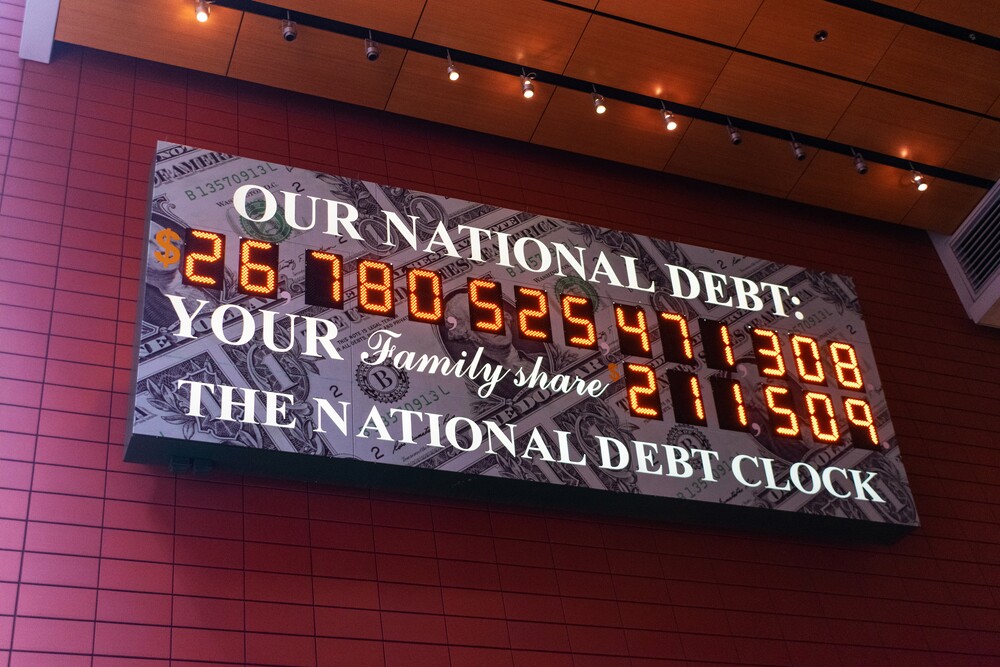
The “debt clock.” You have no share.
Medicare for All, college for all, upgraded infrastructure, good housing for all — every imaginable federal benefit — all are easily affordable. The so-called federal debt is not a burden on future taxpayers or on the government.
The famous “debt clock” implies the lie that somehow the federal “debt” is a danger to you, your children, and the federal government.
It is not a debt, and it is not a danger, to you or anyone.
It is just simple deposits by the public into accounts.
The parallels between the Monopoly game and federal financing are stunning.
Yet, though people tend to understand the rules of Monopoly, too many become hopelessly confused by the same set of facts when applied to real life.
Yes, one is fiction and the other is fact, but that difference is not the source of the confusion.
The confusion is caused by the longtime, ongoing, relentless dissemination of false information about the federal government’s finances and by the misnaming of T-securities as “borrowing” and “debt.” They are neither.
The misinformation is promulgated by agents for the rich, who want to prevent you from asking for the benefits the rich already receive: Retirement benefits, medical care, good housing, safe neighborhoods, college education, spending money for a good life.
Neither the government nor you owes the deposits that sit in T-security accounts. These accounts resemble bank safe deposit boxes, which the bank “pays off” simply by returning the contents. No “debt” or tax liability there.
The Monopoly board game is a good analog for the federal finance system. If you understand one, you should understand the other.
Rodger Malcolm Mitchell
Monetary SovereigntyTwitter: @rodgermitchellSearch #monetarysovereigntyFacebook: Rodger Malcolm Mitchell
……………………………………………………………………..
THE SOLE PURPOSE OF GOVERNMENT IS TO IMPROVE AND PROTECT THE LIVES OF THE PEOPLE.
Gap Psychology describes the common desire to distance oneself from those “below” in any socio-economic ranking, and to come nearer those “above.” The socio-economic distance is referred to as “The Gap.”
Wide Gaps negatively affect poverty, health and longevity, education, housing, law and crime, war, leadership, ownership, bigotry, supply and demand, taxation, GDP, international relations, scientific advancement, the environment, human motivation and well-being, and virtually every other issue in economics.Implementation of Monetary Sovereignty and The Ten Steps To Prosperity can grow the economy and narrow the Gaps:
Ten Steps To Prosperity:
 Some may have forgotten his sucking up to our enemy, Vladimir Putin (whose efforts got Trump elected) so as to get approval for a Trump Tower Moscow.
And they may have forgotten Trump’s attempts to extort the President of Ukraine into providing damaging information about Joe Biden’s son.
And many self-proclaimed “religious” followers seem to have forgotten Trump admitted to groping women while cheating on all three of his wives.
And others may have forgotten Trump’s 30,000+ lies, including his phony doctor’s report, and the hurricane that never hit Alabama (“Sharpiegate“).
And still others may have forgotten the crimes of Trump University and Trump Foundation, crimes that would have resulted in the incarceration of any other person.
And then there was his promise to reveal his tax returns as every other President has done, a promise that, like so many other promises, he broke.
Some may have forgotten his sucking up to our enemy, Vladimir Putin (whose efforts got Trump elected) so as to get approval for a Trump Tower Moscow.
And they may have forgotten Trump’s attempts to extort the President of Ukraine into providing damaging information about Joe Biden’s son.
And many self-proclaimed “religious” followers seem to have forgotten Trump admitted to groping women while cheating on all three of his wives.
And others may have forgotten Trump’s 30,000+ lies, including his phony doctor’s report, and the hurricane that never hit Alabama (“Sharpiegate“).
And still others may have forgotten the crimes of Trump University and Trump Foundation, crimes that would have resulted in the incarceration of any other person.
And then there was his promise to reveal his tax returns as every other President has done, a promise that, like so many other promises, he broke.

 You have been brainwashed into believing the federal government, which created the U.S. dollar from thin air, now somehow can short of the dollars it created.
So, you are led to believe it financially is necessary for the federal government to receive your dollars, to pay for services.
It isn’t. The federal government has neither the need nor the use for your dollars. It has the infinite ability to create new dollars.
That is how it is able to sustain a debt of $25 trillion with no worries at all.
You are swayed by reasonable-sounding complexity:
You have been brainwashed into believing the federal government, which created the U.S. dollar from thin air, now somehow can short of the dollars it created.
So, you are led to believe it financially is necessary for the federal government to receive your dollars, to pay for services.
It isn’t. The federal government has neither the need nor the use for your dollars. It has the infinite ability to create new dollars.
That is how it is able to sustain a debt of $25 trillion with no worries at all.
You are swayed by reasonable-sounding complexity:
 Did you see the clue?
Look at the last line. There is a ceiling on payments above a certain amount of income. That is, the person who makes a half million, or a million, or a hundred million dollars a year pays the same.
The increases in payments stop at a certain level.
This is the same trick the government uses when calculating FICA payments. In 2021, employees pay a 6.2% Social Security tax (with their employer matching that payment) on income up to $142,800. Any earnings above that amount are not subject to FICA tax.
Did you see the clue?
Look at the last line. There is a ceiling on payments above a certain amount of income. That is, the person who makes a half million, or a million, or a hundred million dollars a year pays the same.
The increases in payments stop at a certain level.
This is the same trick the government uses when calculating FICA payments. In 2021, employees pay a 6.2% Social Security tax (with their employer matching that payment) on income up to $142,800. Any earnings above that amount are not subject to FICA tax.

/cdn.vox-cdn.com/uploads/chorus_asset/file/20014029/GettyImages_1216828192.jpg)
 Vote Republican and you are patronizing that restaurant you once loved but now is filled with vermin — the restaurant that no longer exists as you remember it.
.
.
Rodger Malcolm Mitchell
Vote Republican and you are patronizing that restaurant you once loved but now is filled with vermin — the restaurant that no longer exists as you remember it.
.
.
Rodger Malcolm Mitchell
 Here are some of the facts.

 #Monetary Sovereignty - Mitchell