Here’s a direct Trump quote: “His wife, I think, is fantastic and I’m thinking about commuting his sentence very strongly.”
Patti Blagojevich. Trump thinks she’s fantastic
And here is the background:
Chicago Tribune: Trump considers ending Blagojevich’s prison term, citing Comey, ‘sleazebags’
By Rick Pearson and Jason Meisner
President Donald Trump has once again dangled the idea of commuting the 14-year prison sentence for disgraced former Illinois Gov. Rod Blagojevich, telling reporters aboard Air Force One on Wednesday night he was “very strongly” considering springing Blagojevich from prison five years early.
The president’s comments — largely echoing remarks he made 14 months ago — gave new hope to Blagojevich’s wife, Patti, who released a statement Thursday saying the family was “very hopeful that our almost 11 year nightmare might soon be over.”
But Trump also showed he has done little homework on the case since he first raised the idea of using his powers of executive clemency for Blagojevich in May 2018.
Trump repeated the same misstatement he made last year that Blagojevich was sentenced to 18 years in prison and once again mentioned only one wiretapped phone call by Blagojevich, when much of the evidence presented at trial came from witnesses who said the governor was shaking them down for campaign cash in exchange for official acts.
The victims included the then-CEO of Children’s Memorial Hospital, now Lurie Children’s Hospital, who said he was pressured to contribute tens of thousands of dollars in exchange for state funding.
“He’s been in jail for seven years over a phone call where nothing happens. But over a phone — where nothing happens. But over a phone call which, you know, he shouldn’t have said what he said, but it was braggadocio you would say.”
Such mischaracterizations have been blasted before by those who investigated and prosecuted Blagojevich.
Robert Grant, the former head of the FBI in Chicago who helped lead the sprawling Operation Board Games investigation that ultimately led to Blagojevich’s downfall, told the Tribune in May 2018, “It’s clear (Trump) has never seen any of the evidence.
“He took his talking points from Patti Blagojevich. It’s pure fantasy. This was flat-out, old-fashioned corruption, pure and simple.”
Trump: “A lot of people thought it was unfair, like a lot of other things — and it was the same gang, the Comey gang and all these sleazebags that did it.”
Well, for once he didn’t blame Hillary or Obama.
Typically, Trump doesn’t know what he is talking about, and he hopes you are too stupid to notice or care. That may be true of his most ardent fans, but not true of moral human beings.
And you surely know how Trump hates “sleazebags” like:
Health and Human Services Secretary Tom Price
EPA Administrator Scott Pruitt
HUD Secretary Ben Carson
Campaign manager Paul Manafort
Deputy campaign manager Rick Gates
National security adviser Michael Flynn
Personal lawyer Michael Cohen
Commerce Secretary Wilbur Ross
Rep. Chris Collins
Rep. Duncan Hunter
Mobster Salvatore Testa
Mobster Fat Tony Salerno
Roger Stone
Felix Sater
Jeffrey Epstein
Secretary of Labor Alexander Acosta
Trump Campaign Foreign Policy Adviser George Papadopoulos
Alex Van der Zwaan
Konstantin Kilimnik
Ralph Shortey
Timothy Nolan
The people who ran the crooked Trump University
The person who ran the crooked Trump Foundation
Stormy Daniels and other porn stars
Ivanka Trump
Jared Kushner
Donald Trump, Jr.
And whoever the politician was that stiffed creditors out of millions by going bankrupt at least four times while running gambling casinos (Bankrupting gambling casinos?? Is that even possible?) — and now is unable to get credit from any bank in America, so must beg Russia and the Saudis for money.
But hey, Trump thinks Blago’s wife is fantastic, so . . .
Preface: Monetary Sovereignty means just what it says: Being sovereign over your form of money.
The U.S. government is Monetarily Sovereign over its sovereign currency, the U.S. dollar. The federal government created the very first dollars out of thin air.
It continues to create dollars at will. Even without collecting taxes or receiving any other form of income, the federal government can pay any debt denominated in dollars. It never can run short of dollars. It can control the value of the dollar by controlling interest rates.
U.S. cities, counties, and states are monetarily non-sovereign. They have no sovereign currency. Instead, they use the U.S. dollar.
They cannot create dollars at will. They need taxes or other forms of income, in order to pay their debts. They can run short of dollars with which to pay their bills.
England is Monetarily Sovereign over the British pound. Germany is monetarily non-sovereign. It uses the euro, over which it has little control. It can run short of euros and be unable to pay its debts denominated in euros.
Japan and China are Monetarily Sovereign over their currencies. They never can run short. Italy and Greece are monetarily non-sovereign. They use the euro.
For reasons I will explain, Monetarily Sovereign nations pretend they are monetarily non-sovereign.
They pretend to borrow, when they really don’t. They collect taxes, though they have no financial need for income. They strive to export more, though increased importing would be more beneficial.
They allow poverty, though they easily could cure it. And they allow the Gap between the rich and the poor to be excessive, though they easily could cure that, too.
I mention all this because recently I read the following article excerpts:
A lower currency makes a countries exports more attractive because they are cheaper on the international market. For example, a weak U.S. dollar makes U.S. car exports less expensive for offshore buyers.
2. Secondly, by boosting exports, a country can use a lower currency to shrink its trade deficit.
3. Finally, a weaker currency alleviates pressure on a country’s sovereign debt obligations.
After issuing offshore debt, a country will make payments, and as these payments are denominated in the offshore currency, a weak local currency effectively decreases these debt payments.
Consider the Monetarily Sovereign United States. It has the unlimited ability to create U.S. dollars.
Exports are a method by which the U.S. sends goods and services, created by the natural assets and labor of its citizens, to a foreign nation, in exchange for dollars.
It’s easy to understand why a monetarily non-sovereign nation, like Portugal for instance, would want to acquire money in exchange for natural assets. To Portugal, which uses the euro, money is in limited supply.
Portugal needs income to pay its bills.
To all nations, natural assets are limited; labor is limited. But to the U.S., dollars are unlimited. The U.S. needs no income to pay its bills.
Why should the U.S. exchange its limited assets to gain an asset of which it has an unlimited supply?
A common answer is that U.S. exports help U.S. businesses grow and profit, and with those profits, pay employees. But the answer is illogical.
“Grow and profit” means to acquire dollars, of which the federal government has an unlimited supply.
The easier and more sensible plan would be for the federal government to do what businesses are designed to do, i.e. provide dollars to employees. This would cost the government nothing (remember that unlimited money supply), and more importantly, no scarce natural resources would be expended.
One such method would be to implement the Ten Steps to Prosperity. (See below.)
The article says,
“A weaker currency alleviates pressure on a country’s sovereign debt obligations.
“After issuing offshore debt, a country will make payments, and as these payments are denominated in the offshore currency, a weak local currency effectively decreases these debt payments.”
The whole idea is illogical and factually wrong.
First, federal so-called “debt” actually is nothing more than deposits into Treasury security accounts.When you “lend” to the federal government, you don’t really lend. You make a deposit into your T-bill, T-note, or T-bond account at the Federal Reserve Bank.
Your dollars remain in your account, gathering interest, until your account matures, at which time your dollars are returned to you. Your dollars never leave your account until maturity.
The exchange rate of those dollars is irrelevant. Whether a dollar is worth one pound, two yen, or three partridges in a pear tree makes no difference. To pay off the misnamed “debt.” the government returns whatever is in your account.
The federal government does not use your dollars, but even if it did, giving you your money back would be no burden on a government that has the unlimited ability to create its own sovereign currency.
Third, making a currency weaker is inflationary because imported goods instantly become more expensive. (Fortunately, the U.S. government has the unlimited ability to strengthen the dollar, simply by increasing interest rates.)
This increases the demand for dollars, which makes them more valuable.
Bottom line:
Increasing the level of exports does not benefit a Monetarily Sovereign government
Shrinking the trade deficit similarly does not benefit a Monetarily Sovereign government
Federal “debt” and federal finances are substantially different from personal (monetarily non-sovereign) debt an finances. Unlike you and me, the Monetarily Sovereign federal government needs no income, can produce dollars at will, can control the value of those dollars, and never can run short of dollars.
Why then does the federal government pretend dollars are scarce to it? Why does it pretend that total deposits in T-security accounts are a burden and a threat? Why the claim that a trade surplus is superior to a trade deficit.
For the past 10 years the U.S. has run persistent trade deficits.
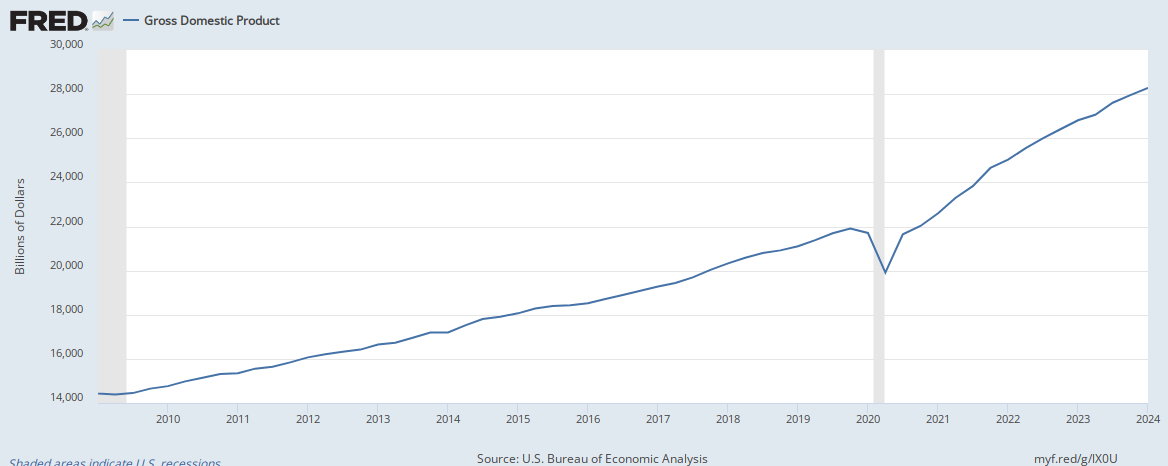
For the past 10 years the U.S. has run persistent trade deficits. During that same period, Gross Domestic Product has risen from $14.5 trillion, to $21.3 trillion, a massive 47% increase.
In the past 10 years, GDP has risen from $14.5 trillion, to $21.3 trillion, a massive 47% increase.
Clearly, trade deficits have not prevented GDP growth. The reason is that federal deficit spending has more than made up for the dollar loss trade deficits cause.
And that is the whole point and the reason why trade deficits do not harm a Monetarily Sovereign nation. Any dollar loss easily is overcome by federal deficit spending.
The question then is, “Why do nations pretend not to understand Monetary Sovereignty?” Why everywhere you turn, do your information sources — the politicians, the media, the economists — tell you that the federal deficit and debt are so high as to be “ticking time bombs“?
The answer is this: The rich run America.
“Rich” is a comparative word. The farther distant one is from the poor the richer one is.
Owning a million dollars makes one rich if everyone else owns one dollar. Owning a million dollars does not make one rich if everyone else also owns a million dollars.
Being “rich” depends on the Gap between the rich and the rest. To be richer, the rich want to widen the Gap between the rich and the rest. That is called, “Gap Psychology.”
So:
–The rich bribe the politiciansvia campaign contributions and promises of lucrative employment when their political careers end.
–The rich bribe the media via advertising dollars and via ownership.
–The rich bribe the economists via gifts to their universities and employment in “think tanks.”
The rich do not want you to learn that the federal government has the unlimited ability to provide you with free medical care, free schooling, fine housing, food and clothing, and the other benefits that the rich receive.
The rich don’t want you to know you can have all these benefits, without paying a penny in taxes.
If you understood that you could have a much better life, you naturally would want it. But, that would narrow the Gap between the rich and the rest. And narrowing the Gap would make the rich less rich.
So, in addition to trying to gather more for themselves, the rich also want you to have less, thus widening both sides of the Gap.
We’ll finish with a few excerpts from an article in the TILJournal, a massive exercise in ignorance, demonstrating the point:
The National Debt: America’s Ticking Time Bomb
By D.T. Osborn
Each taxpayer in America owes approximately 250,000 dollars to places including China through its state-controlled institutions of finance. Here comes the worst news of all; 22 trillion is only a small part of the real National Debt.
That’s because the official dollar amount does not include America’s unfunded liabilities. Unfunded liabilities are those items the Federal government must pay for by American law.
By far the largest and most significant of these are Social Security, Medicare, and Medicaid. Together they currently total more than 50 trillion dollars. When added to the Debt, the total becomes slightly more than 73 trillion dollars… for the moment.
The final figure also includes items such as Federal pensions for workers and elected officials and interest paid on the Debt. The grand total of America’s real debt is about 130 trillion dollars!
This means each American taxpayer owes over 1 million dollars of the real debt as it exists today. So, what do you say, fellow taxpayer? Got an extra million to chip in for poor old Uncle Sam? Yeah, me neither.
This is a path which will lead to the eventual bankruptcy of America.e
And that lie, that you owe someone over 1 million dollars, is the ridiculous scare tactic being fed to you and the rest of the American public. It wrongly assumes that federal financing is similar to personal financing.
It isn’t.
Personal financing requires a person must have some form of income — salary, interest, borrowing, inheritance, etc. — in order to acquire the dollars with which to pay his bills. That is known as “monetary non-sovereignty.”
By contrast, the federal government is Monetarily Sovereign. It needs no form of income — not even taxes — because it has the unlimited ability to create its own sovereign currency, the U.S. dollar, to pay an infinite number of bills.
Former Federal Reserve Chairman, Alan Greenspan: “A government cannot become insolvent with respect to obligations in its own currency.”
Former Federal Reserve Chairman, Ben Bernanke: “The U.S. government has a technology, called a printing press (or, today, its electronic equivalent), that allows it to produce as many U.S. dollars as it wishes at essentially no cost.”
St. Louis Federal Reserve: “As the sole manufacturer of dollars, whose debt is denominated in dollars, the U.S. government can never become insolvent, i.e., unable to pay its bills. In this sense, the government is not dependent on credit markets to remain operational.
And here, in one sentence, By author D.T. Osborn expresses the big lie the rich want you to believe:
“Any real solution to stave off national insolvency requires massive changes in how unfunded liabilities are handled.”
The rich want the federal government to cut Social Security, cut Medicare, and cut Medicaid, thus widening the Gap between the rich and the rest.
The most important problems in economics involve the excessive income/wealth/power Gaps between the richer and the poorer.
Wide Gaps negatively affect poverty, health and longevity, education, housing, law and crime, war, leadership, ownership, bigotry, supply and demand, taxation, GDP, international relations, scientific advancement, the environment, human motivation and well-being, and virtually every other issue in economics.
Implementation of The Ten Steps To Prosperity can narrow the Gaps:
A story: Imagine that you live in a dangerous neighborhood, where robberies, burglaries, and other attacks are common.
So you buy a big rottweiler, or a pit bull, or some other kind of “attack” dog. And everywhere you go, you keep this dog with you for protection.
You take your dog for licensed obedience training because that is your town’s new law. And you keep your dog on a leash because that also is your town’s new law:
“A licensed, well-trained, supervised, and leashed dog, being necessary to the security of a town resident, the right of the people to keep and walk dogs, shall not be infringed.”
And indeed, should you fail to take your dog for licensed, obedience training, and should you fail to keep your dog on a leash, you could be arrested, fined, and your dog taken from you.
As a result of the new “dog law,” you and many other good people of your town buy licensed, trained dogs, which always are kept on leashes, and the incidence of robberies, burglaries, and other attacks declines.
It is true that some bad people in your town buy unlicensed, untrained dogs, which are not kept on leashes. And these dogs have attacked people.
But, there always are law-breakers in every town, and that fact is no reason not to have laws.
On balance, the registered-training, control, and leash laws have helped protect the community.
Sadly, in your town, the local, conservative, “originalist” judges rule that in the law, the words, “A licensed, well-trained, controlled, and leashed dog, being necessary to the security of a town resident” have no meaning.
So now, anyone can own vicious, untrained attack dogs, and let them out unleashed and unsupervised.
And as could be expected, the number of dog attacks — including attacks by multiple dogs — increases dramatically. Many people are terribly injured. Many people die.
The gun massacres in America are now coming so quickly, one after another, that it’s impossible to process our grief and anger before the next one occurs.
There is a sickness in our land, and it cries out for an immediate, righteous, and even radical response.
And we can start by understanding and declaring that the Second Amendment is a failure.
It’s not just a failure because guns are used so widely, and to such ill effect. The Second Amendment of the U.S. Constitution is a failure because the right to bear arms — the right it so famously defends — is supposed to protect Americans from violence. Instead, it endangers them.
As the conservative National Review noted last year, “supporters of a right to bear arms have rooted their arguments in a murky pre-constitutional right to self-defense.”
The right to bear arms is based on an old understanding in English common law: If somebody attacks you, you have the right to protect yourself.
There’s nothing controversial about that, is there?
The language of self-defense was made explicit in D.C. vs Heller, the 2008 Supreme Court ruling cementing individual gun rights.
“The Second Amendment protects an individual right to possess a firearm unconnected with service in a militia,” Justice Antonin Scalia wrote, “and to use that arm for traditionally lawful purposes, such as self-defense within the home.”
We interrupt Mathis’s article to explain that Scalia was a self-described “originalist.” That means he claimed to believe:
The interpretation of a written constitution or law should be based on what reasonable persons living at the time of its adoption would have understood the ordinary meaning of the text to be.
For two hundred years, the 2nd Amendment was interpreted to mean exactly what the framers said (“A well-regulated militia, being necessary to the security of a free state . . .)
During WWII, we used to have well-regulated militias in the United States. My father belonged to one. He didn’t own a gun himself, but the militia owned them.
The purpose of those militias was to back up the army in protecting the nation, not as “defense within the home,” which is the job of the local police.
(The irony and falsity of the “home defense” theory is that statistically, if you have a gun in your home, you are more likely to be shot than if you don’t.)
Then in 2008, the conservative arm of the Supreme Court, led by self-annointed “originalist” and famous gun lover, Justice Antonin Scalia, decided that though the framers explicitly referenced “a well-regulated militia,” they really didn’t mean it.
And they really didn’t mean “the security of a free state,” either. Scalia and the other originalists decided that what the framers really said had nothing to do with a militia or a free state.
Rather, what they supposedly meant is: “Any boob who can fog a mirror has the right not only to own guns in his home, but to carry them in the streets. No regulated militia or security of the free state is necessary.“
(One wonders why the framers were not wise enough to say it that way.)
The result of this decision has been mayhem, with not just daily shootings, but daily mass shootings.
I suggest Scalia’s tombstone be engraved:
“Here lies Antonin Gregory Scalia, who has abetted the mass murder of thousands, which continues to this day.”
Continuing Mathis’s article:
But in reality, guns are used far more often on offense, by bad guys who have easy access to deadly firepower in unthinkable quantities.
On balance, guns do more harm in America than good. The damages are easily measured, while the benefits are mostly theoretical and rare.
This means the Second Amendment, as currently observed, doesn’t actually work under the terms of its own logic.
In recognizing this, America doesn’t have to throw away a formal right to self-defense, or eliminate guns entirely.
But it’s time to reexamine Second Amendment rights with a bigger emphasis on the amendment’s underlying justification, which is to help Americans be and feel safe, and less emphasis on the right to carry a deadly weapon.
Despite Scalia and his conservative accomplices, we do have a few laws about guns. We disallow fully automatic guns. (Why? Where is that in the 2nd Amendment?)
And we disallow felons from having guns. And we require a minimal amount of licensing. (Where does the Constitution state those restrictions?).
At any rate, the stated purpose of the 2nd Amendment is not “to help Americans feel and be safe,” but rather to protect the “free state,” i.e to protect America.
Now that a disingenuous Supreme Court has completely perverted the meaning and purpose of the 2nd Amendment, where do we go from here?
It probably is too late to start over. The above-mentioned boobs already have millions of guns.
But if the right wing Supreme Court would allow, we could follow the entire 2nd Amendment, not just the last few words.
Perhaps the state National Guards could function as the militia, and they could dole out guns only as needed for the security of America — just as the 2nd Amendment says.
Additionally, two possibilities are these laws:
1. Any person who commits a felony while carrying a gun, shall be sentenced to a prison term of 20 years to life, in addition to the term for the felony itself.
2. Any provider of a gun that is used in a felony shall have the same criminal and civil liability as the actual perpetrator of the felony. (This latter is similar to the “dram shop” laws for liquor.)
At a minimum, we should stop pretending that the 2nd Amendment says what it clearly doesn’t and allow communities to enact laws that will reduce the killing.
The most important problems in economics involve the excessive income/wealth/power Gaps between the richer and the poorer.
Wide Gaps negatively affect poverty, health and longevity, education, housing, law and crime, war, leadership, ownership, bigotry, supply and demand, taxation, GDP, international relations, scientific advancement, the environment, human motivation and well-being, and virtually every other issue in economics.
Implementation of The Ten Steps To Prosperity can narrow the Gaps:
President Trump said, “Remember this, our country is taking in billions and billions of dollars from China. Out of that many billions of dollars, we’re taking a part of it and giving it to the farmers because they’ve been targeted by China. The farmers, they come out totally whole.”
Neil Cavuto pointed out that, once again, Trump was not telling the truth when it came to who pays for tariffs.
“I don’t know where to begin here,” the Fox News host said. “Just to be clarifying, China isn’t paying these tariffs. You are. You know, indirectly and sometimes directly.”
“It’s passed along to you through American distributors and their counterparts in the United States that buy this stuff from the Chinese and have to pay the surcharges. Not the Chinese government.”
Cavuto said that this latest round of tariffs “will be felt by consumers directly.”
As usual, Trump is lying, stupid, or both. And Cavuto is correct. Tariffs on foreign goods are paid by the purchasers of those goods.
As ignorant as Trump is, it simply is not possible that he doesn’t understand this. The man is surrounded by advisors, and surely there is someone in the White House who has told him that basic fact.
Then again, considering the bigots, liars, incompetents, crooks, and sycophants (BLICS) with whom Trump has surrounded himself, we can’t be sure of anything that goes on in Crazyland.
Trump wins round 1 of the dumb, dumber, dumbest contest by default. Cavuto didn’t even compete.
Cavuto groused that both political parties had abandoned “any hint of fiscal restraint.” Cavuto bashed the Trump administration for having “not done a good job containing” federal spending rates.
“Well, somebody has done a good job and that is President Trump,” Lou Dobbs, a rabidly pro-Trump primetime host, shot back. “And it is this economy.”
Cavuto then directly confronted Dobbs, asking him if he truly believes Trump has done a good job “reining in spending,” prompting Dobbs to dismissively tell his colleague that he has to “work this thing out with the president.”
“Fact, fact, do you think this president has done anything to contain the deficits and the debt that had spiraled, still, from what levels he had from Barack Obama?” Cavuto fired back.
“Uh-huh. I do, indeed,” Dobbs said in response, prompting Cavuto to demand specifics. Dobbs ended up lashing out at Cavuto instead.
Cavuto: “I asked you a question about the debt! Do you worry about that or not? ”
Later on in the segment, following the Dobbs-Cavuto clash, pro-Trump colleague Maria Bartiromo insisted that Trump would absolutely “take a knife to spending” if he gets a second term in office. “Mark my words.”
Now we have a three-way dumb, dumber, dumbest contest.
First, Cavuto talks about “financial restraint” and Trump “not having done a good job containing” federal spending rates. This is dumb.
Federal deficit spending adds dollars to the economy, which are necessary for economic growth. Reductions in deficit growth lead to recessions, and increases in deficit growth cure recessions.
When federal deficit growth (red line) declines, we have recessions (vertical gray bars), which are cured by increased deficit growth.
Further, reductions in debt lead to depressions. Every depression in U.S. history has been caused by debt reductions:
1804-1812: U. S. Federal Debt reduced 48%. Depression began 1807.
1817-1821: U. S. Federal Debt reduced 29%. Depression began 1819.
1823-1836: U. S. Federal Debt reduced 99%. Depression began 1837.
1852-1857: U. S. Federal Debt reduced 59%. Depression began 1857.
1867-1873: U. S. Federal Debt reduced 27%. Depression began 1873.
1880-1893: U. S. Federal Debt reduced 57%. Depression began 1893.
1920-1930: U. S. Federal Debt reduced 36%. Depression began 1929.
The reason is obvious: To reduce the federal debt requires increasing federal taxes and/or reducing federal spending, both of which take dollars out of the private sector (aka “the economy.”)
It is functionally and mathematically impossible to grow an economy (or even to keep it level) by taking dollars out of the private sector.
Dobbs responded to Cavuto’s question by claiming that Trump has done something to contain the deficits and the debt.
This is dumber.
“Containing” deficits and debt always lead to recessions if we are lucky, and depressions if we are not.
Finally, Maria Bartiromo chimed in by saying, “Trump would absolutely take a knife to spending” if he gets a second term in office.
This is dumb for two reasons:
Trump has no reason to cut spending. The Republicans don’t want cuts. The Democrats don’t want cuts. The voting public really doesn’t want cuts (in the programs they like). And Trump loves spending, especially spending money that isn’t his.
If Trump cut spending, the economy would tank, and Trump would see that happening, and he would panic.
So I judge the contest this way:
Neil Cavuto: Dumb
Maria Bartiromo: Dumber
Lou Dobbs: Dumbest
Dobbs wins not only because Cavuto was correct about tariffs, but because of Dobbs’s blind loyalty to a fool, and because Dobbs could not bring himself to answer Cavuto’s simple question.
Bartiromo didn’t say enough to win, but what little she said, earned her 2nd prize.
Of course, in any such contest, Trump always will win hands down. He’s a professional fool among amateurs.
The most important problems in economics involve the excessive income/wealth/power Gaps between the richer and the poorer.
Wide Gaps negatively affect poverty, health and longevity, education, housing, law and crime, war, leadership, ownership, bigotry, supply and demand, taxation, GDP, international relations, scientific advancement, the environment, human motivation and well-being, and virtually every other issue in economics.
Implementation of The Ten Steps To Prosperity can narrow the Gaps: