Suderman spreads the BS, then contradicts himself: Medicare edition.

Spoiler alert. This post:

  1. Quotes Peter Suderman
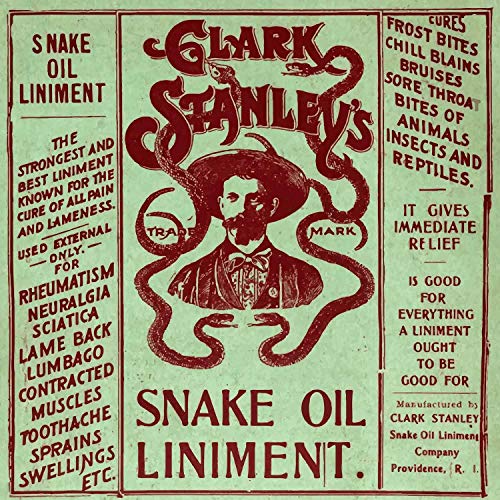
  2. Who is selling snake oil
  3. And who contradicts his own premises.Related image

Here are excerpts from his article:

Health Care Spending Is Out of Control
Health insurance doesn’t just protect people from financial ruin. It insulates them from individual decisions about price and service quality.
PETER SUDERMAN | FROM THE AUGUST/SEPTEMBER 2019 ISSUE of REASON

Health care in America costs too much because we pay for it the wrong way. And it’s all but certain that we’re going to continue doing so for a very long time.

The crux of the problem is third-party payment, or, as most people think of it, insurance.

The crux of the health care problem in America is insurance??? Americans would be better off if there were no health care insurance???

Pass me another swig of snake oil.

Health insurance doesn’t just protect people from financial ruin. It insulates them from individual decisions about price and service quality.

Those decisions become invisible, outsourced to a middleman—either a private insurer or a federal program—while the patient whose health is at stake is removed from the equation. The result is a system where prices are inscrutable, if they can even be called prices at all.

More spoiler alert: Suderman’s premises are:

  1. Health insurance is bad for America because it relieves you of an impossible task: Shopping for the best and also least expensive hospitals, doctors, nurses, etc. (He later will contradict this nonsense in his own article)
  2. Employees are the ones who actually pay too much for health care insurance when it is provided “free” by businesses. (He doesn’t actually say this, but he should have. It’s the one thing to which I would have agreed.)
  3. Federal taxpayers and the federal government can’t afford to pay for the increasing cost of Medicare. (This demonstrates his colossal ignorance of Monetary Sovereignty and federal financing). 

The dominance of third-party payment is almost entirely a result of two policy decisions that have warped the nation’s health care system for decades.

The first was the decision to allow employers to provide fringe benefits, including health coverage, tax-free. This created an incentive for employers to provide more expansive and more expensive coverage.

It made an extra dollar in salary, which would be subject to taxes, worth less than an extra dollar in benefits, which did not incur taxes.

Apparently, Suderman would prefer that employees and employers pay taxes on health care payments, which would reduce the number of companies that would pay for it, and the number of people who would receive it.

These reductions would benefit America how? He never says.

The result is that most private insurance is provided through employers, and it tends to be reasonably comprehensive, covering everything from ordinary doctor visits to foreseeable surgeries to truly catastrophic events.

Ooooh, “reasonably comprehensive” health care insurance. This is a bad thing, how? Suderman never says. Apparently, he thinks you should have insurance that won’t pay for . . . what?

Because employers and insurers manage the costs for everything, patients have little incentive to shop based on prices or quality, which can be difficult to determine anyway.

In addition, employers typically pay a large share of the monthly premium, meaning that tens of millions of people are kept ignorant about not only the cost of medical services but the true price of the insurance itself.

Here is where he contradicts his own premise. How many people are capable of intelligently shopping for health care based on prices and quality, which Suderman admits “can be difficult to determine anyway”?

If doctor “A” may be a  less skilled diagnostician than doctor “B,” but also is less costly for some procedures, but not for others, by what intelligent criteria can a layperson measure dollars vs. quality of care?

Taking price out of the equation simplifies the task for the average person. Only the very rich can afford to say, “I want the best, no matter the cost.”

As for the rest of us, are we would be left to say, “I can’t afford the best health care, so I’ll settle for the surgeon with the shaky hands.”

Seemingly, that is what Suderman wants for you.

The second policy decision was the introduction of Medicare (and, to a lesser extent, Medicaid) in the 1960s.

Medicare expanded a system of government-run third-party payment to seniors, who, for understandable reasons, consume an outsized share of health care services.

The result was a huge new revenue stream for the health care industry, which rapidly reorganized itself around extracting funds from the program—which is to say, from American taxpayers—by any means possible.

Apparently, Suderman thinks Medicare is a bad thing, because it provides “a huge new revenue stream for the health care industry.” The fact that it happens to provide affordable medical services for the elderly is not really a consideration to Suderman.

And there it is again, the ignorance of federal financing. After all these years of promulgating misinformation, Suderman hasn’t learned that state taxpayers fund state spending, and local taxpayers fund local spending, but federal taxpayers do not fund federal spending.
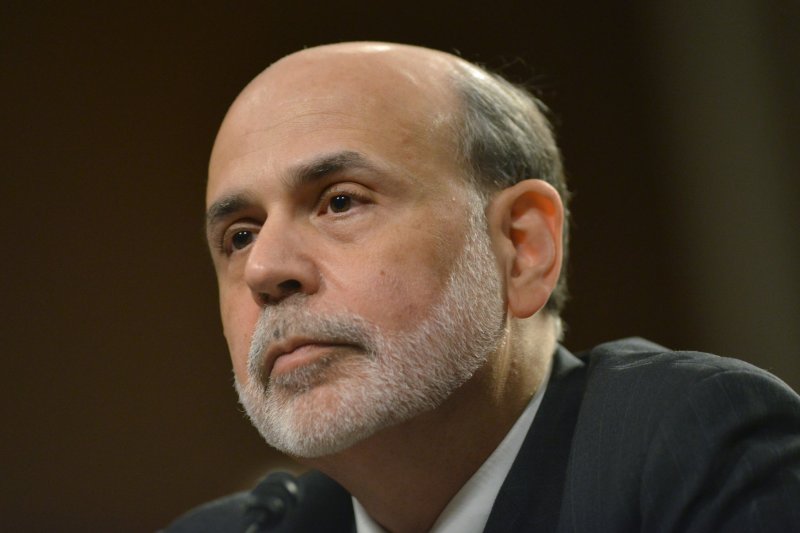
Image result for bernanke
Former Fed Chairman, Ben Bernanke: “The U.S. government has a technology, called a printing press (or, today, its electronic equivalent), that allows it to produce as many U.S. dollars as it wishes at essentially no cost.”

Suderman doesn’t understand (or doesn’t want you to understand) the fundamental differences between federal financing and state/local government financing.

(The federal government is Monetarily Sovereign. State and local governments are monetarily non-sovereign.)

Suderman’s ignorance about this basic fact is pitiful.

In the first year alone, average daily charges for U.S. hospitals shot up by 21.9 percent, according to professors Ted Marmor of Yale and Jon Oberlander of the University of North Carolina at Chapel Hill.

The rate of growth of physician fees more than doubled in the year between the law’s passage and Medicare going into effect.

During the first five years of the program’s existence, reimbursements through the program grew by 72 percent, while enrollment grew by just 6 percent.

And still, America is short of doctors, nurses, and hospital space. But Suderman wants to cut doctor, nurse, and hospital compensation. That should help America.

Better yet, cut Suderman’s compensation, and pay doctors and nurses more. We need more doctors and nurses, and fewer writers that spread disinformation.

In their recent book, Overcharged: Why Americans Pay Too Much for Health Care (Cato), Silver and Hyman argue that the U.S. health system is best understood not as a means of delivering the best possible care but as a system for funneling as much money to health care providers as possible.

Medicare, they note, will pay for countless expensive in-hospital tests and treatments for a dying individual but not less expensive palliative care offered in that same individual’s home.

Suderman not only wants less money for doctors, nurses, and hospitals, but less for tests and treatment of “dying individuals.” (“We’re cutting off your treatments, Mr. Jones.  You’ll be dead in a month, anyway, so this will just make it come a bit sooner. We hope you don’t mind.”)

And yes, the government should pay for palliative home care, just as it pays for hospice (though Suderman probably would complain about that, too, because he complains about all federal spending).

There are few meaningful checks on doctor reimbursements under the program; fraud and waste are pursued after the fact (if at all), which means doctors can always be assured of payment.

Wrong. Medicare and all private insurance companies do place limits on doctor reimbursements. In fact, Medicare’s limits are too low. Suderman surely knows this, so why does he claim otherwise?

Suderman claims your doctor is a wasteful fraud. Apparently, most doctors are, if Suderman says so.

He doesn’t like it that your doctor is “assured of payment.” Better that your doctor should have to sue or beg for payment??

The tax carve-out for employer-sponsored insurance pushes people into more comprehensive coverage, which increases overall demand for health care services, which makes health care providers more money.

If there is anything that angers Suderman, it’s people like you receiving the same “comprehensive coverage” he has.

And having such good care makes you go to the doctor when you aren’t even sick, right? Because you love getting stuck with blood test needles, and enduring digitals, just for the fun of it.

Suderman, who probably has comprehensive coverage, doesn’t want you to understand that overall demand increases when earlier programs were substandard.

It was as if the system was designed with only one goal in mind—maximizing not health or patient satisfaction but the amount of money Americans spend on health care.

The fiscally ruinous results speak for themselves.

Yes, the fiscally ruinous results of not having comprehensive care, have greatly been reduced by health care insurance. Apparently, Suderman believes only rich people deserve comprehensive care.

Silver and Hyman note that the Surgery Center of Oklahoma, a clinic that posts prices online and focuses on patients who pay cash, charges less than $20,000 for a knee replacement; the average price paid across the country is $57,000.

Uh, Peter, who are the people who can afford to pay $20,000 cash for a knee replacement? That’s right, the rich. They are the ones who trot to the Surgery Center of Oklahoma for the best care.

And what happens to the people who can’t afford $20,000 cash? Presumably, the Surgery Center of Oklahoma turns them away.

Fortunately, most people have that health care insurance you so despise.

And, the others just limp along on bad knees.

Direct payment by quality-conscious consumers is an effective way of bringing down costs and total spending. Which is exactly why it will never happen at scale.

No, direct payment by consumers won’t happen because it already has been tried, here and everywhere.

It’s called, “doing without insurance.” 

Heading into the 2020 election, Democrats have proposed multiple ways of expanding Medicare, including pushing Medicare for All, a single-payer system in which the government finances nearly all health care services in the United States.

Right. And what exactly is wrong with that? Suderman never says.

The failed 2017 (Republican) effort to “repeal and replace” Obamacare would have left much of its infrastructure, including most of its spending, in place.

. . . Left much of its infrastructure (and) most of its spending in place“??? What the hell is Suderman talking about? He has zero idea about what would be “left in place.” He’s just babbling ignorance.

And what spending would be “left in place”? Spending by whom? Surely not by the government. It’s the spending that the GOP wants to cut.

The best hope for change is very bleak indeed. Medicare is racing toward a predictable fiscal crisis. The program’s actuaries predict it will be insolvent in 2026, able to pay only about 89 percent of its bills. That percentage will drop below 80 percent in the coming decades.

The system as it exists today, in other words, is unsustainable. It simply can’t go on like it is—and if Congress continues to do nothing, it won’t

And then we finish off with the old “federal spending is unsustainable” lie. It’s the same lie that Suderman and those of his ilk have been telling since 1940 –even before he was born.

Back then, the federal debt was $40 Billion, and called a “ticking time bomb. Today, it is 50,000% higher at $20 Trillion, and that old time-bomb stills a’tickin’. Wrong for 80 years; still wrong, today.

I am tempted to say that Suderman and his ilk are damn fools, but that would give damn fools (like, for instance, Trump backers) a bad name.

So I’ll be kind and just say Peter Suderman is misinformed, and tries to make you uninformed, too.

Rodger Malcolm Mitchell
Monetary Sovereignty
Twitter: @rodgermitchell
Search #monetarysovereignty Facebook: Rodger Malcolm Mitchell

…………………………………………………………………………………………………………………………………………………………………………………………………………………………………………………………………………………………..

The most important problems in economics involve the excessive income/wealth/power Gaps between the richer and the poorer.

Wide Gaps negatively affect poverty, health and longevity, education, housing, law and crime, war, leadership, ownership, bigotry, supply and demand, taxation, GDP, international relations, scientific advancement, the environment, human motivation and well-being, and virtually every other issue in economics.

Implementation of The Ten Steps To Prosperity can narrow the Gaps:

Ten Steps To Prosperity:

1. Eliminate FICA

2. Federally funded Medicare — parts a, b & d, plus long-term care — for everyone

3. Provide a monthly economic bonus to every man, woman and child in America (similar to social security for all)

4. Free education (including post-grad) for everyone

5. Salary for attending school

6. Eliminate federal taxes on business

7. Increase the standard income tax deduction, annually. 

8. Tax the very rich (the “.1%”) more, with higher progressive tax rates on all forms of income.

9. Federal ownership of all banks

10. Increase federal spending on the myriad initiatives that benefit America’s 99.9% 

The Ten Steps will grow the economy, and narrow the income/wealth/power Gap between the rich and you.

MONETARY SOVEREIGNTY


The surprising reason why pharmacology is so difficult, really almost impossible.

It’s an all-too-familiar story. A laboratory somewhere announces that they have discovered a chemical formula that cures a previously intractable disease like cancer.

It works perfectly in Petri dishes, and in mice, and even in monkeys, and now the human trials begin.

Months later, we read that the formula not only didn’t work, but it made the patient sicker.

Why is pharmacology so difficult?

Biological evolution is nothing like human thinking. Biological evolution is much more like machine learning.

Consider the article titled, “Attacking Machine Learning with Adversarial Examples.”:

Adversarial examples are inputs to machine learning models that cause the model to make a mistake; they’re like optical illusions for machines.

To get an idea of what adversarial examples look like, consider this demonstration from Explaining and Harnessing Adversarial Examples: starting with an image of a panda, the attacker adds a small perturbation that has been calculated to make the image be recognized as a gibbon with high confidence.

An adversarial input, overlaid on a typical image, can cause a classifier to miscategorize a panda as a gibbon.

To the human eye, both panda pictures seem identical, but the machine “sees” them differently.

Pharmacology is difficult and machine-learning can be inscrutable, for essentially the same reasons. They do not follow the straight-line logic of human thought.

Consider this A to B puzzle.

Image result for a to b

To the human brain, the algorithm for traveling from A to B might be:

  1. Begin at A
  2. Travel along the dotted line to the airplane.
  3. Pass through the airplane to B.
  4. Stop.

Now consider this maze. What is your algorithm for going from one opening to the other?

Image result for maze

Your algorithm might be:

  1. Enter at either the top-left or bottom-right opening.
  2. Take any route.
  3. If that route gets you to the other opening, stop.
  4. If that route doesn’t get you to the other opening, go to #5.
  5. Enter at either the top-left or bottom-right opening, and take a different route from any route you ever have taken previously.
  6. Go to #3.

That’s the way you, as a typical human, might operate.

But this is the way a machine might begin:

  1. Erase half the lines.
  2. If you come to a dead end, open it and continue.
  3. Fold the paper in half so one opening touches the other.
  4. Draw a new maze.
  5. Write new rules.
  6. Jump up and down on the maze.
  7. Marry someone who owns a compass.
  8. Ask for the solution.

In short, both evolution and machine learning defy human rules and logic. but after many, many moves, might take you from one opening to the other.

For instance, if you marry someone who owns a compass (#7), that person also might happen to own a diagram that happens to show the solution to the maze. That’s how evolution operates.

The process may require millions of iterations, but computers work fast and evolution has plenty of time.

So those millions of iterations very well could provide a solution. It’s similar to the old story about the infinite number of monkeys pressing an infinite number of computer keys, and at some point (an infinite number of points, actually) they type all of Shakespeare’s plays.

Humans always are time-constrained. Biological evolution is not, which means that the paths to the survival of life can be mind-bendingly complex.

I thought about this when I came upon an article:

How tumors hide from chemotherapy
Bob Holmes

For decades, cancer researchers have wondered whether they could starve tumors into submission by choking off their blood supply and thus preventing their fast-growing cells from getting enough food and oxygen.

They developed a drug, Avastin, that blocks a molecular signal triggering blood vessel growth, or angiogenesis.

But, mysteriously, Avastin failed to improve survival unless patients received chemotherapy drugs at the same time — implying that Avastin was somehow helping the chemo to be more effective.

That piqued the interest of Rakesh Jain, a cancer researcher. “How can a drug that kills the blood supply help chemotherapy? You need the blood supply to get the drugs into the tumor.

He started digging deeper, and what he found turned conventional wisdom on its head.

The blood vessels that deliver food and oxygen — and chemotherapy drugs — to a tumor tend to be highly abnormal.

Instead of the usual large, straight, simply branched vessels, the ones in and around a tumor are often unevenly distributed, misshapen, and tangled.

As a result, some parts of the tumor end up far from any blood vessels and thus have little exposure to chemo.

Those same regions become starved of oxygen, and this hypoxia suppresses the immune system and also acts as a signal for the tumor cells to metastasize, or disperse to new sites.

(The blood vessels that supply a tumor often become misshapen and tangled, preventing chemo drugs from reaching the tumor. Drugs that restore normal blood flow can help make chemo more effective.)

Moderate doses of Avastin don’t outright suppress formation of blood vessels around a tumor but can actually make them look more normal, so that they can deliver chemotherapy more efficiently and evenly.

Jain’s clinical collaborators found — surprisingly — that patients who responded with increased blood flow to the tumor lived longer than patients in whom the blood flow declined.

Angiogenesis inhibitors work, in other words, for exactly the opposite reason than scientists initially thought.

Because we are the result of evolution, and evolution uses counter-intuitive “thinking,” solutions to our physical problems can come from that same, counter-intuitive thinking.

Consider, for example, the “illogical” the use of stimulants to combat ADHD:

Most parents wouldn’t give a child with attention deficit hyperactivity disorder (ADHD) a caffeinated drink, for fear that their hyperactivity would only worsen.

So why do doctors give stimulants to kids with ADHD?  It seems so counter-intuitive.

Evolutionary “thinking” and machine learning are not straight-line. They both are the product of “random walk,” processes,  in which each step is non-directed, but evaluated for success or failure.

File:Random Walk Simulator.gif
Five eight-step random walks from a central point. Some paths appear shorter than eight steps where the route has doubled back on itself.

If a step has some immediate value, or at least is not fatally harmful, it is retained as the basis for a next step, even though that earlier step may not have seemed to bring one closer to an ultimate solution.

Human thinking seeks solutions. We don’t have the time or capacity to retain and use all the various steps that might have had immediate value or not been fatallly harmful.

There are many routes to “survival of the fittest” (or more accurately, “survival of the fit enough“). Within our lifetimes, we can’t try them all.

Machine-learning works fast, but it doesn’t display its individual steps. It can tell you where it is, but not how it got there.

In the “panda/gibbon” example, above, we do not see the steps that led to the misidentification. We do not see the “logic.”

Because our brains are made by natural selection, while logic is an artificial construct, we do not know the details of why the following illusion works:

Related image
The illustration seems to quiver. Move it and it will seem to flap like a butterfly.

Biological evolution and machine learning are similar in that they operate via the random walk, a seemingly illogical, unpredictable, and indirect process, alien to human thinking.

Unless, sometime in the distant future, we know, then program a computer with, the cause/effect of every atom and every linkage in the human body, while overcoming the limits of the Uncertainty Principle,  we repeatedly will be amazed that when starting from A, B, C and reaching X, Y, Z, we did not pass through L, M, N.

And that is why pharmacology is so difficult, really almost impossible.

Rodger Malcolm Mitchell
Monetary Sovereignty
Twitter: @rodgermitchell
Search #monetarysovereignty Facebook: Rodger Malcolm Mitchell

…………………………………………………………………………………………………………………………………………………………………………………………………………………………………………………………………………………………..

The most important problems in economics involve the excessive income/wealth/power Gaps between the richer and the poorer.

Wide Gaps negatively affect poverty, health and longevity, education, housing, law and crime, war, leadership, ownership, bigotry, supply and demand, taxation, GDP, international relations, scientific advancement, the environment, human motivation and well-being, and virtually every other issue in economics.

Implementation of The Ten Steps To Prosperity can narrow the Gaps:

Ten Steps To Prosperity:

1. Eliminate FICA

2. Federally funded Medicare — parts a, b & d, plus long-term care — for everyone

3. Provide a monthly economic bonus to every man, woman and child in America (similar to social security for all)

4. Free education (including post-grad) for everyone

5. Salary for attending school

6. Eliminate federal taxes on business

7. Increase the standard income tax deduction, annually. 

8. Tax the very rich (the “.1%”) more, with higher progressive tax rates on all forms of income.

9. Federal ownership of all banks

10. Increase federal spending on the myriad initiatives that benefit America’s 99.9% 

The Ten Steps will grow the economy, and narrow the income/wealth/power Gap between the rich and you.

MONETARY SOVEREIGNTY

 

.

Sanders’s climate change ideas spoiled by cowardice.

Bernie Sanders has proposed a list of his Presidential aspirations, which is long on goals, though short on specific details.

Image result for bernie sanders
The next time you hear me attacked as a socialist, remember this: I don’t believe that government should take over the grocery store down the street or control the means of production.

President Trump was elected with a much shorter list (eliminate Obamacare, build a wall, do the NRA’s and Vladimir Putin’s bidding, deny science, attack allies while sucking up to dictators),  and blame others for his failures, so perhaps Bernie can be forgiven for his omission of specificity.

New York Times: 8/22/19
Sen. Bernie Sanders (I-Vt.) on Thursday unveiled an aggressive $16.3 trillion climate change plan that calls for the U.S. to reach 100 percent renewable energy for electricity and transportation “no later than” 2030, as well as for “complete decarbonization” by 2050.

He refers to the plan itself, which would also declare climate change a national emergency, as a Green New Deal.

 Here are some sample features of one proposal

  • Reaching 100 percent renewable energy for electricity and transportation by no later than 2030 and complete decarbonization by 2050 at latest – consistent with the United Nations Intergovernmental Panel on Climate Change goals – by expanding the existing federal Power Marketing Administrations to build new solar, wind, and geothermal energy sources.
  • Ending unemployment by creating 20 million jobs needed to solve the climate crisis. These jobs will be good-paying, union jobs with strong benefits and safety standards in steel and auto manufacturing, construction, energy efficiency retrofitting, coding and server farms, and renewable power plants.
  • We will also create millions of jobs in sustainable agriculture, engineering, a reimagined and expanded Civilian Conservation Corp, and preserving our public lands.
  • Directly invest an historic $16.3 trillion public investment toward these efforts, in line with the mobilization of resources made during the New Deal and WWII, but with an explicit choice to include black, indigenous and other minority communities who were systematically excluded in the past.
  • A just transition for workersThis plan will prioritize the fossil fuel workers who have powered our economy for more than a century and who have too often been neglected by corporations and politicians.
  • We will guarantee five years of a worker’s current salary, housing assistance, job training, health care, pension support, and priority job placement for any displaced worker, as well as early retirement support for those who choose it or can no longer work.
  • Declaring climate change a national emergencyWe must take action to ensure a habitable planet for ourselves, for our children, and for our grandchildren. We will do whatever it takes to defeat the threat of climate change.
  • Saving American families money by weatherizing homes and lowering energy bills, building affordable and high-quality, modern public transportation, providing grants and trade-in programs for families and small businesses to purchase high-efficiency electric vehicles, and rebuilding our inefficient and crumbling infrastructure, including deploying universal, affordable high-speed internet.
  • Supporting small family farms by investing in ecologically regenerative and sustainable agriculture. This plan will transform our agricultural system to fight climate change, provide sustainable, local foods, and break the corporate stranglehold on farmers and ranchers.
  • Justice for frontline communities – especially under-resourced groups, communities of color, Native Americans, people with disabilities, children and the elderly – to recover from, and prepare for, the climate impacts, including through a $40 billion Climate Justice Resiliency Fund.
  • Commit to reducing emissions throughout the world, including providing $200 billion to the Green Climate Fund, rejoining the Paris Agreement, and reasserting the United States’ leadership in the global fight against climate change.
  • Meeting and exceeding our fair share of global emissions reductions. We will reduce domestic emissions by at least 71 percent by 2030 and reduce emissions among less industrialized nations by 36 percent by 2030 — the total equivalent of reducing our domestic emissions by 161 percent.
  • Making massive investments in research and development. We will invest in public research to drastically reduce the cost of energy storage, electric vehicles, and make our plastic more sustainable through advanced chemistry. 
  • Expanding the climate justice movement. We will do this by coming together in a truly inclusive movement that prioritizes young people, workers, indigenous peoples, communities of color, and other historically marginalized groups to take on the fossil fuel industry and other polluters to push this over the finish line and lead the globe in solving the climate crisis.
  • Investing in conservation and public lands to heal our soils, forests, and prairie lands. We will reauthorize and expand the Civilian Conservation Corps and fully fund the Land and Water Conservation Corps to provide good-paying jobs building green infrastructure.

One may disagree with some aspects of this list, but if one truly wishes to “make America great, again,” the list overall is a much better starting place than caging children and deny the poor of medical insurance.

There is, however, one aspect of the list that demonstrates abject cowardice and ignorance:

This plan will pay for itself over 15 years“, Bernie claims. 

“We will pay for the massive investment we need to reverse the climate crisis by:

  • Making the fossil fuel industry pay for their pollution, through litigation, fees, and taxes, and eliminating federal fossil fuel subsidies.
  • Generating revenue from the wholesale of energy produced by the regional Power Marketing Authorities. Revenues will be collected from 2023-2035, and after 2035 electricity will be virtually free, aside from operations and maintenance costs.
  • Scaling back military spending on maintaining global oil dependence.
  • Collecting new income tax revenue from the 20 million new jobs created by the plan.
  • Reduced need for federal and state safety net spending due to the creation of millions of good-paying, unionized jobs.
  • Making the wealthy and large corporations pay their fair share.
  • Sanders says his proposal would “pay for itself” in 15 years and create 20 million jobs. It would impose new taxes on the fossil fuel industry and eliminate subsidies, which he says would account for $3.1 trillion and be a way of making the industry “pay for their pollution.”

No, the plan will not pay for itself. Nor will federal taxpayers fund the plan. Federal taxes pay for nothing.

The plan, as proposed, will be funded by federal deficit spending, which will pump $16 trillion growth dollars into the economy. The federal government, being Monetarily Sovereign, never can run short of its own sovereign currency, the U.S. dollar.

Image result for bernanke and greenspan
It’s our little secret. Don’t tell the people we don’t use their tax dollars.

Ben Bernanke: “The U.S. government has a technology, called a printing press (or, today, its electronic equivalent), that allows it to produce as many U.S. dollars as it wishes at essentially no cost.”

Alan Greenspan: “Central banks can issue currency, a non-interest-bearing claim on the government, effectively without limit. A government cannot become insolvent with respect to obligations in its own currency.”

St. Louis Federal Reserve: “As the sole manufacturer of dollars, whose debt is denominated in dollars, the U.S. government can never become insolvent, i.e.,unable to pay its bills. In this sense, the government is not dependent on credit markets to remain operational.

Bernie demonstrates courage by proposing such far-reaching plans, but he demonstrates cowardice by failing to tell the voters the truth, namely:

  1. Our Monetarily Sovereign federal government never can run short of its own sovereign currency, the U.S. dollar. It can afford anything, and it does not need to collect dollars from domestic or foreign taxpayers.
  2. The federal deficit and debt are not a burden on the federal government or on federal taxpayers, nor do the deficit and debt limit any future federal spending.
  3. The federal deficit and debt do not lead to inflation, which actually is caused by shortages of goods, not by excess dollars.

By hiding the facts, Sanders is reduced to proposing complex, economy-crushing tax-collection schemes supposedly to “pay for” the federal spending that the federal government easily pays for without taxes.

Thus Sanders must defend not only his spending proposals, but his tax-collection proposals, making passage of his plans far more difficult.


Rodger Malcolm Mitchell
Monetary Sovereignty
Twitter: @rodgermitchell
Search #monetarysovereignty Facebook: Rodger Malcolm Mitchell

…………………………………………………………………………………………………………………………………………………………………………………………………………………………………………………………………………………………..

The most important problems in economics involve the excessive income/wealth/power Gaps between the richer and the poorer.

Wide Gaps negatively affect poverty, health and longevity, education, housing, law and crime, war, leadership, ownership, bigotry, supply and demand, taxation, GDP, international relations, scientific advancement, the environment, human motivation and well-being, and virtually every other issue in economics.

Implementation of The Ten Steps To Prosperity can narrow the Gaps:

Ten Steps To Prosperity:

1. Eliminate FICA

2. Federally funded Medicare — parts a, b & d, plus long-term care — for everyone

3. Provide a monthly economic bonus to every man, woman and child in America (similar to social security for all)

4. Free education (including post-grad) for everyone

5. Salary for attending school

6. Eliminate federal taxes on business

7. Increase the standard income tax deduction, annually. 

8. Tax the very rich (the “.1%”) more, with higher progressive tax rates on all forms of income.

9. Federal ownership of all banks

10. Increase federal spending on the myriad initiatives that benefit America’s 99.9% 

The Ten Steps will grow the economy, and narrow the income/wealth/power Gap between the rich and you.

MONETARY SOVEREIGNTY

Make America Disgraced Again. MADA

With his slogan, “Make America Great, Again,” Trump implied that America was not great. And, historically speaking, he was right that America has not always been great.

There were, in fact, many times when we Americans disgraced ourselves.

  1. We Americans disgraced ourselves during the years we enslaved, tortured and killed black people.
  2. We Americans disgraced ourselves when we imprisoned Japanese Americans during WWII.
  3. We Americans disgraced ourselves when we turned away the SS St. Louis, loaded with Jews trying to escape Hitler.
  4. We Americans disgraced ourselves during the years we refused voting rights for women and blacks.
  5. We Americans disgraced ourselves during the years of anti-Irish sentiment.
  6. We Americans disgraced ourselves when we killed native Americans, and broke our treaties with them.
  7. We Americans disgraced ourselves when we prosecuted the Vietnam war, unnecessarily killing millions of innocent Vietnamese and Americans.
  8. We Americans still disgrace ourselves by jailing, per capita, more people than any other nation on earth, and then compounding the problem by giving guns — high-powered guns — to any fool who wants one.
  9. We Americans still disgrace ourselves by denying millions of people affordable health care, while “lesser” countries offer it.
  10. Millions of Americans disgrace themselves by supporting an absurd, immoral, ill-prepared, unqualified President.

Though America has been great in many, many ways, and still is, it is being led far, far from its previous glories.

Image result for trump
(I have second thoughts about everything.” [At G7, 8/24/2019]

Newsweek DAILY BRIEFING – 08.21.2019
TRUMP ADMIN TO DETAIN CHILDREN INDEFINITELY
The Trump administration has issued a rule change that would end limits on migrant minors’ time in detention and limit safeguards against cruel and unsanitary conditions.

California Senator Kamala Harris asked on Twitter Wednesday, “how does detaining families longer make our border secure or stop transnational gangs — things the DHS should actually be spending their time doing?”

Senator Elizabeth Warren: “The Flores agreement mandates that migrant children cannot be held in detention for more than 20 days. Today, the Trump administration announced its plans to roll back Flores—putting thousands of children in danger.

Inspectors found soiled, emotionally distraught children who were unable to brush their teeth or shower. The administration tried to justify not providing kids with soap and toothbrushes.

The new rule would remove a 20-day limit on detaining families in jails. Families will now be sent to “family residential centers” where they will remain until their immigration case is heard.

It takes an average of 713 days for a judge to hear a case.

“The detention of children can lead to trauma, suicidal feelings, and exposure to dangerously inadequate medical care,” said Clara Long, acting deputy Washington director at Human Rights Watch. “No amount of time in detention is safe for children and prolonged detention is particularly harmful.”

The torturing of innocent men, women, and children is not the badge of a great nation.

The Trump administration, rather than making America great again, instead has chosen to repeat the worst, immoral, cruel excesses of previously disgraced administrations.

Trump’s method for “making America great, again,” includes insulting our allies:

Trump scolds Denmark, calls prime minister ‘nasty’
By Jan M. Olsen and Laurie Kellman Associated Press
Trump said Wednesday he scrapped his trip to Denmark because the prime minister made a “nasty” statement when she rejected his idea to buy Greenland as an absurdity.

“You don’t talk to the United States that way, at least under me,” Trump told reporters in Washington. “I thought it was not a nice statement, the way she blew me off.”

Danish Prime Minister Mette Frederiksen called the whole thing “an absurd discussion” and said she was “disappointed and surprised” that Trump had canceled his visit.

Trump said Frederiksen’s comment labeling his idea as absurd “was nasty.

Trump’s cancellation was “deeply insulting to the people of Greenland and Denmark,” former Prime Minister Helle Thorning-Schmidt wrote on Twitter.

Claus Oxfeldt, chairman of Denmark’s main police union, told Danish media that “It has created great frustrations to have spent so much time preparing for a visit that is canceled,” Oxfeldt was quoted as saying.

There stood Trump, whose every tweet insults someone,* suddenly becoming hyper-sensitive by claiming “America” was insulted when the Danish Prime Minister rightfully called his absurd idea, “absurd.” ( *See: The 598 People, Places and Things Donald Trump Has Insulted on Twitter)

No, Mr. Trump, you are not America, and America was not insulted. You, however, are known internationally as an absurd boor, and that, unfortunately, reflects poorly on us Americans.

In short, every day, it is you Mr. Trump, who insults America.

Trump doubles down on charge that Jews who vote Democrat are ‘disloyal’ [The New York Times]
President Trump on Wednesday repeated his allegation that Jews who vote for Democrats are “being very disloyal to Jewish people and very disloyal to Israel.”

Trump also thanked conservative radio host Wayne Allyn Root (an evangelical Christian) for saying Jews in Israel love Trump “like he’s the King of Israel” and “the second coming of God.

Jonathan Greenblatt, the head of the Anti-Defamation League, said Trump was trying to make himself out to be a savior. “Literally, it’s hard to think of something less kosher than telling the Jewish people you’re the king of Israel, and therefore, we should have some fidelity to you.”

Trump’s comment that Jews are, or should be, loyal to Israel, is part of the bigot’s old trope that Jews are not loyal to the country in which they live.

It was the excuse Hitler gave for murdering them. That slur, together with Trump’s love for dictators, has him re-emerging as the next Hitler “wannabe.”

And as for showing loyalty to a bigot like Trump, the vast majority of Jews have learned from Hitler, the cost of bigotry. When any group is maltreated by a bigot, eventually the maltreatment falls on the Jews. It’s always the Jews.

With Trump as its leader, America cannot claim greatness, nor can those who continue to back Trump.

Trump says he’s ‘Chosen One’ to take on China over trade
From CNBC
President Trump on Wednesday framed his trade war with China in religious terms, saying he was “the Chosen One” to confront Beijing over economic policies he considers unfair to the U.S.

“This isn’t my trade war, this is a trade war that should have taken place a long time ago. Somebody had to do it,” Trump said. He then looked up and pointed to the heavens, saying, “I am the Chosen One.”

Historically, dictators have portrayed themselves as God, or one chosen by God.

From the Pharaohs to Rafael Trujillo (“God in Heaven, Trujillo on Earth”) to Francisco Macias Nguema (“There is no other God than Macias Nguema”) to Trump’s pal, Kim Jong-Il (“Creator of the Universe“).

Will Americans, one day, refer to Donald Trump as “the chosen one”?

Every day, Trump disgraces America and each of us. Fortunately, every four years, we are given the ability to reverse our past errors of judgment or immorality.

Rodger Malcolm Mitchell
Monetary Sovereignty
Twitter: @rodgermitchell
Search #monetarysovereignty Facebook: Rodger Malcolm Mitchell

…………………………………………………………………………………………………………………………………………………………………………………………………………………………………………………………………………………………..

The most important problems in economics involve the excessive income/wealth/power Gaps between the richer and the poorer.

Wide Gaps negatively affect poverty, health and longevity, education, housing, law and crime, war, leadership, ownership, bigotry, supply and demand, taxation, GDP, international relations, scientific advancement, the environment, human motivation and well-being, and virtually every other issue in economics.

Implementation of The Ten Steps To Prosperity can narrow the Gaps:

Ten Steps To Prosperity:

1. Eliminate FICA

2. Federally funded Medicare — parts a, b & d, plus long-term care — for everyone

3. Provide a monthly economic bonus to every man, woman and child in America (similar to social security for all)

4. Free education (including post-grad) for everyone

5. Salary for attending school

6. Eliminate federal taxes on business

7. Increase the standard income tax deduction, annually. 

8. Tax the very rich (the “.1%”) more, with higher progressive tax rates on all forms of income.

9. Federal ownership of all banks

10. Increase federal spending on the myriad initiatives that benefit America’s 99.9% 

The Ten Steps will grow the economy, and narrow the income/wealth/power Gap between the rich and you.

MONETARY SOVEREIGNTY