Only 450 words answer the question, “Does printing money cause inflation?”

Does “printing” money cause inflation? Or is so-called “printing” money the best way to cure inflation?

1. The federal government does not print money. It prints
Federal Reserve Notes (FRN), which are not dollars, but rather are bearer certificates: Titles to dollars.

Only a small percentage of dollars are represented by FRNs.

2. Dollars are balance sheet numbers. They have no physical existence. You cannot feel, see, hear, smell, or taste dollars.

3. The government, being Monetarily Sovereign, has the unlimited ability to create dollars. The government never unintentionally can run short of dollars.

4. Printing FRNs does not cause inflations. The reverse is true. The printing of FRNs results from inflations.

5. The cause of inflations — a general increase in prices — is shortages, generally scarcities of energy and/or food.

Scarcity causes prices to rise, and widespread scarcities of food and/or oil, cause widespread price increases.

6. Federal deficit spending actually can prevent or cure inflations, if the spending cures the shortages.

Case in point: Zimbabwe’s inflation came when its government seized farmland from farmers and gave it to non-farmers, who could not grow enough food.

The resultant food shortage caused hyperinflation, which the government could have cured by deficit spending to purchase food from other countries.

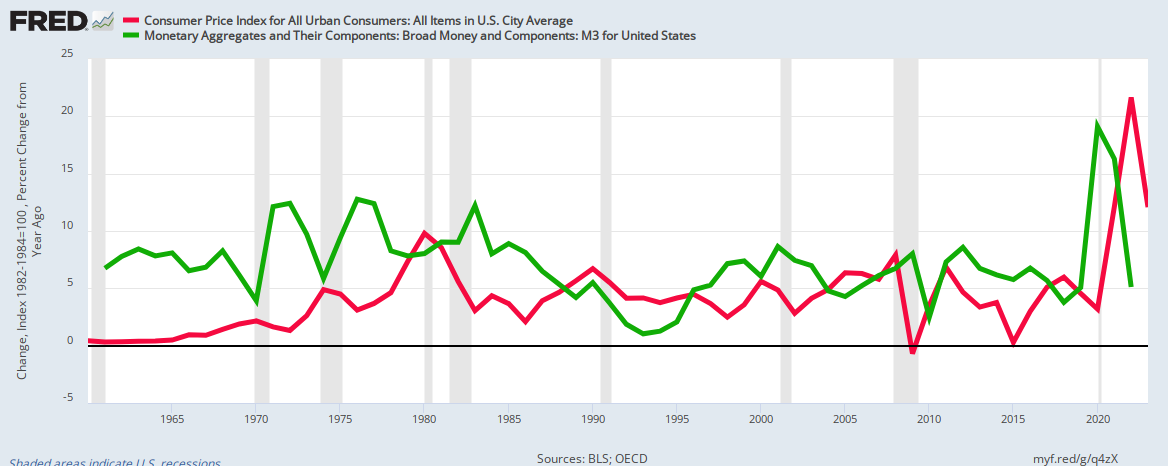
The graph below compares changes in the U.S. money supply (Green – M3) to changes in inflation (red).

Changes in M3 (green) are NOT predictive of changes in prices (red).

The graph below compares changes in the price of oil (blue) (which closely reflect shortages) to changes in inflation. (red).

Changes in the price of oil ((blue — which closely reflect supply changes) ARE predictive of inflation.

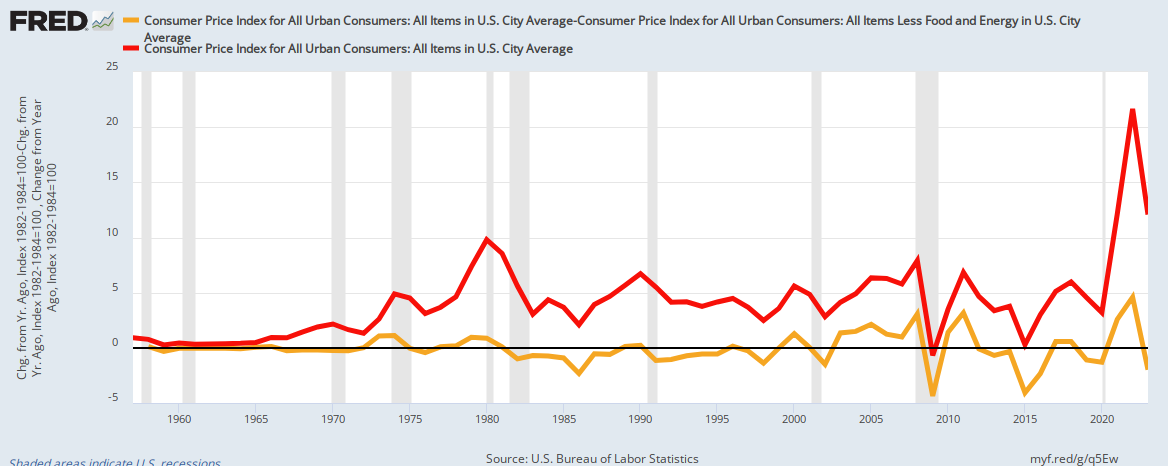
The graph below compares the overall Consumer Price Index (Red) to the price index of food and energy (gold). Food and energy prices (which reflect availability) are predictive of overall inflation.

Food and energy inflation (gold) IS predictive of overall inflation (red).

Discussion of federal projects generally lead to the question, “How will you pay for it.” The correct answer never is, “by raising taxes” or “by cutting other spending.”

The correct answer always is, via federal deficit spending.

In summary:
Prices rise (inflation) because of scarcity, usually a scarcity of food and/or energy. Curing the scarcity reduces prices.

Scarcity can be cured by federal deficit spending to purchase the scarce items and distribute them into the economy.

The amount of deficit spending is not the key to inflation or its cure. The key is how the deficit spending is used.

Deficit spending, to purchase the scarce items, cures inflations. Poorly directed deficit spending that does not cure the scarcity, will worsen inflation.

A Monetarily Sovereign government cannot run short of the sovereign currency needed to cure an inflation.

Rodger Malcolm Mitchell
Monetary Sovereignty
Twitter: @rodgermitchell
Search #monetarysovereignty Facebook: Rodger Malcolm Mitchell

…………………………………………………………………………………………………………………………………………………………………………………………………………………………………………………………………………………………..

The most important problems in economics involve:

  1. Monetary Sovereignty describes money creation and destruction.
  2. Gap Psychology describes the common desire to distance oneself from those “below” in any socio-economic ranking, and to come nearer those “above.” The socio-economic distance is referred to as “The Gap.”

Wide Gaps negatively affect poverty, health and longevity, education, housing, law and crime, war, leadership, ownership, bigotry, supply and demand, taxation, GDP, international relations, scientific advancement, the environment, human motivation and well-being, and virtually every other issue in economics.

Implementation of Monetary Sovereignty and The Ten Steps To Prosperity can grow the economy and narrow the Gaps:

Ten Steps To Prosperity:

1. Eliminate FICA

2. Federally funded Medicare — parts A, B & D, plus long-term care — for everyone

3. Provide a monthly economic bonus to every man, woman and child in America (similar to social security for all)

4. Free education (including post-grad) for everyone

5. Salary for attending school

6. Eliminate federal taxes on business

7. Increase the standard income tax deduction, annually. 

8. Tax the very rich (the “.1%”) more, with higher progressive tax rates on all forms of income.

9. Federal ownership of all banks

10. Increase federal spending on the myriad initiatives that benefit America’s 99.9% 

The Ten Steps will grow the economy and narrow the income/wealth/power Gap between the rich and the rest.

MONETARY SOVEREIGNTY

I just received an advertisement for Trumpcare. Should I join?

I just received an advertisement for Trumpcare. Should I join?

The advertisement was in the form of an Email. It came with a nice logo, featuring a symbolic American flag, and looked quite official.

It resembles what I might receive from a federal agency:

Trumpcare logo.png

Alas, like all things associated with Donald Trump, Trumpcare is mostly BS, a non-existent “program” designed and named solely to stroke the endlessly needy ego of Donald J. Trump and his fact-blind followers.

There is no Trumpcare. There only is a group of proposed modifications to Obamacare (ACA) that provide less care, and cost more than the original.

One of the most important features of Obamacare is the ban on discrimination against pre-existing conditions.

Here is what the site “TrumpCare and Pre-Existing Conditions” says:

TrumpCare weakens (not eliminates) key protections for women, seniors, low-income Americans, and those with pre-existing conditions, which could result in tens of millions (including those with pre-existing conditions) being excluded to from the market or placed in a high-risk pool due to cost.

If one wants to speak truthfully without diving into the whole explainer above, they can simply say, “TrumpCare/ The American Healthcare Act weakens pre-existing conditions protections.”

Or more generally, “TrumpCare/ The American Healthcare Act weakens protections for women, seniors, low-income Americans, and those with pre-existing conditions.”

If one wants to add more detail they can say, “The state waivers, paired with reduced cost assistance, a fee for re-entering the market, less employers offering health plans, and the freezing of Medicaid expansion could lead to many being effectively excluded from insurance due to having a pre-existing condition (the effect is indirect, not direct).”

FACT: As many as 1 in 2 Americans have a condition that could count as a pre-existing condition and, although not every possible pre-existing condition would be excluded, a portion of those 50% with pre-existing conditions could see new hurdles under TrumpCare.

FACT: The plan (before the Amendments) had a price tag that came in under the ACA according to the Congressional Budget Office, saving $337 billion (for the federal government) over the decade (according to their first report).

However, it did this by leaving 52 million without coverage by 2026 (it increases the uninsured by 24 million by 2026 for a total of 52 million).

The cost and uninsured rate are subject to change based on changes to the bill.

Much like Trump University and Trump Foundation, Trumpcare is a bit of sleight-of-hand that seems to promise much, but in reality, it is a figment of Trump’s imagination.

The changes from Obamacare mostly involve turning over to the states, decisions about benefits.

Those of you who live in “red” states know what that means: If you’re middle- or lower-income, you’re about to be cheated by right-wing, “states rights” bologna.

Continuing with the article:

Very simply, TrumpCare/ The American Healthcare Act weakens pre-existing conditions protections.”

Or more generally, “TrumpCare/ The American Healthcare Act weakens protections for women, seniors, low-income Americans, and those with pre-existing conditions.”

If one wants to add more detail they can say, “The state waivers, paired with reduced cost assistance, a fee for re-entering the market, fewer employers offering health plans, and the freezing of Medicaid expansion could lead to many being effectively excluded from insurance due to having a pre-existing condition (the effect is indirect, not direct).”

FACT: As many as 1 in 2 Americans have a condition that could count as a pre-existing condition and, although not every possible pre-existing condition would be excluded, a portion of those 50% with pre-existing conditions could see new hurdles under TrumpCare.

FACT: The plan (before the Amendments) had a price tag that came in under the ACA according to the Congressional Budget Office, saving (the federal government) $337 billion over the decade (according to their first report).

However, it did this by leaving 52 million without coverage by 2026 (it increases the uninsured by 24 million by 2026 for a total of 52 million).

The cost and uninsured rate are subject to change based on changes to the bill.

In summary, so-called “Trumpcare,” if it ever existed, would save money for the Monetarily Sovereign U.S. government (which can afford anything and never run short of dollars), while shifting a massive health burden to the middle- and lower-income people.

By the way, as a lark, I went through that website advertising the non-existent “Trumpcare,” and came to this page  ———————->

Trumpcare Obamacare.png
“Here’s Trumpcare.”

Apparently, “Trumpcare is Obamacare. Surprised?

If you liked Trump University, Trump Foundation, Trump Steaks, Trump Airlines, Trump Vodka, the Trump Casinos, Trump Mortgage, Trump Magazine, Trump Tower Panama, GoTrump.com, Trump: the game, and my very favorite,  Donald Trump, the fragrance (for those of you who wish to smell like Trump), all of which were failures (and some illegal), perhaps you also will enjoy Trumpcare — if it ever passes.

But as with all things Trump, hang on to your wallet.

And by the way, none of the business failures was Trump’s fault. Ask him.

Rodger Malcolm Mitchell
Monetary Sovereignty
Twitter: @rodgermitchell
Search #monetarysovereignty Facebook: Rodger Malcolm Mitchell

…………………………………………………………………………………………………………………………………………………………………………………………………………………………………………………………………………………………..

The most important problems in economics involve:

  1. Monetary Sovereignty describes money creation and destruction.
  2. Gap Psychology describes the common desire to distance oneself from those “below” in any socio-economic ranking, and to come nearer those “above.” The socio-economic distance is referred to as “The Gap.”

Wide Gaps negatively affect poverty, health and longevity, education, housing, law and crime, war, leadership, ownership, bigotry, supply and demand, taxation, GDP, international relations, scientific advancement, the environment, human motivation and well-being, and virtually every other issue in economics.

Implementation of Monetary Sovereignty and The Ten Steps To Prosperity can grow the economy and narrow the Gaps:

Ten Steps To Prosperity:

1. Eliminate FICA

2. Federally funded Medicare — parts A, B & D, plus long-term care — for everyone

3. Provide a monthly economic bonus to every man, woman and child in America (similar to social security for all)

4. Free education (including post-grad) for everyone

5. Salary for attending school

6. Eliminate federal taxes on business

7. Increase the standard income tax deduction, annually. 

8. Tax the very rich (the “.1%”) more, with higher progressive tax rates on all forms of income.

9. Federal ownership of all banks

10. Increase federal spending on the myriad initiatives that benefit America’s 99.9% 

The Ten Steps will grow the economy and narrow the income/wealth/power Gap between the rich and the rest.

MONETARY SOVEREIGNTY

Knowing nothing about the role of the Federal Reserve, Trump hires a wrong-headed sycophant.

Trump’s knowledge of the Federal Reserve approximates his knowledge of men’s hairstyles, tie length, and the truth.

Trump Called Powell an ‘Enemy.’

“My only question is, who is our bigger enemy, Jay Powell or Chairman Xi?” Mr. Trump wrote.

Kevin Cramer, Republican of North Dakota criticized Mr. Trump’s attacks on Mr. Powell: “This is an area where I frankly disagree with the president. He’s forever attacking the Federal Reserve and particularly Jay Powell.

They are independent of politics, and they ought to remain independent of politics.”

To Trump, nothing is independent of politics. Trump has but one criterion in evaluating people: Do they express eternal fealty for him?

As for other criteria: Talent? No.
Knowledge” No.
Honesty? Are you kidding? In a Trump administration?
Intelligence? Only if it’s low.

Lawmakers from both parties routinely give the Fed chair high marks.

Their view of the chair matters, because while the president nominates members to the Fed’s Board of Governors, the White House has no other significant power over the central bank.

Monetary policymakers answer to Congress.

Sadly, the President does have the power to fire the Fed Chairman “for cause,” which with a slavish, timid, immoral GOP, “cause” would be any nonsense Trump could dream up.

Thank heavens Trump feels reluctant to take that step, or by now we would have had half a dozen Scott Pruits and Paul Manaforts as Fed Chairmen.

And yet::

Trump has recently nominated a Fed critic, Judy Shelton, to sit among the Fed’s leadership in Washington.

Her confirmation hearing could come as soon as Feb. 13, 2020.

True to form, Trump has nominated a useless sycophant:

Which Judy Shelton will the Fed get? Gold standard advocate or Trump defender?
By Sam Bell, Jan 29, 2020
Fed nominee has flip-flopped 180 degrees on monetary policy since Trump’s election; will she flip back?

After describing low interest rates as an assault on democratic capitalism during the Obama years, Shelton now embraces lower rates and suggests that the next Bretton Woods conference to reshape international monetary arrangements should be held at Mar-a-Lago.

Many have already written about her flip-flops, including the Wall Street Journal’s Greg Ip and Bloomberg’s Ramesh Ponnuru.

As Ip writes, “Having accused the Fed, under Mr. Obama, ‘of catering to the political class,’ she now says it should support Mr. Trump’s agenda by cutting interest rates to ‘ensure maximum access to capital.’”

If the above doesn’t send shivers up your spine, you have become far too inured to Trump’s own lies and incompetence.

Not only does Shelton have no consistent or coherent policy regarding interest rates, and not only is she an obvious fawner to a compulsive “fawnee,” but she wants to return us to a (fools) gold standard.

And not just an ordinary gold standard but . . .

A “Universal Gold Reserve Bank that would have the potential to become a sort of global monetary authority.”

Thus, does Shelton want the U.S. to surrender the single most valuable asset any government can have — its Monetary Sovereignty — but she also wants the entire world to give up Monetary Sovereignty to an unelected group of what? Honest bankers?

And she fleshes out this truly dumb idea, by making it even worse, if that’s possible:

Circa 2000 Shelton toyed with the idea of a common currency for North America.

“The common currency for this union could be an ‘amero,’” — and she even favored a global common currency.

She asked, “how can we ignore the parallel need for a common unit of account, a global form of money?”

Ah yes, a a global common currency, a cousin of the truly awful euro, which essentially has destroyed the economies of those nations that have adopted it.

The euro nations, having surrendered control over their own money, and given control to the new Masters, the European Union bankers and their billionaire patrons, have “had” to foist austerity on the masses.

For a monetarily non-sovereign government, austerity is necessary, because unlike a Monetarily Sovereign government, such a government needs some form of income. This income must be derived from taxes, which eventually requires net exports.

But because exports must equal imports, if some nations have net exports, other nations must have net imports, and net imports send money out of the country.

That’s fine for a Monetarily Sovereign government like the U.S., which has the unlimited ability to create its sovereign currency,  so it never can run short of money. But it’s not so fine for the euro governments, which gave away that power, and who now live at the mercy of rapacious EU bankers.

And that is what Shelton wants for America.

And she is what Trump wants for the Federal Reserve, An obsequious “yes” woman to run  an institution he feels is unnecessary, even harmful.

Trump’s ignorance is reflected in such headlines as:
Trump says the Federal Reserve has ‘gone crazy,’ and
Trump says the Federal Reserve caused the stock market correction, and
Trump says U.S. Federal Reserve ‘too proud to admit mistake’, and
Trump knocks ‘boneheads’ at Federal Reserve, says interest rates should be ‘zero, or less’ and the best one,
Trump: I Will Abolish The Federal Reserve

See the plan? When the economy and/or the stock market do well, it’s because of Trump. But if they do poorly, it’s because of the Fed. Perfect

The self-anointed “stable genius” has all bases covered. He can’t lose.

Judging by her record, a Shelton Federal Reserve would like nothing better than to end the Fed and hand the powers to a new global monetary authority, the Universal Gold Reserve Bank.

She believes that setting monetary policy to address domestic conditions is “selfish.” (Really.)

In the absence of a proper gold standard, she says she favors fixing the dollar to rival currencies or gold. (Never mind that this would put American monetary policy at the whim of gold speculators and European central bankers.)

For Shelton, limiting the Fed’s power is the point.

Of course, this all assumes she would show up for the job. The last time the Senate confirmed her for a position — U.S. envoy to the European Bank for Reconstruction and Development — she missed about half the meetings, as the Wall Street Journal reported in August.

If the lousy attendance record, the ceding of Monetary Sovereignty and the flip-flopping for Trump don’t disturb the Senate, perhaps Milton Friedman’s assessment of Shelton will.

In 1994, he wrote of then-colleague Judy Shelton’s op-ed, “It would be hard to pack more error into so few words.”

A few years ago Shelton supported a Virginia effort to study an alternative Virginia currency should the dollar collapse. Since then that effort has faltered.

Perhaps America would be better served if she focused on helping her home state of Virginia prepare for a catastrophe rather than causing one as a Federal Reserve official.

Because of Trump’s brilliance, his administration, indeed his entire life, has been famous for its revolving door of fools, toadies, liars, and/or miscreants. Consider this cast of characters:

HHS Secretary Tom Price
EPA Administrator Scott Pruitt
HUD Secretary Ben Carson
Campaign manager Paul Manafort

Image result for alfred e. neuman

Deputy campaign manager Rick Gates
National security adviser Michael Flynn
Personal Lawyer Michael Cohen
Commerce Secretary Wilbur Ross
Mobster Salvatore Testa
Mobster Fat Tony Salerno
Roger Stone
Jeffrey Epstein
Secretary of Labor Alexander Acosta
Foreign Policy Adviser George Papadopoulos
Kellyanne Conway
Konstantin Kilimnik
and now, Judy Shelton

What President ever has surrounded himself with such people?

November is coming. Can we survive that long?

Rodger Malcolm Mitchell
Monetary Sovereignty
Twitter: @rodgermitchell
Search #monetarysovereignty Facebook: Rodger Malcolm Mitchell

…………………………………………………………………………………………………………………………………………………………………………………………………………………………………………………………………………………………..

The most important problems in economics involve:

  1. Monetary Sovereignty describes money creation and destruction.
  2. Gap Psychology describes the common desire to distance oneself from those “below” in any socio-economic ranking, and to come nearer those “above.” The socio-economic distance is referred to as “The Gap.”

Wide Gaps negatively affect poverty, health and longevity, education, housing, law and crime, war, leadership, ownership, bigotry, supply and demand, taxation, GDP, international relations, scientific advancement, the environment, human motivation and well-being, and virtually every other issue in economics.

Implementation of Monetary Sovereignty and The Ten Steps To Prosperity can grow the economy and narrow the Gaps:

Ten Steps To Prosperity:

1. Eliminate FICA

2. Federally funded Medicare — parts A, B & D, plus long-term care — for everyone

3. Provide a monthly economic bonus to every man, woman and child in America (similar to social security for all)

4. Free education (including post-grad) for everyone

5. Salary for attending school

6. Eliminate federal taxes on business

7. Increase the standard income tax deduction, annually. 

8. Tax the very rich (the “.1%”) more, with higher progressive tax rates on all forms of income.

9. Federal ownership of all banks

10. Increase federal spending on the myriad initiatives that benefit America’s 99.9% 

The Ten Steps will grow the economy and narrow the income/wealth/power Gap between the rich and the rest.

MONETARY SOVEREIGNTY
Guess which nation offers free college to everyone.

Before we answer, let’s make one point very clear: The U.S. federal government, being Monetarily Sovereign, has the unlimited ability to create U.S. dollars.

It never can run short of dollars. It can pay any bills of any size, instantly, and without collecting a single penny in taxes.

Further, and contrary to the popular myth, federal deficit spending does not cause inflation. Instead, inflations are caused by shortages, most often shortages of food or energy (oil), not by “excessive” federal deficits or debt. (Ironically, shortages often are cured by federal deficit spending.)

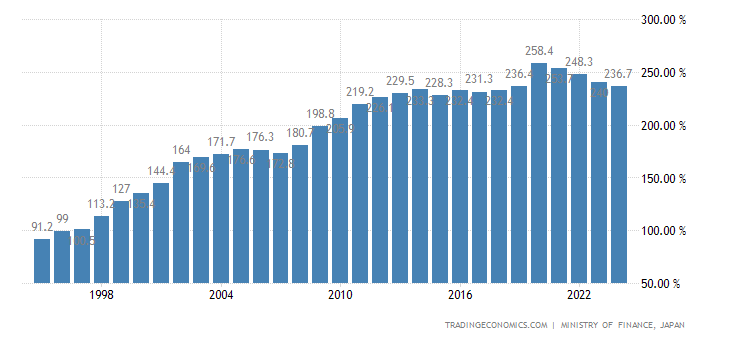
Consider Japan, which has a much-derided Debt/GDP of 240%:

Japan General Government Gross Debt to GDP
Chart: Japanese debt/GDP ratio for 25 years.

America’s debt terrorists would claim that level of debt must lead to inflation.

But Japan’s inflation generally has languished below 1% and often has been below 0%:

Chart: Japan’s inflation rates for 25 years

In summary, the U.S. government easily could provide a free college education to everyone in America, who wanted one.

So, if a college education benefits not only the students, but everyone in the nation, why doesn’t the U.S. federal government fund college for everyone?

The reason: Our deficit terrorists persist in telling you that despite the American government being Monetarily Sovereign, while the public is monetarily non-sovereign, funding college would be unaffordable for the government.

Oh, really?

How US students get a university degree for free in Germany
By Franz Strasser, BBC News, Germany, 3 June 2015

While the cost of college education in the US has reached record highs, Germany has abandoned tuition fees altogether for German and international students alike.

An increasing number of Americans are taking advantage and saving tens of thousands of dollars to get their degrees.

Before we continue with excerpts from the article, keep this in mind: Unlike the U.S. government, which has the unlimited ability to pay for anything, without collecting taxes, the German government is monetarily non-sovereign.

It does not have a sovereign currency. It uses the euro, which is the sovereign currency of the European Union.

When Germany spends, German taxpayers pay.

So why are German taxpayers willing to pay for college, while the American government is not?

Germans have a greater belief in the importance of education than do Americans.

Some Americans believe a college education is an unnecessary, but expensive, form of elitism. They don’t understand that the competitive future of America will be determined by the educated.

Other Americans adopt the “If I had to pay, they should have to pay” attitude, a kind of cutting one’s nose to spite one’s face.

And it hurts us all.

In rural South Carolina one night, Hunter Bliss told his mother he wanted to apply to university in Germany. Amy Hall chuckled, dismissed it, and told him he could go if he got in.

“When he got accepted I burst into tears,” says Amy, a single mother.

“For him to stay here in the US was going to be very costly,” says Amy. “We would have had to get federal loans and student loans because he has a very fit mind and great goals.”

More than 4,600 US students are fully enrolled at Germany universities, an increase of 20% over three years.

At the same time, the total student debt in the US has reached $1.3 trillion (£850 billion).

Health insurance for students in Germany is €80 ($87) a month, much less than what Amy would have had to pay in the US to add him to her plan.

To cover rent, mandatory health insurance and other expenses, Hunter’s mother sends him between $6,000-7,000 each year.

At his nearest school back home, the University of South Carolina, that amount would not have covered the tuition fees.

Even with scholarships, that would have totalled about $10,000 a year. Housing, books and living expenses would make that number much higher.

We interrupt again to remind you that sometimes even a college scholarship isn’t sufficient, when one needs to pay ancillary expenses, and when one must forego a regular paying job.

That is why in the Ten Steps to Prosperity (below), one step is for the government to fund school tuition, and another step is for the government to provide a salary for attending the school.

The financial advantages of studying in Germany have not been lost on other US students. Katherine Burlingame decided to get her Master’s degree at a university in the East German town of Cottbus.

A graduate of Pennsylvania State University, Katherine spent less than €500 ($570) a month in Cottbus, which included housing, transportation and healthcare.

On top of that she received a monthly scholarship by the DAAD (German Academic Exchange Council) of €750 ($815) which more than covered her costs.

“When I found out that just like Germans I’m studying for free, it was sort of mind blowing,” Katherine says.

“I realized how easy the admission process was and how there was no tuition fee. This was a wow moment for me.”

In the 2014-2015 academic year, private US universities charged students on average more than $31,000 for tuition and fees, with many schools charging well over $50,000.

The lie that federal debt is “unsustainable” “unaffordable,” and somehow immoral, has prevented many thousands of bright, ambitious, future American leaders from fulfilling the destiny that would have benefited them and America.

We cannot know how many potential American scientists, mathematicians, inventors, business leaders,  etc. America has lost for lack of education funds. We cannot know what it has cost us as a nation and as individuals.

But we do know this. The cost has been enormous, especially when compared to the zero cost to us of federal spending.

Rodger Malcolm Mitchell
Monetary Sovereignty
Twitter: @rodgermitchell
Search #monetarysovereignty Facebook: Rodger Malcolm Mitchell

…………………………………………………………………………………………………………………………………………………………………………………………………………………………………………………………………………………………..

The most important problems in economics involve:

  1. Monetary Sovereignty describes money creation and destruction.
  2. Gap Psychology describes the common desire to distance oneself from those “below” in any socio-economic ranking, and to come nearer those “above.” The socio-economic distance is referred to as “The Gap.”

Wide Gaps negatively affect poverty, health and longevity, education, housing, law and crime, war, leadership, ownership, bigotry, supply and demand, taxation, GDP, international relations, scientific advancement, the environment, human motivation and well-being, and virtually every other issue in economics.

Implementation of Monetary Sovereignty and The Ten Steps To Prosperity can grow the economy and narrow the Gaps:

Ten Steps To Prosperity:

1. Eliminate FICA

2. Federally funded Medicare — parts A, B & D, plus long-term care — for everyone

3. Provide a monthly economic bonus to every man, woman and child in America (similar to social security for all)

4. Free education (including post-grad) for everyone

5. Salary for attending school

6. Eliminate federal taxes on business

7. Increase the standard income tax deduction, annually. 

8. Tax the very rich (the “.1%”) more, with higher progressive tax rates on all forms of income.

9. Federal ownership of all banks

10. Increase federal spending on the myriad initiatives that benefit America’s 99.9% 

The Ten Steps will grow the economy and narrow the income/wealth/power Gap between the rich and the rest.

MONETARY SOVEREIGNTY