Federal Spending: The myths and the facts.

It takes only two things to keep people in chains: The ignorance of the oppressed and the treachery of their leaders.

……………………………………………………………………………………………………………………………………………………

An article printed in the 2/10/20 Chicago Tribune, by Andrew Taylor, of the Associated Press, demonstrates the disinformation you are being given about our economy.

In this post, we’ll parse the article and comment on each section.

Skepticism and doubts over Trump’s budget plan for ’21
By Andrew Taylor, Associated Press
WASHINGTON — Confronted with trillion-dollar-plus deficits, President Donald Trump is offering a budget plan that rehashes previously rejected spending cuts while leaving Social Security and Medicare benefits untouched.

Trump’s fiscal 2021 budget plan, expected to be released Monday, isn’t likely to generate a serious Washington dialogue about what to do, if anything this election year, about entrenched fiscal problems that have deficits surging despite a healthy economy.

Comment: The federal deficits are economic surpluses; they are dollar additions that are necessary to make the economy grow. Without deficit spending, the economy would not grow, and in fact, it would fall into recession and depression.

The so-called “entrenched fiscal problems” are a widely promulgated myth. The only fiscal problems the U.S. has are the misstatements about the federal deficits and debts.

It was being released on the eve of the New Hampshire primary, a move that minimizes attention.

A blueprint written as if Trump could enact it without congressional approval, the budget proposal relies on rosy economic projections and fanciful claims of future cuts to domestic programs to show that it is possible to bend the deficit curve in the right direction.

As is typical for the Republican party, the spending cuts (which are unnecessary and harmful) would negatively impact programs that benefit lower- and middle-income Americans.

Ironically, these are the GOP base-voters. But they have been so brainwashed by the media, the politicians, and the university economists, that they unintentionally vote against their own best interests.

Why?  They think they are voting against “them” (the poorest and the immigrants), whom they have been taught to hate.

It’s a hatred-seeded vote that boomerangs on the voters.

The reality is that no one — Trump, the Democratic-controlled House or the GOP-held Senate — has any interest in tackling a chronic budget gap that forces the government to borrow 22 cents of every dollar it spends.

Trump’s reelection campaign, meanwhile, is focused on the economy and the historically low jobless rate while ignoring the government’s budget.

The so-called “budget gap” (i.e. the federal deficit) grows the economy. The politicians know this, but pay lip service to claims that federal deficits (economic surpluses) should be avoided as harmful or “unsustainable.”

This disinformation allows the GOP to justify cutting benefits for the non-rich, while increasing benefits to the rich.

The federal government is Monetarily Sovereign, meaning it has the unlimited ability to create U.S. dollars. Therefore, the federal government does not need to borrow, and indeed, does not borrow.

What erroneously is termed “borrowing” actually is the acceptance of deposits into Treasury Security accounts (T-bills, T-notes, T-bonds). The purpose of these securities is not to obtain spending dollars for the federal government (which has unlimited access to dollars) but rather to:

  1. Provide a safe place to stash unused dollars, which helps stabilize the dollar, and
  2. To assist the Fed in controlling interest rates.

These T-securities are paid off every day simply by returning the dollars that were deposited in the accounts. This is no burden on the government or on future taxpayers.

It doesn’t occur to the author, Andrew Taylor, that the “historically low jobless rate,” is in fact related to massive federal deficit spending, which provides dollars to American business, directly and via increased consumer spending.

On Capitol Hill, House Democrats have seen their number of deficit-conscious “Blue Dogs” shrink while the roster of lawmakers favoring costly “Medicare for All” and “Green New Deal” proposals has swelled.

Tea party Republicans have abandoned the cause that defined, at least in part, their successful takeover of the House a decade ago.

Trump has succumbed to the Washington temptation to deliver spending increases and tax cuts first and then deal — or not — with their effect on the deficit.

Trump and key administration figures such as Treasury Secretary Steven Mnuchin had promised that Trump’s signature cuts to corporate and individual tax rates would pay for themselves; instead the deficit spiked by more than $300 billion over 2017 to 2019, to nearly $1 trillion.

The “Blue Dog” Democrats and the Tea Party Republicans were misguided and/or deliberately lying about the effects of federal deficits (which grow the economy) and deficit cuts (which lead to recessions and depressions).

Trump has not “succumbed” to anything. He knows that his re-election chances increase if the economy grows, and the economy can grow only if the money supply grows.

That’s the reason why Trump pushes record federal deficits.

Treasury Secretary Steven Mnuchin is a first-class fabulist. “Pay for themselves” means that tax cuts would actually increase tax collections. If that were true, the tax cuts would not be stimulative. Tax collections remove growth dollars from the economy.

Sadly, “Green New Deal” proposals, to save the world for our grandchildren, are being demeaned by the false belief the federal government can’t afford to pay for them and/or taxpayers will pay.

So the weather grows hotter, while air and water become more polluted, all because of a pernicious myth.

Trump has also signed two broader budget deals worked out by Democrats and Republicans to get rid of spending cuts left over from a failed 2011 budget accord.

The result has been eye-popping spending levels for defense — to about $750 billion this year — and comparable gains for domestic programs favored by Democrats.

The White House hasn’t done much to draw attention to this year’s budget release, though Trump has revealed initiatives of interest to key 2020 battleground states, such as an increase to $250 million to restore Florida’s Everglades and a move to finally abandon a multibillion-dollar, never used, nuclear waste dump that’s political poison in Nevada.

It’s all politics. They talk deficit reduction, to con the voters, but they enact deficit increases to grow the economy, especially in battleground states.

Then they shed crocodile tears about the size of the federal debt.

The White House also leaked word of a $25 billion proposal for “Revitalizing Rural America“ with grants for broadband internet access and other traditional infrastructure projects such as roads and bridges.

The Trump budget also promises a $3 billion increase — to $25 billion — for NASA in hopes of returning astronauts to the moon and on to Mars.

It also is likely to reprise his small-bore infrastructure initiative — proposed in prior years to provide just $200 billion in new federal contributions — while proposing a modest parental leave plan.

The voters love deficit reduction — for other people.

But they love deficit spending in their own back yard for the Internet, roads, bridges, and the always magical return trip to the moon.

Trump took to Twitter on Saturday to promise voters that his budget “will not be touching your Social Security or Medicare” in keeping with his long-standing 2016 campaign promise.

Trump had made a bit of a stir last month at a meeting of global economic elites in Davos, Switzerland, when he told a CNBC interviewer that “at some point” he would consider curbs to popular benefit programs like Medicare and Social Security.

Trump has proposed modest adjustments to eligibility for Social Security disability benefits and he’s proposed cuts to Medicare providers such as hospitals, but the real cost driver of Medicare and Social Security is the ongoing retirement surge of the baby boom-generation and health care costs that continue to outpace inflation.

This is part of the traditional “Talk big cuts, wait for the reaction, then enact small cuts” scam.

The purpose of the scam is to enure voters to a hated idea. Then when actual, smaller cuts are made, the people actually are relieved. “They were talking about stealing a billion from me. But out of compassion, they only stole a few million.”

There is no reason for any cuts. Cuts are harmful to the economy. But the rich who run America, love cuts to programs that benefit the poor.

Now that you’ve seen the myths and the commentary, here is a reminder about the truth:

I. Reduced federal debt growth leads to recessions. Increased federal debt growth cures recessions.

Reductions in federal debt growth (red line) lead to recessions (vertical gray bars). Increases in federal debt growth cure recessions.

.

II. Depressions come on the heels of federal surpluses, because federal surpluses take growth dollars out of the economy.

1804-1812: U. S. Federal Debt reduced 48%. Depression began 1807.
1817-1821: U. S. Federal Debt reduced 29%. Depression began 1819.
1823-1836: U. S. Federal Debt reduced 99%. Depression began 1837.
1852-1857: U. S. Federal Debt reduced 59%. Depression began 1857.
1867-1873: U. S. Federal Debt reduced 27%. Depression began 1873.
1880-1893: U. S. Federal Debt reduced 57%. Depression began 1893.
1920-1930: U. S. Federal Debt reduced 36%. Depression began 1929.
1997-2001: U. S. Federal Debt reduced 15%. Recession began 2001.

III. A growing economy requires a growing supply of moneyFederal deficits grow the money supply and the economy.

By definition, a large economy has a larger money supply than does a small economy.

The graph below shows the essentially parallel paths of GDP (blue line) vs. perhaps the most comprehensive measure of the money supply, Domestic Non-Financial Debt (red line):

Gross Domestic Product (GDP — blue line) essentially parallels the money supply (red line).

Rodger Malcolm Mitchell
Monetary Sovereignty
Twitter: @rodgermitchell
Search #monetarysovereignty Facebook: Rodger Malcolm Mitchell

…………………………………………………………………………………………………………………………………………………………………………………………………………………………………………………………………………………………..

The most important problems in economics involve:

  1. Monetary Sovereignty describes money creation and destruction.
  2. Gap Psychology describes the common desire to distance oneself from those “below” in any socio-economic ranking, and to come nearer those “above.” The socio-economic distance is referred to as “The Gap.”

Wide Gaps negatively affect poverty, health and longevity, education, housing, law and crime, war, leadership, ownership, bigotry, supply and demand, taxation, GDP, international relations, scientific advancement, the environment, human motivation and well-being, and virtually every other issue in economics.

Implementation of Monetary Sovereignty and The Ten Steps To Prosperity can grow the economy and narrow the Gaps:

Ten Steps To Prosperity:

1. Eliminate FICA

2. Federally funded Medicare — parts A, B & D, plus long-term care — for everyone

3. Provide a monthly economic bonus to every man, woman and child in America (similar to social security for all)

4. Free education (including post-grad) for everyone

5. Salary for attending school

6. Eliminate federal taxes on business

7. Increase the standard income tax deduction, annually. 

8. Tax the very rich (the “.1%”) more, with higher progressive tax rates on all forms of income.

9. Federal ownership of all banks

10. Increase federal spending on the myriad initiatives that benefit America’s 99.9% 

The Ten Steps will grow the economy and narrow the income/wealth/power Gap between the rich and the rest.

MONETARY SOVEREIGNTY

A Monopoly™ story, why you can’t see dollars, and why federal tax dollars are destroyed.

Last month, we published the post, “The text of a speech I never will give to my friends at our country club, because they probably won’t believe me, and who needs the aggravation?”

In the post, we said, “The U.S. dollar is not a physical entity. The dollar is a legal entity. It is a group of laws. You can’t see, smell, taste, feel, or hear a dollar any more than you can see, smell, taste, feel, or hear a law.”

The purpose of that paragraph was to help readers visualize why the federal government has absolute control over the U.S. dollar and its value, and why the federal government cannot run short of dollars.

After all, if something has no physical existence, the creator of that thing cannot run short.

Therefore, warnings that the federal government owes too many dollars, or can run short of dollars, make absolutely no sense. It is like warning that the federal government will run short of laws or lies. The government has an infinite supply.

To help readers visualize the concept, we gave the example of the board game Monopoly™.

As you probably know Monopoly™ usually is played by 3-6 players. The object of the game is to make money by buying and selling real estate, and to accomplish this purpose, the game gives players various tokens, dice, instruction cards, and play dollars.

To begin the game, a mythical “Banker” provides each player with an equal amount of play dollars.

One day, four of us wished to play, but when we opened the game box, everything was there except the play dollars.

So we created this table to keep track of the Monopoly™ “economy”:

monopoly 4.png
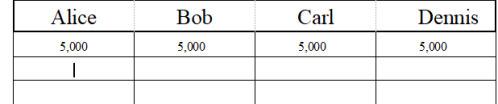
At this stage of the game, the “economy” had 20,000 dollars

It was a simple sheet of paper, containing a four-column table. At the top of each column, we wrote the name of one player.

Then, on the first line, under each player’s name, we wrote “5,000.” That showed how many dollars each player had.

We could have written any number, but we arbitrarily decided that the Bank should give each player 5,000 dollars.

In real-world terms,  this corresponded to a total of 20,000 in deficit spending by the Bank, which added 20,000 dollars into the economy.

By rule, players take turns rolling dice, and at each roll, players may receive other moneys from the Bank, and/or pay the Bank for real estate, taxes, and other penalties.

So money flows back and forth from player to player, and to and from players to the Bank.

In the game’s first transaction Alice paid the Bank 100 dollars for a piece of property.

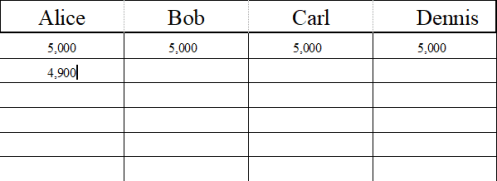
To memorialize the transaction, we deducted 100 dollars from Alice’s column, leaving her with 4,900 dollars.

Monopoly 3 - Copy.png
Now, the money supply of the “economy” is 19,900 dollars.

In total, the money supply of the “economy” fell to 19,900.

But what about the Bank? It received 100 from Alice. But the Bank had no column.

Two questions: Where did that 100 Alice paid to the Bank go? And how much money did the Bank have?

The answers to those two questions lead to the central points of this post.

Where Is The Bank’s Money and How Much Does It Have?
The game’s rules specifically state that the Bank never can run out of money. (The rules even suggest cutting up pieces of paper, if necessary, and using them as Monopoly dollars.)

So again, where did Alice’s dollars go when she paid the Bank? Answer: The Monopoly™ dollars were destroyed. They ceased to exist.

And how much money did the Bank have? Answer: It has none but can create infinite.

Payments to the Bank cannot enrich the Bank; it can create infinite money at any time. Payments to the Bank serve only to impoverish the players. That is the sole effect and the sole purpose of payments to the Bank.

Similarly, payments from the Bank, which the Bank can make endlessly, enrich the players but do not impoverish the Bank. Infinity minus any number still is infinity.

Thus, the Monopoly™ game provides an interesting, simplified corollary to the U.S. financial system.

Players can be thought of as the real people in the United States who pay dollars to, and receive dollars from, the U.S. federal government.

The Monopoly™ Bank resembles the U.S. federal government, and the players correspond to the U.S. economy.

  1. The rules of the game correspond to the laws of the U.S.
  2. Both the Bank and the U.S. government create dollars from thin air, simply by spending dollars into the economy.
  3. Both receive tax dollars that are destroyed upon receipt.
  4. Both can run deficits endlessly, and these deficits enrich the players (the “economy”), while deficits do not impoverish the Bank or the federal government.
  5. For both the Bank and the U.S. federal government, debt and borrowing are meaningless, as they do not provide spending funds to the Bank or to the government.
  6. Any amount of money owed by the Bank or the U.S. government can be paid instantly. Neither can run short of dollars. Neither needs to ask for tax dollars.

Although the Bank pays out far more dollars than it takes in (just like the U.S. federal government does), the players are not concerned that the Bank’s deficits are “unsustainable,” no matter how large they may grow.

Like the Monopoly Bank, the U.S. federal government does not borrow dollars. Why would it? It has the unlimited ability to create dollars from thin air.

What erroneously is termed “U.S. federal borrowing,” actually is the acceptance of deposits into Treasury Security Accounts. This so-called “borrowing” does not provide spending funds to the government. The government can create infinite spending funds.

The purposes of accepting deposits into federal T-security accounts are:

  1. To provide a safe place to “park” unused dollars, which helps stabilize the dollar, and
  2. To assist the Federal Reserve in its task of controlling interest rates.

And the purposes of federal taxes are not to provide the government with spending money, of which it has infinite, but rather:

  1. To control the economy by rewarding activities the federal government wishes to encourage and by punishing the activities the government wishes to discourage, and
  2. To make the populace believe the government’s ability to spend is limited by taxes, so that the people will not ask for more benefits.

The rules of Monopoly™ provides players with regular payments of 200 dollars when their tokens pass “Go.” These payments serve to enrich the players and the MonopolyImage result for monopoly game go “economy.”

The makers of the game could have decided on payments of any size — 10 dollars or 1,000 dollars, the Bank could afford anything — but arbitrarily settled on 200 dollars.

The purpose of the 200 dollar payments is to energize the “economy” by injecting dollars into it. Without the additional dollars, the economy could not grow.

Similarly, the U. S. federal government makes regular Social Security payments. These payments, which enrich the populace and the economy, could be of any size — the federal government can afford anything — but lately, benefits have been reduced.

The government arbitrarily collects taxes on benefits and delays benefits past the original age of 65.

Why would the U.S. federal government, which can afford anything, invent false claims that Social Security, an agency of the federal government, is running short of money? Why would the government reduce benefits that enrich the populace and the economy?

One might think the government would want to do the opposite. But there are reasons:

  1. The Monopoly™ “Pass Go” payment is not more than 200 dollars only because the creators felt that would lengthen the game too much. The Bank easily could afford any level of payment.
  2. The Social Security payments are not higher or extended to more people, because the very rich, who run America, do not want the Gap between them and the rest of Americans to be narrowed. The U.S. Treasury easily could afford any level of payment.

SUMMARY
The game of Monopoly™ provides an interesting corollary to the U.S. federal government and the U.S. economy. The Monopoly™ Bank mirrors the U.S. federal government, and the players represent the economy.

The U.S. federal government originally created laws that created an arbitrary number of U.S. dollars from thin air, and gave them an arbitrary value.

Today, the U.S. government retains the power to create an arbitrary number of dollars from thin air and to give them any value it wishes.

Thus, being Monetarily Sovereign, i.e. sovereign over the U.S. dollar, the government can control the U.S. money supply and the value of the dollar (U.S. inflation).

Like the Monopoly™ Bank, the federal government can sustain any level of deficit spending. It also can set any level of T-security issuance (wrongly termed “borrowing”).

Federal deficit spending is necessary to grow the U.S. economy, and claims that federal spending and federal debt are harmful or unsustainable are false.

Ben Bernanke: “The U.S. government has a technology, called a printing press (or, today, its electronic equivalent), that allows it to produce as many U.S. dollars as it wishes at essentially no cost.”

Alan Greenspan: “Central banks can issue currency, a non-interest-bearing claim on the government, effectively without limit. A government cannot become insolvent with respect to obligations in its own currency.”

St. Louis Federal Reserve: “As the sole manufacturer of dollars, whose debt is denominated in dollars, the U.S. government can never become insolvent, i.e.,unable to pay its bills. In this sense, the government is not dependent on credit markets (borrowing) to remain operational.

Rodger Malcolm Mitchell
Monetary Sovereignty
Twitter: @rodgermitchell
Search #monetarysovereignty Facebook: Rodger Malcolm Mitchell

…………………………………………………………………………………………………………………………………………………………………………………………………………………………………………………………………………………………..

The most important problems in economics involve:

  1. Monetary Sovereignty describes money creation and destruction.
  2. Gap Psychology describes the common desire to distance oneself from those “below” in any socio-economic ranking, and to come nearer those “above.” The socio-economic distance is referred to as “The Gap.”

Wide Gaps negatively affect poverty, health and longevity, education, housing, law and crime, war, leadership, ownership, bigotry, supply and demand, taxation, GDP, international relations, scientific advancement, the environment, human motivation and well-being, and virtually every other issue in economics.

Implementation of Monetary Sovereignty and The Ten Steps To Prosperity can grow the economy and narrow the Gaps:

Ten Steps To Prosperity:

1. Eliminate FICA

2. Federally funded Medicare — parts A, B & D, plus long-term care — for everyone

3. Provide a monthly economic bonus to every man, woman and child in America (similar to social security for all)

4. Free education (including post-grad) for everyone

5. Salary for attending school

6. Eliminate federal taxes on business

7. Increase the standard income tax deduction, annually. 

8. Tax the very rich (the “.1%”) more, with higher progressive tax rates on all forms of income.

9. Federal ownership of all banks

10. Increase federal spending on the myriad initiatives that benefit America’s 99.9% 

The Ten Steps will grow the economy and narrow the income/wealth/power Gap between the rich and the rest.

MONETARY SOVEREIGNTY
Dumb Donald and the Foxconn con.

Regular readers of this blog may remember our post of more than two years ago, Who put the “con” in WisCONsin? Foxconn, that’s who Friday, Sep 15, 2017.

It was followed many months later by our post, How Trump got outfoxed and conned by Foxconn, Thursday, Jan 31,  2019.

And it was followed by our post, Oh, Wisconsin. The Foxconn, GOP con continues. Friday, Oct 25, 2019.

Well, here’s the latest part of the story:

CRONY CAPITALISM
Study Says Foxconn Deal Cost Wisconsin $20 Billion in Lost Economic Growth
Once again, government-subsidized projects fail to deliver
VERONIQUE DE RUGY | January 9, 2020

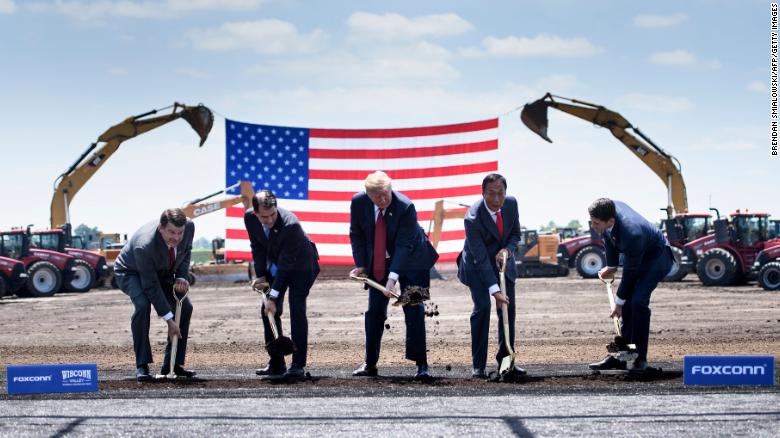
In June 2018, President Donald Trump attended the groundbreaking ceremony for a Foxconn factory in Wisconsin.

Ever exuberant in his comments, he called the project the “eighth wonder of the world” and “one of the great deals, ever.”

Always a bragger, his praise was directed at himself for orchestrating the use of state subsidies and tax credits to bring the Taiwanese multinational electronics company to Wisconsin for it to manufacture high-resolution LCD screens.

You should know that the author, Veronique de Rugy, according to her own biography:

“Veronique de Rugy is a Senior Research Fellow at the Mercatus Center at George Mason University and a nationally syndicated columnist.

“Her primary research interests include the US economy, the federal budget, homeland security, taxation, tax competition, and financial privacy.

“Her popular weekly charts, published by the Mercatus Center, address economic issues ranging from lessons on creating sustainable economic growth to the implications of government tax and fiscal policies.

She has testified numerous times in front of Congress on the effects of fiscal stimulus, debt and deficits, and regulation on the economy.” 

And like the rest of the people at the Mercatus Center, she has zero understanding of Monetary Sovereignty, the financial differences between state vs. federal deficits and debt.

Further, Trump is a lousy business operator, who has destroyed many businesses, with numerous bankruptcies, and has made most of his money passively, by lending his name to businesses run by people who actually know how.

Image result for trump foxconn
February 1, 2019: Foxconn says it is returning to its plan to build a new plant in Wisconsin following an appeal from President  Trump.

To make this deal happen, the state legislature offered a subsidy package of $4.5 billion, mostly in direct cash payments, and lower-priced land acquired through eminent domain.

In exchange, Foxconn promised to create more than 13,000 middle-class manufacturing jobs, a revived manufacturing sector and loads of tax revenue—the combination of which was projected to produce economic returns ranging from $39 billion to $78 billion over the next 15 years.

If these returns sound like a great deal, you’ve been conned.

You had read all of the above in the above-mentioned posts, as early as September, 2017.

A year and a half after Trump paraded at the site with his golden shovel, the reality isn’t as bright.

Before the ceremony, Foxconn announced that the factory would ultimately be smaller than the one initially promised.

It would also be highly automated, with almost all of the assembly work done by robots, and would only require 3,000 employees—90 percent of them “knowledge workers” such as engineers, programmers, and designers.

There’s nothing wrong with such a modern factory, except that it’s not what Trump and other government officials thought they were buying with taxpayers’ money.

Unlike federal spending, the dollars for which are created out of thin air, at the touch of a computer key, state and local spending is indeed funded by taxpayers.

All things considered, the Foxconn fiasco cost every man, woman, and child in Wisconsin something like $4 thousand each, and about $100,000 per new job –assuming even those relatively few jobs materialize.

An by the way, Wisconsinites, the citizens of Illinois thank you, because a large percentage of the jobs will be taken by residents of nearby Chicago. And it didn’t cost Illinois one cent.

And what about the promised economic growth? Even under the deal’s original terms, there’s no way it would have produced much growth.

That’s because, as is often the case, the original projections offered by economic development consultants only considered the expected benefits from the subsidies; the costs were ignored.

In the real world, however, these subsidies don’t fall from the sky. Every single cent comes from additional taxes paid by actual people. When you consider these costs, the economic outlook for the project dims quite a bit.

And that is why you will see Donald Trump nowhere in the vicinity of the site. He is very big on taking credit, even for things he hasn’t done, but he never, ever will admit to being wrong.

In a recent paper on the issue, my Mercatus Center colleagues Matthew Mitchell and Michael Farren did the math and found that “the $3.6 billion in taxes needed to fund the subsidies will likely decrease Wisconsin’s long-run GDP by about $20 billion over the 15-year life of the handout.

And this estimate doesn’t include the local utility infrastructure, and federal subsidies that total another $1.4 billion.” These numbers are harder to sell to taxpayers than the la-la land ones we hear about before every big subsidy deal.

The Wisconsin Republicans, who foisted this deal on the people of Wisconsin, apparently were incapable of, or loathe to, “do the math.”

Many might have assumed that this particular deal was going to be a disaster because it was orchestrated by Trump and Scott Walker, Wisconsin’s Republican governor at the time.

Yes, it’s true that our current president believes in economic engineering and cronyism—which is another way to describe this kind of deal.

Trump has failed elsewhere when trying to spark growth with subsidies. Take, for instance, the Carrier air conditioner plant in Indianapolis, which received large state handouts under Trump’s pressure, only to end up laying off hundreds of workers.

And so, it would be a mistake to assume that this debacle is specific to Trump or to Foxconn.

It might be a mistake “to assume that this debacle is specific to Trump,” except for the fact that the creator of Trump University and Trump Foundation has the unfailing ability to surround himself with the most dishonest and incompetent people:

Health and Human Services Secretary Tom Price, EPA Administrator Scott Pruitt, HUD Secretary Ben Carson, Campaign manager Paul Manafort, Deputy campaign manager Rick Gates, National security adviser Michael Flynn, Personal lawyer Michael Cohen, Commerce Secretary Wilbur Ross, mobster Salvatore Testa, mobster Fat Tony Salerno, Roger Stone, Jeffrey Epstein, Secretary of Labor Alexander Acosta, Trump Campaign Foreign Policy Adviser George Papadopoulos, and Konstantin Kilimnik.

You might wonder how I, a relative stranger to the project, easily was able to foretell its failure, while the team of Trump/ Walker couldn’t.

Easy. Given Trump’s lack of common and business sense, and Walker’s dubious achievements, their assurances about the project were bound to be wrong.

A new paper in the Journal of Economic Perspectives by Cailin Slattery of Columbia University and Owen Zidar of Princeton University looks at state and local business tax incentives and finds yet again that narrow, firm-specific tax breaks aimed at attracting businesses and boosting employment aren’t the way to go.

The study shows that the largest deals benefit the recipients, but not the overall state economy.

Lower-income states also tend to be more generous with their handouts, only to jack up the cost per job created, sometimes up to as much as $400,000 per job.

Unfortunately, a slogan like “subsidized projects aren’t worth the money you pay for them” doesn’t make for a great sound bite at ribbon-cutting ceremonies.

Now we shall see whether the good citizens of Wisconsin, who were among those supporting Trump at the last Presidential election, are smart enough to stop supporting a man who conned them into an expensive, worthless project.

Rodger Malcolm Mitchell
Monetary Sovereignty
Twitter: @rodgermitchell
Search #monetarysovereignty Facebook: Rodger Malcolm Mitchell

…………………………………………………………………………………………………………………………………………………………………………………………………………………………………………………………………………………………..

The most important problems in economics involve:

  1. Monetary Sovereignty describes money creation and destruction.
  2. Gap Psychology describes the common desire to distance oneself from those “below” in any socio-economic ranking, and to come nearer those “above.” The socio-economic distance is referred to as “The Gap.”

Wide Gaps negatively affect poverty, health and longevity, education, housing, law and crime, war, leadership, ownership, bigotry, supply and demand, taxation, GDP, international relations, scientific advancement, the environment, human motivation and well-being, and virtually every other issue in economics.

Implementation of Monetary Sovereignty and The Ten Steps To Prosperity can grow the economy and narrow the Gaps:

Ten Steps To Prosperity:

1. Eliminate FICA

2. Federally funded Medicare — parts A, B & D, plus long-term care — for everyone

3. Provide a monthly economic bonus to every man, woman and child in America (similar to social security for all)

4. Free education (including post-grad) for everyone

5. Salary for attending school

6. Eliminate federal taxes on business

7. Increase the standard income tax deduction, annually. 

8. Tax the very rich (the “.1%”) more, with higher progressive tax rates on all forms of income.

9. Federal ownership of all banks

10. Increase federal spending on the myriad initiatives that benefit America’s 99.9% 

The Ten Steps will grow the economy and narrow the income/wealth/power Gap between the rich and the rest.

MONETARY SOVEREIGNTY
As though there was not already enough evidence, here is more.

[People tend to support those who are like them.
Blacks are more likely to support blacks; Jews are more likely to support Jews; Latinos are more likely to support Latinos; and stupid, immoral, close-minded, bigoted liars are more likely to support stupid, close-minded, immoral, bigoted liars.
T
he fact that New Yorkers don’t support New Yorker, Donald Trump, tells it all.]

……………………………………………………………………………………………………………………………….

As though there was not already enough evidence, here is more.

New Evidence Shows Pressure Campaign Started Earlier With Prior Ukraine Prez
By Josh Kovensky, February 5, 2020 4:05 p.m.

As the Senate votes to acquit President Trump over his bid to extort the Ukrainian government into providing him with domestic political help, TPM has new evidence suggesting that the pressure campaign came far closer to succeeding and at an earlier stage than was previously known.

Months before President Trump pressured Ukrainian leader Volodymyr Zelensky to open investigations during the infamous July 25 phone call, henchmen working for his attorney nearly succeeded in doing the same with the previous Ukrainian leader.

  Hannity and “news” friends.

Text messages obtained by TPM show that former Ukraine President Petro Poroshenko was scheduled to announce investigations into the Bidens and the 2016 election to John Solomon of The Hill in March 2019.

Ultimately, Poroshenko backed out of the interview at the last minute.

The plan was for an investigation of the Bidens to be announced to right-wing “news”man, John Solomon.

Clearly, the motivation for such an announcement was a political plum for Trump, and had nothing to do with American security.

The planned appearance came in the wake of a late February meeting that the then-Ukrainian leader held with Lev Parnas and Igor Fruman, in which they offered what Parnas has described as a “quid pro quo” on behalf of Rudy Giuliani and his client, President Trump: announce investigations into the Bidens and the 2016 election, and receive in return a state visit to the U.S. that could bolster Poroshenko’s re-election chances.

It was, quite simply, a plot involving a foreign government to skew the American elections. The GOP sees nothing wrong with this.

Poroshenko’s planned appearance suggests that he had, at least initially, agreed to the deal, before backing out.

It also highlights that the campaign to turn Ukraine into a domestic political bludgeon for Trump began far earlier than Giuliani’s aborted May 2019 dirt-digging trip to Kyiv.

This was not just the July 25 call, it was a months-long scheme, or effort, or whatever you wanna call it put together by the President, Giuliani, and others,” Parnas told TPM in a telephone interview with his attorney Joseph A. Bondy.

It took Trump and Giuliani months of pressure to convince Poroshenko’s successor, Zelensky, to agree to a TV news appearance,w on CNN in September. Zelensky also backed out at the last minute. e

Trump, Giuliani, and Parnas had the entire show scripted. Trump’s “perfect” phone call came near the end of the plot.

Parnas sent Poroshenko’s press secretary a list of questions ahead of the planned interview: “this will be questions,” Parnas said in an accompanying text.

The questions, obtained by TPM, goad Poroshenko into describing the allegations that Trump would later want Zelensky to investigate.

The questions cover two distinct topics: allegations that Ambassador Marie Yovanovitch was bad-mouthing President Trump in Kyiv and allegations that Joe Biden had abused his position to have a Ukrainian prosecutor fired in a bid to protect his son Hunter Biden from an investigation.

One question on the Yovanovitch portion appears to reference a May 2018 letter sent by Rep. Pete Sessions (R-TX)to Secretary of State Mike Pompeo, demanding the ambassador’s removal.

Even GOP members of Congress were in on the scheme.

“I recently was shown a letter from a member of Congress who suggested Ambassador YO-van-NO-witch was saying derogatory things about president Trump. Do you have any evidence that has happened?” the question reads.

The line of questions about the Bidens conclude in the following sequence:

“Did VP Biden have an interest personally in the prosecutor’s office and its activities?” “Was the VP’s son and his company Barisma Holdings under investigation and how serious were the allegations?” “What happened to that case after the vice president’s intervention?”

The scheme was planned so closely, that even the sequence of questions was predetermined.

Parnas told TPM that Solomon formulated the questions. The topics do not cover allegations of Ukrainian interference in the 2016 election — a right-wing hobbyhorse raised on Trump’s call with Zelensky, and a story in which Poroshenko is supposedly implicated.

Parnas’ allegations about the Poroshenko pressure campaign are supported by contemporaneous Russian-language texts between Parnas and Yuriy Lutsenko, Ukraine’s prosecutor general at the time.

A series of texts beginning in early March shows Parnas attempting to arrange the Poroshenko interview through Lutsenko, who was present at the February meeting in Kyiv.

The House Intelligence Committee released the texts the week before the Senate began the third impeachment trial in U.S. history. Parnas supplied the panel with the texts after receiving them from Manhattan federal prosecutors as discovery in his criminal campaign finance case.

That information was ignored by the GOP-led Senate,

On March 8, Parnas sent Lutsenko the names of Solomon and Fox News’ Sean Hannity along with a March 5 Washington Post article that took a critical look at “the feedback loop between Fox News and the Oval Office.

When a news medium is in cahoots with politicians, to set up a political story on behalf of a political party, it no longer is a news medium. It is a lobbying organization masquerading as a news medium.

In response to the messages, Lutsenko began to complain about Ambassador Marie Yovanovitch and the State Department’s support for her as a response.

But then, Parnas told Lutsenko, using a diminutive for Yuriy, that, “Yura, we’re aware of everything.”

“Try to do an interview tomorrow at one,” Parnas added, apparently referring to an interview that Lutsenko later had with Solomon.

Lutsenko replied that he would try to call, and then wrote that an unnamed person “will definitely be in the Administration,” apparently referring to the Presidential Administration, which houses Ukraine’s executive offices. “I will try to connect you earlier.”

One minute later, Parnas wrote “and be sure that this will be a friendly interview with the President of Ukraine, a state partner of America !!!” Parnas added in a later text that “we will try to agree that that they do an interview with you tomorrow as well.”

Parnas wrote that “we are now in the [studio] and will now call the President’s secretary.” He followed up with screenshots of what appeared to be Solomon interviewing Nazar Kholodnytsky, a Ukrainian prosecutor whose firing Yovanovitch demanded.

TPM obtained texts between Parnas and Darya Khudakova, Poroshenko’s foreign media press secretary.

In the March 8 exchange, Khudyakova asked Parnas if it would be possible to schedule an interview that Tsegolko had made her “responsible to negotiate.”

Khudyakova described the interview to Parnas as “an important moment for us.”

Parnas sent her an image showing a document with the list of questions, covering allegations against both Ambassador Marie Yovanovitch and Joe Biden.

Khudyakova told Parnas that she received the questions, and initially agreed to have Poroshenko do the interview on Monday, March 11, after Parnas proposed the day.

But something happened in the intervening time, and Poroshenko called it off.

Lutsenko told Parnas “these are not questions for an acting President — in the heat of the campaign he cannot respond to questions about the ambassador, Biden, etc.”

Khudyakova wrote to Parnas on the day that the interview was supposed to be held that “it seems that a probability of interview with the President late tonight today is very unlikely.”

It would appear from the texts that Poroshenko’s team chose at the last minute to walk away from the interview, perhaps sensing it unwise.

Or, as Lutsenko wrote a few days later, “I’m ready to screw your competitor, but you just want more.”

It would appear from the context that Lutsenko is referring to “Biden” as the “competitor,” but it’s unclear from the text itself.

Could it be any clearer? They were after Biden, and there was no talk of Ukraine “corruption,” as the White House claimed.

Trump saw how well the threat of an FBI investigation of Hillary Clinton worked. He wanted to use the same ploy on Biden.

Interestingly, a proposed FBI investigation of Trump would not have the same effect, because everyone already knows he is a liar and a crook — and his cult followers don’t care.

But Lutsenko himself eventually spoke to Solomon and got his end of the deal, or at least part of it: Yovanovitch was removed from her post as ambassador in late April, and formally removed from Kyiv in early May.

Lutsenko told Bloomberg in a May 16 interview after Yovanovitch’s departure that there was no evidence to suggest wrongdoing on Biden’s part.

“I do not want Ukraine to again be the subject of U.S. presidential elections,” Lutsenko told Bloomberg. “Hunter Biden did not violate any Ukrainian laws — at least as of now, we do not see any wrongdoing.”

To Trump supporters, none of the above means anything. Trump indeed could shoot someone on 5th Ave. and not lose any of his evangelical followers.

Jim Jones, American cult leader promised his followers a utopia after proclaiming himself messiah of the Peoples Temple, an evangelist group.

He ultimately led his followers into a mass suicide, which left more than 900 dead.

Rodger Malcolm Mitchell
Monetary Sovereignty
Twitter: @rodgermitchell
Search #monetarysovereignty Facebook: Rodger Malcolm Mitchell