The Chicago Tribune’s “If I can’t get free money, no one should. I don’t care about the economy” editorial.

Today, the Chicago Tribune published an editorial titled, “Why government bailouts for United and Boeing are a bad idea.”

The essence of the editorial is: Unless everyone gets a piece of the pie, no one should get any pie. We all should starve.

Here are a few excerpts:

Treasury Secretary Steven Mnuchin has struck a deal in principle to deliver billions in financial assistance to United Airlines and other carriers to protect them from coronavirus fallout.

A similar package appears to be in the works for Boeing. These exercises in corporate favoritism are a bad idea.

We’re not rooting for any company’s failure, nor for hardship to befall employees of any industry. Rather, we’re opposed to the idea of the federal government using portions of the $2 trillion coronavirus rescue package to support and protect major players in specific industries.

In other words, the Tribune is rooting for company failure and for hardship to befall employees of the airline industry.
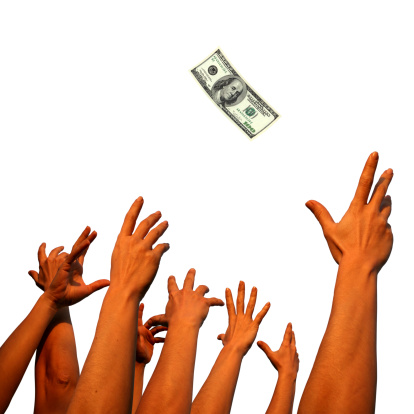
Hands Reaching To Money Stock Photo - Download Image Now - iStock
The enemy is not the allocation of funds. The enemy is insufficient funds.

Why “major players” and “specific industries” should not be helped never is discussed. Is it that the Chicago Tribune is not one of the “major players,” and is not receiving enough help?

Would it be better for “major players” and “specific industries” (who employ millions of workers) not to receive any help?

If the point were that money given to “major players” is being taken from “minor players,” you might agree with the Tribune. But that isn’t the case, at all.

The fact is that a craven, inept, GOP Congress has not allocated enough money to deal with the pandemic and its effect on the economy. Because there is too little money, it mathematically is impossible to give some to all who need or deserve.

In giving to the airlines, Congress has elected to save what it believes to be one of the more crucial industries. You may disagree with that selection. You may mention other industries you believe are more deserving.

But when you have a “too-little, too-late” President and Congress, you are faced with the Hobson’s choice of giving to some or giving to none.

The entire country has been knocked on its heels temporarily by the pandemic. Millions of Americans have lost their jobs, been furloughed or taken pay cuts.

Small business owners, notably restaurateurs, are suffering, and some will seek access individually to emergency loans. The retail, resort, sports, arts, and energy industries are getting crushed. Again, who isn’t besides Amazon?

Yet Boeing and the airlines — and by extension, their shareholders — get singled out for dispensation?

Yes, the airlines won the lottery. Now, shall we march in the streets demanding that airlines not receive any help, and instead should go bankrupt? Will that lift the economy?

The Tribune is fighting the wrong enemy. The enemy is not the allocation of funds. The enemy is insufficient funds.

The deal in principle for Chicago-based United and other airlines, announced Tuesday, would offer up a mix of taxpayer grants and loans to help the companies keep operating and make payrolls.

Just as a reminder, there is no such thing as a “taxpayer grant.” This is part of the Tribune’s endless promulgation of the “Big Lie,” — the lie that federal taxes fund federal spending.

Unlike state and local taxes, which fund state and local government spending, federal taxes fund nothing. They are destroyed upon receipt. Even if the federal government were to stop all tax collections, it could continue spending, forever.

That is the fundamental difference between federal government (Monetarily Sovereign) financing and state/local government (monetarily non-sovereign) financing.

Also, federal loans are ridiculous on their face. The federal government never should lend. It only should give.

When the government gives, it adds growth dollars to the economy. But when it lends, it removes growth dollars from the economy, at the instant it receives repayment — and it destroys those repaid dollars.

A similar offer is under discussion for Chicago-based Boeing. President Donald Trump and members of Congress apparently want to attach conditions to the aid, including requirements that the companies hold off on layoffs.

Another significant demand: giving the government an option to take an ownership position in exchange for the financial assistance.

The first requirement is reasonable. The government is saying, in essence, “We want to save jobs, so we will give you money for you to use in payroll.”

The second requirement is hypocritical for our right-wing government because taking an ownership position is socialism.

All those GOP Congressmen, who hate any sort of federal support for Medicare because it supposedly is “socialism” (It really isn’t), now want to take an ownership position in airlines??

Is the plan for the federal government, as the owner of certain airlines, to compete with privately-owned airlines?  Or put another way, shall we allow an entity having unlimited funds and no need for profits to compete with the private-sector?

Really, really bad socialist idea.

Final terms of the United aid package weren’t released as of Tuesday afternoon. Assuming the Trump administration must go forward with bailouts, extracting ownership stakes so taxpayers might benefit from the economic recovery would make these unsavory transactions fairer.

But wouldn’t you know it, Boeing and the airlines hated that idea. They’d much rather receive the money as a blank check, thank you very much.

Again, the Chicago Tribune editors demonstrate remarkable ignorance of economics, though they persist in writing about economics.

Taxpayers do not benefit from government ownership of anything. Taxpayers benefit only from tax reductions, which can be given regardless of ownership.

As to whether Americans would benefit from improved service with government ownership and management of airlines (i.e. socialism) is a subject for debate. But there is no tax benefit.

Boeing, a government defense contractor and one of two global airplane manufacturers, is the country’s largest overall exporter. Air travel is critical to the economy. No question, the aviation industry is important.

But if high status is an argument for government intervention, it is also a reason why these companies should be able to manage COVID-19 headwinds with their own bank loans and other sources of capital.

Being non-expert in airline finances, the Chicago Tribune has made the moral (not business) decision that the airlines should be able to weather the COVID-19 storm without federal assistance.

How does the Tribune come to this conclusion? Not with any financial figures. It’s just a feeling in their bones.

We’re remembering back to the dark days of the 2008 financial crisis, when Warren Buffett stepped in to protect Goldman Sachs by investing $5 billion. Both sides benefited.

That type of private transaction is available to Boeing, United and the others, assuming they are healthy enough to survive. If they aren’t, why should taxpayers save them?

Again, the Tribune demonstrates it doesn’t know what it is talking about. The Tribune claims that because Warren Buffett helped Goldman Sachs, the airlines can get the same kind of private help, no strings attached. The Tribune just knows this — somehow.

And if the airlines can’t get that kind of help, they don’t “deserve” to survive, so we should let them go bankrupt? It’s a moral thing, not an economic thing. Right?

This is what passes for “thinking” at the Chicago Tribune.

Boeing CEO David Calhoun has addressed some of these issues in television interviews, but his responses have been contradictory.

“If we need to pursue other options in private markets that are a little more unusual, we will. I don’t think we’ll get to that, but we’ll do what we have to do, and we’ll protect the long-term outlook for our shareholders.”

Indeed, this negotiation is about the shareholders. They should be rewarded for the risks they take investing in public companies, but they also should suffer the consequences for failures.

The Tribune claims it is better for shareholders to suffer because of the COVID-19 virus, than for the government to step in. Why? As punishment for . . . being shareholders?

What about the employees; should they be punished, too? And is this true for all industries? Should every industry be punished by COVID-19 for failing to anticipate the federal government’s total ineptitude in the face of a predictable, worldwide threat?

Has the Tribune just expressed the Libertarian / Tea Party belief that any federal spending is bad?

And what about smaller businesses. Should they, their owners and their employees be punished, too?

Really, what is the Tribune’s recommendation? No government action?

Competition creates stronger companies that provide more valuable products and services to customers. Competition also weeds out the weak.

Since airline deregulation in 1978, individual carriers have succeeded and failed, but the public overall has benefited from lower fares, more destinations and safer skies.
A government rescue destroys the competition proposition.

This is not a rescue from competition. Competition didn’t cause the coming depression; the government’s ineptness is causing the problem and the government needs to solve the problem.

To blame the current situation on not being able to compete is the height of ignorance.

And by the way, in addition to “lower fares, more destinations and safer skies,” competition also has given the public more crowded planes, smaller seats, no food, and ticketed flyers being bumped.

I’m old enough to remember when flying was a pleasure. Now, you have to fly a foreign airline like Emirates for that pleasant flying experience. But that’s a story for another blog post.

But hey, rather than save the economy, let’s punish the airlines. That’s the Tribune’s “plan.”

We aren’t eager to see bankruptcies. But they may be inevitable because we don’t want Washington lawmakers using taxpayer dollars to pick private-sector winners and losers. In today’s treacherous circumstances, Boeing, United and the others need to find their own ways forward.

Again, the Big Lie. No “taxpayer dollars” are being used. All federal taxpayer dollars are destroyed upon receipt, and new dollars are created, ad hoc, each time a federal creditor is paid.

Why did the airlines appear to get their way? Capitol Hill operates on a system of clout and fear, and the airline industry can leverage both. This ends up being bad for the American free-market system.

If Congress and the administration swoop in as savior, they are absolving executives of past mistakes. They are telling them they are free to take more big risks and not fret about the consequences because they’ll be backstopped by the government.

Boeing, United and the airline industry should be forced to do what millions of entrepreneurs and mom-and-pop businesses are doing: adapting to a traumatic but necessary shutdown of the economy and figuring out how to survive — without a generous rescue from taxpayers.

The above might be true if we weren’t dealing with an extraordinary situation. Before this pandemic, the airlines and every other business in America were not coming to the federal government, hat in hand.

Only when the federal government completely fumbled its response to the pandemic, have the airlines and all other companies asked for help. Isn’t that the purpose of government? To step in when it screws up, causing the entire private sector to need help?

Now the Tribune editors suggest this all is the airline’s, and all other companies’ fault for not holding back trillions in cash so they could prepare for the next worldwide tragedy and the subsequent failures by the federal government.

What a foolish way to run a business that would be. What a foolish way to run a government that would be.

With that kind of business logic, no wonder so many newspapers have gone out of business.

Rodger Malcolm Mitchell
Monetary Sovereignty
Twitter: @rodgermitchell
Search #monetarysovereignty Facebook: Rodger Malcolm Mitchell

…………………………………………………………………………………………………………………………………………………………………………………………………………………………………………………………………………………………..

THE SOLE PURPOSE OF GOVERNMENT IS TO IMPROVE AND PROTECT THE LIVES OF THE PEOPLE.

The most important problems in economics involve:

  1. Monetary Sovereignty describes money creation and destruction.
  2. Gap Psychology describes the common desire to distance oneself from those “below” in any socio-economic ranking, and to come nearer those “above.” The socio-economic distance is referred to as “The Gap.”

Wide Gaps negatively affect poverty, health and longevity, education, housing, law and crime, war, leadership, ownership, bigotry, supply and demand, taxation, GDP, international relations, scientific advancement, the environment, human motivation and well-being, and virtually every other issue in economics.

Implementation of Monetary Sovereignty and The Ten Steps To Prosperity can grow the economy and narrow the Gaps:

Ten Steps To Prosperity:

1. Eliminate FICA

2. Federally funded Medicare — parts A, B & D, plus long-term care — for everyone

3. Provide a monthly economic bonus to every man, woman and child in America (similar to social security for all)

4. Free education (including post-grad) for everyone

5. Salary for attending school

6. Eliminate federal taxes on business

7. Increase the standard income tax deduction, annually. 

8. Tax the very rich (the “.1%”) more, with higher progressive tax rates on all forms of income.

9. Federal ownership of all banks

10. Increase federal spending on the myriad initiatives that benefit America’s 99.9% 

The Ten Steps will grow the economy and narrow the income/wealth/power Gap between the rich and the rest.

MONETARY SOVEREIGNTY

Why does Trump hate the postal service?

Trump reportedly said he would reject a bailout package if it included aid to keep the US Postal Service functioning
Business Insider•April 11, 2020
insider@insider.com (Connor Perrett)

President Trump reportedly said he wouldn’t sign the CARES Act — the $2.2 trillion stimulus package — if it contained bailout funding for USPS, according to The Washington Post.

Lawmakers have warned the postal service could run out of money by June.

USPS is asking Congress for a $50 billion bailout and $25 billion in loans from the Treasury Department to make up for losses.

Only a fool doesn’t understand the vital importance of the USPS to America. The real question: Why is the postal service required to make a profit?USPS News Link

The White House, Congress, and the Supreme Court don’t make a profit. The military, FEMA, FDA, NASA, FBI don’t make a profit. They are federal agencies, and as such, can receive infinite financial support from the federal government.

What about Air Force One, the planes that fly Trump, his family, and his entourage hither and yon, and charge them no fares. Should Air Force One be required to be profitable?

Any profits the postal service might send to the U.S. Treasury would be destroyed upon receipt. So what is going on, here?

President Donald Trump said he would refuse to sign the $2.2 trillion COVID-19 stimulus package if it contained funding for the United States Postal Service, according to a report Saturday from The Washington Post.

“We told them very clearly that the president was not going to sign the bill if [money for the Postal Service] was in it,” a Trump administration official told the Post.

“I don’t know if we used the v-bomb, but the president was not going to sign it, and we told them that.”

Only a fool doesn’t understand the vital importance of the USPS to America. What’s the problem with funding the postal service?

In addition to the senior White House official, The Washington Post reported a congressional official also confirmed the president threatened to refuse to sign the $2.2 trillion stimulus package known as the Coronavirus Aid, Relief, and Economic Security Act if it contained any relief money for the postal service.

“You can have a loan or you can have nothing at all,” Mnuchin said.

Why a loan? The federal government, having the unlimited ability to create dollars, doesn’t need to receive dollars back. If something is worthwhile, the government should give, not lend.

Why demand payback from this federal agency?

Only a fool doesn’t understand the vital importance of the USPS to America.

As Business Insider previously reported, lawmakers last month warned that the postal service could shut down in less than three months.

“Based on a number of briefings and warnings this week about a critical fall-off in mail across the country, it has become clear that the Postal Service will not survive the summer without immediate help from Congress and the White House,” Reps. Carolyn Maloney, a Democrat from New York, and Gerry Connolly, a Democrat from Virginia, said in a statement.

Is it only the Democrats who understand the vital importance of the postal service? No Republicans?

Only a fool doesn’t understand the vital importance of the USPS to America.

A halt in USPS operations could have varying consequences from preventing access to medication to impacting voters who cast ballots by mail as state lawmakers consider expanding main-in-voting due to the pandemic.

In a statement Friday, Megan Brennan, postmaster general & CEO of USPS said it estimated a net operating loss of over $22 billion dollars over the next eighteen months, and by over $54 billion dollars in “the longer term.”

Almost every federal agency runs at a loss, and that is as it should be. A Monetarily Sovereign government should not be in the profit-making business.

The advantage of Monetary Sovereignty is that there is no profit-motive to compete with the real motive: Providing service to the people.

So why does the often-bankrupt Donald Trump insist that the postal service be profitable?

Only a fool doesn’t understand the vital importance of the USPS to America.

“As Congress and the Administration take steps to support businesses and industries around the country, it is imperative that they also take action to shore up the finances of the Postal Service, and enable us to continue to fulfill our indispensable role during the pandemic, and to play an effective role in the nation’s economic recovery,” Brennan said.

The postal service and its board of governors is asking Congress for a $50 billion bailout as well as $25 billion in loans from the Treasury Department. The president on Tuesday blamed online retailers — like Amazon — for killing the postal service, which has for years reported losses unrelated to its COVID-19 struggles.

And there is the answer to the title question: Trump vindictiveness.

Because Trump personally hates Jeff Bezos, should the postal service be put out of business? Is eliminating the postal service part of Trump’s method for making America great, again? Is Trump’s satisfying of his vengeance the key issue for America?

Only a fool doesn’t understand the vital importance of the USPS to America.

“This is the new one. I’m the demise of the Postal Service,” Trump said. “I’ll tell you who’s the demise of the Postal Service, are these internet companies that give their stuff to the Postal Service.”

Tell me this. How will it help the economy if the postal service charges private companies more to deliver their packages?

Personally, I’d love to see Trump veto the bill, and then try to come up with a replacement for the postal service — similar to his replacement for Obamacare.

Only a fool doesn’t understand the vital importance of the USPS to America.

Only a fool.

Rodger Malcolm Mitchell
Monetary Sovereignty
Twitter: @rodgermitchell
Search #monetarysovereignty Facebook: Rodger Malcolm Mitchell

…………………………………………………………………………………………………………………………………………………………………………………………………………………………………………………………………………………………..

THE SOLE PURPOSE OF GOVERNMENT IS TO IMPROVE AND PROTECT THE LIVES OF THE PEOPLE.

The most important problems in economics involve:

  1. Monetary Sovereignty describes money creation and destruction.
  2. Gap Psychology describes the common desire to distance oneself from those “below” in any socio-economic ranking, and to come nearer those “above.” The socio-economic distance is referred to as “The Gap.”

Wide Gaps negatively affect poverty, health and longevity, education, housing, law and crime, war, leadership, ownership, bigotry, supply and demand, taxation, GDP, international relations, scientific advancement, the environment, human motivation and well-being, and virtually every other issue in economics.

Implementation of Monetary Sovereignty and The Ten Steps To Prosperity can grow the economy and narrow the Gaps:

Ten Steps To Prosperity:

1. Eliminate FICA

2. Federally funded Medicare — parts A, B & D, plus long-term care — for everyone

3. Provide a monthly economic bonus to every man, woman and child in America (similar to social security for all)

4. Free education (including post-grad) for everyone

5. Salary for attending school

6. Eliminate federal taxes on business

7. Increase the standard income tax deduction, annually. 

8. Tax the very rich (the “.1%”) more, with higher progressive tax rates on all forms of income.

9. Federal ownership of all banks

10. Increase federal spending on the myriad initiatives that benefit America’s 99.9% 

The Ten Steps will grow the economy and narrow the income/wealth/power Gap between the rich and the rest.

MONETARY SOVEREIGNTY
Here is what economic ignorance causes

Here is what economic ignorance causes.

The Post-Coronavirus Unemployment Crisis Could Last for Years, Economists Say

Economists expect the U.S. to suffer its largest-ever contraction this quarter and the unemployment rate to soar to a post-Depression record, followed by a recovery that will be moderate and drawn out.

All economists? Some economists? A few economists?

The recovery may be “moderate and drawn out” only because the federal response has been moderate and drawn out.

The stock market alone lost $1.4 trillion in just one week. This doesn’t count all the other weeks this year, and it doesn’t count all the business and personal losses.

And Congress and the President think $2 trillion will prevent a depression?? Really?

Gross domestic product will plummet an annualized 25% from April through June after a smaller setback in the first quarter and the jobless rate will hit 12.6%, the highest since the 1940s, according to the median forecasts in Bloomberg’s monthly survey of 69 economists.

Gross Domestic Product (GDP) = Federal Spending +Non-federal Spending +Net Exports.

Therefore, the more the federal government spends, the faster will GDP grow.

Add a trillion dollars in federal spending and GDP will rise by a trillion dollars. Straight algebra.

Federal spending also stimulates non-federal (private sector) spending, which further increases GDP.

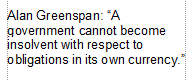
Sadly, our federal government does not acknowledge it is a Monetary Sovereign. It has the unlimited ability to create U.S. dollars at no cost.

Greenspan quote.png

Instead, it follows the right-wing, Tea Party / Libertarian formula of spending the least it can, under the circumstances, because of irrational fears about deficits and “big” government.

Then to exacerbate the problem, the politicians continue with petty, political arguments about precisely where each dollar is to go.

The downturn looks likely to be deemed as the first recession since 2007-2009 by U.S. business-cycle arbiter National Bureau of Economic Research. The second half of the year will see a resumption of growth, according to the survey, though economists say the deck is stacked against a snap-back.

The Fed is expected to keep interest rates near zero until the first half of 2022.

The low-interest-rate myth continues. The popular belief is that low interest rates are economically stimulative because they make borrowing cheaper.

But low interest rates have a negative side: They reduce the amount of interest the federal government pays on its Treasury Securities, i.e. the amount of interest money the government pumps into the economy. This reduction directly cuts GDP.

The blue line is the fed funds (interest) rate. The red line is GDP growth, year-to-year.

As the above graph demonstrates, high interest rates correlate with high GDP growth and low rates correlate with low GDP growth.

As interest rates trended up, through 1980, the GDP growth trended up. Then, as interest rates trended down, the GDP growth rate trended down.

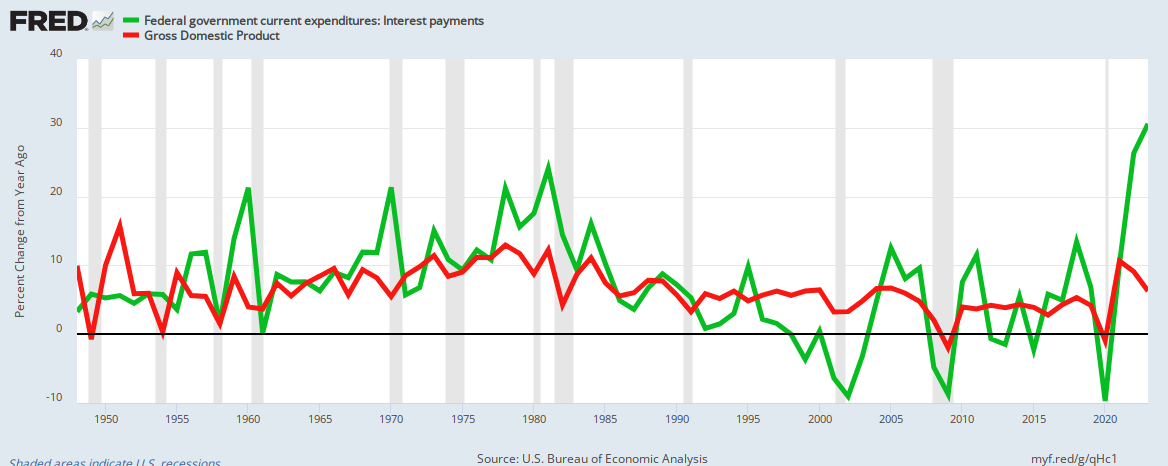
The green line is federal interest payments growth, year-to-year.

The above graph is similar to the previous graph except it shows total interest paid rather than interest rates. The result essentially is the same.

On average, the more interest the federal government pays, the more GDP grows.

“Even if the economy starts to re-open in mid-May, more than 20 million Americans will have lost their job with the economy likely having contracted around 13% peak-to-trough, more than three times deeper than the global financial crisis,” James Knightley, chief international economist at ING Financial Markets, wrote with his forecast submission.

“It will be a gradual re-opening of the economy, so a return to ‘business as usual’ is many months away.

Throw in crippling financial losses and a legacy of defaults and it means we estimate U.S. economic output won’t return” to the late-2019 peak until mid-2022 at the earliest, Knightley said.

People “lose their jobs” because companies cannot afford to maintain payroll. As the companies run short of money, their people run short of money. When consumers run short of money, they buy less, so more companies run short of money, in a self-strengthening helix descending to depression.

To cut the helix, the government must give (not lend) money to businesses and to consumers.

“Crippling financial losses and a legacy of defaults” are symptoms of a lack of money.

See the commonality? The overarching problem facing the economy is a shortage of money — which the federal government could solve with sufficient deficit spending.

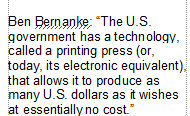
Bernanke quote.png

The U.S. federal government has a massive built-in advantage, that if used properly, would eliminate recessions and depressions. Unlike state and local governments and unlike euro-nation governments, the U.S. government is Monetarily Sovereign.

It has the unlimited ability to create U.S. dollars and to give those dollars any value it chooses.

There is no excuse for a company to fire people because it has run short of payroll dollars if the government simply will provide per-employee financial support.

There is no excuse for “crippling financial losses” if the government will pump dollars into the economy.

We are at war with our financial enemies: Recession and depression. The U.S. government has an ultimate weapon to use against these enemies: Monetary Sovereignty.

Instead, it chooses to fight with sticks and stones — little sticks and tiny stones. And it leaves the battle to the monetarily non-sovereign states, counties, and cities. The army has departed the battlefield, leaving the women and children to fight empty-handed.

The government is in a war against the enemies, recession

As a result, we will lose the war, and the American people will suffer.

Needlessly.

Rodger Malcolm Mitchell
Monetary Sovereignty
Twitter: @rodgermitchell
Search #monetarysovereignty Facebook: Rodger Malcolm Mitchell

…………………………………………………………………………………………………………………………………………………………………………………………………………………………………………………………………………………………..

THE SOLE PURPOSE OF GOVERNMENT IS TO IMPROVE AND PROTECT THE LIVES OF THE PEOPLE.

The most important problems in economics involve:

  1. Monetary Sovereignty describes money creation and destruction.
  2. Gap Psychology describes the common desire to distance oneself from those “below” in any socio-economic ranking, and to come nearer those “above.” The socio-economic distance is referred to as “The Gap.”

Wide Gaps negatively affect poverty, health and longevity, education, housing, law and crime, war, leadership, ownership, bigotry, supply and demand, taxation, GDP, international relations, scientific advancement, the environment, human motivation and well-being, and virtually every other issue in economics.

Implementation of Monetary Sovereignty and The Ten Steps To Prosperity can grow the economy and narrow the Gaps:

Ten Steps To Prosperity:

1. Eliminate FICA

2. Federally funded Medicare — parts A, B & D, plus long-term care — for everyone

3. Provide a monthly economic bonus to every man, woman and child in America (similar to social security for all)

4. Free education (including post-grad) for everyone

5. Salary for attending school

6. Eliminate federal taxes on business

7. Increase the standard income tax deduction, annually. 

8. Tax the very rich (the “.1%”) more, with higher progressive tax rates on all forms of income.

9. Federal ownership of all banks

10. Increase federal spending on the myriad initiatives that benefit America’s 99.9% 

The Ten Steps will grow the economy and narrow the income/wealth/power Gap between the rich and the rest.

MONETARY SOVEREIGNTY

The secret to making the economy rebound.

The secret to making the economy rebound?

It’s no secret. Or rather it is a secret to those who intentionally close their eyes and stumble about.

The secret is to reverse the problems.

Problem #1. Lack of money.

A strong economic rebound likely depends on people and companies being able to preserve their money, so that it can be spent and invested once the gloom begins to subside.

Not only have 16.8 million Americans lost their jobs in the past three weeks, but workers have seen their hours slashed, have seen sales commissions disappear and have accepted salary cuts, such that incomes have declined for half of U.S. working households, according to a survey from The Associated Press-NORC Center for Public Affairs Research.

Congress has been patting itself on the back for pumping a claimed $2 trillion into the economy. Sadly, it’s not $2 trillion, because much of it has be lent, not given, so as the loans are paid off, money will again disappear.

Second, the money is going out slowly, so the effect will be slow.

And third, and most important, it simply isn’t enough. You can’t stimulate the giant U.S. economy with a mere $2 trillion (or whatever). It would be like you giving a dime to a beggar and assuming that would lift her out of poverty.

giving coin to beggar.png
“Here’s a dime. Buy yourself some food, clothing, and a house.”

The solution: Pump BIG money into the economy. Step #1 of the Ten Steps to Prosperity (below) would be a good start.

Eliminating FICA would pump about $1.2 Trillion into the economy and give it to the right people — the American worker — who would spend the money, thereby lifting the economy.

In fact, Steps 1 through 7 would pump dollars into the economy, and Step 10 might, depending on specifics.

Problem #2. Loss of a generation

Children can no longer attend school, reducing the productivity of their parents.

And not just small children. Tomorrow’s leaders are receiving online classes from their schools or attending digital schools like University of Phoenix.

Yes, it’s much better than Trump University, but being honest, it’s much less educational than in-person classes. It simply isn’t, for the many reasons you can imagine yourself.

So this may turn out to be the poorest educated, least productive generation in recent history. I pray I’m wrong on this, but all the signs point in that direction.

Problem #3. Impoverished states, counties, and cities

On a regional basis, many state economies may take time to claw back what has been lost.

The states (and counties and cities) pay for so much already, and unlike the Monetarily Sovereign federal government, they do not have access to unlimited funds.

Think of grades K-12, where there always is a struggle for money. The states and local communities pay for that education, and with lower sales taxes, lower income taxes, and probably lower property taxes, how will these monetarily non-sovereign governments fund education?

Cut teachers? Cut “unnecessary” programs like art, gym, social studies — cut everything but Science, Technology, Engineering, and Mathematics? (STEM), and I’m not confident that even STE will be saved in all circumstances.)

Remember too, that state and local governments are the primary sources of infrastructure and locally needed funds: Roads, flood control, crime control (courts, police, jails, etc.), many hospitals, many universities, garbage collection, water, building codes,  business inspection, etc.

What are the options for these non-federal governments. Only two, and neither contributes to economic recovery: Increase taxes or reduce services. Two disasters.

Problem #4. Reduced business and technical growth

Working from home is creating a collapse in investment. All firms I have spoken to have canceled training, new product introductions and R&D projects, while at U.S. universities and laboratories unless you are working on COVID-19 you have stopped work.

So innovation — the main driver of long-run U.S. growth — has stopped.”

Problem #4 is the invisible one. You can see when people lack money, or when education is lacking, or when your local government can’t take care of your street, or when your house floods, but it’s difficult to tell when new inventions are not forthcoming.

If the Internet had not been created, we would have gone on without it, and none would be the wiser. For all you know, the “next great thing” will not happen, or at least it will be delayed because the potential inventor lost the education and/or the money that would have paved the way.

Problem #5. Fear

President Donald Trump has been telling voters that the U.S. economy will leap back to life “like a rocket,” stronger than ever after its bout with the coronavirus.

But there are emerging signs that any recovery will fail to match the speed and severity of the economic collapse that occurred in just a few weeks.

“Anyone who assumes we’re going to get a sharp snapback in activity isn’t thinking about how consumers are going to feel. They’re going to be very cautious,” said Nariman Behravesh, chief economist at IHS Markit.

“Households and businesses have seen their finances deteriorate. People are buying groceries on their credit cards.”

To understand the consequences of a sudden negative shock on the economy, Behravesh studied how many people returned to flying after the Sept. 11, 2001, terrorist attacks.

“It took 2 1/2 years for airline passenger traffic to go back to previous levels,” he said.

No longer able to campaign on a half-century low unemployment rate, Trump has begun to tell voters that he can quickly rebuild the economy. He said measures like the $2.2 trillion rescue package — with more money likely on the way — can send employment and economic growth to new highs.

Paul Winfree, a former Trump White House official who is now director of economic policy at the conservative Heritage Foundation. said in an email. “Things won’t turn around until a significant majority of people decide that we’ve done enough (privately and publicly) and have to move along.”

If Congress used this crisis as a basis for instituting the Ten Steps to Prosperity (below), we would go a long way toward eliminating the terrible losses of 2020.

But so long as the current incumbents continue to dither and argue about which $250 billion program should be funded, rather than sending at least $7 trillion into the private sector, hope for the future is bleak.r

If nothing else, the current crisis is a strong endorsement for Congressional term limits.

Rodger Malcolm Mitchell
Monetary Sovereignty
Twitter: @rodgermitchell
Search #monetarysovereignty Facebook: Rodger Malcolm Mitchell

…………………………………………………………………………………………………………………………………………………………………………………………………………………………………………………………………………………………..

THE SOLE PURPOSE OF GOVERNMENT IS TO IMPROVE AND PROTECT THE LIVES OF THE PEOPLE.

The most important problems in economics involve:

  1. Monetary Sovereignty describes money creation and destruction.
  2. Gap Psychology describes the common desire to distance oneself from those “below” in any socio-economic ranking, and to come nearer those “above.” The socio-economic distance is referred to as “The Gap.”

Wide Gaps negatively affect poverty, health and longevity, education, housing, law and crime, war, leadership, ownership, bigotry, supply and demand, taxation, GDP, international relations, scientific advancement, the environment, human motivation and well-being, and virtually every other issue in economics.

Implementation of Monetary Sovereignty and The Ten Steps To Prosperity can grow the economy and narrow the Gaps:

Ten Steps To Prosperity:

1. Eliminate FICA

2. Federally funded Medicare — parts A, B & D, plus long-term care — for everyone

3. Provide a monthly economic bonus to every man, woman and child in America (similar to social security for all)

4. Free education (including post-grad) for everyone

5. Salary for attending school

6. Eliminate federal taxes on business

7. Increase the standard income tax deduction, annually. 

8. Tax the very rich (the “.1%”) more, with higher progressive tax rates on all forms of income.

9. Federal ownership of all banks

10. Increase federal spending on the myriad initiatives that benefit America’s 99.9% 

The Ten Steps will grow the economy and narrow the income/wealth/power Gap between the rich and the rest.

MONETARY SOVEREIGNTY