Congress’s Big Lie once again in the news, and how it costs you.

The “Big Lie” in economics goes something like this:

“Federal finances are like personal finances. Just as you can run short of money, and need income in order to pay your bills, so can the federal government run short of money. It too needs income to pay its bills.

“For that reason, the federal government should run a balanced budget and live within its means.”

If you are not initiated in economics, it may all sound plausible, but in fact, it all is a big, fat lie.

The U.S. Federal government is unlike you, and me, and state/local governments, and businesses.

It uniquely is Monetarily Sovereign. It is sovereign over its sovereign currency, the U.S. dollar.

It never can run short of dollars; it has the unlimited ability to create them. It has no “means to live within.”

And running a balanced budget would create a recession or depression because an economy needs a growing supply of money to survive even the most minimal amount of inflation.

If this sounds wrong to you, it’s only because you have been told The Big Lie so often, you have been brainwashed.

One example of many: President Obama: “Washington Has to Live within its Means”

Here’s another:

Trump Using COVID-19 As A Cover To Gut Social Security And Medicare, Critics Charge
HuffPost, Mary Papenfuss, August 8, 2020

Critics erupted Saturday after President Donald Trump signed four executive actions that included deferring payroll taxes that provide funding for both Social Security and Medicare.

While Trump characterized the move as a financial boost for Americans struggling amid the COVID-19 crisis, critics blasted it as a cynical ploy to do what Trump has long intended to do: Gut the vitally important social service programs just as Americans need them more than ever during the pandemic.

“The American people desperately need relief,” noted Rep. Val Demings (D-Fla.). “Instead, the president decided to defund Social Security and Medicare.

No, Trump is not defunding Social Security and Medicare. Even if all payroll taxes (FICA) were completely eliminated, as they should be, Social Security and Medicare could continue paying benefits, forever.

And not just paying benefits forever, but paying double or triple benefits forever.

We quite literally could have Medicare for All and Social Security for All without collecting a single penny in federal taxes.

Presumptive Democratic presidential candidate Joe Biden called Trump’s action a “reckless war on Social Security.” He’s “laying out his road map” to cut the program, he warned in a statement.

House Ways and Means Chair Richard Neal (D-Mass.) called the move “a poorly disguised first step in an effort to fully dismantle these vital programs by executive fiat.”

Trump very well might be laying out a road map to cut Social Security, by falsely telling the public that the program is supported by taxes.

But the truth is that FICA does not fund Social Security, and the so-called Social Security “trust fund” is an accounting fiction.

Even the Social Security Administration lies to you about where they get their funding:

Social Security Trust Fund Cash Flows and Reserves

Although some observers view the trust fund reserves and interest income as accounting fictions, a careful tracing of the cash flows reveals that the reserves and their interest earnings are, for all practical purposes, as real as those of any bank account.

In addition, an examination of the long-term constraints facing the trust funds and the federal budget clarifies that under the Social Security system’s self-financing framework, an improvement in trust fund finances will not relieve the accumulated debt commitments of the rest of the federal government.

The “some observers” are correct, and the trust fund is not as real as “any bank account.”

“Bank accounts” in the private sector receive their deposits from monetarily NON-sovereign depositors, whose money supply is limited.

The fictional SS trust fund received deposits from the Monetarily Sovereign federal government, which cannot run short of dollars.

Therefore, to claim the “trust fund” is running short of dollars is an outright lie, because the government, at no cost to anyone, can replenish the fund, instantly and infinitely.

And, in fact, it isn’t even a “trust fund.”

A trust fund is a financial tool that holds and administers assets for the benefit of another person or organization, called a beneficiary.

The initial assets for the fund are provided by a grantor or donor, and a trustee or team of trustees manages the funds according to that person’s instructions.

If you are paying FICA taxes, which supposedly fund the fictional “trust fund,” that makes you and your employer the grantor or donor.

But the fictional SS trust fund is not managed according to your instructions. 

Quite the opposite. You and your employer are required to put money in, and then the “trustees” do whatever Congress wants them to do with your money.

You are the beneficiary, and your employer is what? The victim?

You can’t take money out when you want, and you even are taxed on your own money, when you are allowed to take your money out.

Some “trust fund” that is!

For the SSA to claim it is a “bank account” or a “trust fund” is very simply a lie.

Even the founder of Social Security, President Franklin D. Roosevelt, knew FICA didn’t fund Social Security.

Excerpts from a Luther Gulick memo:

I raised the question of the ultimate abandonment of the pay roll taxes in connection with old age security and unemployment relief in the event of another period of depression.

I suggested that it had been a mistake to levy these taxes in the 1930’s when the social security program was originally adopted.

FDR said, “I guess you’re right on the economics. They are politics all the way through.

“We put those payroll contributions there so as to give the contributors a legal, moral, and political right to collect their pensions and their unemployment benefits.

“With those taxes in there, no damn politician can ever scrap my social security program. Those taxes aren’t a matter of economics, they’re straight politics.

FDR also mentioned the psychological effect of contributions in destroying the “relief attitude.”

Little did Roosevelt anticipate that Congress and a long line of Presidents would use those contributions to do exactly the opposite of what he had hoped, i.e to limit the benefits to some mythical contribution level, and even to tax them!

This only proves no one can create a law that politicians can’t squirm out of, simply by “misinterpreting” it. (The U.S. Supreme Court is notorious for such “misinterpretations.”)

As you now have learned, Social Security benefits (and Medicare benefits) are not limited by taxes or phony “trust funds.”

Since there is no financial reason why the federal government does not fund Social Security for All, Medicare for All,  College for All, and the myriad other benefits that the poor are forced to do without, what is the real reason?

That question takes us to Gap Psychology, the desire to distance oneself from those below on any social scale.

“Rich” is a comparative. It means just having “much more,” not any specific amount.

The key is “more,” and the greater the distance (the “Gap”) one is from those who have “less,” the richer one is.

So, to become even richer (which the rich always seem to want), one does not need to increase one’s wealth. All one needs do is increase the Gap, and that can be done by holding down those who have less.

And that is the purpose of the Big Lie: To hold you, who are not rich, down.

If the populace understood the Federal government to be Monetarily Sovereign, and not limited in its spending, the people would demand more benefits, such as those described in the Ten Steps to Prosperity (below).

But giving the populace those benefits, which the government easily could do, would narrow the Gap, and so, make the rich less rich.

The purveyors of the Big Lie tell you the government has to “live within its means,” and “can’t afford” certain benefits, and it is “prudent” to spend less, and the “debt is unsustainable,” and spending is “socialism,” and spending causes inflation — all of which are untrue.

But you hear the Big Lie from so many mouths, and in so many different ways, again, again, again, until it has become gospel. That is the very definition of brainwashing.

Even most of you, who are not among the rich, and would gain so much from increased federal spending on many wonderful benefits — even you jeer at the notion of free health care, free college, free food for the poor, free financial support, and the elimination of many taxes.

You have been brainwashed into believing “there is no such thing as a free lunch,” when in fact, U.S. dollars themselves are a free creation, from thin air, by the U.S. government (which itself was created from thin air).

So as you struggle for the necessities, and perhaps a few extras, the rich laugh at your feeble flailing, while they own the government that creates dollars and benefits from thin air.

One last example:

Trump also signed an order providing $400 a week in enhanced unemployment benefits — down from the $600 weekly benefit that expired last month.

Wanting to appear benevolent, without actually being benevolent, Trump rides in on a white stallion, to save the impoverished by allowing them a bare pittance.

It is a dribble, even was too much for the inhumane GOP, which at our borders, already has proved that starving children is no problem.

Heather Robinson | Too bad the American family is enjoying no such ...
                Desperation

And you are supposed to grovel in gratitude at the generosity that allows you an insufficient amount to lead a decent life.

Then, when jobs become available, will you be so desperate, you will accept horrible working conditions at low wages, while the rich business leaders vacation on yachts?

Tomorrow, will you sneer again at so-called “socialism,” and perhaps, in part, your sneering rather than demanding, will be why you allow the rich to make you and your family suffer.

There are penalties for ignorance.

Why aren’t you contacting your Washington politicians and making demands? It takes many voices; yours should be one of them.

Rodger Malcolm Mitchell

Monetary Sovereignty Twitter: @rodgermitchell Search #monetarysovereignty Facebook: Rodger Malcolm Mitchell …………………………………………………………………………………………………………………………………………………………………………………………………………………………………………………………………………………………..

THE SOLE PURPOSE OF GOVERNMENT IS TO IMPROVE AND PROTECT THE LIVES OF THE PEOPLE.

The most important problems in economics involve:

  1. Monetary Sovereignty describes money creation and destruction.
  2. Gap Psychology describes the common desire to distance oneself from those “below” in any socio-economic ranking, and to come nearer those “above.” The socio-economic distance is referred to as “The Gap.”

Wide Gaps negatively affect poverty, health and longevity, education, housing, law and crime, war, leadership, ownership, bigotry, supply and demand, taxation, GDP, international relations, scientific advancement, the environment, human motivation and well-being, and virtually every other issue in economics. Implementation of Monetary Sovereignty and The Ten Steps To Prosperity can grow the economy and narrow the Gaps:

Ten Steps To Prosperity:

1. Eliminate FICA

2. Federally funded Medicare — parts A, B & D, plus long-term care — for everyone

3. Social Security for all or a reverse income tax

4. Free education (including post-grad) for everyone

5. Salary for attending school

6. Eliminate federal taxes on business

7. Increase the standard income tax deduction, annually. 

8. Tax the very rich (the “.1%”) more, with higher progressive tax rates on all forms of income.

9. Federal ownership of all banks

10.Increase federal spending on the myriad initiatives that benefit America’s 99.9% 

The Ten Steps will grow the economy and narrow the income/wealth/power Gap between the rich and the rest.

MONETARY SOVEREIGNTY

The post office con job

The federal government has hundreds of agencies. Here is a complete list.

Of all these hundreds of agencies, just one is required to function like a business and required to make a profit in order to survive. Guess which one.

Right. The United States Postal Service (USPS).

The rest — The White House, the Senate, the House of Representatives, the Supreme Court, the Food and Drug Administration, etc., etc., etc. – – all are funded by federal spending.

Why not the postal service?

Mypostaluniforms.com » summer postal uniforms
A vital federal service

Is the USPS less important than other agencies? The postal service is one of the few agencies mentioned in the Constitution, which states that Congress has “the power to establish post offices and post roads.

Among the other agencies indicated in the Constitution are The Senate and the House, the President, the Internal Revenue Service, Customs and Border Protection (“the power to lay and collect taxes and tariffs), the military agencies (“the power to raise and support military forces”).

None of them pay their own way.

They are too important to the nation to be required to labor under vagaries of a for-profit system.

Consider, for instance, the fallout from a situation in which the military, unable to raise money to pay its soldiers, had to cut back on its defense of America.

Or what if food inspections had to stop because the Food Safety and Inspection Service was “losing” money.

So, it has been with wonderment that over the years I’ve seen articles like this:

Postal Service loses $2.2 billion in 3 months
By Matthew Daly Associated Press, August 7, 2020

WASHINGTON — The U.S. Postal Service says it lost $2.2 billion in the three months that ended in June as the beleaguered agency — hit hard by the coronavirus pandemic — piles up financial losses that officials warn could top $20 billion over two years.

While package deliveries to homebound Americans were up more than 50%, that was offset by continued declines in first-class and business mail, even as costs increased significantly to pay for personal protective equipment and replace workers who got sick or chose to stay home in fear of the virus.

Without an intervention from Congress, the agency faces an impending cash flow crisis.

The Postal Service is seeking an infusion of at least $10 billion to cover operating losses as well as regulatory changes that would undo a congressional requirement that the agency pre-fund billions of dollars in retiree health benefits.

The postal service “lost” $2.2 billion. How much, I wonder, did the military “lose”? How much did the Supreme Court “lose”? What about the Department of Veterans Affairs; how much did it “lose”? Did the National Institute of Corrections “lose” money?

The postal service charges the public for each letter or package. How much did Congress charge the public for each vote? Is the President paid by the veto or approval?

How much have you paid the Department of Agriculture for inspecting that can of corn you purchased?

The last time I drove down to Florida, I took U.S. Highways I65 and I75, and I didn’t pay the government a penny in tolls. Want a 45-minute tour of the U.S. Botanic Garden Conservatory? It’s free.

You get the point. The federal government doesn’t need to charge for anything. It has unlimited money, so why is the postal service struggling financially? There are no good reasons. None.

What will a Congress that is dominated by a postal-hating President do about the postal service? Cut service further? Perhaps one mail delivery per week, or per month? Eliminate mail altogether?

Or will Congress do what the Republicans always want to do: Privatize the postal service so that a few billionaire contributors can take over and make even more billions by raising stamp prices higher and higher?

And as for Republican President Bush’s prefunding of benefits, that either is ignorance or maliciousness. The U.S. government never needs to prefund anything. It has unlimited power to pay any invoice instantly.

Then, there is yet another in a long line of Trump incompetents, Louis DeJoy. He is a businessman whose primary qualification is that he donated millions to Trump and the GOP. So, of course, he was named Postmaster General.

He thinks the postal service should be run like a business, which on the surface may sound like a good idea, except for a few reality checks:

  1. The primary mission of any business is to provide profits to its owners via salaries, dividends, and/or share-price growth. The primary mission of a government agency is to provide service to the voters and residents of its defined territory.
  2. A business is run by its officers and directors, who have the power to pursue it’s primary mission. The post office is run by its officers who take direction from Congress and the President. The primary mission of the postal service often conflicts with the primary missions of Congress and the President, whose objectives are political, not service or business.
  3. Businesses negotiate with unions to make mutually tolerable agreements. The negotiating power of the postal service has been usurped by Congress and the President for political, not business, reasons, which has left the postal service with unfavorable union rules. (See: Should there be workers’ unions in government?“)

Running any federal agency is diametrically opposite from running a business, and seldom do even honest, successful businessmen make good agency heads.

(This fundamental truth doesn’t begin to account for dishonest, unsuccessful, multi-bankrupt, con artists, whose sole interest is to grab as much for themselves and their families as they can.)

In summary, the postal service’s problems are of Congress’s making, and only Congress can solve them. 

The agency should function financially like every other federal agency, with Congress providing sufficient appropriations for efficient service to the public.

The goal should be the highest quality service, not profitability.

Even the best-intentioned, most qualified Postmaster General could not make the postal service live up to its that service requirement, and with Louis DeJoy, we are miles away from that person.

The pearl-clutching concerns about the postal service “losing money” is a con job by the rich to pave the way for privatizing the service.

Rodger Malcolm Mitchell

Monetary Sovereignty Twitter: @rodgermitchell Search #monetarysovereignty Facebook: Rodger Malcolm Mitchell …………………………………………………………………………………………………………………………………………………………………………………………………………………………………………………………………………………………..

THE SOLE PURPOSE OF GOVERNMENT IS TO IMPROVE AND PROTECT THE LIVES OF THE PEOPLE.

The most important problems in economics involve:

  1. Monetary Sovereignty describes money creation and destruction.
  2. Gap Psychology describes the common desire to distance oneself from those “below” in any socio-economic ranking, and to come nearer those “above.” The socio-economic distance is referred to as “The Gap.”

Wide Gaps negatively affect poverty, health and longevity, education, housing, law and crime, war, leadership, ownership, bigotry, supply and demand, taxation, GDP, international relations, scientific advancement, the environment, human motivation and well-being, and virtually every other issue in economics. Implementation of Monetary Sovereignty and The Ten Steps To Prosperity can grow the economy and narrow the Gaps:

Ten Steps To Prosperity:

1. Eliminate FICA

2. Federally funded Medicare — parts A, B & D, plus long-term care — for everyone

3. Social Security for all or a reverse income tax

4. Free education (including post-grad) for everyone

5. Salary for attending school

6. Eliminate federal taxes on business

7. Increase the standard income tax deduction, annually. 

8. Tax the very rich (the “.1%”) more, with higher progressive tax rates on all forms of income.

9. Federal ownership of all banks

10.Increase federal spending on the myriad initiatives that benefit America’s 99.9% 

The Ten Steps will grow the economy and narrow the income/wealth/power Gap between the rich and the rest.

MONETARY SOVEREIGNTY

11 experts try to trick you about the U.S. economy

Uncle Sam broke.png
100% impossible.

The following will give you a treasured opportunity to read the words of 11 experts, each demonstrating his lack of knowledge or lack of honesty about federal finances and economics.

Their hope or effect is to make you ignorant about the economy, during this time of crisis.

If your hope is to become ignorant about federal finances or economic, then do believe what they say. You will be able to cross that item off your bucket list.

But if you wish to understand the facts, and perhaps even be able to contact your political leaders with the facts, read on.

As you read, please remember that federal finances are nothing at all like your personal finances, nothing like business finances, and nothing like state/local government finances.

The federal government uniquely is Monetarily Sovereign. It never, NEVER can run short of its own sovereign currency, the U.S. dollar.

And the government, being sovereign over the dollar, has absolute control over its value.

When it comes to the U.S. dollar, the federal government is God. So don’t use your own personal financial experience as a template about federal finances.

Here are excerpts from an article written by Mike Bebernes, of Yahoo News, followed by my comments.

Coronavirus aid: Is the U.S. taking on too much debt?
Mike Bebernes, Editor,Yahoo News 360•August 4, 2020

Negotiations in Congress about the next stimulus bill aimed at countering the economic effect of the coronavirus have ground to a crawl amid debate over how big the rescue package should be.

Not only is there the expected sparring between Democrats and Republicans, the issue is also reportedly causing a rift within the GOP itself.

A vocal group of Republicans have begun to raise concerns about adding how much the next stimulus will add to the federal deficit, “We have to be careful about not piling on enormous amounts of debt,” Treasury Secretary Steve Mnuchin said.

Kentucky Sen. Rand Paul said some of his GOP colleagues are “no different than socialist Democrats when it comes to debt.”

Right off the bat, you see Mnuchin’s ignorance. The economic effect of the coronavirus is quite simple: Businesses are running short of paying customers and people are running short of income with which to pay businesses.

The effect is that businesses and people are running short of money. This lack of money causes a recession.

The solution to a recession also is quite simple: Give businesses and people money.

As for Rand Paul’s concern, deficit spending is not “socialist.” Socialism is government ownership and control of businesses. Handing out money and/or providing benefits (healthcare, education, etc.) is not socialism.

Fakers love to toss around the word “socialist,” because they know Americans will react negatively to it. Any time you hear someone accuse some federal spending as “socialist,” know you are being conned.

House Democrats passed a $3.4 trillion stimulus bill in May. The proposal under consideration by Senate Republicans carries a $1.1 trillion price tag.

Even if a significantly smaller package ends up being passed, the national debt will still be at historic levels.

The $2.2 trillion CARES Act passed in March pushed the deficit over $26 trillion and has the country on pace for the largest annual ratio of debt as a share of the economy since World War II.

Although it commonly is termed, “debt,” it isn’t the same thing as personal debt or business debt. That thing called “debt” actually is the total of deposits into Treasury Security accounts (T-Bills, T-Notes, T-Bonds) held at the Federal Reserve (The Fed).

These deposits are not a burden on anyone — not on the government, not on taxpayers, and not on future generations. If the government wished, it could pay off the deposits today, merely by returning the dollars currently residing in those T-Security accounts.

If you own a T-bill, and that T-bill matures, the government will send back to you your dollars that reside in your T-bill account.

It would just be a transfer of your dollars similar to a transfer from your savings account to your checking account.

No tax dollars involved in the repayment of federal “debt.”.

The coronavirus isn’t the only reason the U.S. has so much debt. After running a surplus in the late 1990s, the deficit has ballooned over the past two decades.

Despite promising to eliminate the federal debt — which stood at $19 trillion when he took office — President Trump is on pace to have the largest deficit of any president.

The virus is taking dollars from the private sector, which has caused a recession.

Eliminating the so-called “debt” (deposits into T-Security Accounts) would take even more dollars from the economy, causing the deepest depression in U.S. history (and world history).

For example:

1804-1812: U. S. Federal Debt reduced 48%. Depression began 1807.
1817-1821: U. S. Federal Debt reduced 29%. Depression began 1819.
1823-1836: U. S. Federal Debt reduced 99%. Depression began 1837.
1852-1857: U. S. Federal Debt reduced 59%. Depression began 1857.
1867-1873: U. S. Federal Debt reduced 27%. Depression began 1873.
1880-1893: U. S. Federal Debt reduced 57%. Depression began 1893.
1920-1930: U. S. Federal Debt reduced 36%. Depression began 1929.
1997-2001: U. S. Federal Debt reduced 15%. Recession began 2001.

You can thank your god that Trump didn’t live up to his promise, for had he somehow managed to eliminate U.S. debt, you would be living naked in a cave, eating cave bats.

To many fiscal conservatives, large deficits pose a major risk to the economic stability of the country.

Taking on debt may be a quick way to solve problems in the short term, but it only pushes the burden onto future generations, they argue.

The weight of trillions of dollars in debt, plus the interest accrued, will stifle the country’s ability to recover from the recession and hinder growth once the economy improves.

Federal deficit spending adds growth dollars to the economy, which is exactly why they “solve problems in the short term.” Deficit spending also solves problems in the mid-term and the long term.

Think of all the things for which the federal government spends money. Then ask yourself, “Which of these, if eliminated, would grow the economy?”

Being Monetarily Sovereign, the federal government creates new dollars by spending. That is the government’s method of dollar-creation.

To pay a creditor, the federal government sends instructions (not dollars) to the creditor’s bank, instructing the bank to increase the balance in the creditor’s checking account.

The instant the creditor’s bank does as instructed, new dollars are created and added to the nation’s M1 money supply.

Deficit spending is no burden whatsoever on future generations. In fact, federal deficit spending benefits future generations by providing them not only with dollars, but also with roads, bridges, health care, education, military protection, safe food, legal protections, and the myriad other things the government pays for.

As for “interest accrued,” those dollars go into the private sector, stimulating economic growth. Interest is no burden on the federal government, which being Monetarily Sovereign has infinite dollars.

(That is why there is no way to answer the question, “How much money does the federal government have?” The real answer is, “Infinite.”)

America’s ability to keep borrowing enormous amounts of money, at least in theory, could run out if oversized deficits reduce confidence in the U.S. economy.

If that happens sometime in the future, it could cause a major spike in interest rates, severe inflation or even an economic collapse that dwarfs the impact of the pandemic, deficit hawks fear.

The U.S. federal government does not borrow. Being Monetarily Sovereign, it never can run short of U.S. dollars. It has no need to borrow.

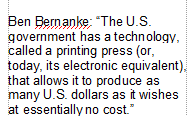
Bernanke quote
Truth from the Chairman

What wrongly is termed “borrowing” actually is the acceptance of deposits into T-security accounts.

The purpose of T-security accounts (“debt”) is not to provide spending money for the U.S. government, the one entity that has infinite dollars.

The primary purposes of T-security accounts are:

  1. to provide a safe parking place for unused dollars, which stabilizes the dollar and
  2. to assist the Fed in setting interest rates.

The federal government could stop accepting deposits into T-security accounts today if it wished. And in the event that people stopped depositing into T-security accounts, the U.S. Federal Reserve has the unlimited ability to make those deposits.

As for a “major spike in interest rates,” the Fed, not depositors, controls interest rates. The rates are exactly what the Fed wants them to be. Only if the Fed wants a “major spike,” will there be one. Otherwise, no major spike.

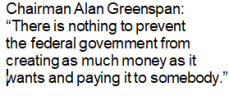
Greenspan II.png
Truth from another Chairman

As for “severe inflation,” it never is caused by federal debt or by federal deficit spending. In fact, deficit spending can cure inflations.

All inflations are caused by shortages of key goods and/or services, usually food or energy (oil).

Inflations are cured when the government deficit-spends to obtain the scarce goods and/or services and then distributes them to the private sector.

Consider the infamous Zimbabwe hyperinflation. The Zimbabwe government took farmland from farmers and gave it to people who didn’t know how to farm.

The predictable result: A massive food shortage that led to inflation. The Zimbabwe government could have ended the inflation by importing and distributing food (or better, by not stealing the farmland in the first place).

Instead, it merely devalued its currency, again, again, and again.

By contrast, Germany cured its infamous hyperinflation by employing businesses and people to build the greatest war machine the world had ever known. That allowed people and businesses to thrive, and eliminated shortages. (War preparation was not the best use for German money, but it did cure the hyperinflation.)

Others argue that these potential future issues pale in comparison to the very real catastrophe that will happen without a large rescue package.

Research suggests that the $600 weekly bonus added to unemployment has kept the economy from collapsing even further over the past few months.

Now that it’s expired, millions of Americans are at risk of losing their homes and countless businesses could close permanently.

True. The $3 trillion rescue package helped avoid the catastrophe that is certain unless at least $7 trillion is pumped into the private sector.

Oh, that won’t happen? Congress won’t do it?  Then assume we will have an economic catastrophe with massive unemployment, starvation, and more death — all unnecessarily.

The only way to truly save the economy, some argue, is to get the pandemic under control.

Spending money to improve testing, help people stay home and prop up struggling state budgets in the short term could prevent the need for an even bigger stimulus down the road.

Some Democrats believe that concerns about debt are insincere and motivated by politics, since the GOP enthusiastically supported tax cuts in 2017 that are expected to add trillions to the deficit.

Getting the pandemic “under control” is not the only way to save the economy, though it’s a good thing to do.

The faster way is to pump trillions of dollars into the private sector so that businesses can do business and consumers can consume.

And now what you nervously have been waiting to see: More truly ignorant comments by a few of America’s opinion leaders:

The stimulus should be limited to the most essential remedies
“Senate Republicans are right to be worried about rising federal debt. But they are wrong to artificially limit the level of spending in the latest coronavirus relief package.” — Henry Olsen, Washington Post

There are zero reasons to limit the stimulus. Note how Olsen takes both sides of the issue. That way, in retrospect, he always can lay claim to having been right. That is how one gets to be an “expert.”

At a certain point, U.S. credit may run out
“America’s borrowing capacity is large, but we may discover that it is not unlimited.” — Brian Riedel, National Review

The U.S. doesn’t borrow, so it doesn’t need “credit” and doesn’t have a “borrowing capacity. Being Monetarily Sovereign, it has absolute control over the value of its money and its credit, and never can run short.

Spend money now, but aggressively tackle the deficit once the pandemic ends
“When the pandemic passes, authorities need to shift out of rescue mode and start weaning capitalism off easy money and bailouts.” — Ruchir Sharma, Wall Street Journal

Sharma’s formula is to “spend money now ” to feed our starving economy, but when the pandemic ends, begin to starve the economy? Wow! Great idea, Ruchir: Starve future generations.

Better to spend money now, and spend money later, to continue to grow the economy.

The previous stimulus proved you can’t spend your way out of a crisis
“Having wasted the opportunity to cool off the spending binge and put the country in a better position to deal with a crisis, Congress now appears ready to do the only thing it knows how: spend even more.” — Eric Boehm, Reason

Remember that Boehm is a Libertarian for whom any amount of federal spending is too much.

Let me correct Boehm’s comment: “The previous stimulus proved that when the economy is in full starvation mode, insufficient stimulus will help some, but way, way more is needed.”

Way back in April I wrote that at least $7 trillion was needed. But, Congress voted for $3 trillion.

Of course, it wasn’t enough, so we now are in a serious recession. Yet, Boehm wants to cut back on all spending.

Future generations will suffer from reckless spending today
“Long after an effective vaccination has been discovered, the events of 2020 could figure in another disaster: a forced reduction in Medicare and Social Security benefits, as well as unprecedented tax hikes, to deal with massive national debt.” — Chris Reed, San Diego Union-Tribune

Apparently, Reed is clueless about Monetary Sovereignty. The federal government cannot ever run short of dollars.

So why would there have to be “a forced reduction in Medicare and Social Security benefits, as well as unprecedented tax hikes”? There is nothing that could force the federal government to do anything it doesn’t want to do.

And again, taxes do not fund the federal “debt.” The government could pay for Medicare and Social Security, and pay off the entire debt, without collecting a single penny in taxes.

Don’t worry about the deficit
Risk of large deficits pales in comparison to the harm insufficient stimulus will cause
“Deficits do matter in a sense, but not in the apocalyptic, over-the-cliff and straight-to-hell manner Republicans like to invoke when they’re feeling stingy.

‘A high-enough deficit under the right circumstances could theoretically bring about inflation. But inflation is not some mystical, unsolvable force.

The government has all kinds of tools at its disposal to deal with inflation.” — Zach Carter, HuffPost

Close, Zach, but no cigar. Deficits do matter because they are absolutely necessary for economic growth. A growing economy requires a growing supply of money, and deficits increase the supply of money.

But you are correct when you wrote this: “The government has all kinds of tools at its disposal to deal with inflation.”

More accurately, the federal government has absolute control over inflation.

Republican concerns about debt are purely political
“If there’s one thing we’ve learned over the past decade, it is that there are no Republican deficit hawks — only poseurs who claim to care about deficits in order to block spending they don’t like.” — New York Times columnist Paul Krugman

Right you are, Paul. Now if only you could unequivocally state: “The Federal Government is Monetarily Sovereign. It never can run short of dollars. No one should worry about deficits or “debt.”

Just do it, Paul.

A large rescue package can jump-start the economy’s recovery
“Congress should use this opportunity to support the American people and the American economy. If we get the economy growing, we will be able to pay off the debt.” — Minneapolis Federal Reserve Bank president Neel Kashkari to “Face the Nation”

Neel, you’re a Fed bank president, so you, of all people, should know that getting the economy “going” has absolutely nothing to do with the government’s ability to pay off the debt.

C’mon, man.

It’s better to overspend now and avoid a collapse
“We should be trying different things: stimulus payments, unemployment benefits, aid to state and local governments, aid to small businesses. Some of these things will be more effective than others, but it’s much better to err on the side of excess.” — Economist Gus Faucher to the Washington Post

Of all the “expert” comments, the comment by Gus Faucher comes closest to the truth.

My only quibble is with his use of the word, “excess.” We are so far from “excess” (whatever “excess” success may be), that even to mention it is misleading.

Historically low interest rates make borrowing money a smart strategy
“Interest rates on federal debt are currently lower than the expected rate of inflation, so there’s no good reason for restraint in the total size of the package.” — Vox correspondent Matthew Yglesias

Oh, Matthew, you know full well that interest rates are set by the government. The government has the unlimited power to pay as much or as little interest as it wishes.

You are correct that “there’s no good reason for restraint in the total size of the package,” but not because of interest rates. It’s because there never is a good reason to restrain federal deficit spending. Never.

So there it is folks, all those experts giving you contradictory advice, and not one of them demonstrates any understanding of federal financing.

Latest on the Spread of the Coronavirus Around the World | World ...
Foodbank line. Broke in America.

Feel free to contact them, tell them to learn Monetary Sovereignty, and say I said so.

Meanwhile, be ready for more poverty, starvation, homelessness, sickness, and death, thanks to Congress, the President, and the people who preach The Big Lie.

Rodger Malcolm Mitchell

Monetary Sovereignty Twitter: @rodgermitchell Search #monetarysovereignty Facebook: Rodger Malcolm Mitchell …………………………………………………………………………………………………………………………………………………………………………………………………………………………………………………………………………………………..

THE SOLE PURPOSE OF GOVERNMENT IS TO IMPROVE AND PROTECT THE LIVES OF THE PEOPLE.

The most important problems in economics involve:

  1. Monetary Sovereignty describes money creation and destruction.
  2. Gap Psychology describes the common desire to distance oneself from those “below” in any socio-economic ranking, and to come nearer those “above.” The socio-economic distance is referred to as “The Gap.”

Wide Gaps negatively affect poverty, health and longevity, education, housing, law and crime, war, leadership, ownership, bigotry, supply and demand, taxation, GDP, international relations, scientific advancement, the environment, human motivation and well-being, and virtually every other issue in economics. Implementation of Monetary Sovereignty and The Ten Steps To Prosperity can grow the economy and narrow the Gaps:

Ten Steps To Prosperity:

1. Eliminate FICA

2. Federally funded Medicare — parts A, B & D, plus long-term care — for everyone

3. Social Security for all or a reverse income tax

4. Free education (including post-grad) for everyone

5. Salary for attending school

6. Eliminate federal taxes on business

7. Increase the standard income tax deduction, annually. 

8. Tax the very rich (the “.1%”) more, with higher progressive tax rates on all forms of income.

9. Federal ownership of all banks

10.Increase federal spending on the myriad initiatives that benefit America’s 99.9% 

The Ten Steps will grow the economy and narrow the income/wealth/power Gap between the rich and the rest.

MONETARY SOVEREIGNTY
Answering two of the great philosophical questions

Being retired from the business world, I have time to just sit back and muse, especially about things of which I have zero knowledge. Do you ever do that? Just lay back, watch the clouds, and imagine things?

It’s both a relaxing and stimulating inactivity, both rewarding and yet unproductive.

In that vein, today, I saw the following article:Bacterial Nomenclature 101 and How to Describe a New Species ...

SCIENTISTS REVIVE 100-MILLION-YEAR-OLD LIFEFORMS

Researchers from the Japan Agency for Marine-Earth Science and Technology dug up chunks of clay from 70 meters beneath the ocean floor.

They injected it with sugar and ammonia and, to their surprise, Ars Technica reports that colonies of bacteria quickly chowed down on the meal.

It’s a bizarre discovery, and one that suggests that organisms can survive more inhospitable environments than scientists thought.

It reminded me of two great philosophical questions:

  1. What is consciousness?
  2. What is life?

They have been debated by philosophers and other scientists for centuries.

Usually, the answers are self-referential in that they assume some circular form of, “Consciousness is awareness.” Or, “Life is what life does.”

For example, here is a definition of “consciousness” from Wikipedia:

Consciousness at its simplest is “sentience or awareness of internal or external existence”.

Despite centuries of analyses, definitions, explanations and debates by philosophers and scientists, consciousness remains puzzling and controversial, being “at once the most familiar and most mysterious aspect of our lives”.

Perhaps the only widely agreed notion about the topic is the intuition that it exists.

Opinions differ about what exactly needs to be studied and explained as consciousness. Sometimes it is synonymous with ‘the mind’, other times just an aspect of mind.

In the past, it was one’s “inner life”, the world of introspection, of private thought, imagination, and volition.

Today, with modern research into the brain it often includes any kind of experience, cognition, feeling, or perception.

It may be ‘awareness’, or ‘awareness of awareness’, or self-awareness. There might be different levels or orders of consciousness, or different kinds of consciousness, or just one kind with different features.

In short, no one knows; everyone thinks they know; and there are no agreed-upon, revelatory answers.

So I thought there might be a route through this impossible maze, if one merely lists, in descending order, from most through least, conscious things.

Here is what I came up with. See if you agree:

CONSCIOUSNESS: 10 examples, in descending order of consciousness

    1. You
    2. Your dog
    3. A praying mantis
    4. A computer with Artificial Intelligence (AI) programming
    5. You sleeping
    6. You fainting, or under deep anesthesia, or being struck on the head
    7. A tree
    8. An amoeba or bacterium
    9. A virus
    10. A planet, a galaxy, and/or the universe

I’m quite sure you are smarter than your dog, but are you really more conscious than your dog?

I think so, because you understand more about your surroundings and their input to you, than does your dog.

Then, there is the praying mantis, that at some level must realize it needs to hide, evade predators, identify a victim, pounce, eat, and plan for the next. That requires at least some small level of consciousness.

Then the big one these days: At what point does an AI computer reach consciousness? Much fiction has explored that question: The robot, Hal, in “2001: A Space Odyssey,” and more recently,  the robot, Ava, in“Ex Machina” are two si-fi characters I especially enjoyed.

Were these two robots more conscious than you, sleeping? As presented, they were fully aware of their existence. They both could pass the “Turing test,” proposed by mathematician, Alan Turing.

Turing Test: A test for intelligence in a computer, requiring that a human being should be unable to distinguish the machine from another human being by using the replies to questions put to both.

The Turing test, however, is not specifically a test of consciousness. It is a test of intelligence or thinking ability. By that test’s standards, your dog might not be conscious.

But, even in sleep, you are conscious, or at least, semi-conscious. You can hear a loud sound. You can feel someone shake you to awaken you. On occasion, perhaps your dream will reflect the reality of outside stimuli, as when someone calls your name and you dream that is happening.

And what about being under deep anesthesia, or being hit on the head, where you are unconscious? The “un” seems to indicate you would have no consciousness, but that isn’t the case.

When you are unconscious, your brain might be less conscious, but much of your body still is conscious of external stimuli. Your heart beats in response to your oxygen needs. Your lungs too, inflate and deflate when oxygen is needed. Your kidneys still seek out and eliminate toxins.

Your immune system continues to remember your old enemies, identify new ones, and to select the right defenses. Your liver . . .

. . . “regulates a wide variety of high-volume biochemical reactions, including the synthesis and breakdown of small and complex molecules, many of which are necessary for normal vital functions. Estimates regarding the organ’s total number of functions vary, but textbooks generally cite it being around 500.”

Your consciousness does not seem to reside solely in your brain, but also throughout your body. Consciousness is a brain/body collaboration, with no bright-line separation between the two.

Brain in a jar.png
Conscious?

The sci-fi “brain-in-a-jar” trope would not be as conscious as a fully functional human being, unless it were hooked up to a functioning body.

Trees do not have central brains, but they respond to stimuli and they communicate via chemical emissions. (Good article: “Do trees talk to each other?”)

Trees apparently have “a kind of experience, cognition, feeling, or perception,” the definition of consciousness used by some researchers.

Consciousness requires some level of thought. We cannot be sure whether an amoeba can think because we cannot be sure what “thought” is.

As Wikipedia says, “Although thinking is an activity of an existential value for humans, there is still no consensus as to how it is adequately defined or understood.”

Amoebas “think” well enough to avoid “bad” and to approach “good,” and to divide when the time is “right.” At what level does that involve consciousness?

Even a virus does what it must do to survive and to procreate under varying conditions and attacks by immune systems. But does a virus “know” what it is doing? Is “knowing” required for consciousness?

Or is the dividing line where consciousness begins and ends more accurately called: Purposeful actions? Are The Galaxies In Our Universe More Right-Handed... Or Left ...

Then we come to “the galaxy” and “the universe.” The universe created the galaxy; the galaxy created you.

Some say this reflects a massive, random accident of physics and chemistry. Others claim the universe is conscious, and that purposeful action is involved because you are a part of the universe.

Purposeful actions are a feature of life. And just like that, you arrive at question #2, “What is life?”

If we were to produce an 10-example, descending list of life, it could be identical to the consciousness 10-example list, we already have discussed.  And every example, by some measure, includes purposeful action.

The two questions, “What is consciousness?” and “What is life?” seem to meet at that point: Purposeful action.

In mathematics, if A=C, and B=C, then A=B. Consciousness = life, and life = consciousness. They are the same.

That said, you might resist the equivalence with regard to AI computers.

One feature of life is the ability to procreate. Yet viruses are considered, by many, to be alive. They do not have the ability to procreate without the aid of some other organism — and that is the situation for AI computers. In their case, the “other organism” would be their human creators.

(Parasites are living organisms that cannot procreate, or even live, without the aid of another organism. A virus can be considered merely to be a simple form of a parasite.)

Of course, a sufficiently advanced AI computer could be created to build additional AI computers. Procreation problem solved.

In summary: Consciousness and life are words given to the same process.

They are not absolute. Rather, the two words describe a process that can exist in varying degrees.

The process is like a long river that is crystal clear at one end and moving down, takes on one atom of mud, then another atom, then gradually more atoms as it becomes muddier and muddier toward the other end.

Standing beside the river and looking down, at what point would you say it is “muddy”?

Like the word “muddy” and for instance, the word “beautiful,” the words “life” and “consciousness” are not objective. They are in the eye of the beholder.

They are words that are defined arbitrarily by each observer. Your definition differs from mine, and their definition differs from ours.

So, it is a fool’s mission to attempt to find the “correct” definition.

The philosophers who have spent centuries debating “What is life,” and “What is consciousness,” may not have realized they were engaged in a semantic debate, not a debate about some form of reality.

Consciousness is life; life is consciousness.

Feel free to set your own parameters.

Rodger Malcolm Mitchell

Monetary Sovereignty Twitter: @rodgermitchell Search #monetarysovereignty Facebook: Rodger Malcolm Mitchell …………………………………………………………………………………………………………………………………………………………………………………………………………………………………………………………………………………………..

THE SOLE PURPOSE OF GOVERNMENT IS TO IMPROVE AND PROTECT THE LIVES OF THE PEOPLE.

The most important problems in economics involve:

  1. Monetary Sovereignty describes money creation and destruction.
  2. Gap Psychology describes the common desire to distance oneself from those “below” in any socio-economic ranking, and to come nearer those “above.” The socio-economic distance is referred to as “The Gap.”

Wide Gaps negatively affect poverty, health and longevity, education, housing, law and crime, war, leadership, ownership, bigotry, supply and demand, taxation, GDP, international relations, scientific advancement, the environment, human motivation and well-being, and virtually every other issue in economics. Implementation of Monetary Sovereignty and The Ten Steps To Prosperity can grow the economy and narrow the Gaps:

Ten Steps To Prosperity:

1. Eliminate FICA

2. Federally funded Medicare — parts A, B & D, plus long-term care — for everyone

3. Social Security for all or a reverse income tax

4. Free education (including post-grad) for everyone

5. Salary for attending school

6. Eliminate federal taxes on business

7. Increase the standard income tax deduction, annually. 

8. Tax the very rich (the “.1%”) more, with higher progressive tax rates on all forms of income.

9. Federal ownership of all banks

10.Increase federal spending on the myriad initiatives that benefit America’s 99.9% 

The Ten Steps will grow the economy and narrow the income/wealth/power Gap between the rich and the rest.

MONETARY SOVEREIGNTY