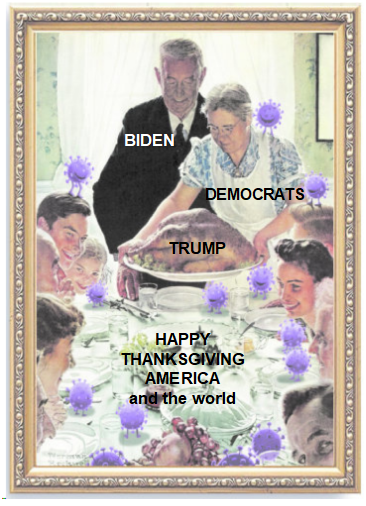
Happy Thanksgiving, America and the world


The solution to America’s student debt problem.

My favorite fountain of economic ignorance, the Libertarians, write about the student debt problem.

Senate Democrats Want Biden To Unilaterally Forgive Billions of Dollars in Student Loans
Legally, he might be able to do it. Fiscally, he shouldn’t.
MIKE RIGGS | 11.17.2020 3:10 PM

With Democrats staring down the possibility of Republicans maintaining control of the Senate, Sen. Elizabeth Warren (D–Mass.) and 12 other Democratic Senators want President-elect Joe Biden to forgive hundreds of billions of dollars in student loan debt by using the Education Department’s power “to modify, compromise, waive, or release student loans.”

Warren promised during her own presidential campaign that she would, if elected, “direct the Secretary of Education to use their authority to begin to compromise and modify federal student loans consistent with my plan to cancel up to $50,000 in debt for 95% of student loan borrowers (about 42 million people).” It appears she’d like Biden to do the same.I Have No Budget, am Buried in Debt, but I'm Going on Vacation : Enemy of Debt

Aside from the question about whether a President has the power to cancel any amount of student loan debt, why just $50,000? Why only 95% of students?

Much of the rationale probably goes to the “Who will pay for it?” question, a question that in itself demonstrates ignorance of federal financing.

Just to reiterate what has often been revealed in this blog, no one pays for a Monetarily Sovereign government’s spending. To pay for anything, our federal government, which unlike state/local governments is Monetarily Sovereign. To pay for anything, it creates brand new dollars, ad hoc.

Despite those misleading “debt clocks,” and warnings about federal debt being a “ticking time bomb,” your federal taxes do not pay for federal financial obligations.

In fact, federal taxes pay for nothing. Future generations of federal taxpayers will pay for nothing. Federal tax dollars, unlike state/local tax dollars, are destroyed upon receipt. The moment they are received they cease to exist as part of any money-supply measure.

This would be quite a gift for many student loan borrowers who still have outstanding balances (myself included).

As the Manhattan Institute’s Beth Akers noted last year, the typical four-year college graduate completes their degree with less than $30,000 in student loan debt.

Meanwhile, the College Board’s most recent effort to calculate the lifetime earnings premium of a college degree finds that the average four-year degree holder makes $400,000 more over their working lifetime than someone with just a high school diploma.

In 2015, researchers Christopher R. Tamborini, ChangHwan Kim, and Arthur Sakamoto published a paper in Demography that measured the 50-year lifetime earnings gap between high school graduates and bachelor’s degree holders at $896,000 for men and $630,000 for women.

In 2011, Georgetown University’s Center on Education and the Workforce pegged the B.A. earnings premium at $964,000. Whether the premium is shrinking or we’re just getting better at measuring it—or some combination of both—it’s still a good return on what comes out to roughly $7,000 in interest for borrowers who repay the average-sized loan in the standard 10-year timeframe.

While the “typical” (median?) four-year graduate may owe “only” $30,000, that isn’t the whole, financial point.

  1. Many students graduate owing far more than $30,000
  2. Even students with “only” $30,000 in debt may have been depleted financially if they paid cash for as much as they could, so as to minimize the student debt.
  3. Some students can’t afford to repay even $1 in debt.
  4. Attending college also has a hidden cost: Students are less able to earn money while in school, so the difference between what they could have earned and actually earned is one, often unrecognized, cost of college. It is the reason for Step #5 in the Ten Steps to Prosperity — Salary for Attending School (below). Many families do not want their children to attend college, because of the need for current income.

While federally issued and guaranteed loans have made it possible for the poorest Americans to attain education, those subsidies have also driven up the cost of education at a rate multiple times higher than inflation.

It is also now quite clear that making student loan debt easy to accumulate but nearly impossible to discharge in bankruptcy has helped millions of students get ahead while enabling a smaller (but still large) number of students to borrow money they can’t repay in order to purchase degree programs they can’t complete, can’t utilize, or can’t recognize as crap.

Loans have not made it possible for the poorest Americans to attain education. Some families need their young people to work, and bring dollars into the family. These families discourage finishing high school, much less than attending college.

The U.S. federal government never should lend dollars to anyone, much less to students. The government neither needs nor uses paid-back dollars. It already has infinite dollars. If the government deems any project to be worth financial support or encouragement, it should give, not lend, money to that project.

The sole function of lending to students is to tie a repayment anvil to their ankles at the time of their greatest money need for business creation and entrepreneurship.

As for the “degree programs they can’t complete, can’t utilize, or can’t recognize as crap,” this is akin to the old, childish, “Why do I have to learn algebra” complaint. Schooling has many benefits, most of which are realized only much later, if ever.

For many students in elementary school, algebra, history, art, sports, etc., etc. never are used in later life. Yet they are taught. Why? Because no one knows which people will benefit from which courses. The same is true of a college education.

The more people who attend college, the more likely some of them will use what they learn, and the more likely benefits to society will accrue.

Additionally, college is a time of life-learning and maturation, among young people of common ages, while being instructed by adults. It is a time of learning how to learn, rather than merely carrying forward ignorant beliefs from generation to generation.

Actually people who borrow the least amount of money that have the hardest time repaying it:

Defaults are concentrated among the millions of students who drop out without a degree, and they tend to have smaller debts. That is where the serious problem with student debt is.

Students who attended a two- or four-year college without earning a degree are struggling to find well-paying work to pay off the debt they accumulated.

That is the “anvil tied to the ankles” we mentioned. These drop-out students struggle to find well-paying jobs, even under the best of situations. But being also liable for debt repayment can lead to destitution.

And many of the drop-outs occur for financial reasons, a self-fulfilling burden on the poor, whose major crime is wanting to extricate themselves from poverty and believing a college education could help.

If the Education Department forgave up to $50,000 in student loan debt for every borrower, it would be helping many people like myself who don’t need it at the expense of the public fisc (and where is the “free” money for people who paid off their student loans, or haven’t gone or won’t ever go to college?).

The “public fisc” presumably is the U.S. Treasury, which never can run short of dollars. The “public fisc” easily could fund millions, billions, or trillions in additional expenses, simply by creating the money.

And then the author, Mike Riggs, offers the, “If I can’t get mine, he shouldn’t get his” reason for the elimination of federal spending.

The foundation of Libertarianism is to oppose all government and all government spending as being “too much. Because all government spending goes to some people and not to others, it all can be criticized on the basis of “If I can’t get mine, he shouldn’t get his.”

This devolves to zero government and zero government spending, which presumably is what Libertarians want.

The stimulus effect would likely be small, considering that the money a liberated borrower would now have to spend on something other than student loans is not the full amount of the loan, but the monthly payment.

As with the COVID-19 stimulus checks, borrowers might bank that amount or put it toward other debts.

The first sentence is a confused mystery. The stimulus effect would be the amount of each loan plus future anticipated payments.

From Forbes, “There are 45 million borrowers who collectively owe nearly $1.6 trillion in student loan debt in the U.S.”

If 45 million students each were given $50,000, that would be an immediate infusion to the economy of $2.7 Trillion. Or if those students merely were given what they owe, that would amount to a $1.6 infusion to the economy. This is not “likely to be small.” It would be a significant stimulus to the American economy, as well as to the individuals receiving the money.

And even if much of the money is banked or used to pay off other debts, it still is a stimulus to the economy.

The most libertarian policy preference in my view is two-pronged: get the federal government out of the lending and guaranteeing game, and make student loan debt reasonably dischargeable in bankruptcy.

These two policies would realign the incentives of colleges, lenders, and students to bring down prices and saddle fewer potential students with loans they are unlikely to repay.

The Libertarian policy always is to reduce government, no matter the current size. They have the weird belief that federal spending takes away their freedoms, which is utter nonsense.

Do government-funded roads, bridges, dams and streets take away your freedoms? What about the government-funded military, fire departments, and police departments?

How about the government agencies that assure safe food, safe air travel, national parks, museums, and schools. And then there is the government-funded judiciary, Congress, national banks, CIA, FBI, NASA, and the myriad other government agencies that protect our lives?

And then comes the Libertarian solution: Make bankruptcy easier. That is, cheat non-government lenders while lowering your credit score, making future borrowing more difficult. Perfect.

If that is a bridge too far for Biden and a Democratic Congress—and it probably is, considering those policies would also make it harder for low-income students to borrow and the market upheaval would probably snuff out a significant number of schools—Dynarski’s writing has convinced me that rethinking repayment timeframes is an acceptable middle way:

One solution is to lengthen the timeframe of loan repayment. In the U.S., the standard is for borrowers to repay their loans in ten years. Other countries let students pay back their loans over a far longer horizon. In Sweden, students pay their loans back over 25 years. For a $20,000 loan with an interest rate of 4.3 percent, this longer repayment would mean a monthly payment of $100 instead of $200.

This is the classic “Lower your payments” scam, which is accomplished by lengthening the payment period. The credit card companies use this scam when they tell people they can pay a minimum amount every month for many years.

Borrowers with very low earnings will struggle with even a payment of $100. Some countries, including England and Australia, therefore link payments directly to income, so that borrowers pay little to nothing during hard times.

Income-driven repayment (IDR), various forms of which U.S. borrowers have been able to apply for since 2009, caps your monthly payment as a percentage of your income and extends the repayment period from 120 months to 300 months. Make 25 years’ worth of payments under any one of several IDR plans, and your balance is forgiven, with the forgiven amount taxed as income.

People with very low incomes, who barely can pay their rent or put food on the table, will be required to pay an unaffordable amount for the rest of their lives, thereby dooming them to poverty, forever.

Some estimates predict 33 percent of IDR participant will fail to pay off their balance after 25 years, but the amount they pay over 300 months could still exceed the amount they borrowed for all but the poorest loan holders (and you’re not getting blood from those stones no matter how hard you squeeze).

Based on typical Libertarian economics ignorance, the author thinks liberty and freedom must be paid for by impoverishing the populace, rather than by a government that cannot be impoverished.

In summary:

  1. All school loans should be paid off
  2. Free school should be made available for all ages, all income groups, and all levels, not just for grades K-12. This will enhance America’s  standard of living and international competitiveness.
  3. The dollars spent will stimulate economic growth
  4. The federal government easily can pay for it all without levying any taxes.
  5. The cost of scholarships will be eliminated, allowing schools to devote more financial resources to teachers’ salaries and to educational hard assets (modernization of buildings, electronics, student transportation, etc).
  6. Contrary to popular wisdom, federal spending for college does not represent a transfer of funds from the middle-classes to the upper classes. It does not represent a transfer from anyone. It represents a transfer from the federal government to the economy.

Rodger Malcolm Mitchell

Monetary Sovereignty Twitter: @rodgermitchell Search #monetarysovereignty Facebook: Rodger Malcolm Mitchell …………………………………………………………………………………………………………………………………………………………………………………………………………………………………………………………………………………………..

THE SOLE PURPOSE OF GOVERNMENT IS TO IMPROVE AND PROTECT THE LIVES OF THE PEOPLE.

The most important problems in economics involve:

  1. Monetary Sovereignty describes money creation and destruction.
  2. Gap Psychology describes the common desire to distance oneself from those “below” in any socio-economic ranking, and to come nearer those “above.” The socio-economic distance is referred to as “The Gap.”

Wide Gaps negatively affect poverty, health and longevity, education, housing, law and crime, war, leadership, ownership, bigotry, supply and demand, taxation, GDP, international relations, scientific advancement, the environment, human motivation and well-being, and virtually every other issue in economics. Implementation of Monetary Sovereignty and The Ten Steps To Prosperity can grow the economy and narrow the Gaps:

Ten Steps To Prosperity:

  1. Eliminate FICA
  2. Federally funded Medicare — parts A, B & D, plus long-term care — for everyone
  3. Social Security for all or a reverse income tax
  4. Free education (including post-grad) for everyone
  5. Salary for attending school
  6. Eliminate federal taxes on business
  7. Increase the standard income tax deduction, annually. 
  8. Tax the very rich (the “.1%”) more, with higher progressive tax rates on all forms of income.
  9. Federal ownership of all banks
  10. Increase federal spending on the myriad initiatives that benefit America’s 99.9% 

The Ten Steps will grow the economy and narrow the income/wealth/power Gap between the rich and the rest.

MONETARY SOVEREIGNTY
Why closing down the economy for COVID-19 is a bad idea

From the 11/15/2020 Chicago Tribune”

Biden aide says lockdown would be ‘last resort’
One of President-elect Joe Biden’s top coronavirus advisers said Sunday that a national lockdown of businesses and schools would be a “measure of last resort” to fight the ongoing surge in COVID-19 cases across the United States.

The number of infections has grown by 5 percent or more in 47 states in the past week, with a national average over the past week of 145,401 new cases per day.

“In the spring we didn’t know a lot about COVID, we responded, in a sense, with an on-off switch,” Dr. Vivek Murthy, a former U.S. surgeon general tapped to help lead Biden’s newly named COVID-19 task force, told Fox News Sunday.

“We just shut things down because we didn’t know exactly how this was spreading and where it was spreading, but we learned a lot more since then.”

…………………………………………………………………………………………………………………………………………………………………………………………………………………………………………………………………………..

Closing down the economy for COVID-19 is a bad idea because:
1. It causes massive suffering for too many American businesses, workers, consumers, and students.
2. It’s bad politics
and the most important reason:
3.It’s unnecessary

1. It causes massive suffering for many businesses, workers, and consumers, and students.
Congress, falsely claiming the federal government can run short of dollars, has been reluctant to send more stimulus dollars into the economy.

So, hundreds of thousands of businesses, especially restaurants, food-service, and travel-related businesses either have gone out of business or have been forced to lay off employees.

The human toll in lost income has been, and will be, monumental. America will be headed toward 3rd-world status, as poverty creeps across the land.

As for students, distance learning simply does not cut it. The education is inferior. American students are losing months from their best learning and best-earning lives, months that cannot be made up.

Today’s students rapidly are becoming America’s “Lost Generation.”

2. It’s bad politics
As foolish and harmful as Trump has been, in his demands that states and cities “open up,” without offering any COVID-19 response plan, he is politically astute.

The people are dying, Trump knows their immediate concern is feeding their children, paying their rent, and avoiding financial destitution. They are so desperate, they will risk their lives to have income.

The politician who closes his/her economy is the politician who will have a more difficult fight in the next election.

3.It’s unnecessary
The combination of 100% mandatory mask-wearing, plus moderate social distancing, would be sufficient to create the equivalence of “herd immunity.”

We as a society all give up a few our liberties so that our entire social structure can function.

We wear set belts in the car (“Click it or ticket.”) For modest discomfort, we save our lives and those of our passengers.
We don’t smoke in airplanes, buses, elevators, restaurants, theaters, and most other public venues.
We wear helmets when riding motorcycles.
We vaccinate ourselves and children, which has substantially eliminated childhood diseases, and reduced influenza.
We don’t urinate, defecate, or go naked in public.
We don’t talk in a theater.
We give some of our money to charity.
We attend funerals and wakes.
In most places, we don’t carry machine guns.
We don’t beat people.
We obey laws.

America is not a one-person island. We cooperate, and cooperation requires doing some things, not for ourselves only, but also for others.

There are dozens of ways we give up freedoms, and one of those many ways would be to wear a mask, for the good of society.

Everyone would prefer not to wear a mask, just as everyone would prefer not to be forced to wear a seat belt. Wearing a mask can be uncomfortable, hot, sweaty. and cumbersome. You have to remember to take one with you. And, masks hide our facial expressions, which are a primary method for our communication.

But wearing a mask is the single, most effective way, to end the COVID — more effective than washing your hands or disinfecting surfaces, and probably more effective even than social distancing.

With the exception of restaurants, most businesses could operate with everyone wearing masks. Most offices could operate. Most production and delivery facilities could operate. Most schools, hospitals, and doctors could function.

With the exception of the players themselves, most sports could operate.

Masks work. If you wear a mask and I wear a mask, the likelihood that either of us would communicate the virus to the other is quite low.

A nationwide mandate that everyone must wear a mask, would effectively end the transmission of COVID. This surely is a small price to pay for herd immunity to a deadly disease.

Had we done this back in May, the disease would be rare, if even existent, today.

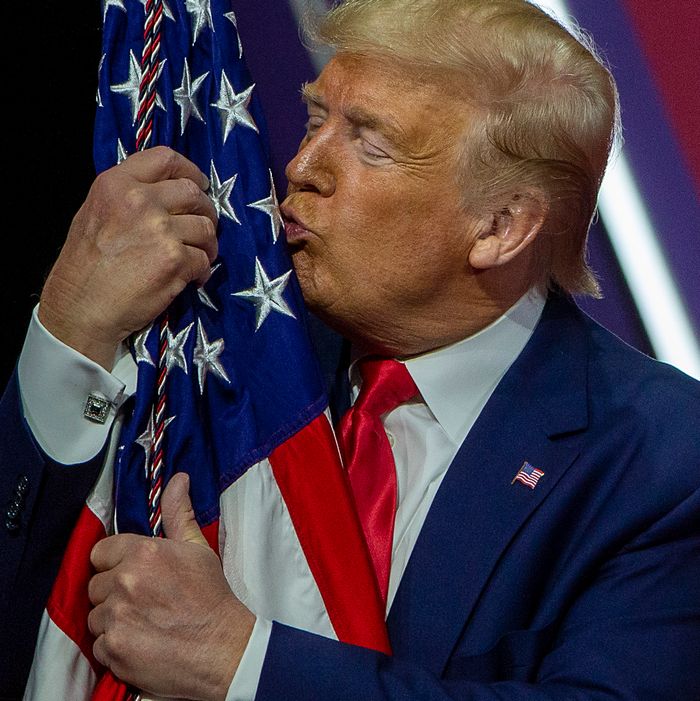
I urge each “no-masker” to be a patriotic American, thinking not only of yourself, but of your fellow Americans, and agree to a nationwide mandate.Watch Trump Fondle an American Flag at CPAC

We are all on this lifeboat together, and this is not a good time to demand your right to do as you please.

Patriotism is more than hugging a flag. It take unselfish cooperation to “make America great, again.”

Given the choice of closing the economy or a national mask-mandate or doing what we are doing, I would choose the mask mandate.

People are getting sick. People are dying. America is dying.

We can’t continue to do nothing.

We must take action. The national mask mandate is the path out of this mess.

Rodger Malcolm Mitchell

Monetary Sovereignty Twitter: @rodgermitchell Search #monetarysovereignty Facebook: Rodger Malcolm Mitchell …………………………………………………………………………………………………………………………………………………………………………………………………………………………………………………………………………………………..

THE SOLE PURPOSE OF GOVERNMENT IS TO IMPROVE AND PROTECT THE LIVES OF THE PEOPLE.

The most important problems in economics involve:

Ten Steps To Prosperity:

  1. Eliminate FICA
  2. Federally funded Medicare — parts A, B & D, plus long-term care — for everyone
  3. Social Security for all or a reverse income tax
  4. Free education (including post-grad) for everyone
  5. Salary for attending school
  6. Eliminate federal taxes on business
  7. Increase the standard income tax deduction, annually. 
  8. Tax the very rich (the “.1%”) more, with higher progressive tax rates on all forms of income.
  9. Federal ownership of all banks
  10. Increase federal spending on the myriad initiatives that benefit America’s 99.9% 

The Ten Steps will grow the economy and narrow the income/wealth/power Gap between the rich and the rest.

MONETARY SOVEREIGNTY
When the loser whines, he’s covering the truth.

Adolf Hitler: “In the big lie there is always a certain force of credibility; because the broad masses of a nation are always more easily corrupted in the deeper strata of their emotional nature than consciously or voluntarily; and thus in the primitive simplicity of their minds they more readily fall victims to the big lie than the small lie, since they themselves often tell small lies in little matters but would be ashamed to resort to large-scale falsehoods.

It would never come into their heads to fabricate colossal untruths, and they would not believe that others could have the impudence to distort the truth so infamously.

Even though the facts which prove this to be so may be brought clearly to their minds, they will still doubt and waver and will continue to think that there may be some other explanation.

For the grossly impudent lie always leaves traces behind it, even after it has been nailed down, a fact which is known to all expert liars in this world and to all who conspire together in the art of lying.

…………………………………………………

Joseph Goebbels (Hitler’s propaganda chief ): “The cleverest trick used in propaganda against Germany during the war was to accuse Germany of what our enemies themselves were doing.

…………………………………………………

Donald Trump: “This is a fraud on the American public. This is an embarrassment to our country. We were getting ready to win this election. Frankly, we did win this election.

So our goal now is to ensure the integrity for the good of this nation. This is a very big moment. This is a major fraud on our nation. We want law to be used in a proper manner.

So we’ll be going to the U.S. Supreme Court. We want all voting to stop. We don’t want them to find any ballots at 4 o’clock in the morning. It’s a very sad moment. To me, it’s a very sad moment. We will win this. As far as I’m concerned, we already have won.”

—————————————————————————————————————————————————————–

While Donald Trump focuses the nation, especially his followers, on the big lie that he won the election because the Democrats cheated, he manages to obscure the fact that for many, many years, the Republicans have been engaged in a massive plot to cheat and disenfranchise voters, particularly black and brown voters, who vote Democrat.

That plot has been far more pervasive and effective than any so-called, unproven “fraud” claimed by Trump.

And, of course, that is the whole point of Trump’s claims: Not only to disenfranchise voters but also to steal the votes of those who survive the gauntlet of voter suppression — a double whammy on Democrats.

From an article written by Dahleen Glanton, and published on 11/16/2020 in the Chicago Tribune:

There is a big difference between voter fraud and voter suppression. Voter fraud is fake. Voter suppression is real.

The people who poured into the streets of Washington, D.C., Saturday to protest the election they say was stolen from Donald Trump are reacting to a fantasy based on lies. Voter fraud is a myth created by Republicans who refuse to accept defeat.

The reason no one can come up with legitimate cases of widespread voter fraud is because they do not exist.

Such theories have been debunked in studies by several academic institutions, including the Brennan Center for Justice at New York University and Arizona State University.

Purging names from the rolls, denying people access to ballots and forcing voters to wait in line for hours, however — that’s real. It is designed to dilute the vote of Black and brown people. It is deliberate and systemic.

Overall, the November election was one of the smoothest ever across the country, according the Election Assistance Commission, a bipartisan agency charged with ensuring secure and accurate elections.

It’s laughable to hear Republicans complain about being disenfranchised. They’ve been disenfranchising Black voters for decades, either by directly setting up barriers or refusing to address voting issues that have long been known.

The push to throw out mail-in ballots they deem as “illegal” is the GOP’s latest attempt at voter suppression. If Trump were to prevail, millions of Black voters in Philadelphia, Atlanta, Milwaukee and Detroit would be disenfranchised.

Let’s talk about what real disenfranchisement looks like.

In 2020, During three days of hearings across Florida, the U. S. Commission on Civil Rights collected more than 30 hours of testimony from more than 100 witnesses under oath and reviewed more than 118,000 pages of documents. These accounts are from those documents.

Black people were turned away at the polls for various reasons in 2000. One poll worker said his precinct workers turned away 30 to 50 potential voters because they could not get through to the supervisor of elections on the phoneto confirm their eligibility.

Haitian Americans, who spoke limited English, said they were not given proper voting instructions. Others said their names were wrongly removed from the voting rolls.

Voters who requested absentee ballots never received them. Some were denied ballots at their polling places because the election records incorrectly indicated that they had been sent absentee ballots. 

Some said they arrived at their designated polling place only to discover their precincts were no longer being used or had moved to another location without notice.

In other instances, voters who had been standing in line to vote at their precincts prior to closing were told that they could not vote because the poll was closed.

In addition, thousands of voters who had registered at motor vehicle licensing offices were not on the rolls when they came to vote.

The commission also heard from several voters who saw Florida Highway Patrol troopers in and around polling places, while other troopers conducted an unauthorized vehicle checkpoint within a few miles of a polling place in a predominantly African American neighborhood.

Cathy Jackson registered to vote in Broward County (but) poll workers told her to go back to her old precinct in Miami-Dade. She went there, and they told her to go back to Broward. When she returned to Broward, she was told again that she could not vote. However, she noticed that an elderly white man whose name also wasn’t on the rolls was allowed to fill out an affidavit and vote. She asked if she could do the same, and they told her no. She was never allowed to cast her ballot.

When Lavonna Lewis, a first-time voter, arrived at her polling place, a white poll worker standing outside told her that the poll was closed. As she turned to leave, the poll worker allowed a white man to walk in and get in line to vote.

The commission concluded that there were problems in nine of the 10 counties with the highest percentages of African Americans. These problems, the commission said, were “serious and not isolated.”

“In many cases, they were foreseeable and should have been prevented,” the commission said. “The failure to do so resulted in an extraordinarily high and inexcusable level of disenfranchisement, with a significantly disproportionate impact on African American voters.”

The NAACP filed a lawsuit against the Florida secretary of state’s office, alleging violation of the 1965 Voting Rights Act. Across the country, the GOP took it to heart — not to make sure such travesties never happened again anywhere in America. Its goal was to figure out what worked best and implement those suppression tools all over the country.
To this day, Republicans are still trying to perfect it.

And:

Five Acts of Voter Suppression That Will Sway the Next Election
Conservatives will continue to deploy these techniques as electoral demographics become more liberal.

The Economist recently explored how the electoral system is historically rigged in favor of Republicans.

The Constitution structured the electoral process to prevent geographically large states from dominating small ones. This has led to sparsely populated areas, which tend to be rural and Republican, having a greater electoral weight than densely populated urban areas, which tend to vote for Democrats.

The Economist estimates that in the midterms, “Democrats need to win 53.5% of all votes cast for the two major parties just to have a 50/50 chance of winning a majority in the House.”

In fact, Republicans consistently win a greater share of each arm of the legislature than the equivalent share of actual votes cast.

“As of the census of 2010, the five most rural states wielded about 50% more electoral votes, and three times as many senators, per resident as the five most urban ones did.”

This gives the Republicans a systemic upper hand, despite having a numerical disadvantage, and means some people’s votes are worth more than others in terms of influence.

U.S. elections are also increasingly affected by forms of voter suppression, which is a distinctly Republican tactic.

1. Gerrymandering — While both parties gerrymander, Republicans do it more. “In the 2012 redistricting cycle, the boundaries of 48% of House districts were drawn entirely by Republican officials, compared with just 10% by Democratic ones.”

Consequently, Republicans consistently have a “seat bonus” in Congress, whereby they have a greater proportion of seats than is represented by their proportion of votes.

2. Making It Difficult for People to Vote — North Carolina reduced the number of early voting stations in 2016, which the legislature itself stated resulted in an 8.5 percent reduction in early voting by Black voters, leading to a 6 percent drop in their share of the early vote.

Early voting allows people who are poor, work long hours, or have inflexible hours to vote before they go to work. The state also cut back on early voting on Sundays — which was popular with Black churches — foolishly admitting in court that this was because early Sunday voters tend to be disproportionately Black and Democratic.

3. Preventing Felons from Voting — The U.S. criminal justice system has a bias against the Black population, so restricting people convicted of a felony from voting creates a bias against Black voters, who are also more likely to be Democrats. The laws vary by state, from permanently preventing anyone with a felony conviction from voting to preventing only those currently incarcerated.

4. Voter ID Laws — Republican states have worked hard to implement stricter ID laws for votersThis law tends to affect poor, elderly, and Black voters, because they are less likely to have a government-issued ID, such as a driver’s license.

5. Purges of the Voting Register — Ohio passed a law removing people from the voting register if they had not voted for two years and did not return a voter card mailed to their registered address.

The argument for the law was, again, to reduce voter fraud, though there is no evidence at all for such voter fraud. The law discriminates against poor people, who may move more frequently due to a lack of rent security, and particularly poor Hispanic voters, who may speak English as a second language and therefore not realize the relevance of the cards.

Both groups are more likely to be Democratic voters. The laws were passed by Republican state legislatures and upheld by conservative-leaning judges.

And:

Voter suppression targets minority voters in the United States and infringes on their right to participate in a fair election.
By Hannah Rachel Abraham And Ebony Purks, November 6, 2020

Since the American Civil War, statewide efforts have been made to discourage entire communities from having a voice in the democratic election process.

Jim Crow laws imposed poll taxes and forced Black Americans to pass literacy tests to be considered eligible to vote.

More modern examples include making voting more inconvenient by shutting down polling stations, therefore forcing people to travel long distances in order to exercise their voting rights.

And:

“Tidal wave of voter suppression” washes over states

In Texas, officials in mostly white Waller County, citing cost concerns, announced that they would not make an early voting site available on the campus of a historically black university.

Then the state passed a law effectively requiring other communities to take similar action.

A Tennessee law threatens third-party groups that register citizens to vote with criminal penalties if they make mistakes on forms or the forms arrive incomplete. The state’s governor, a Republican, said the law will make elections fairer.

And in Florida, state lawmakers overrode the results of a ballot initiative restoring voting rights to felons who have completed their sentences. Lawmakers who opposed the initiative insisted it was up to them to define what constitutes a completed sentence.

States across the country have, in the wake of the Supreme Court’s 2013 decision striking down part of the Voting Rights Act, moved swiftly and repeatedly to reshape almost every element of voting. Lawmakers are using a variety of race and age-neutral measures with explanations as pragmatic as cost and as prudent as election security.

In 2018, South Carolina voting officials estimated that the state was home to about 950,000 eligible but unregistered voters, a figure almost as large as the 1.2 million people who voted in South Carolina’s gubernatorial election that year. Among the reasons, according to Democrats: a state requirement that those registering to vote list their entire Social Security number on registration forms.

In November, the state’s Democratic Party and the Democratic Congressional and Senate Campaign committees filed suit challenging the Social Security requirement. South Carolina settled the case this month, agreeing to require just a portion of Social Security numbers.

The list goes on and on. Wherever state legislatures are controlled by Republicans, suppression of Democrat voters is paramount on the “to-do” list.

So when Trump and his sycophants whine about non-existent voter “fraud,” remember that rampant voter suppression by Republicans is the real problem.

Trump lost. He lost the popular vote and he lost the electoral college vote. And he would have lost even more “bigly” (his word) had the elections been fair.

(He probably would have lost to Hillary Clinton in 2016, in which case we wouldn’t have faced four years of presidential incompetence, and the nightmare of mishandled COVID.)

Rodger Malcolm Mitchell

Monetary Sovereignty Twitter: @rodgermitchell Search #monetarysovereignty Facebook: Rodger Malcolm Mitchell …………………………………………………………………………………………………………………………………………………………………………………………………………………………………………………………………………………………..

THE SOLE PURPOSE OF GOVERNMENT IS TO IMPROVE AND PROTECT THE LIVES OF THE PEOPLE.

The most important problems in economics involve:

Ten Steps To Prosperity:

  1. Eliminate FICA
  2. Federally funded Medicare — parts A, B & D, plus long-term care — for everyone
  3. Social Security for all or a reverse income tax
  4. Free education (including post-grad) for everyone
  5. Salary for attending school
  6. Eliminate federal taxes on business
  7. Increase the standard income tax deduction, annually. 
  8. Tax the very rich (the “.1%”) more, with higher progressive tax rates on all forms of income.
  9. Federal ownership of all banks
  10. Increase federal spending on the myriad initiatives that benefit America’s 99.9% 

The Ten Steps will grow the economy and narrow the income/wealth/power Gap between the rich and the rest.

MONETARY SOVEREIGNTY