Gap Psychology describes the common desire to distance oneself from those “below” in any socio-economic ranking, and to come nearer those “above.” The socio-economic distance is referred to as “The Gap.”
Wide Gaps negatively affect poverty, health and longevity, education, housing, law and crime, war, leadership, ownership, bigotry, supply and demand, taxation, GDP, international relations, scientific advancement, the environment, human motivation and well-being, and virtually every other issue in economics.Implementation of Monetary Sovereignty and The Ten Steps To Prosperity can grow the economy and narrow the Gaps:
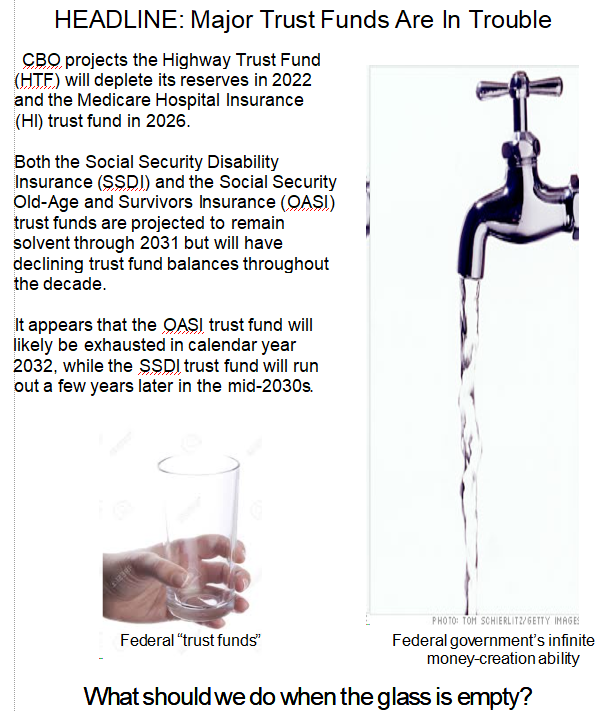
Here is what the “trust fund” scare-mongers like the Committee for a Responsible Federal Budget (CRFB) is telling you: “Major Trust Funds Are In Trouble”:
The common interpretation of Shakespeare’s, “A rose by any other name would smell as sweet” is wrong. Words count. That is why products are given “fresh,” “sweet,” or otherwise positive names.
You never will see a toothpaste or a perfume named, “deadly stinkwort.”
When you misname something you create a false impression of what the thing really is.
Sadly, many things in economics are misnamed. The federal “debt” is not a real debt. It is the total of deposits into Treasury Security (T-bill, T-note, T-bond) accounts.
The federal “deficit” more accurately should be termed the “economic surplus,” because the private sector is enriched.
The “trade deficit” is a “trade surplus,” because the economy receives net goods and services.
And federal “trust funds” are nothing at all like real trust funds. Instead, they merely are bookkeeping balances.
A federal trust fund is an accounting mechanism used by the federal government to track earmarked receipts (money designated for a specific purpose or program) and corresponding expenditures.
The largest and best-known trust funds finance Social Security, portions of Medicare, highways and mass transit, and pensions for government employees.
Federal trust funds bear little resemblance to their private-sector counterparts, and therefore the name can be misleading.
A “trust fund” implies a secure source of funding. However, a federal trust fund is simply an accounting mechanism used to track inflows and outflows for specific programs.
In private-sector trust funds, receipts are deposited and assets are held and invested by trustees on behalf of the stated beneficiaries.
In federal trust funds, the federal government does not set aside the receipts or invest them in private assets.
Rather, the receipts are recorded as accounting credits in the trust funds, and then combined with other receipts that the Treasury collects and spends.
Further, the federal government owns the accounts and can, by changing the law, unilaterally alter the purposes of the accounts and raise or lower collections and expenditures.
Thus, the federal government can do whatever it wishes with the “trust funds.” It can add to them, subtract from them, or change them from the wrongly presumed mission of supporting federal expenditures.
At the click of a computer key or the passage of a law, the balance in the federal “trust funds” could be changed to $100 trillion or $0, and neither would affect taxpayers.
Thus, the notion that any federal “trust funds” are, as the CRFB claims, “in trouble,” is a lie, unless “trouble” comes from those who don’t wish you to understand the differences between the private sector’s real trust funds vs. the federal government’s phony “trust funds.”
(The scare-mongers always “forget” to tell you that Medicare Part B, doesn’t even pretend to be funded via a troubled trust fund. The federal government simply pays for it.)
So why do they broadcast the Big Lie, that federal taxes fund federal spending, and trust funds are going broke, when in fact, federal taxes fund nothing, and the trust funds have whatever Congress and the President want them to have?
They do it because of Gap Psychology, the desire to distance oneself from those below on any social scale.
In some cases, these distinguished people do it because they are paid by the rich. In other cases, they do it because they are rich.
They wish to grow richer by keeping the middle- and lower-income/wealth/power people down. And this is how they want to do it, as the CRFB summarizes:
Policymakers must turn their attention to long-term debt and deficit reduction to get the country on solid fiscal ground.
This includes action to secure Social Security and other trust funds headed toward insolvency, limit the growth of health care and other costs, and raise additional tax revenue.
Here is what those terms mean:
“Debt and deficit reduction” means cut spending and increase taxes
“Secure Social Security” means cut benefits by raising the minimum age (as we have been doing), and with an adverse formula for inflation (as has been attempted)
“Limit the growth of health care” means larger deductibles, fewer procedures covered, and fewer people covered or eliminating a program altogether (i.e. Obamacare).
“Raise additional tax revenue” by increasing the FICA percentage and by raising the maximum salary collection level (but not to the level where it would impact the rich).
In short, the debt scare-mongers want to take dollars from the lower- and middle-income groups and give the dollars to a federal government that has an infinite supply of them.
They want to starve the economy and impoverish the lower- and middle-income groups, thus making the rich richer by comparison. During the resultant recessions and depressions, the rich grow richer by gobbling up assets, while cutting payrolls.
Gap Psychology describes the common desire to distance oneself from those “below” in any socio-economic ranking, and to come nearer those “above.” The socio-economic distance is referred to as “The Gap.”
Wide Gaps negatively affect poverty, health and longevity, education, housing, law and crime, war, leadership, ownership, bigotry, supply and demand, taxation, GDP, international relations, scientific advancement, the environment, human motivation and well-being, and virtually every other issue in economics.Implementation of Monetary Sovereignty and The Ten Steps To Prosperity can grow the economy and narrow the Gaps:
If you make decisions based on false assumptions, you are destined to be wrong.
And if you make decisions based on mythical numbers, you also are destined to be wrong.
But if you make decisions based on false assumptions about mythical numbers, you will be wrong, squared.
Let’s say you assume that you can ride on a tortoise faster than on a horse, and you assume tortoises live on the moon.
So you search the moon for tortoises because you want to ride fast.
That essentially is what the Committee for a Responsible Federal Budget (CRFB) does. It makes a false assumption about a false assumption, and comes to a wrong conclusion, squared.
How Much Would the American Rescue Plan Overshoot the Output Gap? CRFB, Feb 3, 2021 The Congressional Budget Office (CBO) projected on Monday that the nation’s output gap – the difference between actual economic activity and potential output in a normal economy – would be $380 billion for the rest of 2021.
Here is the Wikipedia definition of “output gap“:
“The output gap is the difference between actual GDP and potential GDP, in an attempt to identify the current economic position over the business cycle. The measure of output gap is largely used in macroeconomic policy.
“The output gap is a highly criticized notion, because the potential output is not an observable variable. It is instead often derived from past GDP data, which could lead to systemic biases.
The “output gap” is a guess based on something called “potential GDP” which is merely a prediction of GDP based on infinite variables.
If, for instance, you believe someone can predict the Standard & Poors 500 stock index level of a year in the future, then you believe someone can determine the “output gap.” (And I would like to sell you some swampland in the Himalayas.)
Returning to the CRFB article:
This (output) gap will total roughly $300 billion in the last three quarters of 2021 and nearly $700 billion through 2023, the period over which most future relief would take place.
Assuming CBO’s estimates are correct, President Biden’s $1.9 trillion American Rescue Plan would likely be enough to close the output gap two to three times over.
This overshoot could be beneficial, but could also pose risks to the economy and the fiscal outlook.
Why would any thinking person assume the CBO’s estimates are correct? Aside from being a coin-flip guess, the prediction would largely have to be based on what the government spends. So it’s circular thinking.
What the government spends affects the output, and that spending affects the output gap, which means:
Realistically, there is no output gap. There only is output (i.e. GDP).
The so-called “output gap” simply shows how wrong the predictions turn out to be. It’s not a real thing. It’s a critique.
The theoretical effect of the American Rescue Plan on the economy depends on the economic multiplier associated with the new programs, but in almost any circumstance it would substantially overshoot the output gap as estimated by CBO.
With a multiplier of 0.5x, for example, the plan would close 135 percent of the output gap. With a 1.5x multiplier, it would close the output gap 4 times over.
So now, we have a guess (the “output gap” multiplied by another guess (the “multiplier”) and the resultant WAG (Wild Ass Guess) is what supposedly warns us about “excessive stimulus.”
Based on a recent analysis of the plan from Wendy Edelberg and Louise Sheiner of the Brookings Institution, the American Rescue Plan would theoretically boost output by about $1.5 trillion starting in the second quarter of this year, closing about 225 percent of the output gap through 2023.
This estimate appears to be reduced by the fact that the economy would be performing in excess of its capacity, leading to some additional savings and inflation.
Multipliers from their October 2020 analysis suggest that if the output gap were large enough, the plan could produce closer to $1.9 trillion of additional output and thus close about 275 percent of the output gap.
And theoretically, if the moon were made of spreadable cheese, it appearswe could fly there with a load of bagels and that suggests we could have an endless breakfast.
I’m not sure how an economy can perform in excess of its capacity, but it would be exciting to see. Sort of like putting 2 gallons of milk in a one-gallon jug.
The output gap could differ from CBO’s projections.
Many forecasts and experts suggest the economy will grow faster this year than CBO estimates.
A one percentage point increase in Gross Domestic Product (GDP) growth would reduce the output gap to less than $200 billion, in which case the American Rescue Plan would be large enough to close eight to ten times the output gap based on the Edelberg and Sheiner numbers.
On the other hand, many have argued that CBO is underestimating full employment and potential GDP. If potential GDP were 1 percent larger than CBO’s estimate, the output gap would total $1.3 trillion through 2023 and the America Rescue Plan would close 115 to 145 percent of the output gap.
Here are some definitions from the above:
“Could differ” really means “certainly will differ”
“Many forecasts and experts” really means “Many also have argued the opposite,” so what does that tell you?
“Based on the Edelberg and Sheiner numbers” really means “based on the Edelberg and Sheiner WAGs.”
“Many have argued” is a version of Donald Trump’s “many people say,” meaning, many people also don’t say.
What Happens if We Overshoot?
Though many economists and experts such as Federal Reserve Chairman Jerome Powell have argued it would be better to overshoot with fiscal and monetary support than undershoot, that does not mean an overshoot of any magnitude is desirable.
While the economy can operate above its long-term potential for periods of time, it cannot do so indefinitely or sustainably. It is therefore important to understand what might happen if policymakers spend substantially more than what is necessary to close the output gap.
Think of the reality. How is it possible for an economy to operate “above its long-term potential” unless the guy who figured the “long-term potential” was wrong.
Nothing can operate above its own potential unless the potential is calculated too low. The problem is not in the potential; the problem is in the calculation.
And now we come to some real mathematical magic.
One possibility is that the excess funds are economically ineffective, adding to the debt without improving the economy. Thought of another way, overfilling the fiscal gap could substantially reduce economic multipliers.
The more you add, the bigger it gets
Based on estimates from CBO, adding nearly $2 trillion to the debt would shrink the size of the economy by about 0.3 percent ($100 billion) by the end of the decade while increasing annual debt service payments by roughly $40 billion in that year (and more in future years).
The size of the economy is measured by GDP. And the formula for GDP is:
GDP = Federal Spending + Non-federal Spending + Net Exports
So the CRFB makes the mathematically astounding claim that adding $2 trillion in Federal Spending somehow would reduce GDP.
Have these people flunked high-school algebra? Or do they think you have?
These costs are probably a worthwhile consequence of addressing an economic crisis and restoring the economy to full employment but harder to justify for spending that has little or no economic impact.
It mathematically is impossible to add $2 trillion to the economy and have “little or no economic impact.” And if it would “address and economic crisis and restore the economy to full employment, how could it have “little or no economic impact”?
A second possibility is that excess funds could lead to higher inflation, with producers responding to higher demand by increasing prices once it is no longer possible to easily increase production.
In some ways, higher inflation could be helpful – it could erode outstanding household and business debt (including pandemic-related debt), lower real interest rates set by the Federal Reserve, and help the Fed to reset expectations toward its new flexible inflation targeting regime.
On the other hand, higher inflation could also diminish the effectiveness of the fiscal stimulus, erode the value of savings (including the over $2 trillion of personal savings accumulated because of the pandemic), increase the cost of living for many households who could not easily afford it, or, in the worst case, lead to persistently high inflation and all the consequences that come with it.
Inflations, which are general increases in prices, are caused by shortages, most often by shortages of food and/or energy.
The proof is staring us in our faces, right here in the U.S., where massive increases in federal debt have not caused inflation.
Further, inflation does not lower real interest rates. The Fed raises nominal rates in response to inflation, so whether real rates would go down is questionable.
A third possibility is that excessive stimulus could cause misallocations in the economy. Higher demand amidst a pandemic could lead to increased consumption and production of goods and services that are of less value in normal times.
To the extent that firms and households make long-term investments in response to near-term demand, this could cause modest macroeconomic damage in the long term as well as diminishing welfare gains in the near term.
There are no “normal times.”
Is the Internet “normal”? Is the smartphone “normal?” Is the Tesla normal”? Is a pandemic “normal”? Is walking on the moon “normal”? Is global warming “normal”?
Today’s “times” are not like yesterday’s times, nor are they like tomorrow’s “times.”
The economy always has and always will react to change That reaction is the only “normal.”Products go in and out of favor. Movie film replaced by movie cassettes, which in turn are replaced by online viewing. What next, direct intracranial stimulation?
The auto industry soon will be all-electric, and current batteries soon will be obsolete. Flexibility is mandatory in business.
That is the fundamental nature of an economy. To speak of “normal” times is to spout ignorance.
A fourth possibility is that excessive stimulus could temporarily boost economic activity far above its sustainable potential, leading to an economic cliff or crash as the stimulus fades.
In their estimates, Edelberg and Sheiner explicitly assume what they describe as a “soft landing” for the economy; even in this scenario, there appears to be virtually no economic growth in 2022, which suggests unemployment would rise over that period.
The authors warn of the possibility of a sharper and more painful contraction (a “hard landing”) when stimulus funds run out.
Suddenly, the stimulus could move from “shrink the size of the economy,” to “little or no economic impact,” to “boost economic activity far above its sustainable potential.” Well, I guess that covers all bases: Shrink, no effect, or boost. Well, that was informative.
In short, the CRFB and the CBO are completely clueless, but having predicted all possible outcomes, they later will be able to look back and crow about how prescient they were.
To prevent this cliff, lawmakers may have to enact more and more stimulus. In that case, the economy may become dependent on ever-rising deficits just to maintain sufficient demand.
Yes, a growing economy, by mathematical certainty, requires a growing supply of money, i.e. ever-rising deficits. This growing supply will come from the federal government, which has an infinite supply.
The CRFB makes this sound like some sort of frightening event, when in fact, increased deficit spending always has been necessary for growth. That’s called “economics.”
Aside from any inflationary pressures they might cause, these large deficits would put debt on an even more unsustainable path, substantially boost interest payments, and impose substantial damage on the broader economy.
Even as ongoing stimulus might continue to keep the output gap at bay, it would increasingly weaken potential GDP. In an extreme case, an additional $2 trillion per year of borrowing could lift debt to 175 percent of GDP within a decade, boost interest payments by up to $500 billion per year by decade’s end, and slow economic growth by 0.3 percent per year.
Federal debt has been growing for at least 80 years, during which time the debt hand-wringers consistently have called it “unsustainable.” There is no level of federal debt (i.e. deposits into T-security accounts) is unsustainable.
We already have discussed why the “output gap” is nothing more than a wrong prediction.
And we have discussed why an additional $2 trillion per year added to the economy cannot slow GDP growth. Simple algebra.
For a Monetarily Sovereign nation, the debt/GDP ratio, is completely meaningless. Debt means the total of deposits in T-security accounts. GDP means total spending. Whether deposits in T-security accounts are less than, equal to, or more than GDP has no economic meaning.
Japan, for instance, is a Monetarily Sovereign nation whose debt/GDP ratio is 253%. The next highest ratio is monetarily non-sovereign Greece’s, at 181.1%. The ratios are economically meaningless.
Boosting federal interest payments would add stimulus dollars to the U.S. economy, helping to grow the economy. The federal government, being Monetarily Sovereign creates infinite interest dollars at the touch of a computer key.
And finally, it is mathematically impossible to add $2 trillion to the economy plus another $500 billion, and still slow economic growth.
To be sure, there are also potential benefits to overshooting. Providing more stimulus than needed can insure against the risk that multipliers are lower than expected, underlying economic conditions are worse than expected, or potential GDP is higher than believed.
Excessive fiscal stimulus in the near term could also prevent long-term economic damage from the recession, for example, by preventing viable business closures or stopping long-term unemployed workers from dropping out of the labor market (known as hysteresis). Since it is impossible to perfectly target spending toward the precise needs of society, it may also take more funds to address the specific “bottom-up” weaknesses in the economy than to close the top-down output gap.
Still, with $4 trillion of fiscal support already enacted, it is not clear whether another $1.9 trillion is needed from a bottom-up or top-down approach. While recent data suggest further fiscal support is needed, the package currently under discussion would likely be an overshoot.
Actually, it should be perfectly clear that adding dollars to the private sector will enrich the economy.
However, exactly where the dollars are spent is important.
We suggest spending them on the Ten Steps to Prosperity (below).
In summary, the above article attempts to refute the need for deficit spending, but succeeds only in demonstrating the abject ignorance of the position.
Gap Psychology describes the common desire to distance oneself from those “below” in any socio-economic ranking, and to come nearer those “above.” The socio-economic distance is referred to as “The Gap.”
Wide Gaps negatively affect poverty, health and longevity, education, housing, law and crime, war, leadership, ownership, bigotry, supply and demand, taxation, GDP, international relations, scientific advancement, the environment, human motivation and well-being, and virtually every other issue in economics.Implementation of Monetary Sovereignty and The Ten Steps To Prosperity can grow the economy and narrow the Gaps:
And just when I began to feel so good about Congress and the President at long last beginning to understand and tell the truth about economics, then I am splashed by ice water coming from the Committee for a Responsible Federal Budget.
You know the CRFB.
They are the ones who run interference for those in Congress who want you to believe the common myth that federal finances are just like your finances.
Democratic lawmakers are planning to unveil legislation to substantially boost the child tax credit from $2,000 to $3,000, providing monthly payments to households and higher payments for younger children.
While this thoughtful proposal to expand support for children deserves consideration, it cannot legitimately be classified as COVID relief and should be fully paid for under the House PAYGO rules and normal principles of budgeting.
Briefly, “PAYGO” is an ill-considered concept that requires federal spending to be matched by taxes or T-security deposits.
It’s part of the myth that federal finances are like personal finances (and state/local government finances), where outgo must be funded by income. That’s why CRFB speaks of “normal principles of budgeting.”
Those “normal principles” are normal for you, normal for your state, county, and city, and normal for businesses. But they are not normal for the federal government, and this is what CRFB does not want you to understand.
When you pay for your spending, you must have a money source.
You must have a paying job, or you must borrow, or you must have savings. That’s because youare monetarily non-sovereign.
State and local governments, and businesses operate the same way. They too are monetarily non-sovereign.
The federal government is different. It is Monetarily Sovereign. It uses neither income nor borrowing. It creates, ad hoc, every dollar it spends,, each time it pays a creditor.
The federal government does not borrow and the taxes it collects are destroyed upon receipt.
The federal government does not have money; it creates money. Last year, it was able to spend trillions of dollars it did not have, and yet never ran short, and never bounced a check.
You can’t do that, nor can any other monetarily non-sovereign entity.
Soon, the Biden administration will spend another $2 trillion the government doesn’t have, and still no checks will bounce. That is Monetary Sovereignty.
The following is a statement from Maya MacGuineas, president of the Committee for a Responsible Federal Budget:
We are still in the midst of a pandemic and economic crisis, and more borrowing will be needed to provide necessary relief and support the economic recovery.
However, emergency borrowing authority must be reservedfor pandemic-related needs, not for enacting long-sought-after policy priorities.
It’s amazing how many misstatements the CRFB can pack into three short sentences:
What they call “borrowing” (T-bills, T-notes, T-bonds) merely consists of accepting deposits into T-security accounts. The government does not use those deposits. They remain in the accounts, accumulating interest, until maturity, at which time they are returned. You do not lend to the federal government. You make deposits into your own T-security account.
There is no need to “reserve emergency borrowing authority.” The government can accept as many dollars into T-securities accounts as it wishes, any time it wishes (though again, it doesn’t use the dollarsin those accounts. That’s why it isn’t “borrowing.)
I’m not sure why the CRFB tries to differentiate between “pandemic-related needs” and “long-sought-after policy priorities.” Spending is spending. All federal spending is funded exactly the same way: Via money creation.
House PAYGO rules make clear that new spending increases and tax cuts not related to the COVID response or climate change must be paid for.
Expanding the child tax credit clearly doesn’t qualify under either of these exemptions, as it is clearly meant as a permanent policy and is in many ways duplicative with the proposed $2,000 per child recovery rebates.
All federal spending is “paid for.” Apparently, the CRFB falsely means, “paid for via borrowing or taxing.” This demonstrably false statement has been disproven every year. In 2020 alone, trillions of dollars of federal spending easily were “paid for” without the need for tax increases or borrowing.
Replacing the current $2,000 child tax credit with a more broadly available $3,000 to $3,600 credit would help address the disadvantages that kids face in the federal budget.
But we shouldn’t borrow from our kids in order to pay for their care when there are plenty of offsets available.
This mixed-up sentence speaks of “borrowing from our kids,” which probably means future (totally unnecessary) tax increases. But then it talks about “offsets.” And what are those so-called “offsets” that don’t “borrow from our kids?
Overall, this policy will cost over $100 billion per year and more than $1 trillion over a decade if made permanent. Reducing child poverty is a worthy policy priority and one worth paying for.
Senator Mitt Romney’s recent proposal to consolidate existing support for children and workers and repeal regressive tax breaks represents one possible package of offsets.
The $5.8 trillion of tax increases and budget savings proposed by President Biden during the campaign also offers many alternatives.
Offsets could also be phased in to avoid imposing tax increases during a pandemic or disrupting a fragile recovery.
So, to help reduce child poverty, we should “consolidate existing support for children and workers”?? Ah, that lovely little word “consolidate” which in CRFB language means an even smaller word: “Cut.”
And, of course, “repealing tax breaks” is a synonym for “increasing taxes.” (Historically, the breaks the CRFB has seemed to favor eliminating are those that benefit the poor and middle classes.)
It is the “children and workers” who would have to pay the increased taxes and suffer the reduced support.
Offsets could also be phased in to avoid imposing tax increases during a pandemic or disrupting a fragile recovery.
This is a worthy policy aimed at achieving a worthy goal. That’s no reason to throw budget discipline out the window. Borrowing for the pandemic isn’t an excuse for unrelated tax cuts, nor is it a reason to enact permanent policies that aren’t properly financed.
So let’s see. The recovery is “fragile,” but we should have “budget discipline,” which means increasing taxes during this fragile recovery. How wise.
So the government should do something temporary — cut taxes and increase spending — and when we recover the government can increase taxes and cut spending.
“But we shouldn’t borrow from our kids.” Except that “borrowing from our kids” is exactly what future tax increases and spending cuts would do.
If empty-headed claims were dollars, the CRFB would be the wealthiest organization in the world.
Gap Psychology describes the common desire to distance oneself from those “below” in any socio-economic ranking, and to come nearer those “above.” The socio-economic distance is referred to as “The Gap.”
Wide Gaps negatively affect poverty, health and longevity, education, housing, law and crime, war, leadership, ownership, bigotry, supply and demand, taxation, GDP, international relations, scientific advancement, the environment, human motivation and well-being, and virtually every other issue in economics.Implementation of Monetary Sovereignty and The Ten Steps To Prosperity can grow the economy and narrow the Gaps:



 #Monetary Sovereignty - Mitchell