Hey, wait. Is $2 trillion supposed to be bad??

You always know what you’re going to get from Breitbart: Extreme right-wing red meat for those hypnotized by Donald Trump.Trump's American Carnage - Transcript | FRONTLINE

According to Wikipedia:
Breitbart News Network is an American far-right syndicated news, opinion, and commentary website founded in mid-2007 by American conservative commentator Andrew Breitbart, who conceived it as “the Huffington Post of the right”.

Its journalists are widely considered to be ideologically driven, and some of its content has been called misogynistic, xenophobic, and racist by liberals and many traditional conservatives alike.

The site has published a number of conspiracy theories and intentionally misleading stories.

Breitbart News aligned with the alt-right under the management of former executive chairman Steve Bannon, who declared the website “the platform for the alt-right” in 2016.

In 2016, Breitbart News became a virtual rallying spot for supporters of Donald Trump’s 2016 presidential campaign.

The company’s management, together with former staff member Milo Yiannopoulos, solicited ideas for stories from, and worked to advance and market ideas of, neo-Nazi and white supremacist groups and individuals.

After the election, more than 2,000 organizations removed Breitbart News from ad buys following Internet activism campaigns denouncing the site’s controversial positions.

If you’re misogynistic, xenophobic, and racist, you’ll love Breitbart. If you fall for conspiracy theories and intentionally misleading stories you’ll be an avid reader of Breitbart.

That said, the following Breitbart article makes some interesting points:

Today’s Top Stories From the Breitbart News Desk – Alex Marlow & John Carney
Breitbart News Network

President Biden on Wednesday released the outline of his enormous $2 trillion tax and spending bill. It comes wrapped in the packaging of an infrastructure bill, but only a fraction of the bill is for rebuilding infrastructure as it is commonly understood.

Virtually all large bills passed by Congress contain a variety of laws, some of which do not match the ostensible “main purpose” or title of the bill. This is the norm that Breitbart is trying to spin into a crisis.

It gives politicians nightmares because it forces them to vote for things they don’t like in order to vote for things they do like.

A benign bill to aid widows and orphans may also contain a paragraph supporting wife-beating. The politician can vote against widows and orphans or for wife-beating. Either way will subject him to criticism from across the aisle.

This Hobson’s choice is, however, a fact of politics. It gives the opposition something to carp about.

By some estimates, the corporate tax hikes are three times the size of the 2017 corporate tax cuts. They would return the U.S. to the highest statutory rate in the developed world. The OECD average is 23.59 percent.

Yet corporate America—which has become increasingly vocal on leftwing issues—has barely objected.

The CEO of Delta feels free to attack Georgia’s voter integrity laws but has not spoken up against this enormous tax hike.

Breitbart attempts to create hypocrisy when there is none. The Georgia voter laws have nothing whatsoever to do with federal tax hikes.

The real hypocrisy is that Breitbart even compares them, and in the same sentence.

There are at least three reasons for this silence.

One, our biggest corporations do not pay the statutory rate. That’s for the suckers with small businesses and without armies of lawyers and lobbyists.

Second, corporate executives are rewarded for outperforming other executives. So long as everyone’s tax rate moves in the same direction, there’s not much to object to. In fact, high taxes with lots of loopholes are best for corporate leaders.

Importantly, there is so much spending in this bill that it easily dwarfs whatever paintax hikes might inflict. There is $174 billion to subsidize electric vehicles and the related charging infrastructure, more than enough to buy off the compliance of automakers.

The deeper purpose of this bill is to remake the economy, with the government playing a much larger role in almost every aspect of business and employment.

Giving corporations tax cuts (which is what the GOP did during the Trump administration) is overall financially the same as the federal government buying more goods and services from the private sector.

In either scenario, the entire economy as a whole receives more net income, courtesy of the federal government. The difference lies in which part of the economy receives the money, i.e. the rich or the poor.

Breitbart does not want you to realize that it approves of giving money to the rich while deriding payments that help the poor. 

As the Wall Street Journal explained, the spending program “would reverse Reagan-era tacit understanding that public sector is less efficient than the private in allocating resources.”

Big government, in short, is not just back—it’s going to be everywhere if this bill passes.

The notion that big business is more efficient than big government, is a widespread belief that never has been substantiated. 

From an organizational standpoint, businesses have a profit motive, and governments have an election motive. Businesses function to increase profits and executive compensations, while government agencies function to accomplish the agencies’ goals and politicians’ re-elections.

The profit motive and election motive both compel actions in direct conflict with “efficiency”  and with honesty.

Big businesses and big government are composed of people, each of whom has their own desires, fears, and motives, that may not directly align with the presumed motives of the business or government agency.

There is nothing implicitly wrong with a big nation having a big government. “Big” is not a disadvantage, whether referring to businesses or governments.

In fact, even the term “big” has different definitions, depending on the context.

“Big” can mean number of employees. “Big” can mean amount of income. “Big’ can mean amount of spending.

For instance, in 2020:

Facebook had about 58,000 employees, revenue of $86,billion and net income of $29 billion.

General Motors had about 155,000 employees, revenue of $122 billion, and net income of $6 billion.

Which company is bigger?

When talking about “big government,” are Breitbart and others who lean Libertarian, concerned about the number of employees or the amount of spending?

In truth, they should be concerned about neither.

Presumably, the fear related to “big government” should be about an overpowering, ruthless, lying, dictatorial government, that is concerned only with the welfare of the rich, and cares nothing for the middle-classes and despises the poor (Think Trump). 

But that has nothing to do with the number of government employees or with the amount of government spending. It has to do with the quality of leadership and with the laws they pass.  

“Big government” is a phony bogeyman used by Libertarians and the right-wing attempt to scare voters into accepting less service from the federal government.

In that vein, we bring you this headline from the Libertarian site, REASON:

“Infrastructure projects that are paid for by users, not by federal taxes, can be a big boost to the economy.” by By Adrian Moore, April 1, 2021

Someone should mention to Mr. Moore, that “paid for by users” adds no stimulus money to the economy, and federal taxes, which deplete the private sector’s money supply, pay for nothing.

But infrastructure projects that are paid for by federal spending add stimulus dollars to the economy, and therefore are indeed an economic boost.

This is no reason why $2 trillion may be too much to add to the economy, and it very well may prove to be too little.

Rodger Malcolm Mitchell Monetary SovereigntyTwitter: @rodgermitchellSearch #monetarysovereignty Facebook: Rodger Malcolm Mitchell 

=========================================================================


THE SOLE PURPOSE OF GOVERNMENT IS TO IMPROVE AND PROTECT THE LIVES OF THE PEOPLE.The most important problems in economics involve:

  • Monetary Sovereignty describes money creation and destruction.
  • Gap Psychology describes the common desire to distance oneself from those “below” in any socio-economic ranking, and to come nearer those “above.” The socio-economic distance is referred to as “The Gap.”

Wide Gaps negatively affect poverty, health and longevity, education, housing, law and crime, war, leadership, ownership, bigotry, supply and demand, taxation, GDP, international relations, scientific advancement, the environment, human motivation and well-being, and virtually every other issue in economics. Implementation of Monetary Sovereignty and The Ten Steps To Prosperity can grow the economy and narrow the Gaps: Ten Steps To Prosperity:

  1. Eliminate FICA
  2. Federally funded Medicare — parts A, B & D, plus long-term care — for everyone
  3. Social Security for all
  4. Free education (including post-grad) for everyone
  5. Salary for attending school
  6. Eliminate federal taxes on business
  7. Increase the standard income tax deduction, annually. 
  8. Tax the very rich (the “.1%”) more, with higher progressive tax rates on all forms of income.
  9. Federal ownership of all banks
  10. Increase federal spending on the myriad initiatives that benefit America’s 99.9% 

The Ten Steps will grow the economy and narrow the income/wealth/power Gap between the rich and the rest. 

MONETARY SOVEREIGNTY

The Dumb-dumb Continues

  • The U.S. federal government, unlike state and local governments, is Monetarily Sovereign. Its sovereign currency is the U.S. dollar.
Create meme "to be swimming in money pictures, a rich man , dude with the  money" - Pictures - Meme-arsenal.com
The federal government never can run short of dollars. So what is the purpose of federal taxes?

The federal government never can run short of dollars. So what is the purpose of federal taxes?

  • It created the very first dollars out of thin air. The government arbitrarily gave each dollar a value, and continues to do the same, even now.
  • It does all this by arbitrarily passing laws. The federal government never can run short of dollars.
  • It pays all its bills by creating new dollars, ad hoc. Even if the federal government collected $0 taxes, it could continue spending forever.
  • Misnamed federal “debt” actually is the total of deposits in T-security accounts, which resemble interest-paying, safe deposit boxes.The federal government never touches those dollars, and upon maturity, the government “pays off” the debt (deposits) simply by returning the dollars in those accounts. No tax dollars are used.

All federal tax collections are destroyed upon receipt by the Treasury. They cease to exist in any money-supply measure.With the above in mind, let us examine the following article from the Washington Post:

THE FIX By Peter W. Stevenson President Biden’s White House is in the process of putting together a proposal for an enormous infrastructure and jobs bill — a bill that seems as though it could lead to the Democrats’ second use of the reconciliation process to pass a piece of major legislation without any Republican votes in the Senate. Biden’s team first dreamed up a bill that calls for about $3 trillion in new spending.

The first iteration of the plan would have been offset by about $1 trillion in new taxes. 

But, The Washington Post’s Jeff Stein reports, the team second-guessed itself, worrying that simply left too big a spending deficit, which could, in turn, cause economic mayhem.

Why is the federal deficit “too big”? The net total of all deficits is about $25 trillion. The economy is doing very nicely, thank you, and 2021 promises to be excellent.

So what exactly makes the deficit “too big”? You will not find an answer to that question, at least not a truthful one. 

Because the federal government is Monetarily Sovereign, it can support infinite deficits. In fact, federal deficits pump growth dollars into the economy. When deficits are too small, we have recessions and depressions, which are cured by — you guessed it — running deficits.

Unlike you and me, and the state and local governments, and businesses, the federal government never can run short of dollars. While state and local taxes do “offset” state and local spending, federal taxes offset nothing. Federal finances are nothing like state/local government finances.  

So again, what is the problem with deficits? Ask your political representatives to answer that question. I assure you, they either won’t answer or will answer with a lie. The only problem with deficits is when they are too small to support economic growth.

The second version of the bill, expected to be unveiled this week, more than triples the taxes, to about $3 trillion — and boosts spending up to $4 trillion, Stein reports. 

The revision is an acknowledgment of the limits of new spending, even for Democrats, who are eager to pass more signature legislation while they still control both houses of Congress.

There is no reason for taxes to rise. In fact, the sole purpose of federal taxes is to control the economy by taxing what the government wants to discourage and by giving tax breaks to what the government wants to encourage. 

The purpose of federal taxes is not to provide the federal government with dollars. It already has the infinite ability to create dollars.

But will Congress be able to swallow tax hikes that big? The tax increases would affect businesses, investors and wealthy Americans, starting with a higher tax rate for corporations. 

Biden has said that tax increases for individuals would not affect anyone making less than $400,000 per year. And in a move likely to please his supporters, those changes would come in part by largely reversing President Donald Trump’s 2017 tax cuts.

All federal taxes take dollars from the private sector (aka “the economy”) and destroy them. All taxes negatively affect businesses, investors, wealthy Americans, and not-wealthy Americans.

You can’t drain water from only one end of a bathtub. When tax dollars are taken from anywhere in the economy, everyone is affected. 

Taxes on the rich are levied, not to acquire spending dollars, but rather to narrow the Gap between the rich and the rest of us.

Republicans are already signaling opposition. “The idea we should agree to some huge economy-crushing tax increase so the government can go on yet another spending binge is a nonstarter for me,” said Sen. Patrick J. Toomey (R-Pa.).

Toomey is correct about taxes; they do crush the economy. But he also would vote against a Democratic plan that didn’t include tax increases, because that would increase the deficit.

In short, Toomey opposes all things proposed by Democrats.

“As long as it’s paid for,” Sen. Joe Manchin III (D-W.Va.) said of the bill’s price tag. “This country needs to rebuild itself.”

Manchin simply does not know what he is talking about.

The federal government always has “paid for” all its purchases. No creditor has been cheated. But by “paid for,” Manchin really means “Taxed by an amount equal to spending.”

If, however, the government takes as many dollars out of the economy as it puts in, we will have a recession. And if it keeps taking dollars out, we will have a depression.

Yes, the country needs to “rebuild itself,” and that requires adding federal dollars. A growing economy requires a growing supply of money, and federal deficit spending is an important source of new dollars.

With comments by Biden, Toomey, and Manchin, the dumb-dumb continues.

Rodger Malcolm Mitchell Monetary SovereigntyTwitter: @rodgermitchellSearch #monetarysovereignty Facebook: Rodger Malcolm Mitchell 


THE SOLE PURPOSE OF GOVERNMENT IS TO IMPROVE AND PROTECT THE LIVES OF THE PEOPLE.The most important problems in economics involve:

  • Monetary Sovereignty describes money creation and destruction.
  • Gap Psychology describes the common desire to distance oneself from those “below” in any socio-economic ranking, and to come nearer those “above.” The socio-economic distance is referred to as “The Gap.”

Wide Gaps negatively affect poverty, health and longevity, education, housing, law and crime, war, leadership, ownership, bigotry, supply and demand, taxation, GDP, international relations, scientific advancement, the environment, human motivation and well-being, and virtually every other issue in economics. Implementation of Monetary Sovereignty and The Ten Steps To Prosperity can grow the economy and narrow the Gaps: Ten Steps To Prosperity:

The Ten Steps will grow the economy and narrow the income/wealth/power Gap between the rich and the rest. 

MONETARY SOVEREIGNTY

This newspaper article is designed to fool you. Are you fooled?

Here is an article from today’s Chicago Tribune. It is designed to fool you. Let us count the ways:IDOT official says Peotone airport 'still alive' | Northwest Indiana  Business Headlines | nwitimes.com

The boondoggle of giant infrastructure packages (can you say Peotone?)

The “Peotone” reference has to do with a proposed and unnecessary airport to be built near the small town of Peotone Illinois.

It would have been funded by the state of Illinois.

The state politicians bought the land around Peotone, hoping to make a big big killing.

The airport never was built.

It was a scandal in the state, but it has nothing to do with Biden’s infrastructure proposal.

The sole purpose of mentioning “Peotone” was to make you believe Biden’s proposal is a scandal.

After a year of blowout spending aimed at combating COVID-19 and its economic effects, the tab for taxpayers totals $4 trillion, financed with budget deficits larger than any seen since Americans were fighting World War II.

So you might think politicians would want to take a breather and look for ways to restore a modicum of fiscal discipline.

The author assumes you don’t know the difference between Monetary Sovereignty (the federal government’s financing system) and monetary non-sovereignty (Illinois’s financing system).:

He hopes you falsely believe that federal taxpayers fund federal spending. But keep this in mind”

State and local government spending is funded by state and local taxes. Federal spending is not funded by federal taxes.

The federal government, being Monetarily Sovereign, creates brand new dollars, ad hoc, every time it pays a bill. No taxes or taxpayers are involved.

That is one of the primary differences between federal financing and all other domestic government financing.

But no. President Joe Biden is preparing to go even bigger, with a package aimed at upgrading infrastructure and creating jobs that adds up to another $3 trillion.

That $3 trillion will go into the economy to help grow the economy.

A measure of the economy is called, “Gross Domestic Product” (GDP). The formula for GDP is:

GDP = Federal Spending + Non-federal Spending + Net Exports

Obviously, that $3 trillion increases the first term (Federal Spending), and as the dollars enter the economy, it also increases the 2nd term (Non-federal Spending).

So the infrastructure package absolutely, positively will grow the economy. That is simple algebra.

Infrastructure is one of those government obligations that requires regular investment and upkeep. No one wants to drive on potholed roads or sagging bridges. Aging buses and rail cars don’t make for the most pleasant of commutes.

But as with most outlays, frugal targeting is essential to avoid waste and excess. The bigger the package, the greater the chance that money will be misdirected.

The first paragraph understates the problem. It’s not just a matter of inconvenience and “No one wants to . . . ”

The very survival of the American economy depends on an updated infrastructure.

The second paragraph is just a meaningless warning against any big project. If the government spends nothing, no money will be “misdirected,” and the more that is spent, the more chance of misdirections. So?? Spend nothing??

The fact of Monetary Sovereignty if that even wasteful spending helps the economy grow, as the above formula demonstrates.

Even wasteful dollars flow through the economy, helping to create jobs and enriching the populace. And remember, since taxes don’t fund fedeal spending, “wasteful” spending (whatever that may be), costs you nothing.

Flashy projects that don’t justify their costs may get funded instead of mundane but valuable ones. 

To which “flashy project” is he referring? He never says. He’s just opposed to federal spending.

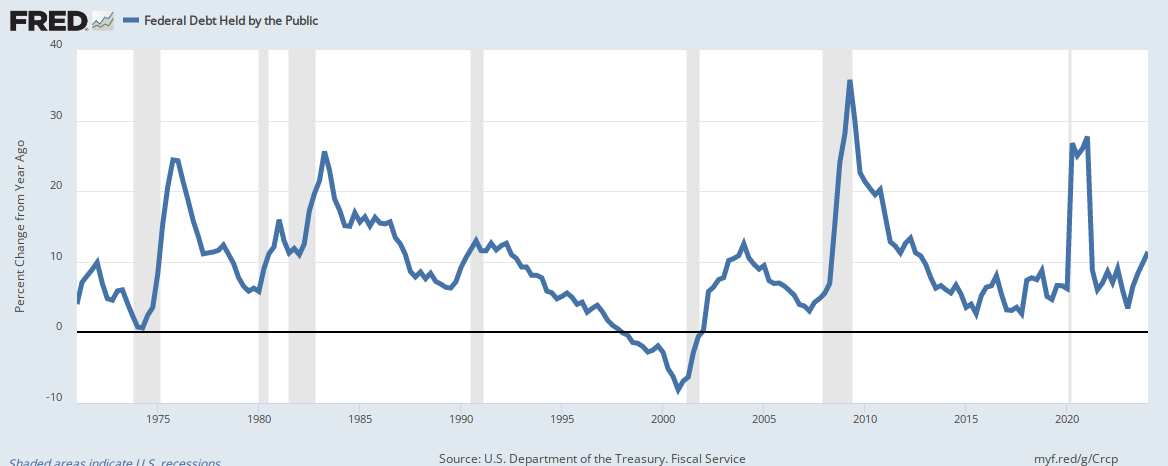
What he doesn’t tell you is that economic growth relies on federal deficit spending, without which we have recessions and depressions.

Debt growth reduction (blue line) leads to recessions

(vertical gray bars), which are cured by debt growth increases.

Now we come to a truly ignorant and deceptive comment:

Proponents claim that our roads and bridges are dissolving like a graham cracker in a glass of milk.

In fact, the great majority of them are in decent condition, and the biggest problems are concentrated in a relatively few states.

That’s why most infrastructure spending decisions are, and should be, decided at the state and local levels where the benefits are concentrated.

So, for instance, when referring to dams, let’s say there are 10,000 dams in America , of which “only” 3,000 are at risk of collapsing.

To the author this is not something for the federal government to worry about, because the “majority” are still in decent condition, today.

If Texas taxpayers don’t want to finance rail investments, maybe the rest of us should demur.

In short, the author tells you that if the Texan rail system falls apart, it won’t affect you, in the rest of the country.

Do you believe that? Apparently, the author does, or at least, he wants you to believe it.

And, of course, he fails to mention that when Texas spends, that really does cost Texas’s taxpayers, but when the federal government spends, it doesn’t cost you or them, anything.

Then, without realizing it, the author admits that federal spending helps grow the economy, but he tries to make it sound like a bad thing.

Residents of Illinois know that infrastructure can consume tax dollars but serve more as a bonus program for lawmakers who can brag of bringing home the bacon.

False. Federal spending does not consume tax dollars, but state spending does.

Organized labor loves an expensive infrastructure plan that puts union members to work.

And countless special interest groups, from asphalt and engineering firms to waste haulers and construction suppliers, lobby hard for infrastructure investment — and donate heavily to the campaigns of the elected officials in charge.

Yes, organized labor (as well as unorganized labor) — all labor, in fact — likes putting people to work. The author wants you to believe this is a bad thing.

And countless businesses (what the author misnames “special interest groups”) benefit from federal spending.

And benefiting business is supposed to be a bad thing, too??

Mass transit investments also deserve close scrutiny right now. Ridership on trains, buses and commuter rail has plunged.

Many people have moved out of cities because they no longer have to show up at their workplaces every day — if ever. Ride-sharing services had already lured away many transit customers.

What will the demand for mass transit be five years from now? That’s highly uncertain, which argues for holding off on major investments that may end up being ill-suited for the needs of the future.

The argument is: Because no one can predict the needs of the future, don’t repair mass transit now. So, he tells you, there is no need to repair roads, or bridges, or railroads, the future might be Zoom-based work-at-home. Or maybe not.

In any event, he proposes we wait until the roads, rails, bridges, dams are collapsing around us before we begin to fix them.

The Biden administration seems to think it can justify every outlay in the name of creating jobs.

But if the federal government borrows hundreds of billions of dollars to spend on infrastructure, those funds can’t be used to finance private investment that would also create jobs.

The federal government does not borrow. It has the unlimited ability to create dollars, so why would it ever borrow?

What is misnamed “borrowing” really is the acceptance of deposits into Treasury Security accounts (T-bills, T-notes, T-bonds). These accountsmost closely resemble safe-deposit boxes that pay interest.

The government never touches the dollars in these accounts. Instead, the money sits there, accumulationg interest, and upon maturity, the money is returned to the account owners.

The federal government never can run short of dollars, so the claim, “. . .  those funds can’t be used to finance private investment” is utter nonsense.

Tax increases would also divert resources from the private sector.

And a nation doesn’t grow richer by paying people to work on lavish boondoggles.

There are no tax increases caused by federal spending. In fact, even if the government didn’t collect a single penny in taxes, it could continue spending, forever.

And ever though the author doesn’t mention any “lavish boondoggles” that supposedly might appear in Biden’s proposal, if there were any, they in fact, would help the nation grow richer by adding dollars to the private sector.

And finally, the author seems to understand the abject ignorance of all he has written, he comes up with this pitiful, semi-apology:

We’re not opposed to all infrastructure investments. Some roads and bridges need attention. Measures to mitigate the effects of climate change are overdue. Clean energy ventures could help reduce our use of fossil fuels. But each item should have to pass a rigorous cost-benefit test.

An infrastructure push could produce a lot of capital improvements that will make our lives better.

But it’s not enough for Washington to spend. It has to spend wisely.

So after his long, misleading diatribe telling you all the reasons why the federal government should not spend, he summarizes with, in effect, “Spend wisely.”

As the headline of this post says, “This newspaper article is designed to fool you. Are you fooled?”

Rodger Malcolm Mitchell

Monetary Sovereignty Twitter: @rodgermitchell Search #monetarysovereignty Facebook: Rodger Malcolm Mitchell …………………………………………………………………………………………………………………………………………………………………………………………………………………………………………………………………………………………..

THE SOLE PURPOSE OF GOVERNMENT IS TO IMPROVE AND PROTECT THE LIVES OF THE PEOPLE.

The most important problems in economics involve:

  1. Monetary Sovereignty describes money creation and destruction.
  2. Gap Psychology describes the common desire to distance oneself from those “below” in any socio-economic ranking, and to come nearer those “above.” The socio-economic distance is referred to as “The Gap.”

Wide Gaps negatively affect poverty, health and longevity, education, housing, law and crime, war, leadership, ownership, bigotry, supply and demand, taxation, GDP, international relations, scientific advancement, the environment, human motivation and well-being, and virtually every other issue in economics. Implementation of Monetary Sovereignty and The Ten Steps To Prosperity can grow the economy and narrow the Gaps:

Ten Steps To Prosperity:

  1. Eliminate FICA
  2. Federally funded Medicare — parts A, B & D, plus long-term care — for everyone
  3. Social Security for all
  4. Free education (including post-grad) for everyone
  5. Salary for attending school
  6. Eliminate federal taxes on business
  7. Increase the standard income tax deduction, annually. 
  8. Tax the very rich (the “.1%”) more, with higher progressive tax rates on all forms of income.
  9. Federal ownership of all banks
  10. Increase federal spending on the myriad initiatives that benefit America’s 99.9% 

The Ten Steps will grow the economy and narrow the income/wealth/power Gap between the rich and the rest.

MONETARY SOVEREIGNTY
Sen. Rick Scott “bravely” opposes wasteful federal spending, but even here, he’s wrong.

Sen. Rick Scott is a brave man. He wants to “reduce waste and save taxpayer dollars.”

Wow, what a courageous position. What next, Sen. Scott, laws favoring motherhood, apple pie, the Pledge of Allegiance, and the American flag?

DUMPSTER DIVING- SHE'S SAVING WHAT BIG CORPORATE STORES THROW AWAY - YouTube
Dumpster diving can uncover some valuable stuff.

Sadly, despite his cloying attempts at false patriotism (He didn’t criticize Trump for forceable attempts to overturn America’s Presidential election and for snuggling up to QAnon, Proud Boys, 3 percenters, et al), Scott is dead wrong about waste and taxpayer dollars.

Federal Waste
“Waste” is in the eye of the beholder.

To a Republican, anything that benefits the poor — Obamacare, food stamps, free school lunches, etc. — and any other Democratic spending proposal, constitutes “waste.”

So, to prevent such “waste,” Scott wants to:

1. Create a 13 member bipartisan Commission to review the efficiency and public need for each federal agency.
Require the Commission to review and report to Congress on all legislation introduced in Congress that would establish a new agency, or a new program to be carried out by an existing agency.
2. Require the Commission to annually recommend, in the form of legislation, whether the reviewed agencies should be abolished, reorganized, or continued and whether the responsibilities of agencies should be consolidated, transferred, or reorganized.
3. Require Congress to vote on the Commission’s timeline for the abolishment of agencies within a year of the bill’s passage.
4. Expedite the process for Congress to vote on a joint resolution either adopting or rejecting the recommendations of the Commission.

Here are some of the “bold” statements from Scott & Friends:

Senator Rick Scott said, “Our nation is on track to reach $30 trillion in debt and reckless, unaccountable spending by politicians in Washington has put us on a path of economic self-destruction.

The so-called “path of economic destruction” has been in existence for at least 80 years. In 1940, the federal debt was about $40 billion.

Today, it is about $25 trillion and as a result, our economy is the strongest in the world. We still await the “economic destruction.”

Senator Joni Ernst said, “Congress’s job is to hold federal agencies accountable and to work to prevent unelected bureaucrats from wasting hardworking taxpayer dollars. 

Congress is elected. Would the commission be composed of Congresspeople or of “unelected bureaucrats”? If Congresspeople, why would they be trusted more than Congress itself? If unelected, why should they overrule our elected Congress?

Senator Mike Braun said, “When I built my business back on Main Street, if you weren’t constantly evaluating whether your money was being well-spent, you’d soon find yourself out of business. The federal government should do the same.

False comparison. The federal government, being Monetarily Sovereign, is nothing like Braun’s hypothetical, monetarily non-sovereign business back on Main Street.

Senator Mike Crapo said, “The federal government must be limited, and taxpayer dollars must be used efficiently to effectively help Americans.

Mike Crapo, not understanding economics, doesn’t realize that the federal government (unlike state and local governments) doesn’t spend taxpayer dollars. It creates new dollars, ad hoc, each time it pays a creditor.

Representative Michael Cloud said, “Hardworking American taxpayers have to make difficult decisions every day to make ends meet and so should Congress. It is vital we restore trust with the American people in how Congress spends taxpayer dollars.

Rep. Cloud, also not understanding economics, doesn’t realize the federal government does not have to “make ends meet.” It has the unlimited ability to create its own sovereign currency, the U.S. dollar.

The problem is that we already have a bipartisan commission to evaluate laws and agencies. It’s called “Congress.” It’s a 541 member commission, elected by the U.S. voters.

In essence, Scott and his pals wish to substitute the will of our elected Congress with 13 elected or unelected (?) Commissioners who will decide whether Congress is right or wrong.

Perhaps, for efficiency, should we simply should do away with Congress and allow these 13 Commissioners to do the work? That would eliminate a great deal of waste in salaries and expenses, wouldn’t it?

Once we get past all the Scott & Friends cloying sophistry and economic ignorance, we only can conclude that Scott wants to take credit for a no-brainer, flag-waving piece of drivel.

After all, who would dare to argue against fighting federal waste?

Well, me for one.

Sure, we all love federal spending that accomplishes something we like, and we dislike federal spending that accomplishes something we hate.

I, for one, think making children stand and recite the Pledge of Allegiance is a waste of time, and the entire federal tax-collection is a monstrous waste of resources.

Those are my opinions. Put me on the Commission.

Except for one fact:

Federal “wasteful” spending is better than no spending at all.

Consider the infamous Gravina Island Bridge, commonly referred to as the “Bridge to Nowhere.” It was to connect Ketchikan, Alaska with Gravina Island, containing the Ketchikan Airport as well as 50 residents. The bridge was projected to cost $398 million.

Most people would have classified that as a colossal waste, except for two facts:

  1. It would have cost taxpayers nothing. The federal government would have created the dollars at the touch of a computer key. No tax dollars would have been involved.
  2. At least (probably more than) $398 million would have been pumped into the U.S. economy. Jobs would have been created in several industries.

No harm; no foul.

The project eventually was canceled, and that cancellation cost the economy the $398 million it would have received. So which was worse, the cancellation or the project itself? 

A BIT OF HISTORY
Years ago, Senator William Proxmire created the “Golden Fleece Award,” a tongue-in-cheek criticism of what he considered federal wasteful spending.

It was great public relations for Proxmire, but sadly for America, some of the recipients of the Golden Fleece Award were research projects that later resulted in valuable results.

That’s the way it is with research. You don’t know where it will lead. Only later can you look back and determine whether if was worthwhile or “wasteful.”

By contrast with “wasteful,” there are some expenditures that are “harmful.”

I believe spending billions on the border wall was a harmful waste when the same billions could be used to vet and process valuable immigrants, while using the justice system to apprehend those that commit crimes.

And for what? To prevent the entry of drugs, the vast majority of which come in via legal channels.

With that wall, we do ongoing harm to innocent human beings and to the American economy. How many potential scientists, soldiers, teachers, business leaders, and consumers have we lost because of that wall.

IN SUMMARY
“Wasteful spending is in the eye of the beholder. What some consider waste, others consider practical.

Federal “wasteful spending” is not like private sector wasteful spending, i.e not like your wasteful spending nor mine, not like business wasteful spending, nor state/local government wasteful spending.

Private sector wasteful spending adds nothing to the economy. It doesn’t add money or accomplishment.

Taxpayers do not pay for federal spending. Sadly, federal taxpayers pay for nothing. Federal taxes are the ultimate wasteful spending.

Federal “wasteful spending” adds money to the economy, and if it is not actually harmful, so-called federal “wasteful spending” stimulates economic growth.

Dumpster diving can uncover some valuable stuff.

Rodger Malcolm Mitchell

Monetary Sovereignty Twitter: @rodgermitchell Search #monetarysovereignty Facebook: Rodger Malcolm Mitchell …………………………………………………………………………………………………………………………………………………………………………………………………………………………………………………………………………………………..

THE SOLE PURPOSE OF GOVERNMENT IS TO IMPROVE AND PROTECT THE LIVES OF THE PEOPLE.

The most important problems in economics involve:

  1. Monetary Sovereignty describes money creation and destruction.
  2. Gap Psychology describes the common desire to distance oneself from those “below” in any socio-economic ranking, and to come nearer those “above.” The socio-economic distance is referred to as “The Gap.”

Wide Gaps negatively affect poverty, health and longevity, education, housing, law and crime, war, leadership, ownership, bigotry, supply and demand, taxation, GDP, international relations, scientific advancement, the environment, human motivation and well-being, and virtually every other issue in economics. Implementation of Monetary Sovereignty and The Ten Steps To Prosperity can grow the economy and narrow the Gaps:

Ten Steps To Prosperity:

  1. Eliminate FICA
  2. Federally funded Medicare — parts A, B & D, plus long-term care — for everyone
  3. Social Security for all
  4. Free education (including post-grad) for everyone
  5. Salary for attending school
  6. Eliminate federal taxes on business
  7. Increase the standard income tax deduction, annually. 
  8. Tax the very rich (the “.1%”) more, with higher progressive tax rates on all forms of income.
  9. Federal ownership of all banks
  10. Increase federal spending on the myriad initiatives that benefit America’s 99.9% 

The Ten Steps will grow the economy and narrow the income/wealth/power Gap between the rich and the rest.

MONETARY SOVEREIGNTY