Federal “deficits” actually are federal growth investments into the economy
We often speak of the federal “debt” as being the total of all federal “deficits.”
It arithmetically seems to work out that way, but only seems.
The truth is that federal “deficits” and federal “debt” are completely separate numbers, fundamentally unrelated.
FEDERAL DEFICITS (Net Investment)
Federal deficits merely are the mathematical differences between federal taxing and federal spending. Remember, however, thatfederal taxing does not fund federal spending.
In fact, your federal tax dollars are destroyed upon receipt. Your dollars, which begin in your checking account (M1 money supply), end up with the Treasury, where they cease to exist in any money supply measure. Gone.
The primary purpose of federal taxes is to control the economy. The federal government taxes what it wishes to discourage and provides tax breaks to what it wishes to encourage or reward. (This is unlike state and local government taxes, whose primary purpose is to fund state and local government spending.)
Any mathematical relationship between federal spending and federal taxing numbers is bogus. The federal government could collect zero taxes while continuing to spend, forever. Similarly, it could tax without spending, but this would throw the nation into a depression.
The point is that deficit spending represents the federal government’s investment in the economy. In fact, rather than referring to federal “deficits” we more accurately should refer to federal “net investment.”
To date, the federal government, which owns unlimited money, has made a net investment in the economy of about $25 trillion dollars.
This troubles the debt-nuts who want you to believe the federal government can run short of its own sovereign currency. It can’t. Never, never, ever.
FEDERAL DEBT (Deposits in T-security accounts)
The Federal debt is the total number of dollars deposited in T-security accounts. These accounts are similar to bank safe-deposit accounts in that the federal government does not touch the money other than to add interest dollars.
The federal government removes dollars from T-security accounts only to pay off owners of the accounts.
Federal “debt” is the total of T-security accounts. Think of them as safe-deposit boxes. The government never uses those dollars.
The dollars in T-security accounts do not fund federal spending.
Depositors’ dollars remain in these accounts, buttressed by interest payments, until account maturity, at which time the dollars are returned to the depositors.
The federal government never uses those dollars
Thus, despite common (and incorrect) usage, the federal government has not “borrowed” the dollars in T-security accounts.
And, in fact, the federal government never borrows dollars. Because it is Monetarily Sovereign, it has the unlimited ability to create its own sovereign currency, the U.S. dollar.
There never is a need for borrowing, and for the same reason, the government does not use tax dollars to facilitate spending. The government creates 100% of the dollars it spends, ad hoc.
The purposes of T-security deposits are:
To help the Fed control interest rates, which in turn, help control inflation.
To provide a safe, interest-paying place to park unused dollars, which helps stabilize the dollar.
In short, there is no direct connection between federal deficits and federal debt. The government could run deficits (i.e. spend more than tax income) without accepting even one dollar is debt (i.e. deposits into T-security accounts).
And the federal government could run trillions of dollars in debt (i.e accept T-security deposits) while spending no more than deficits (spending less tax income).
Dept and deficits are completely separate functions.
SO WHY DOES FEDERAL “DEBT” EQUAL THE TOTAL OF “DEFICITS”?
If deficits and debt are not connected, and neither one pays for federal spending, why does federal “debt” (deposits) just happen to equal the total of “deficits” (net investments)?
It is a quirk of federal law, that the government is not allowed to run deficits that arithmetically are greater than T-security deposits. This law creates the illusion that somehow, debt is the total of deficits (i.e. federal investment being equal to deposits in T-security accounts).
What happens if the total of federal deficits is greater than deposits in T-security accounts?
Answer: The Federal Reserve steps in and, having the ability to create dollars, it deposits enough dollars into T-security accounts to balance the total against total “debt” (deposits}.
Currently, The Federal Reserve holds $2.5 trillion of U.S. Treasuries, which is roughly one-sixth of U.S. “debt” held by the public.
The Federal Reserve is a federal government agency. Many people are confused by the fact of a federal agency “lending” money to the federal Treasury, but this is just a legal workaround to overcome the obsolete law requiring federal investments to equal or be less than deposits in T-security accounts.
IN SUMMARY
Contrary to popular wisdom:
There is no functional relationship between federal net investmentsin the economy (misleadingly known as “deficits”) and deposits into T-security accounts (misleadingly known as “debt”).
The federal government has the power to run “deficits” without “debt,” or to run “debt” without “deficits.” The two numbers are not functionally connected,
Calling them “deficits” or “debt” is highly misleading, and the negative connotations are harmful to federal financial planning.
Accepting deposits into federal T-security accounts does not constitute “borrowing.”
The federal government cannot unwillingly go bankrupt, nor can any agency of the federal government, including Social Security, Medicare, poverty aids, et al.
All claims that some federal agency will run out of money are bogus (unless Congress wants them to run out of money.)
Gap Psychology describes the common desire to distance oneself from those “below” in any socio-economic ranking, and to come nearer those “above.” The socio-economic distance is referred to as “The Gap.”
Wide Gaps negatively affect poverty, health and longevity, education, housing, law and crime, war, leadership, ownership, bigotry, supply and demand, taxation, GDP, international relations, scientific advancement, the environment, human motivation and well-being, and virtually every other issue in economics.Implementation of Monetary Sovereignty and The Ten Steps To Prosperity can grow the economy and narrow the Gaps:
Ten Steps To Prosperity:
Rachel Greszler is a research fellow in economics at The Heritage Foundation. David Ditch is a researcher specializing in transportation issues for Heritage’s Hermann Center for the Federal Budget.Rachel Greszler and David Ditch, The Heritage Foundation on Aug 5, 2021Most Americans realize the federal government spent a lot of money, including three rounds of so-called “stimulus payments” that most households received. But those $3,200 worth of individual checks pale in comparison to total spending.If ordinary Americans had spent like the federal governmentdid in 2020, the median household that earns $68,703 would have spent $131,620 and put $62,917 on the credit card, despite already being $541,287 in debt.
As of 2021, the U.S. debt comes out to roughly $220,000 per household. That’s enough to buy about eight years’ worth of groceries, gas, clothing, and housing for the typical household.
The above is a completely meaningless and misleading comparison, that is supposed to shock you, but not to inform you. You are not, and never will be liable for the so-called, misnamed federal “debt.”It isn’t a debt, and no one is liable for it.
And even that figure doesn’t include the unfunded liabilities of Social Security and Medicare. Without a significant reduction in the size of those programs, each household’s total debt is actually over $660,000. That’s equal to the cost of a median family home, a new car, plus over five years’ worth of a typical household’s income.
Utter nonsense. All federal liabilities are “unfunded” until the government funds them by creating dollars, ad hoc.
The real purpose of the article is to groom you for acquiescence to right-wing calls for Social Security and Medicare cuts. But even if the FICA tax were eliminated, the federal government could support Social Security for All and a comprehensive Medicare for All, forever.
Then follow more meaningless comparisons, all designed only to be shocking. Your household will not ever pay a single penny to pay off the so-called federal “debt.”
However, even this massive a debt doesn’t seem all that bad. Interest rates are low, and the federal government has had little problem seemingly borrowing into oblivion without consequence. (The same could be said of Greece before a financial crisis ensued.)
The fact that interest rates are low is yet more meaningless tripe. The U.S. government sets interest rates at any level it chooses, and it pays interest by creating new dollars, ad hoc, which it has the infinite ability to do.
And by the way, Greszler and Ditch, is it ignorance, stupidity, or traitorousness that causes you to compare the Monetarily Sovereign United States (which has the unlimited ability to create its own sovereign currency, the dollar) with the monetarily non-sovereign Greece (which has no sovereign currency)?
But our currently low interest rate payments—equal to over $2,500 per household in 2021, or the cost of about 6 months’ worth of groceries—are on track to rise to about $6,400 per household in 2031. That’s four months of mortgage payments.
Again, more designed-to-deceive, meaningless, false equivalences between federal finances and personal finances
And that’s the equivalent of an interest-only mortgage. Those costs don’t even begin to reduce the principal amount of debt.
The so-called federal “debt” is not a debt in the usual sense. It is the total of deposits into Treasury Security accounts (similar to safe deposit boxes) which are no burden whatsoever on the government or on future taxpayers.
While ordinary Americans aren’t allowed to take out mortgages or open up new credit cards in their children’s names, the federal government does this every day.
Yet even more ignorant, stupid, or intentionally deceptive false comparisons between federal finances and personal finances. The Heritage fraud goes on and on.
The share of debt for a child born this year was $66,874. And that debt is on track to rise every year, reaching $111,552 by the time they’re 18 and either start working or head off to college. It will then hit $191,768 by the time they’re 30 and potentially raising young children.
The above implies that future children will have to pay for the so-called “debt.” It is a lie of the first order.
No one will pay for the “debt” because it is not debt. It is deposits that will be paid off as they always have been: By simply returning the dollars in those T-security accounts.
Fortunately, it’s not too late to prevent the nation from going broke.
It is impossible for the United States to “go broke.” Being Monetarily Sovereign (unlike Greece), the U.S. has the unlimited ability to create dollars. If needed, it could press one computer key and create a trillion dollars tomorrow.
Congress should cut out wasteful spending such as corporate welfare and excessive compensation for federal bureaucrats.
The Heritage Foundation, being right-wing, now complains about “corporate welfare.” Do they mean the Republicans’ tax cuts for businesses?
And really, how many federal bureaucrats receive “excessive compensation”?
Of course, the whole thing is meaningless, because all federal deficit spending, even so-called “wasteful” spending, benefits everyone by adding stimulus dollars to the economy.
Congress should stop shirking their responsibilities by placing an increasing amount of federal spending on autopilot, and instead seek to reform programs like Social Security and Medicare that are on a path to bankruptcy.
I have no idea what “autopilot” means in this context. I suspect the authors don’t know, either. But none of it matters.
The real purpose is to make you believe Social Security and Medicare should be cut. That is the goal of The Party of the Rich, the Republicans.
The rich, who support Heritage Foundation, always want to widen the Gapbetween the rich and the rest. The wider the Gap, the richer are the rich. It’s known as Gap Psychology — the desire to widen the income/wealth/power Gap below, and to narrow the Gap above.
So they repeatedly warn that Social Security and Medicare soon will run short of money, despite their being a federal agency that has available to them, infinite dollars.
Neither the federal government, nor any agency of the federal government, can go bankrupt unless Congress and the President want them to.
Congress should focus on core federal responsibilities and clear away countless programs that benefit narrow interest groupsat the expense of the public good.
The elderly and the poor — are they what Heritage considers to be “narrow interest groups”?? Or aren’t the rich — Heritage’s buddies — who really comprise the narrow interest groups?
Congress should recognize our looming debt disaster and step away from shortsighted spending plans.
Big problems like the unsustainable national debt won’t be solved quickly or easily. However, Congress must begin to take fiscal responsibility seriously as soon as possible.
The “unsustainable” national debt has been growing massively, and sustaining, since 1940, while organizations like Heritage have been crying “Wolf” again, and again, and again.
Otherwise, a Greece-like fate may await us.
And the article ends appropriately, with one, final, false comparison of monetarily non-sovereign Greece vs. Monetarily Sovereign America. The Big Lie is alive and well at Heritage.
Even, an organization as devoted to advancing the interests of the rich vs. the rest, should be embarrassed by the above article.
It is so wrongheaded and misleading as to be written by fools and approved by traitors. They do more to hurt America than do the most devoted Russian, Iranian, and Chinese spies.
Perhaps The Heritage Foundation should be renamed The Benedict Arnold Foundation.
Rodger Malcolm Mitchell
Monetary SovereigntyTwitter: @rodgermitchellSearch #monetarysovereigntyFacebook: Rodger Malcolm Mitchell
……………………………………………………………………..
THE SOLE PURPOSE OF GOVERNMENT IS TO IMPROVE AND PROTECT THE LIVES OF THE PEOPLE.
Gap Psychology describes the common desire to distance oneself from those “below” in any socio-economic ranking, and to come nearer those “above.” The socio-economic distance is referred to as “The Gap.”
Wide Gaps negatively affect poverty, health and longevity, education, housing, law and crime, war, leadership, ownership, bigotry, supply and demand, taxation, GDP, international relations, scientific advancement, the environment, human motivation and well-being, and virtually every other issue in economics.Implementation of Monetary Sovereignty and The Ten Steps To Prosperity can grow the economy and narrow the Gaps:
Ten Steps To Prosperity:
When you hear about the U.S. federal “debt,” or “deficits,” you probably visualize something akin to personal debt or deficits, corporate debt/deficits, or local government debt/deficits.
And when hear about federal “borrowing,” you probably visualize borrowing similar to personal, corporate, or local government borrowing.
If that’s what you’d visualize, you would be wrong.
Federal finances are nothing at all like personal, corporate, or local government finances.
The difference begins with the fact that the U.S. government is uniquely Monetarily Sovereign.
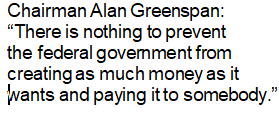
In the beginning of our nation, the federal government created laws from thin air. Some of those laws created the U.S. dollar from thin air– as many dollars as the government wished.
And those laws gave those dollars whatever value the government wished.
That is what being sovereign over the dollar means: Total, 100% control over the laws that have total 100% over all aspects of the dollar. In real effect, the federal government is God of the Dollar
Throughout the history of America, the U.S. federal government has continued to create as many dollars as it wished at whatever values it wished.
These values arbitrarily were changed many times, and even today the federal government creates dollars at will, just by pressing computer keys, and controls their value.
Neither you, nor any corporation, nor any local/state government has this ability with respect to U.S. dollars. You are monetarily non-sovereign.
The federal government’s unique and unlimited ability to create dollars and arbitrarily to control their value means.
Unlike you, businesses, and local governments, the federal government never unwillingly can run short of dollars.
Unlike you, businesses. and local governments, the federal government neither needs nor uses income.
Imagine that you own a dollar-creating machine that allows you legally to create any number of dollars you wished. You could press keys that create, a million dollars, or a billion, or a trillion, trillion, trillion dollars.
Would you need any other source of income?
Think logically: Would you ever need to borrow dollars?
Would you ever need to levy taxes on anyone, to acquire dollars?
Would you ever have any difficulty paying for anything?
And, in fact, the federal government does not borrow dollars. It levies taxes, but not to acquire dollars. And it can pay for anything at the touch of a computer key.
Federal taxes do not provide the federal government with spending money.The purpose of federal taxation is to control the economy by taxing what the government wishes to discourage, and by giving tax breaks to what the government wishes to encourage.
Even if all federal taxing ended, and tax collections equaled $0, the federal government could continue spending, forever.
BORROWING AND THE “DEBT”
The federal government never borrows.
Some people claim that T-securities — T-bills, T-notes, T-bonds — represent borrowing. That claim is wrong.
You, and businesses, and state/local governments borrow to acquire dollars you do not have, or to acquire dollars at a lower cost than you can earn by investing. When you buy a house or a car, you may finance the purchase if you don’t own enough dollars to cover the cost, or if the interest you would pay is less than you could earn with those dollars.
But the federal government has the ability to create infinite dollars at essentially zero cost. It has no reason to borrow.
So why does the government sell T-securities?
.
The purposes of T-securities are:
A. To provide safe, interest-paying “parking places” for unused dollars. This safety helps to stabilize the value of the dollar.
B. To help the Fed control interest rates, which is one of the methods by which the government controls the value of the dollar, i.e. controls inflation.
When you purchase a T-bill, note, or bond, you actually open a T-security account and deposit your dollars into your T-security account.
This account is comparable to a bank, safe-deposit box. The federal government never touches the dollars in your T-security account.
There, your dollars stay, earning interest, until maturity, at which time all the dollars in your account are returned to you.
The so-called federal “debt” is the total of the dollars in all T-security accounts. To pay off the “debt,” the federal government merely returns those dollars to the account holders. No tax dollars or future taxpayers are involved.
Contrary to what you repeatedly are told, your children and grandchildren will not pay off the “debt.” No one will. Paying off the “debt” merely involves the return of existing dollars.
Thus, the “debt,” no matter how large, never is a burden on the federal government, nor on taxpayers, nor on the economy.
In this regard, there is the mistaken belief that the federal government should borrow when interest rates are low, because that would constitute a reduced repayment burden. This belief is laughably wrong because:
The federal government does not borrow and is not a debtor liable for the federal debt.
The federal government sets interest rates at any level it wishes, and can do so, instantly.
The federal government has the infinite ability to pay for anything.
The interest the federal government pays constitutes growth dollars for a healthy economy.
THE “DEFICIT”
The federal “deficit” is the net amount that the federal government invests in the economy each year.
It is the difference between the number of dollars the government spends into the economy vs. the number of dollars the government takes out of the economy via taxation.
It would be far more accurate to replace “deficit” with “federal investment.”
The single most common measure of the economy is Gross Domestic Product (GDP), one formula for which is:
GDP = Federal Spending + Non-federal Spending + Net Exports.
All three terms, Federal Spending, Non-federal Spending, and Net Exports, add growth dollars to the economy. By formula, it is impossible for GDP to grow without growth dollars, andthe primary, long-term source of growth dollars is the federal government.
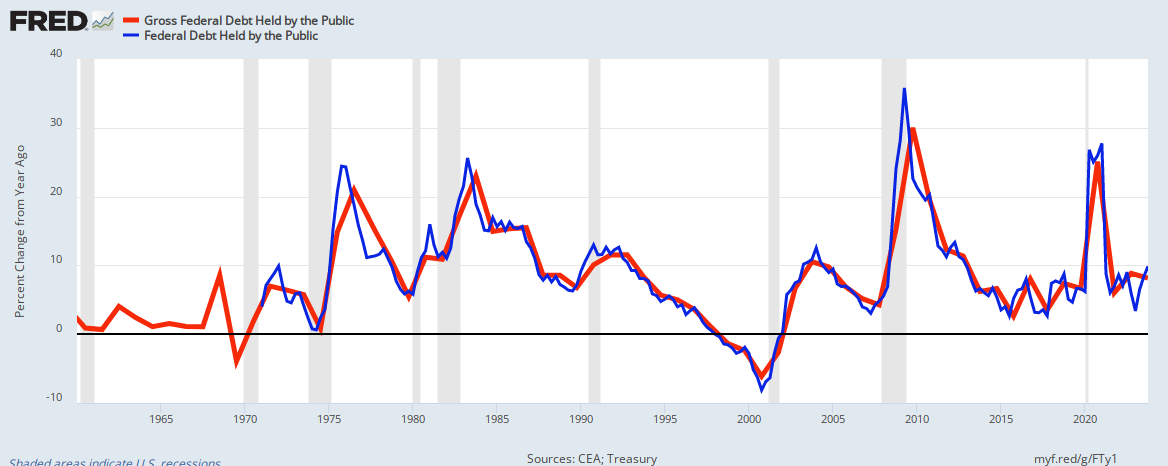
Virtually every recession and depression in U.S. history has resulted from insufficient “deficit” growth, i.e. insufficient federal investmentinto the economy.
Recessions (vertical gray lines) follow reduced deficit growth (red and blue lines). Recessions are cured by increased deficit growth.
Depressions follow federal surpluses (i.e. complete elimination of net federal investment in the economy.)
1804-1812: U. S. Federal Debt reduced 48%. Depression began 1807.
1817-1821: U. S. Federal Debt reduced 29%. Depression began 1819.
1823-1836: U. S. Federal Debt reduced 99%. Depression began 1837.
1852-1857: U. S. Federal Debt reduced 59%. Depression began 1857.
1867-1873: U. S. Federal Debt reduced 27%. Depression began 1873.
1880-1893: U. S. Federal Debt reduced 57%. Depression began 1893.
1920-1930: U. S. Federal Debt reduced 36%. Depression began 1929.
1997-2001: U. S. Federal Debt reduced 15%. Recession began 2001.
To avoid recessions and depressions, the federal government consistently must invest new dollars into the economy. Although this investment commonly is known by the pejorative terms, “deficits” and “debt,” it should be called “economic investment.”
The U.S. federal government, being Monetarily Sovereign, and thus having the infinite ability to create its own sovereign currency, the U.S. dollar, never should reduce its annual investment in the economy. For a healthy economy, the so-called “deficit” and “debt” always should increase.
INFLATION
Contrary to common claims, inflation never is caused by “too much” federal deficit spending.
All inflations are caused by shortages of key goods and services, usually shortages of food or energy.
In fact, the best cure for inflations is additional “deficit” spending to increase the supply of the scarce goods and services. Example:
The notorious Zimbabwe hyperinflation began when the Zimbabwe government took farmland from farmers and gave it to people who did not know how to farm.
The resultant food shortage caused inflation, which could have been cured by additional government investment to assist the new farmers (via education and equipment) and to obtain food from overseas and distribute it to the populace.
Instead, the Zimbabwe government simply printed currency, which gave the illusion that government money-creation caused inflation. In reality, the scarcity of food caused inflation.
Scarcities cause prices to rise. All inflations are caused by scarcities.
Cure the scarcities and you cure the inflation.
GOLD
Let us discuss one more common myths in economics: When the U.S. dollar was “backed” by gold, this helped stabilize the dollar and encouraged trust in the dollar.
The term “back” is another word for “collateral,” which is “something pledged as security for repayment of a loan, to be forfeited in the event of a default.”
The reality: Gold never collateralized the U.S. dollar — not during the times when the U.S. was on various gold standards, and not today. Never.
The notion of “backing” comes from the belief that if something happened to reduce the value of the dollar, the holder of a dollar always could turn to gold.
This notion is utter nonsense.
During gold standard times, the U.S. government arbitrarily determined the exchange rate between the dollar and gold.
The U,S. Coinage Act of 1792 arbitrarily fixed the exchange rate at one dollar to 24.75 grains of fine Gold and 371.25 grains of fine Silver.
In 1862, Congress passed the Legal Tender Act. Paper currency was guaranteed only by the full faith and creditof the United States and could not be redeemed for Gold.
In 1875, Congress passed the Specie Payment Resumption Act, in which paper currency again could be redeemed for Gold.
In 1913, the Federal Reserve was allowed to print paper currency with 40% of the currency’s value to be reserved in Gold.
In 1933, gold had to be turned over to the government at $20.67 per ounce.
In 1934, the government arbitrarily set a new gold price of $35 per ounce
In 1971, dollars no longer could be redeemed for gold. Paper currency was ensured only by the full faith and credit of the United States.
Clearly, gold cannot “back” the dollar whilen the federal government has the unlimited ability to change the exchange value of gold at will. What kind of collateral is it that cannot be relied upon?
It would be akin to your house being collateral for your mortgage, but at any time, you could substitute a different house to back your mortgage.
So what does collateralize the U.S. dollar? The same thing that always has “backed” the dollar, from the day it first was created: The full faith and credit of the U.S. government. Period.
Every form of money, including the U.S. dollar, is a debt of the money issuer, and every debt requires collateral. The U.S. dollar is a debt of the federal government. The collateral for federal debt is “full faith and credit,” which involves certain, specific, and valuable guarantees:
A. – The government will accept only U.S. currency in payment of debts to the government
B. – The government unfailingly will pay all its dollar debts with U.S. dollars and will not default
C. – The government will force all your domestic creditors to accept U.S. dollars, if you offer them, to satisfy your debt.
D. – The government will not require domestic creditors to accept any other money
E. – The government will take action to protect the value of the dollar.
F. – The government will maintain a market for U.S. currency
G. – The government will continue to use U.S. currency and will not change to another currency.
H. – All forms of U.S. currency will be reciprocal, that is five $1 bills always will equal one $5 bill and vice versa.
IN SUMMARY
Federal “deficits” actually are the net annual investments in economic growth by the federal government. The economy cannot grow without money growth; insufficient money growth results in recessions, and federal surpluses result in depressions.
Federal “debt” is the total of government investments, which equals, by law, the total of deposits into T-security accounts. The federal government pays off those T-security accounts by returning the money to the account holders, and not with tax dollars. Thus, no one is liable today or in the future for paying off the “debt.”
Inflation is caused by shortages of key goods and services, not by “excessive” federal deficit spending.
All money is a debt of the money issuer. All debt requires collateral. Gold never has been the collateral for the U.S. dollar. The collateral for the U.S. dollar is, and always has been, the full faith and credit of the U. S. government.
Gap Psychology describes the common desire to distance oneself from those “below” in any socio-economic ranking, and to come nearer those “above.” The socio-economic distance is referred to as “The Gap.”
Wide Gaps negatively affect poverty, health and longevity, education, housing, law and crime, war, leadership, ownership, bigotry, supply and demand, taxation, GDP, international relations, scientific advancement, the environment, human motivation and well-being, and virtually every other issue in economics.Implementation of Monetary Sovereignty and The Ten Steps To Prosperity can grow the economy and narrow the Gaps:
Ten Steps To Prosperity:
The federal government has the infinite power to create laws, and these laws have the infinite ability to create dollars. The government cannot run short of laws or dollars.
A. Federal laws are created from thin air by the federal government. The government creates any, and as many, laws it wants, so long as those laws are in keeping with the Constitution, which also was created from thin air by the government.
The federal government never unintentionally can run short of laws. It has the infinite ability to create laws.
B. Among the many laws the government created from thin air are the laws that created the U.S. sovereign currency: The U.S. dollar.
Initially, the government’s laws created as many dollars as the government wanted, and gave them the value the government wanted.
This infinite ability to create any number of dollars and to specify their value is known as “Monetary Sovereignty.”
The U.S. government is sovereign over the dollar.
This infinite ability to create dollars does not rely on tax collections. Even if the government collected zero taxes, it could continue creating dollars forever.
The federal government never unintentionally can run short of dollars or laws.
Similarly, the federal government has no need to borrow dollars, and indeed the government does not borrow dollars. It pays all its bills by creating new dollars, ad hoc.
The purpose of federal taxes is not to supply the government with dollars, but rather to control the economy by taxing what the government wishes to discourage, and giving tax breaks to what the government wishes to encourage.
C. Having absolute control over all aspects of the U.S. dollar, the federal government has absolute control over the value of the U.S. dollar, i.e. inflation. The government has the power to change the value of the dollar at will, a power it has exercised many times over the years.
Thus, the federal government has the absolute power to control inflation.
Keeping the above facts in mind, we can review the following article that describes how and why the federal government will cheat you out of your health care insurance.
High and rising prescription drug costs are contributing to the budgetary pressure faced by the federal government. Also, a significant number of patients face very high out-of-pocket costs.
Interesting choice of words: “budgetary pressure.” The government not only creates infinite dollars from thin air; it also creates infinite budgets from thin air. And it changes those budgets at will.
So, yes, the cost of drugs easily could exceed the budget, but since the government never unintentionally can run short of dollars, there is no financial pressure.
Any budgetary pressure the government may feel is self-inflicted and essentially meaningless. (Visualize Jeff Bezos budgeting $5,000 to buy a TV set, and discovering the TV set costs $5,001. He may feel budgetary pressure, but will not feel financial pressure.)
Our two new briefs focus on options to reduce prescription drug prices. They include:
Medicare Part B could inject price competition into drug classes that have clinically comparable options but wide price variation – blunting the advantage that higher-priced drugs have under the current formula.
Injecting Price Competition into Medicare Part B Drugs
Currently, Medicare Part B, which covers outpatient physician services, pays for physician-administered drugs by reimbursing physicians the average cost for each specific drug plus a 6 percent add-on percentage of that cost. This arrangement creates misaligned incentives that blunt price competition and advantage higher-priced drugs – especially within drug classes that have clinically comparable options but a wide variation in prices.
This policy option looks at implementing “clinically comparable drug pricing,” where Medicare payments for physician-administered drugs would be set at a single price for groups of drugs within the same therapeutic class. That price would be set at the weighted average of prices manufacturers charge for each of the clinically comparable drugs.
This reform should encourage physicians to administer lower cost drugs and manufacturers to lower prices to maintain market share. The policy would reduce Medicare costs and would likely result in savings for Medicare Advantage plans and commercial payers.
The federal government pays its bills by creating dollars ad hoc. Thus, the government legitimately can be said to have infinite dollars. Federal taxes do not fund federal spending. Tax dollars are destroyed upon receipt by the Treasury.
So, there is no economic value to price competition. In fact, each penny the federal government sends into the economy is economically stimulative, at no cost to anyone.
However, the CRFB seems to claim that physicians make more money when physician-administered drugs are priced higher, and this can influence the choice of drugs. I am not sure how prevalent this situation is, but in any event, there is no fair way to prevent it.
The “weighted average” approach can penalize patients by making some of the more effective, costlier-to-produce drugs unavailable.
As a rule, price competition shifts costs from the government to the private sector, which penalizes the economy as a whole, while also penalizing drug research and development.
Over the next decade (2021-2030), implementing “clinically comparable drug pricing” could:
Reduce total (gross) Medicare spending by at least $122 billion in just three drug classes. That includes $56 billion of savings to fee-for-service Medicare, $37 billion in lower beneficiary premiums and cost sharing, and $29 billion in savings for the Medicare Advantage program.
In more accurate words, implementing “clinically comparable drug pricing” could reduce the federal stimulus to economic growthby $122 billion in just three drug classes, while having no financial benefits for the private sector..
The policy would also generate private sector spillover savings. For example, in the rheumatoid arthritis class of drugs, the policy could reduce commercial drug costs by at least $21 billion.
Actually, there could be zero private sector spillover savings, if the government simply would pay, but the pharmaceutical industry would receive $21 billion less from the government.
Limiting Evergreening for Name-Brand Prescription Drugs To encourage medical innovation, the FDA grants temporary market exclusivities to new name-brand drugs. These exclusivities prohibit generic drug competitors’ access to the market for a limited period.
However, drug manufacturers are often able to take advantage of the current rules, using “evergreening” strategies to extend their exclusivity periods and either delay generic drug market entry or limit the number of patients who switch to a new generic.
One evergreening tactic manufacturers employ involves introducing a new “line” or version of their drug shortly before a generic competitor is released.
This new line can be granted its own exclusivity period. For example, a manufacturer may introduce an extended-release formulation just before a generic of the original immediate-release formulation enters the market. This can allow a brand manufacturer to maintain market share in the face of generic competition – increasing its profits and increasing payer and patient costs.
New FDA exclusivity rules could lead to meaningful savings for consumers, commercial insurers, and government payers. The policy change could also speed up the market entry of brand extended-release and other reformulations, providing clinical benefits to patients.
Under a comprehensive, no-deductible, Medicare-for-All plan, there would be no cost for consumers, and government payers (who have infinite dollars) need no dollar savings. More stimulus dollars would be pumped into the economy by federal spending.
As for commercial insurers, they probably would go the way of the manufacturers of street corner phone booths, horse-drawn wagons, Betamax, and audio cassettes. Medicare for All could offer better service at no cost (and no need to ask for permission to have surgery).
Over the next decade (2021-2030), this policy could:
Reduce federal deficits by at least $10 billion.
I.e. reduce federal economic growth and job stimulus by $10 billion
Save Medicare Part D $7 billion in drug costs and Medicare beneficiaries $4 billion in lower premiums and cost sharing.
I.e., reduce federal economic growth stimulus by $7 billion. If Medicare for All were free, as it should be, premiums would be cut hundreds of billions of dollars, and there would be no need for cost-sharing.
Reduce federal and state Medicaid drug spending.
Medicare for all would eliminate the need for federal and state Medicaid drug spending.
Reduce private sector drug costs by $9 billion.
There is no economic need for the private sector to spend anything for drugs.
In Summary: Incredibly, the CRFB seems to prefer saving money for the infinitely endowed federal government at the expense of the money-deprived.
The CRFB suggestions are based on these myths:
Federal finances are like private finances
The federal government is funded by federal taxes
The federal government can run short of dollars.
In truth, the federal government has infinite dollars available, has no need for tax dollars, and never can run short of its own sovereign currency. It needs to run deficits in order to grow the economy and prevent recessions, and it has absolute control over every aspect of the U.S. dollar including inflation.
Spending by the rich encourages the media, the politicians, and the economists to promulgate these myths. The purpose is to widen the income/wealth/power Gaps between the richer and the poorer, aka Gap Psychology.
Here are the CRFB notables, whose mission in life seems to be to help the rich become richer by widening the Gap between the rich and the rest. They have been quite successful.
Gap Psychology describes the common desire to distance oneself from those “below” in any socio-economic ranking, and to come nearer those “above.” The socio-economic distance is referred to as “The Gap.”
Wide Gaps negatively affect poverty, health and longevity, education, housing, law and crime, war, leadership, ownership, bigotry, supply and demand, taxation, GDP, international relations, scientific advancement, the environment, human motivation and well-being, and virtually every other issue in economics.Implementation of Monetary Sovereignty and The Ten Steps To Prosperity can grow the economy and narrow the Gaps:






 #Monetary Sovereignty - Mitchell