Fed Chairman Jerome Powell and President Joe Biden both wish to reduce inflation, prevent (or cure) a recession, and grow the economy.
Both receive the advice of top, uh, well-paid economists. Yet both favor precisely the opposite policies.
Powell admitted he doesn’t have the right tool but insists on continuing with the wrong tool.
Powell recently said, “I do not think the U.S. is currently in a recession, and the reason is there are too many areas of the economy that are performing too well. This is a very strong labor market … it doesn’t make sense that the economy would be in a recession with this kind of thing happening.”
Translation: He doesn’t understand what’s happening but denies it’s a recession.
Yet he raised interest rates by 0.75 percentage points for a second consecutive time to “cool” the economy.
By “cool,” he means the economy is growing too fast, which causes inflation.
He wishes to slow economic growth, which in his opinion, will cure inflation but not cause the recession he denies already is happening. Apparently, Powell thinks the opposite of “inflation” is “recession.” But the two can occur together in what’s called “stagflation.”
Prices are a function of supply and demand.Inflation occurs when there is an imbalance: Too little supply to meet the demand. Today’s inflation, and indeed all inflations through history, are not caused by demand growth but by supply shrinkage.
Historically, demand increases are not sudden, but supply decreases can come overnight. So markets can adjust to the former but struggle to adapt to the latter.
Today, we have the confluence of many shortages: Oil (energy), food, transportation, computer chips, autos, lumber, appliances, homes, labor, and many items related to the basic shortages. In terms of inflation, the single most crucial shortage is the oil (energy) shortage.
Since the cause of inflation is shortages, curing inflation requires curing shortages.
But Powell’s interest rate increases do not address shortages. They do not increase supply. Interest rate increases reduce both supply and demand. They reduce supply by making borrowing by manufacturers more expensive. They reduce demand by making borrowing by consumers more expensive.
Powell hopes that his rate increases will cut demand more than supply. He has no way to know or control whether this will happen. It’s just a hope.
But Jerome, be careful what you hope for; cutting demand impoverishes the supplier section, which leads to a recession.
To quote the Wall Street Journal:
Inflation is a global phenomenon inflicting significant financial pain on families everywhere. Rising costs are an urgent problem, and interest rates play a key role in maintaining price stability.
But urgency is no excuse for doubling down on a dangerous treatment.
As with any illness, the right medicine starts with the right diagnosis.
Unfortunately, the Fed has seized on aggressive rate hikes—a big dose of the only medicine at its disposal—even though they are largely ineffectiveagainst many of the underlying causes of this inflationary spike.
It’s a global problem, as is COVID, but the U.S. can solve this problem within our borders if we use the correct solutions.
As we often have said, the Fed has been tasked with a problem for which it has no tools — shortages of crucial goods and services. Only Congress and the President have the tools to cure shortages.
Mr. Powell has acknowledged this. He noted that elevated interest rates likely wouldn’t bring down gasoline or food prices. “There are many things we can’t affect,” he admitted —namely, the key causes of today’s inflation.
This is a monumental admission. The man tasked with curing inflation has admitted he doesn’t have the tool to do the job. Still, he persists in using that one tool that will lead to recession.
Higher interest rates won’t end skyrocketing energy prices caused by Vladimir Putin’s war on Ukraine. They won’t fix supply chains still reeling from the pandemic.
And they won’t break up the corporate monopolies that Mr. Powell admitted in January could be “raising prices because they can.”
If the Fed’s interest-rate hikes won’t address many causes of today’s inflation, it’s worth asking: What would they do?
When the Fed raises interest rates, increasing the cost of borrowing money, it becomes more expensive for businesses to invest in their operations.
As a result, employers will slow hiring, cut hours and fire workers, leaving families with less money. In the bloodless language of economists, that’s referred to as “dampening demand.”
It also is referred to as “causing a recession.”
But make no mistake: If the Fed cuts too much or too abruptly, the resulting recession will leave millions of people—disproportionately lower-wage workers and workers of color—with smaller paychecks or no paycheck at all.
But that is the whole plan. Make lower-wage workers and workers of color pay to stop inflation. The general sends the poor to the front, not caring how many die.
Mr. Powell has even conceded that the Fed’s actions may lead to a downturn, saying recession “is not our intended outcome at all, but it’s certainly a possibility.”
If all you have is a hammer, every problem looks like a nail. Who cares whether it works or not?
Despite these warnings, the Fed chairman still has cheerleaders for his rate-hiking approach. Chief among them is Larry Summers. “We need five years of unemployment above 5% to contain inflation—in other words, we need two years of 7.5% unemployment or five years of 6% unemployment or one year of 10% unemployment,” the former Treasury secretary recently told the London School of Economics.
You read that correctly: 10% unemployment. This is the comment of someone who has never worried about where his next paycheck will come from.
What can I say about Larry Summers that I haven’t said here, here, here, here,here, and here? The man has my admiration for his ability to fail into better jobs repeatedly.
Summers is a magical example of the Peter Principle: Being promoted to his level of incompetency is his sole success. What next, Larry? Kill the elderly to cut Social Security costs?
If Messrs. Powell and Summers have their way, the resulting recession will be brutal.
As in past downturns, Republicans in Congress will press for austerity—tax cuts for giant corporations and the rich, weaker regulation on big businesses, and little economic support for the most vulnerable.
Democrats should be ready to reject the Republican playbook and prepared to help working families survive.
Well, maybe, just maybe, the Dems are listening, especially if Sen. Joe Manchin remembers he’s a Democrat.
From Axios:
President Biden has slowly but substantially re-engineered significant parts of the American economy — achievements obscured by COVID, inflation and broad disenchantment. e domestic semiconductor industry, and accelerated U.S. viral research and vaccine production capabilities.
He might be on the cusp of the biggest domestic clean-energy plan in U.S. history.
Interestingly, it all has an America First twist— drilling more oilhere … fixing infrastructure here … moving chip-making here … increasing manufacturing jobs here … creating vaccines here.
The $280 billion CHIPS and Science Act provides grants, tax credits and other incentives to manufacture computer chips in the U.S. The White House says it’ll eventually lower the price of cars, dishwashers and computers.
Biden could get another huge win with the climate plan secretly negotiated by Senate Majority Leader Chuck Schumer and Sen. Joe Manchin. The package would provide new tax credits for buying EVs — plus rebates for buying efficient appliances and weatherizing homes, and tax credits for heat pumps and rooftop solar panels.
Biden’s $1 trillion infrastructurebill to rebuild roads, bridges and rail is one of the biggest packages signed by a president ever.
The Biden administration said it’ll pour $3 billion into the vaccine supply chain, creating thousands of U.S. jobs, and helping prepare for future threats.
Electric-vehicle manufacturing is growing in the U.S., with GM and Ford announcing plans for massive vehicle and battery plants across the Midwest and Appalachia. Fun fact: GM’s Mary Barra, who also chairs the Business Roundtable, is the CEO this White House has hosted most often.
These developments required bipartisanship (remember that?) — something Biden promised but gets little credit for, since these thin bands of Republican support look nothing like traditional bipartisanship.
Not only did Biden land these economic measures and a gun-control bill, but same-sex marriage protection is getting close — baby steps, but in a once unthinkable direction.
Biden has only a bare 50-50 Senate “majority” (depending on Sens. Manchin and Sinema). Even then, he is limited by reconciliationto avoid a purely political GOP. It has no ideas for anything but will filibuster everything the Dems submit.
Somehow, Biden managed to accomplish far more than Trump ever dreamed of. This is partly because Trump is an incompetent, corrupt psychopath, who cares only about himself, and the GOP is a crooked election machine.
But much credit belongs to “weak, timid” Biden, who plays the long game, insults no one, closes no doors, knows how to negotiate, and doesn’t whine about everyone else being at fault.
Whereas Trump split his time evenly among golf, tweeting insults, and self-aggrandizement, Biden moved slowly, quietly, but surely to accomplish, accomplish, accomplish.
Now, if only Powell would stand up and say, “I don’t have the right tool. Interest rates won’t cure shortages. Congress must pass spending bills to end key scarcities. That would end inflation and enrich the economy. And the people would thrive.”
That bit of honesty would send more shock waves through Congress than the attempted coup did.
Rodger Malcolm Mitchell
Monetary SovereigntyTwitter: @rodgermitchellSearch #monetarysovereigntyFacebook: Rodger Malcolm Mitchell
……………………………………………………………………..
THE SOLE PURPOSE OF GOVERNMENT IS TO IMPROVE AND PROTECT THE LIVES OF THE PEOPLE.
Gap Psychology describes the common desire to distance oneself from those “below” in any socio-economic ranking, and to come nearer those “above.” The socio-economic distance is referred to as “The Gap.”
Wide Gaps negatively affect poverty, health and longevity, education, housing, law and crime, war, leadership, ownership, bigotry, supply and demand, taxation, GDP, international relations, scientific advancement, the environment, human motivation and well-being, and virtually every other issue in economics.Implementation of Monetary Sovereignty and The Ten Steps To Prosperity can grow the economy and narrow the Gaps: Ten Steps To Prosperity:
No problem. You haven’t hit the ground yet, so we won’t call it a “fall.” We’ll say it’s a step in the plan.
Today, Powell and his cronies debate whether to call where we are “a recession.” He’s worried about semantics as the economy tanks.
Please let me know if there is a more damaging, less effective way to fight inflation than what Powell now is doing.
Consider this: What action should the government take when there is a food shortage, causing food prices to rise?
Government price controls over food? Or,
Reduce federal benefits to the poor, so they will buy less food, thus curing the shortage. Also, reduce farm aid, so there will be even less food produced? Or,
Fund federal aid to farmers so they can produce more food and give people money so they can buy food?
Number 1 never works. It always leads to more shortages and a reduction in Research and Development, forcing even more shortages.
A classic example is rent controls, which reduce the number of new apartments and cause existing apartments to fall into neglect.
Yet politicians without knowledge of history or economics often turn to price controls.
Number 2 leads to recessions and depressions. Today, we have shortages of oil, food, housing, computer chips, and labor, and these shortages are causing prices to rise, what we call “inflation.” All those who are not rich starve.
Amazingly, the Federal Reserve has chosen solution #2. Raising interest rates makes many goods and services even less affordable, starving the poor and middle classes to cure inflation. Higher interest rates also make increased production more difficult, exacerbating shortages.
The federal government should provide aid to industries whose products are in short supply and to consumers so they can afford those products. Approach #3 is the only correct approach. Cure the shortages, and you cure the inflation.
Shortage of food: Federal aid to farmers. Education. Equipment. Insurance. Tax breaks.
Shortage of oil: Aid to drillers. Aid to electric car/truck makers. Support for R&D alternative energy
Shortage of labor: Eliminate FICA. Reduce tax rates on salaries. Provide Medicare for All.
Shortage of lumber: Aid growers. R&D for alternatives. Tax breaks for alternatives
Housing shortage: Aid home & apartment builders. Cut interest rates. Tax breaks for renters.
Powell: If she lives, I cured her. If she dies, I did everything I could.
Notice how curing inflation, i.e., fixing shortages, requires morefederal spending, not less.
Of course, the expenditures must be targeted toward eliminating the scarcities.
Powell’s interest rate increases only make reducing shortages more difficult.
Those higher rates impoverish consumers and hinder the ability of suppliers to produce.
Powell has found the ultimate way to increase shortages, worsen inflation, and cause a recession.
In effect, Powell is applying leeches to cure anemia.
Gap Psychology describes the common desire to distance oneself from those “below” in any socio-economic ranking, and to come nearer those “above.” The socio-economic distance is referred to as “The Gap.”
Wide Gaps negatively affect poverty, health and longevity, education, housing, law and crime, war, leadership, ownership, bigotry, supply and demand, taxation, GDP, international relations, scientific advancement, the environment, human motivation and well-being, and virtually every other issue in economics.Implementation of Monetary Sovereignty and The Ten Steps To Prosperity can grow the economy and narrow the Gaps: Ten Steps To Prosperity:
The Holocaust never happened. Princess Dianne was murdered.
The Sandy Hook mass shooting was fiction.
Hillary Clinton runs a sex ring.
Donald Trump was cheated out of the election.
Hundreds, perhaps even thousands, of these nonsense stories float and are believed by many.
The latter, the Donald Trump lie, fathered a mush-brained attempt to overthrow the U.S. government by people who incredibly thought they were being patriots by violently breaking into Congress.
Such is the mind of the believer.
One commonality among Conspiracy Theories (CT) is that facts don’t matter. You might think that a demonstration of counter-facts would show even the least intelligent that a CT is utter nonsense. The opposite happens.
The demonstration of counter-facts “proves” in the believers’ minds that the CT must be true, and the facts only show how some unknown “they” are hiding the truth.
We’ll begin this exposition by giving you the facts, of which there essentially is one: The U.S. federal government, being Monetarily Sovereign, has 100% control over the U.S. dollar. Neither the federal government nor any of its agencies can run short of dollars.
The government has absolute control over the value and the supply of dollars. Even if the federal government collected $0 taxes, it could keep spending forever. For that reason, the federal government does not borrow dollars.
(The primary effect of federal taxes is to control the economy. Taxes discourage what the government wishes to discourage, and tax breaks encourage what the government wishes to encourage. Unlike state/local taxes, federal taxes do not provide the federal government with spending money.)
Despite repeated mischaracterizations, T-bills, T-notes, and T-bonds do not represent borrowing. They represent deposits into Treasury Security accounts, the purpose of which is to stabilize the dollar. Who says so:
Alan Greenspan: “A government cannot become insolvent with respect to obligations in its own currency.”
Ben Bernanke: “The U.S. government has a technology, called a printing press (or, today, its electronic equivalent), that allows it to produce as many U.S. dollars as it wishes at essentially no cost.”
Ben Bernanke when he was on 60 Minutes:Scott Pelley: Is that tax money that the Fed is spending?Ben Bernanke: It’s not tax money… We simply use the computer to mark up the size of the account.
Statement from the St. Louis Fed:“As the sole manufacturer of dollars, whose debt is denominated in dollars, the U.S. government can never become insolvent, i.e., unable to pay its bills. In this sense, the government is not dependent on credit markets to remain operational.”
That means the government’s so-called “borrowing” does not help the government spend. The European Central Bank, which also is Monetarily Sovereign, agrees.
Press Conference: Mario Draghi, President of the ECB, 9 January 2014Question: I am wondering: can the ECB ever run out of money?Mario Draghi: Technically, no. We cannot run out of money.
I have never met anyone who believes the U.S. government can run short of its sovereign currency. In that vein, the usual reply to questions is, “It always can print more.”
The response is not 100% true — the government does create dollars but does not print them. It prints dollar bills- receipts for dollars, not dollars themselves- but the federal government’s infinite dollar creation ability is correct.
Unlike state and local governments, the federal government pays all its bills by creating new dollars, which it has the infinite ability to do.
O.K., here they are:
THE TWO MOST PERVASIVE, HARMFUL CONSPIRACY THEORIES.
THEORY I. Federal spending causes inflation. We have discussed this here, here, and elsewhere. The federal spending/inflation myth has two rationales.
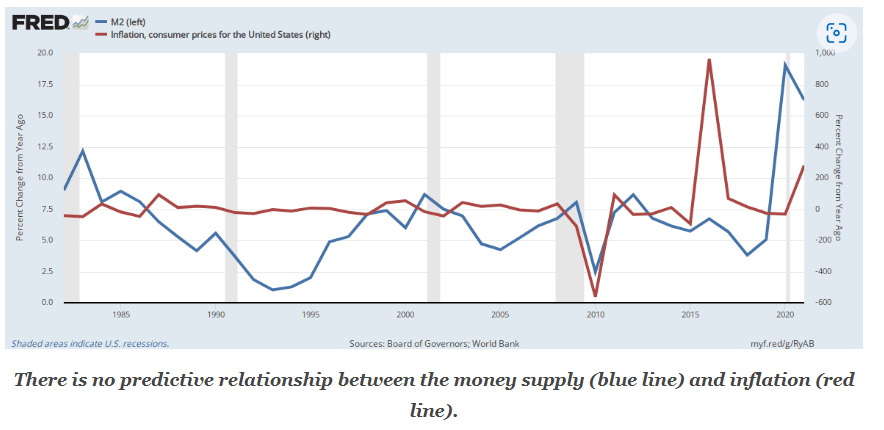
Pumping money into the economy increases the supply of money. When you increase the supply of anything, without increasing the demand, the value of that thing goes down. When the value of money goes down that is inflation.
When people have more money to spend, they will increase their spending, which increases the demand for goods and services. Increased demand without an increase in supply causes prices to rise, i.e. inflation.
Both those rationales are based on faulty logic.
The first assumes increased federal spending does not increase the demand for dollars. The second assumes increased federal spending does not increase the supply of goods and services. Both are wrong.
Increased federal spending provides growth dollars to manufacturers and suppliers, which invest those dollars to increase the supply of goods and services.
When people begin to purchase items that are not necessities, this increases the demand for and prices of all goods and services. Increased federal spending also provides more dollars for previously unaffordable spending, especially for larger ticket items and luxuries. The result: THEORY II. Federal Spending is Unsustainable. For this, we turn to our favorite conspiracy theorist:
The following is a statement from Maya MacGuineas, president of the Committee for a Responsible Federal Budget (CRFB):
Inflation is surging, interest rates are rising, and debt is growing unsustainably. It is well past time for policymakers to work together to get our fiscal house in order.
The thing commonly called federal “debt” is not a debt or borrowing in the usual sense.
When someone borrows or accrues debt, the purpose is to use the borrowed dollars for spending. But federal “debt” is not something used for spending.
It is the total of dollars deposited into T-security accounts. These accounts resemble safe-deposit boxes in that the holder (the government) never touches the contents, which are owned by the depositor.
T-security accounts give people (and nations) a safe, interest-paying place to store unused dollars. This safety and interest payments help stabilize the value of the dollar.
The government creates new dollars to pay all its bills; it never uses the dollarsowned by T-security account holders. It merely holds them, occasionally adding interest to them, and upon maturity, the government sends the dollars back to the owners.
Even under CBO’s outdated economic assumptions and current law policy assumptions, debt will hit a new record in 2031 and rise to an unprecedented 185 percent of GDP in 30 years. We’re entering uncharted territory.
That relationship, Debt/GDP, often falsely is used as a measure of the federal government’s ability to pay off its so-called “debt.”
The assumption is that the higher the ratio, the more difficulty the government has in paying its debt. It is a fale assumption.
“Debt” is deposits into T-security accounts. GDP is total spending in the U.S. by the government, the private sector, and those who import U.S. goods and services. The two figures are not related or comparable.
Worse than an apples/oranges comparison, the Debt/GDP ratio is a monkeys/monkey wrenches comparison: Two unrelated numbers. The federal government pays its debts by creating new dollars, not by raiding T-security accounts.
The evidence that federal “debt” has nothing to do with fiscal health can be seen in the following table. You might expect the nations with the lowest ratio to be the healthiest. Not so. Here are the highs and the lows:
There sits Japan with a 259.0% ratio and the U.S. with a 134.2% ratio. Compare them to Afghanistan, Haiti, Russia, and Myanmar, which have low ratios.
Which are the healthier economies? Which are less likely to default on their financial obligations? There is no financial meaning to the oft-quoted Debt/GDP ratio. It by itself is a conspiracy theory.
Debt scare mongers have been crying wolf about the federal “debt” since at least 1940 perhaps longer, when they called it a “ticking time bomb.”
Over 80 years of ticking and it still has not exploded.
Rising interest rates are fanning the flames of this already dangerous situation. Assuming relatively low rates, interest will hit a record 3.3 percent of GDP by 2032 and more than double that record by 2052.
Again, interest as a percentage of GDP is meaningless, a number that is supposed to scare you. But, rising interest rates are not the result of increased federal spending. They are the Fed’s intentional, though wrongheaded, attempt to cure inflation.
By 2049, interest will be the single largest federal government expenditure, and in combination with health and retirement spending it will make up nearly three-quarters of the budget by 2052.
Translation: By 2049, interest payments will pump more growth dollarsinto the economy than will any other government expenditure.
The federal government has infinite dollars. The private sector (also known as “the economy”) needs growth dollars. Federal interest payments are affordable for the government and stimulative for the economy.
If interest rates follow CBO’s higher interest rate path, debt would reach 235 percent of GDP. And if policy followed CBO’s costly alternative scenario, debt would increase to 262 percent of GDP by 2052.
Again, the DEBT/GDP ratio is meaningless.
All this is a reminder to those who argued we should amp up our borrowing in years past because rates would always remain low that this was a dangerous bet with real consequences.
“Borrowing” means deposits into T-security accounts. The federal government can spend infinite dollars and never “borrows.” Remember what the Fed said, “. . . the government is not dependent on credit markets to remain operational.”
Today’s outlook is all the more reason we need a deficit-reducing reconciliation package focused on generating budgetary savings and controlling inflation.
We need to take action today, before debt and interest costs spiral out of control.
So-called “debt” and interest costs never are out of control for a Monetarily Sovereign entity. They are under total Federal control, whether or not there is inflation, deflation, growth, recession, or depression.
Deficit reduction does nothing to help the federal government but deficit reduction harms the economy.
Deficit growth reduction leads to recessions (vertical gray bars) which are cured by increased deficit growth.
The conspiracy theory repeatedly espoused by the CRFB and others of that ilk can be stated simply: “Federal finances are like private sector (including state/local government) finances.”
But federal finances are nothing like private sector finances.
The federal government is Monetarily Sovereign. We people and our states, counties, and cities are monetarily non-sovereign.
The federal government is the infinite creator of dollars. We are finite users of dollars.
The federal government writes the laws regarding dollars. We obey the laws regarding dollars.
The federal government cannot run short of dollars. We can, and often do, run short of dollars.
The federal government never borrows. We often borrow.
The federal government needs no income. We need income in order to spend.
The federal government arbitrarily creates interest rates. We use the interest rates that exist.
The federal government spends to acquire goods and services and to grow the economy. We spend only to acquire goods and services.
Even wasteful federal spending is economically stimulative. Our wasteful spending merely is wasteful.
Every conspiracy theory requires three things:
A story
Conspirators
A purpose.
The story: Federal finances are like private sector finances.
The conspirators: The people, the CRFB, the media, the university economists, and the politicians.
The purpose: Multiple purposes. Many people spread the story out of ignorance. They’ve heard it so many times they’ve come to believe it. And it sounds so logical
Why does the CRFB so avidly promote the theory that federal finances are like private sector finances? They have the same motive as the media, the university professors, and the politicians. They all are bribed by the very rich.
The rich, who run America, always want to be richer. They become richer by widening the income/wealth/power Gap below them. Were it not for the Gap, no one would be rich. We all would be the same.
So the rich bribe the CRFB et al. via contributions. The rich bribe the media via advertising dollars and ownership of media. Politicians are bribed via campaign contributions and promises of employment after they leave office. University professors and other economists are bribed via endowments to universities and jobs in think tanks.
Almost all your sources of information have been bribed by the rich.
To widen the Gap, your information sources convince you not to ask for government benefits.
So you accept, with only minimum complaint, the levying of the unnecessary FICA tax, which hits you much harder than the rich. It is applied only to salaries, not to other forms of income favored by the rich. And, it stops at about $140K salary, a pittance for the rich.
You accept the increases in Social Security’s qualification ages when the government easily could begin Social Security at age 0.
You accept that Medicare is mainly for the elderly when the federal government easily could provide free Medicare to every man, woman, and child in America.
You accept that Medicare pays only 80% of costs, forcing you to pay the rest or spend money on supplementary insurance.
You accept that there are tax breaks for the rich that you didn’t even know existed — tax breaks that allow billionaires to pay lower taxes than you do.
You accept that there are tax breaks for corporations that allow them to write off every expense, while your write-offs are not only negligible but actually are limited by a “standard deduction.” (You are pleased that the standard deduction goes up because of inflation when it is an increasing limit.)
You accept that you not only must pay income taxes but also spend your time and money computing your income tax when the federal government destroys every penny of taxes you send them.
Finally, you not only accept the Gap-widening, but you are so indoctrinated that you angrily defend it if anyone brings it to your attention. You have become an active participant in spreading the conspiracy theory. And your friends spread it. And their friends spread it.
And now, it has become so embedded into your belief system no one even questions the idea that the federal debt and deficit are too large, or the government can’t afford Medicare for All, or taxes must be increased lest Social Security becomes insolvent.
If you listen closely, you will hear the rich laughing at you as you forget or refuse to believe what you just have read or even promulgate it.
Perhaps, you just feel helpless, that you are a voice in the wind, so what is the use to complaining?
But if enough people contact their representatives again and again, eventually, those voices become the wind that blows away the conspiracy.
———————/////——————–
[No rational person would take dollars from the economy and give them to a federal government that has the infinite ability to create dollars.]
Gap Psychology describes the common desire to distance oneself from those “below” in any socio-economic ranking, and to come nearer those “above.” The socio-economic distance is referred to as “The Gap.”
Wide Gaps negatively affect poverty, health and longevity, education, housing, law and crime, war, leadership, ownership, bigotry, supply and demand, taxation, GDP, international relations, scientific advancement, the environment, human motivation and well-being, and virtually every other issue in economics.Implementation of Monetary Sovereignty and The Ten Steps To Prosperity can grow the economy and narrow the Gaps: Ten Steps To Prosperity:
What process should HHS use to set the price for a drug?
Will the new system set prices only for a limited number of high-cost drugs that lack therapeutic alternatives or more broadly by including drugs that compete with other medicines?
Does the specified price represent the actual price for all sales of a drug, or is it a “ceiling” price, with payers retaining the ability to negotiate lower prices?
Will drug prices set by HHS apply to a narrow or broad population (e.g., only Medicare Part B or Part D beneficiaries or all patients, regardless of their insurance coverage)?
How would HHS assess and incorporate the value of a drug when establishing its acceptable price?
How should HHS select drugs for lowered prices?
The answers are complex, filled with “It depends” and “Maybes.”
The truth is we already havequite a bit of federal price controls, some helpful, some not. The question arises because many people now favor government negotiation of pharmaceutical prices.
Consider this brief video. It shows a woman weeping. She was suffering because the cost of a lifesaving drug was beyond her ability to pay.
In response to many thousands of similar, heart-rending stories:
U.S. Sens. Cory Booker (D-NJ) and Mark R. Warner (D-VA) reintroduced legislation to help lower the costs of needed medical care and prescription drugs for children.
The Fair Drug Prices for Kids Actwould give states the ability to purchase prescription drugs at the lowest price possible, reducing the cost of prescription drugs for children who receive coverage through the Children’s Health Insurance Program (CHIP) and generatingimmediate savings for states and the federal government.
Actually, it’s not “the lowest price possible.” It’s the lowest price being offered, anywhere. And it’s state governments that would negotiate.
But that is a digression from our real question. Should the federal government determine prices for pharmaceuticals?
Senior living: Medicare could get to negotiate drug prices under Democratic billBy KAISER HEALTH NEWS |PUBLISHED: July 25, 2022Democratic senators recently took a formal step toward reviving President Joe Biden’s economic agenda, starting with a measure to let Medicare negotiate prices with drugmakers and to curb rising drug costs more broadly.
A similar proposal died in December when Sen. Joe Manchin, D-W.Va., decided to oppose Biden’s $1.9 trillion Build Back Better bill, which also included provisions allowing for Medicare drug negotiations.
Reining in drug costs has long been wildly popular with the public, with more than 80% of Americans supporting steps such as allowing Medicare to negotiate and placing caps on drug price inflation.
The bill revealed in early July would do both. It would also limit annual out-of-pocket drug costs for Medicare beneficiaries to $2,000, make vaccines free for people on Medicare and provide additional help for lower-income seniors to afford their drugs.
The heart of the bill is the negotiation provisions.
Under the legislation, Medicare could start the new pricing procedures next year, with the secretary of Health and Human Services identifying up to 10 drugs subject to bargaining. The resulting prices would go into effect in 2026. As many as 10 additional drugs would follow by 2029.
The use of the word “negotiate,” when talking about the federal government, is ludicrous if one side has all the power.
The federal government arbitrarily can set an unprofitable price for any drug. But, that drug won’t be sold, which is unacceptable to the public or drug companies.
The populace, which has a limited amount of money available for any spending, always wants, often needs, feels it deserves, and usually will vote for, lower prices.
The federal government, being Monetarily Sovereign, has an unlimitedamount of spending money.
With no more effort than to touch a computer key, it can pay the full, asking prices for any drugs, or it can set prices by law. Clearly, when people are made to suffer from high prices, market forces are not working.
So why not either:
Have the federal government pay the asking price for all drugs and offer them free to the people or,
Have the government set an “affordable” price for all drugs, despite what the drugmakers want.
Solution #1 has problems: Healthcare providers, including pharma makers, would jack up prices to astronomical levels, and simply feed off the government’s trough.
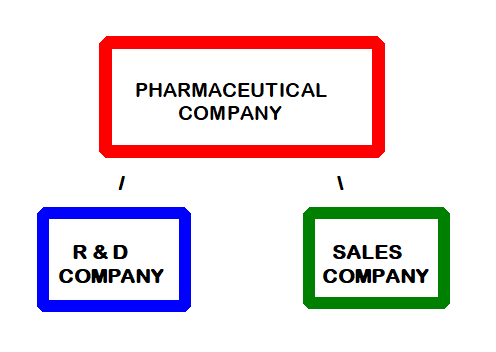
There would be no profit motive for the Research & Development of new drugs, because the current drugs would provide infinite profits.
Government price-setting is a risky business. It often has the opposite results from what one would hope. Rent controls are a perfect example.
Limit rents, and landlords will refuse to maintain or upgrade apartments.
Costly, time-consuming, not itself profitable.
Limit profits, and fewer people will become doctors; fewer hospitals will upgrade ; fewer new drugs will be created; fewer patients will be served.
Solution #2 also has problems. It too would not provide the profits needed for the Research & Development of new drugs, especially drugs for rare diseases and low-profit categories (anti-biotics, for example).
Sincethe Orphan Drug Actwas signed into law in 1983, the FDA has approved hundreds of drugs for rare diseases, but most rare diseases do not have FDA-approved treatments.
The FDA works with many people and groups, such as patients, caregivers, and drug and device manufactures, to support rare disease product development.
In one sense, Medicare already does #2.
Without negotiation, it sets the healthcare prices it is willing to pay, on a take-it or leave-it basis with healthcare practitioners.
That policy has generated the “concierge doctor” system. For annual fees, primary care (usually) doctors can limit their practices to a manageable 600-800 patients, allowing plenty of time to devote to each patient.
This compares with the more typical 2500+ patient load, characterized by quick, robotic diagnoses, treatments, then on-to-the-next.
There is a commonality to the problem of all federal price setting. It doesn’t pay for improvements.
When rents are controlled, landlords don’t maintain or upgrade. When doctor’s fees are controlled, doctors are not rewarded for being better doctors. They are not rewarded for doing the daily “R&D” to keep themselves up to date with the latest procedures. Nor are they rewarded for taking more time with patients.
When the primary reward is numbers sold — how many apartments, how many patients, how many sales — hospitals, convalescent homes, pharmaceutical companies, etc. are rewarded for more, but not for better.




 THEORY II. Federal Spending is Unsustainable. For this, we turn to our favorite conspiracy theorist:




 #Monetary Sovereignty - Mitchell