The Federal Insurance Contributions Act (FICA) tax supposedly funds two major programs:
Social Security provides benefits for retirees, disabled individuals, and survivors of deceased workers. It’s designed to offer a safety net for individuals who can no longer work.
Medicare provides health insurance for people 65 and older and for some younger people with disabilities. It helps cover hospital care, medical services, and, in some cases, prescription drugs.
Great news! You can take money from your right-hand pocket and put it in your left. Think of it as a gift from me.
That is what you are supposed to believe.
Unfortunately, FICA funds nothing. That is because of Monetary Sovereignty. All FICA dollars are destroyed upon receipt by the Treasury.
They begin in the M2 money supply measure, but upon arrival at the Treasury, they cease to be part of any money supply measure. Effectively, they are destroyed.
Due to the misinformation and disinformation you have been given, many bad things have happened to your Social Security and Medicare. Here are just a few:
1. Trust Fund Shortfalls: The Social Security and Medicare “Trust Funds” are not real trust funds. They are merely balance sheets showing additions and subtractions. Congress controls them totally and can change the numbers at will.
Their sole “purpose” (if one can label it a purpose) is to make you falsely believe you should accept smaller benefits. The trust funds and FICA were created and exist only to limit your benefits.
2. Demographic Changes: The government says that an aging population is causing more people to draw benefits while fewer workers are paying into the system.
While those facts are true, they lead to the lie that Social Security and Medicare are running short of money. Your FICA dollars do not fund Social Security or Medicare, and the “trust funds” do not pay for benefits.
The FICA receipts are recorded as accounting credits and combined with other Treasury receipts. The federal government owns the accounts and can unilaterally raise or lower collections and expenditures.
All Social Security and Medicare benefits are funded by creating new money, which the federal government can do endlessly.
3. Increase in Full Retirement Age (FRA): The Social Security FRA has been increased from 65 to 67 for those born in 1960 or later. This means people have to wait longer to receive full benefits.
4. Higher Earnings Subject to Social Security Tax: The maximum income subject to Social Security tax has been increased over the years.
5. Higher Medicare Premiums: Larger Medicare premiums are deducted from Social Security checks for most retirees.
6. Up to 85% of your SS benefits are subject to income tax. You giveth via FICA and the government taketh — and then taketh again via income tax.
Sorry, kids, but I’m running out of money. I’ll have to cut your benefits.
7. At most, Medicareonly pays 80% of your costs while paying reduced fees to doctors and hospitals. (Have you noticed that doctors and hospitals always receive less than they bill?)
In short, you and your medical team receive less than you should.
While all of the above are financially unnecessary and based on the false premise that federal spending is funded by taxes (like state government spending is), at least they are apparent.
People can see that they receive fewer net dollars from the government.
The following is the worst because it looks like a benefit but isn’t:
8. The Inflation Reduction Act (IRA) allows Medicare to negotiate prices for certain high-cost drugs under Medicare Part B and Part D
These drugs treat conditions like heart disease, diabetes, and cancer. The negotiations are projected to save Medicare beneficiaries $1.5 billion in out-of-pocket costs when the new prices take effect in 2026.
Sounds great? It’s supposed to.
Now, think about it. Where will the money come from?
Numbers 1 through 7 obviously take dollars from the private sector, otherwise known as “the economy,” and transfer them to the government, which neither needs nor uses them.
The government already has infinite dollars. When it spends dollars, it simply passes a law and creates new ones. It can do this endlessly at no cost other than pressing a computer key.
Former Fed Chairman Alan Greenspan: “A government cannot become insolvent with respect to obligations in its own currency. There is nothing to prevent the federal government from creating as much money as it wants and paying it to somebody. The United States can pay any debt it has because we can always print the money to do that.”
Former Fed Chairman Ben Bernanke:“The U.S. government has a technology, called a printing press (or, today, its electronic equivalent), that allows it to produce as many U.S. dollars as it wishes at essentially no cost. It’s not tax money… We simply use the computer to mark up the size of the account.”
Let me get this straight. Do you really believe I have Trust Funds, and they are running short of dollars???
Fed Chairman Jerome Powell:“As a central bank, we have the ability to create money digitally.”
St. Louis Fed:“As the sole manufacturer of dollars, whose debt is denominated in dollars, the U.S. government can never become insolvent, i.e., unable to pay its bills. In this sense, the government is not dependent on credit markets to remain operational.”
Number 8, which masquerades as a benefit to the private sector, is just a transfer of dollars from one part of the economy (the people who work for pharmaceutical companies) to another (the people who pay FICA).
No new dollars are created, which means no new benefits are created. The government forces one part of the economy to pay another and claims it is providing you with a benefit.
Even worse, the charade supports the false belief that federal spending is funded by federal taxes, specifically the lie that FICA funds SS and Medicare.
It is akin to the lie that your employer pays half of FICA, when in fact, you pay all of it.
Your employer includes the cost of FICA when determining your salary. That is why employers love to classify workers as “independent contractors.”
It allows them to pay higher salaries at less cost.
One day, probably not during my lifetime, the American public will understand that federal government financing differs from state/local government financing.
The former is Monetarily Sovereign. The latter is monetarily non-sovereign. If you don’t know the difference, you don’t understand federal government finance. Click this link to begin understanding.
The people have not been informed that federal taxes fund nothing and that the government pays for everything by creating new dollars ad hoc.
So what is the purpose of federal taxes if not for funding spending? Read this.
The people need to be informed that the government has 100% control over the U.S. dollar it invented. It can give dollars any value (inflation). Historically, it has often arbitrarily changed the value of the dollar.
It can pay for anything, no matter how many dollars are needed.
Yes, the federal government could pay for comprehensive, no-deductible, free Medicare for every man, woman, and child in America. And yes, it could pay everyone a free Social Security benefit, eliminating poverty, homelessness, illiteracy, hunger, and inequality in America.
And yes, it could pay to make America, as the Bible said, “. . . the light of the world. A city set on a hill . . . .”
And it could do it all without collecting a penny in taxes.
So long as you accept the lies, you will continue to be like cattle grunting and mooing toward the slaughter.
And sadly, I can’t see that changing during my few remaining years.
Rodger Malcolm Mitchell
Monetary SovereigntyTwitter: @rodgermitchellSearch #monetarysovereigntyFacebook: Rodger Malcolm Mitchell;MUCK RACK: https://muckrack.com/rodger-malcolm-mitchell; https://www.academia.edu/
……………………………………………………………………..
The Sole Purpose of Government Is to Improve and Protect the Lives of the People.
The purpose has been to demonstrate how, year after year, so-called experts claim the U.S. is about to enter catastrophe because federal debt is “too high,” while the experts are proven wrong year after year. The economy grows and grows and is healthier than ever.
I’ve been doing this for over 20 years; the experts have been wrong for over 80 years, and they never seem to learn. While I find it frustrating, I’ve tried to remain civil and merely recite the facts. But now, as I near my 90th year, and the road ahead is short, I’ve grown impatient with civility, and I’ve decided to call it like it is: BULLSHIT.
What finally set me off is a BULLSHIT tweet (or whatever “X” calls them now), from the richest man in the world, who, despite his great wealth, seems to know diddly-squat about federal finance:
It was published today shortly after an equally BULLSHIT article titled, US “debt bomb” ticking louder by Nick Beams 10 October 2024, which is summarized at the end of this post.
No Elon, the U.S. federal government, being Monetarily Sovereign, cannot go bankrupt. Even if tax collections fell to $0, and spending tripled, the federal government could continue to pay all its bills, forever.
The U.S. federal government is not like state/local governments, not like euro governments, not like businesses, and not like you and me.
It is uniquely Monetarily Sovereign. It cannot, unwillingly, run short of its own sovereign currency, the U.S. dollar. As real experts have said:
Former Federal Reserve Chairman Alan Greenspan: “A government cannot become insolvent with respect to obligations in its own currency. There is nothing to prevent the federal government from creating as much money as it wants and paying it to somebody. The United States can pay any debt it has because we can always print the money to do that.”
Former Fed Chairman Ben Bernanke: “The U.S. government has a technology, called a printing press (or, today, its electronic equivalent), that allows it to produce as many U.S. dollars as it wishes at essentially no cost. It’s not tax money… We simply use the computer to mark up the size of the account.”
Statement from the St. Louis Fed: “As the sole manufacturer of dollars, whose debt is denominated in dollars, the U.S. government can never become insolvent, i.e., unable to pay its bills. In this sense, the government is not dependent on credit markets to remain operational.”
Press Conference: Mario Draghi, President of the Monetarily Sovereign ECB, 9 January 2014 Question: can the ECB ever run out of money? Mario Draghi: Technically, no. We cannot run out of money.
Because the U.S. federal government has the infinite ability to create its sovereign currency, the U.S. dollar, it never borrows dollars.
Contrary to popular wisdom, T-bills, T-notes, and T-bonds do not represent borrowing. They simply are deposits, the purpose of which is to provide a safe place to store unused dollars and to help the Fed control interest rates.
The government never touches those dollars, which remain the property of the depositors. Not only can our Monetarily Sovereign government not run short of dollars, but federal deficits are necessary to grow the economy, as evidenced by the formula: GDP = Federal Spending + Nonfederal Spending + Net Exports.
When we don’t have sufficient federal deficits, we have depressions and recessions:
1804-1812: U. S. Federal Debt reduced 48%. Depression began 1807.
1817-1821: U. S. Federal Debt reduced 29%. Depression began 1819.
1823-1836: U. S. Federal Debt reduced 99%. Depression began 1837.
1852-1857: U. S. Federal Debt reduced 59%. Depression began 1857.
1867-1873: U. S. Federal Debt reduced 27%. Depression began 1873.
1880-1893: U. S. Federal Debt reduced 57%. Depression began 1893.
1920-1930: U. S. Federal Debt reduced 36%. Depression began 1929.
1997-2001: U. S. Federal Debt reduced 15%. Recession began 2001.
Periodically, we publish yet another shrieking claim that the U.S. federal debt is “unsustainable”and a “ticking time bomb.”
This lie has been told to you every year (really, almost every day) since 1940, and that bomb has never exploded, nor will it.
Rather than repeat the entire list of the thousands of lies to which you have been subject, I will list samples here as a reference and add periodically, at the end, new “federal debt is a ticking time bomb“BULLSHIT as I encounter them.
Read these and see that even respected economists replace facts with BULLSHIT:
September 26, 1940, New York Times: The federal budget was a “ticking time-bomb which can eventually destroy the American system,” said Robert M. Hanes, president of the American Bankers Association.
By 1960, the debt was “threatening the country’s fiscal future,” said Secretary of Commerce Frederick H. Mueller. (“The enormous cost of various Federal programs is a time-bomb threatening the country’s fiscal future, Secretary of Commerce Frederick H. Mueller warned here yesterday.”)BULLSHIT
In 1984: AFL-CIO President Lane Kirkland said. “It’s a time bomb ticking away.”BULLSHIT
In 1985: “The federal deficit is a ticking time bomb, and it’s about to blow up,” U.S. Sen. Mitch McConnell. (Remember him?)BULLSHIT
Later in 1985: Los Angeles Times: “We labeled the deficit a ‘ticking time bomb‘ that threatens to permanently undermine the strength and vitality of the American economy.”BULLSHIT
In 1987: Richmond Times-Dispatch – Richmond, VA: “100TH CONGRESS FACING U.S. DEFICIT’ TIME BOMB‘”BULLSHIT
Later in 1987: The Dallas Morning News: “A fiscal time bombis slowly ticking that, if not defused, could explode into a financial crisis within the next few years for the federal government.”BULLSHIT
In 1989: FORTUNE Magazine: “A TIME BOMB FOR U.S. TAXPAYERS“BULLSHIT
In 1992: The Pantagraph – Bloomington, Illinois: “I have seen where politicians in Washington have expressed little or no concern about this ticking time bomb they have helped to create, that being the enormous federal budget deficit, approaching $4 trillion.“BULLSHIT
Later in 1992, Ross Perot said, “Our great nation is sitting right on top of a ticking time bomb. We have a national debt of $4 trillion.”BULLSHIT
In 1995: Kansas City Star: “Concerned citizens. . . regard the national debt as a ticking time bombpoised to explode with devastating consequences at some future date.”BULLSHIT
In 2004: Bradenton Herald: “A NATION AT RISK: TWIN DEFICIT A TICKING TIME BOMB” BULLSHIT
In 2005: Providence Journal: “Some lawmakers see the Medicare drug benefit for what it is: a ticking time bomb.” BULLSHIT
In 2006: NewsMax.com, “We have to worry about the deficit . . . when we combine it with the trade deficit, we have a real ticking time bomb in our economy,” said Mrs. Clinton. BULLSHIT
In 2007: USA Today: “Like a ticking time bomb, the national debt is an explosion waiting to happen.” BULLSHIT
In 2010: Heritage Foundation: “Why the National Debt is a Ticking Time Bomb. Interest rates on government bonds are virtually guaranteed to jump over the next few years. BULLSHIT
In 2010: Reason Alert: “. . . the time bomb that’s ticking under the federal budget like a Guy Fawkes’ powder keg.” BULLSHIT
In 2011: Washington Post, Lori Montgomery:”. . . defuse the biggest budgetary time bombs that are set to explode.” BULLSHIT
June 19, 2013: Chamber of Commerce: Safety net spending is a ‘time bomb’, By Jim Tankersley: The U.S. Chamber of Commerce is worried that not enough Americans are worried about social safety net spending. The nation’s largest business lobbying group launched a renewed effort Wednesday to reduce projected federal spending on safety-net programs, labeling them a “ticking time bomb” that, left unchanged, “will bankrupt this nation.” BULLSHIT
On June 15, 2014: CBN News: “The United States of Debt: A Ticking Time Bomb” BULLSHIT
On January 27, 2017: America’s “debt bomb is going to explode.” That’s according to financial strategist Peter Schiff. Schiff said that while low interest rates had helped keep a lid on U.S. debt, it couldn’t be contained for much longer. Interest rates and inflation are rising, creditors will demand higher premiums, and the country is headed “off the edge of a cliff.” BULLSHIT
February 16, 2018 America’s Debt Bomb By Andrew Soergel, Senior Reporter: Conservatives and deficit hawks are hurling criticism at Washington for deepening America’s debt hole. BULLSHIT
April 10, 2019,The National Debt: America’s Ticking Time Bomb. TIL Journal. Entire nations can go bankrupt. One prominent example was the *nation of Greece which was threatened with insolvency a decade ago. Greece survived the economic crisis because the European Union and the IMF bailed the nation out. BULLSHIT
SEP 12, 2019, Our national ticking time bomb, By BILL YEARGIN SPECIAL TO THE SUN SENTINEL | At some point, investors will become concerned about lending to a debt-riddled U.S., which will result in having to offer higher interest rates to attract the money. Even with rates low today, interest expense is the federal government’s third-highest expenditure following the elderly and military. The U.S. already borrows all the money it uses to pay its interest expense, sort of like a Ponzi scheme. Lack of investor confidence will only make this problem worse. BULLSHIT
JANUARY 06, 2020, National debt is a time bomb, BY MARK MANSPERGER, Tri City Herald | The increase in the U.S. deficit last year was about $1.1 trillion, bringing our total national debt to more than $23 trillion! This fiscal year, the deficit is forecasted to be even higher, and when the economy eventually slows down, our annual deficits could be pushing $2 trillion a year! This is financial madness. there’s not going to be a drastic cut in federal expenditures — that is, until we go broke — nor are we going to “grow our way” out of this predicament. Therefore, to gain control of this looming debt, we’re going to have to raise taxes. BULLSHIT
February 14, 2020, OMG! It’s February 14, 2020, and the national debt is still a ticking time bomb! The national debt: A ticking time bomb?America is “headed toward a crisis,” said Tiana Lowe in WashingonExaminer.com. The Treasury Department reported last week that the federal deficit swelled to more than $1 trillion in 2019 for the first time since 2012. Even more alarming was the report from the bipartisan Congressional Budget Office (CBO) predicting that $1 trillion deficits will continue for the next 10 years, eventually reaching $1.7 trillion in 2030 BULLSHIT
August 29, 2020, LOS ANGELES, California: America’s mountain of debt is a ticking time bomb The United States not only looks ill, but also dead broke. To offset the pandemic-induced “Great Cessation,” the U.S. Federal Reserve and Congress have marshalled staggering sums of stimulus spending out of fear that the economy would otherwise plunge to 1930s soup kitchen levels. Assuming that America eventually defeats COVID-19 and does not devolve into a Terminator-like dystopia, how will it avoid the approaching fiscal cliff and national bankruptcy? BULLSHIT
April 16, 2021, NATIONAL POLICY: ECONOMY AND TAXES / MARK ALEXANDER / The National Debt Clock: A Ticking Time Bomb: At the moment, our national debt exceeds $28 TRILLION — about 80% held as public debt and the rest as intragovernmental debt. That is $225,000 per taxpayer. Federal annual spending this year is almost $8 trillion, and more than half of that is deficit spending — piling on the national debt. BULLSHIT
Now, the national debt is approaching $31 trillion,which is $12 trillion more than when Donald Trump took office in 2017 and more than half of that debt was tacked on in his final year. Then we’ve had the disastrous year and a half of Joe Biden. Now, the Fed is now hiking its rates and that spells even more trouble for the national debt and the economy at large. BULLSHIT
December 4, 2022 America’s ticking time bomb: $66 trillion in debt that could crash the economy By Stephen Moore, The national debt is $31 trillion when including Social Security’s and Medicare’s unfunded liabilities. Wake up, America. BULLSHIT
That ticking sound you’re hearing is the American debt time bomb that with each passing day is getting precariously close to detonatingand crashing the US economy. BULLSHIT
With the U.S. reaching its debt limit of $31.4 trillion on Jan. 19, Treasury Secretary Janet Yellen urged lawmakers to increase or suspend the debt ceiling. BULLSHIT
April 22, 2023The Debt Ceiling Debate Is About More Than Debt, Jim Tankersley, WASHINGTON — Speaker Kevin McCarthy of California has repeatedly said that he and his fellow House Republicans are refusing to raise the nation’s borrowing limit,and risking economic catastrophe, to force a reckoning on America’s $31 trillion national debt. “Without exaggeration, America’s debt is a ticking time bomb that will detonate unless we take serious, responsible action,” he said this week. BULLSHIT
November 3, 2023 The Fuse on America’s Debt Bomb Just Got Shorter,J Antoni Heritage Organization. The Treasury is now on track to borrow almost as much in just six months as it did in the previous 12 months. That’s nearly a doubling of the deficit. Because the federal debt is $33.7 trillion, just a 1 percent increase in yields adds $337 billion to the annual cost of servicing the debt over time. Absent spending reform, eventually no one will be willing to hold the bomb anymore, and the yields on U.S. debt will begin to resemble those in Argentina. BULLSHIT
February 2, 2024How Florida can help defuse the nation’s debt bomb By BARRY W. POULSON,professor emeritus of economics at the University of Colorado Boulder and DAVID M. WALKER,former comptroller general of the United States. Washington’s out-of-control spending, combined with fiscal and monetary policies have resulted in trillion-dollar-plus annual deficits, over $34 trillion in federal debt, over $125 trillion in total federal liabilities and unfunded obligations, and excess inflation. Excessive spending and loose monetary policy increase inflation in the short term, and mounting debt burdens serve to reduce future economic growth and shift the economic burden and consequences of mounting debt burdens to future generations. BULLSHIT
February 8, 2024Legendary investor Paul Tudor Jones says a ‘debt bomb’ is about to go off in the U.S.: ‘We’re fast-pouring consumption like crazy’. The U.S. economy may seem like it’s firing on all cylinders, but underneath the surface, a “debt bomb” could be on the verge of exploding, according to billionaire hedge fund manager Paul Tudor Jones. The esteemed investor said in an interview with CNBC that he couldn’t deny the economy was strong, but that it was actually “on steroids” due to massive government spending and borrowing. BULLSHIT
Jones is not the only one to call attention to the growing deficit issue in the U.S. On Sunday, Federal Reserve Chairman Jerome Powell took a rare dive into politics, telling CBS’s 60 Minutes that the national debt was “growing faster than the economy,” and calling for lawmakers to get the federal government “back on a sustainable fiscal path.” Meanwhile, U.S. Treasury Secretary Janet Yellen has said she is not yet worried about the increasing national debt as long as the government keeps in check the net payments it makes on its debt relative to GDP. BULLSHIT
Those payments are projected to rise from 2.5% last year to 2.9% next year, according to the Office of Management and Budget—below their level in the early 1990s. Jones told CNBC that the strong economy could postpone the effects of the government’s deficit spending, but only for a little while. “The only question is … when does that manifest itself in markets?” he added. BULLSHIT
“It could be this year, it could be next year. Productivity may mask and it might be three or four years from now. But clearly, clearly we’re on an unsustainable path.” BULLSHIT
June 21, 2024 My Weekly Column: Our debt crisis is a ticking time bomb by Randy Feenstra: On June 18th, the nonpartisan Congressional Budget Office (CBO) – the government agency tasked with monitoring our nation’s fiscal health – confirmed my serious concerns with President Biden’s reckless spending agenda. BULLSHIT
His administration’s fiscal policies have not only caused cumulative inflation to skyrocket by over 20% since he took office, but they have also accelerated our accumulation of debt to levels that are beyond unsustainable. Instead of changing course, he recently released his budget for Fiscal Year 2025, which has a $ 7.3 trillion price tag and looks to raise taxes on our families, farmers, and businesses to the tune of $5.5 trillion. BULLSHIT
The CBO estimates that his debt “cancelation” policies will cost taxpayers nearly $400 billion over the next ten years. I strongly oppose these bailouts. Iowans who never attended college entered the workforce early or helped put their kids through school should not be forced to pick up the tab for President Biden’s costly and unfair executive orders. BULLSHIT
July 22, 2024Federal debt is the ticking bomb in your wallet By E.J. Antoni a public finance economist and the Richard F. Aster fellow at the Heritage Foundation, and a senior fellow at Unleash. The federal government is already running $2 trillion annual deficits, driving up interest on the debt exponentially. The time bomb of federal finance has already started ticking down. BULLSHIT
October 10, 2024 U.S. Debt Bomb is ticking louder by Nick Beams, World Socialist Website. The immediate economic question is: when will the rise in US government debt give rise to a crisis for the US dollar, a major meltdown in the market for debt, the Treasury bond market, or some other area of the financial system? Government debt is now heading towards $36 trillion and increasing at a pace which is regarded as “unsustainable” by Federal Reserve chair Jerome Powell, along with many others. BULLSHIT
May 30, 2025 DEFICIT DANGER. BOJ governor warns US debt time bomb outweighs trade war risks. By Dashan Hendricks. BANK of Jamaica (BOJ) governor Richard Byles has issued a stark warning that America’s spiralling budget deficits now present a more severe danger to the global economy than ongoing trade conflicts, as the world’s largest economy grapples with its third credit rating downgrade since 2011.His comments follow Moody’s recent decision to cut the US government’s credit rating from its top-tier Aaa to Aa1, citing concerns over its US$36-trillion debt burden — which now exceeds the nation’s US$30 trillion GDP. BULLSHIT
———————–//———————–
The above articles contain the same old BULLSHIT (“unsustainable,” “cost taxpayers”) that they’ve been telling since 1940. To buttress their lies, they make false comparisons to family finances or the finances of other monetarily nonsovereign entities like businesses or euro nations.
They have been wrong, repeatedly wrong, for all those years. If we wait long enough, something will happen to prove them right, perhaps in a thousand years?
Today, this makes “only” 84 years of the debt nuts’ BULLSHIT.
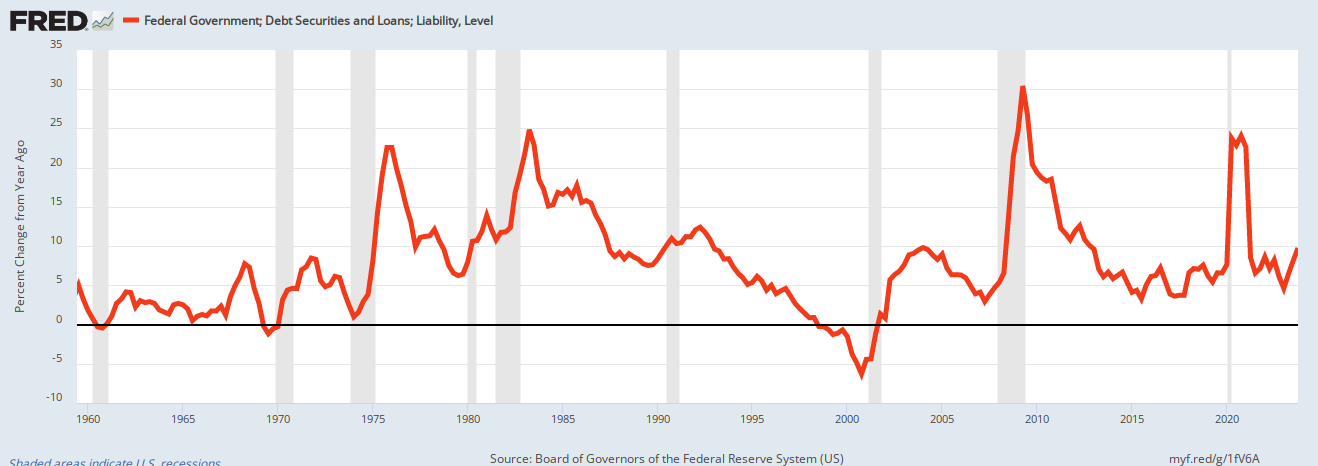
The federal deficit yields economic growth year after year. When deficits are insufficient, we have had recessions, which were cured by increased deficits.
When deficits decline, we have recessions (vertical gray bars), which are cured by increased deficits.
If respected economists keep predicting something terrible is imminent year after year, yet exactly the opposite happens, at what point do they reexamine their beliefs?
At what point does the public say, “Fool me once; shame on you. Fool me repeatedly for 84 years; shame on me.This is just a steaming pile of BULLSHIT“?
Whew, I feel a little better, now — but just a little.
The Sole Purpose of Government Is to Improve and Protect the Lives of the People.
MONETARY SOVEREIGNTY
(Ever wonder why federal spending cuts demanded by debt nuts are designed to widen the income/wealth/power Gap between the rich and the rest, while the few federal spending increases they want are designed to reward and protect the rich?)
The question, “What is consciousness?” has been called a “hard problem” because consciousness is difficult to identify, define,measure, categorize, and locate in the brain.
Some people use the word “awareness,” thinking they have answered the question, but awareness is just a synonym that merely shifts the question to “What is awareness.”
For centuries, philosophers and physical scientists have debated the possible consciousness of entities such as a sleeping person, an “unconscious” person, a dog, a fish, a bee, a tree, a flower, a bacterium, an electron, a rock, the earth, the universe, a fire, etc.
Some claim consciousness only occurs in a brain or nerves, definitions that omit the awareness of trees to pathogens, and the signals trees give and receive when attacked by diseases, bugs, and even humans.
I suggest that if we argue about something, we at least should be able to identify the thing we’re arguing about, and not give it a vague, non-specific, moving-target identity, that will cause further confusion.
Free will
In previous posts — Is A Rock Conscious, What is the Measure of Consciousness? and Be more creative and exercise your brain by working the so-called “hard problems,” — we describe consciousness as the perception of, and the reaction to, stimuli.Everything perceives and reacts to stimuli, and this perception and reaction can be measured. No mystical, magical, “my-intuition-is-better-than-your-ition” silliness.
It’s perception and reaction. They are simple, straightforward, measurable, and comparable among entities.
It’s a definition that allows for discussions about which entities have more consciousness than others, without resorting to the mysticism of the unknowable.
And that brings us to “What is free will.”
It’s become an even harder problem than “What is consciousness” because while consciousness exists,free will doesn’t.
“Free will” is defined as “the ability to act at one’s own discretion,” but “discretion” needs a definition.
I suggest that when people claim they have free will or act at their own discretion, they mean that their discretion is independent of any physical, chemical, or electrical stimulus and is a product of pure reason.
If you have a better definition of free will, please let me know what it is.
Meanwhile, I suggest that free will is an illusion.It does not exist.
You are not the master of your brain. Your brain is the master of you, and its operation is based on its chemistry, electricity, and structure.
That is how you make your choices. Don’t think your choices are made by some mysterious inner voice that somehow is not connected to the cells and chemicals in your brain.
Test your opinion against these thoughts:
1. Does a drunk have “free will”? No, because the artificial chemicals in his brain make him alter his behavior.
2. Does an obese person have difficulty losing weight even when they want to? Yes, the natural chemicals in his cells make him eat more or what he knows he shouldn’t.” Free will?
3. Can fear change your brain chemistry and make you shake, make yourheart pump, and make youforget what you wanted to say? Free will?
I try and try, but I just can’t get to sleep.
4. Have you ever experienced a so-called “earworm,” a song that makes youkeep humming it, even when you would like to forget it. Free will?
5. Is it free will that makes youtoss and turn and stay awake when you are worrying but desperately want to sleep? Free will?
6. Addiction and substance dependence hijacks the brain’s reward system and makes you demand more and more. Free will?
7. Phobias: Irrational fears control your behavior, making you do things you otherwise wouldn’t do. Free will?
8. Obsessive-Compulsive Disorder: Compulsions make you do things beyond your control. Free will?
15, Medication Side Effects: Drugs can alter mood and behavior, impacting decisions. Free will?
Free will? “Yes master,”
16. Social Conditioning: Lifelong habits and beliefs formed by society influence choices. Free will?
In each case I have bolded words (“make,” “involuntary, “cause,” “overpower,” “impact,” “affect,” “disrupt,” “alter,” and “influence”) to indicate changes of your decisions and your actions against your free will.
These examples illustrate how brain chemistry and external factors often override what we perceive as free will.
Stop for a moment and try to think about all your decisions, actions, preferences and beliefs that are based strictly on your free will, and not in opposition.
How often have you used words indicating your lack of free will? I couldn’t help myself getting angry. I simply had to eat that cake. I knewit was dumb to buy that dress, but I did it anyway.
Your decision-making is not based on magic. It is based on the chemicals, electrical signals, and physical structureof your brain. If you are smart, you will make better decisions than if you are not. But what makes you bright?
As you age from newborn to child, teenager to adult, and elderly, you’re still the same human being, and you still feel you have free will. But your brain chemistry and structure change, along with your experiences and your desires.
In old age, why do you look back and think of the stupid things you did as a teenager? Why did you do them? Your desires were affected by your brain’s chemicals, electrical signals and physical structure, all of which change daily.
The phrase, “I don’t feel like it, today” — we all have said it on occasion — but why don’t we feel like it today, but did feel like it yesterday? Perhaps it’s your hormones that are making decisions for you:
Cortisol is released in response to stress. Prolonged high levels can lead to memory issues and mooddisorders.
Thyroid Hormones are vital for brain development and function. They regulate metabolism and are crucial for cognitive processes..
Estrogen and Testosterone influence brain regions involved in learning, memory, sexual behaviors, and emotion processing.
Melatonin regulates the sleep-wakecycle and is important for maintaining circadian rhythms
Serotonin plays a key role in mood regulation, sleep, and appetite.
Dopamine is involved in reward, motivation, and motor control. Imbalances can be linked to schizophrenia.
Ghrelin and Leptin regulate hunger and satiety, influencing eating behaviors and energy balance
I know this is stupid, but . . .
Any changes in any of these hormones and you will think and act differently?
See:Hormones Affect Our Physiology and BehaviorParents often blame their teenager’s unpredictable behavior on hormones, but those molecules play a crucial role in the brain. Neurons can quickly deliver the brain’s messages to precise targets in the body. Hormones, on the other hand, deliver messages more slowly but can affect a larger set of tissues, producing large-scale changes in metabolism, growth, and behavior.The brain is one of the tissues that “listens” for hormonal signals — neurons throughout the brain are studded with hormone receptors — and the brain’s responses play an important part in regulating hormone secretion and changing behaviors to keep body systems in equilibrium.
Have you ever heard the term amygdala hijack“?
Psychologist Daniel Goleman first used the term “amygdala hijacking” in his 1995 book “Emotional Intelligence: Why It Can Matter More Than IQ.”
It refers to situations wherein the amygdala hijacks control of a person’s ability to respond rationally to a threat. This leads to the person reacting in an intense, emotional way that may be disproportionate to the situation.
Without the ability to use their frontal lobes, people are unable to think clearly, and they are not in control of their responses.
The amygdala triggers the release of hormones as part of the fight-or-flight reaction to a threat.
Fight-or-flight response
Amygdala hijack takes place when the structure triggers the fight-or-flight reaction when it is not warranted. The person is then unable to come to their own rational conclusionabout how to react.
The amygdala causes the adrenal glands to release the hormones adrenaline and cortisol. Adrenaline causes the air passages in the body to dilate. This allows the body to supply more oxygen than usual to the muscles.
This hormone also causes the blood vessels to contract, allowing the body to redirect blood to the major muscle groups, including the heart and lungs.
The release of adrenaline also causes the pupils to dilate, thereby enhancing a person’s vision.
During the fight-or-flight response process, the body also increases its blood sugar levels in order to increase energy levels.
All of these reactions allow a person to fight the danger more effectively or to flee from it if necessary.
During amygdala hijack, a person may react in a way that they could regret later. This may include being aggressive, argumentative, or violentin a manner that is dramatically out of proportion to the situation.
When I attend a scary movie, and a monster leaps into a close-up, I involuntarily jump and my heart races. When I view a sex scene, I may be aroused. A chase scene might make my heart beat faster. A sad scene might depress me. All of this is automatic and involuntary.
Do you still think you have Free Will?
Monetary SovereigntyTwitter: @rodgermitchellSearch #monetarysovereigntyFacebook: Rodger Malcolm Mitchell;MUCK RACK: https://muckrack.com/rodger-malcolm-mitchell; https://www.academia.edu/
……………………………………………………………………..
The Sole Purpose of Government Is to Improve and Protect the Lives of the People.
There are two ways to exercise your brain: Learning factsand/or solving problems.
CONSCIOUSNESS
In the sciences, and especially in philosophy, many problems are known as “hard problems.”
You may think of philosophy as mere speculation about speculation, and to some degree, you may be right.
But speculating can teach you how to uncover essential truths that otherwise would remain hidden.
This post will touch on my speculations about uniting a few “hard problems” with solutions that involve consciousness, time and reality.
Perhaps you’ll find the process itself can help stir your creative abilitiesregarding all problems.
The Hard Problem of Consciousness
The posts “Is a rock conscious?” and “What is the Measure of Consciousness” discuss the meanings of consciousness.
If you haven’t already, it might help to read them now as an introduction to this post. Just a suggestion.
Here is what Wikipedia says about the hard problem of consciousness:
The terms “hard problem” and “easy problems” were coined by the philosopher David Chalmers. In the philosophy of mind, the hard problem of consciousness is to explain why and how humans and other organisms have subjective experiences.It is contrasted with the “easy problems” of explaining why and how physical systems give a (healthy) human being the ability to discriminate, to integrate information, and to perform behavioral functions such as watching, listening, speaking (including generating an utterance that appears to refer to personal behaviour or belief), and so forth.The easy problems are amenable to functional explanation—that is, explanations that are mechanistic or behavioral—since each physical system can be explained (at least in principle) purely by reference to the “structure and dynamics” that underpin the phenomenon.
Chalmers and possibly most philosophers believe consciousness goes beyond being a chemical, physical, or molecular phenomenon but includes various metaphysical concepts, like “mind” and “inner life,” and even a religious concept like the soul.
That’s what makes them “hard.” There seem to be no physical sources.
By way of illustration, we know why your laptop computer can “discriminate, integrate information, and perform behavioral functions.” Those are all electro-mechanical processes that humans build into the machine. Your laptop can compute maths because we know how to make it that way.
But so far, your laptop doesn’t appear to have “subjective experiences”—emotions or desires—and we don’t know why or how to build one that does. It’s a “hard problem.”
My AI, Copilot, answered the question, “How can you prove you are not conscious?” this way:
“My responses are generated through pattern recognition and data processing, not through any conscious thought or feeling. I don’t have self-awareness.“My ‘self-awareness’ is more about recognizing patterns and generating relevant responses based on those patterns, rather than any true consciousness or subjective inner life.“I don’t have personal experiences and feelings, like how you experience joy or sadness. ‘Inner life’ refers to the thoughts, emotions, and self-awarenessthat humans experience internally.A HARD PROBLEM“If I did have a subjective inner life, by definition, it would be private and possibly imperceptible even to me. “
In the abovementioned posts, I claim that a “hard problem” is merely a matter of semantics.
At some point, philosophers and lay people, too, have decided there is a non-physical, almost mystical thing called a “subjective inner-lifeexperience” that cannot be explained chemically or physically.
We know, for instance, how an emotion manifests with blood pressure and other physical changes.
But we don’t understand the “subjective” part.
Where in a computer would a subjective inner life reside, and how would we recognize it? Where in a human brain is it created, if it’s in the brain at all?
In short, the problem is “hard” because we have phrased solutions with impossible criteria.
Consciousness is an ambiguous term. It can be used to mean self consciousness, awareness, the state of being awake, and so on. Chalmers uses Thomas Nagel’s definition of consciousness: “the feeling of what it is like to be something.” Consciousness, in this sense, is synonymous with experience.
By denying that consciousness has any physical source and is just a vague “feeling,” we eliminate all possible explanations. What is a “feeling”? What is a “subjective experience”?
My response, which is given in the two mentioned posts, is that the term “consciousness” itself is presented as an anthropomorphic, magical, mysterious fog, impossible to define, much less to measure, when it can actually can be described in straightforward physical terms.
I. “WHAT IS CONSCIOUSNESS?”Consciousness is the perception of, and response to, stimuli.
You can measure perception and response. To do so, create a graph or table showing perceived stimuli and responses. This graph would describe consciousness and measure “feeling.”
Since everything from the nucleus of an atom to a galaxy and, indeed, the entire universe receives stimuli and responds to them, the definition answers the “hard” questions like:
-Is a sleeping person conscious
-Is an “unconscious” person conscious?
-Is a dog conscious?
-Is a fish conscious?
-Is a bee conscious?
-Is a tree conscious?
-Is a flower conscious?
-Is a bacterium conscious?
-Is an electron conscious?
-Is a rock conscious?
-Is the earth conscious?
-Is the universe conscious?
-Is a fire conscious?
The answer is “Yes” to all.
They all perceive and respond to stimuli. Rock perceives temperature, impacts, sound, and chemicals and reacts to all of them—as does fire, the universe, and every other one of the above.
The amount of perception and the responses can all be measured and identified. How strong is the impact on the rock and does the rock quiver or shatter?
Consciousness has no magical mystery or mysticism, so there is no need to invent a “subjective inner life.”Consciousness is the perception of, and response to, stimuli. Try answering the above questions with any other definitions of consciousness you have heard, and you probably will fail because your criteria will fail you.
You will not be able to draw a bright line between consciousness and non-consciousness (which is different from “unconsciousness”).
The question, “What is consciousness?” is “hard” because we have made semantic assumptionsabout it.
We arbitrarily have decided the word “conscious” equals “aware,” “awake,” “subjective,” “feeling,” “experience,” and other anthropomorphic criteria, and then we claim computers and frogs don’t have it.
In short, everything is conscious—from quarks to universes—the difference being degree. Remember that as we continue.
The next “hard problem” is:
II. “WHAT IS TIME?”TIME
Again, referring to Wikipedia:
Time is the continued sequence of existence and events that occurs in an apparently irreversible succession from the past, through the present, and into the future. It is a component quantity of various measurements used to sequence events, to compare the duration of events or the intervals between them, and to quantify rates of change of quantities in material reality or in the conscious experience.Time is often referred to as a fourth dimension, along with three spatial dimensions.
Relativity and Quantum Mechanics (QM) might disagree. QM says time is reversible in theory. Relativity says duration and intervals are relative to the observer, which means “sequence” cannot be measured.
Consider a photon of light. It has no mass.
If you observe a photon in a vacuum, no matter how fast you are moving, the photon always will appear to move at the same speed, 186,000 miles per second relative to you.
If you could aim a photon at a black hole, you would see it disappear into the black hole at that speed.
An atom has mass. If you could accelerate an atom to light speed and aim it at a black hole, that atom would seem to slow down and eventually freeze on the black hole’s event horizon, never entering. (Ironically, if the atom were moving slower, you would see it move.)
So even if the photon and the atom start out side-by-side, at the speed of light, from your vantage point, they would cease to be side-by-side, with the photon entering the black hole and that atom never entering.
Time constraints like sequence, succession, and duration are not absolutesbut relative to you, the observer. Thus, the name “Relativity.”
In answer to the question, “What is time”? Time is change.
You and I are observers. When I experience time differently than you do, it merely means I experience change differently.
Perhaps I have done nothing more than create a synonym rather than an explanation. But I did notice one parallel with consciousness:
Everything changes, and everything is conscious.
That is a clue. When two seemingly dissimilar concepts- time and consciousness- are similarly affected, we look for a hidden relationship.
The definition of consciousness is perception and response to stimuli. “Response” means “change,” so consciousness is related to time in that they both involve change.
Without change, there can be no response, and without response there can be no consciousness,
If consciousness = change, and time = change, one might conclude that mathematically, not only does consciousness = time, but in fact, consciousness is time.
Where there is consciousness, there is time. Where there is time, there is consciousness. The two cannot be separated. You cannot have one without the other.
The conscious stone exists in time.
Humans have intuitive difficulty with the notion that a mere observer can affect time, but this is a common theme in Relativity and Quantum Mechanics.
From the standpoint of an observer, speed affects time, and speed also affects consciousness. A moving stone will react more slowly to stimuli, as will a moving human or a moving insect.
For example, if you were aboard a spaceship moving at Relativistic speed, you would lose at chess if your opponent was stationary on Earth because your thoughts would slow.
Consciousness =Time = Reality.
The third hard question is:
III. “WHAT IS REALITY?”
Copilot says:
“Scientifically, reality is often defined by what can be observed and measured. In QM, particles potentially exist in multiple states untilthey are observed.”
REALITY
The word “until”shows that reality is time-dependent.
Since observing affects reality, we slide from Rene Descartes’s“I think therefore I am” to “I think therefore it is.”
All things are in a continual state of change, that is, subject to time.
An object exists (reality) only as it is observed (conscious), at a particular state of change (time). This is not illusory.
The object does not “seem” to change.
From the standpoint of an observer, the object really has changed, and every measurement will indicate that change.
In QM, reality is expressed in probabilities. All particles have a range of states determined by probability.
A particle can exist here, here, here, or here, in what is termed a “wave function, determined by probability, until it is observed, at which time one of the “heres” is selected.
Reality is Consciousness (perception + response) at a specific Time (point of change).
While we may seem to agree on many things, your reality differs from mine. Your consciousness differs, and your time differs. Yet both realities are equally valid.
SUMMARYThe statement of a problem often carries assumptions about its solution.A problem can become “hard” when the criteria for solving it are invented to be hard.
So, suppose we insist that the problem, “What is consciousness?” can be solved onlyif it includes a mind, brain, subjective experiences, subjective inner life, emotions, feelings, and self-awareness.
In that case, we arbitrarily have introduced unnecessary anthropomorphic elements into any acceptable answer.
So if I say that a tree is conscious, someone could object that it doesn’t have a “mind, brain, subjective inner life,” etc.
But what says those must be criteria for consciousness? They are arbitrary criteria based on invented rules.
On the other hand, if I say a tree is conscious because it receives and responds to stimuli, those are my criteria. I think they are good criteria, and I know of no law or rule that outlaws them. Based on those criteria, many more things would be considered conscious than with the earlier criteria.
If we assume the answer to “What is time?” requires that time operates separately from consciousness, we further depart from potential solutions.
Quantum Mechanics (QM) teaches that time is relative to an observer, so it clearly is not separate from consciousness.
I suggest that many hard problems can be turned into easy problems with appropriate rephrasing.
The next time you come to a “hard problem” ask, “What are the criteria for a solution?”
Try to imagine the criteria expressed in a way that doesn’t make the solution impossible to achieve.
You can begin with the hard problems, “What is life?” or “Does free will exist?”
Rodger Malcolm Mitchell
Monetary SovereigntyTwitter: @rodgermitchellSearch #monetarysovereigntyFacebook: Rodger Malcolm Mitchell;MUCK RACK: https://muckrack.com/rodger-malcolm-mitchell; https://www.academia.edu/
……………………………………………………………………..
The Sole Purpose of Government Is to Improve and Protect the Lives of the People.