America is in its greatest danger since the Civil War. If the Republican Party has its way, America will cease to exist as a democratic republic and devolve into an agglomeration of individual fighting states and fiefdoms.
Elections are the heart and soul of our democracy. If the people don’t believe an election is honest, a democratic nation disappears.
If you don’t want America to have a democracy or to be the UNITED States of America, Trump’s GOP is the party for you.
Read about the danger here:
Republicans cast doubt on the 2024 election.By Clara Ence Morse, Derek Hawkins and Carson TerBushOctober 23, 2024 at 7:00 a.m. EDTTrump’s and Putin’s AmericaNearly half of Republican candidates for Congress or top state offices have used social media to cast doubt on the integrity of the 2024 election, according to a Washington Post analysis, highlighting a pervasive effort within the GOP to undermine public trust in the vote ahead of Nov. 5.From Nov. 9, 2022, to Oct. 11, at least 236 Republican candidates posted or amplified a range of falsehoods or misinformation about election malfeasance. Many candidates baselessly accused Democrats of trying to sway the election through former president Donald Trump’s court cases or by registering noncitizens to vote. Others falsely likened Vice President Kamala Harris’s nomination to a “coup” or promoted misinformation about voter fraud.Of the 48 percent of Republican candidates who have promoted false or misleading information about the 2024 election about two out of three referenced noncitizen voting in connection with 2024 election fraud, about half referenced Trump’s legal troubles, and almost a quarter discussed Harris’s nomination as a coup, undemocratic or disrespectful to the will of primary voters.The rhetoric, which often parrots Trump’s election-related falsehoods, could help lay the groundwork for Republicans to challenge any election outcome they dislike by alleging the results are tainted or fraudulent.First they burn the books; then they burn your votes.“Even after the horrific sights of January 6, endorsing Trump’s baseless claims about election fraud had become a litmus test for any Republican who hopes to secure political seats,” said Yotam Ophir, an expert on political misinformation at the University at Buffalo. “Leaders cannot govern if the public fails to agree on the importance of facts and evidence, and by endorsing Trump’s election falsehoods, Republicans are breaking away from the values and norms of democracy, without which it cannot survive.”Polling shows that most Americans trust their local and state officials to run fair and reliable elections. But Republican messaging that challenges the legitimacy of elections appears to have resonated with the GOP base, a considerable portion of which wrongly believes that Joe Biden won the 2020 presidential election because of voter fraud.Even though voter fraud is rare — due in part to the layers of verification involved in tallying the results — an overwhelming majority of self-identified Trump supporters said they’re concerned there will be fraud this year, according to a NPR/PBS News/Marist poll this month. That’s compared with less than a third among voters who say they support Harris. A separate poll by Gallup showed trust in the results was sharply divided on party lines, with just 28 percent of Republicans saying they were confident the vote would be counted accurately, compared with 84 percent of Democrats.America without electionsHere are the four main ways in which Republican candidates have tried to cast doubt on the 2024 election:Noncitizen votingRepublicans have long argued that Trump’s criminal and civil cases are a form of election interference orchestrated by Democrats, but as his court proceedings moved to the back burner this year, many turned to noncitizen voting as a way to sow distrust in the election.Nearly a third of Republican candidates — at least 153 — have explicitly linked noncitizen voting to election fraud, making it the largest category examined, according to The Post’s analysis. Their posts generally revolve around the unfounded notion that Democrats are allowing undocumented immigrants into the country and registering them to vote. Trump has made similar baseless accusations in dozens of speeches. Noncitizen voting is illegal in state and federal elections, and research shows it happens rarely.Posting on the issue spiked over the summer as the House considered the Save Act, a bill that would mandate proof of citizenship when registering to vote (the Biden administration and many Democrats opposed the bill, saying it risked disenfranchising eligible voters without adding meaningful protections against noncitizen voting). It also coincided with a flurry of posting about noncitizen voting by billionaire Elon Musk, who owns the social media platform X, formerly known as Twitter. His posts were mentioned or retweeted by dozens of candidates.Notes marked with fact-check provide additional context for the candidates’ social media posts.Republicans are linking noncitizen voting to election fraudGOP’s Americafact-checkThere is no evidence to support the suggestion in the three posts below that noncitizen voting is widespread. Independent research and voter roll reviews by state officials have repeatedly shown that noncitizen voting is rare. Minnesota Gov. Tim Walz, Harris’s running mate, signed a law in 2023 allowing undocumented immigrants to obtain driver’s licenses, saying it would improve safety on the roads, but there is no credible evidence that Walz or other Democrats are seeking to tilt the election by registering migrants to vote. Noncitizen voting is illegal in state and federal elections, and many safeguards are in place to prevent it from happening.Trump’s court cases and ‘election interference’Trump is running for president while under indictment in two jurisdictions and awaiting sentencing on 34 felony convictions in another.It’s unprecedented, and about 1 in 4 Republican candidates have baselessly argued in social media posts that his court cases amount to a political sabotage designed to keep him out of office. At least 120 candidates have explicitly likened his prosecutions to “election interference,” a term generally used to describe an attempt to alter an election by force, corruption or foreign intervention.Trump’s federal indictments — one of which has since been thrown out — were secured by special counsel Jack Smith, who was appointed to avoid conflicts of interest in investigating the former president and handle the case with more independence from the Department of Justice than other federal prosecutors receive. State prosecutors filed Trump’s other cases.Why Putin wants Trump to winfact-check The following posts falsely suggest that Trump’s federal charges were part of a conspiracy by Democrats to keep him out of office. Claims that President Biden was involved in a bribery scheme have been discredited, and the FBI informant who raised the allegations has been charged with lying to authorities. And the judge in Trump’s hush money case only imposed a gag order after Trump publicly criticized prosecutors, witnesses and jurors.A Harris ‘coup’Over the summer, when Democrats tapped Harris to replace Biden as the Democratic nominee, Trump and a chorus of Republicans began falsely labeling the move a “coup.” Trump, who until that point boasted that he would coast to victory against Biden, described Harris’s ascent, falsely, as an “overthrow” and evidence of a “rigged” contest.At least 53 Republican candidates have used similar language about Harris’s nomination, according to The Post’s analysis, alleging that Democrats subverted the will of millions of Americans who voted for Biden in the primaries and, as a result, have unfairly put their thumb on the presidential contest.fact-check Replacing Biden at the top of the Democratic ticket was lawful and allowed under party rules, contrary to what the following three posts claim. After Biden dropped out, he endorsed Harris for president. Soon after, she gained the nearly unanimous support from delegates to the Democratic National Convention, who were free under party rules to vote for her.A misinformation grab bagAt least 112 Republican candidates made other false or unsubstantiated claims about election integrity.Trump’s and Putin’s AmericaSome promoted specific unfounded conspiracy theories popular on the right related to mail ballots or voter roll maintenance. Others called back to the 2020 or 2022 elections, alleging a pattern of voter fraud they believe will continue in 2024. And many of these candidates used “election interference” as a catchall accusation against the media, technology companies and Democrats.Other ways Republicans are sowing doubt on the electionFlorida U.S. senator Rick Scott: We must protect the integrity of American Democracy and stop left-wing efforts to rig elections so they can pass their radical agenda.fact-checkSen. Rick Scott links to a website that contains numerous false or misleading claims about voting. None of the Democrat-led voting rights initiatives on the site have been linked to increased fraudulent voting, and claims of vote-rigging have been repeatedly debunked.Texas U.S. senator Ted Cruz: Google is an enemy of democracy and truth. And now, by covering up news about the attempted assassination of Donald Trump, Google has become an enemy of reality. This is election interference.fact-checkIt is true that Google did not autocomplete some searches related to the attempted assassination of Trump in Butler, Pennsylvania, immediately following the shooting, but there is no evidence that this was related to election interference. Google said the searches were not autocompleted because of protections on searches related to violence.Running for U.S. Senate in Rhode Island, Patricia Morgan: You’ve gotta be kidding me Rhode Island Deputy Secretary of State won’t admit that the pandemic is over. Even Joe Biden figured that one out! uring the pandemic, Rhode Island—like many states—introduced these drop-off ballot boxes as a supposedly temporary measure. Yet, here we are, the pandemic is in fact long over, and yet we are still using them. These drop off boxes aren’t about making voting easier for the average Rhode Islander; no, they’re about greasing the wheels for the left’s underhanded tactics. The left doesn’t believe for a second that they can earn your vote fairly, so they resort to rigging the game with these drop off ballot boxes.The RI Secretary of State’s office seem to have their priorities twisted. Instead of standing firm to ensure our elections are safe and secure, they’re bending over backward to keep the doors wide open for ballot harvesting operations. It’s not about making elections more accessible; it’s about leaving them wide open to influence and interference.Trump’s and Putin’s Americafact-checkFraud involving mail ballots is rare, and drop box locations take various security measures, such as monitoring boxes with video cameras, to ensure the integrity of the ballots. The Biden administration and the World Health Organization each declared an end to the public health emergency for the coronavirus pandemic last year, but the virus continues to evolve and periodically surge.Casting doubt on election integrity is more than just a campaign tactic. If Trump loses in November, he and his allies may use the election misinformation they have spent years promoting to stir protests, fuel litigation, and pressure lawmakers and election certifiers to deliver a result in his favor.“It will be false, but it is very dangerous,” said Jeff Greenburg, a former county elections director in Pennsylvania, “because it could incite people to harass or threaten election officials, or even worse commit acts of violence — all as a result of believing a totally secure election was stolen.”Clara Ence Morse is a political data reporter at The Washington Post. She joined The Post as the Investigative Reporting Workshop intern with the Data team, and previously served as the editor in chief of the Columbia Daily Spectator. She lives in Washington, D.C.@ccemorse
“The Buffet rule” proposed a minimum tax rate of 30% for individuals making more than $1 million a year. (Buffett had famously criticized the tax system for allowing him to pay a lower tax rate than his secretary.)
The goal was to address the disproportionate tax burden on middle-class workers compared to the wealthy, who often earn a significant portion of their income through investments taxed at lower rates.
It’s a decent idea for thatpurpose. Unfortunately, Jamie Dimon has co-opted it for different idea—a terrible idea—reducing the so-called “federal debt,” which is neither federal nor debt.
It isn’t federal because the dollars deposited into Treasury Security Accounts are owned by the depositorsand never touched or used by the federal government.
It isn’t debt because those accounts resemble safe deposit boxes, in which the government holds the contents but doesn’t use them and doesn’t owe them.
If someone deposits $1,000 into a bank safe deposit box, that bank’s “debt” does not rise.
By law, those Treasury account deposits equal the total of federal deficits, the difference between taxes and spending, which also are not owed to anyone.
The federal government pays all its bills in full and on time. It doesn’t owe dollars for past purchases, and it creates new dollarsto pay for everything.
The sole purpose of offering T-bills, T-notes, and T=bonds to the public is to provide a safe storage place for unused U.S. dollars. This safety stabilizes the dollar.
Large dollar users like China, Canada, et. al. are loathe to keep vast dollar amounts in private banks, preferring the safety of the U.S. government for their dollars. Thus, the misnamed “federal debt” should be called T-security depositsand/or when they equal total deficits, federal dollar creation.
Wrongly calling these deposits “debt” gives the impression the federal government is “in debt,” which it is not.
JPMorgan CEO Jamie Dimon has put forth a solution to unrestrained US debt: Tax the rich at the same rate as middle-class people, or at a higher rate.
There is no good reason to “restrain” federal money creation.
1. It is not a burden on the federal government, which has the infinite ability to create dollars.
2. It is not a burden on taxpayers, because federal taxes do not fund federal spending
3. It benefits the economy by adding growth dollars.
I. Infinite ability to add growth dollars. The federal government is Monetarily Sovereign. By passing laws (which the government has the infinite ability to do), it created the first dollars in the amounts it arbitrarily determined.
It retains the infinite ability to pass laws that create new dollars.
II. Not a burden on taxpayers. Having the infinite ability to create dollars, the federal government has no need to use tax dollars or to borrow dollars. The sole purpose of federal taxes is not to provide spending money but rather to:
–Assure demand for the dollar by requiring taxes to be paid in dollars –Control the economy by taxing what the government wishes to discourage and by giving tax breaks to what the government wishes to reward.
III.Benefits the economy by adding growth dollars. The most common measure of the economy is Gross Domestic Product (GDP) which is composed of Federal Spending, Non-federal Spending and Net Exports. Increases in federal spending grow the economy.
This graph demonstrates the essentially parallel courses of federal “debt” (dollars created) and GDP.
The following happens whenever the federal government reduces the so-called “debt” (dollars created). Every depression in U.S. history was introduced by deficit reduction:
1804-1812: U. S. Federal Debt reduced 48%. Depression began
1807. 1817-1821: U. S. Federal Debt reduced 29%. Depression began 1819.
1823-1836: U. S. Federal Debt reduced 99%. Depression began 1837.
1852-1857: U. S. Federal Debt reduced 59%. Depression began 1857.
1867-1873: U. S. Federal Debt reduced 27%. Depression began 1873.
1880-1893: U. S. Federal Debt reduced 57%. Depression began
1893. 1920-1930: U. S. Federal Debt reduced 36%. Depression began 1929.
1997-2001: U. S. Federal Debt reduced 15%. Recession began 2001.
In August, Dimon told “PBS News Hour” that the country could clamp down on runaway borrowingwithout eliminating spending. Dimon said he expects that reducing the debt while still investing in the right initiatives is “doable.”
The U.S. government does not borrow dollars. If Dimon had only considered this, he would have known that a government with the infinite ability to create dollars has no reason to borrow them.
Unfortunately, misusing the word “debt” leads to the misunderstanding that the government borrows. It never does. To complicate matters further, the Treasury deposit documents are known as T-bonds, and in the private sector, the word “bond” is evidence of borrowing.
“I would spend the moneythat helps make it a better country, so some of this is infrastructure, earned-income tax credits, military,” he said. “I would have a competitive national tax system, and then I would maximize growth.”
Here, Dimon shows ignorance of federal finance. He thinks the government spends the dollars deposited in T-security accounts. It doesn’t. The government creates new dollars to pay for all purchases.
To pay a creditor, the federal government creates instructions (checks or wires), not dollars, instructing the creditor’s bank to increase the balance in the creditor’s checking account.
As soon as the bank follows those instructions, new dollars are added to the M2 money supply. That is the federal government’s method for creating money.
Calls for wealthier Americans to pay higher taxes have grown louder in the past year as economists have searched for answers to the federal government’s skyrocketing debt.
The “answers” to the federal government’s skyrocketing “debt” (i.e., growth dollars added to the economy) are to keep on skyrocketing. That is what has made the U.S. economy the healthiest in the world.
Anxiety has grown as the government’s debt pile has ballooned to a record $35 trillion. The Congressional Budget Office has projected that it could make up 6% of US GDPby the end of this year, far outpacing the 50-year average of 3.7%.
It is a number that predicts nothing, demonstrates nothing, and says nothing about the federal government’s financial health.
If you go to Debt-to-GDP Ratio by Country, you will find no relationship between those ratios and any country’s creditworthiness.
There is no relationship between Debt/GDP and a nation’s abiliy to pay its obligations.
The “best” (lowest) Debt/GDP ratios belong to ten nations I wouldn’t trust with ten cents. The “worst” ratios include two of the world’s strongest economies, Japan and the United States. This demonstrates the uselessness of Debt/GDP.
Banker Jamie Dimon amazingly doesn’t seem to understand federal finance. There is no connection between Debt and GDP that would reflect on a nation’s — especially a Monetarily Sovereign nation’s — ability to pay its bills. Even this prominent banker is confused by the term “debt.”
If debt remains unchecked amid high interest rates, the government will face higher borrowing costs. Some say that this might compound debt levelsand that the US could eventually spiral into a default.
You have just read the most ignorant paragraph in his entire commentary.
The Fed sets interest rates to control inflation. It can set them at any level it chooses. The government does not need to attract depositors to T-securities. If there are not enough depositors to satisfy the current law, the government can simply change the law.
The government does not borrow
Even if it did borrow, it could pay high interest rates indefinitely.
Higher debt (i.e., deposit) levels are not a concern. The government merely stores the T-certificate deposits at any level, so this is not a burden on anyone.
The federal government cannot default. It has infinite money. The only possibility of default could come from Congress’s refusal to pay, for instance, because of the truly foolish “debt ceiling.”
Otherwise, higher borrowing costs mean Washington will have less to spend on social initiatives.
More ignorance. Washington always has infinite to spend of social initiatives.
A recent report from the Peter G. Peterson Foundation pointed out that the Congressional Budget Office has estimated that by 2054, interest payments on the debt will triple Washington’s historical spending on research and development, infrastructure, and education.
That makes no difference. When you have infinite money, spending more on anything simply grows GDP, a good thing.
Dimon has been among Wall Street’s most consistent voices to raise the alarm, frequently saying runaway borrowing will amplify inflation and interest-rate pressures through the coming decade.
Not everyone shares Dimon’s optimism that tax hikes alone can solve this problem. Though some commentators have pushed for tax-hike proposals that embrace all income levels, others have urged both Democrats and Republicans to consider spending cuts as well.
Spending cuts would be good if you believe if you believe the rich should get richer and the rest should get poorer. Spending cuts would cure those “problems.” Does anyone believe that the CEO of JP Morgan thinks that way.
However, speaking with PBS, Dimon argued that the US should continue to spend money that helps maintain its economic strength and creates a more equitable income environment.
The previous sentence was the only sensible one in the entire Business Insider article. They saved the only good statement for last. If you happen to know Mr. Dimon, be sure to congratulate him on ending his comments with one true statement. Rodger Malcolm Mitchell Monetary SovereigntyTwitter: @rodgermitchellSearch #monetarysovereigntyFacebook: Rodger Malcolm Mitchell;MUCK RACK: https://muckrack.com/rodger-malcolm-mitchell; https://www.academia.edu/
……………………………………………………………………..
The Sole Purpose of Government Is to Improve and Protect the Lives of the People.
In the post “Does Free Will Exist?” we argue that it does not exist and is nothing but an illusion.
Free will is a philosophical and scientific concept that refers to the ability to choose between different possible courses of action. It implies that humans can act independently of any prior event, state of the universe, or outside influence.
Free will is often contrasted with determinism, the view that human actions are predetermined by natural laws or causal factors. Free will is a logically impossible illusion.
If you believe “free will” exists, try this experiment: Ask someone with autism to stop spinning, hand-flapping, and all the other stemming they do. Assuming they would like to stop and indeed do stop, this might come closer to demonstrating free will.
But my guess is that this simple “cure” for autism won’t work, and the people will demonstrate they don’t have free will.
The counter-argument might be that they have free will for some things, and others are beyond their ability to stop — sort of a partial free will.
But I claim free will does not exist in any form, not even a little. Everything we think of as “free will” is our brain giving us orders based on chemicals and neuron communications.
I recognize that proving free will exists is difficult because it’s hard to prove that chemicals and electrical communications do not cause any specific thought.
But I keep seeing evidence free-will doesn’t exist.
Ever since the first human heart transplants back in 1967, patients have reported, often reluctantly, some eerie and inexplicable changes to their personalities.
Following surgery, some say they feel less like themselves and more like their donor.For instance, one transplant recipient in the 1990s reported suddenly developing a love for music after receiving the heart of a young male musician.
“I could never play before, but after my transplant, I began to love music. I felt it in my heart,” she told scientists in a paper published in 2000.
Other transplant recipients say they developed new tastes for food, art, sex, or careersfollowing their surgeries.
Some even claim to have new “memories”implanted.
A 56-year-old college professor received the heart of a police officer killed by a gunshot to the face. After the transplant, the recipient said they had dreams of “a flash of light right in my face… Just before that time, I would get a glimpse of Jesus.” “That’s exactly how Carl died,” the donor’s wife told researchers. She said the main suspect looks “sort of like some of the pictures of Jesus.”
An online survey among 23 heart recipients and 24 other organ recipients found nearly 90 percent experienced personality changes after transplant surgery, no matter the organ they received.
Most of these changes had to do with temperament, emotions, food, identity, religious/spiritual beliefs, or memories.
Brian Carter and his colleagues at CU conclude that “heart transplant recipients may not be unique in their experience of personality changes following transplantation.”
Instead, they argue that “such changes may occur following the transplantation of any organ” and that this demands further research.
Liver or kidney transplant patients in previous studies tend to report changing feelings of stress, anxiety, depression, or other mental health issues.
The “systemic memory hypothesis” predicts that all living cells possess “memory”, and that a transplant recipient can sense a donor’s history through their tissue.
Although a transplant organ’s nerve connections are severed, nerves may still function within the organ. Some evidence suggests nerve connections may be partially restored a year after transplant surgery.
Neurotransmitter interactions based on donor memories might then cause a physiological response to the recipient’s nervous system that impacts their personality.
The study was published in Transplantology.
The study is too small to be definitive, but when added to other facts, it does seem to support the absence of free will.
As we age, the brain undergoes synaptic pruning—which essentially “cleans house” by removing less-used neural connections. This process is influenced by several factors:
The brain tends to keep the neural pathways that are frequently used and eliminate those that are rarely activated. By pruning unused connections, the brain can function more efficiently, allowing it to process information quicker and more effectively.
Genetic factors play a role in how and when this pruning occurs. Exposure to new experiences, learning, and mental stimulation can impact which connections are maintained and or pruned.
Essentially, the brain optimizes itself based on our behaviors and experiences, and none of this is under our will or control. It happens without our knowledge.
A child’s brain changes second by second in structure and in the chemical and electrical inputs it receives. These chemicals and inputs continuously change the child’s desires and beliefs.
We all know that what a child thinks today will change tomorrow and every day after that.
We know that a 5-year-old doesn’t have the judgment of a 30-year-old, and let’s not even talk about teenage judgment.
Input and structure, neither of which are under our intentional control, guide our thoughts and actions. Yet some people claim we have “free will.”
How can we have free will if our brains and our inputs keep changing, unintentionally and unbeknown to us?
There can be no argument that drugs not only affect the brain and the body; for many drugs, that is their very purpose.
Antidepressants can help improve mood and reduce symptoms of depression, but they can also cause side effects like changes in sleeppatterns, appetite, and energy levels.
Antipsychotics treat conditions like schizophrenia and bipolar disorder, and can affect thinking and behavior, sometimes causing drowsiness or changes in personality.
Stimulants: Drugs like caffeine, nicotine, and prescription medications for ADHD can increase alertness and energy but may also lead to anxiety or irritability.
Benzodiazepines: Often prescribed for anxiety, these can have a calming effect but may also cause drowsiness and changes in mood or behavior.
Opioids: Used for pain relief, these can affect mood and behavior, sometimes leading to euphoria or, conversely, depression and anxiety.
Additionally, our thinking is affected by natural chemicals, which are unique to each person. Dopamine, serotonin, norepinephrine, acetylcholine, glutamate, and gamma-aminobutyric acid all affect thinking, feeling, and acting.
Then we have hormones like testosterone, estrogen, progesterone, and oxytocin, the combination of which can dramatically affect what we think, feel, want, believe, and do.
(Bloomberg) — Even before global finance chiefs fly into Washington over the next few days, they’ve been urged in advance by the International Monetary Fund to tighten their belts.
Two weeks ahead of a potentially era-defining US election, and with the world’s recent inflation crisis barely behind it, ministers and central bankers gathering in the nation’s capital face intensifying calls to get their fiscal houses in order while they still can.
The IMF’s Fiscal Monitor on Wednesday will feature a warning that public debt levels are set to reach $100 trillion this year, driven by China and the US.
Managing Director Kristalina Georgieva, in a speech on Thursday, stressed how that mountain of borrowing is weighing on the world.
How to lie with facts. Use meaningless numbers and compare non-comparable things.
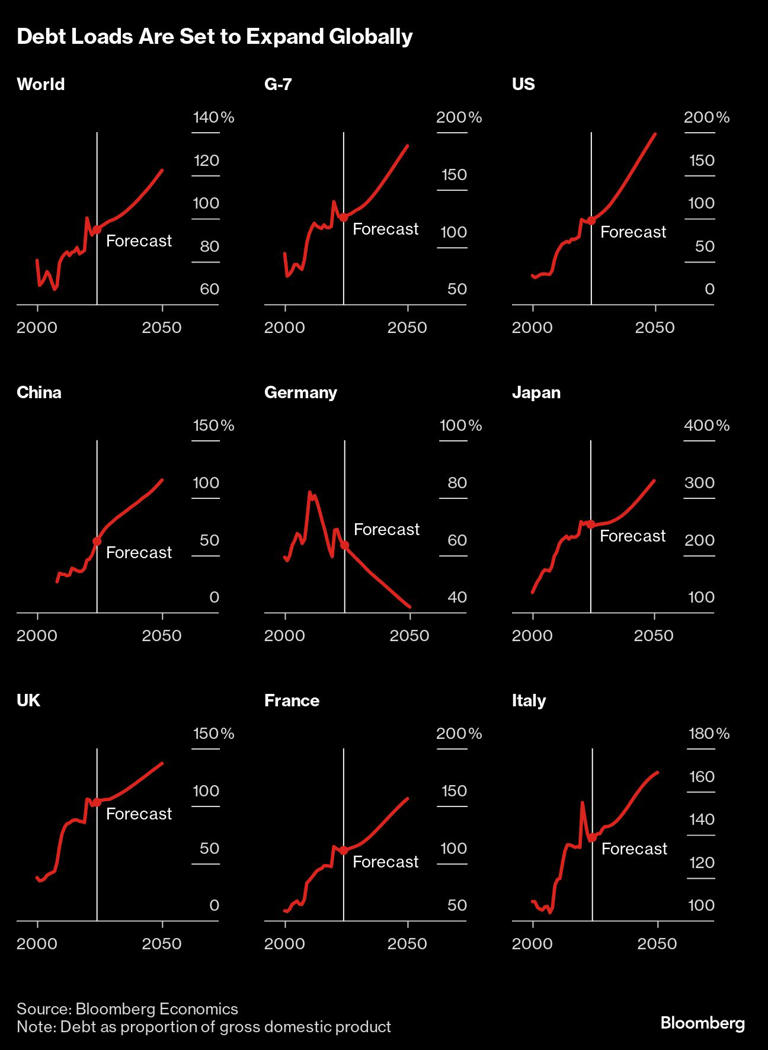
Before we continue, let me show you the graphs showing the debt/GDP ratios of several countries. Look at the graphs and tell me what is misleading about them.
The graphs at the right have two main problems:
1. They combine two completely different things: Monetarily Sovereign nations and monetarily non-sovereign nations.
A Monetarily Sovereign nation has the infinite ability to create its own sovereign currency. It never can run short of money to pay its bills.
The U.S. cannot run short of dollars. China cannot run short of yuan. Japan cannot run short of yen, and the UK cannot run short of pounds. These nations are Monetarily Sovereign.
They all can pay any debt denominated in their sovereign currency, merely by tapping a computer key.
Former Federal Reserve Chairman Alan Greenspan: “A government cannot become insolvent with respect to obligations in its own currency.”
By contrast, Germany, France, and Italy are monetarily non-sovereign. They all use the euro, and can run short of euros to pay their debts. They must borrow from the European Union (EU) when they run short of euros.
The G-7 graph is a mongrelization of Monetarily Sovereign and monetarily non-sovereign nations (Canada, France, Germany, Italy, Japan, United Kingdom, United States) and thus is useless and misleading.
2. The debt/Gross Domestic Product ratio, which is the subject of the graphs is meaningless, though it often has been used by those who do not understand Monetary Sovereignty.
Here are the ten nations with the supposedly “worst” (highest) ratios:
Debt to GDP Ratio (%); Japan 264%, Venezuela 241%, Sudan 186%, Greece 173%, Singapore 168%, Eritrea 164%, Lebanon 151%, Italy 142%, United States 129%, Cape Verde 127%
Japan and the U.S. are ranked worst, along with Sudan, Greece, Lebanon, and Cape Verde.
Who would you prefer to lend to, Japan or Cape Verde? The United States or Sudan?
Now, here are the ten nations with the “best” (lowest) debt/GDP ratios: Brunei 2.1%, Kuwait 2.9%, Cayman Islands 4.5%. Afghanistan 7.4%. Turkmenistan 8%, Azerbaijan 11.7%, Burundi 14.5%, DR Congo 14.6%, Russia 17.2%, Palestine 18.5%
That’s right. According to the IMF, those are the financially safest places in the world.
The debt/GDP ratio is akin to a butter/butterfly ratio. Completely and utterly useless, yet here is the equally useless IMF shrieking about it.
This is what the IMF says about itself:
The International Monetary Fund (IMF) is an organization that aims to ensure the stability of the international monetary system. Its primary purposes are to:
1. Foster collaboration among countries to achieve global monetary stability.
2. Promoting exchange rate stability
3. Support economic policies that promote growth and reduce poverty.
4, Offer loans and financial aid to member countries facing balance of payments problems or economic crises.
5. Provide economic and financial advice.
It does none of those, except #4, which it uses like a loan shark, extorting unreasonable terms from weak countries. And really, would you take “economic and financial advice” from a group that doesn’t know the difference between Monetary Sovereignty and monetary non-sovereignty.
It is like taking medical advice from a quack doctor who doesn’t know the difference between heartburn and sunburn.
Continuing with the article:
“Our forecasts point to an unforgiving combination of low growth and high debt — a difficult future,” she said. “Governments must work to reduce debt and rebuild buffers for the next shock — which will surely come, and maybe sooner than we expect.”
For a Monetarily Sovereign nation “high debt” generally means the government is pumping more growth dollars into the economy. Lack of debt growth leads to recessions:
A decline in debt growth (red line) causes recessions (vertical gray bars) which are cured by an increase in debt growth.
Thus, the IMF’s “cut debt” advice is diametrically wrong, like taking blood from a patient to cure his anemia.
Some finance ministers may get further reminders even before the week is over.
UK Chancellor of the Exchequer Rachel Reeves has already faced an IMF warning of the risk of a market backlash if debt doesn’t stabilize. Tuesday marks the last release of public finance data before her Oct. 30 budget.
The UK tax office is taking a tougher approach to clawing back debts, insolvency specialists say, a bid to squeeze £5 billion ($6.5 billion) in extra revenue.
The above simple proves that many government economists are as financially ignorant as the IMF economists.
We have the same problem in the U.S., with so-called experts claiming our federal debt (which isn’t “federal” and isn’t “debt”) is a “ticking time bomb.” Total bullshit.
What Bloomberg Economics Says: “For all the talk of black holes, the overall effect of Reeves budget will be a policy that’s looser, not tighter, relative to the previous government’s plans.”
As it should be if the UK wants economic growth. If the UK is foolish enough to listen to the IMF and cut debt (which means take dollars out of the economy), it will have a recession.
Meanwhile, Moody’s Ratings has slated Friday for a possible report on France, which faces intense investor scrutiny at present. With its assessment one step higher than major competitors, markets will watch for any cut in the outlook.
France, being monetarily non-sovereign, does risk it’s debt being too high to service. The EU, which is Monetarily Sovereign, could solve France’s financial problems by simply giving them euros. That would cost European taxpayers nothing, and would prevent debt from being an issue.
As for the biggest borrowers of all, the glimpse of the IMF’s report already published contains a grim admonishment: your public finances are everyone’s problem.
True for monetarily non-sovereign nations; not true for Monetarily Sovereign nations.
“Elevated debt levels and uncertainty surrounding fiscal policy in systemically important countries, such as China and the United States, can generate significant spillovers in the form of higher borrowing costs and debt-related risks in other economies,” the fund said.
We’ll end with the final dollop of bullshit from the IMF. China’s and the US’s increase in debt means other nations are being enriched by dollars and yuan. The more these two governments spend on foreign goods and services, the better all the other governments’ finances will be.
As usual, the fools and con men of the IMF offer diametrically the opposite of good advice.