
The lawsuit you never heard of could upend your life

The U.S. Supreme Court has a sordid history, with only brief flashes of morality and honesty.
Following a sad tradition of supporting extremism, bigotry, and personal greed.
It has legalized slavery, counted blacks and women as less than human, denied the words “well-regulated militia” exist, approved civil asset forfeiture without due process, and approved forced sterilization of the mentally feeble. SCOTUS legalized the internment of Japanese Americans, uninhibited use of eminent domain taking, approved Jim Crow laws, and recently, denied women control over their bodies. SCOTUS ruled that money is speech, so those with the most money were given the constitutional right to the most speech. And then, there was Bush v. Gore, a flat-out contradiction of the Constitution. So yes, far too many crooked, immoral, greedy, and even stupid justices have populated many terrible Supreme Courts. The current one follows that sad tradition. My reading of the current Supreme Court is that it will continue to fail the morality/honesty test and will invent ever more twisted reasons to justify decisions reflecting the following concepts:
  1. If something benefits the rich, the Court’s right-wing likes it.
  2. If something benefits the rich at the expense of the poor, they love it.
  3. If something benefits the rich, punishes the poor, and personally benefits certain members of the Court, they positively adore it.
Call me a pessimist if you will, but Moore vs. the United States will test the Court’s morality and honesty yet again, and I predict the Court will find a way to fail the test. Excerpts:

Moore vs. the United States. The Roosevelt Institute and the ITEP report warned that the Supreme Court’s ruling could even affect social programs and the federal deficit.

The decision can affect social programs only if one wrongly believes federal taxes fund federal spending. While state/local taxes fund spending by these monetarily non-sovereign entities, federal taxes do not fund spending by the Monetarily Sovereign U.S. government. Even if all federal tax collections, including FICA, fell to $0, the federal government could continue its deficit spending forever.

“In Moore, the Roberts Court could decide with the stroke of a pen to simultaneously forgive big business decades of tax dues, increase the federal deficit over the long run, jeopardize future public revenue and essential social programs, escalate these multinational companies’ already sizable after-tax profits, and further enrich their shareholders,” the report authors wrote.

Contrary to popular wisdom, Social Security and Medicare are not funded by federal taxes. They are financed by dollars created ad hoc with the press of computer keys. As for the federal deficit, it is necessary for economic growth. When the deficit fails to grow, we have recessions and depressions. The federal deficit is the private sector’s income. Concerns about the federal deficit are based on ignorance of federal finance. Corporate profits create economic growth, and enriching shareholders is fine if the government also will spend to enrich the poor (via Social Security for All and Medicare for All).

The Supreme Court will hear the upcoming case, scheduled for December. It could potentially have far-reaching implications on the United States tax structure.

 The case deals with whether the U.S. Constitution’s 16th Amendment authorizes Congress to tax unrealized sums without apportionment among the states.

Charles and Kathleen Moore are minority shareholders in an Indian farming firm, and they have disputed a provision in the Tax Cuts and Jobs Act passed by Congress in 2017 after the IRS presented them with a $15,000 bill for their investment.

The Moores argue the reparation tax is not on income and violates the 16th Amendment that requires direct federal taxes to be apportioned among the states. After losing a suit in the District Court in Washington state in 2022, the Moores’ dispute will be heard by the Supreme Court.

The Roosevelt Institute and the ITEP explained that before the Tax Cuts and Jobs Act, American individuals and corporations “owning stock in a foreign corporation were allowed to defer payment of U.S. tax on profits generated by the offshore company until those profits were ‘repatriated.'”

Because this is a tax benefit taken mainly by wealthy investors, one might expect the right-wing Supreme Court to rule in favor of the Moores.

If the high court sides with the plaintiffs, almost 400 multinational corporations could collectively receive $271 billion in tax relief.

The U.S. federal government, being Monetarily Sovereign, neither needs nor uses any form of income, including tax income. When this income originates with U.S. taxpayers, it represents a dollar reduction from the private sector and, therefore, is recessive. On the other side of the coin is that most taxpayers will be among the rich, so the tax would help narrow the Gap between the rich and the rest. So, we have a conundrum. Is stimulating economic growth or narrowing the Gap more economically beneficial?

The report noted Chief Justice John Roberts and Associate Justice Samuel Alito are said to own stock in 19 companies that could receive a combined $30 billion if the court strikes down the repatriation tax.

Aha. That would seem to be the closing argument. In the unlikely event that the SCOTUS justices have any remaining morality, Roberts and Alito would recuse. I suspect Roberts still has a modicum of ethics. I doubt Alito has any. If they decide to recuse, it probably will be because Roberts embarrassed Alito into gritting his teeth and going along. If they don’t recuse, Alito and the rest of the right-wing gang will have won the cage match race to the bottom.

The report also argues that depending on the scope of the decision, the Supreme Court could “supplant Congress as a major American tax policymaker, putting at legal jeopardy much of the architecture of laws that prevent corporations and individuals from avoiding taxes, and introducing great uncertainty about our democracy’s ability to tax large corporations and the most affluent.”

Laws that allow the rich to avoid taxes are like roast beef for starving SCOTUS justices. Who will take them on those free junkets if the rich get angry with them? The federal government is not funded with tax dollars. It creates its own funding by pressing computer keys. Taxes control the economy by taxing what the government wishes to encourage and giving tax breaks to what the government wishes to reward. Taxes also create demand for the dollar by requiring tax payments to be in dollars. The actual function of federal taxes is to enrich the rich by widening the Gap between the rich and the rest. “Rich” is just a comparative, not an absolute term. The wider the Gap, the richer are the rich. The rich pay a much smaller percentage of their income and wealth than the poor, so today’s tax law widens the Gap and makes the rich richer. While taxing businesses is anti-growth, taxing the rich (i.e., eliminating tax dodges) would narrow the Gap.

Common Dreams wrote about the report on Moore v. United States and said that while justices could take a narrower view on specific parts of the Moore case, a broader ruling could protect individuals from a wealth tax.

There are many problems with a wealth tax — what constitutes “wealth,” how is it measured, how would a home, a bank account, or company stock be measured for tax purposes. The biggest problem is that, as with current tax laws, the rich would influence (i.e., bribe) Congress to answer those questions in their favor.

The Manhattan Institute, one of eight conservative advocacy groups that filed amicus briefs urging the Supreme Court to hear the Moores’ case, argued in a filing that “the case presents the court with an ideal opportunity to clarify that taxes on unrealized gains, such as wealth taxes, are direct taxes that are unconstitutional if not apportioned among the states.”

On balance — and there are two strong sides to this — I will agree with the conservatives if they rule in favor of the Moores. While state and local taxes are necessary to fund state and local government spending, federal taxes don’t support anything. In my view, the best federal tax is no tax. SUMMARY Remember the three points at the start of this post: If something benefits the rich, the Court’s right-wing likes it. If something benefits the rich at the expense of the poor, the right wing loves it. If something benefits the rich, punishes the poor, and secretly benefits certain members of the Court, they positively adore it. See whether any justice recuses. Then, see the decision and who votes for what. That will demonstrate much about this SCOTUS. My guesses: The right wing will back Moore and the rich. Their obligations to the rich and powerful are too strong to break. Roberts and Alito won’t recuse, though, for appearances, they might dump their stock shares (and repurchase them later.) Those posh vacations on yachts and private planes may be too much fun to give up. And hey, they have lifetime jobs, so let the peons complain. I’d like to be proven wrong on this. The only solution is term limits and a morals clause similar to what every other judge in America must follow. Rodger Malcolm Mitchell Monetary Sovereignty Twitter: @rodgermitchell Search #monetarysovereignty Facebook: Rodger Malcolm Mitchell

……………………………………………………………………..

The Sole Purpose of Government Is to Improve and Protect the Lives of the People.

MONETARY SOVEREIGNTY

Is the problem cruelty, ignorance, or greed? You decide

We’ll begin with our usual reminders:

1. The U.S. federal government is not like state/local governments. It is uniquely Monetarily Sovereign, meaning it cannot unintentionally run short of its sovereign currency, the U.S. dollar.

Unlike state/local governments, the federal government never spends “taxpayer money.” It creates new dollars ad hoc when it pays any bills. Even if the government collected $0 in taxes, it could continue spending forever.

Because federal taxes do not fund federal spending, what is their purpose? The first purpose of federal taxes is to control the economy by taxing what the government wishes to discourage and giving tax breaks to what the government wishes to reward.

The second purpose is to assure demand for the dollar by requiring taxes to be paid in dollars.

2. Federal deficit spending does not, has not, and will not cause inflation. All inflations in history have been caused by scarcities of key goods and services, most notably oil and food, but more recently, transportation, computer chips, metals, lumber, labor, and other goods.

Today’s inflation was COVID-induced by all of the above scarcities. The scarcities and inflation could be cured by more federal spending to acquire and distribute the scarce goods and services.

Recently, I read an article in THE WEEK Magazine that reflects Congress’s cruelty, ignorance, and or greed, primarily those of the right. Here are excerpts and comments:Child Poverty in Western Cities: learning from global approaches – Child in  the City

The child poverty rate in the United States more than doubled between 2021 and 2022, according to new data on poverty, income, and health insurance from the U.S. Census Bureau on Sept. 12.

A year after the rate hit a historic low of 5.2 percent, the percentage of impoverished children jumped to 12.4 percent.

The bureau pointed to the end of the pandemic-era expansion of child tax credits in late 2021 as a critical factor in the dramatic increases.

“This represents a return to child poverty levels before the pandemic,” Liana Fox, assistant division chief at the Census Bureau, said during a news conference, per the Associated Press. “We did see the child tax credit substantially decreased child poverty.”

Why was the program discontinued if the child tax credit was proven to work and no taxpayer dollars were involved? We’ll discuss that later in this post.

The increase was “part of a wider rise in poverty recorded by the Census,” Time noted, “some of which can be attributed to inflation.” However, child advocates said, “the leap was particularly stark for kids — and was avoidable,” the outlet added.

The federal government can cure inflation by using its infinite money-creation power to acquire scarce items and/or reduce business expenses.

How did the rate go from a record low to more than doubling in one year? During the pandemic, Congress expanded the child tax credit as a part of the American Rescue Plan, which helped families stay afloat alongside stimulus checks.

Families received up to $3,600 for kids under 6 and $3,000 for children aged 6 to seventeen.

Officials also made the tax credit refundable, meaning families who did not make enough money to owe income tax could still be eligible for the monthly payments. This allowed millions of low-income families to be qualified and helped drive the child poverty rate to its lowest level in years.

That progress was reversed when the pandemic relief lapsed, and Congress did not vote to extend the expanded child tax credit at the end of 2021. With the program ending, millions of families lost eligibility for the credit.

The child tax credit can sometimes be considered “an upside-down policy,” Sharon Parrott, president of the Center on Budget and Policy Priorities, told NPR. “That’s because the children who need it the most get the least, while higher income children get more.”

That means when the pandemic relief ended, many families no longer reached the income requirement to qualify for the credit.

In contrast, families making six-figure incomes still get the full tax credit, Parrott explained. The child credit is income-based, so the more money you make, the more you earn per child.

Why did Congress favor giving more to the rich and less to the poor? Logically, it should be the other way around. But the rich make bigger campaign contributions. It’s that simple.

The data highlights “that poverty in our country isn’t a personal failing, but rather a policy choice,” said Melissa Boteach, vice president of income security at the National Women’s Law Center, per Time.

Legislators could “lift millions of women and children out of poverty” if they “prioritize families over their wealthy donors,” Boteach added.

The rich have convinced the voting public that the poor are lazy takers whose poverty results from their sloth. “If only they worked harder like I do,” goes the mantra, “they wouldn’t be poor.” It’s all a convenient lie to excuse cruelty and lack of compassion. If anything, the poor work harder than the rich. They are tasked with the most menial, least pleasant, most demeaning, least rewarding, back-breaking jobs our society offers. More than any other fact, luck separates the poor from the rich. “There, but for the grace of God, go I.”

If the expanded tax credit was working, why wasn’t it extended? President Biden blamed congressional Republicans for not extending the expanded child tax credit, arguing that the rise reported by the Census was “no accident.”

But the push to expand the child tax credit reached a stalemate in Congress, with opposition from Democrats and Republicans. “One flash point was an insistence by some lawmakers that it should go only to families with working parents,” wrote The Washington Post editorial board.

That’s the WSJ expression of the “lazy takers” poverty theory. If someone doesn’t have a job, that “proves” they don’t deserve help. It’s a disgusting lie promulgated to support cruelty and indifference. “I am a good person, but I don’t give to charity because (fill in the blank).

Others objected because they felt the money would discourage people from working and fuel inflation, which was already at a record high.

Think about it. Some 0f the financially fortunate in Congress felt that people receiving $3,600 to support a child for a year would not look for work. Only the clueless would believe such nonsense. Others falsely claimed that increasing the federal deficit would exacerbate inflation. (They had no objections to the gigantic tax loopholes enjoyed by the rich, which further increased the deficit.) When Donald Trump paid only $500 in total annual taxes for income that otherwise would have resulted in many millions of tax dollars, he alone increased the deficit by more than several thousand poor people receiving child tax credits.

Sen. Joe Manchin (D-W.Va.) reportedly suggested that parents would use the extra money on drugs, per Intelligencer, and he later opposed his party’s Build Back Better budget proposal, which included an extension to the child tax credit program.

Manchin’s disturbing suggestions were:. If you give anything to the poor, they’ll blow it on booze, cigarettes, and drugs rather than feeding their children. If you’re one of the (mostly) right-wingers who like to make that claim, I genuinely feel sorry for the terrible job your parents did on you. They made you into a small, mean-spirited excuse for a person.

On a smaller scale, it’s “encouraging that 13 states have a version of the tax credit in place,” the Post editorial board reported. Most are blue states, but “there are also programs in conservative states such as Idaho and Oklahoma, where lawmakers understand how effectively it works,” the board noted.

The irony is that when states spend money, their taxpayers fund the dollars, unlike federal taxpayers, who fund nothing. And here’s a cute switch by the increasingly right-wing extremist Wall Street Journal:

The temporary infusion of cash provided by the child tax credits and other pandemic stimulus programs contributed to “an inflation surge that gutted real incomes.”

Manchin was right to oppose a program that would have cost $1.2 trillion over the next decade.

The U.S. doesn’t need more inflationary spending that disproportionately “punishes lower-income Americans.”

Get it? The Wall Street Journal tells its gullible readers that helping the poor is bad for the economy and even bad for the poor!  (As though that right-wing paper gives a fig about the well-being of the poor.) In the lying words of the hate-mongers, giving to the poor encourages unemployment, drugs, inflation, and amazingly, even makes the poor and their children poorer. (Never mind that the child poverty rate more than doubled when the child tax credit ended.) Perhaps the death of the WSJ’s owner, Rupert Murdoch, will help this paper come to some semblance of accuracy, though it has not yet improved the equally extremist Fox News. SUMMARY Giving money to the poor makes them less poor, doesn’t cause inflation, doesn’t increase illegal drug use, doesn’t increase unemployment, doesn’t threaten America’s solvency, and doesn’t cost taxpayers a thing. In answer to the title question, “Is the problem cruelty, ignorance, or greed”? The answer, of course, is: All three. And it applies to Washington and the voting public. Rodger Malcolm Mitchell Monetary Sovereignty Twitter: @rodgermitchell Search #monetarysovereignty Facebook: Rodger Malcolm Mitchell

……………………………………………………………………..

The Sole Purpose of Government Is to Improve and Protect the Lives of the People.

MONETARY SOVEREIGNTY
Why the right-wing wants to cut benefits to the average American

The Libertarians (the cruel shills for the Republican Party) have a non-solution for a non-problem. The non-problem is that the U.S. federal government is running short of its sovereign currency, the U.S. dollar. The non-solution is to take dollars from the poor and middle-income people.

Welfare Cuts Are Inevitable Because Congress Won’t Touch Social Security Until Congress is willing to acknowledge that it makes no sense to send monthly checks to wealthy seniors, everything else will be on the chopping block. ERIC BOEHM | 9.27.2023 2:05 PM

The headline implies at least four lies: Lie #1. The federal government can’t afford to send money to the poor and middle-income people. Lie #2. The solution would be for the government to take dollars from Social Security. Lie #3. Congress doesn’t dare to take Social Security dollars from the poor and middle-income people. Lie #4. The only recourse is to take welfare dollars from the poor.

Amid the fractious debate over the federal budget, Speaker of the House Kevin McCarthy (R–Calif.) has outlined plans for cutting several prominent welfare programs to save about $150 billion annually.

According to The Washington Post, those cuts would affect a wide range of federal safety net programs, including food stamps and Meals on Wheels, which help feed needy families.

Other cuts would affect Federal Pell Grants for low-income college students, grants that help families afford housing, and a program that helps offset high heating bills.

Notice that none of the Libertarian non-solutions to the non-problem involve taking dollars from the rich by eliminating the kind of tax dodges that all people like Donald Trump to pay almost $0 federal taxes.

Regardless of whether you think the federal government should be in the business of funding any of those things in the first place, there’s no denying that sudden cuts to existing welfare programs can be disruptive to the individuals and families that have come to rely upon them.

Here, the Libertarian implies that the federal government should not help low-income college students, families that can’t afford housing, or low-income families that can’t pay their heating bills. This is typical for the heartless Libertarians and Republicans. They don’t give a damn about people but are concerned with just two things: Saving government money for a government that has infinite money and helping the rich grow richer.

Ben Bernanke: “The U.S. government has a technology, called a printing press (or, today, its electronic equivalent), that allows it to produce as many U.S. dollars as it wishes at essentially no cost.”

It’s also true that, as Reason’s Liz Wolfe points out in this morning’s newsletter, the proposed cuts reflect the reality of a government that has been living beyond its means for too long.

You and I can “live beyond our means.” but the federal government cannot. It has infinite “means.”

Alan Greenspan: “The United States can pay any debt it has because we can always print the money to do that.

“It’s not exactly a winning PR move to slash the programs that serve needy toddlers and first-generation college kids, but there’s an important fundamental truth at the heart of the fiscal hawks’ concerns: government spending simply cannot continue at current levels with no consequences,” Wolfe writes.

This lie has been told since at least 1940 and probably beyond. That was the first year I found that the federal debt, or deficit, was called a “ticking time bomb.” The phony bomb still is ticking after eighty-three years. And precisely what are the “consequences” to which Wolfe refers and Boehm agrees? You never will see that explained in any Libertarian screed. The reason: There are no consequences. Period.

That’s true. But here’s an element of this debate that doesn’t get talked about enough: Cutting welfare programs for needy families is necessary because Congress insists that relatively wealthy senior citizens get paid first.

And here it comes: The theory is that seniors are wealthy, and despite paying the useless FICA tax for their entire lives, they really don’t deserve anything for their investment. So, cut Social Security because that’s where the money — the infinitely available money — goes. And who cares about those old folks, anyway?

Budgeting is always, at its core, an exercise in priority-setting. That’s especially true when your budget is wildly out of whack, and you’ve been borrowing at an unsustainable rate, as Congress has done for years.

What part of budgeting is “wildly out of whack”? Would reducing the money going to the middle and the low be the best way to put the budget in “whack”? And then for two more lies in just five words (Is that a world record?) “Borrowing at an unsustainable rate.” Lie #5. The federal government borrows. No, the federal government does not borrow dollars. Why would it borrow when it has the infinite ability to create dollars?

Statement from the St. Louis Fed: “As the sole manufacturer of dollars, whose debt is denominated in dollars, the U.S. government can never become insolvent, i.e., unable to pay its bills. In this sense, the government is not dependent on credit markets to remain operational.”

The confusion arises because private sector bills, notes, and bonds differ entirely from T-bills, T-notes, and T-bonds The former have to do with borrowing. The latter have to do with depositing. A borrower receives from a lender money that the borrower uses. But the federal government doesn’t use or even touch the dollars deposited into T-security accounts. The federal government, unlike state/local governments, is Monetarily Sovereign. It pays all its creditors with newly created dollars, ad hoc. Despite Monetary Sovereignty being the single most important difference between federal and personal finances, you will never see those words in any discussion of federal budgeting being “unsustainable.” Lie #6. “Unsustainable rate.” No amount of spending is unsustainable for the federal government. It has the infinite ability to create dollars.

When there’s no longer enough money to go around, you’re faced with a difficult proposition: Who gets paid first, and who has to wait at the back of the line?

The federal government always has enough money to go around. It cannot run short of dollars. Ever. Boehm knows this.

Alan Greenspan: “There is nothing to prevent the federal government from creating as much money as it wants and paying it to somebody.”

In the federal budget, seniors get paid first. Everyone else has to wait.

Lie #7. No, the rich are paid first. They are paid by the tax loopholes that allow them not to pay taxes in the first place.

McCarthy and his fellow Republicans are not proposing any cuts or changes to Social Security and Medicaid, the Post notes. That’s despite the fact that the two major entitlement programs are driving most of the federal government’s long-term deficit.

The federal deficit is the government’s method for pumping growth dollars into the economy. If the government did not run deficits, we would have yearly recessions and depressions.

U.S. depressions tend to come on the heels of federal surpluses.

1804-1812: U. S. Federal Debt reduced 48%. Depression began 1807. 1817-1821: U. S. Federal Debt reduced 29%. Depression began 1819. 1823-1836: U. S. Federal Debt reduced 99%. Depression began 1837. 1852-1857: U. S. Federal Debt reduced 59%. Depression began 1857. 1867-1873: U. S. Federal Debt reduced 27%. Depression began 1873. 1880-1893: U. S. Federal Debt reduced 57%. Depression began 1893. 1920-1930: U. S. Federal Debt reduced 36%. Depression began 1929. 1997-2001: U. S. Federal Debt reduced 15%. Recession began 2001.

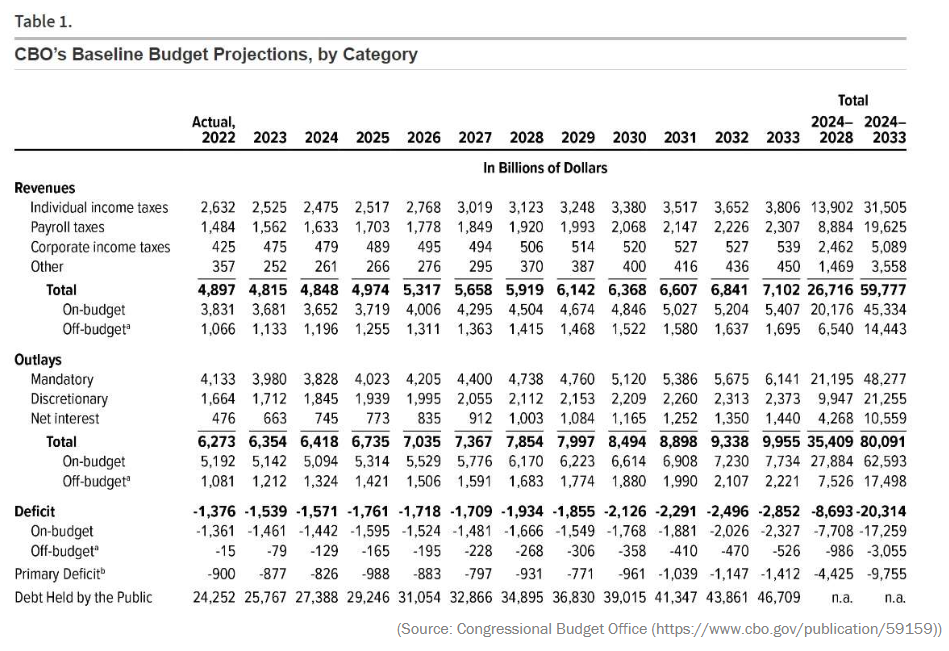
Over the next decade, discretionary spending—including those welfare programs the GOP aims to cut—is projected to decline relative to the size of the U.S. economy, according to the Congressional Budget Office’s (CBO) projections.

Meanwhile, Social Security and Medicare are growing, fast. By 2030, the CBO expects so-called “mandatory spending” on entitlement programs to consume more than 60 percent of the federal budget.

The federal budget is what Congress wishes it to be. If 60% is too much, the government merely can increase discretionary spending. This would reduce the meaningless percentage and increase the Gross Domestic Product. Economic growth is both a direct and indirect result of federal spending.  GDP=Federal Spending + Nonfederal Spending + Net Exports

Of course, because those programs are funded with a separate revenue stream—payroll taxes—it would be complicated for Congress to cut spending on Social Security to offset cuts on welfare programs.

Unlike state and local governments, the federal government does not fund programs via “revenue streams.” It supports all programs by creating new dollars, ad hoc. Tax dollars are destroyed upon receipt. Even if all federal tax collections totaled #0, the federal government could continue spending forever.

Even so, the ongoing refusal of either major party to consider any long-term changes to the two major entitlement programs tells you all you need to know about the priorities in Washington.

What tells me all I need to know about priorities in Washington is the failure of either party to get rid of tax dodges by the rich.

There is no shortage of alternative ideas out there.

Congress could fiddle with the specifics of Social Security to make the program less expensive over the long term—raising the retirement age, for example, or changing how contributions and disbursements work.

Yes, soaking the elderly is the Libertarian mantra. But they don’t ask the rich to pay more by closing tax loopholes. That would reduce those luscious political contributions the politicians love so much.

It could (and should) allow younger Americans to opt out of the system retirement.

Boehm exceeds his stupidity allowance by suggesting that younger Americans opt out of Social Security. I can’t even go into how cruel and ignorant that idea is other than saying it does not surprise me coming from Libertarian Eric Boehm. A pox on him and his descendants ten generations, hence. Rodger Malcolm Mitchell Monetary Sovereignty Twitter: @rodgermitchell Search #monetarysovereignty Facebook: Rodger Malcolm Mitchell

……………………………………………………………………..

The Sole Purpose of Government Is to Improve and Protect the Lives of the People.

MONETARY SOVEREIGNTY
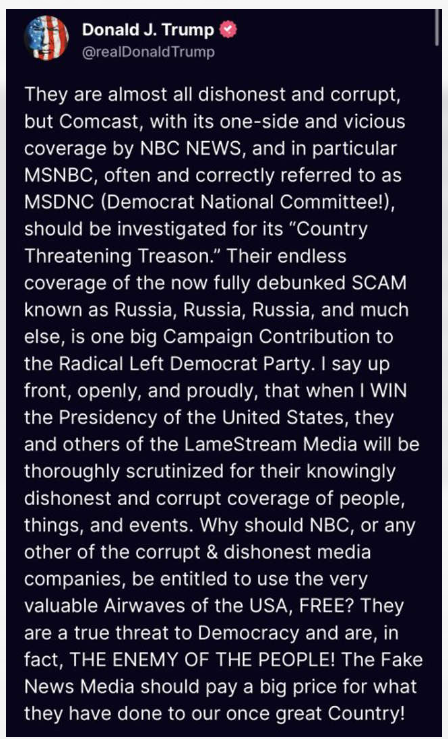
Trump promises to be just like Putin, Kim, Castro, and all other dictators. Shut down opposing media.

Our founders fought the Revolutionary War to rid ourselves of the dictator, King George III. It would be sad if an increasingly crazed traitor cost us what America’s brave patriots won.

I usually comment at length on articles I find interesting. I won’t comment further on this one:

Trump Vows to Ban All News Media That Don’t Praise Him

Rodger Malcolm Mitchell
Monetary Sovereignty

Twitter: @rodgermitchell Search #monetarysovereignty
Facebook: Rodger Malcolm Mitchell

……………………………………………………………………..

The Sole Purpose of Government Is to Improve and Protect the Lives of the People.

MONETARY SOVEREIGNTY