The genius of the board game, Monopoly®.

If you have, like I have, spent the most recent 25 years of your life trying to explain to your friends and strangers, something the basics of which an 8-year-old should be able to understand — and like me, you have utterly failed — try using the board game Monopoly® as your example.

First, why do I say 8-year-old? Well, this is the on-line ad:

GREAT FAMILY GAME: This Monopoly board game is fun for families and kids ages 8 and up.

So yes, and 8-year-old can understand Monopoly®.

But, why do I reference Monopoly®?

You, your friends and strangers almost surely have played Monopoly®. Behind chess, checkers, and backgammon, Monopoly® is the world’s most popular board game in history.

So, even the semi-literate universe knows how the game works.

As they will recall, it is a game about buying, improving, renting, and selling real estate. There are players — usually four, plus a Bank.

The players are analogs for the U.S. private sector (aka, “the economy”), and the Bank is an analog for the U.S. Treasury. It doles out money. It collects money that it doesn’t need.

And by law (i.e. by rule), it never can run short of money — just like the Treasury. Here are some of the Monopoly® game’s parallels to reality:

1. The real world and the game use paper “money,” which isn’t really money. The U.S. dollar bill is the title to a dollar,not in of itself a dollar. The actual dollar is merely a bookkeeping notation in the government’s accounting records.
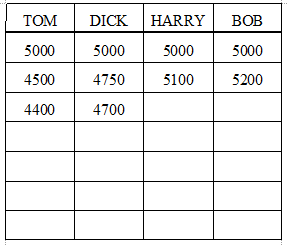
How to play Monopoly without using Monopoly paper dollars. Create a table. THE BANK HAS NO COLUMN BECAUSE IT HAS INFINITE MONEY.

A U.S. dollar has no physical presence. It is just a number in a balance sheet.

Similarly, a Monopoly® paper dollar merely represents game points.

Years ago, I played a game of Monopoly® that did not include any paper “dollars” at all.

We simply used a record of points — a table in which each participant had a column in which his/her winnings and losings were recorded.

The Bank had no column, because the Bank (like the U.S. Treasury), had the infinite ability to create dollars.

Such a column would have made no sense.

The use of the table proves that, like U.S. dollars, Monopoly® dollars have no physical substance. They are just balance sheet numbers.

2. Like the U.S. Treasury, the Monopoly® Bank generally runs a deficit, which is an asset for the private sector.

Just as the U.S. Treasury never can run short of U.S. dollars, the Monopoly® Bank never can run short of Monopoly® dollars.

This is stated in the rules of the game.

Monopoly taxes, which are paid to the Bank, do not fund Band spending. Since the Bank had no column to show how much money it has, all taxes paid to the bank disappear upon payment.

When players pass “GO” and receive $200, no taxpayers are obligated to fund those $200 payments. No one asks, “How will the Bank pay for it?” just as no one should ask, how will the federal government pay for (anything).

3. For historical reasons, based on obsolete gold standards and silver standards, the U.S. federal government keeps track of “deficits” (i.e. the difference between tax income and spending).

In U.S. history, there have been intermittent gold and silver standards, in which the U.S. required itself to store physical gold and silver in dollar amounts equal to those deficits.

“Wait,” you say. “Gold and silver are physical metals, measured in ounces. How can ounces be equal to dollars?”

Answer: The U.S. government, being Monetarily Sovereign, has the unlimited power to fix an ounce of silver and an ounce of gold to equal any number of dollars it wishes.

The government has the unlimited power to fix the price of any commodity vs. the dollar: Iron, corn, cotton, water, oil, etc.

Ever since 1971, when President Nixon took us off the last gold standard, the value of gold vs. dollars has varied wildly.

For that reason, keeping track of deficits no longer is necessary other than to measure dollars going into the economy.

When too few dollars are pumped into the economy we have recessions, and when dollars actually are taken out of the economy we have depressions.

1804-1812: U. S. Federal Debt reduced 48%. Depression began 1807.

1817-1821: U. S. Federal Debt reduced 29%. Depression began 1819.

1823-1836: U. S. Federal Debt reduced 99%. Depression began 1837.

1852-1857: U. S. Federal Debt reduced 59%. Depression began 1857.

1867-1873: U. S. Federal Debt reduced 27%. Depression began 1873.

1880-1893: U. S. Federal Debt reduced 57%. Depression began 1893.

1920-1930: U. S. Federal Debt reduced 36%. Depression began 1929.

1997-2001: U. S. Federal Debt reduced 15%. Recession began 2001.

By contrast, the game of Monopoly® does not keep track of the Bank’s deficits. There is no need to, because the deficits do not affect the Bank’s ability to pay, just as federal deficits do not affect the federal government’s ability to pay.

4. Similarly, neither the Monopoly® Bank nor the federal government ever borrows dollars. Being Monetarily Sovereign, they never need to.

The U.S. Treasury issues Treasury certificates (T-bills, T-notes, T-Bonds), which misleadingly are called “borrowing.”

In a typical borrowing situation, someone needs additional money temporarily, so they borrow it from a lender, and later, pay it back.

But, the federal government, having the unlimited ability to create dollars, never is in a  position in which it needs money.

It has the infinite ability to create money, at the touch of a computer screen. Those T-securities, which misleadingly are labeled “borrowing,” are more akin to safe-deposit boxes, into which depositors place values, and later retrieve them.

The sole differences between T-security accounts and safe deposit boxes are:

a. T-security accounts have a maturity date; safe-deposit boxes do not

b. T-security accounts receive interest; safe deposit boxes do not (although negative interest rates for T-security accounts have been discussed, which would make them even more like safe-deposit boxes.)

The federal government never touches the contents of safe-deposit boxes or of T-security accounts, and to “pay them off,” the owner simply retrieves the contents of the T-security accounts and the safe-deposit boxes.

There is no bank or government obligation to “pay off” safe-deposit boxes or T-security accounts. The sole financial purposes of T-securities are:

a. To provide a safe place to store unused dollars, which stabilizes the dollar

b. To assist the Federal Reserve to control interest rates, which helps control inflation

T-securities do not provide spending funds for the federal government. Every time you think of federal government financing ( which is nothing like state/local government financing) think of the Monopoly® Bank.

That will help you visualize why federal deficits and debt are not a burden on the government or on taxpayers. Compare that with the contents of the following article from the Committee for a Responsible Federal Deficit (CRFB):

The Nation’s Upcoming Fiscal Challenges APR 29, 2021 | BUDGETS & PROJECTIONS
Record Debt Levels: Debt held by the public will total 108 percent of Gross Domestic Product this fiscal year. After the previous record of 106 percent of GDP, set in 1946 just after World War II, policymakers ran years of balanced budgets to bring debt down to manageable levels. We now face large structural deficits and an ever-rising debt-to-GDP ratio.

The “debt” / GDP ratio is meaningless. It predicts nothing. It has nothing to do with the federal government’s ability to pay its debts. It does not say anything about the health of the economy.

The End of Discretionary Spending Caps: Since 2012, discretionary spending caps have been in place (though in practice, these caps have often been increased and in some instances violated).

“Increased” and “violated” because they serve no function.

These caps expire at the end of this fiscal year, leaving appropriators without a legal constraint on discretionary spending and thus creating the opportunity for a spending free-for-all.

Obviously, caps that are “increased” and “violated” are not caps at all, and do nothing to prevent Congress from spending as much as it wishes. Further, there are no economic reasons to restrict Congressional spending. On the contrary, federal spending stimulates economic growth.

Predictable Expirations and Fiscal Deadlines: President Biden’s agenda, like those who came before him, will be in many ways dictated by a series of expirations and deadlines.
This year alone, the country will have to deal with the return of the debt limit (August 1), the end of expanded unemployment benefits (September 6), the expiration of numerous program authorizations (September 30), and the end of the expanded Child Tax Credit and other tax breaks (December 31).

The “debt limit” is one of the least intelligent laws passed by Congress, and that is saying something. The “limit” does not limit debt. It limits payment for debt already contracted.

It’s a “stiff your creditors” law, that has no economic purpose. Zero. Zilch. None. The fact that every time it is reached, Congress raises it, should reveal something to even the least educated among us.

Policymakers must also address the statutory Pay-As-You-Go scorecard if they choose to avoid an across-the-board sequestration. 

“Pay-As-You-Go” is a system by which the federal government would add net zero dollars to the economy, thereby guaranteeing a depression. Not smart, which is why the CRFB likes it.

Major Trust Funds Are Headed Toward Insolvency: Four major trust funds are projected to deplete their reserves within the next 14 years: the Highway Trust Fund in FY 2022; The Medicare Hospital Insurance trust fund in FY 2026; Social Security’s retirement fund in calendar year 2032; and the Social Security Disability Insurance trust fund in calendar year 2035.
Given this tight timeline, all of these trust funds should ideally be secured during President Biden’s time in office.

Just as federal “debt” is not debt, federal “trust funds” are not trust funds, and they cannot “deplete their reserves” unless Congress and the President want them to.

Just as the federal government cannot run short of dollars, no agency of the federal government can run short of dollars, again, unless Congress and the President want them to.

See if you can learn when the non-existent trust funds for the military, the Supreme Court, the White House, the Senate, and the House of Representatives will face insolvency. Oh, they have no trust funds? Ask yourself, “Why not?”

IN SUMMARY The board game, Monopoly®, is similar to the U.S. economy.

The Monopoly® Bank resembles the U.S. government, and the Monopoly® players resemble the U.S. economy.

Just as the Monopoly® Bank never can run short of dollars, the U.S. government never can run short of dollars.

Just as the Bank does not borrow dollars, the U.S. government does not borrow dollars.

Federal Treasury securities, misnamed “borrowing,” actually are similar to safe deposit boxes. Just as your bank doesn’t touch what you put into your safe deposit box, the federal government doesn’t touch what you put into your T-security account.

To “pay off” that misnamed “debt,” the federal government simply allows you to take back the contents of your T-security account, in the same way as you would take back the contents of your safe deposit box. No tax payers or tax dollars are involved.

………………………………………………………………………….

Rodger Malcolm Mitchell [ Monetary Sovereignty, Twitter: @rodgermitchell, Search: #monetarysovereignty Facebook: Rodger Malcolm Mitchell ]

THE SOLE PURPOSE OF GOVERNMENT IS TO IMPROVE AND PROTECT THE LIVES OF THE PEOPLE. The most important problems in economics involve:

  • Monetary Sovereignty describes money creation and destruction.
  • Gap Psychology describes the common desire to distance oneself from those “below” in any socio-economic ranking, and to come nearer those “above.” The socio-economic distance is referred to as “The Gap.”

Wide Gaps negatively affect poverty, health and longevity, education, housing, law and crime, war, leadership, ownership, bigotry, supply and demand, taxation, GDP, international relations, scientific advancement, the environment, human motivation and well-being, and virtually every other issue in economics. Implementation of Monetary Sovereignty and The Ten Steps To Prosperity can grow the economy and narrow the Gaps: Ten Steps To Prosperity:

  1. Eliminate FICA
  2. Federally funded Medicare — parts A, B & D, plus long-term care — for everyone
  3. Social Security for all
  4. Free education (including post-grad) for everyone
  5. Salary for attending school
  6. Eliminate federal taxes on business
  7. Increase the standard income tax deduction, annually.
  8. Tax the very rich (the “.1%”) more, with higher progressive tax rates on all forms of income.
  9. Federal ownership of all banks
  10. Increase federal spending on the myriad initiatives that benefit America’s 99.9% 

The Ten Steps will grow the economy and narrow the income/wealth/power Gap between the rich and the rest.

MONETARY SOVEREIGNTY

Whipping a horse while reining it in.

What happens when you spur the economy and rein it in at the same time.

Imagine you and me debating quantum chromodynamics.

I know nothing about the subject, and in all probability, you know virtually nothing, too.

So, our debate would be meaningless.

And yet, this is precisely what is happening in America, with regard to federal taxes: Debates by people who know nothing.

Consider excerpts from the following article:

The Memo: Biden tries to flip the script on taxes, by Niall Stanage
President Biden’s plan to increase taxes on wealthy Americans is reigniting one of the fiercest divides in politics: How much should the government do, and who should foot the bill?

Immediately you see the first bit of ignorance, with the words, “who should foot the bill?”

No one “foots the bill” for federal government spending.

The federal government creates new dollars, ad hoc, every time it pays a creditor.

Unlike state and local government taxes, which do fund state and local government spending, federal taxes do not fund federal spending.

This is basic economics that Biden and most in Congress surely must understand.

They understood it when they passed earlier trillion-dollar stimulus bills without tax increases. So how could they not understand it for the proposed trillion-dollar stimulus bill?

Biden this week will propose a massive boost to social infrastructure spending on things such as paid leave, child care and tuition-free community college.
To pay for it, according to multiple media reports, he will nudge up the highest rate of income tax and dramatically hike the capital gains tax paid by top earners.

Biden claims that the purpose of his proposed tax increase is to “pay for” his proposed spending boost. If he truly believes that, he is ignorant about federal financing.

More likely, he doesn’t believe it, which would mean he is lying. So, why?

The plan is expected to call for an approximate doubling of the capital gains tax, from its current level of 20 percent, for Americans with incomes of over $1 million.
At the heart of the plan is a key question: whether income derived from the sale of assets should be treated basically the same as income in the form of a paycheck.
Biden and his backers answer with an emphatic yes. Wealthier Americans derive a greater proportion of their overall income from investment, they note.
The beneficial treatment of capital gains, they say, has the effect of further helping those who are already in a privileged position – and therefore exacerbating wealth inequality and social incohesion.
A Gini ratio of 0 indicates perfect equality, where everyone has the same income. A Gini ratio of 1 indicates total inequality, where one person has all the income. Inequality in America has grown substantially.

Could it be that the real purpose of Biden’s tax proposal is to narrow the income/wealth/power Gap between the very rich and the rest of us?

Could it be that he is using the need for infrastructure and other spending, as an excuse to tax the rich more, while benefiting the “not-rich”?

If that is his motive, then I bow to him as a genius, and I pray he succeeds.

The wide, and widening, income/wealth/power Gap between the relative handful of Americans and the rest of us, is the single biggest, most corrosive economic problem facing America.

But there are counterarguments, too.
Those who favor keeping the capital gains tax low insist that it is a key driver of investment and that high rates encourage people to hold on to their assets rather than incur a high tax bill, thus diluting economic dynamism.

That “key driver of investment” line is utter nonsense.

All investment begins in the short term, and only after a year of inactivity does it become long-term and earn the lower tax rate.

In that sense, yes, it “dilutes economic dynamism.” But, is that a good thing?

Is there an economic benefit from encouraging people to hold on to their investments for a year or more?

I don’t see it. That phrase “dilute economic dynamism” is another way to say, “reduce speculation,” which the public has been taught is a bad thing.

Some economists hate “speculation,” which is short-term investing. But speculation is what grows America.

Every entrepreneur is a speculator, i.e. one who invests in businesses, stocks, property, or other ventures in the hope of gain but with the risk of loss.

That is how new businesses are created. “Economic dynamism” built the American dream, and now some stodgy, old economists want to tax it?

No, I hope the real reason for Biden’s tax proposal is to narrow that debilitating Gap between the haves and the have-lesses.

Then there are the politics to consider. Democrats up until recently were petrified of being labeled the “tax-and-spend” party by conservatives – a fear that was rooted in the knowledge of how effective such attacks had been in the 1980s and early ’90s.
Given the razor-thin Democratic majorities on Capitol Hill, whether Biden can even get his proposals passed will depend upon his ability to corral moderates such as Sens. Joe Manchin (D-W.Va.) and Kyrsten Sinema (D-Ariz.).

Because federal taxing does not fund federal spending, Democrats should become the “spend-and-don’t-tax” party.

Manchin and Sinema probably are not moderate in their beliefs. They are Democrats who won in historically Republican-leaning states.

So to maintain office, they must appear to be moderate. Yet, they probably are are social spending, economic-growth Democrats at heart.

Success is far from guaranteed. Progressives are adamant that the time is right for Democrats to cast off their traditional timidity about taxation and push a more egalitarian agenda.
Conservatives are equally emphatic that doing so would be a huge mistake. “This is how you stall an economy,” said Grover Norquist, the president of Americans for Tax Reform and perhaps Washington’s best-known anti-tax campaigner.

Norquist is absolutely correct when it comes to federal taxes.

Unlike state/local taxes, federal taxes do not provide spending money to the federal government, which has infinite spending money. Federal taxes, absolutely, positively are an anchor slowing the U.S. economy.

Most federal taxes should be eliminated, altogether. The sole purpose of federal taxes is to control the economy by taxing what the government wishes to discourage and giving tax breaks to what the government wishes to encourage.

Think of federal taxes as reins on a horse. They steer the horse, but reins do not make a horse go faster.

A problem occurs when taxation is linked with federal deficits and debt, both of which erroneously are decried as economic negatives. But deficit spending grows the economy.

Combining federal deficit spending with federal taxes is like spurring a horse while reining it in.

Biden, Norquist insisted, “could just have sat back because you are going to see this surge in the second quarter.
“There could be this incredible growth. You could be coasting on that, but instead what you are doing is chasing investment away from the United States, telling people, ‘You don’t want to get capital gains in the U.S.'”

Norquist is wrong about “sitting back” and “coasting.” In this competitive world, that is no way to win a race against other nations. Winning jockeys do not sit back and coast.

The Biden plan, Norquist argued, “is a boat anchor on economic growth when, going into 2022, you would want to be going gangbusters.”

The best way to “go gangbusters” (a phrase from the dark ages) is for the federal government to spend more and tax less.

Biden aides have been stressing how few people would be affected by the new top rate of capital gains tax.
Jen Psaki, the White House press secretary, emphasized the $1 million income threshold for the top rate on Friday, and added, “The president’s bottom line is that people making under $400,000 a year should not, will not, have their taxes go up.”

Is it $1 million or is it $400,000? A bit of confusion, here.

Ron Klain, Biden’s chief of staff, tweeted that the plan was one Biden had “campaigned on extensively.”
Klain added that it “changes the tax rate for less than 1% of Americans (in fact, less than 1/2 of 1% of Americans).”

If that is the case, then Biden would be using the federal tax for exactly what it is designed to do: Narrow the Gap between the rich and the rest.

Conservatives such as Norquist argue this framing is misleading.
They say, for a start, that a capital gains tax hike would have a detrimental impact on the stock market, thus affecting the huge number of Americans who have individual investments, 401(k) accounts or IRAs.
“If a 1 percent fall in stock prices is all that you get from a really major increase in capital gains taxes, that’s not a big problem,” Paul Krugman, the Nobel Prize-winning economist and liberal New York Times columnist, told Bloomberg TV.
More broadly, progressives are scathing of the predictions of doom from what they see as a basic move toward a more equitable tax structure.

Yes, that is exactly what America needs: A more equitable tax structure.

The current tax system disadvantages the middle- and lower-income groups, while providing massive tax breaks to the rich.

Donald Trump apparently paid no taxes at all in eight of the last ten years, and most business owners pay taxes at a lower rate than do their employees.

Begin with the FICA tax, which ostensibly supports Social Security and Medicare, but does neither.

It is a 15.3% tax on lower salaries. Then there are the business owners tax breaks on “business” (i.e. personal) expenses like vacations, yachts, clubs, meals, cars, planes, etc.

And while a home renter gets no tax breaks on rent, a home owner receives various tax breaks.

Jonathan Tasini, a Democratic strategist who backed Sen. Bernie Sanders (I-Vt.) in the 2016 presidential race, argued that any assertion about the dangers of hiking the capital gains tax rate “is greed dressed up as economic argument.”
“There is no rich person in the world who will honestly tell you that he … would not have invested money in a company because of capital gains rates.
You are making a profit already! What we are saying is you have to give back,” he added.

Correct. The tax is on profits. And, in fact, if there are losses, they lead to tax breaks (which is why Trump avoided taxes)

Tasini also argued that debates about taxation in general often proceed along false lines – as if the tax revenue simply disappears into the ether rather than being used for public benefit.

Here, Taxini veers into an area of which he knows little. Federal tax revenue does, in fact, “disappear into the ether.

It is not “used for public benefit.” When the U.S. Treasury receives tax dollars, those dollars disappear from any part of any money measure (M1, M2, M3, etc.) They simply are destroyed.

Federal taxes are destroyed upon receipt.

That is why federal taxes are, as Norquist describes them, a boat anchor on economic growth.” A growing economy requires a growing supply of money. Federal taxes reduce the supply of money.

(By contrast, state and local government taxes, do not disappear into the ether. They are deposited into commercial banks where they become part of the M1 money supply and bank reserves.)

“Nobody who makes money, whether you become rich or less than that, does so entirely on their own or because of their own genius.
All taxes are about giving back to pay for everything that society provides that allows you to make money and invest – and that includes having the roads and bridges that take you to the office where you make a living,” he said.

No, federal taxes do not pay for roads and bridges, although state and local government taxes do pay for these things.

The above is where Tasini confuses federal (Monetarily Sovereign) finances with state/local (monetarily non-sovereign) finances.

He now has moved into what we mentioned in the very first sentence of this post” Pontificating about quantum chromodynamics when he doesn’t even understand the basics of physics.

Mark Zandi, the chief economist of Moody’s Analytics, argued that the overall impact of Biden’s proposals was likely to be fairly modest, especially when the benefits of infrastructure spending are factored into the equation.
Taxpayers in the million-dollar-plus bracket are “a very rarefied group,” Zandi said. If the Biden plan were to pass, he added, then maybe in a decade “an econometrician would be able to tease out some negative effects, all else being equal.
But I think it is going to be very much on the margins.

Zandi is correct. The sole effect of the tax on the rich will be, to some very slight degree, narrow the income/wealth/power Gap.

The real narrowing device will be the increased spending for benefits to the middle- and lower-income groups.

The problem is that the Republican Party has become “the Party of the rich,” so it opposes taxes that affect the rich while supporting taxes that affect the not-rich, like FICA increases.

This is revenue that is going to presumably pay for the American Family Plan, which is child care and family leave, and some of it is going to less wealthy households who are going to use it and spend it.
It could help them go to work and so raise labor force participation.”
Overall, Zandi predicted, the plan would be “a tailwind rather than a headwind” for economic activity.
Even so, Biden faces a pitched political battle to get his plan passed. And opponents such as Norquist insist the American public is on their side. 

Biden faces a pitched political battle for two reasons:

  1. The rich, who run America, have bribed the media (via advertising and ownership), the politicians (via political contributions and promises of employment, later), and the university economists (via contributions to the universities and promises of lucrative employment in think tanks). They are the ones who fight against taxes on the rich.
  2. Economic ignorance afflicting the public and some in Congress.

If Biden simply cut taxes on the not-rich, he wouldn’t have to ask for a tax increase on the rich, and he still could pay for everything while narrowing the income/wealth/power Gap. That would be ideal.

……………………………………………………………………………………………………………………………

Rodger Malcolm Mitchell [ Monetary Sovereignty, Twitter: @rodgermitchell, Search: #monetarysovereignty Facebook: Rodger Malcolm Mitchell ]

THE SOLE PURPOSE OF GOVERNMENT IS TO IMPROVE AND PROTECT THE LIVES OF THE PEOPLE. The most important problems in economics involve:

  • Monetary Sovereignty describes money creation and destruction.
  • Gap Psychology describes the common desire to distance oneself from those “below” in any socio-economic ranking, and to come nearer those “above.” The socio-economic distance is referred to as “The Gap.”

Wide Gaps negatively affect poverty, health and longevity, education, housing, law and crime, war, leadership, ownership, bigotry, supply and demand, taxation, GDP, international relations, scientific advancement, the environment, human motivation and well-being, and virtually every other issue in economics.

Implementation of Monetary Sovereignty and The Ten Steps To Prosperity can grow the economy and narrow the Gaps:

Ten Steps To Prosperity:

  1. Eliminate FICA
  2. Federally funded Medicare — parts A, B & D, plus long-term care — for everyone
  3. Social Security for all
  4. Free education (including post-grad) for everyone
  5. Salary for attending school
  6. Eliminate federal taxes on business
  7. Increase the standard income tax deduction, annually.
  8. Tax the very rich (the “.1%”) more, with higher progressive tax rates on all forms of income.
  9. Federal ownership of all banks
  10. Increase federal spending on the myriad initiatives that benefit America’s 99.9% 


The Ten Steps will grow the economy and narrow the income/wealth/power Gap between the rich and the rest.

MONETARY SOVEREIGNTY


The five ignorant reasons why the U.S. should not try to reduce global warming

Here are the five ignorant reasons why we should do nothing to reduce global warming:

I. Why should we do it if some other countries don’t do it?

Here's Why Cage Divers Don't Become Shark Bait
If you don’t close the door, why should I?


II. Human-caused global warming is not happening, no matter what 98% of scientists say

Fire? What fire? I see no fire.


III. Even if global warming is happening, it would cost too much to fix

We don’t want to pay for a baby sitter


IV. It would hurt businesses and cost jobs.

UPDATED! Pandemic Diary, November 24th, 2020: The Dam Bursts – Ryan Schultz
Don’t tell anyone. It’ll be bad for business.


V. Donald Trump

===========================================================

The Wall Street Journal.
Biden to Propose Cutting U.S. Emissions in Half by 2030 Andrew Restuccia, Timothy Puko, Sha Hua “Unless China stops its uninhibited growth of emissions, anything we do will be offset fourfold by the Chinese,” said Rep. Garret Graves (R., La.), the top Republican on the House Select Committee on the Climate Crisis.
Mr. Biden’s emissions target is certain to face criticism from GOP lawmakers and some in the business community who worry that the administration’s climate policies could harm the economy. Rep. Michael McCaul (R., Texas) criticized the Paris agreement this week, arguing it “disproportionately penalizes American workers.”
The New York Times Amid Biden Climate Push, a Question Looms: Is America’s Word Good?
The question is dogging Biden as he tries to reassert the American role in other parts of the world stage after four years of Donald Trump’s America First isolationism.
Biden was vice president when the world applauded the Obama administration for resuming climate talks after his predecessor, George W. Bush, rejected the 1997 Kyoto Protocol climate treaty.
Now he’s trying to lead another comeback as the U.S. returns to the Paris Agreement that Trump deserted in a flashy show of defiance.
Sen. Mitch McConnell of Kentucky, the Republican leader, has already said his party will oppose Biden’s $2 trillion infrastructure plan, which is the cornerstone of the administration’s efforts to meet current and future climate goals.
A group of Republican House leaders last week also introduced legislation calling for a wholesale renegotiation of the Paris Agreement and denounced Biden’s plans for global re-engagement.
Adam S. Posen, president of the Peterson Institute for International Economics, said “Obviously, Trump made it worse because of incompetence and overt nationalism.”
These are the 130 current members of Congress who have doubted or denied climate change
Ellen Cranley Apr 29, 2019 Collin Peterson is notably the only Democrat to appear on this list.
Politico reported in January 2019 that though House Agriculture Committee Chairman Peterson was feeling “some” pressure to pursue action on climate policy, but said climate change policy poses a threat to agricultural workers and he believes that activists “would like us to quit farming.”

Click the above link to see the names of the Congressional climate change deniers. 

Actual Twitter message from Mitch McConnell:

“This Administration’s zeal for costly climate policy at home is not matched by our biggest competitors.

China’s share of emissions is nearly double ours. The Paris Agreement is largely toothless. Democrats can kill U.S. jobs & industries with no real impact on global emissions.”

So there you have it. The Republicans have ignorant reasons for not wanting to help control global warming.

The destruction of the earth and the future for our children and grandchildren is not as important as those five ignorant reasons.

…………………………………………………………………………

Rodger Malcolm Mitchell [ Monetary Sovereignty, Twitter: @rodgermitchell, Search: #monetarysovereignty Facebook: Rodger Malcolm Mitchell ]

THE SOLE PURPOSE OF GOVERNMENT IS TO IMPROVE AND PROTECT THE LIVES OF THE PEOPLE. The most important problems in economics involve:

  • Monetary Sovereignty describes money creation and destruction.
  • Gap Psychology describes the common desire to distance oneself from those “below” in any socio-economic ranking, and to come nearer those “above.” The socio-economic distance is referred to as “The Gap.”

Wide Gaps negatively affect poverty, health and longevity, education, housing, law and crime, war, leadership, ownership, bigotry, supply and demand, taxation, GDP, international relations, scientific advancement, the environment, human motivation and well-being, and virtually every other issue in economics. Implementation of Monetary Sovereignty and The Ten Steps To Prosperity can grow the economy and narrow the Gaps: Ten Steps To Prosperity:

  1. Eliminate FICA
  2. Federally funded Medicare — parts A, B & D, plus long-term care — for everyone
  3. Social Security for all
  4. Free education (including post-grad) for everyone
  5. Salary for attending school
  6. Eliminate federal taxes on business
  7. Increase the standard income tax deduction, annually.
  8. Tax the very rich (the “.1%”) more, with higher progressive tax rates on all forms of income.
  9. Federal ownership of all banks
  10. Increase federal spending on the myriad initiatives that benefit America’s 99.9% 


The Ten Steps will grow the economy and narrow the income/wealth/power Gap between the rich and the rest.

MONETARY SOVEREIGNTY



The victimization of white, Christian Americans

Facts never are as persuasive as beliefs

To progressives, America’s massive support for Donald Trump and the Republican Party is a mystery. They point to:

  • Trump’s incessant lying and insulting of all who may disagree with him or fail to worship him
  • His tax dodging
  • His draft dodging and insulting of the military
  • His cheating of innocent employees
  • His cheating of students at his fake “university.”
  • His unfaithfulness to his three wives and cohabitation with prostitutes
  • His incompetence and denials regarding the COVID-19 pandemic
  • His incompetence and denials regarding global warming
  • His anti-poor, pro-rich tax efforts.
  • His false claims to repeal and replace ACA (Obamacare)
  • His repeated employment and firing of incompetent advisors
  • His bigotry and cruelty to all non-whites
  • His limited ability and desire to read
  • His psychopathy
  • His laziness and endless golfing
  • His unabashed nepotism
  • His flirtations with ruthless dictators while insulting allies.
  • His failure to honor treaties, thus hurting America’s reputation abroad
  • His endless boasting and false claims about mythical achievements and attributes
  • His continuing, traitorous attempts to overthrow the U.S. government and denial of democracy
  • His using the Bible as a prop, while never attending church
  • His multiple bankruptcies that cheated innocent lenders and demonstrated business incompetence

To the progressive eye, Donald Trump obviously not only is the most inferior of all past Presidents but equally obvious, he is an active threat to America.

And yet, in the most recent election, more than 70 million Americans, many claiming to be religious, patriotic, and concerned with morals, gave him their vote. Some even were people of color, whom Trump has made no secret of despising.

The mystery of Trump’s support may seem intractable, but there are several solutions to that mystery. First, let us discuss white American Christians, as they are his largest support group.

Despite all logic, a great number, perhaps the majority of white Americans feel victimized and under threat. Some of their beliefs can be summarized by words I personally have heard:

  1. “They” (blacks and orientals) are given all the advantages in college. They get accepted despite having poor high school grades, and they are not flunked out for having poor test scores. They take the places of deserving white kids, and most of them don’t even pay tuition. If you’re white, it’s tough to get into good colleges.
  2. The blacks commit most of the crime, but the police are afraid to touch them. The gang bangers all have guns, but any time a black thug gets shot, there are riots, with the BLM rioters looting and burning. Look at Portland. If the so-called “white supremacists” did that, they’d be locked up for the rest of their lives. BLM just gets a tap on the wrist, so they can go out and do it again.
  3. The Mexicans are a bunch of illiterate criminals, who take our jobs at low pay. That’s why white working men can’t find jobs and white women aren’t safe.
  4. All the blacks and Mexicans want are free government benefits: Free food, free rent, free school, free healthcare — and I’m paying for it with my taxes.
  5. Most of the Muslims really hate America.
  6. Jews want to run the world. Look at George Soros.
  7. The real danger to America is Antifa

Never mind that the facts disagree. Never mind that white Christianity, though declining in numbers, still is the dominant group in America — dominant in business, dominant in politics, dominant in almost every aspect of American life.

And never mind the 240+ years of pain the American whites have laid on the backs of people of color. Facts never are as persuasive as beliefs, and the widespread belief is that “they” (immigrants and people of color) are “taking over,” and “Donald Trump is fighting for us white Christians.”

This falls into the category of “The enemy of my enemy is my friend.”

The belief that Donald Trump, with all his warts, fights for white Christian America, is enough to sway millions of voters who otherwise would find such a man repugnant. As a hate-monger, Trump has helped make white America afraid to lose what they have, and resentful of those they see as receiving unfair favors.

But, one wonders, why do some people of color, the blacks, browns, and the yellows — and some Jews — support him?

To a great degree this support is a function of Gap Psychology the desire to distance oneself from those below, on any social scale, and to come closer to those above.

Voting for a wealthy, successful white man, who as a “tough boss,” dominates everyone, especially women, is a cultural dream for his followers in the Latin and black communities. Trump’s insults and hate-mongering are perceived as strengths.

With their vote, Trump’s supporters obey Gap Psychology, by distancing themselves from their own cultural backgrounds and by coming nearer to Trump’s.

Many dictators have come into power by promising the people to protect them from the “others,” and by projecting the strength his followers do not themselves have. Hitler’s followers were not dissuaded by his hate- and fear-mongering, because he reflected their own attitudes. He fulfilled their own secret wishes.

Finally, as for the Jews, it came down to Trump’s seeming support for Israel against the hated Muslims, and his tax cuts. Had it not been for Ivanka’s marriage to a Jew, Trump would have been even more overt about his true hatred of Jews.

SUMMARY What Progressives view as Trump’s liabilities — his lying, blustering incompetence — white conservatives view as his assets — strength in his protection against nonwhites and aliens who are trying to “take over” America.

He follows the classic dictator’s handbook, first by branding certain groups as “outsiders,” then by claiming these outsiders are a danger that only he can defend against, and finally, by instilling fear of disagreeing with him, the one true leader.

It is a handbook followed through the centuries countless times, and only by the narrowest margins did America escape its myths in the past election. Yet, the battle continues, as it will for every nation on earth, forever.

History shows, the danger of the autocrat never will disappear because he/she casts himself as the last hope of the endangered.

………………………………………………………………………………………………………………………………………………………………………………..

Rodger Malcolm Mitchell [ Monetary Sovereignty, Twitter: @rodgermitchell, Search: #monetarysovereignty Facebook: Rodger Malcolm Mitchell ]

THE SOLE PURPOSE OF GOVERNMENT IS TO IMPROVE AND PROTECT THE LIVES OF THE PEOPLE. The most important problems in economics involve:

  • Monetary Sovereignty describes money creation and destruction.
  • Gap Psychology describes the common desire to distance oneself from those “below” in any socio-economic ranking, and to come nearer those “above.” The socio-economic distance is referred to as “The Gap.”

Wide Gaps negatively affect poverty, health and longevity, education, housing, law and crime, war, leadership, ownership, bigotry, supply and demand, taxation, GDP, international relations, scientific advancement, the environment, human motivation and well-being, and virtually every other issue in economics. Implementation of Monetary Sovereignty and The Ten Steps To Prosperity can grow the economy and narrow the Gaps: Ten Steps To Prosperity:

  1. Eliminate FICA
  2. Federally funded Medicare — parts A, B & D, plus long-term care — for everyone
  3. Social Security for all
  4. Free education (including post-grad) for everyone
  5. Salary for attending school
  6. Eliminate federal taxes on business
  7. Increase the standard income tax deduction, annually.
  8. Tax the very rich (the “.1%”) more, with higher progressive tax rates on all forms of income.
  9. Federal ownership of all banks
  10. Increase federal spending on the myriad initiatives that benefit America’s 99.9% 

The Ten Steps will grow the economy and narrow the income/wealth/power Gap between the rich and the rest.

MONETARY SOVEREIGNTY

Mitchell’s laws:

Liberals think the purpose of government is to protect the poor and powerless from the rich and powerful. Conservatives think the purpose of government is to protect the rich and powerful from the poor and powerless.

●The more federal budgets are cut and taxes increased, the weaker an economy becomes

●Austerity is the government’s method for widening  the gap between rich and poor.

●Until the 99% understand the need for federal deficits, the upper 1% will rule.

To survive long term, a monetarily non-sovereign government must have a positive balance of payments.

●Those, who do not understand the differences between Monetary Sovereignty and monetary non-sovereignty, do not understand economics.

●Everything in economics devolves to motive, and the motive is the Gap. ==================================================================================================================================================================