The Student loan con

Twitter: @rodgermitchell; Search #monetarysovereignty
Facebook: Rodger Malcolm Mitchell

…………………………………………………………………………………………………………

Three truths support the student loan industry:

  1. America needs college educated, young people in order to compete in the world economic and military power structure
  2. Lending is profitable.
  3. The very rich, who run America, promulgate  the Big Lie that the U.S. can run short of its own sovereign currency, so federal taxes are necessary to fund federal spending.

Even in the early days of America, days of a low-tech, agrarian America,  educating our young was recognized as necessary for the economic growth of this nation.

So cities, counties and states voted to provide free education through grades K-12. Some governments even have made such education mandatory for children up to the age of 18.

While cities, counties and states are monetarily non-sovereign, meaning they can run short of dollars and do require taxes or other income in order to spend, the U.S. federal government, being Monetarily Sovereign, cannot run short of dollars and can spend forever, with no income at all.

Yet, the less financially-viable states, counties and cities give money for education, while the unlimited-spending,  federal government has provided a lending system — a system that makes advanced education less available than if dollars simply were given.

Federal Student Loan History

The federal government began guaranteeing student loans provided by banks and non-profit lenders in 1965, creating the program that is now called the Federal Family Education Loan (FFEL) program.

The first federal student loans, however, provided under the National Defense Education Act of 1958, were direct loans capitalized with U.S. Treasury funds, following a recommendation of economist Milton Friedman.

One only can speculate about why Friedman wanted the Treasury to lend, rather than give, funds. The payback of those loans had no benefit to the Treasury, whatsoever, but it punished the private sector.

When Congress wanted to expand on that start, budget rules made the guarantee approach seem more attractive. Today, this system of guaranteed student loans has been entirely replaced, and all new loans are issued directly by the Department of Education.

Under 1965 budget rules, a direct loan would have to show up in the budget as a total loss in the year it was made, even though most of it would be paid back with interest in future years.

In contrast, a guaranteed loan, which placed the full faith and credit of the United States behind a private bank loan, would appear to have no up front budget cost at all — because the government’s payments for defaults and interest subsidies would not occur until later years.

This raised concerns among economists, who worried that the government was making financial commitments without accounting for the ultimate costs.

The so-called economists “worried” about the financial commitments of a government that never has had, and never will have, any difficulty paying those financial commitments.

In 1990, President George H.W. Bush’s  Federal Credit Reform Act (established that) all government loan programs—whether guarantees of commercial loans, or loans made directly from a federal agency—would have to account for their full long-term expenses and income. Every loan program would have an estimated “subsidy cost.”

The subsidy cost is the amount of money that needs to be set aside when the loan is made in order to cover the costs to the government over the life of the loan.

Here, federal financing is confused with private financing. While private lenders may need to “set aside money to cover costs,” the federal government has no such need.

Indeed, the federal government never sets aside money, simply because the federal government creates dollars ad hoc, by spending dollars.

According to the Government Accountability Office, the old approach “distorted costs and did not recognize the economic reality of the transactions,” while the new approach “provides transparency regarding the government’s total estimated subsidy costs rather than recognizing these costs sporadically on a cash basis over several years as payments are made and receipts are collected.”

The GAO completely confuses private financing with federal financing. The “economic reality” of federal transactions is: The federal government’s method for creating dollars is to spend dollars.

The federal government pays all its bills by sending instructions (no dollars) to each creditor’s bank, instructing the bank to increase the balance in the creditor’s checking account.

At the moment the bank does as instructed, dollars are created.

This more rational approach to budgeting changed the nature of policy discussions on Capitol Hill. Student loan programs were among the first to be affected.

“More rational” means “irrational” for a Monetarily Sovereign government.

In 1993, newly elected President Clinton proposed replacing the guarantee program with the direct approach as part of his deficit reduction plan. Estimates from all of the government’s budgeting and auditing agencies showed that direct lending would deliver the same loans to students at significantly lower cost to taxpayers.

President Clinton’s administration ran federal surpluses (took dollars out of the private sector) in the final years of his term, which led to the recession of 2001. Every depression and most recessions in U.S. history have resulted from decreases in deficit growth.

Federal spending does not cost taxpayers anything. Even if all federal taxes were reduced to $0, the federal government could continue spending, forever.

In 1994, Congress  passed a law that prohibited the Department of Education from encouraging or requiring colleges to switch to the direct loan program.

Those profiting from the guarantee system could use their substantial resources to lure or retain colleges and universities, while the direct loan program was not allowed to make its own case. Not surprisingly, campus participation in the direct loan program declined.

As usual, Congress voted for a system favored  by their rich banker campaign contributors, despite it being more costly to the public.

In 2003, a team of investigative reporters at U.S. News and World Report looked into what was causing some colleges to switch back to the guarantee program.

Their front-page story found that much like old-time political ward bosses, the student loan industry “used money and favors, along with their friends in Congress and the Department of Education, to get what they wanted.”

The #1 criminal enterprise in America is the U.S. Congress.  It freely and legally (Congress makes the laws) accepts bribes to favor the rich.

If the RICO laws ( Racketeer Influenced and Corrupt Organizations Act) applied to Congress, every Senator and Representative would be in jail.

By 2007, new volume in the direct loan program had reached the lowest share of total federal student loan volume since it began in the 1990s. This trend, however, reversed in 2008.

Widespread credit market disruptions in 2008 and 2009 threatened the ability of many private lenders to make loans under the federal guaranteed student loan program, and numerous private lenders discontinued participation in the program.

In response, schools that previously participated in the guarantee program switched to the direct loan program, and direct loan program volume, as share of total loan volume, began to increase in 2008.

Note that no consideration was made regarding what was best for students or for the American public at large. The sole concern was for bank profits.

Congress and President George W. Bush enacted a temporary program in May 2008 to allow the U.S. Department of Education to buy guaranteed loans made by private lenders. The proceeds from the loans would be used to originate new student loans.

The temporary program, the Ensuring Continued Access to Student Loans Act (ECASLA), marks a major historical change in the guaranteed loan program, as it provides federal capital to private lenders making student loans. In this regard, the guaranteed program now shares more characteristics with the direct loan program.

In 2010, Congress passed and the President signed into law a bill that eliminated the FFEL program for all new loans made as of July 1, 2010.

With ECASLA, the banks lend to students; then the government buys the loans, giving the banks immediate profits. The banks use that money to make new loans, and thereby their profits multiply.

The Congressional Budget Office estimated that the elimination of the FFEL program under the law would generate $68.7 billion in savings over the next ten years. These savings were used to increase funding for the Pell Grant program.

The supposed “savings” to the federal government are not used to fund Pell or any other government program. All dollars sent to the U.S. government are destroyed upon receipt. They cease to be a part of the money supply. The government creates new dollars, ad hoc, when it spends.

“Pell” provides one drop of water when the entire Great Lakes are needed.

The Federal Pell Grant Program supplies grants for students who have limited income with funding to pursue an undergraduate post-secondary education. The Pell Grant does not have to be repaid, and eligible applicants are determined by specific criteria.

Federal Pell Grants are awarded via participating colleges and institutions to individuals who are enrolled in specific programs that are directed towards teacher certification or licensing.

According to the Federal Student Aid website, “The maximum Pell Grant award for the 2008-09 award year (July 1, 2008 to June 30, 2009) is $4,731.

The student loan scam is brilliant in that it widens the Gap between the rich and the rest in three ways.

  1. It saddles “the rest” with a debt from which they have difficulty recovering, even into retirement, thus forcing them to work longer and harder. Unlike Donald Trump, who “smartly” used the bankruptcy laws for his own profit, students can’t discharge their loans in bankruptcy.
  2. The burden of debt makes it difficult for the young people to start businesses that would allow them to move up the financial ladder.
  3. The prospect of debt forces not-rich young people to seek out less prestigious, cheaper universities (making them less competitive in the job market) or to give up college altogether (making financial advancement less likely).

The student loan program guarantees the rich a large and desperate population of underpaid workers to toil in job slavery.

What makes the program truly brilliant is that the populace doesn’t object. Aside from FICA, the student loan program is our single, most regressive federal program, and the people happily accept both.

If Congress were sincere in its desire to educate the American public it would provide Steps #4 and #5 of the Ten Steps to Prosperity:

Step 4. FREE EDUCATION (INCLUDING POST-GRAD) FOR EVERYONEFive reasons why we should eliminate school loans

Monetarily non-sovereign State and local governments, despite their limited finances, support grades K-12. That level of education may have been sufficient for a largely agrarian economy, but not for our currently more technical economy that demands greater numbers of highly educated workers.

Because state and local funding is so limited, grades K-12 receive short shrift, especially those schools whose populations come from the lowest economic groups. And college is too costly for most families.

An educated populace benefits a nation, and benefitting the nation is the purpose of the federal government, which has the unlimited ability to pay for K-16 and beyond.

Step 5. SALARY FOR ATTENDING SCHOOL

Even were schooling to be completely free, many young people cannot attend, because they and their families cannot afford to support non-workers. In a foundering boat, everyone needs to bail, and no one can take time off for study.

If a young person’s “job” is to learn and be productive, he/she should be paid to do that job, especially since that job is one of America’s most important.

The public is well aware of the need to educate our young people, but the elite .1% have bribed all sources of information.

The Politicians are bribed with campaign contributions; the media are bribed via ownership and advertising budgets; the university economists are bribed with university donations.

Thus the public is led to believe that the federal government can’t afford to provide free college education, and that the 99.9% don’t deserve free education.

As always,  the Big Lie  dominates political and economics discourse, and no one of influence seems to have the knowledge or the desire to debunk it.

The federal student loan programs constitute a gigantic con, and the public has bought into it, like fish rushing with mouths agape, at a hooked worm.

Rodger Malcolm Mitchell
Monetary Sovereignty

………………………………………………………………………………………………………………………………………………………………………………………………………………………………………………………………………………………………………………………………………..

The single most important problems in economics involve the excessive income/wealth/power Gaps between the have-mores and the have-less.

Wide Gaps negatively affect poverty, health and longevity, education, housing, law and crime, war, leadership, ownership, bigotry, supply and demand, taxation, GDP, international relations, scientific advancement, the environment, human motivation and well-being, and virtually every other issue in economics.

Implementation of The Ten Steps To Prosperity can narrow the Gaps:

Ten Steps To Prosperity:
1. ELIMINATE FICA (Ten Reasons to Eliminate FICA )
Although the article lists 10 reasons to eliminate FICA, there are two fundamental reasons:
*FICA is the most regressive tax in American history, widening the Gap by punishing the low and middle-income groups, while leaving the rich untouched, and
*The federal government, being Monetarily Sovereign, neither needs nor uses FICA to support Social Security and Medicare.
2. FEDERALLY FUNDED MEDICARE — PARTS A, B & D, PLUS LONG TERM CARE — FOR EVERYONE (H.R. 676, Medicare for All )
This article addresses the questions:
*Does the economy benefit when the rich can afford better health care than can the rest of Americans?
*Aside from improved health care, what are the other economic effects of “Medicare for everyone?”
*How much would it cost taxpayers?
*Who opposes it?”
3. PROVIDE AN ANNUAL ECONOMIC BONUS TO EVERY MAN, WOMAN AND CHILD IN AMERICA, AND/OR EVERY STATE, A PER CAPITA ECONOMIC BONUS (The JG (Jobs Guarantee) vs the GI (Guaranteed Income) vs the EB) Or institute a reverse income tax.
This article is the fifth in a series about direct financial assistance to Americans:

Why Modern Monetary Theory’s Employer of Last Resort is a bad idea. Sunday, Jan 1 2012
MMT’s Job Guarantee (JG) — “Another crazy, rightwing, Austrian nutjob?” Thursday, Jan 12 2012
Why Modern Monetary Theory’s Jobs Guarantee is like the EU’s euro: A beloved solution to the wrong problem. Tuesday, May 29 2012
“You can’t fire me. I’m on JG” Saturday, Jun 2 2012

Economic growth should include the “bottom” 99.9%, not just the .1%, the only question being, how best to accomplish that. Modern Monetary Theory (MMT) favors giving everyone a job. Monetary Sovereignty (MS) favors giving everyone money. The five articles describe the pros and cons of each approach.
4. FREE EDUCATION (INCLUDING POST-GRAD) FOR EVERYONEFive reasons why we should eliminate school loans
Monetarily non-sovereign State and local governments, despite their limited finances, support grades K-12. That level of education may have been sufficient for a largely agrarian economy, but not for our currently more technical economy that demands greater numbers of highly educated workers.
Because state and local funding is so limited, grades K-12 receive short shrift, especially those schools whose populations come from the lowest economic groups. And college is too costly for most families.
An educated populace benefits a nation, and benefitting the nation is the purpose of the federal government, which has the unlimited ability to pay for K-16 and beyond.
5. SALARY FOR ATTENDING SCHOOL
Even were schooling to be completely free, many young people cannot attend, because they and their families cannot afford to support non-workers. In a foundering boat, everyone needs to bail, and no one can take time off for study.
If a young person’s “job” is to learn and be productive, he/she should be paid to do that job, especially since that job is one of America’s most important.
6. ELIMINATE CORPORATE TAXES
Corporations themselves exist only as legalities. They don’t pay taxes or pay for anything else. They are dollar-transferring machines. They transfer dollars from customers to employees, suppliers, shareholders and the government (the later having no use for those dollars).
Any tax on corporations reduces the amount going to employees, suppliers and shareholders, which diminishes the economy. Ultimately, all corporate taxes come around and reappear as deductions from your personal income.
7. INCREASE THE STANDARD INCOME TAX DEDUCTION, ANNUALLY. (Refer to this.) Federal taxes punish taxpayers and harm the economy. The federal government has no need for those punishing and harmful tax dollars. There are several ways to reduce taxes, and we should evaluate and choose the most progressive approaches.
Cutting FICA and corporate taxes would be a good early step, as both dramatically affect the 99%. Annual increases in the standard income tax deduction, and a reverse income tax also would provide benefits from the bottom up. Both would narrow the Gap.
8. TAX THE VERY RICH (THE “.1%) MORE, WITH HIGHER PROGRESSIVE TAX RATES ON ALL FORMS OF INCOME. (TROPHIC CASCADE)
There was a time when I argued against increasing anyone’s federal taxes. After all, the federal government has no need for tax dollars, and all taxes reduce Gross Domestic Product, thereby negatively affecting the entire economy, including the 99.9%.
But I have come to realize that narrowing the Gap requires trimming the top. It simply would not be possible to provide the 99.9% with enough benefits to narrow the Gap in any meaningful way. Bill Gates reportedly owns $70 billion. To get to that level, he must have been earning $10 billion a year. Pick any acceptable Gap (1000 to 1?), and the lowest paid American would have to receive $10 million a year. Unreasonable.
9. FEDERAL OWNERSHIP OF ALL BANKS (Click The end of private banking and How should America decide “who-gets-money”?)
Banks have created all the dollars that exist. Even dollars created at the direction of the federal government, actually come into being when banks increase the numbers in checking accounts. This gives the banks enormous financial power, and as we all know, power corrupts — especially when multiplied by a profit motive.
Although the federal government also is powerful and corrupted, it does not suffer from a profit motive, the world’s most corrupting influence.
10. INCREASE FEDERAL SPENDING ON THE MYRIAD INITIATIVES THAT BENEFIT AMERICA’S 99.9% (Federal agencies)Browse the agencies. See how many agencies benefit the lower- and middle-income/wealth/ power groups, by adding dollars to the economy and/or by actions more beneficial to the 99.9% than to the .1%.
Save this reference as your primer to current economics. Sadly, much of the material is not being taught in American schools, which is all the more reason for you to use it.

The Ten Steps will grow the economy, and narrow the income/wealth/power Gap between the rich and you. 

Brownback destroyed Kansas. Same concept would grow the U.S.

Twitter: @rodgermitchell; Search #monetarysovereignty
Facebook: Rodger Malcolm Mitchell

……………………………………………………………………………………………………………………………..

As readers of this blog know, the Big Lie is this: Federal taxes fund federal spending.

Unlike state and local governments, and even unlike euro nation governments, the U.S. government is Monetarily Sovereign.  That means it neither needs nor uses tax dollars. It creates dollars ad hoc, by paying invoices.

Even if all federal tax collections fell to $0, the federal government could continue spending, forever.

The Big Lie is expressed in many ways, by the left and by the right. Here is one example:

Brownback eager to see Trump repeat Kansas’ mistakes
12/27/16 10:11 AM, By Steve Benen

Arthur Laffer, the architect of Kansas’ failed far-right economic experiment, is certain that if Donald Trump adopts similar policies at the national level, it will “lead to economic ‘nirvana’ in the U.S.”

The last chief executive to listen to Laffer’s advice, Kansas Gov. Sam Brownback (R), is thinking along the same lines. The Wall Street Journal reported over the holiday weekend:

Sam Brownback, the Kansas governor whose tax cuts brought him political turmoil, recurring budget holes and sparse evidence of economic success, has a message for President-elect Donald Trump: Do what I did.

In 2013, Mr. Brownback set out to create a lean, business-friendly government in his state that other Republicans could replicate. He now faces a $350 million deficit when the Kansas legislature convenes in January and projections of a larger one in 2018. The state’s economy is flat and his party is fractured.

Still, Mr. Brownback views his signature idea – eliminating the 4.6% state individual income tax for partnerships, limited liability corporations and similar businesses – as a national model.

He’s not alone. In 2012, Senate Majority Leader Mitch McConnell (R-Ky.) said of Brownback’s radical economic experiment, “This is exactly the sort of thing we want to do here, in Washington.”

This is an unbelievably crazy idea.

As regular readers know, it’s been about six years since Brownback announced his plan to conduct “a real-live experiment” with his state’s economy.

The far-right Kansan, working with a GOP-led legislature, cut taxes far beyond what the state could afford, slashed public investments, and waited for prosperity to flourish across every corner of the state.

None of that has happened. Not only have Kansas’ job growth and economic growth rates lagged behind neighboring states, the state’s budget is in shambles, and Kansas’ debt rating has been downgraded multiple times.

Given these results, common sense suggests the governor and his allies might re-think some of their economic assumptions.

Instead, Brownback and his cohorts are convinced their failures are actually successes, and Republicans at the national level would be wise to repeat Kansas’ missteps.

Clearly, Mr. Benen, the author of the above article, does not understand the differences between a monetarily NON-sovereign government (Kansas) and a Monetarily Sovereign government (the U.S.).

Kansas uses the U.S. dollar, a currency over which it is not sovereign. It, and all other states, counties, and cities, can run short of dollars, so they need continual infusions of dollars to fund their spending.

These dollars can come from taxes, tourism, or exports.  Reducing taxes requires that more dollars come from tourism or exports, or the state will face insolvency.

By contrast, the federal government cannot run short of its own sovereign currency. The U.S. could, and indeed should, reduce taxes, as Kansas did, an act that would leave more dollars in the economy and increase economic growth.

In fact, just the elimination of FICA (see Step #1 in the Ten Steps to Prosperity, below) would provide a powerful stimulus to the U.S. economy.

Unfortunately, Mr. Brownback, being Republican, also “slashed public investments” which invariably translates into cutting programs that benefit poor and middle-income people.

The Big Lie, whether spoken by the right or by the left, leads to one result: It widens the Gap between the rich and the rest.

And, the Big Lie, whether spoken by the right or the left, has one of two causes: Ignorance or intent. Either Mr. Benen is ignorant of Monetary Sovereignty, or he intends to help widen the Gap between the rich and the rest.

Readers of Mr. Benen’s articles might conclude he has a progressive bent, and he would be among the last commentators to opt for widening the Gap.

However, the same readers might conclude he is intelligent, well-read, and understands the truths of Monetary Sovereignty.

Which is the real Steve Benen?  I cannot say. What I can say is his article damages America by spreading the Big Lie, whether intentionally or not.

The bottom line to all of the above is that state finances are different from federal finances, monetary non-sovereignty is different from Monetary Sovereignty,  and tax cuts that were disastrous for Kansas could work quite well for the U.S.

Ignorance has its penalties, and the public, not understanding the above differences, pays dearly for its ignorance.

Rodger Malcolm Mitchell
Monetary Sovereignty

………………………………………………………………………………………………………………………………………………………………………………………………………………………………………………………………………………………………………………………………………..

The single most important problems in economics involve the excessive income/wealth/power Gaps between the rich and the rest.

Wide Gaps negatively affect poverty, health and longevity, education, housing, law and crime, war, leadership, ownership, bigotry, supply and demand, taxation, GDP, international relations, scientific advancement, the environment, human motivation and well-being, and virtually every other issue in economics.

Implementation of The Ten Steps To Prosperity can narrow the Gaps:

Ten Steps To Prosperity:
1. ELIMINATE FICA (Ten Reasons to Eliminate FICA )
Although the article lists 10 reasons to eliminate FICA, there are two fundamental reasons:
*FICA is the most regressive tax in American history, widening the Gap by punishing the low and middle-income groups, while leaving the rich untouched, and
*The federal government, being Monetarily Sovereign, neither needs nor uses FICA to support Social Security and Medicare.
2. FEDERALLY FUNDED MEDICARE — PARTS A, B & D, PLUS LONG TERM CARE — FOR EVERYONE (H.R. 676, Medicare for All )
This article addresses the questions:
*Does the economy benefit when the rich can afford better health care than can the rest of Americans?
*Aside from improved health care, what are the other economic effects of “Medicare for everyone?”
*How much would it cost taxpayers?
*Who opposes it?”
3. PROVIDE AN ANNUAL ECONOMIC BONUS TO EVERY MAN, WOMAN AND CHILD IN AMERICA, AND/OR EVERY STATE, A PER CAPITA ECONOMIC BONUS (The JG (Jobs Guarantee) vs the GI (Guaranteed Income) vs the EB) Or institute a reverse income tax.
This article is the fifth in a series about direct financial assistance to Americans:

Why Modern Monetary Theory’s Employer of Last Resort is a bad idea. Sunday, Jan 1 2012
MMT’s Job Guarantee (JG) — “Another crazy, rightwing, Austrian nutjob?” Thursday, Jan 12 2012
Why Modern Monetary Theory’s Jobs Guarantee is like the EU’s euro: A beloved solution to the wrong problem. Tuesday, May 29 2012
“You can’t fire me. I’m on JG” Saturday, Jun 2 2012

Economic growth should include the “bottom” 99.9%, not just the .1%, the only question being, how best to accomplish that. Modern Monetary Theory (MMT) favors giving everyone a job. Monetary Sovereignty (MS) favors giving everyone money. The five articles describe the pros and cons of each approach.
4. FREE EDUCATION (INCLUDING POST-GRAD) FOR EVERYONEFive reasons why we should eliminate school loans
Monetarily non-sovereign State and local governments, despite their limited finances, support grades K-12. That level of education may have been sufficient for a largely agrarian economy, but not for our currently more technical economy that demands greater numbers of highly educated workers.
Because state and local funding is so limited, grades K-12 receive short shrift, especially those schools whose populations come from the lowest economic groups. And college is too costly for most families.
An educated populace benefits a nation, and benefitting the nation is the purpose of the federal government, which has the unlimited ability to pay for K-16 and beyond.
5. SALARY FOR ATTENDING SCHOOL
Even were schooling to be completely free, many young people cannot attend, because they and their families cannot afford to support non-workers. In a foundering boat, everyone needs to bail, and no one can take time off for study.
If a young person’s “job” is to learn and be productive, he/she should be paid to do that job, especially since that job is one of America’s most important.
6. ELIMINATE CORPORATE TAXES
Corporations themselves exist only as legalities. They don’t pay taxes or pay for anything else. They are dollar-transferring machines. They transfer dollars from customers to employees, suppliers, shareholders and the government (the later having no use for those dollars).
Any tax on corporations reduces the amount going to employees, suppliers and shareholders, which diminishes the economy. Ultimately, all corporate taxes come around and reappear as deductions from your personal income.
7. INCREASE THE STANDARD INCOME TAX DEDUCTION, ANNUALLY. (Refer to this.) Federal taxes punish taxpayers and harm the economy. The federal government has no need for those punishing and harmful tax dollars. There are several ways to reduce taxes, and we should evaluate and choose the most progressive approaches.
Cutting FICA and corporate taxes would be a good early step, as both dramatically affect the 99%. Annual increases in the standard income tax deduction, and a reverse income tax also would provide benefits from the bottom up. Both would narrow the Gap.
8. TAX THE VERY RICH (THE “.1%) MORE, WITH HIGHER PROGRESSIVE TAX RATES ON ALL FORMS OF INCOME. (TROPHIC CASCADE)
There was a time when I argued against increasing anyone’s federal taxes. After all, the federal government has no need for tax dollars, and all taxes reduce Gross Domestic Product, thereby negatively affecting the entire economy, including the 99.9%.
But I have come to realize that narrowing the Gap requires trimming the top. It simply would not be possible to provide the 99.9% with enough benefits to narrow the Gap in any meaningful way. Bill Gates reportedly owns $70 billion. To get to that level, he must have been earning $10 billion a year. Pick any acceptable Gap (1000 to 1?), and the lowest paid American would have to receive $10 million a year. Unreasonable.
9. FEDERAL OWNERSHIP OF ALL BANKS (Click The end of private banking and How should America decide “who-gets-money”?)
Banks have created all the dollars that exist. Even dollars created at the direction of the federal government, actually come into being when banks increase the numbers in checking accounts. This gives the banks enormous financial power, and as we all know, power corrupts — especially when multiplied by a profit motive.
Although the federal government also is powerful and corrupted, it does not suffer from a profit motive, the world’s most corrupting influence.
10. INCREASE FEDERAL SPENDING ON THE MYRIAD INITIATIVES THAT BENEFIT AMERICA’S 99.9% (Federal agencies)Browse the agencies. See how many agencies benefit the lower- and middle-income/wealth/ power groups, by adding dollars to the economy and/or by actions more beneficial to the 99.9% than to the .1%.
Save this reference as your primer to current economics. Sadly, much of the material is not being taught in American schools, which is all the more reason for you to use it.

The Ten Steps will grow the economy, and narrow the income/wealth/power Gap between the rich and you.
The #1 reason you go into debt to send your child to college. It’s also why Trump won

Study these numbers, and you will see the #1 reason why you go deeply into debt to send your child to college, and why Donald Trump won:

Holgorsen contract extension through 2021 exceeds $18M
By Allan Taylor in News, Sports, WVU Sports | December 03, 2016 at 3:45PM

MORGANTOWN, W.Va. — West Virginia University reached a contract extension with Dana Holgorsen, signing the head coach through 2021 with a package worth $18.6 million before incentives.

Holgorsen’s 2017 salary will climb to $3.5 million, a bump from the $2.9 million he was slated to earn under his previous deal. By the final year of the extension, Holgorsen would receive $4 million.
……………………………………………………………….

With $2.7M extension, ‘never any doubt’ where Gibson wanted to be
By Allan Taylor in Sports, WVU Sports | December 21, 2016 at 9:10PM

Defensive coordinator, Tony Gibson will earn $850,000 next year, up from the $700,000 he was scheduled to receive under the previous deal. In 2018 his salary climbs to $900,000 and in 2019 it reaches $950,000.

If your child attended West Virginia University, did you object to the school spending so much for football coaches?

West Virginia University Salaries:

Professor: Ave.9 Month Salary: $116,853; Ave.Effective Annual Salary: $155,804
Assistant Professor $110,414
Postdoctoral Fellow  $47,459 per year
Research Associate $52,253 per year
Research Assistant Professor $66,962
Graduate Research Assistant $22,871
Associate Professor $97,229
Professional Technologist II $50,149 per year
Teaching Assistant Professor $57,152per year
Post Doctoral Fellow $49,225 per year
Assistant Professor – Hourly $79.83 hourly
Research Assistant $22,983 per year
Postdoctoral Research Associate $45,898 per year
Graduate Assistant – Hourly $12.21
Senior Lecturer $44,526 per year

Do you agree that Coach Holgorsen is worth more that 20 times as much to you and your child, as is a full professor?

Tuition and fees: $46,704
Room and board: $13,730
Books, transportation, personal expenses: $3,566

Total: $64,000

What percentage of your annual income was devoted to sending your child to a college in which the football coach makes what 20 professors make? Did you object?

2017 School Rankings: West Virginia University is ranked #183 in National Universities. Schools are ranked according to their performance across a set of widely accepted indicators of excellence.

#183 (tie) in National Universities
#247 (tie) in High School Counselor Rankings
#99 (tie) in Top Public Schools
#150 (tie) in Business Programs
#116 (tie) in Engineering Programs (doctorate)

Did you object to spending so much to send your child to a school that is ranked #183 among universities, and spends millions on football coaches?

But the good news is:

West Virginia University college football ranking: 16 

And really, that’s the important thing, isn’t it? Football ranking. That’s why you didn’t object. Right?

I don’t mean to pick on West Virginia University. It is not unique. In fact, it is typical.

It shows you why the politicians can continue to tell the Big Lie every year for at least 75 years — the lie that Social Security and Medicare are “going broke” and deficits are “unsustainable” (See: From “ticking time bomb” to “looming collapse.”) — and the populace continues to believe it.

How Police Dogs Work 

People often wonder if dogs sniff out hidden drugs because they want to eat them. In fact, the dogs have absolutely no interest in drugs. What they’re actually looking for is their favorite toy. Their training has led them to associate that toy with the smell of drugs.

The toy used most often is a white towel. Police dogs love to play a vigorous game of tug-of-war with their favorite towel.

“Sniffer” dogs are not trained with treats.  They are trained with praise and games.

Like those trained dogs, the public prefers games to facts. It’s the  perfect example of “bread and circuses.”

“Sniffer dogs” and the public — so long as they receive circuses, they don’t worry about bread. The most recent election proved that.

Donald Trump supplied the circuses, and the public didn’t care that every other sentence was a lie.

That is why you go deeply into debt to send your child to college and that is why Trump won, and that is why you accept the Big Lie, that has proven wrong for at least 75 years.  

You have been well-trained with circuses.

Arf!

Rodger Malcolm Mitchell
Monetary Sovereignty

………………………………………………………………………………………………………………………………………………………………………………………………………………………………………………………………………………………………………………………………………..

The single most important problems in economics involve the excessive income/wealth/power Gaps between the rich and the rest.

Wide Gaps negatively affect poverty, health and longevity, education, housing, law and crime, war, leadership, ownership, bigotry, supply and demand, taxation, GDP, international relations, scientific advancement, the environment, human motivation and well-being, and virtually every other issue in economics.

Implementation of The Ten Steps To Prosperity can narrow the Gaps:

Ten Steps To Prosperity:
1. ELIMINATE FICA (Ten Reasons to Eliminate FICA )
Although the article lists 10 reasons to eliminate FICA, there are two fundamental reasons:
*FICA is the most regressive tax in American history, widening the Gap by punishing the low and middle-income groups, while leaving the rich untouched, and
*The federal government, being Monetarily Sovereign, neither needs nor uses FICA to support Social Security and Medicare.
2. FEDERALLY FUNDED MEDICARE — PARTS A, B & D, PLUS LONG TERM CARE — FOR EVERYONE (H.R. 676, Medicare for All )
This article addresses the questions:
*Does the economy benefit when the rich can afford better health care than can the rest of Americans?
*Aside from improved health care, what are the other economic effects of “Medicare for everyone?”
*How much would it cost taxpayers?
*Who opposes it?”
3. PROVIDE AN ANNUAL ECONOMIC BONUS TO EVERY MAN, WOMAN AND CHILD IN AMERICA, AND/OR EVERY STATE, A PER CAPITA ECONOMIC BONUS (The JG (Jobs Guarantee) vs the GI (Guaranteed Income) vs the EB) Or institute a reverse income tax.
This article is the fifth in a series about direct financial assistance to Americans:

Why Modern Monetary Theory’s Employer of Last Resort is a bad idea. Sunday, Jan 1 2012
MMT’s Job Guarantee (JG) — “Another crazy, rightwing, Austrian nutjob?” Thursday, Jan 12 2012
Why Modern Monetary Theory’s Jobs Guarantee is like the EU’s euro: A beloved solution to the wrong problem. Tuesday, May 29 2012
“You can’t fire me. I’m on JG” Saturday, Jun 2 2012

Economic growth should include the “bottom” 99.9%, not just the .1%, the only question being, how best to accomplish that. Modern Monetary Theory (MMT) favors giving everyone a job. Monetary Sovereignty (MS) favors giving everyone money. The five articles describe the pros and cons of each approach.
4. FREE EDUCATION (INCLUDING POST-GRAD) FOR EVERYONEFive reasons why we should eliminate school loans
Monetarily non-sovereign State and local governments, despite their limited finances, support grades K-12. That level of education may have been sufficient for a largely agrarian economy, but not for our currently more technical economy that demands greater numbers of highly educated workers.
Because state and local funding is so limited, grades K-12 receive short shrift, especially those schools whose populations come from the lowest economic groups. And college is too costly for most families.
An educated populace benefits a nation, and benefitting the nation is the purpose of the federal government, which has the unlimited ability to pay for K-16 and beyond.
5. SALARY FOR ATTENDING SCHOOL
Even were schooling to be completely free, many young people cannot attend, because they and their families cannot afford to support non-workers. In a foundering boat, everyone needs to bail, and no one can take time off for study.
If a young person’s “job” is to learn and be productive, he/she should be paid to do that job, especially since that job is one of America’s most important.
6. ELIMINATE CORPORATE TAXES
Corporations themselves exist only as legalities. They don’t pay taxes or pay for anything else. They are dollar-transferring machines. They transfer dollars from customers to employees, suppliers, shareholders and the government (the later having no use for those dollars).
Any tax on corporations reduces the amount going to employees, suppliers and shareholders, which diminishes the economy. Ultimately, all corporate taxes come around and reappear as deductions from your personal income.
7. INCREASE THE STANDARD INCOME TAX DEDUCTION, ANNUALLY. (Refer to this.) Federal taxes punish taxpayers and harm the economy. The federal government has no need for those punishing and harmful tax dollars. There are several ways to reduce taxes, and we should evaluate and choose the most progressive approaches.
Cutting FICA and corporate taxes would be a good early step, as both dramatically affect the 99%. Annual increases in the standard income tax deduction, and a reverse income tax also would provide benefits from the bottom up. Both would narrow the Gap.
8. TAX THE VERY RICH (THE “.1%) MORE, WITH HIGHER PROGRESSIVE TAX RATES ON ALL FORMS OF INCOME. (TROPHIC CASCADE)
There was a time when I argued against increasing anyone’s federal taxes. After all, the federal government has no need for tax dollars, and all taxes reduce Gross Domestic Product, thereby negatively affecting the entire economy, including the 99.9%.
But I have come to realize that narrowing the Gap requires trimming the top. It simply would not be possible to provide the 99.9% with enough benefits to narrow the Gap in any meaningful way. Bill Gates reportedly owns $70 billion. To get to that level, he must have been earning $10 billion a year. Pick any acceptable Gap (1000 to 1?), and the lowest paid American would have to receive $10 million a year. Unreasonable.
9. FEDERAL OWNERSHIP OF ALL BANKS (Click The end of private banking and How should America decide “who-gets-money”?)
Banks have created all the dollars that exist. Even dollars created at the direction of the federal government, actually come into being when banks increase the numbers in checking accounts. This gives the banks enormous financial power, and as we all know, power corrupts — especially when multiplied by a profit motive.
Although the federal government also is powerful and corrupted, it does not suffer from a profit motive, the world’s most corrupting influence.
10. INCREASE FEDERAL SPENDING ON THE MYRIAD INITIATIVES THAT BENEFIT AMERICA’S 99.9% (Federal agencies)Browse the agencies. See how many agencies benefit the lower- and middle-income/wealth/ power groups, by adding dollars to the economy and/or by actions more beneficial to the 99.9% than to the .1%.
Save this reference as your primer to current economics. Sadly, much of the material is not being taught in American schools, which is all the more reason for you to use it.

The Ten Steps will grow the economy, and narrow the income/wealth/power Gap between the rich and you.

The perfect expression of the Big Lie

Twitter: @rodgermitchell; Search #monetarysovereignty
Facebook: Rodger Malcolm Mitchell

……………………………………………………………………………………………………………………………………………..

This blog frequently refers to the “Big Lie,” the lie that says our Monetarily Sovereign federal government uses taxes to pay its bills.

Based on the Big Lie, politicians and others tell you the federal deficit and debt are “unsustainable,” “dangerous,” and a “ticking time bomb”  — all lies.

And these lies lead to the lies that FICA must be increased, while Medicare, Social Security, and other social benefits must be decreased. The politicians say it because the rich want them to say it, and the rich want it, because those lies widen the Gap between the rich and the rest.

In various posts, we have addressed the specifics of many lies emanating from the Big Lie, but seldom have we seen them expressed in such concise fashion as in the following:

Trump’s Economic Plan is a Betrayal of the People Who Voted for Him

“President-elect Donald Trump’s race to enact the biggest tax cuts since the 1980s went under a caution flag Monday as Senate Majority Leader Mitch McConnell warned he considers current levels of U.S. debt “dangerous” and said he wants any tax overhaul to avoid adding to the deficit.

“‘I think this level of national debt is dangerous and unacceptable,’ McConnell said, adding he hopes Congress doesn’t lose sight of that when it acts next year. ‘My preference on tax reform is that it be revenue neutral,’ he said…

“The Committee for a Responsible Federal Budget, a nonpartisan think tank, has projected that Trump’s plans would increase the debt by $5.3 trillion over a decade, with deficits already over $600 billion a year and rising on autopilot…

“‘What I hope we will clearly avoid, and I’m confident we will, is a trillion-dollar stimulus,’ he said. ‘Take you back to 2009. We borrowed $1 trillion and nobody could find that it did much of anything. So we need to do this carefully and correctly and the issue of how to pay for it needs to be dealt with responsibly.'”

Let’s analyze this abominable series of lies:

Lie #1. “Current levels of U.S. debt (are) dangerous.”

Why? What is dangerous about the U.S. debt? Will the federal government run short of dollars to pay its debts? No. The U.S. cannot run short of its own sovereign currency.

Has the massive “debt” increase caused the much-feared, overblown threat of hyperinflation? No. Inflation has been running below the Fed’s target rate. In fact, the U.S. never has had hyperinflation.

Lie #2. Tax reform(should) be revenue neutral

No it shouldn’t. This is a restatement of the notorious “Balanced Budget Amendment” argument, in which somehow the U.S. economy is expected to grow without a growing supply of dollars. There is no known economic mechanism for that to happen.

Every depression and most recessions have come on the heels of reduced deficit growth.

Lie #3. The Committee for a Responsible Federal Budget, (is a) a nonpartisan think tank

While the CRFB does not self-identify as Republican, it strongly leans to the right, and it is highly partisan for one goal: Widening the Gap between the rich and the rest.

The CRFB invariably favors cuts to social programs along with increases in FICA.

Lie #4. Trump’s plans would increase the debt by $5.3 trillion over a decade

Whether or not the figures turn out to be correct, this is a lie by inference. The CRFB loves to quote large numbers, implying that somehow these numbers are bad. However, if you go to the CRFB website you will not find a single analysis telling you why the numbers are bad.

Because there are no reasons, the CFRB hopes you simply will believe the lie without substantiation.

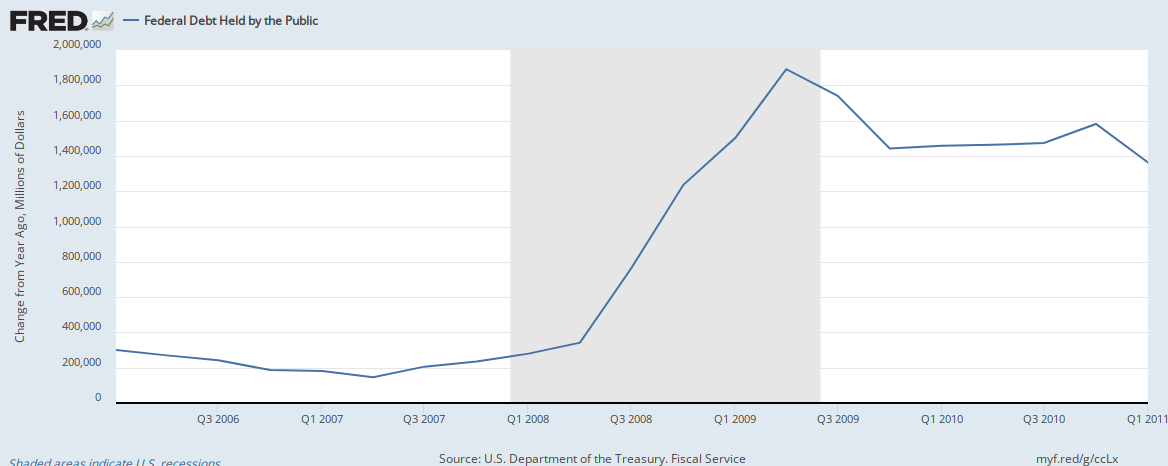
Lies #5 and #6. We borrowed $1 trillion and nobody could find that it did much of anything.

These are the most outrageous lies of all.

The U.S. doesn’t “borrow.” The Federal Reserve Bank accepts deposits in T-security accounts. The intentionally misleading word “debt,” when applied to T-securities, should be changed to “deposits.”

“Nobody could find that it did much of anything” except the deficit spending is what brought us out of the worst recession since the Great Depression of the 1930s.

Mitch McConnell and his fellow liars have learned that if one repeats a lie often enough, and if many other people repeat the same lie, the populace will believe it, no matter how obvious the lie is.

Most people are aware the federal government cannot run short of its own sovereign currency. And most people also are aware that despite massive deficit spending, the Fed’s primary concern has been the lack of inflation.

Finally, most people are aware of what the above graph tells them: The sharp increase in stimulus spending (i.e. deficits) brought us out of the recession and into almost a decade of economic growth and reduced unemployment.

The rich have bribed McConnell and his fellow politicians to lie. But they haven’t bribed you to believe their lies.

So why would you?

Rodger Malcolm Mitchell
Monetary Sovereignty

………………………………………………………………………………………………………………………………………………………………………………………………………………………………………………………………………………………………………………………………………..

The single most important problems in economics involve the excessive income/wealth/power Gaps between the rich and the rest.

Wide Gaps negatively affect poverty, health and longevity, education, housing, law and crime, war, leadership, ownership, bigotry, supply and demand, taxation, GDP, international relations, scientific advancement, the environment, human motivation and well-being, and virtually every other issue in economics.

Implementation of The Ten Steps To Prosperity can narrow the Gaps:

Ten Steps To Prosperity:
1. ELIMINATE FICA (Ten Reasons to Eliminate FICA )
Although the article lists 10 reasons to eliminate FICA, there are two fundamental reasons:
*FICA is the most regressive tax in American history, widening the Gap by punishing the low and middle-income groups, while leaving the rich untouched, and
*The federal government, being Monetarily Sovereign, neither needs nor uses FICA to support Social Security and Medicare.
2. FEDERALLY FUNDED MEDICARE — PARTS A, B & D, PLUS LONG TERM CARE — FOR EVERYONE (H.R. 676, Medicare for All )
This article addresses the questions:
*Does the economy benefit when the rich can afford better health care than can the rest of Americans?
*Aside from improved health care, what are the other economic effects of “Medicare for everyone?”
*How much would it cost taxpayers?
*Who opposes it?”
3. PROVIDE AN ANNUAL ECONOMIC BONUS TO EVERY MAN, WOMAN AND CHILD IN AMERICA, AND/OR EVERY STATE, A PER CAPITA ECONOMIC BONUS (The JG (Jobs Guarantee) vs the GI (Guaranteed Income) vs the EB) Or institute a reverse income tax.
This article is the fifth in a series about direct financial assistance to Americans:

Why Modern Monetary Theory’s Employer of Last Resort is a bad idea. Sunday, Jan 1 2012
MMT’s Job Guarantee (JG) — “Another crazy, rightwing, Austrian nutjob?” Thursday, Jan 12 2012
Why Modern Monetary Theory’s Jobs Guarantee is like the EU’s euro: A beloved solution to the wrong problem. Tuesday, May 29 2012
“You can’t fire me. I’m on JG” Saturday, Jun 2 2012

Economic growth should include the “bottom” 99.9%, not just the .1%, the only question being, how best to accomplish that. Modern Monetary Theory (MMT) favors giving everyone a job. Monetary Sovereignty (MS) favors giving everyone money. The five articles describe the pros and cons of each approach.
4. FREE EDUCATION (INCLUDING POST-GRAD) FOR EVERYONEFive reasons why we should eliminate school loans
Monetarily non-sovereign State and local governments, despite their limited finances, support grades K-12. That level of education may have been sufficient for a largely agrarian economy, but not for our currently more technical economy that demands greater numbers of highly educated workers.
Because state and local funding is so limited, grades K-12 receive short shrift, especially those schools whose populations come from the lowest economic groups. And college is too costly for most families.
An educated populace benefits a nation, and benefitting the nation is the purpose of the federal government, which has the unlimited ability to pay for K-16 and beyond.
5. SALARY FOR ATTENDING SCHOOL
Even were schooling to be completely free, many young people cannot attend, because they and their families cannot afford to support non-workers. In a foundering boat, everyone needs to bail, and no one can take time off for study.
If a young person’s “job” is to learn and be productive, he/she should be paid to do that job, especially since that job is one of America’s most important.
6. ELIMINATE CORPORATE TAXES
Corporations themselves exist only as legalities. They don’t pay taxes or pay for anything else. They are dollar-transferring machines. They transfer dollars from customers to employees, suppliers, shareholders and the government (the later having no use for those dollars).
Any tax on corporations reduces the amount going to employees, suppliers and shareholders, which diminishes the economy. Ultimately, all corporate taxes come around and reappear as deductions from your personal income.
7. INCREASE THE STANDARD INCOME TAX DEDUCTION, ANNUALLY. (Refer to this.) Federal taxes punish taxpayers and harm the economy. The federal government has no need for those punishing and harmful tax dollars. There are several ways to reduce taxes, and we should evaluate and choose the most progressive approaches.
Cutting FICA and corporate taxes would be a good early step, as both dramatically affect the 99%. Annual increases in the standard income tax deduction, and a reverse income tax also would provide benefits from the bottom up. Both would narrow the Gap.
8. TAX THE VERY RICH (THE “.1%) MORE, WITH HIGHER PROGRESSIVE TAX RATES ON ALL FORMS OF INCOME. (TROPHIC CASCADE)
There was a time when I argued against increasing anyone’s federal taxes. After all, the federal government has no need for tax dollars, and all taxes reduce Gross Domestic Product, thereby negatively affecting the entire economy, including the 99.9%.
But I have come to realize that narrowing the Gap requires trimming the top. It simply would not be possible to provide the 99.9% with enough benefits to narrow the Gap in any meaningful way. Bill Gates reportedly owns $70 billion. To get to that level, he must have been earning $10 billion a year. Pick any acceptable Gap (1000 to 1?), and the lowest paid American would have to receive $10 million a year. Unreasonable.
9. FEDERAL OWNERSHIP OF ALL BANKS (Click The end of private banking and How should America decide “who-gets-money”?)
Banks have created all the dollars that exist. Even dollars created at the direction of the federal government, actually come into being when banks increase the numbers in checking accounts. This gives the banks enormous financial power, and as we all know, power corrupts — especially when multiplied by a profit motive.
Although the federal government also is powerful and corrupted, it does not suffer from a profit motive, the world’s most corrupting influence.
10. INCREASE FEDERAL SPENDING ON THE MYRIAD INITIATIVES THAT BENEFIT AMERICA’S 99.9% (Federal agencies)Browse the agencies. See how many agencies benefit the lower- and middle-income/wealth/ power groups, by adding dollars to the economy and/or by actions more beneficial to the 99.9% than to the .1%.
Save this reference as your primer to current economics. Sadly, much of the material is not being taught in American schools, which is all the more reason for you to use it.

The Ten Steps will grow the economy, and narrow the income/wealth/power Gap between the rich and you.

MONETARY SOVEREIGNTY