Most economists claim that inflations are caused by “excessive” federal deficit spending.
I suspect the notion is that pumping dollars into the economy puts more dollars into consumers’ pockets, and having more dollars causes consumers to buy more, and these increased purchases cause inflation.
It’s the “too many dollars chasing too few products” mantra.
In her excellent book, The Deficit Myth, Professor Stephanie Kelton wrote:
“The economists behind MMT (Modern Monetary Theory) recognize that there are real limits to spending, and that attempting to push beyond those limits can manifest in excessive inflation.” (p.59)
Professor Kelton devoted an entire chapter to inflation (Chapter 2, “Think of Inflation”) in which she repeatedly claimed that ‘Excessive’ federal spending causes inflation.
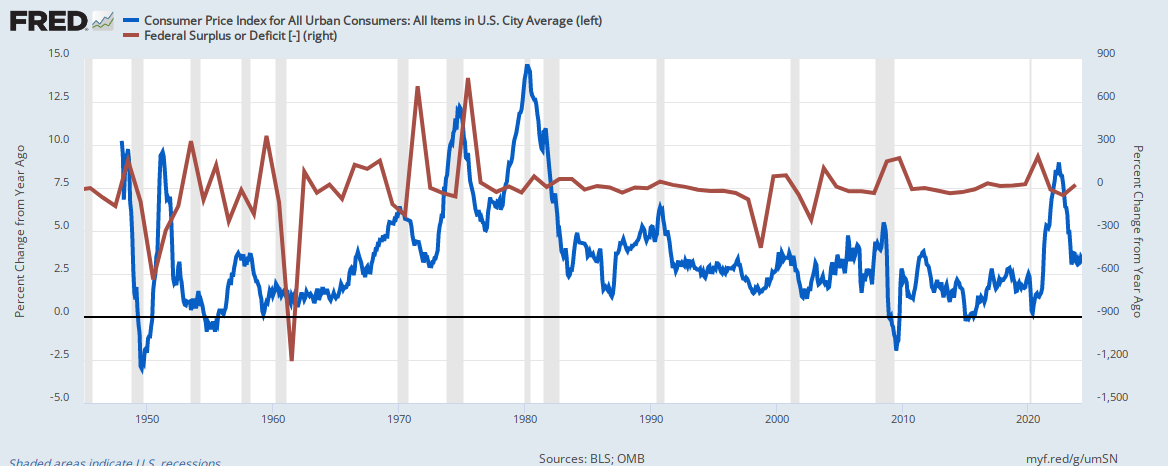
Here is a graph showing federal deficits:
Federal Surplus or Deficit — Percentage Change From a Year Ago
Looking at the above graph, one might assume we had “excessive inflations” in 1948, 1953, 1959, 1971, 1975, and perhaps a blip in 2009.
Here is a graph showing inflations in the U.S.:
Consumer Price Index for All Urban Consumers — Percentage Change From a Year Ago.
For comparison, we put the two graphs together and we see this:
Inflations (blue line). Deficits (red line).
If MMT and the rest of the economics community were correct, we should see a correlation between the peaks and valleys of federal deficit spending and inflation.
But we don’t. We don’t see any relationship at all. It sometimes is up and down together; it sometimes is the reverse. It’s completely random.
Deficits don’t cause inflation.
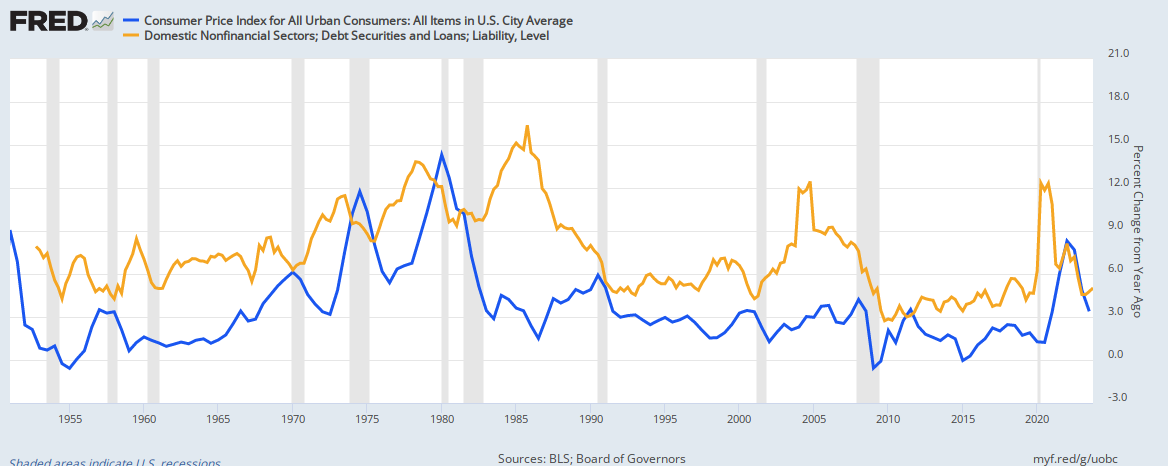
Here’s another graph. It compares changes in the overall money supply (Domestic Nonfinancial Sectors, Debt securities and Loans, Liability Level) to changes in inflation.
Orange = Domestic Nonfinancial Sectors, Debt securities and Loans, Liability Level. Blue = inflation.
Again, no predictable correspondence. Sometimes they move together; sometimes they move in opposite directions. The peaks and valleys sometimes match; sometimes they don’t.
An increased money supply doesn’t cause inflation.
And now finally look at this graph:
Blue is inflation. Green is oil prices
While inflations don’t seem to match federal deficit spending, when it comes to oil prices and inflations, the peaks as valleys line up rather nicely.
Oil shortages cause oil prices to rise, which causes inflation.
The philosophy in the blog you’re reading is called Monetary Sovereignty (MS).
MS is in substantial agreement with MMT regarding the federal government’s unlimited ability to spend dollars, the economic need for federal deficit spending, and the fact that the federal “debt” is not a burden on anyone — not on the public, not on future generations, not on lenders or borrowers, and not on the federal government.
Professor Kelton MMT makes quite a point about not believing standard, old economic theories. In fact, she even quotes Mark Twain, “What gets us into trouble is not what we don’t know. It’s what we know for sure that just ain’t so.”,
Ironically, MMT falls into the standard, old “deficits cause inflation” trap.
Not only do federal deficits not cause inflation, but federal deficit spending, properly directed, actually is the best cure for inflations.
Case in point: The infamous Zimbabwe hyperinflation began when the government took land from white farmers and gave it to black non-farmers.
Because the non-farmers didn’t know how to grow food, Zimbabwe suffered from food scarcities, which made the prices of foods rise spectacularly. That leads to the completely obvious truism:
Scarcity makes prices rise.
Had the Zimbabwe government deficit spent to train and otherwise aid the non-farmers to be better farmers, and/or had the government bought food from other countries, and distributed the food to the populace, the scarcity of food would have been eliminated.
There would have been no inflation.
Instead, the government of Zimbabwe’s response to inflation was merely to print more currency, with higher denominations, thus guaranteeing that prices would continue to rise.
Unfortunately, MMT has not been able to completely divorce itself from economic orthodoxy. Most MMT adherents were taught by economists who learned, and then taught, the common dogma about federal deficit spending and inflation.
The myths were passed down the chain.
Sadly, the fear of “excessive” deficit spending has stood in the way of what deficits really do: Federal deficits grow the economy. They grow a healthy economy and cure a sick one.
Warren Mosler, one of the creators of MMT, created “Mosler’s law” which that states, “There is no financial crisis so deep that a sufficiently large fiscal adjustment (federal deficit spending) cannot deal with it.”
That said, I try my utmost to keep an open mind. Though I have looked very hard, I’ve not found an instance of an inflation that was caused by government deficits. Every deficit I’ve researched has been caused by a shortage of some sort, usually a shortage of energy or food.
If you know of any caused by deficit spending, please let me know.
Until then, encourage federal deficit spending to implement programs like the Ten Steps to Prosperity (below).
Gap Psychology describes the common desire to distance oneself from those “below” in any socio-economic ranking, and to come nearer those “above.” The socio-economic distance is referred to as “The Gap.”
Wide Gaps negatively affect poverty, health and longevity, education, housing, law and crime, war, leadership, ownership, bigotry, supply and demand, taxation, GDP, international relations, scientific advancement, the environment, human motivation and well-being, and virtually every other issue in economics.Implementation of Monetary Sovereignty and The Ten Steps To Prosperity can grow the economy and narrow the Gaps:
The essence of the post was: If everyone wore a mask, the transmission of the COVID-19 virus would be reduced to low levels approximating the effect of “herd immunity.”
Sadly, President Trump, being concerned about how wearing a mask made him look, discouraged mask-wearing. So, his followers did their best sheep imitations by not wearing masks.
The predictable result: Millions of Americans became infected and many thousands died.
Yesterday (8/15/20) we published excerpts from an article saying that men, far more often than women, refuse to wear masks because they feel the masks make them look weak. It is a macho thing.:
According to bias, behavior, and health experts, the reason is maddeningly simple: Masks aren’t manly.
The post belittled the lack of self-confidence exhibited by men, so frightened about not looking “manly,” they are willing to risk their lives and the lives of others, by not wearing masks.
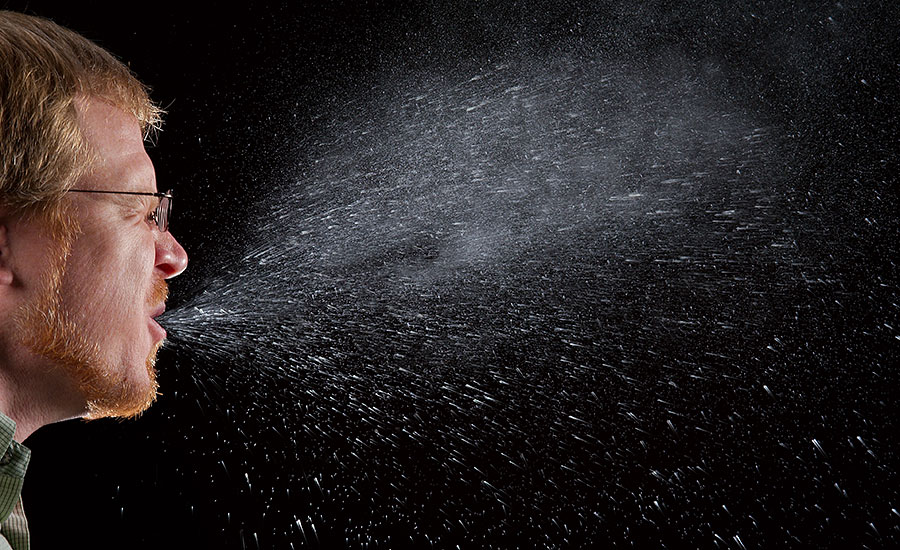
In response to that post, I received a note from a reader who wrote, “Sneeze goes right through masks. Masks are useless except to keep from drooling into the surgical field.”
The reader is correct — and incorrect.
VIRAL LOAD
You will not become ill if just one COVID-19 virus enters your mouth.
All viral diseases, including COVID-19, rely on “viral load,” the number of viruses that are in your body at any one time.
“Viral load, also known as viral burden, viral titre or viral titer, is a numerical expression of the quantity of virus in a given volume of fluid; sputum and blood plasma being two bodily fluids.” Wikipedia
The key to preventing the spread and the severity of sickness from COVID-19 is to reduce the number of viruses transmitted from person to person, i.e. reduce the viral load.
The fewer viruses received, the more likely will a person’s immune system be able to respond effectively.
That is one reason why social distancing has a positive effect. The farther you are from a person, the fewer of the person’s viruses will make it to your mouth. At six feet distant, someviruses will be transmitted, though fewer than at two feet distant.
It also is why an outdoor setting is less conducive to transmission than is an indoor venue. Outdoors, the breeze dissipates the concentration of viruses far better than does indoor air circulation.
The above-mentioned reader is correct that viruses do penetrate masks. If there were zero penetration, a mask-wearer would not be able to breath.
But:
Masks reducethe number of virus-containing droplets that penetrate the mask to be projected by an infected person.
Masks reducethe distance of droplet projection by an infected person, reducing the number that reach another person.
Masks reduce the number of droplets that penetrate the second person’s mask and are received by that person.
In total, the number of virus-containing droplets transmitted from infected people to non-infected people would be greatly reduced if everyone wore masks.
In this vein, here are excerpts from two informative articles:
Determining the viral load of patients helps predict the risk of severe disease and death, allowing clinicians to implement more aggressive care.
The new study is the first to report on the SARS-CoV-2 viral load at diagnosis as an independent biomarker of the risk of death in a large cohort of hospitalized patients.
The team also noted that viral load in the COVID-19 disease may correlate with infectivity, disease phenotype, morbidity, and mortality.
The researchers discovered that a high viral load was tied to mortality or the risk of death among hospitalized patients with COVID-19.
Not only does viral load determine whether or not a person will become infected, but it also determines how serious the infection will be and the outcome, including the likelihood of death.
The more viruses you receive, the worse your outcome.
According to the latest findings, gargling with mouthwash solutions may help inactivate the viral load of the SARS-COV-2 virus persisting in the mouth and throat and thereby, help lessen the spread of the infection.
The study, however, made it clear that using mouthwashes is no guaranteed treatment for the viral outbreak or protecting one from the infection; what it can possibly do is lower the chances of spread and transmission.
Researchers have based their evidence of using oral disinfecting solutions after studies based out of Ruhr University Bochum in Germany found out that high quantities of coronavirus exist within the upper respiratory tract, including the mouth and the throat.
It is also possible that the oral and throat cavities act as the ideal environments for the virus to settle in healthy individuals post-infection.
Since the spread of respiratory droplets, coughing, sneezing or talking are the likely causes of spread, a gargling solution like mouthwash could reduce the risk of transmission and subsequently lower the viral load or even stop it from multiplying.
Although the article wasn’t specific on this point, we assume it refers to alcohol-based mouthwashes (most are), since alcohol does inactivate viruses.
Here, the mouthwash acts as a kind of “mask” in that it reduces both the projection and the reception of the virus. You give fewer and you kill some of what you receive.
IN SUMMARY
For most problems in life, including diseases, partial solutions are all we have, and they are better than no solutions.
Herd immunity is one such partial solution. Herd immunity does not provide total immunity. Not everyone benefits. But it reduces the incidence and the effect of diseases.
With regard to COVID-19, we may never find an absolute prevention or cure. Even if a vaccine is developed, it may not be 100% effective. Partial solutions are all we ever may have.
One excellent partial solution is universal mask-wearing. Masks reduce the projection and the reception of the virus.
Additionally, it now is suspected that gargling with mouthwash will reduce the virus loadin your mouth and throat, where most of the virus begins to do its damage.
And these reductions, by reducing overall virus load, will reduce sickness and death.
So I say to my readers, never demean any solution because of it not being 100% effective. Our lives rely on partial solutions.
Wear a mask. Gargle. Help yourself and help your neighbor.
Gap Psychology describes the common desire to distance oneself from those “below” in any socio-economic ranking, and to come nearer those “above.” The socio-economic distance is referred to as “The Gap.”
Wide Gaps negatively affect poverty, health and longevity, education, housing, law and crime, war, leadership, ownership, bigotry, supply and demand, taxation, GDP, international relations, scientific advancement, the environment, human motivation and well-being, and virtually every other issue in economics.Implementation of Monetary Sovereignty and The Ten Steps To Prosperity can grow the economy and narrow the Gaps:
Back in 2015, well before Trump won the Presidency, well before he even was the leading Republican candidate, this blog warned about his dictatorial bent.
With less than three months until the most consequential election in many decades, this might be a good time to examine dictatorships.
We soon might live in one.
All dictatorships are remarkably similar. They are like movies having the same characters, and the same plot, being filmed again and again, but just with a different cast.
The four characters in a dictatorship always are: The dictator, the sycophants surrounding the dictator, the enforcers (police, army), and the public.
I. THE DICTATOR
All dictators are psychopaths.
When you read “The Hare,” the test for psychopathy, which lists twenty characteristics common to psychopaths, you’ll be able to understand why dictators exhibit psychopathic tendencies.
The clinician scores each item with 0 (no presence), 1 (uncertain) or 2 (definitely present). Psychopaths score 30 to 40 points. The general population typically scores less than 5.
1. GLIB AND SUPERFICIAL CHARM — the tendency to be smooth, engaging, charming, slick, and verbally facile.
Psychopathic charm is not in the least shy, self-conscious, or afraid to say anything. A psychopath never is tongue-tied.
“I am a stable genius.”
2. GRANDIOSE SELF-WORTH — a grossly inflated view of one’s abilities and self-worth, self-assured, opinionated, cocky, a braggart.
Psychopaths are arrogant people who believe they are superior human beings.
3. NEED FOR STIMULATION or PRONENESS TO BOREDOM — an excessive need for novel, thrilling, and exciting stimulation; taking chances and doing things that are risky.
Psychopaths often have a low self-discipline in carrying tasks through to completion because they become bored easily.
They fail to work at the same job for any length of time, for example, or to finish tasks that they consider dull or routine.
4. PATHOLOGICAL LYING — can be moderate or high; in moderate form, they will be shrewd, crafty, cunning, sly, and clever; in extreme form, they will be deceptive, deceitful, underhanded, unscrupulous, manipulative and dishonest.
They will defend their lies even when confronted with negating facts.
5. CONNING AND MANIPULATIVENESS — the use of deceit and deception to cheat, con, or defraud others for personal gain; distinguished from Item #4 in the degree to which exploitation and callous ruthlessness is present, as reflected in a lack of concern for the feelings and suffering of one’s victims.
6. LACK OF REMORSE OR GUILT — a lack of feelings or concern for the losses, pain, and suffering of victims; a tendency to be unconcerned, dispassionate, coldhearted and unempathetic.
This item is usually demonstrated by a disdain for one’s victims.
7. SHALLOW AFFECT — emotional poverty or a limited range or depth of feelings; interpersonal coldness in spite of signs of open gregariousness and superficial warmth.
8. CALLOUSNESS and LACK OF EMPATHY — a lack of feelings toward people in general; cold, contemptuous, inconsiderate, and tactless.
9. PARASITIC LIFESTYLE — an intentional, manipulative, selfis, and exploitative financial dependence on others as reflected in a lack of motivation, low self-discipline and the inability to carry through one’s responsibilities.
10. POOR BEHAVIORAL CONTROLS — expressions of irritability, annoyance, impatience, threats, aggression and verbal abuse; inadequate control of anger and temper; acting hastily.
11. PROMISCUOUS SEXUAL BEHAVIOR — a variety of brief, superficial relations, numerous affairs, and an indiscriminate selection of sexual partners; the maintenance of numerous, multiple relationships at the same time; a history of attempts to sexually coerce others into sexual activity (rape) or taking great pride at discussing sexual exploits and conquests.
12. EARLY BEHAVIOR PROBLEMS — a variety of behaviors prior to age 13, including lying, theft, cheating, vandalism,bullying, sexual activity, fire-setting, glue-sniffing, alcohol use and running away from home.
13. LACK OF REALISTIC, LONG-TERM GOALS — an inability or persistent failure to develop and execute long-term plans and goals; a nomadic existence, aimless, lacking direction in life.
14. IMPULSIVITY — the occurrence of behaviors that are unpremeditated and lack reflection or planning; inability to resist temptation, frustrations and momentary urges; a lack of deliberation without considering the consequences; foolhardy, rash, unpredictable, erratic and reckless.
15. IRRESPONSIBILITY — repeated failure to fulfill or honor obligations and commitments; such as not paying bills, defaulting on loans, performing sloppy work, being absent or late to work, failing to honor contractual agreements.
16. FAILURE TO ACCEPT RESPONSIBILITY FOR OWN ACTIONS — a failure to accept responsibility for one’s actions reflected in low conscientiousness, an absence of dutifulness, antagonistic manipulation, denial of responsibility, and an effort to manipulate others through this denial.
17. MANY SHORT-TERM RELATIONSHIPS — a lack of commitment to a long-term relationship reflected in inconsistent, undependable, and unreliable commitments in life, including in marital, business, and familial bonds.
18. JUVENILE DELINQUENCY — behavior problems between the ages of 13-18; mostly behaviors that are crimes or clearly involve aspects of antagonism, exploitation, aggression, manipulation, or a callous, ruthless tough-mindedness.
19. REVOCATION OF CONDITION RELEASE — a revocation of probation or other conditional releases due to technical violations, such as carelessness, low deliberation or failing to appear.
20. CRIMINAL VERSATILITY — a diversity of types of criminal offenses, regardless if the person has been arrested or convicted for them; taking great pride at getting away with crimes or wrongdoings.
By our count, Trump scores a 39, ( a “2” on every criterion except #19), at the very top of the psychopathy scale, and somewhat higher even than Adolf Hitler.
II. THE SYCOPHANTS
Shakespeare wrote, “Uneasy lies the head that wears a crown.” Dictators need constant emotional reinforcement, which requires a coterie of sycophants.
Similarly, dictators also are leery of those who are too talented or are given too much praise, viewing them as dangerous and untrustworthy competition.
Trump surrounds himself with incompetents, liars, toadies, and criminals. (Tom Price, Scott Pruitt, Ben Carson, Paul Manafort, Rick Gates, Michael Flynn, Michael Cohen, Wilbur Ross, Chris Collins, Duncan Hunter, Salvatore Testa, Tony Salerno, Roger Stone, Felix Sater, Jeffrey Epstein, Alexander Acosta, George Papadopoulos, Alex Van der Zwaan, Konstantin Kilimnik, et al).
Their sole qualification for his support was loyalty to Trump, who quickly dismisses any who do not display sufficient fealty to him.
And the above list doesn’t even include Mitch McConnell and the entire GOP, who lack spines or morals, so don’t dare to criticize even the most outrageous of Trumpian comments or actions.
The book, Everything That Touches Trump, Dies, “is written to argue the myriad ways in which bowing to the president will poison even those with good intentions — like those who join the administration to serve the country, or those Republicans who go along with Trumpism because they like Supreme Court Justice Neil Gorsuch.”
Many, otherwise well-intentioned people, joined Trump’s sycophant’s club only to leave in disappointment. Jeff Sessions, Rex Tillerson, John Bolton, James Comey, Anthony Scaramucci, Reince Priebus, Sean Spicer, Preet Bharara, Michael Short, Mike Dubke, Sally Yates, Angella Reid — the list goes on and on.
An example of a perfect sycophant in Trump’s menagerie is Kellyanne Conway, defends Trump’s every action, no matter how obscene. Her reputation will forever be “Trump’s Goebbels.”
(Joseph Goebbels, Hitler’s Minister of Propaganda, initiated the “Heil Hitler” salute and insisted on the use of “Der Führer” as the title. His letters are full of groveling praise — such as repeated testimonials that the experience of Hitler transformed his consciousness — and imagined scenes of glorious triumphs against various adversaries in which the Führer stands firm and unshakeable.)
Sycophants are an extreme embodiment of Gap Psychology, the urge to distance oneself from those below in any social hierarchy and to near those above.
Sycophants are emotionally vulnerable people who willingly relinquish their own personalities and beliefs to those of the dictator. They say what he says. They believe what he believes. They excuse and defend everything the dictator does, no matter how vile.
The ultimate sycophants are the members of a cult, who will go so far as commit suicide upon the orders of the cult leader. (See: Jim Jones.)
The dictator creates what are claimed to be “dangerous” enemies to hate (Trump created such “enemies” as: Mexicans, blacks, all foreigners, non-citizens, Muslims, gays, the poor, strong women, liberals, China, Democrats, ‘the elite’, the ‘lamestream’ media.”), and then he offered his protection from these “enemies.”
(For Hitler, enemies were foreigners, Jews, Gypsies, the disabled, Catholics, foreigners.)
Cultism is why the German people so willingly attacked their Jewish neighbors and sent them off to death camps. They believed what their dictator told them.
Suppressed studies. Muzzled scientists. Disbanded scientific advisory committees. These are some examples of the gross violations of scientific integrity that the Trump administration has carried out during its 3½ years in power.
At the Union of Concerned Scientists, we have been tracking these attacks on science since day one and our tracker has now hit a new, grim milestone – the Trump administration has so far engaged in more than 150 attacks on science, far exceeding the attacks recorded during the George W. Bush and Barack Obama administrations.
And during the COVID-19 pandemic, where death counts have reached 150,000, there has never been a clearer example showing that the Trump administration’s willful disregard of science comes at a fatal cost.
Only a few of the 150 examples:
Global warming is a Chinese hoax
Vaccination is a danger
The threat of COVID-19 is a lie
Air and water pollution are not a problem
Mask-wearing is a liberal plot to destroy the economy
COVID-19 testing is a liberal plot to make Trump look bad
Hydroxychloroquine prevents and cures COVID-19
Injecting disinfectant into the body can cure COVID-19
III. THE ENFORCERS
This group includes the military, private security, the police, palace guards, special forces, etc.
In addition to the military, Hitler had his personal bodyguard units, including the SS (“Protection Squadron”)
In addition to the U.S. Army, Trump has at his disposal and has used federal law enforcement officers from the FPS, ICE, Customs and Border Protection (CBP), and the U.S. Marshals Service in Portland Oregon alone.
When you see officers in riot gear attacking peaceful protestors, or read about police brutality, particularly against minorities, have you ever wondered what is going through the minds of the enforcers?
They are Americans, most often family people, who have parents and children, yet they willingly attack the parents and children of their fellow Americans with a gusto that can go well beyond “keeping the peace.”
Why? Why are all dictatorships supported by a military composed of brutal, amoral, fellow citizens? What changes, mentally and emotionally, in these people when they join an enforcer group?
That nice, polite, young man, your neighbor boy whom you watched grow up and whom you thanked for protecting the nation by joining the army — that same young man will kick down your door, shoot you and your family, and burn down your house if ordered to by his superiors.
If, one day, you had told that young man to kill a neighbor, he would have refused. But put him in a uniform, and make him part of an enforcer organization, and he will obey any order, no matter how appalling.
The German death camp guards went home each evening to hug their loving wives and play with their children; then each morning went back to work, torturing and killing other wives and children.
Why?
Our friends and neighbors knocked him down, then marched by, as he lay unconscious, bleeding, and near death on the sidewalk.
What happens to our “protectors” when they receive orders from the dictator? All over America, we see the answer.
The boys we cheer as heroes for defending us are the same boys who kill us; they essentially “lose their minds” and their morals when part of a strong dictatorial group. The group’s morals become their morals; the group’s beliefs become their beliefs.
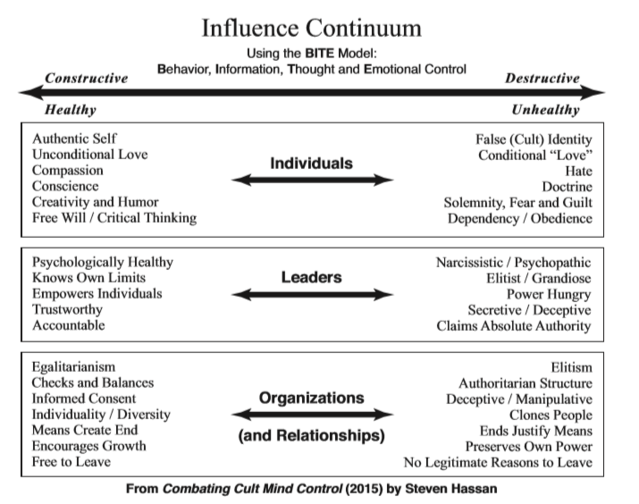
The military, the police, and all similar organizations are cults, where any divergence from the cult’s path is strongly discouraged and often punished.
They do not think of themselves as part of the community. They often think of you as the enemy, to be controlled by whatever means possible.
The greatest danger to any nation is not a foreign army, but the nation’s own army. It is relatively rare, these atomic-weapon days, for a foreign army to “take over” another nation.
But it is a daily occurrence for a dictator to use an nation’s own army to take over that nation.
From day one, military recruits are not only taught the value of instant obedience to orders, but they’re also conditioned through the rigorous, rapid, and heavily directive nature of boot camp.
The idea is to acclimatize new recruits to the idea of following the leader to hell and back.
When people are dying around you and your lieutenant tells you to “Take that hill!” then obedience and training are required for swift and efficient action.
But as a society, we’ve had to embrace the hard lessons of unthinking obedience gone wrong. The Nuremberg defense is the classic example of why “just following orders” is an unacceptable excuse for morally damning actions.
But this wasn’t the last, and it wasn’t always an enemy of the U.S. damning themselves.
IV. THE PUBLIC
By necessity, the public knows only what it is told and what it experiences.
If your fellow citizens experience problems (illness, hunger, poverty), and the controlled media tell you there are no problems, or the problems are minimal, you receive mixed messages.
That is why every dictator makes a point of demeaning the “lamestream” media. He wants to control what you see and what you hear so that you will dismiss claims of problems as “fake news.”
So far, America’s media have been free to report the facts, though dictator-driven and Russia-driven social media have had a powerful effect on what you believe.
The American Constitution created by men who had no knowledge of the Internet. It was created without the knowledge of semi-automatic and automatic guns in everyone’s hands.
It was created without the knowledge of a Congress for whom the independence of the judiciary is anathema and “law and order” is used as a synonym for fascism, racism, and tyranny.
It was created, with good intentions, to be a document that establishes a government far different from the European autocracies, with their dominant royalties.
But it only is a document, a piece of paper. Its power lies solely in the good intentions of the powerful people entrusted to interpret it honestly.
The Constitution did not prevent the forced removal of American citizens of Japanese descent. The Constitution has not prevented bigotry in hiring and compensation. The Constitution has not prevented poverty. It did not prevent the illegal Vietnam war.
The Constitution did not prevent slavery. In fact, the original Constitution prohibited the passing of laws that banned slavery. And despite what the Constitution now says, Americans remain divided about that unholy abuse (“separate but equal,” statues of slave-holders, “black lives matter”).
The Constitution cannot prevent the perversions of a dishonest President, a compliant Congress, a corrupted judiciary, nor a bigoted Supreme Court.
The Constitution does not defend America. That fragile piece of paper called “The Constitution,” relies on the American people to defend it.
Today, America is at the precipice. A dishonest leader, defended by a bootlicking Congress, a biased Supreme Court, and Americans who have forgotten the Hitlerian lessons of World War II, has taken steps to subvert the coming elections.
It once may have seemed inconceivable that America could become a 3rd world, banana-republic-style dictatorship, but no longer.
The thought that the most powerful nation on earth, militarily and economically, could be ruled by an amoral, dictatorial government, with the naive blessing of a minority of the American people, should make you shudder, for your self. For your children. For the world.
Gap Psychology describes the common desire to distance oneself from those “below” in any socio-economic ranking, and to come nearer those “above.” The socio-economic distance is referred to as “The Gap.”
Wide Gaps negatively affect poverty, health and longevity, education, housing, law and crime, war, leadership, ownership, bigotry, supply and demand, taxation, GDP, international relations, scientific advancement, the environment, human motivation and well-being, and virtually every other issue in economics.Implementation of Monetary Sovereignty and The Ten Steps To Prosperity can grow the economy and narrow the Gaps:
Of all these hundreds of agencies, just one is required to function like a business and required to make a profit in order to survive. Guess which one.
Is the USPS less important than other agencies? The postal service is one of the few agencies mentioned in the Constitution, which states that Congress has “the power to establish post officesand post roads.”
Among the other agencies indicated in the Constitution are The Senate and the House, the President, the Internal Revenue Service, Customs and Border Protection (“the power to lay and collect taxes and tariffs), the military agencies (“the power to raise and support military forces”).
None of them pay their own way.
They are too important to the nation to be required to labor under vagaries of a for-profit system.
Consider, for instance, the fallout from a situation in which the military, unable to raise money to pay its soldiers, had to cut back on its defense of America.
Or what if food inspections had to stop because the Food Safety and Inspection Service was “losing” money.
So, it has been with wonderment that over the years I’ve seen articles like this:
Postal Service loses $2.2 billion in 3 months By Matthew Daly Associated Press, August 7, 2020
WASHINGTON — The U.S. Postal Service says it lost $2.2 billion in the three months that ended in June as the beleaguered agency — hit hard by the coronavirus pandemic — piles up financial losses that officials warn could top $20 billion over two years.
While package deliveries to homebound Americans were up more than 50%, that was offset by continued declines in first-class and business mail, even as costs increased significantly to pay for personal protective equipment and replace workers who got sick or chose to stay home in fear of the virus.
Without an intervention from Congress, the agency faces an impending cash flow crisis.
The Postal Service is seeking an infusion of at least $10 billion to cover operating losses as well as regulatory changes that would undo a congressional requirement that the agency pre-fund billions of dollars in retiree health benefits.
The postal service “lost” $2.2 billion. How much, I wonder, did the military “lose”? How much did the Supreme Court “lose”? What about the Department of Veterans Affairs; how much did it “lose”? Did the National Institute of Corrections “lose” money?
The postal service charges the public for each letter or package. How much did Congress charge the public for each vote? Is the President paid by the veto or approval?
How much have you paid the Department of Agriculture for inspecting that can of corn you purchased?
The last time I drove down to Florida, I took U.S. Highways I65 and I75, and I didn’t pay the government a penny in tolls. Want a 45-minute tour of the U.S. Botanic Garden Conservatory? It’s free.
You get the point. The federal government doesn’t need to charge for anything. It has unlimited money, so why is the postal service struggling financially? There are no good reasons. None.
What will a Congress that is dominated by a postal-hating President do about the postal service? Cut service further? Perhaps one mail delivery per week, or per month? Eliminate mail altogether?
Or will Congress do what the Republicans always want to do: Privatize the postal serviceso that a few billionaire contributors can take over and make even more billions by raising stamp prices higher and higher?
And as for Republican President Bush’s prefunding of benefits, that either is ignorance or maliciousness. The U.S. government never needs to prefund anything. It has unlimited power to pay any invoice instantly.
Then, there is yet another in a long line of Trump incompetents, Louis DeJoy. He is a businessman whose primary qualification is that he donated millions to Trump and the GOP. So, of course, he was named Postmaster General.
He thinks the postal service should be run like a business, which on the surface may sound like a good idea, except for a few reality checks:
The primary mission of any business is to provide profits to its owners via salaries, dividends, and/or share-price growth. The primary mission of a government agency is to provide service to the voters and residents of its defined territory.
A business is run by its officers and directors, who have the power to pursue it’s primary mission. The post office is run by its officers who take direction from Congress and the President. The primary mission of the postal service often conflicts with the primary missions of Congress and the President, whose objectives are political, not service or business.
Businesses negotiate with unions to make mutually tolerable agreements. The negotiating power of the postal service has been usurped by Congress and the President for political, not business, reasons, which has left the postal service with unfavorable union rules. (See: Should there be workers’ unions in government?“)
Running any federal agency is diametrically opposite from running a business, and seldom do even honest, successful businessmen make good agency heads.
(This fundamental truth doesn’t begin to account for dishonest, unsuccessful, multi-bankrupt, con artists, whose sole interest is to grab as much for themselves and their families as they can.)
In summary, the postal service’s problems are of Congress’s making, and only Congress can solve them.
The agency should function financially like every other federal agency, with Congress providing sufficient appropriations for efficient service to the public.
The goal should be the highest quality service, not profitability.
Even the best-intentioned, most qualified Postmaster General could not make the postal service live up to its that service requirement, and with Louis DeJoy, we are miles away from that person.
The pearl-clutching concerns about the postal service “losing money” is a con job by the rich to pave the way for privatizing the service.
Gap Psychology describes the common desire to distance oneself from those “below” in any socio-economic ranking, and to come nearer those “above.” The socio-economic distance is referred to as “The Gap.”
Wide Gaps negatively affect poverty, health and longevity, education, housing, law and crime, war, leadership, ownership, bigotry, supply and demand, taxation, GDP, international relations, scientific advancement, the environment, human motivation and well-being, and virtually every other issue in economics.Implementation of Monetary Sovereignty and The Ten Steps To Prosperity can grow the economy and narrow the Gaps:







 #Monetary Sovereignty - Mitchell