Objections to abortion come in two “flavors.” The moral objection is that the fetus is a living human being, and anything done to terminate a fetus is murder.
This question devolves to timing. When does a human life begin?
Is an egg a human being? Most people would say, “No,” although the human egg, the largest cell in the body, contains almost everything required to make a human; the sperm, the smallest cell in the body, adds very little.
Is a human created the moment the egg is fertilized? Is a human created the moment a heartbeat can be detected?
Or when the fetus reacts to some stimulus — touch, sound, chemical? At what point during the pregnancy should the termination of a fetus be considered the murder of a human being?
Or, does human life begin only when the fetus emerges?
Despite the fury with which those questions are debated, there is no “right” answer. You can argue and present evidence until you turn blue, and you will not be able to prove anything. It’s all subjective.
We don’t even know how to define life, let alone determine when or if the end of a fetus should be defined as “murder.”
The other “flavor” is religious. Religions have rules that are couched in “morality,” but often have very little moral theme. Attending mass, eating kosher, covering your head, protecting the Qur’an, are not moral conscripts. They merely are religious rules, arbitrarily changeable, more akin to club rules than to morality.
Abortion is not even mentioned in the Old or New Testaments or in the Qur’an, though religious scholars have debated abortion for at least two thousand years, perhaps longer:.
Laws that prohibit absolutely the practice of abortion are a relatively recent development.
In the early Roman Catholic church, abortion was permitted for male fetuses in the first 40 days of pregnancy and for female fetuses in the first 80-90 days.
Not until 1588 did Pope Sixtus V declare all abortion murder, with excommunication as the punishment.
Only 3 years later a new pope found the absolute sanction unworkable and again allowed early abortions. 300 years would pass before the Catholic church under Pius IX again declared all abortion murder.
In 1920 the Soviet Union became the 1st modern state formally to legalize abortion.
In the early period after the 1917 revolution, abortion was readily available in state operated facilities. These facilities were closed and abortion made illegal when it became clear that the Soviet Union would have to defend itself against Nazi Germany.
After World War II women were encouraged to enter the labor force, and abortion once again became legal.
Strangely, some people even object to the use of condoms, which seems to indicate they believe a sperm is a human being. Others object to “the pill,” indicating the egg itself must be considered a human.
In sum, abortion laws have little to do with morals or with god. They are man-made (as opposed to woman-made) rules related to genital power and national interests.
I mention all this because of an odd paradox.
Consider Planned Parenthood. It is an organization reviled by some because it provides abortions. But it also:
“. . . provides a wide range of confidential, safe, expert health care. The majority of Planned Parenthood’s services are preventive: care that helps prevent unintended pregnancies with birth control and sex education, reduce the spread of STDs through testing and treatment, and screen for cervical, breast, and other cancers.”
Think of Planned Parenthood as a tool people can use, not only to end pregnancies, but to prevent pregnancies, and to educate themselves about many aspects of human reproduction and health. In this sense, Planned Parenthood does not abort; people abort.
Why do I phrase it that way? Because of guns, and the oft-heard defense of guns: “Guns don’t kill; people kill.”
There are several reasons why people own guns: For self-protection, for sport, to prevent and commit crimes. Guns are but a tool, the primary purpose of which is to threaten or kill. As a tool, the purpose of a gun is determined by the user.
So here we have two tools, Planned Parenthood and guns, that are tools, and as tools, their use is not determined by the tool but by the user.
The purposes of Planned Parenthood primarily are educational and self-protection, and secondarily to kill. The purposes of guns secondarily are entertainment and self-protection, but primarily to threaten and kill.
A real weirdness is revealed when you realize that the people who most avidly defend guns often are the same people who most avidly oppose Planned Parenthood.
Another interesting thought: Those people who favor guns, while opposing Planned Parenthood, seem to care nothing about the aftermaths.
That is, what do gun owners do about people who have been shot?
What care is provided by, for instance, the National Rifle Association (NRA) or any gun-owner group, for the people who survive a shooting, but are left with horrible disabilities, disfigurements, and terrible pain? What care is provided by gun owners for the families of people who are shot?
Similarly, what care is provided by abortion opponents, for unwanted children who sadly often suffer a lifetime of parental neglect? What care do pro-lifers provide to impoverished parents trying to care for those unwanted children? What care do anti-abortionists provide to mothers whose health is damaged by an unwanted pregnancy?
Ironically, it is the abortion providers, not the abortion opponents, who are more active in “sex education, reducing the spread of STDs through testing and treatment, and screening for cervical, breast, and other cancers.”
NRA Applauds Barrett. As a “pro-lifer” she opposes abortion, yet she favors anti-life guns.
Guns and Planned Parenthood: So different, yet oddly parallel, like two trains on adjacent tracks, running in opposite directions.
Do you favor all types of guns? Do you oppose Planned Parenthood?
No one can do a better job of describing how to thoroughly destroy the American economy than Maya MacGuineas, head of the Committee for a Responsible Federal Budget (CRFB). She not only writes articles for the CRFB web site, but she often is invited to spew her wisdom before Congress. She is a true celebrity in Washington.
To give you a taste of her acumen, here are excerpts from an Email I just received from her:
Wed, Oct 7 at 8:29 AM, The Cost of the Trump and Biden Campaign Plans
Whoever is inaugurated on January 20, 2021, will face many fiscal challenges over his term.
Under current law, trillion-dollar annual budget deficits will become the new normal, even after the current public health emergency subsides.
Meanwhile, the national debt is projected to exceed the post-World War II record high over the next four-year term and reach twice the size of the economy within 30 years.
For reasons never explained, MacGuineas repeatedly compares the national “debt” (i.e. the federal “debt”), with Gross Domestic Product.
The former is nothing more than the total of deposits into Treasury Security accounts; the latter is total spending in America. The two are not directly related, co-dependent or in any way comparable.
The federal government could stop accepting deposits into T-security accounts tomorrow, at which time the so-called “debt” would begin to shrink to $0 — and this would have no effect on GDP. Or the government could accept twice as much in deposits, and this too would have no effect on GDP.
So her complaint that these deposits will “reach twice the size of the economy” is meaningless, meant more to shock you than to educate you.
Four major trust funds are also headed for insolvency, including the Highway and Medicare Hospital Insurance trust funds, within the next presidential term.
What MacGuineas (and many others) misleadingly term “trust funds” are not trust funds. They are nothing more than bookkeeping accounts that are 100% controlled by the federal government. These accounts cannot become insolvent unless Congress wants them to become insolvent.
The federal government, which has the unlimited power to create U.S. dollars, along with the unlimited power to change its bookkeeping, can put any numbers it wishes into those accounts, any time it wishes.
The federal government arbitrarily could decide to double or triple the balances in these so-called “trust fund” accounts, and as if by magic, the numbers would double, and MacGuineas could stop fretting.
Whenever you see or hear the words, “federal trust funds,” know you are not being told the truth. Though even federal sites refer to “trust funds,” these are like the Bank in the game of Monopoly™: Changeable according to the players’ desires.
Fiscal irresponsibility prior to the pandemic worsened structural deficits that were already growing due to rising health and retirement costs and insufficient revenue.
It is not fiscally irresponsible for the federal government to spend more. On the contrary, not spending more would be fiscally irresponsible. Federal deficit spending grows the economy, and insufficient federal deficit spending shrinks the economy.
The country’s large and growing national debt threatens to slow economic growth, constrain the choices available to future policymakers, and is ultimately unsustainable.
The above sentence is diametrically wrong. False complaints about the national “debt” being “a ticking time bomb,” have been voiced since 1940, while the economy has grown massively.
MacGuineas herself has been making the same wrong predictions continually. and for many, many years, but has learned nothing from her predictive failures.
Yet neither presidential candidate has a plan to address the growth in debt. In fact, we find both candidates’ plans are likely to increase the debt.
Under current law, the so-called “debt” results from federal deficit spending, which pumps stimulus dollars into the economy. MacGuineas opts to remove dollars from the economy by running federal surpluses. She ignores the fact that removing dollars from the economy causes recessions and depressions.
A growing economy requires a growing supply of money. Federal deficit spending increases the supply of money, which grows the economy.
The formula for GDP is: GDP = Federal Spending + Non-federal Spending + Net Exports. All these terms are related to the money supply in the United States.
Under our central estimate, we find President Donald Trump’s campaign plan would increase the debt by $4.95 trillion over ten years and former Vice President Biden’s plan would increase the debt by $5.60 trillion.
Debt would rise from 98 percent of Gross Domestic Product (GDP) today to 125 percent by 2030 under President Trump and 128 percent under Vice President Biden, compared to 109 percent under current law.
Despite MacGuenias’s hand-wringing, both plans are insufficient to grow GDP over time. An average of 1/2 trillion dollars in deficit spending in a $20 trillion economy, amounts to only 5% per year, a level that on average, has led to recessions.
Vertical gray lines are recessions. Year to year reductions in federal “debt” growth lead to recessions, while increases in federal “debt” cure recessions.
President Donald Trump has issued a 54 bullet point agenda that calls for lowering taxes, strengthening the military, increasing infrastructure spending, expanding spending on veterans and space travel, lowering drug prices, expanding school and health care choice, ending wars abroad, and reducing spending on immigrants. He also has proposed a “Platinum Plan” for black Americans, which increases spending on education and small businesses.
Meanwhile, Vice President Joe Biden has proposed a detailed agenda to increase spending on child care and education, health care, retirement, disability benefits, infrastructure, research, and climate change, while lowering the costs of prescription drugs, ending wars abroad, and increasing taxes on high-income households and corporations.
Which of the above proposals does MacGuineas suggest should be eliminated?
She never says.She decries deficit spending while not saying where the deficit spending should be reduced. Why is she so reticent? Because she probably understands the economic need for federal deficit spending, but she is paid to deny it.
That is why she has been mouthing the same tripe for so many years.
Debt has already grown from 39 percent of the economy in 2008 to 76 percent in 2016, and is estimated to reach 98 percent by the end of FY2020. Under current law, the Congressional Budget Office (CBO) projects debt will continue to rise to 109 percent of GDP by 2030.
Our central estimate of the Trump plan finds debt would rise to 125 percent of the economy by 2030, excluding the effects of further COVID relief. Under our central estimate of the Biden plan, debt would rise to 128 percent of the economy by 2030, again excluding COVID proposals.
Then next few paragraphs of MacGuineas’s letter comprise an endless recitation of “debt” as a percentage of “the economy” (GDP), all with the tacit — and completely wrong — assumptions that a low ratio is a good ratio, and a high ratio is a bad ratio.
Based solely on the percentages, which nations would you expect to have the healthiest and/or strongest economies”?
Japan 237.54%, Venezuela 214.45%, Sudan 177.87%, Greece 174.15%,
Lebanon 157.81%, Italy 133.43%, Eritrea 127.34%, Cape Verde 125.29%,
Mozambique 124.46%, Portugal 119.46%, Barbados 117.27%, Singapore 109.37%,
United States 106.70%, Bhutan 103.85%, Cyprus 101.04%, Bahrain 100.19%,
Belgium 99.57%, France 99.20%, Spain 95.96%, Jordan 94.83%, Jamaica 94.13%,
Belize 92.64%, Angola 90.46%, Brazil 90.36%, Republic Of The Congo 90.19%,
Antigua And Barbuda 88.35%, Canada 88.01%, Egypt 86.93%, United Kingdom 85.67%,
Aruba 83.57%, Sri Lanka 82.99%, Tunisia 81.55%, Mauritania 80.61%, Zambia 80.50%,
Dominica 79.84%, Gambia 78.67%, San Marino 77.12%, Pakistan 77.00%, Argentina 75.90%,
Sao Tome And Principe 74.10%, Sierra Leone 72.37%, Suriname 72.05%,
Saint Lucia 71.62%, Saint Vincent And The Grenadines 71.38%, Uruguay 71.34%,
Austria 71.17%, Croatia 70.73%, Montenegro 70.58%, Togo 70.39%, India 69.04%,
El Salvador 68.10%, Mauritius 67.50%, Hungary 66.62%, Slovenia 65.44%, Albania 65.13%,
Morocco 65.11%, Laos 64.13%, Burundi 63.54%, Djibouti 62.99%, Ireland 62.42%,
Ukraine 62.03%, Senegal 62.00%, Ghana 61.99%, Maldives 61.43%, Oman 61.29%,
Bahamas 60.49%, Nauru 60.39%, Finland 59.88%, Saint Kitts And Nevis 59.49%,
Malawi 59.01%, Israel 58.96%, Gabon 58.48%, South Africa 57.81%, Puerto Rico 57.70%,
Ethiopia 57.43%, Vietnam 57.36%, Guyana 57.22%, Bolivia 57.11%, Germany 56.93%,
Malaysia 56.32%, Costa Rica 56.15%, Grenada 56.12%, Kyrgyzstan 56.09%, Niger 55.60%,
Kenya 55.50%, China 55.36%, Guinea Bissau 54.92%, Yemen 54.51%, Seychelles 54.49%,
Mexico 54.11%, Benin 54.00%, Qatar 52.74%, Vanuatu 52.18%, Netherlands 52.04%,
Namibia 51.60%, Belarus 51.08%, Serbia 50.95%, Ivory Coast 50.92%, Iraq 50.25%,
Fiji 50.22%, Rwanda 50.00%, Trinidad And Tobago 49.75%, Tajikistan 49.46%,
Samoa 49.44%, Ecuador 49.20%, Colombia 49.16%, Armenia 47.95%, Poland 47.48%,
Algeria 46.92%, Slovakia 46.90%, Liberia 46.66%, Guinea 45.98%, Georgia 45.05%,
Uganda 44.81%, Chad 42.91%, Burkina Faso 42.47%, Malta 42.46%,
Central African Republic 42.25%, Dominican Republic 41.92%, Thailand 41.47%,
Eswatini 41.11%, Australia 41.10%, Madagascar 41.02%, Nicaragua 40.88%,
Honduras 40.80%, South Korea 40.54%, North Macedonia 40.48%, Switzerland 39.49%,
Myanmar 39.19%, Philippines 39.10%, Cameroon 38.11%, Romania 37.99%, Lesotho 37.95%,
South Sudan 37.81%, Panama 37.81%, Papua New Guinea 37.72%, Equatorial Guinea 37.49%,
Sweden 37.23%, Mali 36.93%, Norway 36.75%, Latvia 36.66%, Tanzania 36.57%,
Bosnia And Herzegovina 36.34%, Haiti 36.23%, Comoros 35.08%, Bangladesh 34.81%,
Taiwan 33.91%, Lithuania 33.79%, Denmark 33.61%, Iceland 33.13%, Nepal 33.07%,
Czech Republic 31.57%, Turkmenistan 30.25%, Nigeria 30.05%, Iran 30.04%, Turkey 29.93%,
Cambodia 29.57%, Indonesia 29.29%, Moldova 28.82%, New Zealand 28.07%, Peru 27.18%,
Chile 27.17%, Guatemala 24.76%, Saudi Arabia 23.71%, Kiribati 23.48%,
Marshall Islands 23.37%, Uzbekistan 23.23%, Paraguay 22.37%, Tuvalu 21.81%,
Luxembourg 21.61%, Zimbabwe 20.99%, Kazakhstan 20.90%, Bulgaria 19.33%,
United Arab Emirates 19.20%, Micronesia 18.41%, Kuwait 17.78%, Azerbaijan 17.59%,
Solomon Islands 14.56%, Dr Congo 14.01%, Russia 13.79%, Botswana 12.78%, Estonia 7.61%,
Afghanistan 6.88%, Brunei 2.63%
If you say there seems to be no relationship between “debt” and GDP you would be correct, for several reasons:
Some nations are Monetarily Sovereign, which means they have the unlimited ability to create their own sovereign currency. Any liability denominated in their own currency is serviced simply by creating new currency. They cannot become insolvent if they owe their own currency.
Some nations are monetarily non-sovereign, which like you, me, the euro nations, and all local governments, cannot arbitrarily create money, and so can become insolvent.
The word “debt” means something entirely different, depending on what is owed, and why. If the “debt” consists of optional deposits, as does America’s, Japan’s, Canada’s, Australia’s, and the UK’s, paying it off merely requires returning the money on deposit.
But if the debt is necessary for the purchase of goods and services, like state and local government debt, then taxpayers must fund it, or the government will become insolvent.
If the “debt” adds net money to the economy, as with Monetarily Sovereign governments, it will grow the economy.
But, if the debt must be paid by taxpayers, which subtracts net money, as is the case with monetarily non-sovereign governments. it will shrink the economy.
Conclusion: Even before the onset of the COVID-19 pandemic and subsequent global economic crisis, the federal government was on an unsustainable fiscal path.
Under our central estimate, neither major candidate for President of the United States in 2020 has put forward a plan that would address our unsustainable fiscal path.
The favorite word used by debt critics is “unsustainable.” They never explain what they mean by that word.
Does it mean the U.S. government will run short of dollars? No, that is impossible. The government has the unlimited ability to create dollars at the touch of a computer key.
Does “unsustainable” mean other nations will not lend to the U.S.? No, the U.S. never borrows from other nations. What erroneously is termed “borrowing.” actually is the acceptance of deposits, which has two purposes:
To provide a safe, parking place for unused dollars, which helps stabilize the dollar.
To assist the Fed in controlling interest rates.
Neither purpose has anything to do with the federal government acquiring dollars. The U.S. government does not need to “acquire” dollars. It creates all the dollars it needs. Those dollars on deposit never are touched. They merely are returned when the T-certificates mature.
Does “unsustainable“ mean people will refuse to use the U.S. dollar? No, Despite an 80-year supply increase of more than 50,000%, the U.S. dollar remains a trusted currency. No knowledgeable person fears U.S. insolvency.
So what does the oft-used term “unsustainable“mean? It is a term that has no specific meaning, but is used to hint atsome dark, unspecified, future event, to make you believe the federal debt is too high, without your knowing why.
This high and rising debt could have significant economic, generational, fiscal and distributional consequences.
What are the consequences of a high and rising debt? Answer: Economic growth and prosperity.
Addendum: As I write this, I am watching the so-called debate between Kamala Harris and Mike Pence. It isn’t a debate so much as a performance, but one thing struck me: The both repeat the Big Liethat federal government financing is like state/local government financing.
They both claim that federal taxes fund federal spending, and the “How will you pay for it?” question needs be answered via a complex, convoluted, Byzantine explanation involving increased taxes and money transfers.
The real answer: The federal government will do what it always has done: It will create new dollars, ad hoc, every time it pays a bill. It’s called “Monetary Sovereignty.”
It is the way, the only way, the U.S. economy has grown and will continue to grow.
Gap Psychology describes the common desire to distance oneself from those “below” in any socio-economic ranking, and to come nearer those “above.” The socio-economic distance is referred to as “The Gap.”
Wide Gaps negatively affect poverty, health and longevity, education, housing, law and crime, war, leadership, ownership, bigotry, supply and demand, taxation, GDP, international relations, scientific advancement, the environment, human motivation and well-being, and virtually every other issue in economics.Implementation of Monetary Sovereignty and The Ten Steps To Prosperity can grow the economy and narrow the Gaps:
“A well-regulated Militia, being necessary to the security of a free State, the right of the people to keep and bear Arms, shall not be infringed.”
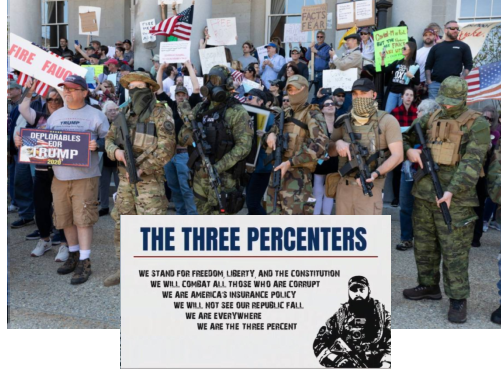
Now that the Supreme Court, in its great wisdom, has decided that the first thirteen words of the 2nd Amendment, unlike every other word in the Constitution, are useless, meaningless, and to be ignored, we can get on with the job of arming every man, woman, and child with high-powered weapons.
Thank goodness, we can count on these guys to protect America.
Heavily armed 400 members of the NFAC (Not Fucking Around Coalition)black militia marches in Lafayette, LA, August 21, 2020
Heavily-armed protesters wearing Proud Boys and Black Guns Matter masks entered the Michigan Capitol Thursday to defend their Second Amendment rights, as lawmakers continue to debate whether to ban guns from the building. Around 1,000 demonstrators gathered on the state Capitol lawn in Lansing throughout the day as part of the annual Second Amendment March that celebrates their right to open carry firearms across the state. Many protesters had AR-15 rifles slung over their shoulders, while many sported paraphernalia in support of extreme right-wing groups and Donald Trump.
There are scores of armed groups, with thousands of members who identify themselves as “militias,” though they are not “well-regulated,” as the useless and meaningless words in the Constitution demand.
From the look of those heavily-armed, “militia” people, perhaps the Supreme Court might have second thoughts about ignoring the well-regulated phrase.
But, I’m sure these guys will come to your defense if the crazy libs force you to receive Medicare, Social Security, and unemployment benefits.
From a humanitarian standpoint, you would expect both parties to want to pump vast amounts of money into the economy. Paying for businesses to stay open, paying for medical services, paying the unemployed, and the newly impoverished — this is exactly what Americans need now.
And from a politicalstandpoint, a huge stimulus check would help grow the economy and prevent a depression, which the GOP, being the party in power, should welcome. Similarly, the Dems, who would benefit in the next election from a weak economy, should oppose stimulus.
But in the byzantine world of Washington, things seldom are as they may seem. The Dems say, “More,” and the GOP says, “Less.” Why?
Let’s look at some background:
1. In the past 50 years, the federal debt (blue) has grown massively, from $280 Billion to $21 Trillion.
2. In the same period, inflation (red) has grown relatively modestly.
Monster increase in federal debt; moderate increase in inflation. And still sustainable.
3. The debt still is sustainable, has not replaced private debt, is not running short of lenders, and is not a “ticking time bomb.” None of the warnings from the debt fear-mongers have come true.
4. Because of Covid, we now suffer from a terrible recession. Many millions of Americans have run short of money, or soon will. They can’t afford even the basics: Food, rent, clothing, transportation, schooling.
5. The federal government has unlimited money. Even without collecting a single penny in taxes, it never can run short of dollars. At the touch of a computer key, the federal government could pump trillions more dollars into the economy. It could give every man, woman, and child survival money.
The U.S. government has the power to ease the fear and suffering of its people, at no cost to anyone. And yet, we see articles like this:
WASHINGTON — Democrats controlling the House narrowly passed a $2.2 trillion COVID-19 relief bill Thursday night, a move that came as top-level talks on a smaller, potentially bipartisan measure dragged on toward an uncertain finish. An air of pessimism has largely taken over the Capitol.
The Democratic bill passed after a partisan debate by a 214-207 vote without any Republicans in support.
The move puts lawmakers no closer to actually delivering aid such as more generous weekly unemployment payments, extended help for small businesses and especially troubled economic sectors such as restaurants and airlines, and another round of $1,200 direct payments to most Americans.
Passage of the $2.2 trillion plan came after a burst of negotiations this week between Treasury Secretary Steven Mnuchin and House Speaker Nancy Pelosi, D-Calif. The Trump administration delivered concessions Wednesday, including a $400 per week pandemic jobless benefit and a markedly higher overall price tag of $1.6 trillion, but that failed to win over Pelosi.
“This isn’t half a loaf, this is the heel of the loaf,” Pelosi said in a televised interview Thursday. Pelosi spoke after the White House attacked her as “not being serious.”
White House Chief of Staff Mark Meadows has drawn a line in the sand and warns that Trump won’t approve legislation that approaches a $2 trillion threshold.
So, why do the Dems want to stimulate the economy, while the GOP is dragging its feet? Two reasons:
1. The GOP is the “party of the rich.” Gap Psychology shows why the primary goal of the rich is to become richer. The only way to do that is to widen the income/wealth/power Gap between the rich and the rest.
The Gap is what makes them rich; the wider the Gap, the richer they are.
There are two ways for the rich to widen the Gap: Either get more for themselves or force the “non-rich” to settle for less. The COVID recession is forcing the “non-rich” into desperate poverty.
Desperate workers, willing to accept any job at a low wage, are exactly what the rich want. A generous stimulus package would narrow the Gap.
Desperate workers, wider economic Gap: Sounds like heaven to the party of the rich.
2. A stimulus package passed today would primarily affect the post-election economy — much too late to improve the GOP’s political chances this year.
So from the Republican standpoint, why do anything that might help a possibly Democrat administration, especially since the GOP has been locked into the false narrative that deficits are bad?
They would rather wait until they see this year’s election results. Then if they win, they always can ride in heroically to stimulate economic growth before the mid-term elections.
As for the starving, jobless Americans, who cares about them? To the right-wing, they merely are what Modern Monetary Theory refers to as “buffer stock.”
Gap Psychology describes the common desire to distance oneself from those “below” in any socio-economic ranking, and to come nearer those “above.” The socio-economic distance is referred to as “The Gap.”
Wide Gaps negatively affect poverty, health and longevity, education, housing, law and crime, war, leadership, ownership, bigotry, supply and demand, taxation, GDP, international relations, scientific advancement, the environment, human motivation and well-being, and virtually every other issue in economics.Implementation of Monetary Sovereignty and The Ten Steps To Prosperity can grow the economy and narrow the Gaps:










 #Monetary Sovereignty - Mitchell