The minimum wage: Good or bad?

The minimum wage: Good or bad?

The answer is: Neither . . . or both. I’ll give you my answer.

The minimum wage, any minimum wage, affects:

  1. Low wage workers
  2. Unions
  3. Businesses
  4. States, counties, and cities
  5. The nation

A recent article addresses some of these issues:

This governor says a low minimum wage is great for his state Rick Newman

Yahoo Finance By Rick Newman, May 6, 2016 11:07 AM

When Florida Gov. Rick Scott traveled to California recently to speak at the Milken Institute’s annual gathering of business leaders it was to persuade California companies to move to Florida.

“Our taxes are lower than in California, our regulations are less,” Scott, a Republican who’s been governor since 2011, explains in the video above. “I want more jobs in our state.”

Scott points to some research showing higher wages will lead employers to hire fewer people. “Raising the minimum wage means people are going to lose their jobs,” he says. “In Florida, you can compete globally.”

By that, he means that the Florida minimum wage of $8.05, while higher than the federal minimum, can help companies compete with foreign producers in China, Mexico, Vietnam and elsewhere that pay a fraction of U.S. wages.

States that have lost jobs and businesses to Florida recently include California (where the minimum wage is $10 and will rise to $15 in some areas by 2022), Pennsylvania ($7.25, but the state also has the nation’s second-highest corporate tax rate), New York ($9 minimum wage, rising to $15 in many areas by 2018) and Connecticut ($9.60, rising to $10.10 in 2017).

Immediately, we see the complexity of the minimum wage argument. Governor Scott conflates low taxes and few regulations with low minimum wage, to create a picture of a state that is more competitive with other states.

The difficulty is:

  1. Florida’s comparatively low minimum wage, low taxes, and few regulations do not make it competitive with other countries, especially poorer nations where wages, taxes and regulations are far lower than Florida’s.
  2. It is difficult to say what exactly accounts for any of Florida’s successes in attracting business from other states. Taxes? Regulations? (Which regulations?) Minimum wage? (At what level?) The weather? Sea port? Unionization? Some other factors?

Florida’s hardly the only state luring businesses with low taxes.

General Electric recently chose to relocate its headquarters from Connecticut to Massachusetts, swapping the threat of higher taxes in the Nutmeg state for tax sweeteners.

Foreign automakers and other manufacturers generally locate their factories these days in nonunionized, low-tax southern states such as Tennessee and Alabama instead of in the Northeast or Midwest.

Florida even nabbed billionaire hedge-fund manager David Tepper, who recently moved his personal residence from New Jersey, where the top individual income-tax rate is nearly 9%. In Florida, there’s no individual income tax.

The article switches focus from minimum wage to taxes.

Economists generally agree that a minimum wage can stifle hiring if it’s too high – but they don’t agree on what’s too high and what’s just right.

There are also some unhappy tradeoffs that come with low taxes. Florida typically ranks high in surveys of the most business-friendly states by organizations such as CNBC and the Tax Foundation, but low state taxes often mean a lower level of government services or higher taxes at the local level.

Wallethub, for instance, finds that Florida is friendlier for high-income taxpayers than for lower-income ones. It also finds that Florida ranks below average on government services, the overall economic climate and safety.

Let’s see if we can sort this all out. Florida is business-friendly, not because it has a low minimum wage, but for a variety of reasons, and no one is able to say, which of those reasons are most important.

Additionally, no on knows what level of minimum wage will “stifle” hiring.

And if we do identify a minimum wage level that “stifles” hiring, we still have to decide whether having more lower-paying jobs is economically and socially better than offering fewer, higher paid jobs.

Which do you think is economically and socially better?
-More, lower paying jobs, i.e. a low unemployment state filled with Walmart greeters and Wendy’s servers, many of whom require two jobs to survive, or
–Fewer, higher paying jobs, i.e. a higher unemployment state and a greater need for  unemployment insurance payments.

(When salaries are low, more people take multiple jobs, which exacerbates the unemployment rate.)

In 2014, the Median Household income for the United States was $53,657.  Florida’s was $46,140, 14% lower. Only seven states had a lower median income than Florida’s.

Being opposed to a wide Gap between the rich and the rest, I would opt for fewer, higher paying jobs — if that were the only alternative — which it isn’t, as we will see.

Florida, in it’s efforts to please the rich, charges no tax on income (good for the rich), but does charge a general, regressive sales tax of 6% (bad for the poor and middle classes). Florida’s lack of income tax dollars results in poorer social services for the lower and middle income groups.

Let us return to the “interested parties” and try to summarize how an increased minimum wage affects each:

  1. Low wage workers: There probably will be a reduction in available jobs as American businesses:
    1. become less internationally competitive
    2. or move more production overseas
    3. or mechanize to find more ways to cut human labor
  2. Unions: May focus more on non-salary demands (vacation time, insurance, tenure), which magnify the effects (good and bad) of an increased minimum wage.
  3. Businesses: Seemingly countering the above-mentioned negative effects would be increased demand by those workers who benefit from increased wages. However, because a higher minimum wage does not add dollars to the economy, and may actually reduce dollars as businesses spend more on overseas production, total GDP, total wages and total jobs offered probably would suffer.
  4. States, counties, and cities: Some would benefit and some would suffer, depending on local circumstances. There would be a widening of the Gap between the state, county, and city “haves” and the “have-nots,” as salary differences are reduced but local effects (weather, geography, mores, taxes, tourism) become relatively more important.
  5. The nation: Some workers will benefit and some will lose. With no net increase in the money supply — and even a possible decrease, due to increased imports — it is difficult to identify a source of national benefit from an increased minimum wage.

My opinion: Lowest paid workers should receive pay increases, but from the federal government, not from businesses. These increases can come from the first seven steps, and the tenth step, in the “Ten Steps to Prosperity” (below). For example:

*Eliminating FICA, instituting Medicare for All, free education for all, and salary for attending school (Steps #1, #2, #4, and #5) not only would put more dollars into workers’ pockets, but reduce U.S. business costs and add dollars to the economy, stimulating GDP — all of which would add jobs and narrow the Gap between the rich and the rest.

*An economic bonus for every man, woman and child (Step #3) would provide the same benefit to the lowest income people as a minimum wage increase, while adding dollars to, and thus stimulating, the overall economy.

*Eliminating corporate taxes (Step #6) would make American business more internationally competitive, while stimulating the economy and adding American jobs.

*Finally, increase federal spending in initiatives that benefit the 99.9% (Step #10) is a catchall that includes most federal domestic spending, from road building to computer programming, all of which would increase employment and wages.

Bottom line: The fundamental goals of an increase in the minimum wage are to: lift the lower income groups, narrow the Gap between the rich and the rest, and grow the economy.

But, forcing American business to pay more won’t do it.

The federal government is the only organization having the resources to accomplish those goals.

I oppose a minimum wage increase as being counter-effective, and favor instead, instituting the Ten Steps to Prosperity.

Rodger Malcolm Mitchell
Monetary Sovereignty
===================================================================================
Ten Steps to Prosperity:
1. ELIMINATE FICA (Ten Reasons to Eliminate FICA )
Although the article lists 10 reasons to eliminate FICA, there are two fundamental reasons:
*FICA is the most regressive tax in American history, widening the Gap by punishing the low and middle-income groups, while leaving the rich untouched, and
*The federal government, being Monetarily Sovereign, neither needs nor uses FICA to support Social Security and Medicare.
2. FEDERALLY FUNDED MEDICARE — PARTS A, B & D, PLUS LONG TERM CARE — FOR EVERYONE (H.R. 676, Medicare for All )
This article addresses the questions:
*Does the economy benefit when the rich afford better health care than the rest of Americans?
*Aside from improved health care, what are the other economic effects of “Medicare for everyone?”
*How much would it cost taxpayers?
*Who opposes it?”
3. PROVIDE AN ECONOMIC BONUS TO EVERY MAN, WOMAN AND CHILD IN AMERICA, AND/OR EVERY STATE, A PER CAPITA ECONOMIC BONUS (The JG (Jobs Guarantee) vs the GI (Guaranteed Income) vs the EB) Or institute a reverse income tax.
This article is the fifth in a series about direct financial assistance to Americans:

Why Modern Monetary Theory’s Employer of Last Resort is a bad idea. Sunday, Jan 1 2012
MMT’s Job Guarantee (JG) — “Another crazy, rightwing, Austrian nutjob?” Thursday, Jan 12 2012
Why Modern Monetary Theory’s Jobs Guarantee is like the EU’s euro: A beloved solution to the wrong problem. Tuesday, May 29 2012
“You can’t fire me. I’m on JG” Saturday, Jun 2 2012

Economic growth should include the “bottom” 99.9%, not just the .1%, the only question being, how best to accomplish that. Modern Monetary Theory (MMT) favors giving everyone a job. Monetary Sovereignty (MS) favors giving everyone money. The five articles describe the pros and cons of each approach.
4. FREE EDUCATION (INCLUDING POST-GRAD) FOR EVERYONEFive reasons why we should eliminate school loans
Monetarily non-sovereign State and local governments, despite their limited finances, support grades K-12. That level of education may have been sufficient for a largely agrarian economy, but not for our currently more technical economy that demands greater numbers of highly educated workers.
Because state and local funding is so limited, grades K-12 receive short shrift, especially those schools whose populations come from the lowest economic groups. And college is too costly for most families.
An educated populace benefits a nation, and benefiting the nation is the purpose of the federal government, which has the unlimited ability to pay for K-16 and beyond.
5. SALARY FOR ATTENDING SCHOOL
Even were schooling to be completely free, many young people cannot attend, because they and their families cannot afford to support non-workers. In a foundering boat, everyone needs to bail, and no one can take time off for study.
If a young person’s “job” is to learn and be productive, he/she should be paid to do that job, especially since that job is one of America’s most important.
6. ELIMINATE CORPORATE TAXES
Corporations themselves exist only as legalities. They don’t pay taxes or pay for anything else. They are dollar-tranferring machines. They transfer dollars from customers to employees, suppliers, shareholders and the government (the later having no use for those dollars).
Any tax on corporations reduces the amount going to employees, suppliers and shareholders, which diminishes the economy. Ultimately, all corporate taxes come around and reappear as deductions from your personal income.
7. INCREASE THE STANDARD INCOME TAX DEDUCTION, ANNUALLY. (Refer to this.)
Federal taxes punish taxpayers and harm the economy. The federal government has no need for those punishing and harmful tax dollars. There are several ways to reduce taxes, and we should evaluate and choose the most progressive approaches.
Cutting FICA and corporate taxes would be an good early step, as both dramatically affect the 99%. Annual increases in the standard income tax deduction, and a reverse income tax also would provide benefits from the bottom up. Both would narrow the Gap.
8. TAX THE VERY RICH (THE “.1%) MORE, WITH HIGHER PROGRESSIVE TAX RATES ON ALL FORMS OF INCOME. (TROPHIC CASCADE)
There was a time when I argued against increasing anyone’s federal taxes. After all, the federal government has no need for tax dollars, and all taxes reduce Gross Domestic Product, thereby negatively affecting the entire economy, including the 99.9%.
But I have come to realize that narrowing the Gap requires trimming the top. It simply would not be possible to provide the 99.9% with enough benefits to narrow the Gap in any meaningful way. Bill Gates reportedly owns $70 billion. To get to that level, he must have been earning $10 billion a year. Pick any acceptable Gap (1000 to 1?), and the lowest paid American would have to receive $10 million a year. Unreasonable.
9. FEDERAL OWNERSHIP OF ALL BANKS (Click The end of private banking and How should America decide “who-gets-money”?)
Banks have created all the dollars that exist. Even dollars created at the direction of the federal government, actually come into being when banks increase the numbers in checking accounts. This gives the banks enormous financial power, and as we all know, power corrupts — especially when multiplied by a profit motive.
Although the federal government also is powerful and corrupted, it does not suffer from a profit motive, the world’s most corrupting influence.
10. INCREASE FEDERAL SPENDING ON THE MYRIAD INITIATIVES THAT BENEFIT AMERICA’S 99.9% (Federal agencies)Browse the agencies. See how many agencies benefit the lower- and middle-income/wealth/ power groups, by adding dollars to the economy and/or by actions more beneficial to the 99.9% than to the .1%.
Save this reference as your primer to current economics. Sadly, much of the material is not being taught in American schools, which is all the more reason for you to use it.

The Ten Steps will grow the economy, and narrow the income/wealth/power Gap between the rich and you.
========================================================================================================================================================================================================================================================================================================

10 Steps to Economic Misery: (Click here:)
1. Maintain or increase the FICA tax..
2. Spread the myth Social Security, Medicare and the U.S. government are insolvent.
3. Cut federal employment in the military, post office, other federal agencies.
4. Broaden the income tax base so more lower income people will pay.
5. Cut financial assistance to the states.
6. Spread the myth federal taxes pay for federal spending.
7. Allow banks to trade for their own accounts; save them when their investments go sour.
8. Never prosecute any banker for criminal activity.
9. Nominate arch conservatives to the Supreme Court.
10. Reduce the federal deficit and debt

THE RECESSION CLOCK

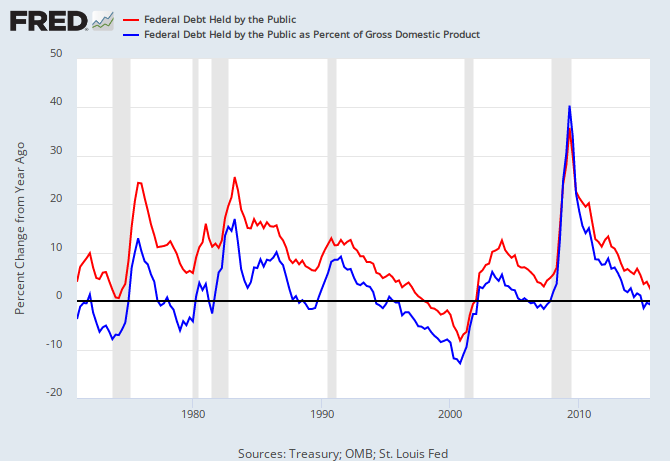
Recessions begin an average of 2 years after the blue line first dips below zero. A common phenomenon is for the line briefly to dip below zero, then rise above zero, before falling dramatically below zero. There was a brief dip below zero in 2015, followed by another dip – the familiar pre-recession pattern.
Recessions are cured by a rising red line.
Monetary Sovereignty

Vertical gray bars mark recessions.

As the federal deficit growth lines drop, we approach recession, which will be cured only when the growth lines rise. Increasing federal deficit growth (aka “stimulus”) is necessary for long-term economic growth.

————————————————————————————————————————————————————————————————————————————————————————————————-

Mitchell’s laws:
•Those, who do not understand the differences between Monetary Sovereignty and monetary non-sovereignty, do not understand economics.
•Any monetarily NON-sovereign government — be it city, county, state or nation — that runs an ongoing trade deficit, eventually will run out of money.
•The more federal budgets are cut and taxes increased, the weaker an economy becomes..

•No nation can tax itself into prosperity, nor grow without money growth.
•Cutting federal deficits to grow the economy is like applying leeches to cure anemia.
•A growing economy requires a growing supply of money (GDP = Federal Spending + Non-federal Spending + Net Exports)
•Deficit spending grows the supply of money
•The limit to federal deficit spending is an inflation that cannot be cured with interest rate control.
•The limit to non-federal deficit spending is the ability to borrow.

Liberals think the purpose of government is to protect the poor and powerless from the rich and powerful. Conservatives think the purpose of government is to protect the rich and powerful from the poor and powerless.

•The single most important problem in economics is the Gap between rich and the rest..
•Austerity is the government’s method for widening
the Gap between rich and poor.
•Until the 99% understand the need for federal deficits, the upper 1% will rule.
•Everything in economics devolves to motive, and the motive is the Gap between the rich and the rest..

MONETARY SOVEREIGNTY
 

Reversal of fortune: Liberal Republicans? Conservative Democrats?

Things change.

Since the Civil War,  and even well before, American Southerners essentially have had one fundamental political issue: Slavery.

This subsequently has broadened into more generalized hatred of non-whites, non-Christians, gays and foreigners, but it began with contempt for slaves. (Hatred does not accept boundaries.)

Because Lincoln was a Republican, the old “Solid South” voted against Republicans (i.e for Democrats) for nearly 100 years.

Wikipedia: By the mid-1960s, changes had come in many of the Southern states.

Former Dixiecrat Senator Strom Thurmond, of South Carolina changed parties in 1964; Texas elected a Republican Senator in 1961; Florida and Arkansas elected Republican governors in 1966.

In the upper South, where Republicans had always been a small presence, Republicans gained a few House and Senate seats.

Republican President Richard Nixon adopted a “Southern Strategy” for the presidential election of 1972: Continue enforcement of the civil rights legislation of the 1960s, but be quiet about it, so that offended Southern whites would continue to blame the Democrats, while talking up the Democrats’ increasing association with liberal views.

This strategy was wildly successful – Nixon carried every southern state by huge margins.

What formerly was Republican Lincolnian liberalism transitioned into Republican Nixonian conservatism. Today, the “Solid South” still votes hatred.

Nixon’s cynical pandering to Southern bigotry worked, and the same voters who were solidly Democratic are now solidly Republican.

But things change.

The nation’s population has become less white, and the nation, as a whole, has moved toward the liberal side of the spectrum.

Meanwhile, the nation’s richest .1% generally remain conservative, and their money (aka “free speech”) has moved the nation’s politicians to the right.

The leftward move of the population and the rightward move of the politicians is a dichotomy that never long continues.

Now, comes Donald Trump, a nominative Republican, who:
–donated money to Democrats
–does not subscribe to the conservative’s small government (code for “state’s rights”)
–likes single-payer Medicare and considers healthcare to be one of three federal responsibilities (along with education and the military)
–supports Planned Parenthood (except for abortion)
–historically has not adhered to the conservative agenda

In short, Trump, the anti-Cruz, still leans conservative, but is the most liberal of all Republican Presidential wannabes.

And, now comes Hillary Clinton nominative Democrat, who agrees with the Obama conservative agenda:
–cutting Social Security benefits
–budget-balancing deficit reduction and austerity
–coddling criminal bankers
–disagreeing with Bernie Sanders’ expansion of Medicare

In short, Clinton, the anti-Sanders, still leans liberal, but is the most conservative of the Democratic Presidential wannabes.

Are we witnessing the start of a trend, in which the Republicans become liberal and the Democrats become conservative?

A few facts:
*Congress currently is conservative.
*The nation, as a whole, has become far more liberal over the years.
*The population among the traditionally liberal is growing, while the conservative population is declining.
*The adoption of “Obamacare,” though invented by a conservative, still is a sign of growing liberalism
*The laws benefiting gays are signs of growing liberalism
*Even conservative media tend to lean liberal with regard to laws affecting the poor and middle classes
*Ted Cruz, the most conservative candidate, was soundly rebuffed by Republican voters
*Republicans hold their Congressional majorities only by denying minorities the vote and by gerrymandering
*Republicans only hope of a Presidency is via the non-representational Electoral College, counter to a one-man, one-vote democracy

While Trump drags Republicans to the left, Clinton drags Democrats to the right, and if the current course becomes a trend, and particularly if Clinton wins big, one easily could imagine a Sandersesque politician replacing Trump and taking over the Republican Party.

Politicians want first, to win. Pragmatic politics (realpolitik) may recognize America’s shift toward liberalism, so many conservative politicians could “jump ship” and decide, “If you can’t beat ’em, join ’em.”

Or, the two parties simply may discard the extremes on both sides, and approach each other, in a Trumpist/Clintonist blend of ideologies.

This moderation could be reflected in the Supreme Court, currently divided equally between liberal and conservative ideologies (thereby demonstrating the farcical myth of “disinterested” jurists measuring matters of Constitutional law).

Today, a right-wing Congress refuses to consider any Justice nominated by a Democratic President. The nations voters, who usually display more sense and understanding of the Constitution than does Congress, may reject such ideological polarization.

In summary, the haters will continue to hate, but their influence is waning. Bigotry is less in vogue these days. Because politicians are the world’s best followers, and as they notice which way the political winds are blowing, they may do as they are wont to do: Switch positions.

Which leaves the question: In switching, will they overshoot, with the Republicans becoming less conservative and more liberal even than the Democrats?

It has happened before.

In 1951 Eric Hoffer published a book titled, “The True Believer” in which he . . .

. . . analyzes and attempts to explain the motives of the various types of personalities that give rise to mass movements; why and how mass movements start, progress and end; and the similarities between them, whether religious, political, radical or reactionary.

He argues that even when their stated goals or values differ mass movements are interchangeable, that adherents will often flip from one movement to another, and that the motivations for mass movements are interchangeable.

Thus, religious, nationalist and social movements, whether radical or reactionary, tend to attract the same type of followers, behave in the same way and use the same tactics and rhetorical tools.

Hoffer states that mass movements begin with a widespread “desire for change” from discontented people who place their locus of control outside their power and who also have no confidence in existing culture or traditions.

As examples of the interchangeable nature of mass movements, Hoffer cites how almost 2000 years ago Saul, a fanatical opponent of Christianity, became Paul, a fanatical apologist and promoter of Christianity.

Another example occurred in Germany during the 1920s and the 1930s, when Communists and Fascists were ostensibly bitter enemies but in fact competed for the same type of angry, marginalized people; Nazis Adolf Hitler and Ernst Röhm, and Communist Karl Radek, all boasted of their prowess in converting their rivals.

The “New Poor” are the most likely source of converts for mass movements/for they recall their former wealth with resentment and blame others for their current misfortune.

While mass movements idealize the past and glorify the future, the present world is denigrated: “The radical and the reactionary loath the present.” Thus, by regarding the modern world as vile and worthless, mass movements inspire a perpetual battle against the present.

Successful mass movements need not believe in a god, but they must believe in a devil. Hatred unifies the true believers, and “the ideal devil is a foreigner.”

So it has been and so it may be. The mass movement that created the hate-based Tea/Republicans may flip to a liberal, Lincolnesque Republican party, while the rich, ever conservative, may create a conservative, Clintonesque Democratic party.

Thanks to Trump and Clinton, Sanders and Cruz, we may see yet another reversal of fortune.

Rodger Malcolm Mitchell
Monetary Sovereignty
===================================================================================
Ten Steps to Prosperity:
1. ELIMINATE FICA (Ten Reasons to Eliminate FICA )
Although the article lists 10 reasons to eliminate FICA, there are two fundamental reasons:
*FICA is the most regressive tax in American history, widening the Gap by punishing the low and middle-income groups, while leaving the rich untouched, and
*The federal government, being Monetarily Sovereign, neither needs nor uses FICA to support Social Security and Medicare.
2. FEDERALLY FUNDED MEDICARE — PARTS A, B & D, PLUS LONG TERM CARE — FOR EVERYONE (H.R. 676, Medicare for All )
This article addresses the questions:
*Does the economy benefit when the rich afford better health care than the rest of Americans?
*Aside from improved health care, what are the other economic effects of “Medicare for everyone?”
*How much would it cost taxpayers?
*Who opposes it?”
3. PROVIDE AN ECONOMIC BONUS TO EVERY MAN, WOMAN AND CHILD IN AMERICA, AND/OR EVERY STATE A PER CAPITA ECONOMIC BONUS (The JG (Jobs Guarantee) vs the GI (Guaranteed Income) vs the EB) Or institute a reverse income tax.
This article is the fifth in a series about direct financial assistance to Americans:

Why Modern Monetary Theory’s Employer of Last Resort is a bad idea. Sunday, Jan 1 2012
MMT’s Job Guarantee (JG) — “Another crazy, rightwing, Austrian nutjob?” Thursday, Jan 12 2012
Why Modern Monetary Theory’s Jobs Guarantee is like the EU’s euro: A beloved solution to the wrong problem. Tuesday, May 29 2012
“You can’t fire me. I’m on JG” Saturday, Jun 2 2012

Economic growth should include the “bottom” 99.9%, not just the .1%, the only question being, how best to accomplish that. Modern Monetary Theory (MMT) favors giving everyone a job. Monetary Sovereignty (MS) favors giving everyone money. The five articles describe the pros and cons of each approach.
4. FREE EDUCATION (INCLUDING POST-GRAD) FOR EVERYONEFive reasons why we should eliminate school loans
Monetarily non-sovereign State and local governments, despite their limited finances, support grades K-12. That level of education may have been sufficient for a largely agrarian economy, but not for our currently more technical economy that demands greater numbers of highly educated workers.
Because state and local funding is so limited, grades K-12 receive short shrift, especially those schools whose populations come from the lowest economic groups. And college is too costly for most families.
An educated populace benefits a nation, and benefiting the nation is the purpose of the federal government, which has the unlimited ability to pay for K-16 and beyond.
5. SALARY FOR ATTENDING SCHOOL
Even were schooling to be completely free, many young people cannot attend, because they and their families cannot afford to support non-workers. In a foundering boat, everyone needs to bail, and no one can take time off for study.
If a young person’s “job” is to learn and be productive, he/she should be paid to do that job, especially since that job is one of America’s most important.
6. ELIMINATE CORPORATE TAXES
Corporations themselves exist only as legalities. They don’t pay taxes or pay for anything else. They are dollar-tranferring machines. They transfer dollars from customers to employees, suppliers, shareholders and the government (the later having no use for those dollars).
Any tax on corporations reduces the amount going to employees, suppliers and shareholders, which diminishes the economy. Ultimately, all corporate taxes come around and reappear as deductions from your personal income.
7. INCREASE THE STANDARD INCOME TAX DEDUCTION, ANNUALLY. (Refer to this.)
Federal taxes punish taxpayers and harm the economy. The federal government has no need for those punishing and harmful tax dollars. There are several ways to reduce taxes, and we should evaluate and choose the most progressive approaches.
Cutting FICA and corporate taxes would be an good early step, as both dramatically affect the 99%. Annual increases in the standard income tax deduction, and a reverse income tax also would provide benefits from the bottom up. Both would narrow the Gap.
8. TAX THE VERY RICH (THE “.1%) MORE, WITH HIGHER PROGRESSIVE TAX RATES ON ALL FORMS OF INCOME. (TROPHIC CASCADE)
There was a time when I argued against increasing anyone’s federal taxes. After all, the federal government has no need for tax dollars, and all taxes reduce Gross Domestic Product, thereby negatively affecting the entire economy, including the 99.9%.
But I have come to realize that narrowing the Gap requires trimming the top. It simply would not be possible to provide the 99.9% with enough benefits to narrow the Gap in any meaningful way. Bill Gates reportedly owns $70 billion. To get to that level, he must have been earning $10 billion a year. Pick any acceptable Gap (1000 to 1?), and the lowest paid American would have to receive $10 million a year. Unreasonable.
9. FEDERAL OWNERSHIP OF ALL BANKS (Click The end of private banking and How should America decide “who-gets-money”?)
Banks have created all the dollars that exist. Even dollars created at the direction of the federal government, actually come into being when banks increase the numbers in checking accounts. This gives the banks enormous financial power, and as we all know, power corrupts — especially when multiplied by a profit motive.
Although the federal government also is powerful and corrupted, it does not suffer from a profit motive, the world’s most corrupting influence.
10. INCREASE FEDERAL SPENDING ON THE MYRIAD INITIATIVES THAT BENEFIT AMERICA’S 99.9% (Federal agencies)Browse the agencies. See how many agencies benefit the lower- and middle-income/wealth/ power groups, by adding dollars to the economy and/or by actions more beneficial to the 99.9% than to the .1%.
Save this reference as your primer to current economics. Sadly, much of the material is not being taught in American schools, which is all the more reason for you to use it.

The Ten Steps will grow the economy, and narrow the income/wealth/power Gap between the rich and you.
========================================================================================================================================================================================================================================================================================================

10 Steps to Economic Misery: (Click here:)
1. Maintain or increase the FICA tax..
2. Spread the myth Social Security, Medicare and the U.S. government are insolvent.
3. Cut federal employment in the military, post office, other federal agencies.
4. Broaden the income tax base so more lower income people will pay.
5. Cut financial assistance to the states.
6. Spread the myth federal taxes pay for federal spending.
7. Allow banks to trade for their own accounts; save them when their investments go sour.
8. Never prosecute any banker for criminal activity.
9. Nominate arch conservatives to the Supreme Court.
10. Reduce the federal deficit and debt

THE RECESSION CLOCK

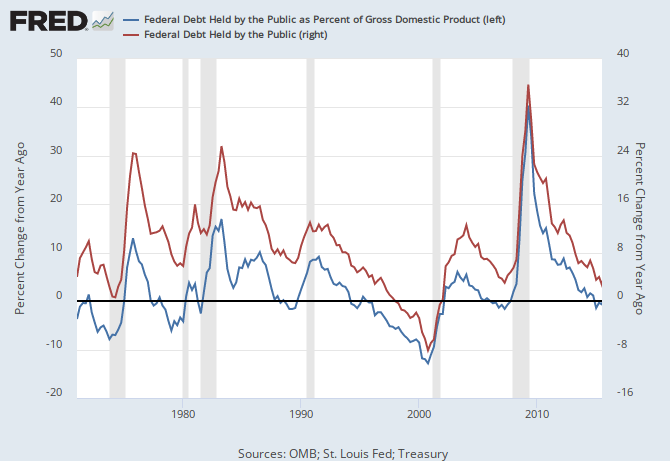
Recessions begin an average of 2 years after the blue line first dips below zero. A common phenomenon is for the line briefly to dip below zero, then rise above zero, before falling dramatically below zero. There was a brief dip below zero in 2015, followed by another dip – the familiar pre-recession pattern.
Recessions are cured by a rising red line.

Monetary Sovereignty

Vertical gray bars mark recessions.

As the federal deficit growth lines drop, we approach recession, which will be cured only when the growth lines rise. Increasing federal deficit growth (aka “stimulus”) is necessary for long-term economic growth.

————————————————————————————————————————————————————————————————————————————————————————————————-

Mitchell’s laws:
•Those, who do not understand the differences between Monetary Sovereignty and monetary non-sovereignty, do not understand economics.
•Any monetarily NON-sovereign government — be it city, county, state or nation — that runs an ongoing trade deficit, eventually will run out of money.
•The more federal budgets are cut and taxes increased, the weaker an economy becomes..

•No nation can tax itself into prosperity, nor grow without money growth.
•Cutting federal deficits to grow the economy is like applying leeches to cure anemia.
•A growing economy requires a growing supply of money (GDP = Federal Spending + Non-federal Spending + Net Exports)
•Deficit spending grows the supply of money
•The limit to federal deficit spending is an inflation that cannot be cured with interest rate control.
•The limit to non-federal deficit spending is the ability to borrow.

Liberals think the purpose of government is to protect the poor and powerless from the rich and powerful. Conservatives think the purpose of government is to protect the rich and powerful from the poor and powerless.

•The single most important problem in economics is the Gap between rich and the rest..
•Austerity is the government’s method for widening
the Gap between rich and poor.
•Until the 99% understand the need for federal deficits, the upper 1% will rule.
•Everything in economics devolves to motive, and the motive is the Gap between the rich and the rest..

MONETARY SOVEREIGNTY

Single payer: Too good to be true. Is that the problem?

Twitter: @rodgermitchell; Search #monetarysovereignty
Facebook: Rodger Malcolm Mitchell

Back in 2013, we discussed H.R. 676, Medicare for All.

Its stated purpose: “To provide for comprehensive health insurance coverage for all United States residents, improved health care delivery, and for other purposes. No deductibles, copayments, coinsurance, or other cost-sharing shall be imposed with respect to covered benefits.”

All your medical bills — your doctors, your hospital, your drugs, inpatient, outpatient, even long-term care — all would be paid. You wouldn’t have to worry about Medicare supplement insurance, Medicaid coverage, shopping for and paying for any sort of health insurance.

No parents would have to pay for sick children. No children would have to pay for sick parents. No one would be uninsured.

Is it too good to be true, one gigantic worry, one gigantic burden, off your back? Who could possibly not love that?

Well, as it turns out, lots of people.

First, there is the health insurance industry. You know them, the hard to reach folks you have to beg to cover your hospital stay, your expensive drugs, your outpatient nursing care.

These are the people who charge you and your boss excessive premiums, offer confusing arrays of plans — gold, silver, bronze, cardboard — with deductibles and exceptions and non-coverages, and whose profits depend on them denying, denying, denying.

Quick now, tell me exactly what your expensive health insurance covers and doesn’t cover. You don’t know? Not everything? Why not?

And don’t even get me started on those uber-expensive long-term care plans, with their complex, convoluted requirements that you absolutely, positively do not understand, and the limits that kick in just when you need help most.

Second, there are the very rich, those people who don’t need health insurance because, let’s face it, when you have a few hundred million dollars, you can pay for any medical problem. You don’t need insurance.

The rich don’t want you to have good health care because that would narrow the Gap between them and you.

If there were no Gap, no one would be rich and no one would be poor, and the wider the Gap, the richer are the rich and the poorer are the poor.

Third, there are the politicians, media and university economists, who are paid by the rich to tell you why your receiving of free medical care is bad for you and bad for the country.

Bernie Sanders’ Health Care Plan Proves That U.S. Single-Payer is an Expensive Fantasy
It’s too disruptive and too expensive. Peter Suderman |Jan. 19, 2016 1:13 pm

On Sunday night, shortly before the Democratic primary debate, Sanders released his plan, dubbing it, Medicare for All: Leaving No One Behind.

The Sanders plan would require $1.38 trillion—trillion! with a T!—in additional federal spending every single year.

The tax hikes required to pay for this much new spending would be enormous, and while the Sanders plan does its best to place most of the burden on high earners through a slew of income tax hikes, he also adds new taxes on employers and an additional 2.2 percent flat tax on virtually all income beyond the standard deduction.

The author of the article is Peter Suderman. We’ve spoken of him before. He’s a reliable mouthpiece for the rich. He greets any proposed benefits for the middle class with contempt (He calls them “welfare state,” and “entitlement state”).

Suderman is completely clueless (or pretends to be clueless) about Monetary Sovereignty.

To Suderman, federal spending is unaffordable and unsustainable and just plain bad, while personal spending is fine, because in Suderman-world, the federal government is broke while you and I can afford anything.

Here is what Bernie Sanders says about the costs of Medicare for All:

“The United States currently spends $3 trillion on health care each year—nearly $10,000 per person. Reforming our health care system, simplifying our payment structure and incentivizing new ways to make sure patients are actually getting better health care will generate massive savings.

“This plan has been estimated to save the American people and businesses over $6 trillion over the next decade.

“Bernie’s plan will cost over $6 trillion less than the current health care system over the next ten years. The United States currently spends $3 trillion on health care each year—nearly $10,000 per person.

“Reforming our health care system, simplifying our payment structure and incentivizing new ways to make sure patients are actually getting better health care will generate massive savings.

“This plan has been estimated to save the American people and businesses over $6 trillion over the next decade. The typical middle class family would save over $5,000 under this plan”

The real problem is that the American public has been so brainwashed with the false notion that federal deficits are unaffordable, unsustainable and downright awful, that no politician can tell the truth and expect to be elected.

Sanders has given us a hint about what he will do after being elected, however. He has hired Stephanie Kelton to be his chief economist.

Kelton is extremely knowledgeable about Monetary Sovereignty. She knows the federal government cannot run short of dollars; she knows federal deficits are necessary for economic growth.

Bernie wouldn’t have hired Stephanie unless he plans to educate the public about the facts.

Getting back to Suderman’s article:

Sanders’ defense also reveals another problem beyond his savings: The way he would get rid of private health insurance premiums would be to get rid of private health insurance.

The problem is that most people like their current health plans and doctors. Disruption is the essential element of a single-payer overhaul.

This “Sudermanism” either is extremely stupid or a cunning lie. Saying that most people like paying for their current health care plans is like saying that most people like paying off their three-year-old car — and so would not like to receive abigger, better newer, model, absolutely free.

And notice that little insert of the words “and doctors.” There is nothing in ‘Medicare for All” that says you will give up your doctors. In fact, the opposite is true.

But the well-paid Suderman’s of the world, try to disseminate the Big Lie that you will lose your doctors. Medicare pays doctors. “Medicare for All” would pay doctors. No one would give up anything.

But the issue goes well beyond dollars. Most importantly, it’s a human issue:

CEO of $200 million/Year Biz: Single Payer is Good For Business

Richard Master CEO of MCS Industries, Inc.: I was out of the country. My son was introducing us to future in-laws in Chile. He developed an allergic reaction he bought an inhalator for $15 that would cost $150 in the US. At the same time, my company was going through negotiations regarding insurance increases.

Question: What were the most shocking, surprising things you learned?

Master: In almost every rock you turn over in this investigation is another outrage. We do not negotiate for pharmaceutical drugs in this country. As a result, we pay 40-50% more in this country than any other country in the world. Healthcare is eating the economy alive. It is 10-15% of local school district budget.

Question: MCS pays $1.5 million for health insurance. How would that change under single payer? Would it save your company money?

Master: Yes, about 20%.

Actually, Medicare for All, fully funded by the federal government, would save his company 100%.

Question: Are there other ways that single payer help your company.

Master: It’s also an argument for prevention. When people have to pay a “deductible” most families don’t have two or four five thousand dollars for deductible. So, from a preventative care, this would be transformative.

It’s against the law to discriminate against older employees. But employers and HR professionals looking to moderate their costs are inclined to prefer younger employees, because insurance companies even under the affordable care act can charge three times as much for older employees than younger ones.

Question: How would single payer help American companies in terms of international competition?

Master: If you look at the total medical bill in terms of gross domestic product it’s at 18%. That’s about twice the foreign companies. We’re not competitive as a society.

We have a Canadian company CEO– a conservative– who said it is a non-starter to open in the United states. I can’t do it because it would cost me an additional million dollars.

Question: So there are whole industries that can’t do business in the US because they can’t compete with foreign companies that do not have to worry about health care costs?

Chuck Pennacchio, Associate Professor of History and Politics, University of the Arts in Philadelphia, Executive Director of Healthcare for All Pennsylvania, Associate Producer of “Fix It: Healthcare at the Tipping Point”:

We did a study in PA that found that it would generate 300-400,000 new jobs. It will raise wages for employees and give companies ability to compete worldwide

Master: It would also transform how doctors work. There probably would be additional care that would be given, particularly to the 29 million people who don’t have insurance coverage right now. You would also be eliminating the classism– the stigma of medicaid.

Question: Misconceptions and lies about single payer. The biggest one is that that it costs more. So, we’re going to save $500 billion a year and cover everyone and get rid of co-pay.

Chuck: Dental and mental health, eye care, transport– it’s comprehensive health care. They’re all covered. Folks have a floor under their feet. Chuck– choice of provider. Under single payer you’ll have far greater choice. Insurance companies preclude confine and limit who yu can see. You’ll have choice of access to hospitals, providers.

One of the canards of single payer is that it rations healthcare. Administrative costs in other countries. are 2-4% and it’s 20-25% in the US.

Question: The claim is that there are long waiting lists that lead to people dying. Is that true? single payer reduces quality– people wait and die?

Richard: Large out of pocket and deductible expenses– people see self-rationing (in the US) at the beginning of the year elective surgeries are reduced.

Chuck: we are living under the terms of the ACA and we are seeing utilization of healthcare at a 30 year low. The problem in the US is not just the 29 million without insurance. It’s the 100 million who are underinsured.

Chuck: People have a piece of paper that says they have insurance. There are four tiers of insurance. Platinum, gold, silver, then bronze. At the top level people are paying a lot more in premiums and they have lower co-pays and deductibles.

When you get to the bronze level, people have huge deductibles and co-pays, so folks don’t have the wherewithal when they need it. Look at a single mom makes $35,000 a year, with two kids. A low end plan requires her to come up with $3500 deductible. Where does she come up with it. So they stay away from the doctors.

Chuck: A third of the population are underinsured.

Question: Are there statistics on how under the underinsured function differently regarding healthcare.

Master: They cut their pills in half because they can’t afford them. 25% OF PEOPLE who get a prescription don’t fill their prescription, or go to the pharmacist instead of the doctor.

We’re 19 out of 19 industrialized countries in terms of death by preventable disease because there are economic barriers to care. Depending on the year there 1-1.5 million personal bankruptcies in the US. About 60% of those bankruptcies are medical bill related. This is really a burden on people in the US and the anxiety that people feel.

If they lose their job. What a terrible thing for a breadwinner to lose his or her job and to ultimately have the family not have health care.

People are dying from illnesses they can’t afford to have treated. And all the while, the rich and the right-wing tell us the federal government “can’t afford” to save American lives, and the federal deficit is “unsustainable.”

All lies.

There is much more to this disgraceful story. See FIXIT.com.

When Donald Trump says he wants to “make America great again,” he should begin with making us a first-world nation in healthcare, rather than worrying about how many people are allowed to carry guns in public, or how many Mexicans and Muslims are here.

The greatest crisis in America today is the lack of a Medicare for All program. Medicare for All would add stimulus dollars to the economy while saving lives.

Is it too good to be true?

Rodger Malcolm Mitchell
Monetary Sovereignty

===================================================================================
Ten Steps to Prosperity:
1. Eliminate FICA (Click here)
2. Federally funded Medicare — parts A, B & D plus long term nursing care — for everyone (Click here)
3. Provide an Economic Bonus to every man, woman and child in America, and/or every state a per capita Economic Bonus. (Click here) Or institute a reverse income tax.
4. Free education (including post-grad) for everyone. Click here
5. Salary for attending school (Click here)
6. Eliminate corporate taxes (Click here)
7. Increase the standard income tax deduction annually Click here
8. Tax the very rich (.1%) more, with higher, progressive tax rates on all forms of income. (Click here)
9. Federal ownership of all banks (Click here and here)

10. Increase federal spending on the myriad initiatives that benefit America’s 99% (Click here)

The Ten Steps will grow the economy, and narrow the income/wealth/power Gap between the rich and you.
——————————————————————————————————————————————

THE RECESSION CLOCK

Recessions begin an average of 2 years after the blue line first dips below zero. There was a dip below zero in 2015. Recessions are cured by a rising red line.

Monetary Sovereignty

Vertical gray bars mark recessions.

As the federal deficit growth lines drop, we approach recession, which will be cured only when the growth lines rise. Increasing federal deficit growth (aka “stimulus”) is necessary for long-term economic growth.

#MONETARYSOVEREIGNTY


Pandering to the ignorant

Twitter: @rodgermitchell; Search #monetarysovereignty
Facebook: Rodger Malcolm Mitchell

Mitchell’s laws:
•Those, who do not understand the differences between Monetary Sovereignty and monetary non-sovereignty, do not understand economics.
•Any monetarily NON-sovereign government — be it city, county, state or nation — that runs an ongoing trade deficit, eventually will run out of money.
•The more federal budgets are cut and taxes increased, the weaker an economy becomes..

Liberals think the purpose of government is to protect the poor and powerless from the rich and powerful. Conservatives think the purpose of government is to protect the rich and powerful from the poor and powerless.

•The single most important problem in economics is the Gap between rich and the rest..
•Austerity is the government’s method for widening
the Gap between rich and poor.
•Until the 99% understand the need for federal deficits, the upper 1% will rule.
•Everything in economics devolves to motive, and the motive is the Gap between the rich and the rest..

============================================================================================================================================================================================================================================================

Pandering to the ignorant — all the politicians do it, mainly because we all are ignorant about most issues.

We learn about issues from our leaders, from the media and from our equally ignorant friends.

So, when our leaders and the media wish to mislead us, and our friends don’t know any more than we do, where does that leave us?

Ignorant.

But ignorance does not prevent us from forming opinions, and it is a sad truth of human nature, that the opinions of the ignorant often are firmly held.

Religion and politics are examples. No one really knows anything about God — not what He wants, not how much control over our lives He has, and not whether He is a He or a She or an It, nor whether He/She/It really exists.

But, lacking solid information, most of us have very strong beliefs about the answers to these questions.

Politicians take advantage of that strange relationship between ignorance and strong belief, by making ridiculous claims.

When Republican politicians repeatedly vote to defund ACA, there is an implied claim that those votes are meaningful. But they have as much meaning as voting to make the sun stop rising in the east.

Apparently some voters enjoy seeing their politicians engaged in such futility, apparently hoping that somehow, despite all logic, the vote will make the sun rise in the west.

Donald Trump’s claim that he will deport 11 million people and bring back “the good ones” falls into the same category:  “Stupid things we do and say to make a point.”

One might think it would be better to say intelligent or factual things to make the same point, but politicians have learned facts are not necessary, and actually may be an impediment to belief.

We are more ready to believe something outrageously wrong than something subtly correct.

Which brings us to the following article:


Senator Cruz Introduces Bill To Let States Reject Refugees

WASHINGTON (Reuters) – Senator Ted Cruz, who is seeking the Republican nomination for president in 2016, said on Tuesday that he introduced legislation to give governors the ability to opt out of refugee resettlement programs.

Cruz said that if President Barack Obama wanted to send refugees to any state, his legislation would let its governor refuse to participate, “to conclude that the federal government has not done a sufficient job ensuring that the safety and security of the citizens of the state will be protected.”

I’m certain that Senator Cruz’s followers believe this is a wonderful idea, and I’m equally certain that at least a majority of his base knows it’s impossible.

The Constitution of the United States requires that anyone in America can travel to any state in America. So governors can “opt out” all they want, and it means absolutely nothing.

Your governor may hate blacks, browns, gays, Muslims or short people, but once they are anywhere in America, he can’t prevent them from entering your state.

And Cruz knows this.

So why does he waste not only his own time and effort, but the time and effort of the entire Senate?

Why does he wish to demonstrate stupidity, especially when he is running for President?

Because he wishes to show he is “tough on immigration.”

By the strange phenomenon of human nature, his outrageously stupid act provides better proof to his followers that he is brilliant and tough, than had he set out his calm, logical reasons for not allowing refugees to come into America.

His followers don’t want a calm and logical leader. To them, calm and logical is weakness.  They want a “hair-on-fire,” screaming, bigoted, “mad-man-with-a-chainsaw” leader.  To them, ignorance + cruelty = strength.

It never occurs to them that while such qualities may play well in an auditorium, they are not appropriate for the President of the United States. We may find the wild, crazy rebel romantically attractive, but when we wish to settle down, it’s with someone who is kind, thoughtful and logical.

Those who vote for mean-spirited bigots of outrageous action rather than leaders of intelligence and compassion, get exactly what they asked for.

They get the Joe McCarthys and the George Wallaces, the Hitlers and the Stalins, the Trumps and the Cruzes.

And then they suffer and wonder why.

Rodger Malcolm Mitchell
Monetary Sovereignty

===================================================================================
Ten Steps to Prosperity:
1. Eliminate FICA (Click here)
2. Federally funded Medicare — parts A, B & D plus long term nursing care — for everyone (Click here)
3. Provide an Economic Bonus to every man, woman and child in America, and/or every state a per capita Economic Bonus. (Click here) Or institute a reverse income tax.
4. Free education (including post-grad) for everyone. Click here
5. Salary for attending school (Click here)
6. Eliminate corporate taxes (Click here)
7. Increase the standard income tax deduction annually Click here
8. Tax the very rich (.1%) more, with higher, progressive tax rates on all forms of income. (Click here)
9. Federal ownership of all banks (Click here and here)

10. Increase federal spending on the myriad initiatives that benefit America’s 99% (Click here)

The Ten Steps will add dollars to the economy, stimulate the economy, and narrow the income/wealth/power Gap between the rich and the rest.
——————————————————————————————————————————————

10 Steps to Economic Misery: (Click here:)
1. Maintain or increase the FICA tax..
2. Spread the myth Social Security, Medicare and the U.S. government are insolvent.
3. Cut federal employment in the military, post office, other federal agencies.
4. Broaden the income tax base so more lower income people will pay.
5. Cut financial assistance to the states.
6. Spread the myth federal taxes pay for federal spending.
7. Allow banks to trade for their own accounts; save them when their investments go sour.
8. Never prosecute any banker for criminal activity.
9. Nominate arch conservatives to the Supreme Court.
10. Reduce the federal deficit and debt

No nation can tax itself into prosperity, nor grow without money growth. Monetary Sovereignty: Cutting federal deficits to grow the economy is like applying leeches to cure anemia.
1. A growing economy requires a growing supply of dollars (GDP=Federal Spending + Non-federal Spending + Net Exports)
2. All deficit spending grows the supply of dollars
3. The limit to federal deficit spending is an inflation that cannot be cured with interest rate control.
4. The limit to non-federal deficit spending is the ability to borrow.

THE RECESSION CLOCK

Recessions come only after the blue line drops below zero.

Monetary Sovereignty

Vertical gray bars mark recessions.

As the federal deficit growth lines drop, we approach recession, which will be cured only when the growth lines rise. Increasing federal deficit growth (aka “stimulus”) is necessary for long-term economic growth.

#MONETARYSOVEREIGNTY