Save us from our “friends,” again

Twitter: @rodgermitchell; Search #monetarysovereignty
Facebook: Rodger Malcolm Mitchell

……………………………………………………………………………………………………………………………………………………

Two other posts on this blog were titled “Save us from our friends.”

In each, we saw examples of articles by people who, on the surface, seemed to be sympathetic to the plight of the working men and women — those good Americans who will live out their latter days in poverty or as financial burdens on their families, because of America’s insufficient healthcare and Social Security.

I say, “on the surface,” because the articles subscribe to the “Big Lie” that federal taxes fund federal spending. So the suggestions always are of the nature: “If we cut here or add there, we can keep Social Security and Medicare solvent.”

As readers of this blog know, Social Security, Medicare, the White House, Congress, the Supreme Court and the military branches et al are agencies of our Monetarily Sovereign federal government.

Unlike state and local governments, which are monetarily non-sovereign, the federal government cannot run short of its own sovereign currency, the dollar, which it invented.

It cannot become insolvent so none of its agencies can become insolvent unless Congress and the President will it.

I can’t tell for certain, whether the following are examples of innocent ignorance or clever deceit. You decide:

Don’t Eliminate the Link between Social Security Contributions and Benefits

Because of the way the Social Security program is funded — through a payroll tax on workers along with an employer contribution — many people believe there is an account for them at some government agency holding those contributions, or at least giving them credit for them, and that they will be able to collect their contributions when they retire.

It’s their money, collected from them monthly, and no matter their income level they have a right to get that money back when they retire.

First, Social Security is not funded through payroll taxes (FICA) any more than the other federal agencies are funded through a tax. They aren’t.

Even if there were no FICA, the federal government could, and should, provide Social Security benefits — higher benefits than today’s — for every man, woman, and child in America.

Contrary to popular myth, and public ignorance of federal financing, the federal government does not use tax dollars for spending. It destroys them.

Try telling them that they don’t. Even those people who understand that if their income is high enough they may not receive payments equal to all they put in get something back — it’s there for them no matter what — and this increases support for the program.

But if we change the funding so that payments for Social Security come out of the general fund — the money the government collects through taxes for all purposes — and impose means testing (i.e. phase out the payments once income is high enough), the link between contributions and benefits would be broken and I fear support for the program would be broken as well.

” . . . it’s there for them no matter what . . .” Wrong. It (meaning FICA deposits) are not there or anywhere. Once dollars are received by the federal government they cease to be a part of the money supply. They are destroyed upon receipt, and new dollars are created every time the federal government spends.

” . . . so that payments for Social Security come out of the general fund . . . “ I sometimes lazily have used this phrase myself, but strictly speaking, it is wrong. There are no dollars in any federal  “fund.”

Unlike you, me, and local governments, which do pay bills out of income and funds, the federal government creates fresh dollars each time it pays a bill.

” . . . the link between contributions and benefits would be broken and I fear support for the program would be broken as well.”

This is the “what-Franklin-Roosevelt-intended” belief.

President Roosevelt, realizing that FICA was not necessary, supposedly said, “We put those payroll contributions there so as to give the contributors a legal, moral, and political right to collect their pensions and their unemployment benefits. With those taxes in there, no damn politician can ever scrap my social security program”

The contributions do not exist for financial reasons. They exist only for psychological reasons. That fact often is forgotten.

But nice try, Mr. President. The benefits have been cut many times, and today, the right-wing is determined to cut them even more. The whole thing even could be privatized (i.e. given to the rich) if the Republicans have their way.

When programs are supported through the general fund there is competition for funding, there is never enough money to go around, and it wouldn’t be long before the people in power, or with lots of influence over those in power (who don’t really need Social Security in most cases) would argue that the money is best used elsewhere.

” . . . there is never enough money to go around . . . “ This is known as the Big Lie, the lie that the federal government is supported by taxes and can run short of dollars.

There always, always, always is enough money. The U.S. dollar is created from thin air by federal laws that are created from thin air. So long as the federal government doesn’t run short of laws, it never will run short of dollars.

Here are some words from another of our “friends.”

GOP Plans to Gut Social Security
Posted on December 14, 2016,Yves Smith
By Dale Coberly. Originally published at Angry Bear

The  Republicans have opened a new assault on Social Security.  At present all I know about it is what I read  in a Talking Points Memo by Tierney Sneed.

Sneed quotes Paul Van de Water,  who is someone who actually knows that Social Security can be fixed entirely and forever by simply raising the payrolll tax one tenth of one percent per year until the balance between wage growth and growth in the cost of retirement is restored.

But somehow she doesn’t bother to mention this,  or maybe Van De Water forgot to mention it because he favors a “tax the rich” solution…  without understanding that that will turn Social Security into welfare as we knew it, and lead to its ultimate destruction by those rich who would then be paying for it.

Nobody pays for Social Security, not the rich, not the poor, not you and not me.

If Coberly, Sneed and Van de Water “know” their fix for Social Security,  they also must know the moon is made of cheese. Both statements are equally correct.

The CRFB  (Committee for a Responsible Federal Budget). an organization dedicated to the destruction of Social Security by misrepresenting the facts, is playing cute games like “use our calculator to find out how old you will be when SS runs out of funds.”

But SS will never run out of funds as long as the workers are allowed to pay… in advance…for their own benefits. With no change at all in SS, SS will pay 80% of “scheduled benefits,”  but this is 80% of scheduled benefits which meanwhile have grown 25% in real value.

He’s right about the CRFB, whose entire existence is based on the lie that the federal government can run short of dollars and that deficits and debt are “unsustainable.”

. . .SS will never run out of funds as long as the workers are allowed to pay… in advance…for their own benefits.”  He should have said, “SS never will run out of funds as long as Congress and the President don’t sabotage it.” Workers do NOT pay for their benefits.

Meanwhile, something that calls itself “the Bipartisan Policy Center, says “Ultimately, we are going to need something that’s a little more balanced between benefits saving and revenue changes in order to get a proposal that could pass Congress and get approved by the president,” said Shai Akabas, director fiscal policy at the Bipartisan Policy Center.”

It’s hard to see how much cuts (“benefit savings”) make sense to balance a dollar a week increase in the payroll tax (revenue changes),  but that’s the kind of thinking that “Bipartisan” gets you.  “Hey folks,  we can save you a dollar a week just by gutting Social Security so it becomes meaningless as insurance so workers can retire at a reasonable age.”

I am getting too discouraged.  As long as no one is working to tell the people how this will work for them,  we are just going to stand around like sheep and watch them cut our throats.

I’m even more discouraged than you are, Mr. Coberly, when even our “friends,” who try to defend us, have no idea what they are talking about. Does anyone know how to reach Dale Coberly so we can educate him?

The list of pretend “friends” goes on and on. Simply Google “save Social Security” and you’ll find such nonsense as:

6 ways to save Social Security and keep it from going broke
By Jill Cornfield • Bankrate.com

“Every group should feel like they’re sacrificing something,” says Polina Vlasenko, a senior research fellow at the American Institute for Economic Research in Baltimore. “No one group should feel that someone else is getting off free.”

Vlasenko, of the American Institute for Economic Research, offers these suggestions:

  • Raising the age for early retirement (and partial benefits) to 65, instead of the current 62.
  • Pushing the age for full retirement (and full benefits) to 70. It’s currently in the midst of a gradual rise from 65 to 67, depending on your birth year.

These are known as the “work ’til you drop” solutions, also the. “Only the rich deserve to retire while they are able to enjoy it” solutions.

And then this bit of ignorance: from Bloomberg

How the Next President Could Save Social SecurityBy Dave Merrill and Chloe Whiteaker October 26, 2016

The problem
Since 2010, the number of workers supporting a growing number of retiring baby boomers is not sufficient to pay all the benefits they are due.

‘Trust fund’ draw down
Since there are not enough payroll taxes being collected day-to-day, money is drawn from Social Security’s “trust fund” reserve to meet the shortfall.

A better way
Congress could restore solvency to the system by combining several smaller, less painful fixes. Actuaries at the Social Security Administration have analyzed more than 100 individual policy provisions and provided estimates of the financial effect of each on the long-range solvency problem.

While simply adding the financial effect of one provision to another does not give an exact measure of a combined proposal, it can give a back-of-the-envelope estimate of the size and scope of the provisions needed to keep Social Security afloat for at least 75 years.

Pick two
For example, adding together any two of these potent provisions eliminates the shortfall, with some left over to replenish the trust fund.

The above is known as the “death by a thousand cuts” solution. Snip a little here and snip a little there, and maybe the public won’t notice that they are less and less able to retire with dignity.

My suggestion: Contact Dave Merrill and Chloe Whiteaker and ask them to defend their completely unnecessary ways to make you poor in your old age.

And finally, the ever-reliable AARP, the insurance agency that pretends to be a lobbyist for the elderly:

Updating Social Security: 12 Proposals You Should Know About
Pros and cons of options on the table in Washington and on the campaign trail:

1. Raise the Full Retirement Age.
2. Begin Longevity Indexing
3. Recalculate the COLA
4. Increase the Payroll Tax Cap
5. Eliminate the Payroll Tax Cap
6. Reduce Benefits for Higher Earners
7. Increase the Payroll Tax Rate
8. Apply Payroll Tax to All Salary Reduction Plans
9. Cover All Newly Hired State and Local Government Workers
10. Benefit Improvements
11. Increase Number of Years Used to Calculate Initial Benefits
12. Begin Means-Testing Social Security Benefits

To see an outline of the proposals, click the article’s link.

This really should have been titled “Screwing the middle- and lower-income groups: 12 Proposals we don’t want you to understand”

But since you do understand, you will recognize that every proposal is based on one Big Lie: The lie that Social Security benefits are funded by FICA.

As long as your “friends” (even Bernie Sanders) tell you the Social Security and Medicare benefits are “paid for” by taxes, you will continue to see complex, convoluted, Rube Goldbergian “solutions” to a non-problem: The supposed impending insolvency of two of a thousand federal agencies.

Yes, you’re being raped, but so long as you don’t object, your politicians will assume you enjoy it.

Rodger Malcolm Mitchell
Monetary Sovereignty

……………………………………………………………………………………………………………………………………………

The single most important problems in economics involve the excessive income/wealth/power Gaps between the rich and the rest.

Wide Gaps negatively affect poverty, health and longevity, education, housing, law and crime, war, leadership, ownership, bigotry, supply and demand, taxation, GDP, international relations, scientific advancement, the environment, human motivation and well-being, and virtually every other issue in economics.

Implementation of The Ten Steps To Prosperity can narrow the Gaps:

Ten Steps To Prosperity:
1. ELIMINATE FICA (Ten Reasons to Eliminate FICA )
Although the article lists 10 reasons to eliminate FICA, there are two fundamental reasons:
*FICA is the most regressive tax in American history, widening the Gap by punishing the low and middle-income groups, while leaving the rich untouched, and
*The federal government, being Monetarily Sovereign, neither needs nor uses FICA to support Social Security and Medicare.
2. FEDERALLY FUNDED MEDICARE — PARTS A, B & D, PLUS LONG TERM CARE — FOR EVERYONE (H.R. 676, Medicare for All )
This article addresses the questions:
*Does the economy benefit when the rich can afford better health care than can the rest of Americans?
*Aside from improved health care, what are the other economic effects of “Medicare for everyone?”
*How much would it cost taxpayers?
*Who opposes it?”
3. PROVIDE AN ANNUAL ECONOMIC BONUS TO EVERY MAN, WOMAN AND CHILD IN AMERICA, AND/OR EVERY STATE, A PER CAPITA ECONOMIC BONUS (The JG (Jobs Guarantee) vs the GI (Guaranteed Income) vs the EB) Or institute a reverse income tax.
This article is the fifth in a series about direct financial assistance to Americans:

Why Modern Monetary Theory’s Employer of Last Resort is a bad idea. Sunday, Jan 1 2012
MMT’s Job Guarantee (JG) — “Another crazy, rightwing, Austrian nutjob?” Thursday, Jan 12 2012
Why Modern Monetary Theory’s Jobs Guarantee is like the EU’s euro: A beloved solution to the wrong problem. Tuesday, May 29 2012
“You can’t fire me. I’m on JG” Saturday, Jun 2 2012

Economic growth should include the “bottom” 99.9%, not just the .1%, the only question being, how best to accomplish that. Modern Monetary Theory (MMT) favors giving everyone a job. Monetary Sovereignty (MS) favors giving everyone money. The five articles describe the pros and cons of each approach.
4. FREE EDUCATION (INCLUDING POST-GRAD) FOR EVERYONEFive reasons why we should eliminate school loans
Monetarily non-sovereign State and local governments, despite their limited finances, support grades K-12. That level of education may have been sufficient for a largely agrarian economy, but not for our currently more technical economy that demands greater numbers of highly educated workers.
Because state and local funding is so limited, grades K-12 receive short shrift, especially those schools whose populations come from the lowest economic groups. And college is too costly for most families.
An educated populace benefits a nation, and benefitting the nation is the purpose of the federal government, which has the unlimited ability to pay for K-16 and beyond.
5. SALARY FOR ATTENDING SCHOOL
Even were schooling to be completely free, many young people cannot attend, because they and their families cannot afford to support non-workers. In a foundering boat, everyone needs to bail, and no one can take time off for study.
If a young person’s “job” is to learn and be productive, he/she should be paid to do that job, especially since that job is one of America’s most important.
6. ELIMINATE CORPORATE TAXES
Corporations themselves exist only as legalities. They don’t pay taxes or pay for anything else. They are dollar-transferring machines. They transfer dollars from customers to employees, suppliers, shareholders and the government (the later having no use for those dollars).
Any tax on corporations reduces the amount going to employees, suppliers and shareholders, which diminishes the economy. Ultimately, all corporate taxes come around and reappear as deductions from your personal income.
7. INCREASE THE STANDARD INCOME TAX DEDUCTION, ANNUALLY. (Refer to this.) Federal taxes punish taxpayers and harm the economy. The federal government has no need for those punishing and harmful tax dollars. There are several ways to reduce taxes, and we should evaluate and choose the most progressive approaches.
Cutting FICA and corporate taxes would be a good early step, as both dramatically affect the 99%. Annual increases in the standard income tax deduction, and a reverse income tax also would provide benefits from the bottom up. Both would narrow the Gap.
8. TAX THE VERY RICH (THE “.1%) MORE, WITH HIGHER PROGRESSIVE TAX RATES ON ALL FORMS OF INCOME. (TROPHIC CASCADE)
There was a time when I argued against increasing anyone’s federal taxes. After all, the federal government has no need for tax dollars, and all taxes reduce Gross Domestic Product, thereby negatively affecting the entire economy, including the 99.9%.
But I have come to realize that narrowing the Gap requires trimming the top. It simply would not be possible to provide the 99.9% with enough benefits to narrow the Gap in any meaningful way. Bill Gates reportedly owns $70 billion. To get to that level, he must have been earning $10 billion a year. Pick any acceptable Gap (1000 to 1?), and the lowest paid American would have to receive $10 million a year. Unreasonable.
9. FEDERAL OWNERSHIP OF ALL BANKS (Click The end of private banking and How should America decide “who-gets-money”?)
Banks have created all the dollars that exist. Even dollars created at the direction of the federal government, actually come into being when banks increase the numbers in checking accounts. This gives the banks enormous financial power, and as we all know, power corrupts — especially when multiplied by a profit motive.
Although the federal government also is powerful and corrupted, it does not suffer from a profit motive, the world’s most corrupting influence.
10. INCREASE FEDERAL SPENDING ON THE MYRIAD INITIATIVES THAT BENEFIT AMERICA’S 99.9% (Federal agencies)Browse the agencies. See how many agencies benefit the lower- and middle-income/wealth/ power groups, by adding dollars to the economy and/or by actions more beneficial to the 99.9% than to the .1%.
Save this reference as your primer to current economics. Sadly, much of the material is not being taught in American schools, which is all the more reason for you to use it.

The Ten Steps will grow the economy, and narrow the income/wealth/power Gap between the rich and you.

MONETARY SOVEREIGNTY

The Chicago Tribune lies again.

Twitter: @rodgermitchell; Search #monetarysovereignty
Facebook: Rodger Malcolm Mitchell

……………………………………………………………………………………………………………………………………………………

As always, the lying Chicago Tribune wants you to believe the United States government can run short of its own sovereign currency.

The purpose: To take away your Social Security and Medicare benefits that the richest .1% do not want you to have.

Welcome back, balanced budget amendment
The Republican Congress should launch this ‘desperate but necessary device’
Chicago Tribune, 12/12/16

In 1994, Congress was considering a constitutional amendment to require the federal budget to be balanced. A stubborn habit of running deficits had gotten out of control in the previous decade and a half, quadrupling the national debt.

“The balanced-budget amendment is a desperate but necessary device for restoring discipline to the management of the nation’s treasury by Congress and the president,” this page said then.

It was a lie then, and it is a lie now. The federal deficit is the federal government’s method for growing the economy by adding dollars to the money supply.

Larger economies have more money than do smaller economies.  Therefore, to go from smaller to larger an economy must have more money. Federal deficit spending is how the government accomplishes that goal.

The amendment, sponsored by Illinois’ own Democratic Sen. Paul Simon, passed the House but fell one vote short of the necessary two-thirds majority in the Senate. Ensuing developments only highlight how useful the rule could have been.

After a brief spell of budget surpluses during the Clinton administration, deficits came roaring back, topping out at $1.55 trillion in 2009, during the Great Recession.

What the lying Chicago Tribune fails to mention is:

1. Clinton’s surpluses caused the recession of 2001.
2. That recession was cured by the reduction in the surplus during 2001.
3. Almost every recession has been caused by reduced deficit growth
4. Almost every recession has been cured by increased deficit growth.
5. The federal government has not and cannot run short of dollars.
6. There is not mechanism by which removing money from an enconomy can help that economy grow. Federal surpluses remove dollars from the economy.

One might think that a Balanced Budget Amendment would merely stagnate the economy, because it would freeze the amount of federal dollars entering the economy. However, even the smallest amount of inflation would deflate the economy, as the value of the money supply would shrink.

Clinton’s surpluses began in the 1st quarter of 1998 and reversed  in the 2nd quarter of 2001 when a recession began. 

The total government debt has tripled since 2000, and projections say it will expand at an unhealthy pace in the coming decade.

The lying Chicago Tribune, either by ignorance or intent, switches from “deficits” to “debt.” The two are substantially different.

Deficits are the differences between taxes and spending. Debts are deposits in T-security accounts at the Federal Reserve Bank.

It would be possible for the government to run trillions of dollars in deficits, while accepting zero deposits in T-security accounts — and vice versa.

And what is it that makes the pace of deposits in those T-security accounts “unhealthy”? The Tribune never says, nor does any other debt fear-mongering site ever say.

They all feel it’s enough to claim the deficit and debt are “too high,” without providing any substantiation.

On the contrary, there is massive evidence that deficits stimulate economic growth, and insufficient deficit growth causes recessions and depressions.

It doesn’t even embarrass the lying Chicago Tribune that the federal “debt” has tripled in 16 years and we are in a period of economic growth.

(Actually, the federal debt has, since 2000, gone from about $3.7 trillion to $13.9 trillion — almost quadrupled, and yes, the economy is growing.)

It is a symptom of serial liars, that they are not embarrassed by the revelation of their lies (See: Donald Trump).

But there is one glimmer of hope: the revival of the balanced budget amendment.

With Republicans in control of 33 legislatures after this year’s election, the chances of ratification by the states are good. And 28 states have already gone so far as to call for a constitutional convention to consider such a measure.

The prospect of a convention that could stray into further amending the Constitution may be enough to spur Congress to approve the amendment and send it to the states, with 38 required for ratification.

The last time such a proposal came to a vote, in 2011, it fell well short in the House, partly because supporters of the idea couldn’t agree on the particulars — notably whether to include a spending limit of 18 percent of GDP.

The version introduced last year by Rep. Bob Goodlatte, the Republican chairman of the House Judiciary Committee, set the spending ceiling at 20 percent of GDP.

First, the lying Chicago Tribune said it was a deficit problem. Then it became a debt problem. Now it’s a spending problem. Make up your mind, Tribune.

“Deficit,” “debt,” and “spending” are strikingly different, but when one has zero facts one uses zero facts. So the Tribune changes subjects from paragraph to paragraph in its efforts to deceive you.

Where did 20% come from?  What is the evidence that federal spending should be limited to 20% of GDP?  

There is none, but that doesn’t bother the lying Chicago Tribune.

But there hasn’t been much appetite in Washington for tough fiscal decisions, so the details didn’t much matter.

Apparently, the details don’t much matter to the lying Chicago Tribune, either.

Each version contains an escape hatch for emergencies like wars and recessions, allowing Congress to run a deficit by a three-fifths vote of each house. The spending limit, if included, could be waived by a two-thirds vote of each.

Wait a minute! An “escape hatch” to increase spending (or deficits or debt) in case of recessions??  If spending (or deficits or debt) are bad for the economy, why would anyone want to institute these supposedly harmful actions in the case of a recession?

Wouldn’t a recession be the last time one would want to introduce an “unhealthy” action?

Apparently, the lying Tribune has forgotten it’s premise that spending (or deficits or debt) are harmful.  There’s an old saying, “If you lie, you need a good memory.” 

In practice, all this means a constitutional amendment is no guarantee of fiscal responsibility. With enough members who are averse to restraining spending or raising taxes, the limit could be breached in good times as well as bad.

State experience indicates that ingenious lawmakers can find ways around the balanced budget requirement that exists in 49 states, including ours. Illinoisans know all too well that the mandate is hardly airtight: Next year, the state government, already awash in unpaid bills, is expected to go into the red once again, possibly by another $5 billion.

And now, the lying Chicago Tribune sneaks from Monetary Sovereignty to monetary non-sovereignty. The federal government is Monetarily Sovereign, meaning it never can run short of its own sovereign currency the dollar.

Illinois is monetarily non-sovereign, meaning it has no sovereign currency. It uses the dollar, over which it is not sovereign, so it can run short of dollars.

Not to differentiate between the two either is ignorance on the level of abject stupidity, or it is lying on the level of abject enormity. I suggest it is the latter.

Still, the federal experience shows that without such a requirement, lawmakers have an even easier time spending beyond the government’s means. The fact that a constitutional amendment could be evaded is no reason to reject it. A determined thief can get into a locked car by smashing a window, but most people lock their cars anyway.

The lying continues and continues.  The U.S. federal government has no “means.” It can pay any invoice of any amount at any time.  All through wars, recessions, depressions, inflations and stagflations, the U.S. government never has bounced a check.

The better course would be for Congress and the president simply to summon the will to keep outlays at a level not to exceed income, year after year. As we learned in the 1990s, that option is not outside the realm of possibility. But until such time as our leaders volunteer to abandon their irresponsible ways, a balanced budget amendment offers a good way to make them.

In the event the federal government and the states are deceitful enough to pass a “Balanced Budget Amendment,” we absolutely, positively will have a depression that will make the Great Depression look like Disneyland.

If such a ridiculous amendment actually looks like it might pass, here is my advice for you:

Don’t buy stocks. Don’t buy corporate bonds. Don’t buy gold or silver. Don’t switch to euros or yen or to any other foreign currency.  Don’t move to Canada or to Switzerland.

Do this: Sell all your assets and deposit every dollar into U.S. T-bond accounts at the Federal Reserve Bank.  Those will be the only investments in the world that reliably will gain value.

Why? Because the U.S. government always pays its bills, no matter how high they may be, and no matter what the lying Chicago Tribune might imply.

By the way, don’t give this advice to the lying Chicago Tribune.  Let them go under. Serve them right.

Sadly, their employees would suffer more than the rich owners. It is ever thus.

Rodger Malcolm Mitchell
Monetary Sovereignty

…………………………………………………………………………………………………………………………………………..

The single most important problems in economics involve the excessive income/wealth/power Gaps between the rich and the rest.

Wide Gaps negatively affect poverty, health and longevity, education, housing, law and crime, war, leadership, ownership, bigotry, supply and demand, taxation, GDP, international relations, scientific advancement, the environment, human motivation and well-being, and virtually every other issue in economics.

Implementation of The Ten Steps To Prosperity can narrow the Gaps:

Ten Steps To Prosperity:
1. ELIMINATE FICA (Ten Reasons to Eliminate FICA )
Although the article lists 10 reasons to eliminate FICA, there are two fundamental reasons:
*FICA is the most regressive tax in American history, widening the Gap by punishing the low and middle-income groups, while leaving the rich untouched, and
*The federal government, being Monetarily Sovereign, neither needs nor uses FICA to support Social Security and Medicare.
2. FEDERALLY FUNDED MEDICARE — PARTS A, B & D, PLUS LONG TERM CARE — FOR EVERYONE (H.R. 676, Medicare for All )
This article addresses the questions:
*Does the economy benefit when the rich can afford better health care than can the rest of Americans?
*Aside from improved health care, what are the other economic effects of “Medicare for everyone?”
*How much would it cost taxpayers?
*Who opposes it?”
3. PROVIDE AN ANNUAL ECONOMIC BONUS TO EVERY MAN, WOMAN AND CHILD IN AMERICA, AND/OR EVERY STATE, A PER CAPITA ECONOMIC BONUS (The JG (Jobs Guarantee) vs the GI (Guaranteed Income) vs the EB) Or institute a reverse income tax.
This article is the fifth in a series about direct financial assistance to Americans:

Why Modern Monetary Theory’s Employer of Last Resort is a bad idea. Sunday, Jan 1 2012
MMT’s Job Guarantee (JG) — “Another crazy, rightwing, Austrian nutjob?” Thursday, Jan 12 2012
Why Modern Monetary Theory’s Jobs Guarantee is like the EU’s euro: A beloved solution to the wrong problem. Tuesday, May 29 2012
“You can’t fire me. I’m on JG” Saturday, Jun 2 2012

Economic growth should include the “bottom” 99.9%, not just the .1%, the only question being, how best to accomplish that. Modern Monetary Theory (MMT) favors giving everyone a job. Monetary Sovereignty (MS) favors giving everyone money. The five articles describe the pros and cons of each approach.
4. FREE EDUCATION (INCLUDING POST-GRAD) FOR EVERYONEFive reasons why we should eliminate school loans
Monetarily non-sovereign State and local governments, despite their limited finances, support grades K-12. That level of education may have been sufficient for a largely agrarian economy, but not for our currently more technical economy that demands greater numbers of highly educated workers.
Because state and local funding is so limited, grades K-12 receive short shrift, especially those schools whose populations come from the lowest economic groups. And college is too costly for most families.
An educated populace benefits a nation, and benefitting the nation is the purpose of the federal government, which has the unlimited ability to pay for K-16 and beyond.
5. SALARY FOR ATTENDING SCHOOL
Even were schooling to be completely free, many young people cannot attend, because they and their families cannot afford to support non-workers. In a foundering boat, everyone needs to bail, and no one can take time off for study.
If a young person’s “job” is to learn and be productive, he/she should be paid to do that job, especially since that job is one of America’s most important.
6. ELIMINATE CORPORATE TAXES
Corporations themselves exist only as legalities. They don’t pay taxes or pay for anything else. They are dollar-transferring machines. They transfer dollars from customers to employees, suppliers, shareholders and the government (the later having no use for those dollars).
Any tax on corporations reduces the amount going to employees, suppliers and shareholders, which diminishes the economy. Ultimately, all corporate taxes come around and reappear as deductions from your personal income.
7. INCREASE THE STANDARD INCOME TAX DEDUCTION, ANNUALLY. (Refer to this.) Federal taxes punish taxpayers and harm the economy. The federal government has no need for those punishing and harmful tax dollars. There are several ways to reduce taxes, and we should evaluate and choose the most progressive approaches.
Cutting FICA and corporate taxes would be a good early step, as both dramatically affect the 99%. Annual increases in the standard income tax deduction, and a reverse income tax also would provide benefits from the bottom up. Both would narrow the Gap.
8. TAX THE VERY RICH (THE “.1%) MORE, WITH HIGHER PROGRESSIVE TAX RATES ON ALL FORMS OF INCOME. (TROPHIC CASCADE)
There was a time when I argued against increasing anyone’s federal taxes. After all, the federal government has no need for tax dollars, and all taxes reduce Gross Domestic Product, thereby negatively affecting the entire economy, including the 99.9%.
But I have come to realize that narrowing the Gap requires trimming the top. It simply would not be possible to provide the 99.9% with enough benefits to narrow the Gap in any meaningful way. Bill Gates reportedly owns $70 billion. To get to that level, he must have been earning $10 billion a year. Pick any acceptable Gap (1000 to 1?), and the lowest paid American would have to receive $10 million a year. Unreasonable.
9. FEDERAL OWNERSHIP OF ALL BANKS (Click The end of private banking and How should America decide “who-gets-money”?)
Banks have created all the dollars that exist. Even dollars created at the direction of the federal government, actually come into being when banks increase the numbers in checking accounts. This gives the banks enormous financial power, and as we all know, power corrupts — especially when multiplied by a profit motive.
Although the federal government also is powerful and corrupted, it does not suffer from a profit motive, the world’s most corrupting influence.
10. INCREASE FEDERAL SPENDING ON THE MYRIAD INITIATIVES THAT BENEFIT AMERICA’S 99.9% (Federal agencies)Browse the agencies. See how many agencies benefit the lower- and middle-income/wealth/ power groups, by adding dollars to the economy and/or by actions more beneficial to the 99.9% than to the .1%.
Save this reference as your primer to current economics. Sadly, much of the material is not being taught in American schools, which is all the more reason for you to use it.

The Ten Steps will grow the economy, and narrow the income/wealth/power Gap between the rich and you.

MONETARY SOVEREIGNTY
Charade: More cuts to Social Security and Medicare

Twitter: @rodgermitchell; Search #monetarysovereignty
Facebook: Rodger Malcolm Mitchell

…………………………………………………………………………………………………………………………………………………

Here are the players in the charade: The Republicans are the aggressive “Party of the Rich,” and the Democrats are the “go-along and just pretend to be the Party of the Poor.”

Here is the plot of the charade:

First Draft of the GOP’s Plan to Overhaul Social Security
The Fiscal Times, by Eric Pianin, December 11, 2016

A senior Republican House chairman has begun circulating a proposal that would make major cuts and changes to the Social Security system, a move to contravene in (sic) President-elect Donald Trump’s repeated vow to leave the retirement program for 61 million retirees and their families unscathed.

The comprehensive proposal — already generating Democratic outrage – would put in place a series of highly controversial measures long debated by the two parties.

Those measures include gradually raising the retirement age for receiving full benefits from 67 to 69 and adopting a less generous cost of living index than the current one.

The proposal would also inaugurate means testing by changing the benefits formula to reduce payments to wealthier retirees. It would also eliminate the annual COLA adjustments for wealthier individuals and their families.

The plan – drafted by veteran Rep. Sam Johnson (R-TX), chair of the House Ways and Means subcommittee on Social Security — includes some measures that might attract Democratic interest.

One would increase retirement benefits for lower-income workers and another would increase the minimum benefit for low-income earners who worked full careers.

However, Johnson’s call late last week for the start of a “fact-based conversation” about ways to fix Social Security and assure its long-term solvency drew immediate fire from House Democratic Leader Nancy Pelosi of California, who warned that Johnson’s approach, if adopted, would cut current benefits by a third or more.

“Slashing Social Security and ending Medicare are absolutely not what the American people voted for in November,” Pelosi said in a statement. “Democrats will not stand by while Republicans dismantle the promise of a healthy and dignified retirement for working people in America.”

The announcement was jarring to many Democrats coming on the heels of the Republicans vow to move swiftly next month to repeal the Affordable Care Act but without a replacement plan in hand.

House Speaker Paul Ryan (R-WI) and House Budget Committee Chair Tom Price (R-GA), have also signaled interest in pursuing major changes to Medicare and Medicaid.

Many fiscal conservatives and deficit hawks may applaud the Republicans coming to terms with major entitlement programs that will contribute to the long-term debt.

The Social Security trust fund — which spends about $918 billion a year in benefits to retirees and their families, as well as disabled workers – is not in any imminent danger. However, the Trustees Report in March warned that the fund will begin running out of money in 2034 when beneficiaries will begin to face a 21 percent benefit cut.

Democrats including presidential nominee Hillary Clinton and Sen. Bernie Sander of Vermont, meanwhile, advocated changes in the law that would greatly expand retirement benefits, especially for widows and others struggling to make ends meet, by raising the cap on the federal payroll tax that goes to fund Social Security.

Late last week, Rep. Tom Cole of Oklahoma, an influential House Republican, and Rep. John Delaney of Maryland, a moderate Democrat, renewed their support for a plan to create a bipartisan, 13-member panel to recommend to Congress ways to prevent the massive trust fund from running out of money and extending its solvency for another 75 years.

1. This entire article, together with the ongoing efforts of the Republicans and the tacit accommodation by the Democrats, is based on the Big Lie, the lie that federal taxes pay for federal spending.

The United States government, being Monetarily Sovereign, is the absolute ruler over its own sovereign currency, the dollar. The U.S. government never can run short of dollars. Even if all federal tax collections, including FICA, fell to $0, the U.S. could continue spending, forever.

And being sovereign over the dollar, it has absolute control over the dollar’s value (i.e inflation.) The U.S. government has the power to make one dollar equal to a pound of gold, a pound of lead or a pound of cabbage. That is the power of Monetary Sovereignty.

2. Therefore, the so-called “trust fund” cannot run short of dollars, any more than the “White House trust fund,” the “Supreme Court trust fund” or the “Congress trust fund”  could run short of dollars.

3. And in fact, there are no “federal trust funds.” They are accounting fictions designed for one purpose and one purpose only: To make you believe your benefits must be cut and your taxes increased.  Even without FICA, and even with benefit increases, Social Security and Medicare cannot become insolvent unless Congress wills it.

4. This is not a case of ignorance by either party.  Both understand full well, the facts of Monetary Sovereignty. Stephanie Kelton, who teaches Monetary Sovereignty at the University of Missouri, Kansas City, was on Bernie Sanders’ staff, and was the chief economist for the Senate Democrats.

Yet you do not hear Bernie Sanders, or any other Democrat, much less a Republican, admitting that all this concern about federal agency insolvency is a charade.

Interestingly, the people who know finances best, occasionally have admitted the truth:

From Ben Bernanke when, as Fed chief, when he was on 60 Minutes:
Scott Pelley: Is that tax money that the Fed is spending?
Ben Bernanke: It’s not tax money… We simply use the computer to mark up the size of the account.

And here is a statement from the St. Louis Fed:
“As the sole manufacturer of dollars, whose debt is denominated in dollars, the U.S. government can never become insolvent, i.e., unable to pay its bills. In this sense, the government is not dependent on credit markets to remain operational.”

And Alan Greenspan:
“The United States can pay any debt it has, because it always can print more money.”

That last sentence about “credit markets” really means, “Not only does the government not depend on taxes; it doesn’t depend on borrowing.”

And here come the Democrats, the tacit accommodators.

How the Democratic and GOP Platforms Clash Over Social Security Reform
By Eric Pianin, July 27, 2016

The new Democratic national platform includes a substantial increase in the average benefits to seniors while requiring wealthier Americans to pay a much larger share of the overall cost.

The platform, heavily influenced by Sanders, who calls it the “most progressive” in the party’s history, in close collaboration with Hillary Clinton’s camp, rejects any notion that Social Security should be restructured to prevent a cash crisis or a federal debt crisis.

Instead, the newly minted campaign document would extend the Social Security trust fund’s solvency 50 years or more by lifting a cap on the payroll tax to force wealthier Americans to assume a much larger share of the program’s cost.

It would also increase average monthly benefits to seniors and recast cost-of-living adjustments to make it more advantageous to seniors with substantial medical expenses.

Sounds great, right? Sounds fair. More benefits to seniors and the rich paying more.

Not so fast. A little trick is buried in there. Notice that the Democrats do not deny that Social Security (and by extension, Medicare) could become insolvent. No, they still subscribe to the the Big Lie. 

Well, O.K., but still they want the rich to pay more. That should count for something, shouldn’t it?  Yes . . . except the rich run America, so it’s not going to happen.

Remember all those speeches the Clintons give — those speeches for which they are paid upwards of $200,000 plus lodging, transportation, and dinner, for two hours of work. These speeches were not made in front of poor people who want rich people to pay more.

And as for all those millions upon millions of campaign contribution dollars, they came from rich people, who are accustomed to a healthy return on their investments.

So what is going on here? It’s simple.  Remember Obama’s hoped-for “Grand Bargain,” in which he wanted to give away the store to the Republicans — i.e., unnecessarily cut spending on Social Security and Medicare and cut the debt?

It was all part of a Grand Ploy, in which the Republicans ask to totally screw the middle class and poor, and the Democrats ask only partly to screw the middle-class and poor. Then they get together in a “bipartisan agreement.”

(“Bipartisan” is a popular Washington word meaning: “It must be great because we all agreed on the amount to screw you. Our Party takes the credit for the good parts and the other Party gets the blame for the bad parts.”)

In a “bipartisan” agreement both parties get together and (wink, wink) agree to put on a charade for the public. Then they produce the document their financial supporters, the rich, really want.

Every time you see or hear the word, “bipartisan,” know this: The poor and middle are about to be screwed.

“Democrats are proud to be the party that created Social Security, one of the nation’s most successful and effective programs. Without Social Security, nearly half of America’s seniors would be living in poverty,” the platform document states.

“We will fight every effort to cut, privatize, or weaken Social Security, including attempts to raise the retirement age, diminish benefits by cutting cost-of-living adjustments, or reducing earned benefits.”

Except that is exactly what the Democrat, Obama, tried to do with his Grand Bargain and all during his administration: Cut, privatize, or weaken Social Security, including attempts to raise the retirement age, diminish benefits by cutting cost-of-living adjustments, and/or reducing earned benefits.”

And lest you think the Big Lie is told only by elected politicians:

Medicare and Social Security Worse than They Look: Trustees
By Rob Garver, July 22, 2015

The Medicare and Social Security trust fund trustees reported on the long-term solvency of the country’s two largest entitlement programs on Wednesday, and as usual, provided projected insolvency dates for the various funds under their supervision.

Medicare, it turns out, has enough in its Hospital Insurance Trust Fund to continue paying benefits at current levels until 2030, when it will run dry.

After that, dedicated tax revenues under current law would allow the program to pay out only 86 percent of scheduled benefits.

Its other major funds, which cover Part B and Part D, are projected to remain solvent indefinitely because they are funded automatically, but they are becoming increasingly costly.

Note the little weasel words, “under current law.” Very simply, this means that current law requires Medicare (and Social Security) to spend no more than the tax dollars dedicated to Social Security and Medicare.

This does not mean FICA taxes pay for Social Security and Medicare. It merely means that someone adds up tax dollars received in one column, and SS  and Medicare dollars spent in another column, and compares the two columns.

If the 2nd column is bigger than the first, they are supposed to cut spending.

This arbitrary law has nothing to do with affordability or solvency. It is just an arbitrary column comparison that could be changed tomorrow.

It just as well could read that SS and Medicare are allowed to spend no more than double, or triple, or ten times the amount of taxes received. Congress and the President have total control over that law.

And what is that little thing about Part B and Part D are projected to remain solvent indefinitely because they are funded automatically”?

Here is what that includes:

1. Funds authorized by Congress
2. Premiums from people enrolled in Medicare Part B (Medical Insurance) and Medicare prescription drug coverage (Part D)
3. Other sources, like interest earned on the trust fund investments

Forget #’s 2 and 3. The important one is #1, Funds authorized by Congress. Congress has the unlimited power to authorize funds to support Medicare parts B and D, as well as Part A

As there are no limits to what Congress can authorize, the Big Lie is exposed for what it is: A great big lie.

Bottom line: The United States of America, being Monetarily Sovereign, never can run short of its own sovereign currency, the dollar. Thus, no agency of the USA can run short of dollars, unless Congress and the President wish it.

There is absolutely no honest reason why Medicare and Social Security benefits should be reduced and/or taxes increased.

In fact, Medicare and Social Security should be provided free to you and to every other man, woman, and child in America. (See Steps #2 and #3 in the Ten Steps to Prosperity, below).

Do this now, while you’re thinking about it.  Contact both of your Senators, your Representative, and the President, and tell them you know the truth. You know the U.S. cannot run short of dollars, and there is no reason to cut benefits or increase taxes.

Tell them that unless they admit this publicly, and make it part of their personal platform, you will vote for their opponent in the next election.

Don’t be like the people who fail to vote, and then complain about how things are run. Contact your politicians, now, and expose the charade.

Rodger Malcolm Mitchell
Monetary Sovereignty

…………………………………………………………………………………………………………………………………………………………………….

The single most important problems in economics involve the excessive income/wealth/power Gaps between the rich and the rest.

Wide Gaps negatively affect poverty, health and longevity, education, housing, law and crime, war, leadership, ownership, bigotry, supply and demand, taxation, GDP, international relations, scientific advancement, the environment, human motivation and well-being, and virtually every other issue in economics.

Implementation of The Ten Steps To Prosperity can narrow the Gaps:

Ten Steps To Prosperity:
1. ELIMINATE FICA (Ten Reasons to Eliminate FICA )
Although the article lists 10 reasons to eliminate FICA, there are two fundamental reasons:
*FICA is the most regressive tax in American history, widening the Gap by punishing the low and middle-income groups, while leaving the rich untouched, and
*The federal government, being Monetarily Sovereign, neither needs nor uses FICA to support Social Security and Medicare.
2. FEDERALLY FUNDED MEDICARE — PARTS A, B & D, PLUS LONG TERM CARE — FOR EVERYONE (H.R. 676, Medicare for All )
This article addresses the questions:
*Does the economy benefit when the rich can afford better health care than can the rest of Americans?
*Aside from improved health care, what are the other economic effects of “Medicare for everyone?”
*How much would it cost taxpayers?
*Who opposes it?”
3. PROVIDE AN ANNUAL ECONOMIC BONUS TO EVERY MAN, WOMAN AND CHILD IN AMERICA, AND/OR EVERY STATE, A PER CAPITA ECONOMIC BONUS (The JG (Jobs Guarantee) vs the GI (Guaranteed Income) vs the EB) Or institute a reverse income tax.
This article is the fifth in a series about direct financial assistance to Americans:

Why Modern Monetary Theory’s Employer of Last Resort is a bad idea. Sunday, Jan 1 2012
MMT’s Job Guarantee (JG) — “Another crazy, rightwing, Austrian nutjob?” Thursday, Jan 12 2012
Why Modern Monetary Theory’s Jobs Guarantee is like the EU’s euro: A beloved solution to the wrong problem. Tuesday, May 29 2012
“You can’t fire me. I’m on JG” Saturday, Jun 2 2012

Economic growth should include the “bottom” 99.9%, not just the .1%, the only question being, how best to accomplish that. Modern Monetary Theory (MMT) favors giving everyone a job. Monetary Sovereignty (MS) favors giving everyone money. The five articles describe the pros and cons of each approach.
4. FREE EDUCATION (INCLUDING POST-GRAD) FOR EVERYONEFive reasons why we should eliminate school loans
Monetarily non-sovereign State and local governments, despite their limited finances, support grades K-12. That level of education may have been sufficient for a largely agrarian economy, but not for our currently more technical economy that demands greater numbers of highly educated workers.
Because state and local funding is so limited, grades K-12 receive short shrift, especially those schools whose populations come from the lowest economic groups. And college is too costly for most families.
An educated populace benefits a nation, and benefitting the nation is the purpose of the federal government, which has the unlimited ability to pay for K-16 and beyond.
5. SALARY FOR ATTENDING SCHOOL
Even were schooling to be completely free, many young people cannot attend, because they and their families cannot afford to support non-workers. In a foundering boat, everyone needs to bail, and no one can take time off for study.
If a young person’s “job” is to learn and be productive, he/she should be paid to do that job, especially since that job is one of America’s most important.
6. ELIMINATE CORPORATE TAXES
Corporations themselves exist only as legalities. They don’t pay taxes or pay for anything else. They are dollar-transferring machines. They transfer dollars from customers to employees, suppliers, shareholders and the government (the later having no use for those dollars).
Any tax on corporations reduces the amount going to employees, suppliers and shareholders, which diminishes the economy. Ultimately, all corporate taxes come around and reappear as deductions from your personal income.
7. INCREASE THE STANDARD INCOME TAX DEDUCTION, ANNUALLY. (Refer to this.) Federal taxes punish taxpayers and harm the economy. The federal government has no need for those punishing and harmful tax dollars. There are several ways to reduce taxes, and we should evaluate and choose the most progressive approaches.
Cutting FICA and corporate taxes would be a good early step, as both dramatically affect the 99%. Annual increases in the standard income tax deduction, and a reverse income tax also would provide benefits from the bottom up. Both would narrow the Gap.
8. TAX THE VERY RICH (THE “.1%) MORE, WITH HIGHER PROGRESSIVE TAX RATES ON ALL FORMS OF INCOME. (TROPHIC CASCADE)
There was a time when I argued against increasing anyone’s federal taxes. After all, the federal government has no need for tax dollars, and all taxes reduce Gross Domestic Product, thereby negatively affecting the entire economy, including the 99.9%.
But I have come to realize that narrowing the Gap requires trimming the top. It simply would not be possible to provide the 99.9% with enough benefits to narrow the Gap in any meaningful way. Bill Gates reportedly owns $70 billion. To get to that level, he must have been earning $10 billion a year. Pick any acceptable Gap (1000 to 1?), and the lowest paid American would have to receive $10 million a year. Unreasonable.
9. FEDERAL OWNERSHIP OF ALL BANKS (Click The end of private banking and How should America decide “who-gets-money”?)
Banks have created all the dollars that exist. Even dollars created at the direction of the federal government, actually come into being when banks increase the numbers in checking accounts. This gives the banks enormous financial power, and as we all know, power corrupts — especially when multiplied by a profit motive.
Although the federal government also is powerful and corrupted, it does not suffer from a profit motive, the world’s most corrupting influence.
10. INCREASE FEDERAL SPENDING ON THE MYRIAD INITIATIVES THAT BENEFIT AMERICA’S 99.9% (Federal agencies)Browse the agencies. See how many agencies benefit the lower- and middle-income/wealth/ power groups, by adding dollars to the economy and/or by actions more beneficial to the 99.9% than to the .1%.
Save this reference as your primer to current economics. Sadly, much of the material is not being taught in American schools, which is all the more reason for you to use it.

The Ten Steps will grow the economy, and narrow the income/wealth/power Gap between the rich and you.

MONETARY SOVEREIGNTY

Who is America’s single most damaging person

Twitter: @rodgermitchell; Search #monetarysovereignty
Facebook: Rodger Malcolm Mitchell

Who is America’s single most damaging person? Who is the one person causing the most harm to America as a nation, and to each American, individually?

In a sense, the answer is simple: The President, no matter who he is. He has so much power, that even a casual lift of his little finger can cause major damage.

And when you have a President who is a congenital liar, and who combines a massive ego with a lack of knowledge and a lack of experience, and who surrounds himself with unqualified people, and puts them in charge of agencies whose missions are opposed to their own personal missions, he clearly will cause more damage than anyone, especially if he has a Congress of the same political stripe.

So let’s move beyond the obvious and go to the real question: Who is America’s second most damaging person?

Considering all the possible choices. You could throw a dart at a list of Senators and Representatives, and come up with a candidate. But individually, their power is limited, and most of them focus only on three goals: Be elected, be re-elected and be re-re-elected, regardless of any damage they cause.

True, a Senator can cause trouble for the nation — Joseph McCarthy and Strom Thurmond come to mind — but they need help from an acquiescent Congress, and currently, most are so self-indulgent and short-lived (politically speaking), they haven’t convinced their fellow misfits to follow their lead.  So the damage has been limited.

The most (second most after the President) damaging person is one who combines longevity, focus of purpose, access to influential people, a loud “megaphone,”  and an agendum that will maximize the damage to the most Americans.

After some thought, I nominate Maya MacGuineas, president of The Committee for a Responsible Federal Budget (CRFB), as the one person, other than America’s Presidents, who has damaged, and continues to damage, the United States of America more than any other individual.

The CRFB was formed in June, 1981. More than 35 years of mischief is plenty of time to do real damage.

The focused purpose of the CRFB is to reduce the federal deficit and debt (aka “austerity”), a process that negatively affects the lives of all Americans — except for the most wealthy among us, the .1%.”

CRFB was formed by Robert Giaimo (D-CT) and Henry Bellmon (R-OK). Mr. Giaimo had served in the House of Representatives for 20 years, including four as Chairman of the House Budget Committee. Mr. Bellmon had served 12 years as a Senator and was the ranking Republican on the Senate Budget Committee from its inception in 1975.

Thus, the organization was born with access to influential people. Further, the CRFB claims it regularly meets with members of Congress and their staff, hosts several policy briefings, and offers practical solutions that can achieve bipartisan support and put the country on a “sustainable fiscal course.”

Additionally, the Board of the CRFB includes a long list of luminaries,  wealthy, white people, nearly all men, who personally benefit from austerity, while the rest of America suffers.

We’ve spoken of MacGuineas and the CRFB before:
More BS from Maya MacGuineas et al
Stephanie Kelton vs May MacGuineas
Open letter to May MacGuineas

Fundamentally, the CRFB parrots the Big Lie that federal financing is like personal financing, federal taxes fund federal spending, and the federal government should run a balanced budget.

(The truth: Federal financing is not like personal financing [The federal government is Monetarily sovereign; people are not.], federal taxes do not fund federal spending [Even if all federal tax collections fell to $0, the federal government could continue spending, forever.] and balanced budgets are recessionary [any time the government runs a balanced budget or even reduces deficit growth, we have a recession or a depression.)

Given the economics experience of the CRFB board and its staff, there seems to be no possibility that these facts are unknown to them. The sole conclusion one can draw is that for certain reasons to be discussed later, the CRFB intentionally is trying to cripple America. 

Here are examples of their latest “Obamacare reform” efforts that would injure the American economy, and especially punish the “not-rich” (aka the 99.9%).

What’s The Plan to Replace ‘ObamaCare’?, November, 2016

Broadly, the blueprint would repeal most of the Affordable Care Act’s tax and coverage provisions and replace them with a mixture of tax credits, (generally looser) regulations, high risk pools, state flexibility, and other provisions to promote low-cost health insurance coverage.

The focus of the CRFB is on saving money for the federal government while increasing costs to the public. Their underlying belief is that the federal government is short of dollars, but you are not.

Never mind that the federal government, being Monetarily Sovereign, never needs to save money. It has the unlimited ability to create its sovereign currency, the dollar. It never, never, never unintentionally can run short of its own sovereign currency.

The blueprint would also take steps to reform Medicare and Medicaid to slow spending overall growth (though it would repeal some cost-control measures in the Affordable Care Act).

“Reform” is the term the .1% use when promoting a plan to charge the 99.9% more or to provide less benefit to the 99.9%. “Slowing spending” means the government would pay less, but you, the public would pay more — and you would receive less.

Likely, the plan would result in less coverage than current law but more than before the Affordable Care Act. It would also likely encourage economic growth to a small degree.

Reductions in federal spending do not encourage economic growth. Gross Domestic Product = Federal Spending + Non-federal Spending + Net Exports.

And, the CRFB doesn’t care that you would receive “less coverage.” In fact, that is what the want.

Ideally, the final healthcare bill will provide for low-cost insurance coverage for individuals and the government while reducing the deficit and, perhaps most importantly, further slowing the growth of private and public health care spending over the long term.

The plan relies on the beliefs that there are:

  1. Too many doctors and the doctors earn too much.
  2. Too many hospitals and the hospitals earn too much.
  3. Too much research being done on pharmaceuticals and medical methods, and the pharmaceutical companies earn too much.
  4. The healthcare insurance companies, which merely are middlemen in the process, and do not in themselves provide healthcare, must be protected.
  5. The federal government is running short of money.

Not one of these beliefs are factual. They are part of one Big Lie.

You can visit the site to see more details, but the overall approach is three-fold.

  1. Reduce federal government spending.
  2. Increase your personal spending.
  3. Reduce your benefits.

This, in fact, seems to be the entire agenda of the CRFB.

Moving on now to the CRFB’s Social Security agenda:

How Old Will You Be When Social Security’s Funds Run Out?

The Social Security Trust Funds are on a path to run out. The Social Security Trust Funds are projected to become insolvent in 2034, according to the program’s trustees.

At that point, revenues coming into the program will be insufficient to cover scheduled benefits, causing all beneficiaries to suffer a 21 percent benefit cut, regardless of their age, income level, or how much they depend on the program.

The program’s trustees are lying and the CRFB is promulgating the lie. Neither the federal government, nor any federal agency, can become insolvent, unless Congress and the President want it.

Note that no other federal agency has “revenues coming in” (aka FICA).  The White House is a federal agency. It is not supported by FICA or any other tax. Yet there never is a discussion of a White House “trust fund” running out of funds.

Similarly, Congress is a federal agency, yet we never hear of Congress being insolvent.

The Supreme Court also is a federal agency, not supported by any “trust fund,” yet the Supreme Court is not “on a path to run out” of money.

Do you wonder why?

The facts are these:

  1. The Social Security “Trust Fund” is an accounting fiction that does not support Social Security.
  2. The sole purpose of the fictional “Trust Fund” is to provide an excuse for reducing benefits and/or increasing taxes.
  3. Even if FICA were eliminated, Social Security (and Medicare) could provide increased benefits for all Americans, forever. 

Moving on to the CRFB’s comments regarding taxes:

Expanding Medical Deduction Would Add to Debt

Today, the House voted to expand the medical expense deduction by reversing a change used to pay for the Affordable Care Act (ACA). Because this proposal is not offset, CBO estimates it will cost $33 billion over 10 years.

Translation: “Because this proposal is not offset, it will” save us Americans $33 billion and pump $33 billion into the economy over 10 years.

Taxpayers can currently deduct very high out-of-pocket medical costs from their taxable income. Between 1986 and 2013, such costs could be counted as an itemized deduction if they exceeded 7.5 percent of adjusted gross income (AGI).

In order to help finance the costs of the Affordable Care Act and possibly help to slow health care cost growth, Congress changed this threshold to 10 percent of income starting in 2013 for most taxpayers and in 2017 for seniors.

The bill passed in the House (H.R. 3590) would permanently undo the increases of the threshold in the health care law, preventing the increase that is scheduled to take place next year for seniors and rolling back the increase for non-seniors that has been in effect for three years.

To the CRFB, tax savings for sick people and seniors is an anathema. This group of elites would much prefer that sick people and the elderly pay more, and the federal government, which can afford anything, pay less.

Notice that the 7.5% threshold limit does not apply to corporations, but only to individuals. Notice also, that most rich people have incorporated themselves, so they receive full deductions.

The CRFB article continues with additional complaints about tax deductions that “were responsible for significant deterioration of the nation’s medium-term fiscal picture.”

This, of course, is a statement of “the Big Lie.” The U.S. federal government, being Monetarily Sovereign, cannot have a “deterioration” of its “fiscal picture” — not short-term, not medium-term, and not long-term.

In a section titled, “Economics:

Trump Will Face Highest Debt-to-GDP Ratio of Any New President Since Truman

By our estimates, the national debt will total about 77 percent of Gross Domestic Product (GDP) when Trump takes office –higher than at the start of any other presidency, save Truman’s. .

And not only would President-elect Trump begin with higher debt levels than any president other than Truman, but he also faces an unsustainably growing national debt which would rise far more rapidly if he followed through with his costly campaign proposals.

Translation: Trump and the nation benefit from higher debt levels, in that higher debt is a reflection of higher federal deficit spending, i.e. higher stimulus spending.

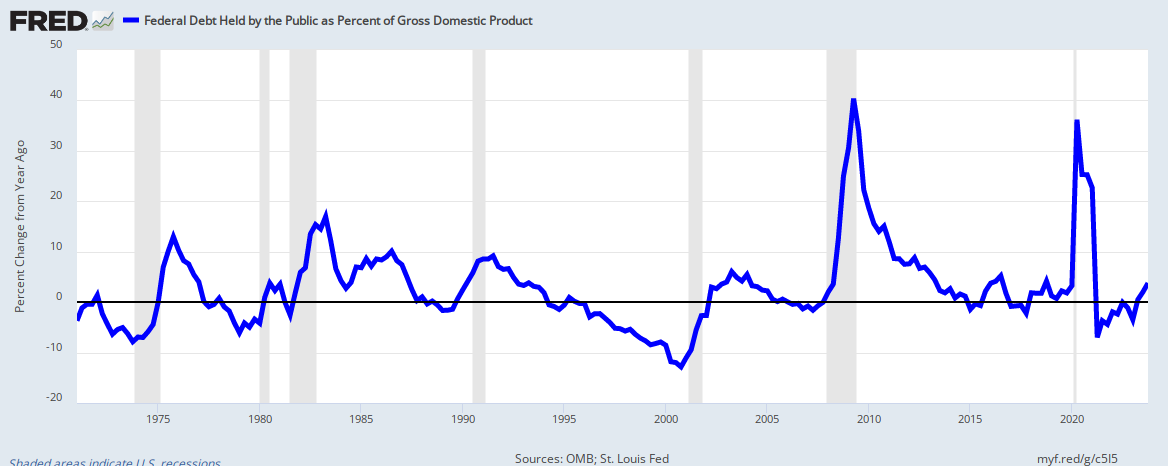
Here is a graph that demonstrates the fact that decreased growth in deficit spending results in recessions, while increased growth cures recessions.

Even before FCRB began, as far back as 1940 and before, debt fighters have been claiming the federal debt is “unsustainable” (their favorite word) or a “ticking time bomb.  See here.

The Big Lie is not new. We’ve documented it for at least 76 years — year after year after year, repeatedly telling us, the American public, that the growing debt is “unsustainable.”

And yet here we are today, 76 years later. The debt still is growing and we still are sustaining. How could that be unless the whole thing is a gigantic lie: The Big Lie?

Here is the purpose of the Big Lie: It encourages fewer benefits going to the poor and middle classes,  with more tax collections (increases in FICA and “broadening the base.”)

This widens the Gap between the .1% and the rest. Since it is the Gap that makes the .1% rich (Without the gap, no one would be rich; we all would be the same.)

Thus, the primary goal of the rich is not simply to make more money, but more importantly, to widen the Gap. Pushing us down is just as important as pulling themselves up.

And that is what the FCRB is paid to do: Promote programs that will widen the Gap between the .1% and the rest.

And that is what makes Maya MacGuineas America’s second most damaging person — more damaging than any spy, more damaging than any bigot Senator, more damaging than a purveyor of false news, like Breitbart.

She has access to influential people,  regularly meets with members of Congress and their staff, hosts several policy briefings, and offers false solutions that can achieve bipartisan support and put the country on a downward fiscal course.

She and the CRFB combine longevity, focus of purpose, access to influential people, a loud “megaphone,”  and an agendum that will maximize the damage to the most people.

The most delicious irony would be if fate made Ms. MacGuineas completely dependent on Medicare and Social Security, but because of CFRB, benefits were so reduced, and taxes so high, she would be unable to “sustain.”

Rodger Malcolm Mitchell
Monetary Sovereignty

The single most important problems in economics involve the excessive income/wealth/power Gaps between the rich and the rest.

Wide Gaps negatively affect poverty, health and longevity, education, housing, law and crime, war, leadership, ownership, bigotry, supply and demand, taxation, GDP, international relations, scientific advancement, the environment, human motivation and well-being, and virtually every other issue in economics.

Implementation of The Ten Steps To Prosperity can narrow the Gaps:

Ten Steps To Prosperity:
1. ELIMINATE FICA (Ten Reasons to Eliminate FICA )
Although the article lists 10 reasons to eliminate FICA, there are two fundamental reasons:
*FICA is the most regressive tax in American history, widening the Gap by punishing the low and middle-income groups, while leaving the rich untouched, and
*The federal government, being Monetarily Sovereign, neither needs nor uses FICA to support Social Security and Medicare.
2. FEDERALLY FUNDED MEDICARE — PARTS A, B & D, PLUS LONG TERM CARE — FOR EVERYONE (H.R. 676, Medicare for All )
This article addresses the questions:
*Does the economy benefit when the rich can afford better health care than can the rest of Americans?
*Aside from improved health care, what are the other economic effects of “Medicare for everyone?”
*How much would it cost taxpayers?
*Who opposes it?”
3. PROVIDE AN ANNUAL ECONOMIC BONUS TO EVERY MAN, WOMAN AND CHILD IN AMERICA, AND/OR EVERY STATE, A PER CAPITA ECONOMIC BONUS (The JG (Jobs Guarantee) vs the GI (Guaranteed Income) vs the EB) Or institute a reverse income tax.
This article is the fifth in a series about direct financial assistance to Americans:

Why Modern Monetary Theory’s Employer of Last Resort is a bad idea. Sunday, Jan 1 2012
MMT’s Job Guarantee (JG) — “Another crazy, rightwing, Austrian nutjob?” Thursday, Jan 12 2012
Why Modern Monetary Theory’s Jobs Guarantee is like the EU’s euro: A beloved solution to the wrong problem. Tuesday, May 29 2012
“You can’t fire me. I’m on JG” Saturday, Jun 2 2012

Economic growth should include the “bottom” 99.9%, not just the .1%, the only question being, how best to accomplish that. Modern Monetary Theory (MMT) favors giving everyone a job. Monetary Sovereignty (MS) favors giving everyone money. The five articles describe the pros and cons of each approach.
4. FREE EDUCATION (INCLUDING POST-GRAD) FOR EVERYONEFive reasons why we should eliminate school loans
Monetarily non-sovereign State and local governments, despite their limited finances, support grades K-12. That level of education may have been sufficient for a largely agrarian economy, but not for our currently more technical economy that demands greater numbers of highly educated workers.
Because state and local funding is so limited, grades K-12 receive short shrift, especially those schools whose populations come from the lowest economic groups. And college is too costly for most families.
An educated populace benefits a nation, and benefitting the nation is the purpose of the federal government, which has the unlimited ability to pay for K-16 and beyond.
5. SALARY FOR ATTENDING SCHOOL
Even were schooling to be completely free, many young people cannot attend, because they and their families cannot afford to support non-workers. In a foundering boat, everyone needs to bail, and no one can take time off for study.
If a young person’s “job” is to learn and be productive, he/she should be paid to do that job, especially since that job is one of America’s most important.
6. ELIMINATE CORPORATE TAXES
Corporations themselves exist only as legalities. They don’t pay taxes or pay for anything else. They are dollar-transferring machines. They transfer dollars from customers to employees, suppliers, shareholders and the government (the later having no use for those dollars).
Any tax on corporations reduces the amount going to employees, suppliers and shareholders, which diminishes the economy. Ultimately, all corporate taxes come around and reappear as deductions from your personal income.
7. INCREASE THE STANDARD INCOME TAX DEDUCTION, ANNUALLY. (Refer to this.) Federal taxes punish taxpayers and harm the economy. The federal government has no need for those punishing and harmful tax dollars. There are several ways to reduce taxes, and we should evaluate and choose the most progressive approaches.
Cutting FICA and corporate taxes would be a good early step, as both dramatically affect the 99%. Annual increases in the standard income tax deduction, and a reverse income tax also would provide benefits from the bottom up. Both would narrow the Gap.
8. TAX THE VERY RICH (THE “.1%) MORE, WITH HIGHER PROGRESSIVE TAX RATES ON ALL FORMS OF INCOME. (TROPHIC CASCADE)
There was a time when I argued against increasing anyone’s federal taxes. After all, the federal government has no need for tax dollars, and all taxes reduce Gross Domestic Product, thereby negatively affecting the entire economy, including the 99.9%.
But I have come to realize that narrowing the Gap requires trimming the top. It simply would not be possible to provide the 99.9% with enough benefits to narrow the Gap in any meaningful way. Bill Gates reportedly owns $70 billion. To get to that level, he must have been earning $10 billion a year. Pick any acceptable Gap (1000 to 1?), and the lowest paid American would have to receive $10 million a year. Unreasonable.
9. FEDERAL OWNERSHIP OF ALL BANKS (Click The end of private banking and How should America decide “who-gets-money”?)
Banks have created all the dollars that exist. Even dollars created at the direction of the federal government, actually come into being when banks increase the numbers in checking accounts. This gives the banks enormous financial power, and as we all know, power corrupts — especially when multiplied by a profit motive.
Although the federal government also is powerful and corrupted, it does not suffer from a profit motive, the world’s most corrupting influence.
10. INCREASE FEDERAL SPENDING ON THE MYRIAD INITIATIVES THAT BENEFIT AMERICA’S 99.9% (Federal agencies)Browse the agencies. See how many agencies benefit the lower- and middle-income/wealth/ power groups, by adding dollars to the economy and/or by actions more beneficial to the 99.9% than to the .1%.
Save this reference as your primer to current economics. Sadly, much of the material is not being taught in American schools, which is all the more reason for you to use it.

The Ten Steps will grow the economy, and narrow the income/wealth/power Gap between the rich and you.

MONETARY SOVEREIGNTY