Trump’s many problems: He’s not at fault

Twitter: @rodgermitchell; Search #monetarysovereignty
Facebook: Rodger Malcolm Mitchell

…………………………………………………………………………………………………………………………………………………………………………..
It takes only two things to keep people in chains: The ignorance of the oppressed and the treachery of their leaders.
………………………………………………………………………………………………………………………………………………………………………………

The Trump administration has had more than a President’s usual share of problems, but none of them can be hung on President Donald Trump. I know this because he’s told me.

If they were his fault, I would have heard the words, “I’m sorry,” or “I screwed up,” or just simply, “It was my fault.” I’ve not even heard him declare, “The buck stops here.”

Since those words, so far as I can tell, are completely alien to him, I’ve wondered who exactly has been at fault. So I did a bit of digging, and I now can reveal the causes of all the problems.

For your reference, here is a “Blame List” as offered by Trump and/or his public voices. Some of these may surprise you (especially those marked with (“!”), but I can assure you, they all are real.

This list is not comprehensive. Even today, as it was being assembled, additional finger pointing undoubtedly was emerging.

Image result for trump hands up
Who, me? I’m just the President


THE DONALD TRUMP BLAME LIST
Anthony Weiner
Arnold Schwarzenegger
Barack Obama
Bill Clinton
Billy Bush
Canada
Carlos Slim
China
CNN
Colin Kaepernick
Delta’s Computers
Democrats
Disloyal Republicans
Don McGahn
Fake News
FOX News (!)
Hillary Clinton
House Freedom Caucus
Immigrants
ISIS
Ivanka Trump (!)
James Comey
Jared Kushner (!)
Jews
Jimmy Kimmel
Judge James Robart
Judge Andrew Napolitano
Leaks
Lester Holt
Liberal Media
Mexico
Michael Flynn
Mike Flynn
MSNBC
Muslims
NBC News
New York Times
Numbers
Planned Parenthood
President George W. Bush
Protesters
Reince Priebus
Reporters Who Say Bad Things About Trump
Sally Yates
Sanctuary Cities
Sean Spicer
Chuck Schumer’s tears
Special Interests
Steve Bannon
Susan Rice
Ted Cruz’s Father
The Swamp
The Tuesday Group
The Generals
The Washington Post
Thugs
Unelected Bureaucracy
Voter Fraud
White House Staffers
Women In The Military
Women Who Accuse Him of Unwanted Sexual Advances

It is comforting to know that we are being led by a strong, responsible President who always is right and never at fault, a rare person, indeed.

Rodger Malcolm Mitchell
Monetary Sovereignty

………………………………………………………………………………………………………………………………………………………………………………………………………………………………………………………………………………………………………………………………………..

The single most important problems in economics involve the excessive income/wealth/power Gaps between the have-mores and the have-less.

Wide Gaps negatively affect poverty, health and longevity, education, housing, law and crime, war, leadership, ownership, bigotry, supply and demand, taxation, GDP, international relations, scientific advancement, the environment, human motivation and well-being, and virtually every other issue in economics.

Implementation of The Ten Steps To Prosperity can narrow the Gaps:

Ten Steps To Prosperity:
1. ELIMINATE FICA (Ten Reasons to Eliminate FICA )
Although the article lists 10 reasons to eliminate FICA, there are two fundamental reasons:
*FICA is the most regressive tax in American history, widening the Gap by punishing the low and middle-income groups, while leaving the rich untouched, and
*The federal government, being Monetarily Sovereign, neither needs nor uses FICA to support Social Security and Medicare.
2. FEDERALLY FUNDED MEDICARE — PARTS A, B & D, PLUS LONG TERM CARE — FOR EVERYONE (H.R. 676, Medicare for All )
This article addresses the questions:
*Does the economy benefit when the rich can afford better health care than can the rest of Americans?
*Aside from improved health care, what are the other economic effects of “Medicare for everyone?”
*How much would it cost taxpayers?
*Who opposes it?”
3. PROVIDE A MONTHLY ECONOMIC BONUS TO EVERY MAN, WOMAN AND CHILD IN AMERICA (similar to Social Security for All) (The JG (Jobs Guarantee) vs the GI (Guaranteed Income) vs the EB (Economic Bonus)) Or institute a reverse income tax.
This article is the fifth in a series about direct financial assistance to Americans:

Why Modern Monetary Theory’s Employer of Last Resort is a bad idea. Sunday, Jan 1 2012
MMT’s Job Guarantee (JG) — “Another crazy, rightwing, Austrian nutjob?” Thursday, Jan 12 2012
Why Modern Monetary Theory’s Jobs Guarantee is like the EU’s euro: A beloved solution to the wrong problem. Tuesday, May 29 2012
“You can’t fire me. I’m on JG” Saturday, Jun 2 2012

Economic growth should include the “bottom” 99.9%, not just the .1%, the only question being, how best to accomplish that. Modern Monetary Theory (MMT) favors giving everyone a job. Monetary Sovereignty (MS) favors giving everyone money. The five articles describe the pros and cons of each approach.
4. FREE EDUCATION (INCLUDING POST-GRAD) FOR EVERYONE Five reasons why we should eliminate school loans
Monetarily non-sovereign State and local governments, despite their limited finances, support grades K-12. That level of education may have been sufficient for a largely agrarian economy, but not for our currently more technical economy that demands greater numbers of highly educated workers.
Because state and local funding is so limited, grades K-12 receive short shrift, especially those schools whose populations come from the lowest economic groups. And college is too costly for most families.
An educated populace benefits a nation, and benefitting the nation is the purpose of the federal government, which has the unlimited ability to pay for K-16 and beyond.
5. SALARY FOR ATTENDING SCHOOL
Even were schooling to be completely free, many young people cannot attend, because they and their families cannot afford to support non-workers. In a foundering boat, everyone needs to bail, and no one can take time off for study.
If a young person’s “job” is to learn and be productive, he/she should be paid to do that job, especially since that job is one of America’s most important.
6. ELIMINATE FEDERAL TAXES ON BUSINESS
Businesses are dollar-transferring machines. They transfer dollars from customers to employees, suppliers, shareholders and the federal government (the later having no use for those dollars). Any tax on businesses reduces the amount going to employees, suppliers and shareholders, which diminishes the economy. Ultimately, all business taxes reduce your personal income.
7. INCREASE THE STANDARD INCOME TAX DEDUCTION, ANNUALLY. (Refer to this.) Federal taxes punish taxpayers and harm the economy. The federal government has no need for those punishing and harmful tax dollars. There are several ways to reduce taxes, and we should evaluate and choose the most progressive approaches.
Cutting FICA and business taxes would be a good early step, as both dramatically affect the 99%. Annual increases in the standard income tax deduction, and a reverse income tax also would provide benefits from the bottom up. Both would narrow the Gap.
8. TAX THE VERY RICH (THE “.1%) MORE, WITH HIGHER PROGRESSIVE TAX RATES ON ALL FORMS OF INCOME. (TROPHIC CASCADE)
There was a time when I argued against increasing anyone’s federal taxes. After all, the federal government has no need for tax dollars, and all taxes reduce Gross Domestic Product, thereby negatively affecting the entire economy, including the 99.9%.
But I have come to realize that narrowing the Gap requires trimming the top. It simply would not be possible to provide the 99.9% with enough benefits to narrow the Gap in any meaningful way. Bill Gates reportedly owns $70 billion. To get to that level, he must have been earning $10 billion a year. Pick any acceptable Gap (1000 to 1?), and the lowest paid American would have to receive $10 million a year. Unreasonable.
9. FEDERAL OWNERSHIP OF ALL BANKS (Click The end of private banking and How should America decide “who-gets-money”?)
Banks have created all the dollars that exist. Even dollars created at the direction of the federal government, actually come into being when banks increase the numbers in checking accounts. This gives the banks enormous financial power, and as we all know, power corrupts — especially when multiplied by a profit motive.
Although the federal government also is powerful and corrupted, it does not suffer from a profit motive, the world’s most corrupting influence.
10. INCREASE FEDERAL SPENDING ON THE MYRIAD INITIATIVES THAT BENEFIT AMERICA’S 99.9% (Federal agencies)Browse the agencies. See how many agencies benefit the lower- and middle-income/wealth/ power groups, by adding dollars to the economy and/or by actions more beneficial to the 99.9% than to the .1%.
Save this reference as your primer to current economics. Sadly, much of the material is not being taught in American schools, which is all the more reason for you to use it.

The Ten Steps will grow the economy, and narrow the income/wealth/power Gap between the rich and you.

MONETARY SOVEREIGNTY

Does your computer play?

Twitter: @rodgermitchell; Search #monetarysovereignty
Facebook: Rodger Malcolm Mitchell

…………………………………………………………………………………………………………………………………………………………………………..
It takes only two things to keep people in chains: The ignorance of the oppressed and the treachery of their leaders..
………………………………………………………………………………………………………………………………………………………………………………

The title of this post, “Does your computer play?” could have you thinking about the games you have loaded into your iPad.

Or perhaps your mind drifts to the computers that win at chess, Jeopardy, or Go.

But that is not what the title means.

It means literally, “does your computer play?” and by “play, ” we mean, play for its own enjoyment, just as you do.

The notion that a computer can have enjoyment, and even play to obtain it, may sound absurd.

Siri, who seemingly knows how to find any answer (though repeatedly confuses the question) is not smart enough to enjoy anything, much less enjoy playing. Even our massively brilliant, super-computers are not intelligent enough to have emotions or to desire play. So we ask:

Do today’s super-computers have as much brainpower as a wasp?

Here are a few excerpts from an article in the June, 2017 issue of Discover Magazine.

Image result for gecko playing
Do geckos play? If so, do they enjoy playing?

Turtles, Spiders and Other Surprisingly Playful Animals
Mammals aren’t the only ones who can have a good time.
By: Marta Zaraska

In April 2013, on board an unmanned spacecraft, a thick-toed gecko wriggled out of its polyurethane collar.

In microgravity, the object floated away, approaching another gecko, and then a third. The animals got curious.

One pushed the collar with its snout. Another tried inserting its head into it. Yet another pinned the thing down to the floor.

As the spacecraft orbited Earth, the geckos started to play.

If Geckos are capable of play, are they smarter than a super computer?

It’s not just kittens and baby chimps that play, but also birds, reptiles, fish and even invertebrates, including spiders and wasps.  Until recently, researchers doubted these diverse species were even capable of the (play) behavior.

Consider the case of Pigface, a Nile soft-shelled turtle who spent nearly his entire life alone in an enclosure at the National Zoo in Washington, D.C.

In the 1980s, when Pigface was already in his 40s, he began biting himself and clawing at his face. “He used to self-mutilate so bad he’d get fungal growth on his skin,” recalls Gordon Burghardt, a behavioral biologist at the University of Tennessee, Knoxville.

“So the reptile curator thought, ‘Hey, maybe he’s bored?’ No one back then thought that reptiles could get bored.”

In 1991, Burghardt and other researchers gave Pigface two basketballs and a round hoop fashioned from a garden hose, then recorded his behavior. Pigface resembled a frolicking dog: He’d nose, bite, push and shake the toys with his mouth.

“That was the first pretty good proof that reptiles could play,” he says.

Boredom cured.

Burghardt had speculated that an evolutionary purpose of play is to relieve boredom. But this begs the question, “What is the evolutionary purpose of boredom?”

Boredom’s apparent prevalence among animals indicates it must have some evolutionary purpose, and if so, might that purpose be to create curiosity?  And the purpose of curiosity might be to stimulate learning. And learning clearly has evolutionary improvement advantages.

According to Burghardt, play is defined as a behavior that is:

  1. Voluntary
  2. Repeated several times
  3. Doesn’t have an obvious function (so running for fun, yes, but not running away from a predator)
  4. Differs in significant ways from regular, functional behavior
  5. Initiated by healthy, largely unstressed animals.

Immediately, however, we run into a difficulty. What is “voluntarily”? Some would argue that nothing we do is “voluntarily,” because all we do is a result of our chemistry.

But, before descending into sophistry, let’s assume that we do have free will. Do dogs have free will? Frogs? Insects? Do computers have free will? If free will exists, where does it end?

As for #3, “obvious” function, “obvious” to whom? Doesn’t the rough play of lion cubs serve an “obvious” training function?

Finally, #5 demands healthy, unstressed animals. Really? Unhealthy or stressed animals can’t play?  I’m not so sure about that.

There are many different types of play, some of them simpler than others.

Take ravens, for example. In an experiment published in 2014, researchers from Germany’s Max Planck Institute for Ornithology and Lund University in Sweden observed a group of ravens interacting with a small stuffed mouse and a plastic spider.

Sometimes, the birds would manipulate the toys with their beaks or feet — what scientists call object play. Sometimes, if one raven started to play with a toy, another would join — that’s social play.

That’s play at its simplest and most primitive: the running, jumping and romping around that’s defined as locomotion play. No big brain required.

A comparison across 15 orders of mammals showed that larger-brained orders contained more playful species. However, within a given order, such as, say, primates, some of the most playful species were those with the tiniest brains.

Regardless of size, play may enhance a brain’s functionality. Play changes the brain, affecting development of the prefrontal cortex, which is responsible for complex thoughts and regulating emotions.

In one experiment, playing enhanced the young rats’ neural plasticity, which helped them to be more flexible in their behavior later in life.

Which demonstrates the functionality of play, drawing into question description #3. Play often is a rehearsal for real life.

So what if you are a spider and you don’t have a cortex at all? Can you still play? Most likely, yes, says Jonathan Pruitt, an evolutionary ecologist who studies spider behavior at the University of California, Santa Barbara.

Pruitt, Burghardt and Susan Riechert from the University of Tennessee described a peculiar behavior of the Anelosimus studiosus spider. Males and immature females of this species engage in what Pruitt calls “almost-sex,” and they do it over and over again.

The “almost-sex” differs in quite important ways from the real deal, one of them being that the male doesn’t end up being eaten. Under normal reproductive conditions, there’s a 30 percent chance that a female will eat the male. “But they never kill any of the males during these play interactions,” Pruitt says.

Toning down on aggression is a typical feature of play; it’s even been noted in wasps.

Back in 2006, Italian scientists studying young paper wasps noticed that when the insects aggregate in clusters to keep each other warm and survive the winter, they engage in something very much resembling play-fighting in mammals.

They beat the antennae of other wasps, lick them and bite them, behaviors that don’t serve any obvious function.

“You don’t need a big brain to play,” Burghardt says. “How it is organized is probably more important.”

If you don’t need a big brain to play — if even wasps can play — what then is required for play? 

Jennifer Mather, a psychologist, and her colleague, Roland Anderson of the Seattle Aquarium, gave a few bored octopuses old pill bottles just to see what would happen. And the animals played.

They jetted water at the bottles, pushing the “toy” away, waited for it to float back on the aquarium intake’s current and pushed it away again, over and over, seemingly enjoying themselves.

As for why play evolved at all, there is no simple answer. The surplus resource theory, as Burghardt calls it, also helps explain why geckos on board the spacecraft started to play while their cousins on Earth — the control group — didn’t.

Reptiles depend on external sources of heat, and have a metabolic rate much slower than that of birds or mammals. It’s harder and more costly for them to engage in vigorous activities in normal circumstances. But in space, near-weightlessness made it less energetically costly to play, and so they did.

Are spiders and wasps and geckos actually having fun? Burghardt described how three cichlid fish played with a thermometer in their tank, bouncing the “toy” repeatedly. The animals were clearly playing, but how much (or even if) they were enjoying themselves was impossible to tell.

On the other hand, Bekoff and others who have observed ravens rolling down mounds of snow, sometimes doing so on their backs with sticks held in their feet, had a much clearer feeling that fun was involved.

Does what we call “play” necessarily involve fun? Or, is it just a cure for boredom? Or, is it a serious rehearsal for real life?

Coming back to your computer, do computers get bored? Can computers have “fun”? Can computers play?

Experiments done in rats hint that specific chemical messengers in the brain, such as dopamine and endocannabinoids, may have a role in the pleasure of play. The endocannabinoid system, which is involved in processing sensations such as pain and regulating mood  does occur in fish, birds, amphibians and possibly even in sea urchins.

Dopamine, long known to be a gatekeeper for the brain’s pleasure center, “is present in spiders, and we know it has large influence on behavior,” says Pruitt, yet he admits that we still have zero idea whether it could make play fun for spiders.

“One thing we might learn is that play is a very basic behavior and a very needed one in the repertoire of very diverse species,” Bekoff says. “Ant play may be different from dog play, but it may be important for the ants.”

Even octopuses and spiders need play.

Need play for what? What is there about play that all animals seem to need? What does play contribute to evolution?

And if play does contribute to the evolution of animal species, can play contribute to the evolution of computers.? If animals can play, what prevents computers from playing? Questions, questions.

Until recently, we humans have been the prime evolutionary force for computers. Improving computers has meant we continuously have made them more life-like. They can see, hear, speak, and understand languages. They can recognize faces and voices. They can learn and make decisions. They can drive cars.

With the advent of machine learning, we have given computers a bit of ability to self-evolve. What then are computers missing, that separates them from humans, geckos, and wasps?

Perhaps the clue may be found in one sentence from the article:

“In one experiment, playing enhanced the young rats’ neural plasticity, which helped them to be more flexible in their behavior later in life.”

Living brains and nervous systems are not digital and not solely electronic. They also are analog and chemical. They not only can change physically but function differently, depending on chemical input. Those billions of neurons in the human brain and the thousands in a wasp brain are adaptable via learning.

The on/off digital settings of computer neurons can accomplish a narrower range of functions than can the near-infinite analog settings of living synapses.  The narrower range allows computers to be faster and more accurate, but far less flexible.

That is the tradeoff: Speed and accuracy for flexibility and growth.

Can we have both? Life’s electrochemical, analog, nervous systems, which seem to operate at the quantum level, allow very tiny animals to produce such massive complexities as emotions, and desires, and boredom, and with boredom, the desire to relieve that boredom with play.

It is doubtful that on/off digital systems ever will match that complexity, though perhaps quantum computers, which come somewhat closer to analog thought than digital, may accomplish the task.

One day, quantum and/or analog computers could be as smart as a wasp,  and able to enjoy play — or even become as smart as a human.

So far, our massive brains have not been able to create purposefully, what nature has given us accidentally — that incredibly complex entity we call “life.”

But nature has had two developmental advantages: Billions of years and many trillions of experiments.

Given time and effort, we may create computers that mimic life. That is what we want, what we have been trying to accomplish: Entities that can feel boredom and enjoyment at playing, like wasps and birds, and also are fast and accurate like digital computers — i.e. humans, only better.

If ever you walk into your office and find your computer playing, and when you try to interrupt the game, your computer whines to you angrily, “Wait until I finish,” you’ll be able to infer that we, as creators, have achieved a truly quantum leap in computer evolution.

When your computer plays, we will be gods.

Rodger Malcolm Mitchell
Monetary Sovereignty

………………………………………………………………………………………………………………………………………………………………………………………………………………………………………………………………………………………………………………………………………..

THOUGHTSs

•All we have are partial solutions; the best we can do is try.

•Those, who do not understand the differences between Monetary Sovereignty and monetary non-sovereignty, do not understand economics.

•Any monetarily NON-sovereign government — be it city, county, state or nation — that runs an ongoing trade deficit, eventually will run out of money no matter how much it taxes its citizens.

•The more federal budgets are cut and taxes increased, the weaker an economy becomes..

•No nation can tax itself into prosperity, nor grow without money growth.

•Cutting federal deficits to grow the economy is like applying leeches to cure anemia.

•A growing economy requires a growing supply of money (GDP = Federal Spending + Non-federal Spending + Net Exports)

•Deficit spending grows the supply of money

•The limit to federal deficit spending is an inflation that cannot be cured with interest rate control. The limit to non-federal deficit spending is the ability to borrow.

•Until the 99% understand the need for federal deficits, the upper 1% will rule.

•Progressives think the purpose of government is to protect the poor and powerless from the rich and powerful. Conservatives think the purpose of government is to protect the rich and powerful from the poor and powerless.

•The single most important problem in economics is the Gap between the rich and the rest.

•Austerity is the government’s method for widening the Gap between the rich and the rest.

•Everything in economics devolves to motive, and the motive is the Gap between the rich and the rest..

MONETARY SOVEREIGNTY

The Meaning of America — now worse

Twitter: @rodgermitchell; Search #monetarysovereignty
Facebook: Rodger Malcolm Mitchell

…………………………………………………………………………………………………………………………………………………………………………..
It takes only two things to keep people in chains: The ignorance of the oppressed and the treachery of their leaders..
………………………………………………………………………………………………………………………………………………………………………………

On March 16, 2013, we published a post titled, The Meaning of America.

The summary paragraphs from this post were:Image result for high wall

“Today, we witness the meaning of America. Cut Social Security; cut Medicare; cut Medicaid; cut federal employment; cut payments to the millions of people who rely on federal payments; cut immigration.

“Today, we are led by moral and intellectual midgets, frightened little cowards, selfishly clinging to what they have amassed for themselves, uncaring about others, who now that they are here, would build a wall of meanness around America, to prevent others from achieving the American Dream.

“It’s bad economics. It’s not the world’s moral leader, the America in which we like to believe. It’s small. It’s wicked. It’s selfish. It’s stupid. It’s just, plain mean.

“They are here only because they or their ancestors were given sanctuary by benevolent Americans, and now, this is their mantra of meanness: ‘Screw you. I’ve got mine.'”

This was written well before the Trump tragedy for America began.

The post examined three, anti-immigration lies being told at that time, by the GOP Congress:

  1. The U.S. is too crowded. We have no room for more aliens.
  2. These aliens will take our jobs.
  3. These aliens will use up our services like Social Security, Medicare, food stamps, etc.

Today, it is clear that under Trump, the cruel lies have multiplied:

Trump Is Embarking on an Orgy of Cruelty for No Good Reason
Posted on May 10, 2017, By Robert Reich / RobertReich.org

1. His new budget comes down especially hard on the poor–imposing unprecedented cuts in low-income housing, job training, food assistance, legal services, help to distressed rural communities, nutrition for new mothers and their infants, funds to keep poor families warm, even “meals on wheels.”
2. Trump and his enablers in the GOP are on the way to repealing the Affordable Care Act, and replacing it in a way that could cause 14 million Americans to lose their health insurance next year, and 24 million by 2026 — to give $600 billion in tax cuts over the decade mostly to wealthy Americans.
3. Trump is banning Syrian refugees and slashing the total number of refugees this year by more than half. This comes just when the world is experiencing the worst refugee crisis since World War II.
4. Trump is rounding up undocumented immigrants helter-skelter – including people who have been productive members of our society for decades, and young people who have been here since they were toddlers.

Trump is not an anomaly. Trump is not a loose cannon. Trump is not crazy.  Donald Trump is a perfect reflection of what the Republican Party has espoused — an increasingly cruel, selfish, unAmerican theology — since the Newt Gingrich and Dick Armey “Contract With America” in 1994.

Among the bills that emerged from the “Contract” were:

The “Fiscal Responsibility Act,” that would require a dramatic cut to Social Security, Medicare, Medicaid and other programs that benefit the 99% of Americans, while cutting taxes on the rich.

The “Taking Back Our Streets Act”, based on the proven-false premise that harsh laws and long prison terms were the way to cut street crimes committed by the poor. (No punishment provisions were included for the white collar crimes committed by the rich — the crimes that caused the “Great Recession.”)

The “Personal Responsibility Act” to punish teen pregnancy by eliminating aid to mothers under 18, limiting Aid to Families with Dependent Children, and limiting unemployment compensation — all under the GOP doctrine that the poor are not victims of circumstance, but instead are lazy, criminal malingerers, who must be punished for their sloth.

The “Common Sense Legal Reform Act” to protect businesses from so-called “frivolous litigation,” which included terms making damage suits by the average person against the rich corporations almost impossible.

For more than two decades, the Republican Party has based its appeal on the notion that the rich inherently are good and moral, while the rest of us must be controlled, like wild animals, with severe punishments for any breach, and especially for not being rich.

Interestingly, many of the very people victimized by this austere philosophy, have embraced it as a reflection of “Gap Psychology,” the desire to distance oneself from those below on any social scale.

Demonizing those less fortunate is an integral part of that psychology.

Thus the increasingly evil cruelty, lies, and selfishness of a Donald Trump is the natural evolution of the inhumanity the GOP has promulgated, and what too many Americans now have endorsed.

This country was founded on the belief that the “poor and huddled masses yearning to breathe free” were intellectually and morally equivalent, if not superior, to the imperial princes of wealth. We were proud to be the “common man.”

But today, we have forgotten our foundation, and now have come to adopt the feudal, European “intrinsic superiority of the monarchs,”  from which we fled.

The 2013 post ended with the words, “Screw you. I’ve got mine.”

It has become worse today. But don’t point your finger solely at Trump. He is just the manifestation of the GOP-induced cancer.

It is who we have become.

Rodger Malcolm Mitchell
Monetary Sovereignty

………………………………………………………………………………………………………………………………………………………………………………………………………………………………………………………………………………………………………………………………………..

THOUGHTSs

•All we have are partial solutions; the best we can do is try.

•Those, who do not understand the differences between Monetary Sovereignty and monetary non-sovereignty, do not understand economics.

•Any monetarily NON-sovereign government — be it city, county, state or nation — that runs an ongoing trade deficit, eventually will run out of money no matter how much it taxes its citizens.

•The more federal budgets are cut and taxes increased, the weaker an economy becomes..

•No nation can tax itself into prosperity, nor grow without money growth.

•Cutting federal deficits to grow the economy is like applying leeches to cure anemia.

•A growing economy requires a growing supply of money (GDP = Federal Spending + Non-federal Spending + Net Exports)

•Deficit spending grows the supply of money

•The limit to federal deficit spending is an inflation that cannot be cured with interest rate control. The limit to non-federal deficit spending is the ability to borrow.

•Until the 99% understand the need for federal deficits, the upper 1% will rule.

•Progressives think the purpose of government is to protect the poor and powerless from the rich and powerful. Conservatives think the purpose of government is to protect the rich and powerful from the poor and powerless.

•The single most important problem in economics is the Gap between the rich and the rest.

•Austerity is the government’s method for widening the Gap between the rich and the rest.

•Everything in economics devolves to motive, and the motive is the Gap between the rich and the rest..

MONETARY SOVEREIGNTY

The almost-too-easy way to grow the economy and narrow the Gap

Twitter: @rodgermitchell; Search #monetarysovereignty
Facebook: Rodger Malcolm Mitchell

…………………………………………………………………………………………………………………………………………………………………………..
It takes only two things to keep people in chains: The ignorance of the oppressed and the treachery of their leaders..
………………………………………………………………………………………………………………………………………………………………………………

Following the “Great Recession” of 2008, our economy has grown at an achingly slow pace. Look at the graph (below) and compare the past ten years with the period beginning 1972 (the year in which the U.S. went off a gold standard and became more completely Monetarily Sovereign):

GDP Growth Line (Vertical bars are recessions)

Meanwhile, the Gaps between the richer and poorer, as expressed by the GINI ratio, (below) have widened. [A Gini ratio of 0 indicates perfect equality, where everyone has the same income. A Gini ratio of 1 indicates total inequality, where one person has all the income]:

Income inequality has grown substantially in the past 50 years

In short, the economy has grown quite slowly, while the rich have become relatively richer, and the poor have become relatively poorer.

We have suggested the Ten Steps to Prosperity (see section below), as a process by which the economy can grow faster and the Gap can shrink. Some of those steps require significant changes in federal law, together with significant bureaucratic expansions.

But there is one Step that requires only minuscule changes in federal law together with a reduction in the bureaucracy: Step 1. Eliminate the FICA tax.

  1. FICA is the most regressive tax in America, punishing lower-income, salaried workers, while barely touching higher income salaried workers, and having no effect on people who get their incomes from non-salary sources — mostly the retired and the rich.
  2. Corporations submit half of all FICA collected, but corporations don’t actually “pay” taxes.  They merely are legal conduits between customers and corporate employees and owners.  Functionally, employees pay all FICA taxes; corporate managers consider FICA to be as much a cost of paying employees as are salaries.
  3. The Federal government neither needs nor uses FICA dollars. Being Monetarily Sovereign, the federal government creates dollars ad hoc, every time it pays a bill. Tax dollars you send to the Treasury cease to be part of the money supply. Your tax dollars effectively are destroyed.

The elimination of FICA would add a $1 trillion+ to the money supply, which would stimulate the economy by increasing Non-federal Spending:

Gross Domestic Product = Federal Spending + Non-federal Spending + Net Exports.

Spending by consumers is by far the largest part of the U.S. GDP.  It accounts for an average of about two-thirds of GDP in the United States.

With GDP at about $18 Trillion, an addition of $1 Trillion (from FICA) would create about 5% of GDP growth (broad estimate, less investment).

Social Insurance Receipts*
          Year  | $ Trillions
          
2010 | 0.9
2011 | 0.8
2012 | 0.8
2013 | 0.9
2014 | 1.0
2015 | 1.1
2016 | 1.1
2017 | 1.1
2018 | 1.2

*Amount of Revenue by Source

With GDP growth averaging about 4% in the past ten years, an additional 5% growth (to 9%) would be quite significant — similar to the growth rate in the 1971-1981 period.

This brings us to the subject of inflation. There have been many changes to the methods for calculating inflation (a general increase in prices), and these changes have resulted in somewhat different results.

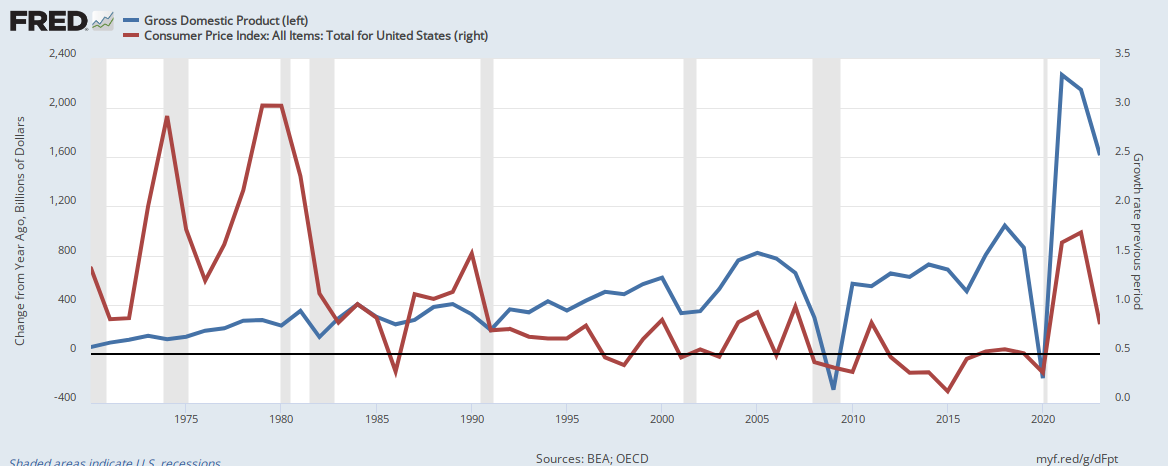
But, there does not seem to have been a relationship between GDP increases and inflation. (See graph below.)

GDP increases were not marked by inflation

While an increase in the Supply of money is inflationary, an increase in the Demand for money is deflationary: Value = Demand/Supply.

The Demand for money is based on the formula: Demand = Reward/Risk.

Interest is the Reward for owning money. The Federal Reserve controls inflation to its target rate (2%-3%) by increasing the Reward, i.e. by increasing interest rates.

We cannot end this article without referring to the brainwashing conducted by our thought leaders, including the U.S. government.

The Office of Retirement and Disability (Social Security) publishes a bulletin titled, “Social Security Trust Fund Flows and Reserves.”

The bulletin includes such sentences as:

Social Security benefits are paid from the reserves of the Old-Age, Survivors, and Disability Insurance (OASDI) trust fund.

The reserves are funded from dedicated tax revenues and interest on accumulated reserve holdings, which are invested in Treasury securities.

There is no “trust fund” for Social Security any more than there is a “trust fund” for other federal agencies.

Have you ever wondered why there is no “trust fund” to pay for the military, or for the White House, or Congress, or for the Supreme Court, or the CIA, the FBI, NSA, or any other agency you can mention? Have you ever wondered why no one claims these agencies soon will be

Have you ever wondered why no one claims these agencies soon will be insolvent?

The reason: The Social Security “trust fund” is an accounting fiction. It pays for nothing. Social Security and Medicare benefits are paid the same way as Congress’s salaries: By federal deficit spending.

“Trust fund” balances are available to finance future benefit payments and other trust fund expenditures–but only in a bookkeeping sense.

These funds are not set up to be pension funds, like the funds of private pension plans. They do not consist of real economic assets that can be drawn down in the future to fund benefits. Instead, they are claims on the Treasury.

The fake “trust fund” merely is a group of balance sheet notations, completely controlled by the government. The “trust fund assets” consist of nothing more than “liabilities” of the U.S. Treasury.  All the “trust fund” owns is what the Treasury owes it.

Thus, rather than paying Social Security and Medicare benefits out of a non-existent “trust fund,” the Treasury could pay benefits directly.  If the “trust fund” ceased to exist, this would have zero effect on the Treasury’s ability to pay Social Security and Medicare benefits.

The next time you read an article or see a graph telling you the Social Security trust fund will run short funds at some future date, know you are being treated to The Big Lie — the lie that federal taxes fund federal spending.

While state and local taxes do fund state and local spending, federal taxes do not fund federal spending. The federal government creates dollars, ad hoc, by spending, and never can run short of dollars.

Even if all federal tax collections fell to $0, the federal government could continue spending, forever.

IN SUMMARY:

Growing the economy, narrowing the Gap, and controlling inflation are three of the most important financial responsibilities of the federal government.  These responsibilities could be accomplished easily and simply by eliminating the useless and harmful FICA tax.

If we eliminated FICA tomorrow, you instantly would begin to reap the economic benefits.

Rodger Malcolm Mitchell
Monetary Sovereignty

………………………………………………………………………………………………………………………………………………………………………………………………………………………………………………………………………………………………………………………………………..

The single most important problems in economics involve the excessive income/wealth/power Gaps between the have-mores and the have-less.

Wide Gaps negatively affect poverty, health and longevity, education, housing, law and crime, war, leadership, ownership, bigotry, supply and demand, taxation, GDP, international relations, scientific advancement, the environment, human motivation and well-being, and virtually every other issue in economics.

Implementation of The Ten Steps To Prosperity can narrow the Gaps:

Ten Steps To Prosperity:
1. ELIMINATE FICA (Ten Reasons to Eliminate FICA )
Although the article lists 10 reasons to eliminate FICA, there are two fundamental reasons:
*FICA is the most regressive tax in American history, widening the Gap by punishing the low and middle-income groups, while leaving the rich untouched, and
*The federal government, being Monetarily Sovereign, neither needs nor uses FICA to support Social Security and Medicare.
2. FEDERALLY FUNDED MEDICARE — PARTS A, B & D, PLUS LONG TERM CARE — FOR EVERYONE (H.R. 676, Medicare for All )
This article addresses the questions:
*Does the economy benefit when the rich can afford better health care than can the rest of Americans?
*Aside from improved health care, what are the other economic effects of “Medicare for everyone?”
*How much would it cost taxpayers?
*Who opposes it?”
3. PROVIDE A MONTHLY ECONOMIC BONUS TO EVERY MAN, WOMAN AND CHILD IN AMERICA (similar to Social Security for All) (The JG (Jobs Guarantee) vs the GI (Guaranteed Income) vs the EB (Economic Bonus)) Or institute a reverse income tax.
This article is the fifth in a series about direct financial assistance to Americans:

Why Modern Monetary Theory’s Employer of Last Resort is a bad idea. Sunday, Jan 1 2012
MMT’s Job Guarantee (JG) — “Another crazy, rightwing, Austrian nutjob?” Thursday, Jan 12 2012
Why Modern Monetary Theory’s Jobs Guarantee is like the EU’s euro: A beloved solution to the wrong problem. Tuesday, May 29 2012
“You can’t fire me. I’m on JG” Saturday, Jun 2 2012

Economic growth should include the “bottom” 99.9%, not just the .1%, the only question being, how best to accomplish that. Modern Monetary Theory (MMT) favors giving everyone a job. Monetary Sovereignty (MS) favors giving everyone money. The five articles describe the pros and cons of each approach.
4. FREE EDUCATION (INCLUDING POST-GRAD) FOR EVERYONE Five reasons why we should eliminate school loans
Monetarily non-sovereign State and local governments, despite their limited finances, support grades K-12. That level of education may have been sufficient for a largely agrarian economy, but not for our currently more technical economy that demands greater numbers of highly educated workers.
Because state and local funding is so limited, grades K-12 receive short shrift, especially those schools whose populations come from the lowest economic groups. And college is too costly for most families.
An educated populace benefits a nation, and benefitting the nation is the purpose of the federal government, which has the unlimited ability to pay for K-16 and beyond.
5. SALARY FOR ATTENDING SCHOOL
Even were schooling to be completely free, many young people cannot attend, because they and their families cannot afford to support non-workers. In a foundering boat, everyone needs to bail, and no one can take time off for study.
If a young person’s “job” is to learn and be productive, he/she should be paid to do that job, especially since that job is one of America’s most important.
6. ELIMINATE FEDERAL TAXES ON BUSINESS
Businesses are dollar-transferring machines. They transfer dollars from customers to employees, suppliers, shareholders and the federal government (the later having no use for those dollars). Any tax on businesses reduces the amount going to employees, suppliers and shareholders, which diminishes the economy. Ultimately, all business taxes reduce your personal income.
7. INCREASE THE STANDARD INCOME TAX DEDUCTION, ANNUALLY. (Refer to this.) Federal taxes punish taxpayers and harm the economy. The federal government has no need for those punishing and harmful tax dollars. There are several ways to reduce taxes, and we should evaluate and choose the most progressive approaches.
Cutting FICA and business taxes would be a good early step, as both dramatically affect the 99%. Annual increases in the standard income tax deduction, and a reverse income tax also would provide benefits from the bottom up. Both would narrow the Gap.
8. TAX THE VERY RICH (THE “.1%) MORE, WITH HIGHER PROGRESSIVE TAX RATES ON ALL FORMS OF INCOME. (TROPHIC CASCADE)
There was a time when I argued against increasing anyone’s federal taxes. After all, the federal government has no need for tax dollars, and all taxes reduce Gross Domestic Product, thereby negatively affecting the entire economy, including the 99.9%.
But I have come to realize that narrowing the Gap requires trimming the top. It simply would not be possible to provide the 99.9% with enough benefits to narrow the Gap in any meaningful way. Bill Gates reportedly owns $70 billion. To get to that level, he must have been earning $10 billion a year. Pick any acceptable Gap (1000 to 1?), and the lowest paid American would have to receive $10 million a year. Unreasonable.
9. FEDERAL OWNERSHIP OF ALL BANKS (Click The end of private banking and How should America decide “who-gets-money”?)
Banks have created all the dollars that exist. Even dollars created at the direction of the federal government, actually come into being when banks increase the numbers in checking accounts. This gives the banks enormous financial power, and as we all know, power corrupts — especially when multiplied by a profit motive.
Although the federal government also is powerful and corrupted, it does not suffer from a profit motive, the world’s most corrupting influence.
10. INCREASE FEDERAL SPENDING ON THE MYRIAD INITIATIVES THAT BENEFIT AMERICA’S 99.9% (Federal agencies)Browse the agencies. See how many agencies benefit the lower- and middle-income/wealth/ power groups, by adding dollars to the economy and/or by actions more beneficial to the 99.9% than to the .1%.
Save this reference as your primer to current economics. Sadly, much of the material is not being taught in American schools, which is all the more reason for you to use it.

The Ten Steps will grow the economy, and narrow the income/wealth/power Gap between the rich and you.

MONETARY SOVEREIGNTY