Simple single payer facts and utter nonsense

Twitter: @rodgermitchell; Search #monetarysovereignty
Facebook: Rodger Malcolm Mitchell

…………………………………………………………………………………………………………………………………………………………………………..
It takes only two things to keep people in chains: The ignorance of the oppressed and the treachery of their leaders..
………………………………………………………………………………………………………………………………………………………………………………

Boiled down to its essence, there are only two facts you need to know about “single payer” health care:

  1. Single payer simply means that instead of insurance companies and states paying doctors and hospitals, the federal government pays the bills.
  2. The federal government, being Monetarily Sovereign, easily can afford to pay any amount, while for-profit insurance companies and monetarily non-sovereign states cannot.

That’s it. You now know everything you need to know about single payer vs. whatever-you-want-to-call the U.S. current system. All else is trivial by comparison.Image result for healthcare insurance companies

The U.S. already knows how to do single payer. It’s called “Medicare.”

But those opposed to single payer, either for idealistic or for money reasons, want to confuse the debate. And in that vein, I bring you right-wing columnist John Kass, and some excerpts from his column in today’s Chicago Tribune:

What’s not being asked in the Charlie Gard case?

In the story of Charlie Gard — the seriously ill 11-month-old boy that British health care is compelled to let die over his parents’ wishes — there is something important that is missing.

You’ve probably heard of Gard’s rare illness and the British health care bureaucrats who think it best that he die. And you also may have heard about his parents’ battle in the hopes of saving their son, and the latest court hearing where a last-ditch effort was scheduled in the hopes of bringing him to the U.S. for experimental treatment.Image result for healthcare insurance companies

The question is this: If America adopts such a government health care (single payer) system, could what has happened to Charlie Gard and his parents happen here?

Those in favor of government health care might not want to answer it; and journalists in favor of such a system might not want to know. Or they might not want to appear rude.

But the answer is yes.

I’ll interrupt to remind you that what Kass misleadingly calls “government health care” really is the government taking the place of privately-owned insurance companies.

The actual health care still is provided by doctors and hospitals, no matter who pays.Image result for healthcare insurance companies

Little Charlie suffers from a rare genetic illness. Blind and deaf, he endures painful epileptic seizures. His doctors in London insist that his illness can’t be treated, and that he will die when life-support is withdrawn.

And health care bureaucrats in London want it withdrawn.

But his parents, Chris Gard and Connie Yates, are fighting to bring him to the U.S. for a chance at experimental medicine. They’ve raised almost $2 million.

Yet British doctors say prolonging Charlie’s life will only cause him pain. 

Reminder: This is doctors, not the government, objecting to Charlie being subjected to more pain. Would American doctors have the same objection? If not, why not?

So the Charlie Gard story is a political story, where a government and its bureaucrats, not the parents, decide whether a baby lives or dies.

No, it is doctors making life/death decisions, as they must do every day. It comes with the territory.

Some governments might be seen as progressive, others as conservative, but to the people who pull the levers, one thing is understood.

Government is about force. It always has been about force.

“Force” is another word for “law,” which Libertarian anarchists profess to hate.

They might be driven by what some call scientific reason, and by others as the end product of cost-benefit analytics.

But with a bureaucracy, it always ends up being about the same thing. Force.

Or, as in the case of the British doctors, mercy for a blind, deaf child who is experiencing terrible pain.

Someday it might be your child whose fate is being decided by others. Someday it might be you. But who should make that decision? The government or the parents?

Would you sit quietly, and allow bureaucrats to tell you what must be done?

Yes, governments often must protect helpless children, even from their parents. It is what we expect governments to do.

Kass is a right-wing Libertarian, who opposes government, and especially opposes progressive benefits for the poor. So he writes emotional articles designed to denigrate social programs.

To both the Republicans and the Democrats (but especially the Republicans), federal funding for universal health care is an anathema.  It narrows the health care gap between the rich and the rest, something the rich resist mightily.

You’ll notice Kass talks about federal bureaucrats but does not mention insurance company bureaucrats, the latter having a much stronger profit motivation to deny benefits.

When it comes to paying doctors and hospitals, for-profit bureaucracies deal in force, as do government bureaucracies, the primary difference being that private insurance companies cannot afford to insure the already-sick or those having rare, expensive illnesses — the “Charlie Gards” of the world.

The next time you’re involved in a discussion about single-payer, universal health care, remember these two simple facts:

  1. Single payer simply means that instead of insurance companies and states paying doctors and hospitals, the federal government pays the bills.
  2. The federal government, being Monetarily Sovereign, easily can afford to pay any amount, while for-profit insurance companies and monetarily non-sovereign states are financially motivated not to pay.

Don’t let the toadies for the rich confuse a simple issue.

Rodger Malcolm Mitchell
Monetary Sovereignty

………………………………………………………………………………………………………………………………………………………………………………………………………………………………………………………………………………………………………………………………………..

The single most important problems in economics involve the excessive income/wealth/power Gaps between the have-mores and the have-less.

Wide Gaps negatively affect poverty, health and longevity, education, housing, law and crime, war, leadership, ownership, bigotry, supply and demand, taxation, GDP, international relations, scientific advancement, the environment, human motivation and well-being, and virtually every other issue in economics.

Implementation of The Ten Steps To Prosperity can narrow the Gaps:

Ten Steps To Prosperity:
1. ELIMINATE FICA (Ten Reasons to Eliminate FICA )
Although the article lists 10 reasons to eliminate FICA, there are two fundamental reasons:
*FICA is the most regressive tax in American history, widening the Gap by punishing the low and middle-income groups, while leaving the rich untouched, and
*The federal government, being Monetarily Sovereign, neither needs nor uses FICA to support Social Security and Medicare.
2. FEDERALLY FUNDED MEDICARE — PARTS A, B & D, PLUS LONG TERM CARE — FOR EVERYONE (H.R. 676, Medicare for All )
This article addresses the questions:
*Does the economy benefit when the rich can afford better health care than can the rest of Americans?
*Aside from improved health care, what are the other economic effects of “Medicare for everyone?”
*How much would it cost taxpayers?
*Who opposes it?”
3. PROVIDE A MONTHLY ECONOMIC BONUS TO EVERY MAN, WOMAN AND CHILD IN AMERICA (similar to Social Security for All) (The JG (Jobs Guarantee) vs the GI (Guaranteed Income) vs the EB (Economic Bonus)) Or institute a reverse income tax.
This article is the fifth in a series about direct financial assistance to Americans:

Why Modern Monetary Theory’s Employer of Last Resort is a bad idea. Sunday, Jan 1 2012
MMT’s Job Guarantee (JG) — “Another crazy, rightwing, Austrian nutjob?” Thursday, Jan 12 2012
Why Modern Monetary Theory’s Jobs Guarantee is like the EU’s euro: A beloved solution to the wrong problem. Tuesday, May 29 2012
“You can’t fire me. I’m on JG” Saturday, Jun 2 2012

Economic growth should include the “bottom” 99.9%, not just the .1%, the only question being, how best to accomplish that. Modern Monetary Theory (MMT) favors giving everyone a job. Monetary Sovereignty (MS) favors giving everyone money. The five articles describe the pros and cons of each approach.
4. FREE EDUCATION (INCLUDING POST-GRAD) FOR EVERYONE Five reasons why we should eliminate school loans
Monetarily non-sovereign State and local governments, despite their limited finances, support grades K-12. That level of education may have been sufficient for a largely agrarian economy, but not for our currently more technical economy that demands greater numbers of highly educated workers.
Because state and local funding is so limited, grades K-12 receive short shrift, especially those schools whose populations come from the lowest economic groups. And college is too costly for most families.
An educated populace benefits a nation, and benefitting the nation is the purpose of the federal government, which has the unlimited ability to pay for K-16 and beyond.
5. SALARY FOR ATTENDING SCHOOL
Even were schooling to be completely free, many young people cannot attend, because they and their families cannot afford to support non-workers. In a foundering boat, everyone needs to bail, and no one can take time off for study.
If a young person’s “job” is to learn and be productive, he/she should be paid to do that job, especially since that job is one of America’s most important.
6. ELIMINATE FEDERAL TAXES ON BUSINESS
Businesses are dollar-transferring machines. They transfer dollars from customers to employees, suppliers, shareholders and the federal government (the later having no use for those dollars). Any tax on businesses reduces the amount going to employees, suppliers and shareholders, which diminishes the economy. Ultimately, all business taxes reduce your personal income.
7. INCREASE THE STANDARD INCOME TAX DEDUCTION, ANNUALLY. (Refer to this.) Federal taxes punish taxpayers and harm the economy. The federal government has no need for those punishing and harmful tax dollars. There are several ways to reduce taxes, and we should evaluate and choose the most progressive approaches.
Cutting FICA and business taxes would be a good early step, as both dramatically affect the 99%. Annual increases in the standard income tax deduction, and a reverse income tax also would provide benefits from the bottom up. Both would narrow the Gap.
8. TAX THE VERY RICH (THE “.1%) MORE, WITH HIGHER PROGRESSIVE TAX RATES ON ALL FORMS OF INCOME. (TROPHIC CASCADE)
There was a time when I argued against increasing anyone’s federal taxes. After all, the federal government has no need for tax dollars, and all taxes reduce Gross Domestic Product, thereby negatively affecting the entire economy, including the 99.9%.
But I have come to realize that narrowing the Gap requires trimming the top. It simply would not be possible to provide the 99.9% with enough benefits to narrow the Gap in any meaningful way. Bill Gates reportedly owns $70 billion. To get to that level, he must have been earning $10 billion a year. Pick any acceptable Gap (1000 to 1?), and the lowest paid American would have to receive $10 million a year. Unreasonable.
9. FEDERAL OWNERSHIP OF ALL BANKS (Click The end of private banking and How should America decide “who-gets-money”?)
Banks have created all the dollars that exist. Even dollars created at the direction of the federal government, actually come into being when banks increase the numbers in checking accounts. This gives the banks enormous financial power, and as we all know, power corrupts — especially when multiplied by a profit motive.
Although the federal government also is powerful and corrupted, it does not suffer from a profit motive, the world’s most corrupting influence.
10. INCREASE FEDERAL SPENDING ON THE MYRIAD INITIATIVES THAT BENEFIT AMERICA’S 99.9% (Federal agencies)Browse the agencies. See how many agencies benefit the lower- and middle-income/wealth/ power groups, by adding dollars to the economy and/or by actions more beneficial to the 99.9% than to the .1%.
Save this reference as your primer to current economics. Sadly, much of the material is not being taught in American schools, which is all the more reason for you to use it.

The Ten Steps will grow the economy, and narrow the income/wealth/power Gap between the rich and you.

MONETARY SOVEREIGNTY

Did you know, raising interest rates kills economic growth? Nah, it’s a myth

Twitter: @rodgermitchell; Search #monetarysovereignty
Facebook: Rodger Malcolm Mitchell

…………………………………………………………………………………………………………………………………………………………………………..
It takes only two things to keep people in chains: The ignorance of the oppressed and the treachery of their leaders..
………………………………………………………………………………………………………………………………………………………………………………

Do you believe any of these popular myths about our economy:

Image result for myth
There should be a sign


  1. The federal deficit is too high.
  2. Federal deficit spending (aka “printing money”) causes hyperinflation
  3. The federal debt is “unsustainable.”
  4. Our children will pay for the federal debt
  5. Federal taxes fund federal spending.
  6. The federal government can run short of dollars.
  7. The federal government should live within its means
  8. Federal finances are like personal finances.
  9. The International Monetary Fund (IMF) benefits poor nations
  10. Federal debt crowds out private debt
  11. Federal spending crowds out private spending
  12. The poor are lazy, dishonest “takers”; the rich are smart, energetic “makers.”
  13. The U.S. government should be run like a business, by a businessperson
  14. Austerity helps an economy grow.
  15. Some people don’t pay their “fair share” of federal taxes
  16. Raising interest rates kills economic growth.
  17. If you cross your fingers for the next hour, your baseball team will win.

O.K., that last one isn’t economics, but it’s just as scientifically factual as the others.

You can see a more complete list of common, economics myths at: Which of these myths do you believe? A test of your knowledge.

Today’s post focuses on myth #16, which the duplicitous and the uninformed promulgate on a weekly, if not hourly, basis, especially when the Fed announces an interest rate hike.

Here are excerpts from a typical article written by a noted debt fearmonger:

Dear Mr. President, Be Careful What You Wish for: Higher Interest Rates Will Kill the Recovery
Posted on June 11, 2017 by Ellen Brown,

Higher interest rates will triple the interest on the federal debt to $830 billion annually by 2026, will hurt workers and young voters, and could bankrupt over 20% of US corporations, according to the IMF.

Ah, the IMF, the International Monetary Fund, the group that always, always, always prescribes austerity as a cure for a failing economy — essentially prescribing leeches to cure anemia.

Is the IMF composed of liars, or of incompetents? Hard to tell — but they are led by Christine Lagardewho embodies huge dollops of both attributes.

Responding to earlier presidential pressure, the Federal Reserve is expected to raise interest rates this week for the third time since November, from a funds target of 1% to 1.25%.

An increase in the base rate, however small, will tighten the screw on younger voters and some of the poorest communities who rely on credit to get by.

Allow us to place this into some sort of context. The interest increase of .25% on a $5,000 loan amounts to less than the cost of one extra pack of cigarettes every 3 months — not much of a “screw tightening.”

More importantly for his economic programme, higher interest rates in the US will act like a honeypot for foreign investors . . . . [S]ucking in foreign cash has a price and that is an expensive dollar and worsening trade balance. . . .

It might undermine (Trump’s) call for the repatriation of factories to the rust-belt states if goods cost 10% or 20% more to export.

Higher interest rates will attract investors to U.S. dollars, thereby strengthening the dollar. A strong dollar makes imports less costly, which is one reason why interest rate increases fight inflation.

And those cheaper imports particularly benefit the “younger voters and some of the poorest communities” about whom Ellen Brown expressed such concern.

As for the “repatriation of factories to the rust-belt states,” that was just a con-job by Trump, along with “I will save the coal industry,”  and “The Keystone oil pipeline will create thousands of jobs.”

There will be no “repatriation” of factories unless two things happen, neither of which is attractive or likely:

  1. American wages drop below the level of 3rd world nation wages
  2. Automation ceases to be the primary job-consuming, efficiency-building factor in America

Raising interest rates benefits financial institutions, due to a rise in interest on their excess reserves and net interest margins (the difference between what they charge and what they pay to depositors).

This neither adds nor subtracts dollars from the economy. It just changes the flow. Borrowers will pay more dollars to lenders and depositors. But there is one important benefit to the economy:

The hardest hit will be the federal government.

According to a report by Deloitte University Press republished in the Wall Street Journal in September 2016, the government’s interest bill is expected to triple, from $255 billion in 2016 to $830 billion in 2026.

Said another way, “the government will pump many hundreds of billions of additional stimulus dollars into the economy every year, reaching $575 additional stimulus dollars in the year 2026.

This stimulus will be a boon to economic growth while costing Americans nothing.

The Fed returns the interest it receives to the Treasury after deducting its costs.

That means that if, rather than dumping its federal securities onto the market, it were to use its quantitative easing tool to move the whole federal debt onto its own balance sheet, the government could save $830 billion in interest annually – nearly enough to fund the president’s trillion dollar infrastructure plan every year, without raising taxes or privatizing public assets.

That’s Brown’s restatement of the “Federal taxes fund federal spending” myth. After all these years, she still doesn’t understand that unlike state and local governments, the federal government uniquely is Monetarily Sovereign.

As such, it creates its sovereign currency, the dollar, by the act of paying bills. Every time the government pays a bill, it creates new dollars, ad hoc. Even if all federal tax collections fell to $0, the federal government could continue spending, forever.

As noted by fund manager Eric Lonergan in a February 2017 article, “The Bank of Japan is in the process of owning most of the outstanding government debt of Japan (it currently owns around 40%).”

Forty percent of the US national debt would be $8 trillion, three times the amount of federal securities the Fed holds now as a result of quantitative easing. Yet the Bank of Japan, which is actually trying to generate some inflation, cannot get the CPI above 0.2 percent.

Oh, what a surprise. The Bank of Japan, rather than the people of Japan, receives the interest on 40% of government securities, and this does not generate inflation.

Well, of course not. With no increase in the money supply, inflation is not stimulated.

The Deloitte report asks: Since the anticipated impact of higher interest rates is slower growth, the question becomes: why would the Fed purposely act to slow the economy? We see at least two reasons.

First, the Fed needs to raise rates so that it has room to lower them when the next recession occurs. And second, by acting early, the Fed likely hopes to choke off inflationary pressure before it starts to build.

Really? “The anticipated impact of higher interest rates is slower growth”?

Blue line = Interest rate; Red line = GDP growth

Over the 25-year period, 1955-1980, interest rates averaged higher as GDP growth increased. From 1980-2015, interest rates averaged lower while GDP growth also fell.

There is zero evidence to support the myth that interest rate increases cause slower growth.

Now, the Fed wishes to raise the rate from 1% to 1.25%, still historically low, and the Ellen Browns of the world are panicked.

The Fed is paying 1% (soon to be 1.25%) on $2.2 trillion in excess reserves.

At 1%, that works out to $22 billion annually. At 1.25%, it’s $27.5 billion; and at 3.5% by 2020, it will be $77 billion, most of it going to Wall Street megabanks.

This tab is ultimately picked up by the taxpayers.

Wrong again. Ms. Brown, please repeat this to yourself, again and again, until you learn it: “Taxpayers do not fund federal spending.”

Among other possibilities, an extra $22 billion annually accruing to the federal government would be enough to end homelessness in the United States.

Instead, it has become welfare for those Wall Street banks that largely own the New York Fed, the largest and most powerful of the twelve branches of the Federal Reserve.

And wrong, yet again. If $22 billion annually is enough “to end homelessness” in the United States, nothing stops the federal government from spending it. The government cannot run short of its own sovereign currency.

Better yet, the government should institute the Ten Steps to Prosperity (below).

Ellen Brown is an attorney, founder of the Public Banking Institute, a Senior Fellow of the Democracy Collaborative, and author of twelve books including Web of Debt and The Public Bank Solution. She co-hosts a radio program on PRN.FM called “It’s Our Money.” Her 300+ blog articles are posted at EllenBrown.com.

Sad, but she can’t help it. Even if she understands the truth, there is no way she can admit it after twelve books, a radio show and 300+ blog articles devoted to the myth that raising interest rates kills the economy.

Excessive inflation however, does kill an economy, and that is what the Fed wishes to prevent.

Rodger Malcolm Mitchell
Monetary Sovereignty

………………………………………………………………………………………………………………………………………………………………………………………………………………………………………………………………………………………………………………………………………..

The single most important problems in economics involve the excessive income/wealth/power Gaps between the have-mores and the have-less.

Wide Gaps negatively affect poverty, health and longevity, education, housing, law and crime, war, leadership, ownership, bigotry, supply and demand, taxation, GDP, international relations, scientific advancement, the environment, human motivation and well-being, and virtually every other issue in economics.

Implementation of The Ten Steps To Prosperity can narrow the Gaps:

Ten Steps To Prosperity:
1. ELIMINATE FICA (Ten Reasons to Eliminate FICA )
Although the article lists 10 reasons to eliminate FICA, there are two fundamental reasons:
*FICA is the most regressive tax in American history, widening the Gap by punishing the low and middle-income groups, while leaving the rich untouched, and
*The federal government, being Monetarily Sovereign, neither needs nor uses FICA to support Social Security and Medicare.
2. FEDERALLY FUNDED MEDICARE — PARTS A, B & D, PLUS LONG TERM CARE — FOR EVERYONE (H.R. 676, Medicare for All )
This article addresses the questions:
*Does the economy benefit when the rich can afford better health care than can the rest of Americans?
*Aside from improved health care, what are the other economic effects of “Medicare for everyone?”
*How much would it cost taxpayers?
*Who opposes it?”
3. PROVIDE A MONTHLY ECONOMIC BONUS TO EVERY MAN, WOMAN AND CHILD IN AMERICA (similar to Social Security for All) (The JG (Jobs Guarantee) vs the GI (Guaranteed Income) vs the EB (Economic Bonus)) Or institute a reverse income tax.
This article is the fifth in a series about direct financial assistance to Americans:

Why Modern Monetary Theory’s Employer of Last Resort is a bad idea. Sunday, Jan 1 2012
MMT’s Job Guarantee (JG) — “Another crazy, rightwing, Austrian nutjob?” Thursday, Jan 12 2012
Why Modern Monetary Theory’s Jobs Guarantee is like the EU’s euro: A beloved solution to the wrong problem. Tuesday, May 29 2012
“You can’t fire me. I’m on JG” Saturday, Jun 2 2012

Economic growth should include the “bottom” 99.9%, not just the .1%, the only question being, how best to accomplish that. Modern Monetary Theory (MMT) favors giving everyone a job. Monetary Sovereignty (MS) favors giving everyone money. The five articles describe the pros and cons of each approach.
4. FREE EDUCATION (INCLUDING POST-GRAD) FOR EVERYONE Five reasons why we should eliminate school loans
Monetarily non-sovereign State and local governments, despite their limited finances, support grades K-12. That level of education may have been sufficient for a largely agrarian economy, but not for our currently more technical economy that demands greater numbers of highly educated workers.
Because state and local funding is so limited, grades K-12 receive short shrift, especially those schools whose populations come from the lowest economic groups. And college is too costly for most families.
An educated populace benefits a nation, and benefitting the nation is the purpose of the federal government, which has the unlimited ability to pay for K-16 and beyond.
5. SALARY FOR ATTENDING SCHOOL
Even were schooling to be completely free, many young people cannot attend, because they and their families cannot afford to support non-workers. In a foundering boat, everyone needs to bail, and no one can take time off for study.
If a young person’s “job” is to learn and be productive, he/she should be paid to do that job, especially since that job is one of America’s most important.
6. ELIMINATE FEDERAL TAXES ON BUSINESS
Businesses are dollar-transferring machines. They transfer dollars from customers to employees, suppliers, shareholders and the federal government (the later having no use for those dollars). Any tax on businesses reduces the amount going to employees, suppliers and shareholders, which diminishes the economy. Ultimately, all business taxes reduce your personal income.
7. INCREASE THE STANDARD INCOME TAX DEDUCTION, ANNUALLY. (Refer to this.) Federal taxes punish taxpayers and harm the economy. The federal government has no need for those punishing and harmful tax dollars. There are several ways to reduce taxes, and we should evaluate and choose the most progressive approaches.
Cutting FICA and business taxes would be a good early step, as both dramatically affect the 99%. Annual increases in the standard income tax deduction, and a reverse income tax also would provide benefits from the bottom up. Both would narrow the Gap.
8. TAX THE VERY RICH (THE “.1%) MORE, WITH HIGHER PROGRESSIVE TAX RATES ON ALL FORMS OF INCOME. (TROPHIC CASCADE)
There was a time when I argued against increasing anyone’s federal taxes. After all, the federal government has no need for tax dollars, and all taxes reduce Gross Domestic Product, thereby negatively affecting the entire economy, including the 99.9%.
But I have come to realize that narrowing the Gap requires trimming the top. It simply would not be possible to provide the 99.9% with enough benefits to narrow the Gap in any meaningful way. Bill Gates reportedly owns $70 billion. To get to that level, he must have been earning $10 billion a year. Pick any acceptable Gap (1000 to 1?), and the lowest paid American would have to receive $10 million a year. Unreasonable.
9. FEDERAL OWNERSHIP OF ALL BANKS (Click The end of private banking and How should America decide “who-gets-money”?)
Banks have created all the dollars that exist. Even dollars created at the direction of the federal government, actually come into being when banks increase the numbers in checking accounts. This gives the banks enormous financial power, and as we all know, power corrupts — especially when multiplied by a profit motive.
Although the federal government also is powerful and corrupted, it does not suffer from a profit motive, the world’s most corrupting influence.
10. INCREASE FEDERAL SPENDING ON THE MYRIAD INITIATIVES THAT BENEFIT AMERICA’S 99.9% (Federal agencies)Browse the agencies. See how many agencies benefit the lower- and middle-income/wealth/ power groups, by adding dollars to the economy and/or by actions more beneficial to the 99.9% than to the .1%.
Save this reference as your primer to current economics. Sadly, much of the material is not being taught in American schools, which is all the more reason for you to use it.

The Ten Steps will grow the economy, and narrow the income/wealth/power Gap between the rich and you.

MONETARY SOVEREIGNTY

This article got me so damn angry I could spit. Why Democrats lose elections.

Twitter: @rodgermitchell; Search #monetarysovereignty
Facebook: Rodger Malcolm Mitchell

…………………………………………………………………………………………………………………………………………………………………………..
It takes only two things to keep people in chains: The ignorance of the oppressed and the treachery of their leaders..
………………………………………………………………………………………………………………………………………………………………………………

The following article got me so damn angry, I could spit:

Opinion: Pelosi’s ‘Medicare for All’ Problem
Democrats want it, but at what cost?
Jonathan Allen, RollCall.com

Democrats were advised to stay away from promoting the “Medicare for All” plan that has energized the party’s grass-roots activists and its rank and file in Congress.

“Keep the focus on the Republican plan and make them own it,” the polling memo from GBA Strategies & Greenberg Quinlan Rosner Research reads. “The Republican plan is extremely unpopular and Democrats have little to gain by shifting the spotlight to new Democratic proposals or fixes.”

Democrats have little to gain by telling the truth??

Democrats have little to gain by providing health care to every man woman and child in America??

The Democrats have little to gain by doing what its grass-roots activists want??

Is this the nuttiest idea, ever?

Democrats’ polling data shows that health care is a top-of-mind issue for many voters. The data was accompanied by a three-page memo on messaging, two pages of which were dedicated to likely GOP attacks on a single-payer system.

Notably, none of those arguments were refuted in the message document.

The Democrats are so clueless, they don’t know how to justify giving everyone a longer, healthier life.

If you can’t even sell long life and health, what the heck good are you? Why are you in Congress?

Democratic leader Nancy Pelosi is trying to squash her own party’s desire to fight for a health care system in which the government is the single payer for necessary medical expenses and the health insurance industry is all but eliminated as a middle man.

Pelosi said she’s supported the idea for decades but that the American public isn’t there yet.

Well, Nancy, if the Democrats aren’t “there yet,” and you aren’t “there yet,” is it any wonder your constituents aren’t “there yet”?

Or do you expect the people to do the leading, while you trail miserably behind?

And now, here comes the really, really stupid part:

“I say to people, ‘If you want it, do it in your states. States are laboratories,’” she said. “States are a good place to start.”

What a cowardly comment. “Let the states do it. We are too frightened to take a chance. We are afraid to lose elections — which is we have been doing consistently for the past 8 years!”

Image result for lady hiding under desk
Our political leaders

Is this why you are in the House, Nancy — to hide under your desk and hope the states will do something for your constituents??

No, Nancy, states are not a good place to start. States are monetarily NON-sovereign.

Like you and me, they do not have the unlimited ability to create dollars.

Making the states “laboratories” practically guarantees the failure of any Medicare for All plan, because of the states’ need for taxes.

By contrast, the Federal Government is Monetarily Sovereign. It never can run short of its sovereign currency, the U.S. dollar.

The Federal Government creates dollars, ad hoc, every time it pays a bill. That is something I can’t do, you can’t do, the states, counties and villages can’t do — but it is exactly what the federal government does every day.

It is how the federal government was created to operate.

The federal government creates dollars by deficit spending.

Michigan Rep. John Conyers now has 112 members of the caucus signed up for his “Medicare for All” bill — nearly 60 percent of the rank and file.

The problem is that Sanders’s bill and Conyers’s bill talk about “affordability,”  and “cost cutting,” and “taxes”, none of which are appropriate to a federally funded program.

The federal government can afford to fund a comprehensive, no-deductible, Medicare for All program, plus long-term care for everyone, without using a single tax dollar.

Moreover, the dollars the federal government would create to fund these programs would stimulate economic growth, create millions of jobs, and dramatically improve the health and lifespans of Americans

When I asked a Pelosi aide about her position, I was sent a Vox piece on the cost of California’s single-payer health care plan — $400 billion per year, or twice the state’s budget.

Right. The so-called state “laboratories” would have to spend billions of taxpayers’ dollars.

In a vacuum, most Americans think the government should provide health care for all — either through a single-payer or hybrid system — but the question isn’t usually asked with a price tag attached.

Conyers’ plan would require massive tax increases not only on the 1 percent but on the top 5 percent of earners.

No, no, no, dammit, no.

Federal funding of Medicare for All would not require a single tax dollar.  Zero. Zilch. Nada.

The Monetarily Sovereign federal government uniquely does not spend tax dollars. It creates new dollars, ad hoc, by spending.

Even if all federal tax collections were $0, the federal government could continue spending — and creating dollars — forever.

Pelosi outlined her alternative at the California Democratic Party’s convention earlier this month.

“We must defeat the repeal of the Affordable Care Act,” she said. “But that is not our only fight. We must go further. The Affordable Care Act enables every state to create a public option.

“I believe California can lead the way for America by creating a strong public option.”

What unmitigated bullshit.

Monetarily NON-sovereign California and its taxpayers are supposed to “lead the way,” while the cowardly, lying national Democratic party pretends to lead — from behind?

Let’s just get this straight. The states, counties, and cities cannot afford Medicare for All without increasing taxes, and with price inflation on medical services, the problem only will worsen.

The federal government can afford Medicare for All, with zero additional taxes. All medical price inflation will do is cause the government to pump more stimulus dollars into the economy.

In that sense, medical price inflation will help grow America.

Pelosi’s a tough customer who has shown a willingness to stand up to her base at times, but it’s getting harder for leaders in Washington to tell activists that they’re wrong and survive the backlash.

This will be a big test of Democrats’ faith in her leadership and of Pelosi’s ability to navigate the increasingly treacherous shoals of modern politics.

Yeah, some “tough customer” she is — hoping California, not her, will lead.

No, this election will be a big test of Democrats’ courage and willingness to tell voters the truth.  So far, they have shown neither.

The voters have been lied to continually since August, 1972 (when the federal government became Monetarily Sovereign).

So, perhaps the public can be excused for not understanding the financial differences between the monetarily NON-sovereign states and the  Monetarily Sovereign federal government.

But the Democratic politicians have no such excuse. Professor Stephanie Kelton (UMKC), who understands Monetary Sovereignty quite well, and has been an adviser to Sanders and the Democrats, has been ignored by the weak-willed ninnies now leading the party.

I feel for her. I don’t see how she can stand dealing with those useless people.

Democrats. Either do your jobs or get the heck out of Congress.

Really, I’m so damn angry I could spit.

Are you angry, too?

Rodger Malcolm Mitchell
Monetary Sovereignty

………………………………………………………………………………………………………………………………………………………………………………………………………………………………………………………………………………………………………………………………………..

The single most important problems in economics involve the excessive income/wealth/power Gaps between the have-mores and the have-less.

Wide Gaps negatively affect poverty, health and longevity, education, housing, law and crime, war, leadership, ownership, bigotry, supply and demand, taxation, GDP, international relations, scientific advancement, the environment, human motivation and well-being, and virtually every other issue in economics.

Implementation of The Ten Steps To Prosperity can narrow the Gaps:

Ten Steps To Prosperity:
1. ELIMINATE FICA (Ten Reasons to Eliminate FICA )
Although the article lists 10 reasons to eliminate FICA, there are two fundamental reasons:
*FICA is the most regressive tax in American history, widening the Gap by punishing the low and middle-income groups, while leaving the rich untouched, and
*The federal government, being Monetarily Sovereign, neither needs nor uses FICA to support Social Security and Medicare.
2. FEDERALLY FUNDED MEDICARE — PARTS A, B & D, PLUS LONG TERM CARE — FOR EVERYONE (H.R. 676, Medicare for All )
This article addresses the questions:
*Does the economy benefit when the rich can afford better health care than can the rest of Americans?
*Aside from improved health care, what are the other economic effects of “Medicare for everyone?”
*How much would it cost taxpayers?
*Who opposes it?”
3. PROVIDE A MONTHLY ECONOMIC BONUS TO EVERY MAN, WOMAN AND CHILD IN AMERICA (similar to Social Security for All) (The JG (Jobs Guarantee) vs the GI (Guaranteed Income) vs the EB (Economic Bonus)) Or institute a reverse income tax.
This article is the fifth in a series about direct financial assistance to Americans:

Why Modern Monetary Theory’s Employer of Last Resort is a bad idea. Sunday, Jan 1 2012
MMT’s Job Guarantee (JG) — “Another crazy, rightwing, Austrian nutjob?” Thursday, Jan 12 2012
Why Modern Monetary Theory’s Jobs Guarantee is like the EU’s euro: A beloved solution to the wrong problem. Tuesday, May 29 2012
“You can’t fire me. I’m on JG” Saturday, Jun 2 2012

Economic growth should include the “bottom” 99.9%, not just the .1%, the only question being, how best to accomplish that. Modern Monetary Theory (MMT) favors giving everyone a job. Monetary Sovereignty (MS) favors giving everyone money. The five articles describe the pros and cons of each approach.
4. FREE EDUCATION (INCLUDING POST-GRAD) FOR EVERYONE Five reasons why we should eliminate school loans
Monetarily non-sovereign State and local governments, despite their limited finances, support grades K-12. That level of education may have been sufficient for a largely agrarian economy, but not for our currently more technical economy that demands greater numbers of highly educated workers.
Because state and local funding is so limited, grades K-12 receive short shrift, especially those schools whose populations come from the lowest economic groups. And college is too costly for most families.
An educated populace benefits a nation, and benefitting the nation is the purpose of the federal government, which has the unlimited ability to pay for K-16 and beyond.
5. SALARY FOR ATTENDING SCHOOL
Even were schooling to be completely free, many young people cannot attend, because they and their families cannot afford to support non-workers. In a foundering boat, everyone needs to bail, and no one can take time off for study.
If a young person’s “job” is to learn and be productive, he/she should be paid to do that job, especially since that job is one of America’s most important.
6. ELIMINATE FEDERAL TAXES ON BUSINESS
Businesses are dollar-transferring machines. They transfer dollars from customers to employees, suppliers, shareholders and the federal government (the later having no use for those dollars). Any tax on businesses reduces the amount going to employees, suppliers and shareholders, which diminishes the economy. Ultimately, all business taxes reduce your personal income.
7. INCREASE THE STANDARD INCOME TAX DEDUCTION, ANNUALLY. (Refer to this.) Federal taxes punish taxpayers and harm the economy. The federal government has no need for those punishing and harmful tax dollars. There are several ways to reduce taxes, and we should evaluate and choose the most progressive approaches.
Cutting FICA and business taxes would be a good early step, as both dramatically affect the 99%. Annual increases in the standard income tax deduction, and a reverse income tax also would provide benefits from the bottom up. Both would narrow the Gap.
8. TAX THE VERY RICH (THE “.1%) MORE, WITH HIGHER PROGRESSIVE TAX RATES ON ALL FORMS OF INCOME. (TROPHIC CASCADE)
There was a time when I argued against increasing anyone’s federal taxes. After all, the federal government has no need for tax dollars, and all taxes reduce Gross Domestic Product, thereby negatively affecting the entire economy, including the 99.9%.
But I have come to realize that narrowing the Gap requires trimming the top. It simply would not be possible to provide the 99.9% with enough benefits to narrow the Gap in any meaningful way. Bill Gates reportedly owns $70 billion. To get to that level, he must have been earning $10 billion a year. Pick any acceptable Gap (1000 to 1?), and the lowest paid American would have to receive $10 million a year. Unreasonable.
9. FEDERAL OWNERSHIP OF ALL BANKS (Click The end of private banking and How should America decide “who-gets-money”?)
Banks have created all the dollars that exist. Even dollars created at the direction of the federal government, actually come into being when banks increase the numbers in checking accounts. This gives the banks enormous financial power, and as we all know, power corrupts — especially when multiplied by a profit motive.
Although the federal government also is powerful and corrupted, it does not suffer from a profit motive, the world’s most corrupting influence.
10. INCREASE FEDERAL SPENDING ON THE MYRIAD INITIATIVES THAT BENEFIT AMERICA’S 99.9% (Federal agencies)Browse the agencies. See how many agencies benefit the lower- and middle-income/wealth/ power groups, by adding dollars to the economy and/or by actions more beneficial to the 99.9% than to the .1%.
Save this reference as your primer to current economics. Sadly, much of the material is not being taught in American schools, which is all the more reason for you to use it.

The Ten Steps will grow the economy, and narrow the income/wealth/power Gap between the rich and you.

MONETARY SOVEREIGNTY

You live on the edge of insolvency, though you may not realize it.

mTwitter: @rodgermitchell; Search #monetarysovereignty
Facebook: Rodger Malcolm Mitchell

…………………………………………………………………………………………………………………………………………………………………………..
It takes only two things to keep people in chains: The ignorance of the oppressed and the treachery of their leaders..
………………………………………………………………………………………………………………………………………………………………………………

The U.S. federal government is Monetarily Sovereign, which simply means it has the unlimited ability to create its own sovereign currency, the dollar.

The federal government never can run short of dollars, which it creates ad hoc, every time it pays a creditor. The federal government needs no income. Even if federal tax collections were $0, the federal government could continue spending, paying its bills, and creating dollars, forever.

Those are the fundamental truths of Monetary Sovereignty.

By contrast, your state, county, city, business, you and me all are monetarily non-sovereign. The dollar is not our sovereign currency.  We can run short of dollars. We all need income to pay our bills.

I live in Illinois. It is insolvent. It is so broke it can’t even pay its Lotto winners their prize money.  So it discontinued its Lotto, which makes it even more broke.

Illinois isn’t the only state with financial problems. Maine and New Jersey are in the news for similar situations. And not just Illinois, Maine, and New Jersey, but thousands of monetarily non-sovereign governments — villages, cities, counties, and states — are on the edge of insolvency, if not already insolvent.

And there is a reason.

To remain solvent, a monetarily non-sovereign entity must have more dollars flowing in than flow out.

Imagine the fictional town of Mini. The entire town consists of one house. The sole resident is one man, the Mayor of Mini.

The Mayor receives all his income from his Mini salary, and Mini receives all its income from the Mayor’s taxes. No dollars flow across Mini’s borders, either in or out. The same dollars just keep flowing back and forth.

Image result for endless loop
For one to have a surplus, the other must have a deficit.

Immediately you see the problem. The Mayor has no dollars left for food, clothing, etc. And Mini has no dollars left over for any town functions.

The only way Mini and the Mayor both can survive is if they both receive additional dollars from outside.

If for instance, a tourist comes by with dollars, and rents a room in the Mayor’s house, the influx of dollars allows the Mayor to survive financially, and even to increase his tax payments, which allows Mini to survive.

While a Monetarily Sovereign entity never can be unwillingly insolvent, a monetarily non-sovereign entity long-term must have more dollars coming in than going out.

Similarly, to financially survive long-term,  not only you but your village, your county, and your state all must be net exporters of goods and services, i.e. net importers of dollars.

But, there is a problem. In a closed system, not everyone can be a net exporter or net importer of anything. For one entity to be a net importer, another must be a net exporter.

(The monetarily non-sovereign euro nations struggle because the Monetarily Sovereign European Union is too stingy with euros. The individual nations all must be net exporters of goods and services to survive — a practical impossibility.)

When that tourist to Mini showed up, the Mayor became a net importer of dollars (a net exporter of a service), and Mini also became a net importer of dollars (from the Mayor’s extra dollars).

But where did the tourist obtain his dollars? 

For the tourist, and for villages, cities, counties, states, you and me all to survive financially long-term, every single one of us must run a long-term surplus of dollars, and some other entity must be able to run a long- term deficit without becoming insolvent.

Ultimately, that entity is the U.S. federal government. It uniquely has the unlimited ability to run deficits forever. That’s what makes it Monetarily Sovereign.

The implication is clear: When the federal government shifts any financial burden to a state, county, or village, it moves that entity toward insolvency.

Some politicians will tell you that the states, counties, and villages can do a “better job” serving the public, because of being “nearer” to the public, and for that reason, some of the costs should be transferred from the federal government to the states, counties, and villages.

Do you see what’s wrong with that idea?

  1. It’s wrong on the face of it, because the states are not “nearer” to anyone. Southern Illinois, for instance, is solid Republican, and Chicago is solid Democrat, with each suburb of Chicago varying between left and right. So, to whom, is Illinois “closer”?
  2. Illinois is broke. Forcing it to pay even more costs is ludicrous. The federal government never can be “broke.”

And then there are the politicians who tell you that the federal deficit is “too high” and “unsustainable.” But as we have seen, the deficit is necessary to fund all those monetarily non-sovereign entities, the states, counties, villages, businesses, you, and me.

Dollars have to come from somewhere, and ultimately that “somewhere” is the federal government that originally created them.

Now it’s true that new dollars also come from banks in the form of loans, but those new dollars must be paid back, and when they are paid back, the loans and the new dollars disappear.

The only dollars that never need to be paid back are the deficit dollars created by the Monetarily Sovereign federal government.

Return now to the title of this post, “You live on the edge of insolvency, but may not realize it.”

If not for the dollars you receive as income, you would be insolvent. In essence, you live on the edge of insolvency.

You cannot rely solely on other monetarily non-sovereign entities to supply you with dollars. They all have the same problem. They too need a continual inflow of dollars. They all need income.

Only the federal government doesn’t have that problem. It neither needs nor uses income. Tax dollars sent to the federal government cease to be a part of the money supply the instant they are received. In short, tax dollars are destroyed upon receipt.

Image result for sun rays and planets
The earth is warmed only if it receives more heat than it emits.

Think of the federal government as the sun, and any individual state as a planet.

Every second, the sun runs a “deficit” of heat rays. It sends out more heat than it receives.

The planet is kept warm only if it receives more heat than it gives off.

An individual state is solvent only if it receives more dollars than it spends.

Think of what would happen if the “politicians” of the universe decided that the sun’s heat deficit was “unaffordable” and “unsustainable,” and the earth would have to do with less heat from the sun.

Think of what would happen if the “politicians” of the universe were to decide that the sun must run a balanced budget, meaning the heat it sends out must be balanced by the heat it receives from the rest of the solar system.

Everything in the solar system would become heat insolvent, and the entire solar system would turn to ice.

Today, our politicians tell us the federal government’s dollar deficits are “unaffordable” and “unsustainable.” So the states will be forced to do with fewer dollars, and the government will need to run a balanced budget.

If that happens, we all will be dollar insolvent and our economy will turn to ice.

And that is exactly what history reveals to us:

U.S. depressions tend to come on the heels of federal surpluses.
1804-1812: U. S. Federal Debt reduced 48%. Depression began 1807.
1817-1821: U. S. Federal Debt reduced 29%. Depression began 1819.
1823-1836: U. S. Federal Debt reduced 99%. Depression began 1837.
1852-1857: U. S. Federal Debt reduced 59%. Depression began 1857.
1867-1873: U. S. Federal Debt reduced 27%. Depression began 1873.
1880-1893: U. S. Federal Debt reduced 57%. Depression began 1893.
1920-1930: U. S. Federal Debt reduced 36%. Depression began 1929.

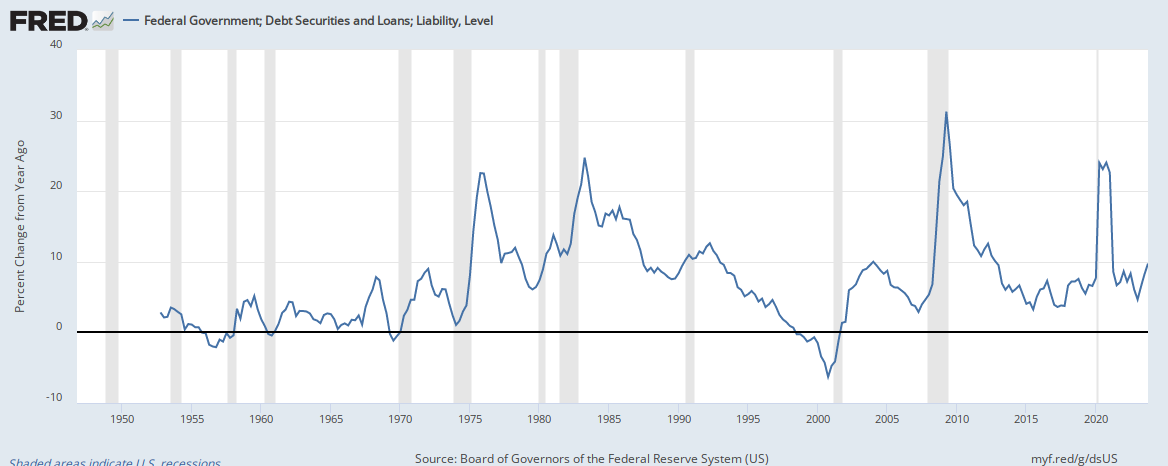
U.S. recessions tend to come on the heels of deficit growth reductions:

Monetary Sovereignty
Deficits are vertical gray lines. As the federal deficit growth line drops, we approach recessions, which are cured only when deficit growth rises.

Federal deficit growth is necessary for economic growth.

All of us — the states, counties, villages, businesses, you, and me — we all live on the edge of insolvency. Only the Monetarily Sovereign federal government can save us.

Remember this the next time a politician or blogger tells you the federal government “can’t afford” something, and the deficit and debt are “unsustainable,” and the government should run a balanced budget.

At the behest of the rich, the politicians try to make you insolvent and turn your world into ice, so the rich can make you their desperate slave.

Rodger Malcolm Mitchell
Monetary Sovereignty

………………………………………………………………………………………………………………………………………………………………………………………………………………………………………………………………………………………………………………………………………..

The single most important problems in economics involve the excessive income/wealth/power Gaps between the have-mores and the have-less.

Wide Gaps negatively affect poverty, health and longevity, education, housing, law and crime, war, leadership, ownership, bigotry, supply and demand, taxation, GDP, international relations, scientific advancement, the environment, human motivation and well-being, and virtually every other issue in economics.

Implementation of The Ten Steps To Prosperity can narrow the Gaps:

Ten Steps To Prosperity:
1. ELIMINATE FICA (Ten Reasons to Eliminate FICA )
Although the article lists 10 reasons to eliminate FICA, there are two fundamental reasons:
*FICA is the most regressive tax in American history, widening the Gap by punishing the low and middle-income groups, while leaving the rich untouched, and
*The federal government, being Monetarily Sovereign, neither needs nor uses FICA to support Social Security and Medicare.
2. FEDERALLY FUNDED MEDICARE — PARTS A, B & D, PLUS LONG TERM CARE — FOR EVERYONE (H.R. 676, Medicare for All )
This article addresses the questions:
*Does the economy benefit when the rich can afford better health care than can the rest of Americans?
*Aside from improved health care, what are the other economic effects of “Medicare for everyone?”
*How much would it cost taxpayers?
*Who opposes it?”
3. PROVIDE A MONTHLY ECONOMIC BONUS TO EVERY MAN, WOMAN AND CHILD IN AMERICA (similar to Social Security for All) (The JG (Jobs Guarantee) vs the GI (Guaranteed Income) vs the EB (Economic Bonus)) Or institute a reverse income tax.
This article is the fifth in a series about direct financial assistance to Americans:

Why Modern Monetary Theory’s Employer of Last Resort is a bad idea. Sunday, Jan 1 2012
MMT’s Job Guarantee (JG) — “Another crazy, rightwing, Austrian nutjob?” Thursday, Jan 12 2012
Why Modern Monetary Theory’s Jobs Guarantee is like the EU’s euro: A beloved solution to the wrong problem. Tuesday, May 29 2012
“You can’t fire me. I’m on JG” Saturday, Jun 2 2012

Economic growth should include the “bottom” 99.9%, not just the .1%, the only question being, how best to accomplish that. Modern Monetary Theory (MMT) favors giving everyone a job. Monetary Sovereignty (MS) favors giving everyone money. The five articles describe the pros and cons of each approach.
4. FREE EDUCATION (INCLUDING POST-GRAD) FOR EVERYONE Five reasons why we should eliminate school loans
Monetarily non-sovereign State and local governments, despite their limited finances, support grades K-12. That level of education may have been sufficient for a largely agrarian economy, but not for our currently more technical economy that demands greater numbers of highly educated workers.
Because state and local funding is so limited, grades K-12 receive short shrift, especially those schools whose populations come from the lowest economic groups. And college is too costly for most families.
An educated populace benefits a nation, and benefitting the nation is the purpose of the federal government, which has the unlimited ability to pay for K-16 and beyond.
5. SALARY FOR ATTENDING SCHOOL
Even were schooling to be completely free, many young people cannot attend, because they and their families cannot afford to support non-workers. In a foundering boat, everyone needs to bail, and no one can take time off for study.
If a young person’s “job” is to learn and be productive, he/she should be paid to do that job, especially since that job is one of America’s most important.
6. ELIMINATE FEDERAL TAXES ON BUSINESS
Businesses are dollar-transferring machines. They transfer dollars from customers to employees, suppliers, shareholders and the federal government (the later having no use for those dollars). Any tax on businesses reduces the amount going to employees, suppliers and shareholders, which diminishes the economy. Ultimately, all business taxes reduce your personal income.
7. INCREASE THE STANDARD INCOME TAX DEDUCTION, ANNUALLY. (Refer to this.) Federal taxes punish taxpayers and harm the economy. The federal government has no need for those punishing and harmful tax dollars. There are several ways to reduce taxes, and we should evaluate and choose the most progressive approaches.
Cutting FICA and business taxes would be a good early step, as both dramatically affect the 99%. Annual increases in the standard income tax deduction, and a reverse income tax also would provide benefits from the bottom up. Both would narrow the Gap.
8. TAX THE VERY RICH (THE “.1%) MORE, WITH HIGHER PROGRESSIVE TAX RATES ON ALL FORMS OF INCOME. (TROPHIC CASCADE)
There was a time when I argued against increasing anyone’s federal taxes. After all, the federal government has no need for tax dollars, and all taxes reduce Gross Domestic Product, thereby negatively affecting the entire economy, including the 99.9%.
But I have come to realize that narrowing the Gap requires trimming the top. It simply would not be possible to provide the 99.9% with enough benefits to narrow the Gap in any meaningful way. Bill Gates reportedly owns $70 billion. To get to that level, he must have been earning $10 billion a year. Pick any acceptable Gap (1000 to 1?), and the lowest paid American would have to receive $10 million a year. Unreasonable.
9. FEDERAL OWNERSHIP OF ALL BANKS (Click The end of private banking and How should America decide “who-gets-money”?)
Banks have created all the dollars that exist. Even dollars created at the direction of the federal government, actually come into being when banks increase the numbers in checking accounts. This gives the banks enormous financial power, and as we all know, power corrupts — especially when multiplied by a profit motive.
Although the federal government also is powerful and corrupted, it does not suffer from a profit motive, the world’s most corrupting influence.
10. INCREASE FEDERAL SPENDING ON THE MYRIAD INITIATIVES THAT BENEFIT AMERICA’S 99.9% (Federal agencies)Browse the agencies. See how many agencies benefit the lower- and middle-income/wealth/ power groups, by adding dollars to the economy and/or by actions more beneficial to the 99.9% than to the .1%.
Save this reference as your primer to current economics. Sadly, much of the material is not being taught in American schools, which is all the more reason for you to use it.

The Ten Steps will grow the economy, and narrow the income/wealth/power Gap between the rich and you.

MONETARY SOVEREIGNTY