Sending your money to the federal government is like pouring your dollars into the toilet

The federal government is “Monetarily Sovereign.” That means, it creates all the money it spends by pressing computer keys. It never, never, never can run short of dollars.

Even if the federal government didn’t collect a single penny in taxes, it could continue to spend forever. Who says so?

Fed Chairman, Alan Greenspan: “A government cannot become insolvent with respect to obligations in its own currency. There is nothing to prevent the federal government from creating as much money as it wants and paying it to somebody. The United States can pay any debt it has because we can always print the money to do that.”

Fed Chairman, Ben Bernanke: “The U.S. government has a technology, called a printing press (or, today, its electronic equivalent), that allows it to produce as many U.S. dollars as it wishes at essentially no cost. It’s not tax money… We simply use the computer to mark up the size of the account.

Fed Chairman Jerome Powell stated, “As a central bank, we have the ability to create money digitally.

The St. Louis Fed: “As the sole manufacturer of dollars, whose debt is denominated in dollars, the U.S. government can never become insolvent, i.e., unable to pay its bills. In this sense, the government is not dependent on credit markets to remain operational.”

Chat GPT: “The federal government is not financially constrained and does not need to ‘fund’ its spending.”

Treasury Secretary, Paul O’Neill: “I come to you as a managing trustee of Social Security. Today we have no assets in the trust fund. We have promises of the good faith and credit of the United States government that benefits will flow.”

Mario Draghi, President of the Monetarily Sovereign European Central Bank “We cannot run out of money.”

Paul Krugman (Nobel Prize–winning economist): “The U.S. government is not like a household. It literally prints money, and it can’t run out.”

Why does the federal government collect taxes if the government doesn’t need the money?

  1. To control the economy by taxing what the government wishes to discourage and by giving tax breaks to what the government wishes to reward.
  2. To assure demand for the U.S. dollar by requiring dollars to be used to pay taxes.

You pay taxes with money from the M2 money supply measure. When your dollars reach the Treasury, they cease to be part of any money supply measure. Effectively, they are destroyed.

Why are they not included in any money supply measure? The government has infinite money, and therefore there is no measure for infinity.

When Donald Trump claims to reduce the debt through tariffs, he is misleading you in two ways.

  1. Tariffs are paid by the buyer. They are part of the price you pay for imported goods.
  2. Tariff dollars come out of the U.S. economy. They reduce economic growth and lead to recessions.
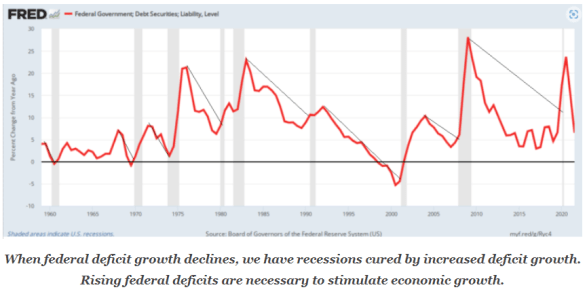
Tariffs reduce Net Federal Deficit Spending (blue line) as well as the Debt/ Gross Domestic Product ratio (red line). Reductions in these lines lead to recessions (vertical gray bars), which are cured only by increases in federal deficit spending.

Thus, Trump’s tariffs hurt you in three ways.

  1. They take dollars directly out of your pocket
  2. They cause overall inflation.
  3. And they lead to recessions.

The side effects of inflation and recessions include demands to cut social benefits and increase taxes to “fund” them.

Trump relies on your not understanding the differences between federal finances and your personal finances. You cannot create dollars from thin air. You must have sufficient income to cover your expenses.

The federal government can create dollars from thin air, and it neither needs nor uses income to fund its spending.

And no, federal deficit spending does not cause inflation.

Contrary to popular myth, there is no relationship between changes in federal deficit spending (blue) and inflation (green). The peaks and valleys of the two lines do not correspond.

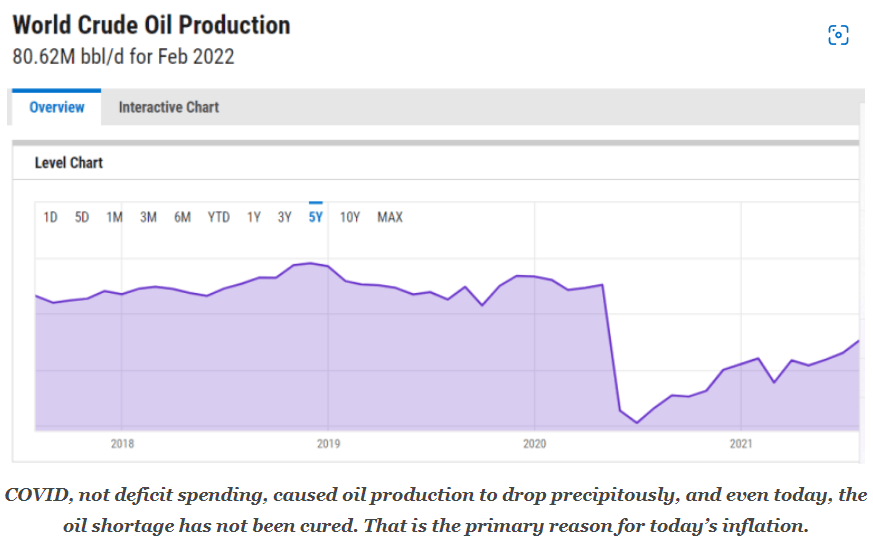
So what does cause inflation? Shortages of crucial goods and services, most notably shortages of energy.

Note the close relationship between inflation (green) and oil prices (orange). Energy and food are the primary drivers of inflation.

To prevent and cure inflation, we never should cut federal spending. All that does is cause recessions. Instead, we should cure the shortages that caused the inflation.

When the primary cause is an oil shortage, the government should:

  1. Deficit spending to support oil drilling  and refining
  2. Support the production of renewable energy (wind, solar, geothermal, atomic).
  3. Support the use of renewable energy (i.e., electric cars and trucks)
  4. Fund research into creating more energy sources

Sadly, we are doing the opposite. Trump is discouraging the development of wind energy (his “windmills”) and solar power, while also discouraging the use of renewable energy sources (such as credits for solar installations and electric cars).

The massive tariff collections + discouraging the production of renewable energy + discouraging the use of renewable energy combine to make a perfect inflation/recession storm (aka “stagflation.”)

When the inevitable stagflation happens, we Trump will blame it on Biden, Obama, the Fed, any data-gathering agency that tells the truth, China, Mexico, Canada, NATO, black “criminals,” Mexican “rapists,” immigrants, “woke,” people collecting social benefits like Medicare, Social Security, Obamacare, and “stolen” elections.

Why do we assume this? Because this is his history and because he cannot help himself. See: “A Psychopath Slipped Into the White House.”

He seemingly scores “high” on the Hare Test for Psychopathy , meaning he strongly indicates psychopathy.
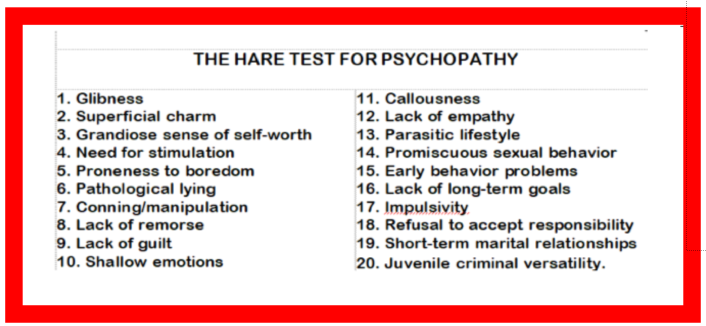
 

The test is scored 2 (definitely present), 1 (possibly present), and 0 (not present). A total score of 30 or more is generally considered the threshold for diagnosing psychopathy.

Although you may not be a professional psychologist, and you may only have a distant observation of Donald Trump and his actions and statements, you can come to your own private conclusion about him. My guess is that the result will not be in question.

SUMMARY and PREDICTIONS

The federal deficit is necessary for economic growth and to prevent/cure recessions and depressions. You, not a foreign nation, pay for the tariffs.

Trump’s wildly eccentric and highly damaging use of tariffs will result in stagflation, which he will deny exists and/or blame on others or on world situations.

His proven reluctance to accept adverse facts will prevent him from addressing stagflation, which will worsen as he remains in power.

He will attempt to remain in office even after his current term ends, and at least three members of the Supreme Court — Alito, Thomas, and Gorsuch — will approve of his “creative” efforts to remain president in name or in fact(i.e., running as a Vice President with the intention of having the President resign).


Rodger Malcolm Mitchell

Monetary Sovereignty

Twitter: @rodgermitchell

Search #monetarysovereignty

Facebook: Rodger Malcolm Mitchell;

MUCK RACK: https://muckrack.com/rodger-malcolm-mitchell;

https://www.academia.edu/

……………………………………………………………………..

A Government’s Sole Purpose is to Improve and Protect The People’s Lives.

MONETARY SOVEREIGNTY
Bad ideas lead to bad results

A decision based on a false belief, will probably be a bad decision.

Rep. Jay Obernolte (R., Calif.), a Budget Committee member, said the Republican plan would unquestionably put the country on a stronger fiscal footing. “If you have to pick between a higher-tax, higher-spending regime and a lower-tax, lower-spending regime, the latter is always better for economic growth,” he said.

That belief may be common, but it is not supported by fact. Using it as a basis for Trump’s “big, beautiful” tax cut for the rich adds greater falsity.

1. Obernolte’s statement conveniently omits the questions, “Lower tax for whom?” and “Lower spending for whom?” 

In the case of Trump’s tax cut, the answers are: “Lower tax for the rich” and “lower spending for the rest of America.” As is usual for the right wing, the tax cut makes the rich richer and the rest poorer.

2. Because the U.S. government is Monetarily Sovereign, we never “have to pick between a higher-tax, higher-spending regime and a lower-tax, lower-spending regime.” We can and should have a lower tax (especially for the poorer), higher spending regime.

3. Federal debt and deficits are not a burden on the federal government or on taxpayers. Being Monetarily Sovereign, the federal government has infinite dollars to fund any debt

4. The so-called “federal debt”  is neither “federal” nor “debt.” It is the total of dollars deposited into Treasury Security accounts, wholly owned by depositors and held for safekeeping by the government (Think: Safe deposit boxes).

5, The “debt” is not a burden on taxpayers. Tax rates have nothing to do with the “debt.” Federal tax rates are arbitrarily chosen by Congress for political reasons, not to fund spending. (By contrast, state and local taxes do fund monetarily non-sovereign state and local spending.)

6. The purposes of federal taxes are:

A. To control the economy by taxing what the government wishes to discourage and by giving tax breaks to what the government wishes to reward 

B. To assure demand for the U.S. dollar by requiring taxes to be paid in dollars.

7. Federal deficit spending does not cause inflation. See: “At long last, let’s put this inflation question to bed.”  Inflations, i.e, general increases in prices, are based on shortages of crucial goods and services. Federal deficit spending does not create those shortages.

Even during wars, it’s not the federal spending that causes shortages; it’s the war needs. If during a war, federal spending was lower, inflation would be worse, as there would be even fewer consumer goods.

In fact, federal deficit spending can cure inflation when the spending supports the availability of scarce goods and services.

Example: The notorious Zimbabwe inflation was caused by a food shortage. It could have been cured by government spending to aid farming and imports of food. Instead, the government simply printed currency, which created the illusion that the currency creation caused the inflation.

The most recent inflation was caused by COVID-related shortages of oil, food, metals, paper, lumber, shipping, labor and other needs.  Government spending has helped reduce those shortages and inflation.

8. Just as federal deficit spending does not cause inflation, it also does not force interest rates up. 

A. Interest rate increases add to business costs, which result in higher, not lower prices

B. Interest rate increases are an arbitrary option of the Federal Reserve because of the mistaken belief that they cure inflation. The Fed also raises rates to encourage the purchase of Treasury Securities. This takes spending dollars from the economy, and therefore is recessive.

The federal government does not need to sell Treasury securities to pay its bills. It pays all its bills with newly created dollars, not by so-called borrowing.

Because inflation is supply-based, not demand-based, recessions do not cure inflation. In fact, we can have both simultaneously. It is called “stagflation.”

There are those of a Libertarian bent who simply do not like government (except when they receive such benefits as Medicare, Medicaid, Social Security, highways, military defense, police defense, schools, parks, disaster relief, food and drug inspection, new drug R&D, FBI, CIA, etc.)

They invent false reasons why government spending should be cut (except for programs that benefit them).

Federal deficit spending is necessary for economic growth. It is part of the formula for Gross Domestic Product:

GDP = Federal Spending + Non-federal Spending + Net Exports

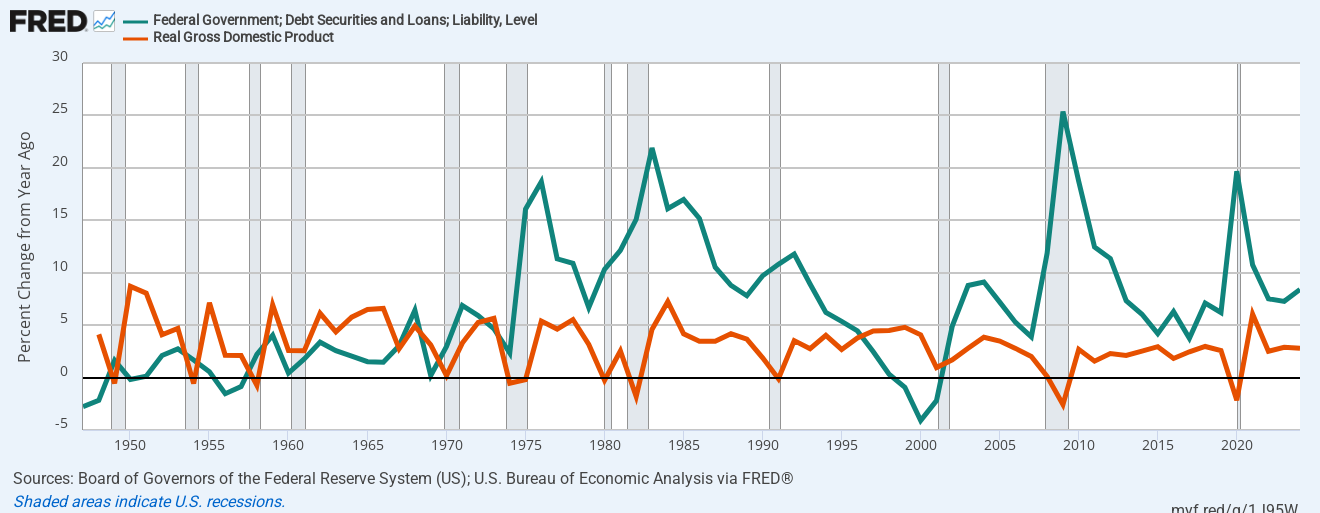
As you can see from the following graph, relative declines in federal spending (green) precede recessions (vertical gray bars). Increases and decreases in federal deficit spending are generally associated with increases and decreases in GDP.

        Is anyone fooled by the pols who pretend outrage at the federal deficit and debt, and then pass legislation that widens the income/wealth/power Gap between the rich and the rest? 

        Those folks simply are the greedy rich. I don’t know what to say about the media and economists who go along with that charade.

        Bottom line: The economy always does better when the federal government spends more and taxes less. That’s simple algebra. Given the power, my first act would be to eliminate FICA, and give everyone Medicare.

        Rodger Malcolm Mitchell

        Monetary Sovereignty

        Twitter: @rodgermitchell

        Search #monetarysovereignty

        Facebook: Rodger Malcolm Mitchell;

        MUCK RACK: https://muckrack.com/rodger-malcolm-mitchell;

        https://www.academia.edu/

        ……………………………………………………………………..

        A Government’s Sole Purpose is to Improve and Protect The People’s Lives.

        MONETARY SOVEREIGNTY


        What you should know about our economy that others don’t know.

        On September 7, 2009, we published a summary of our economy, facts that seem unknown to the public and ostensibly to economists, the media, and politicians (though I believe many of them fake their ignorance.

        Much has changed in the past 13 years, but not the realities, and it is these realities that seem to mystify our thought leaders.

        Today’s post will give you those realities, so you will understand why our economy continually lurches from recession to recession, with Congress, the President, and the Federal Reserve flailing about in apparent helplessness against the winds of fate.

        Our leaders are not helpless. On the contrary, they have all the tools necessary to exert absolute control over our economy, even during the most stressful times. Even in the face of war, COVID, global warming, and population changes, etc., recessions, depressions, and inflations could be prevented, and prosperity could be implemented, but for the prevailing lack of knowledge or effort.

        Economists wish to portray economics as a mathematically-based science, similar to physics, where precise predictions often are possible. But because economics is intertwined with psychology, at best a pseudo-science, predictions veer from inaccurate to just plain WAG (Wild Ass Guesses).

        Knowing that exact replication of economics studies is impossible, and even approximations can be wrong, economists tend not to stray far from earlier WAGs and to quote liberally from the past.

        Unfortunately, the past, at least the more distant past, omitted Monetary Sovereignty. It is the recognition that the creator of a currency never can run short of that currency, does not need or use income to pay for things, and has absolute control over all aspects of that currency.

        The finances of a Monetarily Sovereign entity are nothing like those of a monetarily non-sovereign entity. Confusingly, similar words are used to describe both.

        Words like “debt,” “deficit,” “trust fund,” “taxes,” “financial burden,” “prudent,” “money supply,” “borrow,” and even “pay” have different meanings and implications when applied to Monetarily Sovereign entities vs. monetarily non-sovereign entities. These differences are not widely understood or taught in schools.

        What follows is a summary-in-brief of those differences. 

        But if it ever becomes widely understood, the intelligent application of Monetary Sovereignty will significantly reduce the incidence of inflations, recessions, depressions, poverty, hunger, homelessness, street crime, illiteracy, sickness, and the collection of taxes.

        Here are some facts of which you may not be aware:

        1. The U.S. government arbitrarily created the U.S. dollar from thin air. There were no U.S. dollars in the thousands of centuries before the 1780s.
        2. Then suddenly, the U.S. government created U.S. dollars from thin air — as many as it wanted to — by creating new laws, also from thin air, which it has the infinite ability to do.
        3. Just as laws have no physical existence, so do U.S. dollars have no physical reality. Dollars are nothing more than numbers on balance sheets controlled by the government. Those printed dollar bills are only titles to dollars. Just as a house title is not a house and a car title is not a car, a dollar bill is not a dollar.
        4.  Every form of money is a form of debt. Bank savings accounts, checking accounts, money market accounts, C.D.s, travelers’ checks, and corporate bonds all are owed by someone or something. Even the dollar bill represents a debt of the federal government, which is why it has the words  “federal reserve note” printed on it. “Bill” and “note” are words referencing debt.
        5. Just as a car title is not a car, and a house title is not a house, a dollar bill is not a dollar. It is a bearer title to a dollar, which is no more physical than a number.
        6. Because dollars have no physical existence but are only numbers, the federal government has the power to create infinite dollars merely by pressing computer keys. It makes as many dollars as it wishes.
        7. (Former Federal Reserve Chairman Ben Bernanke: “The U.S. government has a technology, called a printing press [or, today, its electronic equivalent], that allows it to produce as many U.S. dollars as it wishes at essentially no cost.“)
        8. The federal government gives its dollars any value it wishes. Through the years, the federal government often arbitrarily changed the value of dollars.
        9. Today, the federal government retains the power to create laws that develop infinite dollars and to give those dollars whatever value it wishes.
        10. This ability is called “Monetary Sovereignty.” The federal government is sovereign over the U.S. dollar.
        11. While the federal government is Monetarily Sovereign, state/local governments, businesses, and people are monetarily non-sovereign.
        12. Monetarily non-sovereign entities do not have the infinite ability to create U.S. dollars or to give those dollars arbitrary values. Monetarily non-sovereign entities can run short of dollars.
        13. While the U.S. government and the governments of the U.K., Mexico, Canada, Australia, Sweden, and others are Monetarily Sovereign, the governments of France, Italy, Germany, Portugal, and others are monetarily non-sovereign. They use the euro. They cannot control their money supplies, nor do they have the ability to fight inflation, recession, or depression.
        14. The European Union (E.U.) is sovereign over the euro. The E.U. is run by the rich. It can fight inflation, recession, and depression but instead forces the poorest people of the euro nations to shoulder that burden.
        15. The U.S. federal government cannot unintentionally run short of dollars, even if it collects no taxes.
        16. Federal taxes and American federal taxpayers do not fund federal government spending. The federal government could provide unlimited benefits (Medicare for All, Social Security for All, College for All, etc.) without taxes. The term, “spending taxpayers’ money,” when referring to the federal government is incorrect. The government does not spend taxpayers’ money.
        17. The purpose of federal taxes is not to provide the federal government with dollars but rather to:
          A. Control the economy by taxing what it wishes to discourage and giving tax breaks to what it wishes to encourage
          B. To assure demand for the dollar by requiring dollars to be used for tax payments, and
          C. to discourage the public from asking for benefits. This is a function of Gap Psychology — the desire of the rich to distance themselves from the middle- and lower-income/wealth/power public.
        18. Money is the way modern economies are measured. By definition, a large economy has a larger money supply than does a small economy. Therefore, a growing economy requires an increasing supply of money. QED.
          The graph shows the essentially parallel paths of GDP (red) vs. a broad measure of the U.S. money supply, Domestic Non-Financial Debt (blue)
        19. Medicare and Social Security are not funded by so-called “trust funds,” which are not real trust funds but only balance sheet lines.
          WHAT ARE FEDERAL TRUST FUNDS?
          September 20, 2016, Peter G. Peterson Foundation
               A federal trust fund is an accounting mechanism used by the federal government to track earmarked receipts (money designated for a specific purpose or program) and corresponding expenditures.
               The largest and best-known funds finance Social Security, Medicare, highways and mass transit, and pensions for government employees.
               Federal trust funds bear little resemblance to their private-sector counterparts.
               In private-sector trust funds, receipts are deposited, and assets are held and invested by trustees on behalf of the stated beneficiaries.
               In federal trust funds, the federal government does not set aside the receipts or invest them in private assets.
               Instead, the receipts are recorded as accounting credits in the trust funds, and the receipts themselves are comingled with other receipts that Treasury collects and spends.
        20. The government has total control over these balance sheet numbers, belying the false claim that the “trust funds” soon will run short of dollars. The federal government has absolute control over those balance sheet numbers. It can add to them or reduce them at will.
        21. Your Social Security check comes from a mythical trust fund that contains no money and receives no money. Social Security (and Medicare) benefits are paid ad hoc by the U.S. government, not from a trust fund, and are not dependent on FICA taxes. Which can and (opinion) should be eliminated.
        22. The federal government creates new dollars ad hoc by paying bills. No receipts by the Treasury are spent. They all are destroyed.
        23. Debt is not a burden on the federal government. It is not, as some have been calling it for over eighty years, “a ticking time bomb.”The infinite ability to create dollars means the government can service any debt denominated in dollars by creating dollars, ad hoc.
        24. The federal Debt/GDP ratio often is quoted with alarm. A high ratio wrongly is thought to indicate the federal government’s difficulty paying its debts. In fact, the Debt/GDP ratio is meaningless, having zero predictive power. Looking at a list of countries by their Debt/GDP ratio will not tell you which countries are better or worse able to pay their bills.
        25. It is impossible to evaluate any aspect of a nation’s economy by looking at its Debt/GDP ratio. The ratio says nothing about the health of the U.S. economy or about the federal government’s ability to pay its bills. See Debt to GDP ratio by country.
        26. The federal government creates dollars by paying creditors.
          A. To pay a creditor, the federal government sends instructions (not dollars) to the creditor’s Bank, instructing the Bank to increase the balance in the creditor’s checking account.
          B. The instant the Bank obeys those instructions, new dollars are created from thin air and added to the M1 money supply measure.
          C. The instructions then are cleared through the Federal Reserve and the government agency issuing the instructions.
        27. What is commonly called “debt” is the total of dollar deposits into privately owned Treasury Security accounts by the purchase of T-bills, T-notes, and/or T-bonds.
          A. To make a deposit into a T-security account, one opens a T-security account and uses U.S. dollars to invest in a T-bill, T-note, or T-bond.
          B. The government never touches those dollars other than to make interest deposits.
          C. The government does not use those dollars; it creates new dollars, ad hoc, to pay its bills.
          D. Upon maturity, the government returns the account balance to the account owner. Visualize how a bank treats deposits in safe deposit boxes.
          E. Because the dollars already exist in the T-security accounts, returning them is not a financial burden on the U.S. government or any taxpayer.
        28. Not needing an input of dollars, the government provides T-bills, etc., only to provide a safe place to store unused dollars and to help it control interest rates. Both purposes help the government stabilize the dollar. 
        29. Even if large holders of T-securities (China is a notable example) were to stop buying T-securities (the term “lending” erroneously is used), the federal government could continue spending as before. If the Federal Reserve felt a need to issue T-securities, they could buy them themselves. There is no financial need for the U.S. to sell T-securities to China.
        30. Some worry that one day the U.S. dollar will cease to be the world’s reserve currency. That should not be a concern. A reserve currency is nothing more than a currency banks hold in reserve to facilitate international commerce. Many currencies function as reserve currencies, including: the euro, Japanese yen, British pound, Chinese yuan, and others.
        31. A federal “deficit” is the difference between dollars the government creates and sends to the economy (aka “the private sector”) vs. dollars the private sector sends to the government.
        32. When federal deficit and debt growth are reduced we experience recessions and depressions.
          1804-1812: Federal Debt reduced by 48%. Depression began 1807.
          1817-1821: Federal Debt reduced by 29%. Depression began 1819.
          1823-1836: Federal Debt reduced by 99%. Depression began 1837.
          1852-1857: Federal Debt reduced by 59%. Depression began 1857.
          1867-1873: Federal Debt reduced by 27%. Depression began 1873.
          1880-1893: Federal Debt reduced by 57%. Depression began 1893.
          1920-1930: Federal Debt reduced by 36%. Depression began 1929.
          1997-2001: Federal Debt  reduced by 15%. The recession began 2001.
        33. Federal deficits enrich the economy and are necessary to grow the economy. They add dollars to the economy, and they help prevent and cure recessions.
        34. Gross Domestic Product (GDP) is a measure of dollars spent in the economy, which is why adding dollars to the economy stimulates GDP growth.
        35. Balanced budgets, though appropriate for personal finances, cause recessions and depressions when attempted by the federal government. To grow, the private sector needs to receive more dollars from the federal government than it pays to the federal government (aka a federal deficit).
        36. The federal government receives dollars from the economy through taxes, fines, and other payments.
        37. All dollars received by the federal government are destroyed upon receipt.
          a. Taxes are paid from the private sector (aka “the economy) checking accounts (Those dollars are part of the “M1” money supply) and are sent to the U.S. Treasury.
          b. When dollars reach the Treasury, they cease to be part of any money supply measure. Because the government has the infinite ability to create dollars, there can be no measure of how many dollars the government has. It has infinite dollars. (Infinite dollars + Tax Dollars = Infinite dollars. No change.)
          c. Because tax dollars do not increase the federal government’s money supply, they are effectively destroyed.
          d. Dollars sent to monetarily non-sovereign state/local governments, businesses, and people are not destroyed. They are deposited into private sector banks and remain part of the M1 money supply.
        38. Monetarily non-sovereign entities (state/local governments, businesses, etc.) create dollars by borrowing and lending.
          a. When a bank lends dollars, it does not lend depositors’ funds. It adds dollars to the borrower’s checking account (M1) and balances its books by counting the borrower’s note as dollars.
          b. Upon consummating the loan, the Bank has dollars (the note), and the borrower also has the dollars it borrowed. Thus a loan creates dollars.
          c. As the loan is paid down, dollars held by the borrower are sent to the lender, and the loan balance loses value.
        39. By contrast, the federal government does not borrow its own sovereign currency, the U.S. dollar. It pays all its bills by creating new dollars.
        40. The federal government collects taxes not to fund spending but to:
          a. Control the economy by taxing what it wishes to discourage and giving tax breaks to what it wishes to encourage
          b. Create demand for the dollar by requiring taxes to be paid in dollars
          c. Create the false impression that taxes are necessary to fund spending so that the public acquiesces to benefit limits.
        41. Import duties are taxes levied on imported goods. These taxes are paid by the purchaser, not by the seller. For example, a duty on imports of Chinese goods is paid by the American consumer, not by the Chinese exporter.
        42. Inflation is a general increase in prices.
        43. Prices increase because supply is insufficient to satisfy demand (scarcity).
        44. Historically, dollar creation has not caused an increase in demand sufficient to cause inflation. Federal deficit spending does not cause inflation.
          There is no relationship between increases in federal deficit spending (red) and inflation (blue)
          A. All inflations have been caused by the insufficient supply of critical goods and services, most often oil and food.
          B. Today’s inflation is caused by scarcities of oil, food, lumber, computer chips, shipping (supply chain), labor, and other COVID-related factors.
          Oil shortages cause most inflations. Curing oil shortages cures most inflations.
          C. These shortages are not caused by money creation and cannot be cured by restricting money creation plans such as interest rate increases. Those plans do not remedy the scarcities that are responsible for inflation.
          D. Curing inflation requires curing shortages, not recessing the economy.
          Federal deficit spending does not cause inflation.

          E. Shortages often begin with a disease, weather, war, or government mismanagement. COVID caused many shortages and was the original impetus for today’s inflation.
          F. The famous Zimbabwe inflation began when the government took farmland from experienced farmers and gave it to people who didn’t know how to farm. The resultant food shortage, not Zimbabwe’s money creation, caused hyperinflation.
        45. The federal government can cure shortages by additional deficit spending to obtain scarce goods and services or encourage their creation. 
        46. Eliminating the FICA tax would fight inflation by lowering labor costs and thus the cost of most goods.
        47. There is no economic benefit to privately owned banks. The federal government should own all the banks. Because the federal government doesn’t have a profit motive, there would be none of those risky securities the big banks have dreamed up. These garbage contracts led to the Big Recession of 2008, and because the banks were not punished, no lessons were learned. The same problems are happening today.
        48. More efficient and generous immigration laws would fight inflation by reducing the labor shortage.
        49. Low interest rates are not stimulative.
          Low interest rates (purple) do not correspond with high economic growth (green).
        50. Increasing interest rates can make the dollar more valuable and have some stimulative effect because low rates force the government to pay more interest dollars into the economy. But low rates do not cure shortages. They actually can exacerbate shortages and intensify inflation.
        51. Interest rate increases make private sector money creation (borrowing) more difficult, which can recess the economy.
        52. On balance, high and low interest rates have both stimulative and recessive elements. But they do not cure inflations, and it is the inflations that lead to recessions or “stagflation” (the combination of a stagnant economy and inflation). 
        53. A symptom of this bifurcation is the stock market’s adverse reaction to good economic news. Any good news (low unemployment, high GDP growth, etc.) impels the Fed to raise interest rates, which the public believes will hurt business and depress securities.
        54. Recessions have no agreed-upon definition but often are defined as a decline in real Gross Domestic Product (GDP) for two consecutive quarters. GDP is a measure of spending. Federal Spending + Nonfederal Spending + Net Exports = GDP.
        55. Depressions often are defined as recessions that last at least two years.
        56. The prevention and cure for recessions and depressions is federal deficit spending, which adds dollars to the economy (aka the private sector) and increases GDP. 
        57. Reductions in federal deficit spending or surpluses lead to recessions and depressions, providing the private sector with insufficient growth dollars.
        58. The Fed has no cure for stagflation, though Congress and the President do.
          A. The “stagnation” part of stagflation is cured by federal stimulus spending, as is done to cure every recession.
          B. The “inflation” part of stagflation is cured by federal spending to obtain the goods and services whose scarcity is causing inflation.
        59. Though state and local governments are monetarily non-sovereign concerning the U.S. dollar, nothing stops any entity –you, me or anyone–from creating their own sovereign currency and being Monetarily Sovereign concerning that currency.
          A. The currency would face the problem of demand, i.e., the acceptance of the money in payment, which in part would depend on the “full faith and credit” of the issuer.
          B. Many forms of money exist in America. One example is manufacturer coupons. They are issued by businesses, have a stated value, and are accepted by retailers.
          C. Some aspects of the U.S. dollar’s “full faith and credit” are:
               i. The government will accept only U.S. currency in payment of debts to the government
               ii. It unfailingly will pay all its dollar debts with U.S. dollars and will not default
               iii. It will force all domestic creditors to accept U.S. dollars, if offered, to satisfy any debt.
               iv. It will not require domestic creditors to accept any other money
               v. It will protect the value of the dollar.
               vi. It will maintain a market for U.S. currency
               vii. It will continue to use U.S. currency and will not change to another currency.
               viii. All forms of U.S. currency will be reciprocal; five $1 bills always will equal one $5 bill, etc.
        60. An example of Monetary Sovereignty and full faith & credit can be found in the board game, “Monopoly®.” By rule, the Bank in that game never can run out of Monopoly dollars, and it does not rely on income to pay its debts. Thus, the Monopoly bank is Monetarily Sovereign.
        61. Being Monetarily Sovereign, the Bank has infinite Monopoly dollars, and neither its deficits nor its debt is a burden on the Bank or on the players (corresponding to the real-world economy).
        62. Gold and silver are not, and never have been money. At most, they have been value standards to which the value of money is compared.
        63. Gold or silver never “backed” the dollar. The prices of gold and silver vary wildly, but through the years, the federal government arbitrarily and often has changed the value of dollars vs. gold and silver (which destroys the “backed” claim.) The only thing backing the U.S. dollar is the full faith and credit of the U.S. government.
        64. Lack of money is the mother of street crime. Impoverished neighborhoods endure far more street crime than do wealthy neighborhoods.
        65. The prevention and cure for street crime is not more police or more severe punishment. The prevention and cure for street crime is to reduce poverty.
        66. The federal government has the power to reduce poverty and thus to reduce street crime) by paying for health care insurance (Medicare for All), living expenses (Social Security for All), education (college for all), food (Supplemental Nutrition Assistance Program — SNAP for all), life insurance for all, and housing (rent assistance for all).
        67. “Rich” and “poor” are relative terms. A person having a million dollars would be poor if everyone else had ten million. A person with a thousand dollars would be rich if everyone else had ten dollars. The income/wealth/power difference between those who have more and those who have less is the Gap.
        68. The wider the Gap, the richer are the rich.
        69. To become more prosperous, the rich (who run our world) continually attempt to widen the Gap. They can widen the Gap by gaining more for themselves or by forcing the poorer to have less.
        70. To force the poorer to have less, the rich feed them the disinformation that the federal government cannot afford to pay for benefits, that federal spending causes inflation, or that benefits require taxes. None are true.
          A. The federal government can afford anything (It’s Monetarily Sovereign);
          B. federal spending never has caused inflation (shortages of oil and other goods and services cause inflation);
          C. federal taxes don’t pay for anything (the federal government creates dollars, ad hoc, to pay for all its spending). Federal taxes are destroyed upon receipt.
        71. The rich also spread the disinformation that if the federal government provides benefits, the poor will refuse to work. To debunk this myth, one only needs to look at the rich, or even at the upper middle classes, who continue to work despite receiving massive tax benefits.
        72. Human wants are unlimited. Even the rich wish to be richer, more powerful, more respected, more envied, more admired, and to have more of everything. Most people want a better life for themselves and their children.
        73. Thus, even upon receiving free medical care, housing, food, clothing, education, etc., people will continue to work for more than what is considered “basic” at any moment in time.
        74. To help spread their disinformation, the rich bribe:
          A. Politicians (via political donations and promises of future employment),
          B. Economists (via university donations and jobs in think tanks), and
          C. The media (via advertising dollars and media ownership).
        75. The rich bribe politicians to pass tax laws and other laws favorable to the wealthy and unfavorable to the rest of us, to widen the income/wealth/power Gap.
        76. Congress’s approval of benefits reveals an ugly part of the human psyche: Jealousy. President Biden’s approval of student loan debt reduction elicited cries of “Unfair” from those who already had paid off much or all of their student loan debt.
        77. But all benefits are felt to be “unfair” by those who didn’t receive the benefit before it was begun. This demonstrates the intimate relationship between economics and psychology. 
        78. The European Union (E.U.) is Monetarily Sovereign over the euro and is run by the rich, forcing the euro nations to struggle for lack of euros. This helps widen the Gap between the European rich and the rest.
        79. The United States is a not-very-democratic republic. While we, the people, do elect our leaders, the election system is highly skewed toward rural power. The Senators’ elections and the national Presidential elections give excessive power to rural voters vs. urban voters. This originally was done by our founders to encourage rural states to join the union.
        80. Within the Senate, voting rules give a few Senators, sometimes only one Senator, extreme power. Even the supposedly population-based House of Representatives accomplishes this dubious, undemocratic achievement via gerrymandering,the manipulation of an electoral constituency’s boundaries so as to favor one party or class. 
        81. The Supreme Court, the final arbiter of all laws, proudly pays no attention to what the public wants. Instead, they are nine (currently) unelected people who make national decisions based on their personal and religious philosophies and party affiliation. 
        82. As such, the unelected Supreme Court’s desired impartial functions have been superseded by the Justices’ personal biases. A case could be made for eliminating the Supreme Court and allowing the elected Executive and Legislative branches of government, which more closely reflect the desires of the public, to fill the role. An alternative would be to impose term limits on SCOTUS justices.

        The above points are merely summaries of broader truths about the U.S. economy. Most have been discussed at greater length in this blog’s preceding posts.

        Rodger Malcolm Mitchell
        Monetary Sovereignty

        Twitter: @rodgermitchell Search #monetarysovereignty
        Facebook: Rodger Malcolm Mitchell

        ……………………………………………………………………..

        The Sole Purpose of Government Is to Improve and Protect the Lives of the People.

        MONETARY SOVEREIGNTY

        Fed Chair Powell pushes the economy over the cliff. Next stop: Stagflation

        WASHINGTON (AP) — Intensifying its fight against high inflation, the Federal Reserve raised its key interest rate Wednesday by a substantial three-quarters of a point for a third straight time and signaled more large rate hikes to come — an aggressive pace that will heighten the risk of an eventual recession.

        Barring the kind of miracle that allows Jerome Powell to come to his senses, we very soon will be in a stagflation — a combination of stagnation and inflation — and Jerome Powell will not know what to do about it. The past interest rate increases have done nothing to halt or even moderate inflation. So, Chairman Powell does the only “sensible” thing. He keeps doing what repeatedly has failed, praying that somehow, in some way, magic will happen. He is not “heightening the risk of recession.” He intentionally is causing a recession. He says so himself but uses oblique language to describe it.
        Trust me. I’m doing this to cure your acrophobia.

        The officials also forecast that they will further raise their benchmark rate to roughly 4.4% by year’s end, a full point higher than they had envisioned as recently as June.

        And they expect to raise the rate again next year, to about 4.6%. That would be the highest level since 2007.

        By raising borrowing rates, the Fed makes it costlier to take out a mortgage or an auto or business loan.

        Get it? To fight higher prices, the Fed will raise the prices of mortgages, autos, and business operations — and just about every other thing you wish to buy. And some people believe this nonsense.

        Consumers and businesses then presumably borrow and spend less, cooling the economy and slowing inflation.

        “Cooling the economy” is the Fed’s way of saying, “causing a recession.” Here is the definition of a recession: “a period of temporary economic decline during which trade and industrial activity are reduced, generally identified by a fall in GDP in two successive quarters.” Sounds like “cooling,” doesn’t it? Sadly, the Fed doesn’t have the courage or morals to tell the truth, which is that they want to cause a recession as a way to end inflation. So they say they are going to “cool” the economy” What makes them feel the economy needs “cooling”? One measure of the economy’s “heat” is unemployment. A “hot” economy should have low unemployment. According to the Fed’s metric, the Fed should raise interest rates when unemployment goes down. Similarly, when unemployment rises, you might expect the Fed to cut rates We should see the unemployment rate and the interest rate move in opposite directions. Is that what we see?
        When unemployment (red) goes up, and the economy could use some stimulus, the Fed tends to raise interest rates (green), which is anti-stimulus. By the Fed’s own philosophy, interest rates should rise when unemployment goes down, But we see the opposite.
        In short, the Fed is consistent. It consistently does exactly the opposite of what it claims the economy needs. The reason: The Fed focuses on the false premise that inflation is caused by low interest rates and is cured by raising interest rates. And as far as the economy needing “cooling,” what exactly does it mean? What does it mean for an economy to be too hot? Here’s an interesting graph: It shows one of the prime measures of economic growth, the annual change in real per capita gross domestic product. If anything should measure the “heat” of an economy, this is it. A year ago, in early 2021, one might have said the economy is pretty “hot.” No longer. The economy now seems to be growing at a normal rate. So why does it need “cooling”? Notice what happens before we have a recession. The annual change drops, which is exactly what the Fed wants to happen now. I’ve been at this for twenty-five years, and I still don’t know what it means for an economy to be too hot. What I do know, however, is what causes inflation: Shortages of key goods and services. Today, we have those shortages, not because demand is too great, and not because interest rates are too low, and not because the federal deficits are too high. We have shortages because the confluence of COVID, the Russian war, and reduced oil pumping caused supply to constrict.  

        Falling gas prices have slightly lowered headline inflation, which was a still-painful 8.3% in August compared with a year earlier.

        Think of it. The Fed has raised the benchmark interest rate almost 4 points — a massive change — and inflation didn’t budge, but falling gas prices moved the needle. That tells you something about the ineffectiveness of interest rate changes. Here’s another interesting graph. It compares inflation to oil prices: The parallels are stunning. Inflation follows oil prices because oil affects the price of every other product. The price of oil is determined by supply and demand. Increase the supply, and inflation will go down. The same is true regarding demand. Decrease the demand for oil, and inflation will fall. But short of causing a recession, how does one decrease the demand for oil? The only answer is something we are just beginning to do: Find substitutes for oil.  Most oil is used for energy, so businesses must expand production of solar, wind, nuclear, geothermal, and tidal energy sources — and this will require increased government spending and lower interest rates.

        Speaking at a news conference, Chair Jerome Powell said that before Fed officials would consider halting their rate hikes, they would “want to be very confident that inflation is moving back down” to their 2% target.

        He noted that the strength of the job market is fueling pay gains that are helping drive up inflation.

        Powell, as an agent for the very rich, tells us that those nasty pay gains for the 99% are causing inflation. If only we could find a way to cut back on pay gains, all would be well.

        “If we want to light the way to another period of a very strong labor market,” Powell said, “we have got to get inflation behind us. I wish there was painless way to do that. There isn’t.”

        Translation: “The labor market is too strong. Unemployment is too low, and people are earning too much. So, I’m going to create a strong labor market by cutting economic growth. This will increase unemployment and cut salaries, which will be painful (to everyone but the rich).” This is the logic that will help widen the Gap between the rich and the rest.

        Fed officials have said they are seeking a “soft landing,” by which they would manage to slow growth enough to tame inflation but not so much as to trigger a recession.

        Yet most economists are skeptical. They say they think the Fed’s steep rate hikes will lead, over time, to job cuts, rising unemployment and a full-blown recession late this year or early next year.

        Job cuts, unemployment and a full-blown recession are exactly what the very rich want. Their incomes won’t be hurt. They won’t be fired. Their pay won’t be cut. And they’ll buy bonds paying higher interest. Meanwhile, the working class will suffer, the Gap will widen, and all will be well with the world.

        “No one knows whether this process will lead to a recession, or if so, how significant that recession would be,” Powell said at his news conference. “That’s going to depend on how quickly we bring down inflation.”

        The way to bring down inflation is to cure the shortages that are causing inflation, not by causing a recession. The federal government needs to support farming, transportation, and the manufacturing and service industries. One way: Cut business costs. Eliminate FICA and provide free health care insurance to every man, woman, and child in America. This would substantially reduce the cost of running businesses. Eliminating FICA instantly would cut the prices of all goods and services. It’s a quick first step, easily done. Simply stop collecting the tax and have the government pay for Social Security and health care insurance.

        In their updated economic forecasts, the Fed’s policymakers project that economic growth will remain weak for the next few years, with rising unemployment. They expect the jobless rate to reach 4.4% by the end of 2023, up from its current level of 3.7%.

        This is the cure for inflation?? Weak economic growth and rising unemployment for years??? Some might say the cure is worse than the disease. That’s the best the Fed can do?

        Historically, economists say, any time unemployment has risen by a half-point over several months, a recession has always followed. Fed officials now foresee the economy expanding just 0.2% this year, sharply lower than their forecast of 1.7% growth just three months ago. And they envision sluggish growth below 2% from 2023 through 2025.

        That gloomy forecast seems about right based on the reluctance to increase federal deficit spending and the plan to repeatedly increase interest rates.

        Even with the steep rate hikes the Fed foresees, it still expects core inflation — which excludes the volatile food and gas categories — to be 3.1% at the end of next year, well above its 2% target.

        Translation: “What we’re doing won’t help much, but it will hurt you, and most importantly, it will make you believe we’re doing something.

        Powell acknowledged in a speech last month that the Fed’s moves will “bring some pain” to households and businesses.

        Pain to the working class but not the rich — that’s the goal.

        Inflation now appears increasingly fueled by higher wages and by consumers’ steady desire to spend and less by the supply shortages that had bedeviled the economy during the pandemic recession.

        Utter nonsense. Prices can’t rise without supply shortages. But yes, reducing the cost of labor will help reduce inflation. And that can be accomplished by eliminating FICA while providing health care insurance to everyone.

        Some economists are beginning to express concern that the Fed’s rapid rate hikes — the fastest since the early 1980s — will cause more economic damage than necessary to tame inflation.Mike Konczal, an economist at the Roosevelt Institute, noted that the economy is already slowing and that wage increases — a key driver of inflation — are levelling off and by some measures even declining a bit.

        Part of the problem is a false belief that some economic damage is necessary to tame inflation — the false belief that the medicine must be bitter.

        Even at the Fed’s accelerated pace of rate hikes, some economists — and some Fed officials — argue that they have yet to raise rates to a level that would actually restrict borrowing and spending and slow growth.

        Translation: “The purpose of raising interest rates is to restrict borrowing and spending and to slow growth, but that won’t work.” Huh?

        Many economists sound convinced that widespread layoffs will be necessary to slow rising prices.

        Translation: “It’s all the fault of the working class. They are making too much money. We’ll have to starve them a bit to control inflation.”

        Research published earlier this month under the auspices of the Brookings Institution concluded that unemployment might have to go as high as 7.5% to get inflation back to the Fed’s 2% target.

        SUMMARY Interest rate increases will not reduce inflation. They will cause stagflation, courtesy of the Fed, who will blame it on the working class making too much money. The Fed will not blame the very rich for making too much money. The Fed knows who their bosses are. Rodger Malcolm Mitchell Monetary Sovereignty Twitter: @rodgermitchell Search #monetarysovereignty Facebook: Rodger Malcolm Mitchell

        MONETARY SOVEREIGNTY