The following story appeared today online. It purports to tell you why you’ll have a benefit cut if Social Security benefits are not taxed.
That’s right. The article claims that either you allow the government to take away part of your benefits via taxes, or it will take away part of your benefits via benefit cuts.
This Hobson’s choice is brought to you by the rich, who want to widen the income/wealth/power Gap between them and you.
Spoiler alert: Here’s the “why” mentioned in the headline of this post: The lies of the rich and the ignorance of the populace.
“If you dare to ask for more, I’ll give you lesss. So shut up and be grateful for what you get. I have rich people to take care of. “
Trump-backed tax plan may slash Social Security benefits by 33%, raising solvency concerns /
Retirees across the United States may soon face a daunting financial challenge. A proposed tax plan, supported by President Trump and several legislators, aims to eliminate federal income taxes on Social Security benefits, tips, and overtime.
While this might initially seem beneficial, experts warn it could lead to a significant reduction in Social Security benefits, potentially cutting them by 33% by 2035.
Proposed tax plan details
The tax proposal suggests removing federal income taxes on Social Security benefits, a move that could eliminate a crucial revenue stream for the program.
Currently, Social Security is funded primarily through payroll taxes (91%), with a smaller portion coming from taxes on benefits (4%) and interest from trust fund assets (5%). The elimination of these taxes could severely impact the program’s financial health.
Not one word of the above paragraph is true. All federal spending, including spending for the Supreme Court, for Congress, for the Senate, for the House, for the military — ALL federal spending — is funded the same way: By federal new money creation.
Congress and the President vote for spending, and the money is automatically created. No fake “trust funds”are involved.
The federal government, being Monetarily Sovereign, cannot run short of dollars, nor can any agency of the federal government run short unless Congress and the President want it to.
The financial helplessness implied in the article is a lie. The federal government has ownership and control over the Social Security agency, and so can add as many dollars as it wishes at any time it wishes.
Social Security faces financial challenges due to a growing retiree population and a slower-growing workforce.
The Congressional Budget Office (CBO) estimates that under current law, the Social Security Trust Fund will be depleted by 2034. If this occurs, benefits would need to be reduced to about 77% of scheduled payments, equating to a 23% cut.
The Social Security “trust fund” is not a trust fund. It is merely a record of payments.
As a record, and only a record, it “has” no money. It’s just a balance sheet for informational purposes. The purpose of FICA taxes (according to the SS founder, President Franklin D. Roosevelt) is to give you the illusion of ownership, so you will protest against cuts.
FICA does not fund SS benefits. It actually limitsbenefits as practiced by Congress.
Impact of eliminating benefit taxesRemoving taxes on Social Security benefits would eliminate a revenue source expected to contribute $1.1 trillion over the next decade.
False. The “revenue” source is not FICA taxes. The revenue source is the federal government, which has the unlimited power to credit those taxes to Social Security — or not — or to credit some other figure.
The amount of FICA does not control how much Social Security is allowed to spend. Congress and the President do.
If Congress and the President wished, they could pass a law saying, for instance, that every person living in America receives double the current level of SS benefits. That law would be funded by Congressional fiat just as taxing benefits now is reverse funded by fiat.
This would exacerbate the program’s deficit, potentially depleting the trust fund sooner. The Committee for a Responsible Federal Budget (CRFB) estimates that eliminating these taxes could advance the fund’s depletion by one year, while Penn Wharton suggests it could be two years.
The CRFB is a libertarian-leaning mouthpiece that likes to express shock at how many growth dollars the federal government pumps into the economy. Their solution to the non-problem invariably tends toward cutting benefits to the middle- and lower-income groups, but seldom suggests cutting tax loopholes enjoyed by the rich.
How much you need to save in order to retire
If taxes on Social Security, tips, and overtime are all eliminated, as proposed by President Trump, the CRFB estimates the trust fund could be depleted three years earlier.
This scenario could lead to benefit cuts as early as 2032, rather than 2035, putting additional financial strain on retirees.
Again, the above is a lie or ignorance, hoping that you will believe the lie or share the ignorance. The bottom line: The author claims that any increase in your benefits will result in a decrease in your benefits, so shut up and accept your losses.
Magnitude of potential benefit cutsThe proposed tax eliminations could reduce Social Security revenues by up to $2 trillion over the next decade.
Translation: The proposed tax eliminations could increase Social Security benefits by up to $2 trillion over the next decade, while also increasing the number of growth dollars added to the economy by those same $2 trillion.
This would necessitate deeper benefit cuts than currently projected. The CRFB estimates that benefits could be reduced by 33% by 2035, compared to the 23% cut projected by the CBO under existing law.
The same old lie: “Don’t you dare ask for more or we’ll give you even less than you currently receive. And by the way, we’re giving the rich another tax break, but that doesn’t count.”
Experts like Nancy Altman, President of Social Security Works, caution against the proposed tax eliminations. Altman argues that while eliminating taxes might increase benefits for some, the overall impact would be detrimental, leading to drastic benefit reductions. She describes the proposal as “not honest,” highlighting the potential long-term harm to retirees.
Ms. Altman, with all your experience, you should know better. Eliminating taxes would not “lead to benefit reductions” if you told America that the federal government can easily fund SS forever.
The proposed tax plan, while seemingly beneficial in the short term, poses significant risks to the financial stability of Social Security. Retirees could face earlier and more severe benefit cuts, underscoring the need for careful consideration of the plan’s long-term implications.
As the debate continues, stakeholders must weigh the immediate benefits against the potential for substantial future losses.
If ever the stakeholders, i.e. SS current and future recipients, ever begin to understand the truth, there will be an uprising and (gasp!) the income/wealth/power Gap between the rich and the rest will narrow.
Seems like a simple question — “When will the U.S. government run out of U.S. dollars?”
Sadly, the media writers, economists, and politicians don’t seem to know. Some claim “soon.” Some claim “eventually.” A few say “never.”
Scott Horsley
For instance, Scott Horsley:
Scott Horsley is NPR’s Chief Economics Correspondent. He reports on ups and downs in the national economy as well as fault lines between booming and busting communities.Horsley spent a decade on the White House beat, covering both the Trump and Obama administrations. Before that, he was a San Diego-based business reporter for NPR, covering fast food, gasoline prices, and the California electricity crunch of 2000. He also reported from the Pentagon during the early phases of the wars in Iraq and Afghanistan.Horsley earned a bachelor’s degree from Harvard University and an MBA from San Diego State University.
Mr. Horsley seems to believe the government will run out of money in 2033 or maybe in 2036. I say that because of the article he wrote:
Congress has less than a decade to fix Social Security before the popular program runs short of cash, threatening a sharp cut in benefits for nearly 60 million retirees and family members, according to a government report released Monday.
Social Security (SS) is an agency of the U.S. government. The only two ways SS can run out of dollars are:
If Congress and the President want it to run out, or
If the U.S. government runs out.
Can the government run out of its sovereign currency, which it created from scratch in the 18th century?
For millions of years, there was no U.S., no U.S. laws, and no U.S. dollars. Then suddenly, in the late 1780s, a group of men created a government from thin air.
This government passed laws, also from thin air. Some of the laws created the U.S. dollar, again from thin air.
That government created as many laws as it wished, and those laws created as many dollars as the law-writers wished.
It all was arbitrary.
So, returning to the question, “When will the U.S. government run out of U.S. dollars?”
The report from Social Security trustees predicts the retirement program’s trust fund will be exhausted in November of 2033.
Despit what you repeatedly have been told, it isn’t a trust fund. It’s just a line item in a balance sheet. (See: “The phony trust fund controversy.“) The government can change those numbers to whatever it chooses at any time it chooses.
Congress votes; the President approves; someone presses a computer key; and a one billion dollar “trust fund” instantly becomes a fifty billion dollar “trust fund.”
At that point, benefits would automatically be cut by 21%, unless lawmakers adopt changes before then.
Among the laws the government created were the laws creating Social Security.
As an agency of the government, Social Security is funded the same way as every other agency: Congress votes, and the President approves.
Congress and the President have unlimited freedom to decide how much any agency will receive:
Mandatory spending – funding for Social Security, Medicare, veterans benefits, and other spending required by law. This typically uses over half of all funding. (Congress and the President make the law)
Discretionary spending – federal agency funding. Congress sets funding levels for these each year. This usually accounts for around a third of all funding. (Congress and the President set the levels)
Interest on the debt – this usually uses less than 10 percent of all funding. Congress and the President decide how much interest to pay and tax).
In short, every penny of federal spending ultimately is decided by Congress and the President. It all returns to the fundamental question, “When will the U.S. government run out of U.S. dollars?”
By now, I’m sure you know the answer: The U.S. government cannot unintentionally run short of U.S. dollars.People don’t realize that FICA doesn’t fund Social Security and Medicare and that those trust funds are fictions.
Even if the government had to pay someone a billion, a trillion, or a billion trillion dollars today, it could do so simply by passing a law and pressing a computer key.
Former Federal Reserve Chairman Alan Greenspan:“A government cannot become insolvent with respect to obligations in its own currency. There is nothing to prevent the federal government from creating as much money as it wants and paying it to somebody. The United States can pay any debt it has because we can always print the money to do that.”
Former Federal Reserve Chairman Ben Bernanke:“The U.S. government has a technology, called a printing press (or, today, its electronic equivalent), that allows it to produce as many U.S. dollars as it wishes at essentially no cost. It’s not tax money… We simply use the computer to mark up the size of the account.”
Statement from the St. Louis Fed:“As the sole manufacturer of dollars, whose debt is denominated in dollars, the U.S. government can never become insolvent, i.e., unable to pay its bills. In this sense, the government is not dependent on credit markets to remain operational.”
The answer to the question, “When will the U.S. government run out of U.S. dollars?” is a resounding, NEVER, unless Congress and the President make that arbitrary decision.
You and I are limited in our money supply. Your state, county, and city governments are limited. All businesses are limited. Banks are limited. Even euro nations are limited. All are monetarily non-sovereign.
They were not the original creators of the U.S. dollar.
By contrast, the U.S. government is Monetarily Sovereign. It was the creator of the dollar. It cannot unintentionally run short — not now, not in 2033, not in 2036, not ever.
So why do writers like Scott Horsley think SS and Medicare, agencies of the federal government, will run short?
There’s some good news in the new forecast. Thanks to higher-than-expected worker productivity and a decline in expected disabilities, Social Security isn’t burning through cash as fast as trustees predicted a year ago.
Still, the long-term demographic challenges haven’t gone away.
A growing number of baby boomers are collecting benefits, while there are fewer people in the workforce paying taxes for each retiree.
Given today’s low birthrates, that mismatch is not expected to change for decades, although a surge in immigration helps.
Remember what Ben Bernanke said, “It’s not tax money… We simply use the computer to mark up the size of the account.”
The federal government does not use your tax dollars to fund its spending. You (and Mr. Horsley) may be shocked to learn that every dollar you send to the U.S. Treasury is destroyed upon receipt.
When you pay taxes, the dollars come out of your bank account, where they were part of the “M2 money supply measure.”
When the dollars reach the Treasury, they instantly disappear from M2 and are not found in any money supply measure.
They join the Treasury’s infinite money supply. Adding dollars to infinite dollars still yields infinite dollars.
These dollars, which are not part of any money supply, no longer can be found. They have been destroyed.
Why does the federal government collect taxes if not to fund spending?
To control the economy by taxing what it wishes to discourage and by giving tax breaks to what it wishes to reward.
To assure demand for the U.S. dollar by requiring taxes to be paid in dollars.
To make you believe dollars are limited by taxes, so you will not request benefits. (This doesn’t discourage the rich from requesting and getting tax benefits unavailable to you.)
Proposed FixesCongress could fix the problem by raising taxes that support Social Security, reducing retirement benefits, or some combination of the two. But a politically palatable solution has been elusive.
Mr. Horsley can think of only two fixes: Raise taxes or cut benefits. Both fixes predictably would impact the middle and lower income groups, thereby widening theincome/wealth/power Gapbetween the rich and the rest.
This is exactly what the rich want because the wider the Gap, the richer they are. Increasing your taxes and lowering your benefits makes the rich richer.
And that is precisely what the rich bribe the media, the economists, and the politicians to do.
It’s not that Mr. Horsley himself has been bribed. He may simply be following the “party line” created by others who have been bribed — just going with the flow, and not thinking about the reality that the federal government can’t unintentionally run short of dollars.
“When you see the two major candidates running for president tripping over themselves to promise what they won’t do to fix the problem, you have to worry because those kinds of reforms really start at the top,” says Maya Macguineas, president of the Committee for a Responsible Federal Budget.
Ah, yes, the famous Maya Macguineas, who repeatedly implies that the federal government is running out of dollars — now there is a “reliable” source.
The Biden administration has pledged not to touch Social Security benefits.
“Seniors spent a lifetime working to earn the benefits they receive,” Treasury Secretary Janet Yellen, who leads the trustees, said in a statement.
“We are committed to steps that would protect and strengthen these programs that Americans rely on for a secure retirement.”
Yes, yes, blah, blah, blah. “Committed to steps,” “Protect and strengthen.” And more blah, blah, blah. But what exactly are those steps?
Congressional Democrats have proposed higher taxes on the wealthy to support Social Security.
Congressional Republicans have balked at that, instead calling for reducing the benefit formula and raising the retirement age for younger workers.
The classic Democrat/Republican false choices. The Dems want to soak the rich. The GOP wants to soak the rest of us.
“Those who want to cut Social Security couch it in affordability,” says Nancy Altman, who heads the advocacy group Social Security Works.
“But of course, there’s no question we can afford it. It’s really a question of values. And as polarized as we are, we’re not polarized over this.”
Altman is confident that lawmakers will find a solution before automatic cuts take effect.
“If they didn’t act, not only would they all be voted out of office,” she says. “They couldn’t even remain in Washington. They’d be chased down the street.”
Why aren’t they already being chased? Because the public has been fed so many lies by so many “reliable sources,” the people don’t realize they are being lied to.
On first reading of this post, most people will think, “That can’t be true.” But it’s true.
The federal government could fund a comprehensive, no-deductible Medicare for every man, woman, and child in America and a generous Social Security program for everyone, all without collecting a single penny in taxes.
Yes, there’s no question we can afford it. So? So? AFFORD IT!
But the clock is ticking, and delay has already been costly.
“Every year the trustees warn us we have to make changes and the sooner we make them, the better and easier it will be,” says Macguineas. “And every year we fail to make those changes.”
Medicare and disability solvencyWhile Social Security’s retirement program is in danger of running short of cash, a separate program that supports disabled people appears to be solvent for the long term, trustees said.
Medicare’s finances have also improved somewhat in the last year, thanks to a strong economy and lower-than-expected spending. Still, the program which provides health care for nearly 67 million people, is expected to face its own cash crunch in 2036.
You have been fed lie after lie after lie. Your information sources wring their hands in mock horror that one day soon, the federal government will run short of dollars, perhaps right after the universe runs short of stars and politicians become honest.
Even the densest among us can see the solution: The federal government should pay for Social Security and Medicare, period.Eliminate FICA. It doesn’t fund SS or Medicare. It doesn’t fund anything. Those FICA dollars are destroyed upon receipt.
FICA serves only as a convenient excuse (convenient for the rich) to limit and cut your SS and Medicare benefits, thus widening the income/wealth/power Gap and making the rich richer and you poorer.
In technical terms, that pisses me off, and it should piss you off, too. What are you going to do about it?
Rodger Malcolm Mitchell
Monetary SovereigntyTwitter: @rodgermitchellSearch #monetarysovereigntyFacebook: Rodger Malcolm Mitchell
……………………………………………………………………..
The Sole Purpose of Government Is to Improve and Protect the Lives of the People.
There exists an organization called SOCIAL SECURITY WORKS. They oppose cuts to Social Security. They are our friends.
Heaven help us.
Here are direct quotes from their website:
Social Security belongs to the workers and their families who have worked hard, paid taxes in, and earned its benefits.
Not really. The taxes workers paid did nothing to earn SS benefits. Federal taxes do not fund federal spending. Our Monetarily Sovereign government creates dollars, ad hoc, when it pays bills.
The payment of Social Security benefits creates dollars; the payment of FICA destroys dollars. We could have either one without the other.
Social Security did not cause the federal deficit, and its benefits should not be cut to reduce the deficit.
This depends on how the accounting is viewed. Under some accounting, Social Security and Medicare are viewed separately from other budgeting. But considered as a whole, federal deficits merely are the differences between total tax collections and total spending.
In that view, the Social Security program has reduced the deficit, but is projected to increase the future deficit.
Left unsaid is the fact that federal deficits are economically stimulative and are necessary for a growing economy. It’s federal surpluses that are economically depressive.
The federal government found the money to bail out Wall Street; it must find the money to pay what it owes to Social Security.
The federal government pays all its debts by creating dollars. It doesn’t need to “find the money.” It never has defaulted. So IF it “owed” Social Security anything, it would pay. But any “owing” merely is accounting gimmickry.
Today’s and tomorrow’s beneficiaries – children, people with disabilities, widows, widowers, and retired workers – deserve no less.
In this, Social Security’s 75th Anniversary year, we are united in support of the following principles:
Social Security has a surplus of $2.6 trillion, which it has loaned to the federal government.
To date, the people, in paying FICA, have paid the federal government more than the government has paid to the people. This has subtracted dollars from the economy and so, has been recessive.
The notion of the right pocket “lending” to the left pocket is phony accounting. The federal government, being Monetarily Sovereign, does not borrow dollars. It does not need to. It creates dollars at will.. So called “borrowing” is nothing more than deposits in T-security accounts at the Federal Reserve Bank.
Social Security did not cause the federal deficit. Its benefits should not be cut to reduce the deficit.
Already discussed.
Social Security, which has stood the test of time, should not be privatized in whole or in part.
Not sure what the “test of time” refers to, but SS should not be privatized. Privatization would destroy the fundamental purpose of Social Security: Safe, reliable benefits.
The rich want to privatize Social Security so Wall Street can profit from your money, thereby guaranteeing more for the rich and less for the rest.
Social Security is insurance and should not be means-tested. Because workers pay for it, they should receive it regardless of their income or savings.
Workers don’t pay for it, but that’s not the reason SS shouldn’t be means tested. Means testing opens the door to complications and unfairness similar to the means testing complications and unfairness inherent in the U.S. tax code. Inevitably, there would be exceptions based on changing definitions of “means.”
Social Security is fully funded for more than 25 years; thereafter it has sufficient funds to meet 75 percent of promised benefits. To reassure Americans that Social Security will be there for them, Congress should act in the coming few years outside the context of deficit reduction to close this funding gap by requiring those who are most able to afford it to pay somewhat more.
The above was based on the false premise that FICA funds Social Security.To reassure Americans that Social Security will be there for them, Congress should tell the truth about Monetary Sovereignty, and the government’s unlimited ability to fund Social Security. Collecting FICA does not change that unlimited ability.
Social Security’s retirement age, already scheduled to increase from 65 to 67, should not be raised further. That would be a benefits cut that places the greatest hardship on older Americans who are in physically demanding jobs, or are otherwise unable to find or keep employment.
Social Security Works should not be satisfied to ask that there be no increases in the retirement age. They should ask that the retirement age be reduced.
Social Security, whose average benefit is $13,000 in 2010, provides vital protection against the loss of wages as the result of disability, death, or old age. Those benefits should not be reduced, including by changes to the cost of living adjustment or the benefits formula.
Social Security’s benefits should be increased for those who are most disadvantaged. The benefits, which are very important to virtually all workers and their families, are particularly crucial to those who are disadvantaged.
The benefits should be increased for everyone. For the same reasons “Medicare for All” is a worthwhile goal, so is “Social Security for All.”
Both provide the same function: Putting dollars into the hands of the populace.
Social Security Works has their heart in the right place, but not their head. Because they do not understand Monetary Sovereignty, their arguments easily can be countered by the question, “Where will the money come from”?
It’s a question that relies on a false premise, but unless SSW understands that, they always will be reduced to begging on the basis of morality while being defeated on the basis of affordability.
On balance, the Social Security Works dissemination of the false, financial narrative does more harm than good.
=================================================================================== Ten Steps to Prosperity:
1. Eliminate FICA (Click here)
2. Federally funded Medicare — parts A, B & D plus long term nursing care — for everyone (Click here)
3. Provide an Economic Bonus to every man, woman and child in America, and/or every state a per capita Economic Bonus. (Click here) Or institute a reverse income tax.
4. Free education (including post-grad) for everyone. Click here
5. Salary for attending school (Click here)
6. Eliminate corporate taxes (Click here)
7. Increase the standard income tax deduction annually Click here
8. Tax the very rich (.1%) more, with higher, progressive tax rates on all forms of income. (Click here)
9. Federal ownership of all banks (Click here and here)
10. Increase federal spending on the myriad initiatives that benefit America’s 99% (Click here)
The Ten Steps will grow the economy, and narrow the income/wealth/power Gap between the rich and you.
========================================================================================================================================================================================================================================================================================================
10 Steps to Economic Misery: (Click here:)
1. Maintain or increase the FICA tax..
2. Spread the myth Social Security, Medicare and the U.S. government are insolvent.
3. Cut federal employment in the military, post office, other federal agencies.
4. Broaden the income tax base so more lower income people will pay.
5. Cut financial assistance to the states.
6. Spread the myth federal taxes pay for federal spending.
7. Allow banks to trade for their own accounts; save them when their investments go sour.
8. Never prosecute any banker for criminal activity.
9. Nominate arch conservatives to the Supreme Court.
10. Reduce the federal deficit and debt
No nation can tax itself into prosperity, nor grow without money growth. Monetary Sovereignty: Cutting federal deficits to grow the economy is like applying leeches to cure anemia.
1. A growing economy requires a growing supply of dollars (GDP=Federal Spending + Non-federal Spending + Net Exports)
2. All deficit spending grows the supply of dollars
3. The limit to federal deficit spending is an inflation that cannot be cured with interest rate control.
4. The limit to non-federal deficit spending is the ability to borrow.
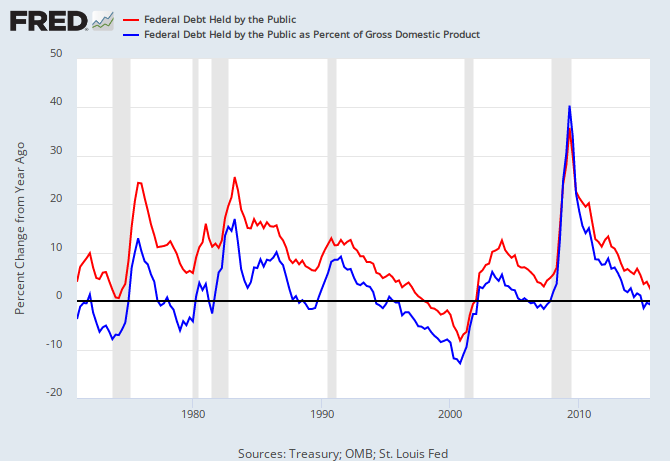
THE RECESSION CLOCK
Recessions begin an average of 2 years after the blue line first dips below zero. There was a dip below zero in 2015. Recessions are cured by a rising red line.
Vertical gray bars mark recessions.
As the federal deficit growth lines drop, we approach recession, which will be cured only when the growth lines rise. Increasing federal deficit growth (aka “stimulus”) is necessary for long-term economic growth.
Mitchell’s laws:
•Those, who do not understand the differences between Monetary Sovereignty and monetary non-sovereignty, do not understand economics.
•Any monetarily NON-sovereign government — be it city, county, state or nation — that runs an ongoing trade deficit, eventually will run out of money.
•The more federal budgets are cut and taxes increased, the weaker an economy becomes..
•Liberals think the purpose of government is to protect the poor and powerless from the rich and powerful. Conservatives think the purpose of government is to protect the rich and powerful from the poor and powerless.



 #Monetary Sovereignty - Mitchell