Good news, if true. CBO: Deficits are falling now, are set to soar later

Assuming the following headline is correct, it’s short-term bad news for the economy, but great long-term news:

“CBO: Deficits are falling now, are set to soar later” Courtenay Brown. Neil Irwin, Axios

The federal government’s budget deficit is expected to shrink this year before skyrocketing in the years ahead, the Congressional Budget Office (CBO) said Wednesday.

Why is it short-term bad news but great long-term news? Because this is:

    1. Federal deficit spending goes into the economy as an economic growth stimulus.
    2. The federal government has infinite dollars; it never can run short of dollars.
    3. The economy does not have infinite dollars. To grow, it needs a growing input of dollars from the federal government.
    4. Federal spending is funded not by federal taxes but by *federal money creation. Federal tax dollars are destroyed upon receipt by the Treasury.
    5. Federal spending does not cause inflation; shortages of critical goods and services cause inflation. Inflations can be cured by additional federal spending to obtain and distribute scarce goods and services.

*Here is how the federal government creates dollars:

  • To pay a bill, the federal government sends instructions (not dollars) to the creditor’s bank, instructing the bank to increase the balance in the creditor’s checking account (“Pay to the order of”)
  • When the bank does as instructed, new dollars are created and added to the M1 money supply.

  • This transaction is then cleared by the Federal Reserve

Similarly, dollars are destroyed when you pay taxes:

  • To pay taxes, you take dollars from your checking account. Those dollars were part of the M1 money supply.
  • When your dollars reach the Treasury, they disappear from the M1 money supply. They cease to exist in any money supply measure.

Because the Treasury has access to infinite dollars, there can be no money supply measure for Treasury dollars. Your tax dollars are destroyed.

The federal government collects tax dollars, not to fund spending, but to:

  1. Control the economy by taxing what the government wishes to discourage and giving tax breaks for what it wishes to encourage.
  2. To create demand for dollars, which must be used for tax payments. This helps stabilize the dollar.
  3. To create the impression that federal taxes are necessary to fund federal spending. This discourages the public from asking for federal benefits. 

Restricting federal benefit spending on benefits helps widen the Gap between the rich (who run America) and the rest of us. Widening the Gap makes the rich richer.

Why it matters: America’s reprieve from climbing deficits is only temporary as coronavirus-related government spending wanes and tax revenues increase.

The use of the word “reprieve” is misleading. Climbing deficits are essential for economic growth.

By the numbers: The CBO projects the budget deficit will shrink to $1 trillion this year, down from $2.8 trillion in 2021.

Shrinking budget deficits reduce the amount of money coming into the economy and thereby lead to recessions.

Recessions (vertical gray bars) result from reduced federal deficit growth and are cured by increased federal deficit growth.

It’s expected to rise to more than $2 trillion in 2032, reaching 6.1% of GDP, up from a projected 4.2% this year.

The deficit as a percentage of GDP is a meaningless number. It has no predictive significance.
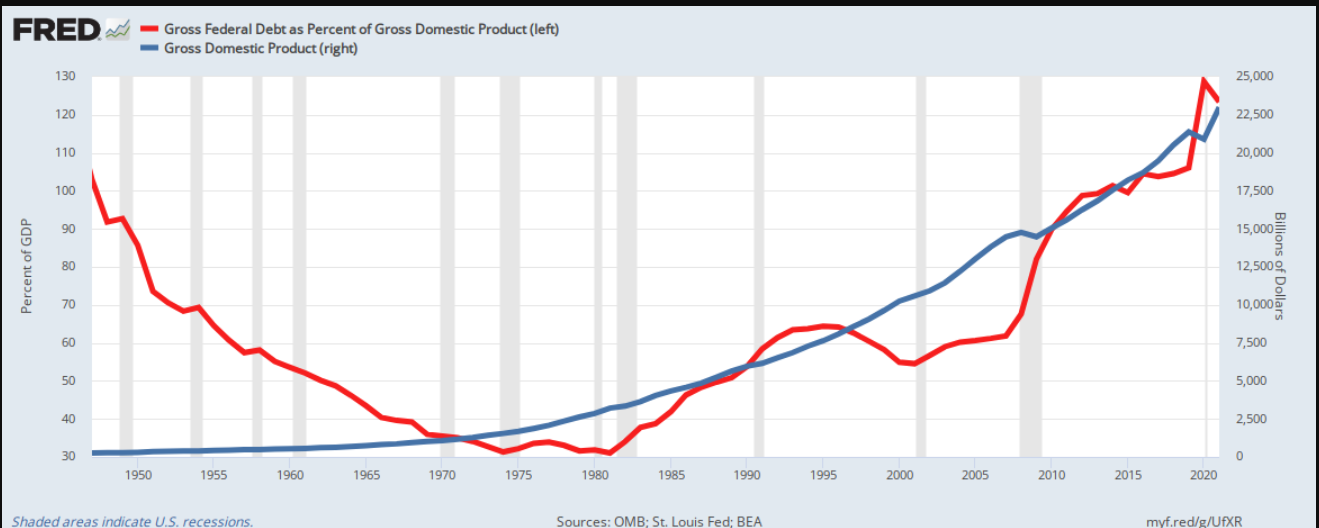
GDP (blue) rose during periods of falling Debt/GDP and during periods of rising Debt/GDP. The ratio, Debt/GDP, has no predictive value.

Federal debt held by the public is estimated to dip from 100% of GDP at the end of this year to 96% in 2023, reflecting rapid inflation that is causing GDP to expand more rapidly. It’s expected to reach 110% of GDP — the highest ever recorded — by the end of the decade.

A meaningless fact. Whether an economy has a high or a low Debt/GDP ratio tells nothing about the health of that economy. For example:

Top Countries with the Lowest Debt-to-GDP Ratios (%)

    1. Brunei — 3.2%
    2. Afghanistan — 7.8%
    3. Kuwait — 11.5%
    4. Congo (Dem. Rep.) — 15.2%
    5. Eswatini — 15.5%
    6. Burundi — 15.9%
    7. Palestine — 16.4%
    8. Russia — 17.8%
    9. Botswana — 18.2%
    10. Estonia — 18.2%

Top Countries with the Highest Debt-to-GDP Ratios (%)

    1. Venezuela — 350%
    2. Japan — 266%
    3. Sudan — 259%
    4. Greece — 206%
    5. Lebanon — 172%
    6. Cabo Verde — 157%
    7. Italy — 156%
    8. Libya — 155%
    9. Portugal — 134%
    10. Singapore — 131%
    11. Bahrain — 128%
    12. United States — 128%

The Debt/GDP ratios tell you nothing about the economic health of the nations. The data come from an article by WorldPopulationReview.com, which falsely states:

“Nations with a low debt-to-GDP ratio are more likely to be able to repay their debts with relative ease. Nations whose economies struggle to produce income or which have an oversized debt tend to have a high debt-to-GDP ratio.

This is a perfect example of belief overcoming obvious facts.

The U.S. is Monetarily Sovereign. A Monetarily Sovereign nation has the infinite ability to pay debts denominated in that nation’s own sovereign currency. Such countries have the unlimited ability to create sovereign currency. They never can run short.

By contrast, a monetarily non-sovereign — for instance, a euro nation like Greece, Italy, or Portugal — can have difficulty paying its debts.

The belief that a high Debt/GDP ratio mitigates debt repayment ability All the concerns about the U.S. federal deficit or debt being too high are based on ignorance about government financing.

Clearly, the WorldPopulationReview.com authors of the above article know little-to-nothing about Monetary Sovereignty. 

Details: The CBO is now expecting higher interest rates over the coming years than it did in the last forecast, as the Federal Reserve acts to try to contain inflation. Higher interest rates would strain the nation’s fiscal position further.

America’s fiscal position is clear. It always can pay any debt denominated in dollars. Even if the U.S. federal government didn’t collect a penny in taxes, it could pay off any financial obligation.

Further, the so-called federal “debt” is not the federal government’s debt. It is the total of deposits into privately-owned Treasury Security accounts. 

To purchase a T-security (T-bill, T-note, T-bond), you deposit dollars into your T-security account. The government never touches those dollars. Periodically the government adds to the balance, but it never uses the dollars for anything.

The dollars remain in your account until maturity when they are returned to you. This functions similarly to a bank safe deposit box, the contents of which are not a debt of the bank.

Last July, for example, the CBO projected that the 10-year Treasury yield would average 2% in 2023; now that projection is 2.9%.

In the CBO projections, interest costs alone will pass $1 trillion in 2030.

Translation: Federal interest payments will add 1 trillion growth dollars to the economy by 2030. The federal government, being Monetarily Sovereign, easily can make these payments without collecting taxes.

As this post was being written, another relevant article appeared. It is an excellent example of the economic ignorance that mischaracterizes the federal “debt.”

Biden’s Student Loan Debt Forgiveness Plan Now Estimated To Cost $400 Billion
According to a new report for the Congressional Budget Office, student loan debt forgiveness will likely completely wipe out gains made by the Inflation Reduction Act—and then some.
Emma Camp | 9.27.2022

The “gains” are deficit reductions that the author wrongly believes will benefit the economy and mitigate inflation. They will not, though they will mitigate economic growth and probably cause stagflation.

U.S. depressions tend to come on the heels of federal surpluses.

1804-1812: U. S. Federal Debt reduced 48%. Depression began 1807.
1817-1821: U. S. Federal Debt reduced 29%. Depression began 1819.
1823-1836: U. S. Federal Debt reduced 99%. Depression began 1837.
1852-1857: U. S. Federal Debt reduced 59%. Depression began 1857.
1867-1873: U. S. Federal Debt reduced 27%. Depression began 1873.
1880-1893: U. S. Federal Debt reduced 57%. Depression began 1893.
1920-1930: U. S. Federal Debt reduced 36%. Depression began 1929.
1997-2001: U. S. Federal Debt reduced 15%. Recession began 2001.

The sweeping student loan forgiveness plan will wipe all the budget savings created by the Inflation Reduction Act—and then some.

Translation: “The sweeping student loan forgiveness plan will add federal dollars to the economy, thereby stimulating economic growth.”

In a letter published on Monday, the Congressional Budget Office (CBO), a nonpartisan federal agency, estimated that Biden’s student loan debt forgiveness plan will increase the cost of student loans by $400 billion.

Translation: ” . . . will decrease students’ loan cost by $400 billion. It will stimulate economic growth by keeping more money in the economy and by encouraging more young people to attend and finish college..”

That’s more than the White House originally projected, and it means that the fiscally imprudent debt relief effort will end up swamping the modest budgetary savings achieved by last month’s passage of the Inflation Reduction Act by more than $150 billion.

Translation: ” . . . it means that the fiscally prudent debt relief effort will end up overcoming the economy’s budgetary losses caused by last month’s passage of the Inflation Reduction Act by more than $150 billion.

. . . the plan is likely to massively increase the national deficit by over $150 billion.

Translation: “. . . the plan is likely to massively increase the economy’s money supply by over $150 billion.”

Student loan forgiveness stands to be a massively expensive project—one that not only erases recent gains in spending reduction but manages to make the problem significantly worse than the status quo.

Translation: “Student loan forgiveness stands to be a massively beneficial project—one that not only erases recent economic losses in income reduction but manages to make the economy significantly better than the status quo.”

The so-called “problem” is the increased federal deficit, which is not a problem at all. It is necessary for a growing economy.

Only one thing could make “the problem worse than the status quo”: Running a federal surplus, which invariably leads to recessions or depressions.

SUMMARY

Federal finances differ from personal, business, and state/local government finances.

Those who bemoan a growing federal deficit and debt do not understand that a Monetarily Sovereign entity can pay any size debt instantly. It does so by creating its own sovereign currency.

Gross Domestic Product (GDP), a measure of the economy, is a measure of spending. A growing economy requires a growing supply of money. By deficit spending, the federal government creates new dollars and adds them to the economy. 

Thus, by increasing the money supply, federal deficits help boost GDP. That is why falling federal deficit growth results in recessions, which are cured by increased deficit growth.

For the above reason, the oft-quoted federal Debt/GDP ratio does not indicate anything about the economic health of a Monetarily Sovereign nation. 

Further, the misnamed federal “debt” is not the federal government’s debt. It is the total of privately owned deposits into Treasury Security accounts.

The next time you read or hear negative comments about the federal deficit or debt, know this: The author of those comments doesn’t understand how U.S. federal finances work — or doesn’t want you to understand.

Rodger Malcolm Mitchell
Monetary Sovereignty

Twitter: @rodgermitchell Search #monetarysovereignty
Facebook: Rodger Malcolm Mitchell

……………………………………………………………………..

THE SOLE PURPOSE OF GOVERNMENT IS TO IMPROVE AND PROTECT THE LIVES OF THE PEOPLE.

MONETARY SOVEREIGNTY

 

Fed Chair Powell pushes the economy over the cliff. Next stop: Stagflation

WASHINGTON (AP) — Intensifying its fight against high inflation, the Federal Reserve raised its key interest rate Wednesday by a substantial three-quarters of a point for a third straight time and signaled more large rate hikes to come — an aggressive pace that will heighten the risk of an eventual recession.

Barring the kind of miracle that allows Jerome Powell to come to his senses, we very soon will be in a stagflation — a combination of stagnation and inflation — and Jerome Powell will not know what to do about it. The past interest rate increases have done nothing to halt or even moderate inflation. So, Chairman Powell does the only “sensible” thing. He keeps doing what repeatedly has failed, praying that somehow, in some way, magic will happen. He is not “heightening the risk of recession.” He intentionally is causing a recession. He says so himself but uses oblique language to describe it.
Trust me. I’m doing this to cure your acrophobia.

The officials also forecast that they will further raise their benchmark rate to roughly 4.4% by year’s end, a full point higher than they had envisioned as recently as June.

And they expect to raise the rate again next year, to about 4.6%. That would be the highest level since 2007.

By raising borrowing rates, the Fed makes it costlier to take out a mortgage or an auto or business loan.

Get it? To fight higher prices, the Fed will raise the prices of mortgages, autos, and business operations — and just about every other thing you wish to buy. And some people believe this nonsense.

Consumers and businesses then presumably borrow and spend less, cooling the economy and slowing inflation.

“Cooling the economy” is the Fed’s way of saying, “causing a recession.” Here is the definition of a recession: “a period of temporary economic decline during which trade and industrial activity are reduced, generally identified by a fall in GDP in two successive quarters.” Sounds like “cooling,” doesn’t it? Sadly, the Fed doesn’t have the courage or morals to tell the truth, which is that they want to cause a recession as a way to end inflation. So they say they are going to “cool” the economy” What makes them feel the economy needs “cooling”? One measure of the economy’s “heat” is unemployment. A “hot” economy should have low unemployment. According to the Fed’s metric, the Fed should raise interest rates when unemployment goes down. Similarly, when unemployment rises, you might expect the Fed to cut rates We should see the unemployment rate and the interest rate move in opposite directions. Is that what we see?
When unemployment (red) goes up, and the economy could use some stimulus, the Fed tends to raise interest rates (green), which is anti-stimulus. By the Fed’s own philosophy, interest rates should rise when unemployment goes down, But we see the opposite.
In short, the Fed is consistent. It consistently does exactly the opposite of what it claims the economy needs. The reason: The Fed focuses on the false premise that inflation is caused by low interest rates and is cured by raising interest rates. And as far as the economy needing “cooling,” what exactly does it mean? What does it mean for an economy to be too hot? Here’s an interesting graph: It shows one of the prime measures of economic growth, the annual change in real per capita gross domestic product. If anything should measure the “heat” of an economy, this is it. A year ago, in early 2021, one might have said the economy is pretty “hot.” No longer. The economy now seems to be growing at a normal rate. So why does it need “cooling”? Notice what happens before we have a recession. The annual change drops, which is exactly what the Fed wants to happen now. I’ve been at this for twenty-five years, and I still don’t know what it means for an economy to be too hot. What I do know, however, is what causes inflation: Shortages of key goods and services. Today, we have those shortages, not because demand is too great, and not because interest rates are too low, and not because the federal deficits are too high. We have shortages because the confluence of COVID, the Russian war, and reduced oil pumping caused supply to constrict.  

Falling gas prices have slightly lowered headline inflation, which was a still-painful 8.3% in August compared with a year earlier.

Think of it. The Fed has raised the benchmark interest rate almost 4 points — a massive change — and inflation didn’t budge, but falling gas prices moved the needle. That tells you something about the ineffectiveness of interest rate changes. Here’s another interesting graph. It compares inflation to oil prices: The parallels are stunning. Inflation follows oil prices because oil affects the price of every other product. The price of oil is determined by supply and demand. Increase the supply, and inflation will go down. The same is true regarding demand. Decrease the demand for oil, and inflation will fall. But short of causing a recession, how does one decrease the demand for oil? The only answer is something we are just beginning to do: Find substitutes for oil.  Most oil is used for energy, so businesses must expand production of solar, wind, nuclear, geothermal, and tidal energy sources — and this will require increased government spending and lower interest rates.

Speaking at a news conference, Chair Jerome Powell said that before Fed officials would consider halting their rate hikes, they would “want to be very confident that inflation is moving back down” to their 2% target.

He noted that the strength of the job market is fueling pay gains that are helping drive up inflation.

Powell, as an agent for the very rich, tells us that those nasty pay gains for the 99% are causing inflation. If only we could find a way to cut back on pay gains, all would be well.

“If we want to light the way to another period of a very strong labor market,” Powell said, “we have got to get inflation behind us. I wish there was painless way to do that. There isn’t.”

Translation: “The labor market is too strong. Unemployment is too low, and people are earning too much. So, I’m going to create a strong labor market by cutting economic growth. This will increase unemployment and cut salaries, which will be painful (to everyone but the rich).” This is the logic that will help widen the Gap between the rich and the rest.

Fed officials have said they are seeking a “soft landing,” by which they would manage to slow growth enough to tame inflation but not so much as to trigger a recession.

Yet most economists are skeptical. They say they think the Fed’s steep rate hikes will lead, over time, to job cuts, rising unemployment and a full-blown recession late this year or early next year.

Job cuts, unemployment and a full-blown recession are exactly what the very rich want. Their incomes won’t be hurt. They won’t be fired. Their pay won’t be cut. And they’ll buy bonds paying higher interest. Meanwhile, the working class will suffer, the Gap will widen, and all will be well with the world.

“No one knows whether this process will lead to a recession, or if so, how significant that recession would be,” Powell said at his news conference. “That’s going to depend on how quickly we bring down inflation.”

The way to bring down inflation is to cure the shortages that are causing inflation, not by causing a recession. The federal government needs to support farming, transportation, and the manufacturing and service industries. One way: Cut business costs. Eliminate FICA and provide free health care insurance to every man, woman, and child in America. This would substantially reduce the cost of running businesses. Eliminating FICA instantly would cut the prices of all goods and services. It’s a quick first step, easily done. Simply stop collecting the tax and have the government pay for Social Security and health care insurance.

In their updated economic forecasts, the Fed’s policymakers project that economic growth will remain weak for the next few years, with rising unemployment. They expect the jobless rate to reach 4.4% by the end of 2023, up from its current level of 3.7%.

This is the cure for inflation?? Weak economic growth and rising unemployment for years??? Some might say the cure is worse than the disease. That’s the best the Fed can do?

Historically, economists say, any time unemployment has risen by a half-point over several months, a recession has always followed. Fed officials now foresee the economy expanding just 0.2% this year, sharply lower than their forecast of 1.7% growth just three months ago. And they envision sluggish growth below 2% from 2023 through 2025.

That gloomy forecast seems about right based on the reluctance to increase federal deficit spending and the plan to repeatedly increase interest rates.

Even with the steep rate hikes the Fed foresees, it still expects core inflation — which excludes the volatile food and gas categories — to be 3.1% at the end of next year, well above its 2% target.

Translation: “What we’re doing won’t help much, but it will hurt you, and most importantly, it will make you believe we’re doing something.

Powell acknowledged in a speech last month that the Fed’s moves will “bring some pain” to households and businesses.

Pain to the working class but not the rich — that’s the goal.

Inflation now appears increasingly fueled by higher wages and by consumers’ steady desire to spend and less by the supply shortages that had bedeviled the economy during the pandemic recession.

Utter nonsense. Prices can’t rise without supply shortages. But yes, reducing the cost of labor will help reduce inflation. And that can be accomplished by eliminating FICA while providing health care insurance to everyone.

Some economists are beginning to express concern that the Fed’s rapid rate hikes — the fastest since the early 1980s — will cause more economic damage than necessary to tame inflation.Mike Konczal, an economist at the Roosevelt Institute, noted that the economy is already slowing and that wage increases — a key driver of inflation — are levelling off and by some measures even declining a bit.

Part of the problem is a false belief that some economic damage is necessary to tame inflation — the false belief that the medicine must be bitter.

Even at the Fed’s accelerated pace of rate hikes, some economists — and some Fed officials — argue that they have yet to raise rates to a level that would actually restrict borrowing and spending and slow growth.

Translation: “The purpose of raising interest rates is to restrict borrowing and spending and to slow growth, but that won’t work.” Huh?

Many economists sound convinced that widespread layoffs will be necessary to slow rising prices.

Translation: “It’s all the fault of the working class. They are making too much money. We’ll have to starve them a bit to control inflation.”

Research published earlier this month under the auspices of the Brookings Institution concluded that unemployment might have to go as high as 7.5% to get inflation back to the Fed’s 2% target.

SUMMARY Interest rate increases will not reduce inflation. They will cause stagflation, courtesy of the Fed, who will blame it on the working class making too much money. The Fed will not blame the very rich for making too much money. The Fed knows who their bosses are. Rodger Malcolm Mitchell Monetary Sovereignty Twitter: @rodgermitchell Search #monetarysovereignty Facebook: Rodger Malcolm Mitchell

MONETARY SOVEREIGNTY

The Big Lie for suckers is all crap to widen the Gap.

Stated simply, the Big Lie in economics is: “Federal taxes fund federal spending.” Suckers believe it.

The Big Truth in economics is: Federal taxes don’t fund a damn thing. In fact, they are destroyed upon receipt at the Treasury.

No federal tax dollars are spent. The federal government creates new dollars, ad hoc, to pay all its bills.

The federal government never can run short of dollars. It has infinite dollars. Even if the federal government didn’t collect a penny in taxes, it could continue to spend, forever.

Tax Preparation Services for Individual | Green Tree Tax | Tax Help
From the TV show 60 Minutes: Scott Pelley: Is that tax money that the Fed is spending? Ben Bernanke: It’s not tax money… We simply use the computer to mark up the size of the account.

To the federal government, which created the first US dollars from thin air, dollars are not physical things.  They simply are numbers on balance sheets, and the government controls the balance sheets.

The government can put any numbers it wishes on those balance sheets. In short:

  1. The government never can run short of numbers
  2. The government never can run short of laws.
  3. The government never can run short of dollars.

If you sent $100 trillion dollars to the federal government, it wouldn’t help to pay for anything, not even one little bit.

Twenty-two Republican governors have signed a letter sent to President Joe Biden calling on him to withdraw his student loan forgiveness plan. 

In the letter, dated Monday, the governors wrote that they “fundamentally oppose (Biden’s) plan to force American taxpayers to pay off the student loan debt of an elite few.”

Calm down, fellow taxpayers; we won’t pay any of that student loan debt. 

So why does the GOP claim it? Because they want you to help them widen the Gap between the rich and the rest of us

Note the words “elite few” in their letter? That’s part of the GOP con job. The party that gave a giant tax break to the rich wants you to believe they are all for the poor.

No, they don’t want the poor and middle classes to be able to afford college at all. They want the only people to afford college to be the “elite few.”

They create a phony culture war to make you believe the federal government can’t afford to pay for your benefits.

The rich falsely claim Social Security is going broke; Medicare is growing broke; the government can’t afford food stamps and other anti-poverty measures — and it’s all crap to widen the Gap.

Why widen the Gap? Because it’s the Gap that makes the rich rich. Without the Gap, no one would be rich, and the wider the Gap, the richer they are. Widening the Gap is a way for the rich to become richer.

The Republicans, including Texas Gov. Greg Abbott and Florida Gov. Ron DeSantis, also claimed that Biden’s plan would harm low-income families – writing, “hourly workers will pay off the master’s and doctorate degrees of high salaried lawyers, doctors, and professors. … Simply put, your plan rewards the rich and punishes the poor.”

What an ironic sham. Essentially, they say, “Federal aid to the middle and poor harms the middle and poor.”  And people believe it!!

White House spokesperson Abdullah Hasan said, “These same Republican governors didn’t seem to object when their Republican colleagues in Congress passed a $2 trillion tax giveaway for the rich or had hundreds of thousands of dollars of their own small business loans forgiven.”

“While Republican elected officials try to keep working middle-class Americans in mountains of debt, President Biden is committed to delivering relief to the borrowers who need it most,” Hasan wrote in an email sent to USA TODAY Wednesday afternoon.

Hasan is absolutely correct. But so long as people believe the Big Lie that federal finances are like state and local government finances, and specifically, that federal taxes fund federal spending, the BIG LIE will continue to be told.

Federal taxes have three purposes:

  1. To help control the economy by discouraging what the government wishes to limit and by encouraging what the government wishes to increase.
  2. To provide demand value to the US dollar by required taxes to be paid with dollars.
  3. And the most important one: To help the rich become richer by providing tax breaks available only to the rich. (which is how billionaire  Donald Trump paid less taxes than you did.)

Hey, it works. The rich keep getting richer, and the suckers keep voting against federal spending that would help them.

Rodger Mitchell

The one step that immediately would cure inflation (and no, it isn’t raising interest rates).

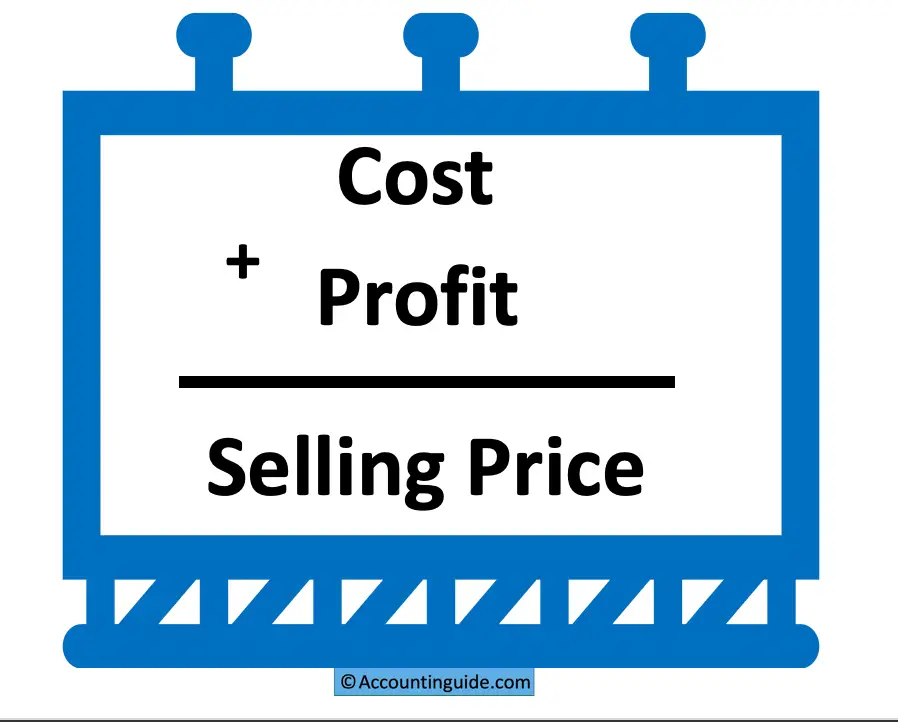
Inflation is a general increase in the prices of goods and services. But what factors determine prices?

Cost-plus Pricing | Definition | Example | Advantage - Accountinguide
Economic growth: To lower prices, cut business costs. Recession: To lower prices cut business profits.

Sellers determine prices by answering the question, “What price would provide the most long-term profit?”

If pricing aims to maximize long-term profit, how is profit determined?

Profit is the difference between income and costs. The two ways to increase profit are to increase dollar sales and/or to decrease costs. This is all quite basic.

Pricing is constrained by costs, competitors, customers, and/or laws. 

Costs generally set the lower boundary for pricing, as businesses only temporarily can allow costs to exceed total income.

The old joke, “We lose money on every sale, but make it up in volume” is just that. A joke, at least in the long term.

Competitors, customers, and/or laws set the upper boundary for pricing. Sellers set prices between the lower and upper boundaries by estimating where long-term profits are maximized.

Generally, sellers don’t cut costs just to be nice guys. Their sole purpose is to maximize long-term profits. If long-term profits were not a goal, sellers would have no motivation to cut costs.

This is all basic economics 101, yet economists seem to have forgotten that inflation is price increases and recession is economic growth decreases, and the two are unrelated. The opposite of inflation is not recession. The opposite of inflation is deflation.

You can have price increases with growth decreases, and that’s called “stagflation (stagnation and inflation).

And that is what the Fed and Congress are creating: Stagflation.

There are two ways to cut prices:

  1. Cut business profits, which causes a recession, or
  2. Cut business costs which encourages economic growth.

The best way to fight inflation, i.e. to cut prices, is to cut costs because higher costs lead to higher prices. An important component of most business costs is the cost of labor.

What if I told you there is a simple way to cut the cost of labor without cutting the number of employees or cutting pay scales? 

Well, there is, and it is dead simple: Eliminate the FICA tax and provide free, comprehensive Medicare for All.

FICA costs employers 15,3% of all salaries under $143,000. This means, that for every salaried employee you, as the employer, pay as much as $22 thousand dollars per employee to the federal government. Those are dollars that come directly out of your profits.

They are non-productive dollars that must be made up with higher prices. They are inflation dollars.

And don’t think the employees pay any those dollars. If you, the employer, told your employees they no longer would have FICA deducted from their paychecks, you could lower gross salaries and still leave them with the same net salaries. 

Employers pay the full 15.3% to the government.

As for health care, why has this become a financial burden for businesses? Why does your business pay for any part of health care insurance when the federal government can provide it? Those are lost, non-productive dollars.

And no, federal taxpayers do not fund federal spending. The government could provide Social Security and Medicare to every man, woman, and child in America without collecting a single dollar in taxes.

The federal government cannot run short of dollars. Not ever. Being Monetarily Sovereign, it has the unlimited ability to create U.S. dollars. It neither needs nor uses tax dollars.

The federal government’s trillions of tax dollars extracted from the economy are lost forever. Unlike state and local tax dollars, federal tax dollars are not recirculated back into the economy. They are destroyed upon receipt.

The federal government always has infinite dollars, and adding tax dollars to that does not change how many dollars the federal government has.

IN SUMMARY

  1. Inflation is a general increase in prices.
  2. This increase always is caused by shortages of key goods and services, not by so-called “excessive government spending.”.
  3. The Fed increases interest rates to ease those shortages by reducing demand, but reduced demand is the definition of recession. Thus, the Fed tries to cure higher prices by causing a recession.
  4. The non-recession way to reduce higher prices is to reduce shortages and business costs.
  5. Shortages can be reduced by more federal spending to acquire or encourage the production and distribution of scarce goods and services.
  6. Business costs can be reduced by reducing employment and business taxes. When a business pays less in taxes, its prices can be lowered while generating the same desired long-term profits.
  7. The instant solution to inflation is to eliminate FICA taxes and to provide free Medicare to every man, woman, and child. This will reduce business costs, allowing businesses to lower prices.
  8. The long-term solution to inflation is for the federal government to address shortages by investing in the production and distribution of scarce items: Renewable and nuclear energy, shipping (roads, ships, railroads, airplanes), food, water, computer chips, lumber, and lower federal taxes on businesses and individuals below the upper-income group.

Federal taxes and interest rate increases are recessionary and do not prevent inflation.

Based on the Fed’s reliance on interest rate increases to combat inflation, I predict we will have a long period of stagflation until business profits increase sufficiently to cause business growth.

Tell this to your Congresspeople.

Rodger Malcolm Mitchell
Monetary Sovereignty

Twitter: @rodgermitchell Search #monetarysovereignty
Facebook: Rodger Malcolm Mitchell

MONETARY SOVEREIGNTY