The “Woke” controversy as the GOP camouflage for bigotry

Ask any Democrats what “woke” means, and they likely will say they don’t know. Ask any Republican the same question, and they will say, “I don’t know, but I don’t like it.

George Wallace stood in schoolhouse door 52 years ago today - al.com
Part of American history; George Wallace blocked a schoolhouse door to prevent black children from entering. DeSantis doesn’t want your children to know.

Merriam-Webster added the word “woke” to its dictionary in 2017, defining it as “aware of and actively attentive to important facts and issues (especially issues of racial and social justice.”)

The Oxford dictionary adopted it the same year, defining it as “alert to racial or social discrimination and injustice.”

Those definitions seem benign enough unless one is a bigot, in which case the words seem threatening and too close to home.

This brings us to the related concept, “Critical Race Theory.” Per Brittanica:

Critical race theory (CRT) was officially organized in 1989, at the first annual Workshop on Critical Race Theory, though its intellectual origins go back much farther, to the 1960s and ’70s.

Its immediate precursor was the critical legal studies (CLS) movement, which dedicated itself to examining how the law and legal institutions serve the interests of the wealthy and powerful at the expense of the poor and marginalized.

(CRT is) based on the premise that race is not a natural, biologically grounded feature of physically distinct subgroups of human beings but a socially constructed category that is used to oppress and exploit people of colour.

And this division, whether social or biological, leads to legally social problems.

    • African Americans and Hispanic Americans (Latinxs), for example, are on average more likely than similarly qualified white persons to be denied loans or jobs;
    • they tend to pay more than whites for a broad range of products and services
    • they are more likely than whites to be unjustly suspected of criminal behaviour by police or private (white) citizens
    • and they are more likely than whites to be victims of police brutality, including the unjustified use of lethal force.
    • If convicted of a crime, people of colour, particularly African Americans, are generally imprisoned more often and for longer periods than whites who are found guilty of the same offenses.

These are facts in America. They cannot and should not be denied. Exposing these facts, particularly to young people, is the first and necessary step toward reducing, if not ending, the evils of racism.

Critical race theorists hold that racism is inherent in the law and legal institutions of the United States insofar as they function to create and maintain social, economic, and political inequalities between whites and nonwhites, especially African Americans.

America has a long history of racism, beginning with our negative attitudes toward native Americans (aka “Indians”) and later toward blacks, browns, and yellows. Those attitudes have been encoded into law.

Donald Trump's infamous ad calling for death penalty in Central Park Five  case resurfaces in Netflix's 'When They See Us' | MEAWW
Trump’s infamous ad demanding the death penalty for 5 innocent black teens.

Native Americans were legally denied land and forced into reservations, which then repeatedly were reduced in size.

People of color legally have been denied voting rights, legally segregated into “separate-but-equal” schools, legally redlined for mortgages and other loans, and legally mistreated by the police and judges for the most minor offenses.

Japanese Americans “legally” were sent to concentration camps.

These are absolute facts of American history, and to deny them is to deny reality.

Nations that deny their past, especially the shameful aspects, will most likely repeat the evil.

When those with evil intent come into power, their first act is to attempt the erasure of the past, so the populace will not remember the results of evil. (After World War II, Germany, the author of the greatest evil the world ever had known, made their children understand what happened, lest it happens again.)

America has resisted admitting its own sins. America’s bigots have become afraid that their children will learn about racism in America.

That is why Florida’s Governor Ron DeSantis created:

The “Stop WOKE Act,prohibits workplace training or school instruction that teaches:

    • that individuals are “inherently racist, sexist, or oppressive, whether consciously or unconsciously”;
    • that people are privileged or oppressed based on race, gender, or national origin;
    • or that a person “bears personal responsibility for and must feel guilt, anguish, or other forms of psychological distress” over actions committed in the past by members of the same race, gender, or national origin.

The law says such trainings or lessons amount to discrimination.

No school is known to teach that children bear “personal responsibility for, and must feel guilty about our history.” But the Republican party uses that as an excuse to hide the past to repeat yesterday’s racism.

This is what FoxNews, the apologist for the GOP’s racism, says:

DEMOCRATS GETTING INCREASINGLY NERVOUS ABOUT WOKE CULTURE

But the meaning of woke evolved again with the rise of “cancel culture” — as the two terms saw increased use, they became intertwined in the public consciousness.

Often, someone gets canceled after they say something insensitive – something not woke.

The irony thickens. The GOP uses the pejorative phrase “cancel culture” to describe liberals while canceling teachers and schools who teach the facts about American racism. Presumably, the GOP objects to this:

Open any newspaper on any day, and you will see many articles like the above. The GOP, approving racism, calls all attempts to stop bigotry “cancel culture.” Here’s what they don’t call “cancel culture”:

Virginia School Board Members Call for Books to Be Burned
‘Devastating.’ Latina Professor and University Officials Respond to Students Burning Book About White Privilege

Per Fox News:

In addition to meaning aware and progressive, many people now interpret woke to be a way to describe people who would rather silence their critics than listen to them.

The reason “many people” interpret woke as being “cancel culture” is the GOP, and particularly Donald Trump, describe it that way. Repeat a lie often enough, and it becomes the truth in the eyes of the innocent and the needy.

Becoming knowledgeable about racism in America is quite different from the GOP’s Hitlerian book burning, but the GOP tries to link the two.

Donald Trump has led the GOP down the dark whirlpool of bigotry, from which it shows no sign of climbing.

He is a shameless bigot whose sole appeal to his angry base is his hatred of everything, not Trump.

Trump voices the anger his followers feel and the scapegoats they need.

Here Are 13 Examples Of Donald Trump Being Racist.

  1. He attacked Muslim Gold Star parents.
  2. He claimed a judge was biased because “he’s a Mexican.”
  3. The Justice Department sued his company ― twice ― for not renting to black people.
  4. Discrimination against black people has been a pattern in his businesses
  5. He refused to condemn the white supremacists who are campaigning for him
  6. He questioned whether President Obama was born in the United States
  7. He treats racial groups as monoliths
  8. He trashed Native Americans, too
  9. He encouraged the mob justice that resulted in the wrongful imprisonment of the Central Park Five.
  10. He condoned the beating of a Black Lives Matter protester
  11. He called supporters who beat up a homeless Latino man “passionate.”
  12. He stereotyped Jews and shared an anti-Semitic meme created by white supremacists.
  13. He treats African-American supporters as tokens to dispel the idea he is racist.

Trump is an extravagant hatemonger.

Most recently, he has even begun calling his long-time loyal friend, Allen Weisselberg, a liar. (And this is a man who went to jail to protect Trump.)

SUMMARY “Woke” acknowledges the American bigotry enshrined in the law.

Our young people must understand the depth and seriousness of American bigotry and the laws that support it, so they can learn and vote to curtail it.

American hatemongers do not want our young people to understand and seek a solution to the growing problem. The term “cancel culture” has been invented to justify more bigotry-supporting laws.

The GOP has devolved into the Party of Hatred toward all but white male, citizen, Christians. It demonizes any discussion of maltreatment of people not in the “approved” group.

It is the minority party in America, led by a psychopath. But by appealing to the basest elements of the national psyche, it has been able to twist the law to support its nefarious agenda.

In the late 1930s and the early 1940s, Germany and Italy taught the world the horrors of that dictatorial plan. Apparently, America now must relearn those lessons.

Meanwhile, as we are being schooled, we suffer the consequences.


Rodger Malcolm Mitchell Monetary Sovereignty Twitter: @rodgermitchell Search #monetarysovereignty Facebook: Rodger Malcolm Mitchell

……………………………………………………………………..

The Sole Purpose of Government Is to Improve and Protect the Lives of the People.

MONETARY SOVEREIGNTY

We could defeat Russia’s army without a single American casualty, but . . .

If someone told you we could defeat Russia’s army without losing a single soldier and without costing American taxpayers one dime, would you be in favor? Since World War II ended, Russia has been an enemy of the U.S. Fortunately, we haven’t been in a shooting war against them, but we have come close. Remember the Cuban missile crisis? With Vladimir Putin in charge, Russia is a genuine danger to America, but we can minimize the threat of actual combat, and our soldiers won’t have to lift a finger. Ukraine is doing the job for us and will continue to do the job unless we genuinely are stupid — which we very well may be. March 11, 2022: 500 Russian soldiers surrendered at Ukraine | weehingthong

Ukraine seeks more help as GOP skepticism weighs on future aid Joseph Morton, The Dallas Morning News

WASHINGTON — At a Rockwall, Texas, town hall in August, U.S. Rep. Pat Fallon served up plenty of conservative red meat to the right-leaning crowd.

The Sherman Republican roasted Democrats over federal spending, inflation and border policies — as many in the audience chuckled and murmured along in agreement.

But he also faced tough questions on one topic — his May vote supporting $40 billion to help Ukraine fend off Russia’s invasion.

Ten of his Republican House colleagues from Texas voted against that aid package, reflecting skepticism among the party’s base for spending so much money to help another country.

Ukraine war: Bucha street littered with burned-out tanks and corpses - BBC News
Destroyed Russian tanks
“Spending so much money,” which is 100% free. American taxpayers will not fund any of this spending, not one cent. The federal government simply will create the dollars out of thin air, as it always does.
Former Fed Chairman, Alan Greenspan: “A government cannot become insolvent with respect to obligations in its own currency.” Former Fed Chairman, Ben Bernanke: “The U.S. government has a technology, called a printing press (or, today, its electronic equivalent), that allows it to produce as many U.S. dollars as it wishes at essentially no cost.” Quote from Ben Bernanke when he was on 60 Minutes: Scott Pelley: Is that tax money that the Fed is spending? Ben Bernanke: It’s not tax money… We simply use the computer to mark up the size of the account. Statement from the St. Louis Fed: “As the sole manufacturer of dollars, whose debt is denominated in dollars, the U.S. government can never become insolvent, i.e., unable to pay its bills. In this sense, the government is not dependent on credit markets to remain operational.”

But Fallon also said he expected that the money approved to that point would be enough to keep Ukraine in the fight for more than a year — and that was before Congress signed off on another $12 billion.

“So I’m rooting for Ukraine,” Fallon said. “I hope they win. I will not be voting for any more money over the next 14 months, because they have what they need for now.”

Of course, Fallon has no idea what he’s talking about. He doesn’t know what Ukraine needs, and since the money costs us nothing, what is the purpose of being tightfisted?

Before leaving for its recess, Congress passed a stopgap spending measure — opposed by all Texas GOP House members — that included a little more than $12 billion to help Ukraine.

Why did the GOP oppose it? Simple  The Democrats proposed it. Period.

The Biden administration recently announced details of the latest package of military aid: a slew of additional munitions, armored vehicles and four High Mobility Artillery Rocket Systems, or HIMARS.

The HIMARS, which have proved key to the fight, come from Grand Prairie-based Lockheed Martin Missiles and Fire Control, which builds them in Arkansas.

It’s good for Lockheed Martin. It’s good for Arkansas. It’s good for the American economy. But the GOP opposes it.Ukraine: What are Himars missiles and are they changing the war? - BBC News

Ukrainian Defense Minister Oleksii Reznikov hailed the arrival of four HIMARS last week, thanking the Biden administration and the American people.

“HIMARS time: good time for Ukrainians and bad time for the occupiers,” he wrote.

But Ukrainian President Volodymyr Zelenskyy called last week for even more support, stressing the importance of having an air shield to defend against an onslaught of Russian missile strikes.

Advocates for supporting Ukraine say the current situation underscores how the United States must keep the stream of weapons and financial support flowing. But a potential new GOP majority next year could make it tougher to get such measures passed.

Polling shows the percentage of Americans who feel there is too much support flowing to Ukraine has increased, particularly among Republicans.

Why is there “too much support”? Because the public has been fed The Big Lie that federal taxes fund federal spending. Read the Big Truth, and remember it. FEDERAL TAXES DON’T FUND FEDERAL SPENDING.

Rep. Chip Roy, R-Austin, has voted against Ukraine aid.

He said he is all for finding ways to help Ukraine against the atrocities being committed by Russia, but questioned the amount of money involved in light of other pressing domestic priorities.

We are Monetarily Sovereign. Our federal government has the infinite ability to create unlimited dollars. We can fund Ukraine while funding every other domestic program and still not levy one additional penny in taxes.

Roy said the administration hasn’t provided a detailed explanation of why sending money to Ukraine is in the U.S. national interest, how it will be offset in the budget or evidence it will prove effective in the long run.

Imagine a. U.S. Congressman who doesn’t understand why weakening the Putin government’s military is in the national interest at $0 cost. How did Chip Roy ever get elected to Congress, knowing so little?

He said some of his constituents have flown to Ukraine to volunteer in hospitals, assist refugees and adopt children affected by the fighting.

But they don’t favor a “blank check” for Ukraine, he said, and he’s concerned that’s what the U.S. is providing.

Some of his constituents have risked their lives to help Ukraine, but the GOP refuses to help while risking absolutely nothing — even while supporting the American economy. It boggles the mind.

“We’re literally just propping up the government,” Roy said. “The Communist Party in China is getting money that we’re giving allegedly to Ukraine.

Oligarchs in Ukraine are getting enriched off of our taxpayer dollars, because we’re just dumping money, like truckloads of money. … It’s just mind-boggling that we operate this way.”

Now he’s just making up bullsh*t. He can’t name one “oligarch” who is enriching the Communist Party in China. He must be getting his info from QAnon.

Cynthia Cook, director of the defense-industrial initiatives group at the Center for Strategic and International Studies, said that Ukraine’s success has been aided by the weapons systems provided by the United States, but that the final outcome hasn’t been determined.

“The battle is not won,” Cook said. “The amount of territory that they would have to retake to expel Russia from their soil is still pretty substantial, especially if, as it seems, that they would like to recapture Crimea.

It’s not over until it’s over.”

The longer it goes. Ukraine destroys more Russian tanks, planes, and missiles and kills more Russian soldiers. Hundreds of thousands of Russian men have fled to Norway. Ukraine is weakening Russian morale. It costs us nothing. We could not possibly have invented a better scenario for America. But the GOP wants to stop. They want to snatch defeat from the jaws of victory.

Those opposed to more aid need to understand the United States is getting something for its money, she said, namely a more peaceful future if Ukraine’s success helps prevent Russian tanks from eventually rolling into Poland.

We went into Viet Nam. We went into Afghanistan. We went into Korea. We lost many thousands of American men and women. Finally, we have a chance to win a war without losing a single American, and we a reluctant.

“The message is one of ‘we are spending money on a foreign country,’ but at the same time this is a critical fight for democracy,” she said. “It’s pretty important for Europe … if Russia is pushed back from Ukraine and that sort of diminishes the chances of future, more worrisome fights.”

Get it, GOP  Yours is the party that never has a productive idea. Now, when a great one falls in your lap, you resist it. Incredible.

Rep. Dan Crenshaw, R-Houston, clashed with Rep. Marjorie Taylor Greene, R-Ga., on Twitter earlier this year over his support for Ukraine aid.

In an interview, Crenshaw said that the initial price tag brought a lot of “sticker shock” but that the United States has gotten quite a bit in return.

There isn’t even “sticker shock” because the sticker reads $00.00. Perhaps, that’s the shock. And let’s face it, if a nincompoop like Marjorie Taylor Greene opposes it, it must be great. Ask her husband about that.

“Some Republicans would disagree, but their reasoning is, frankly, lacking in substance,” Crenshaw said.

He said that he would like more details and justification on just where the money is being spent, but that the result of that investment has been “enormous” strategic gains.

Right, for an investment of ZERO, we are getting great returns.

“And the fact that that’s lost on people blows my mind,” Crenshaw said.

I share your feelings, Dan, but people still are being fed the Big Lie. That blows my mind even more.

Austin Rep. Michael McCaul is the top Republican on the House Foreign Affairs Committee, which puts him in line to chair the panel if his party retakes the majority in the midterms. He has supported Ukraine aid and said the United States could be doing more.

“Once we finally gave them what they needed, like the HIMARS, they started winning and they’re beating them,” McCaul said. “And I don’t understand [opposition to Ukraine aid]. I grew up during the Cold War and I thought killing Russians was a good thing.”

But he also said that he’s discussed the issue with members of the conservative House Freedom Caucus and that they are primarily concerned about the cost.

They are concerned about the cost because they do not understand federal finance. How did these people get into Congress with so little knowledge?

He said it will be his role and those of like-minded members to explain to skeptics and incoming rookie members the importance of keeping the support flowing.

“It’s just an education thing,” McCaul said. “They may not understand what’s going on.”

Well, hurry up and educate them. After that, they also may understand why Medicare for All, Social Security for All, Free College for All, more financial support for the poor, and even life insurance for all are both beneficial and easily affordable. It, too, would cost taxpayers $00.00.

Fallon said he understands the sentiment from some Republicans who feel more priority should be paid to the southern border — he certainly agrees much more needs to be done there.

There need not be a financial “priority.” The federal government can afford both.

But he emphasized the United States does not want to see Putin emboldened. “We don’t want Russia to win,” Fallon said.

Talking about both sides of his mouth, Fallon doesn’t want Russia to win, but he will not vote to help Ukraine win. Our leaders truly are pitiful. With Putin’s help, Ukraine has given us a gift. Pray we are not foolish enough to throw it away. Rodger Malcolm Mitchell Monetary Sovereignty Twitter: @rodgermitchell Search #monetarysovereignty Facebook: Rodger Malcolm Mitchell

……………………………………………………………………..

The Sole Purpose of Government Is to Improve and Protect the Lives of the People.

MONETARY SOVEREIGNTY

More = less and other Big Lies from the Libertarians

BACKGROUND The federal government, being Monetarily Sovereign has infinite money. It neither needs nor uses tax dollars. It never can run short of dollars.
363 Unlimited Money Photos and Premium High Res Pictures - Getty Images
The U.S. federal government has infinite dollars.
Contrary to popular wisdom, federal taxpayers do not fund federal spending. Instead, the government creates new dollars, ad hoc, every time it pays a bill. The economy does not have infinite money and needs a continual input of dollars to grow. Gross Domestic Product, (GDP) a measure of spending, also is a measure of growth. Federal deficit spending provides that continual input, without which we would have recessions and depressions. Libertarianism is not the most ignorant idea on the planet. Trumpism surely wins the gold medal in that contest. But Libertarianism’s endless insistence that a gigantic nation should have a small government and that every expenditure always, always, always is too large puts them in the running for at least a bronze or perhaps even a silver medal. Here is their latest bit of humor masquerading as fiscal prudence.

Maintaining the Student Loan Forgiveness Application Will Cost an Estimated $100 Million

This latest expense is yet more evidence that sweeping student loan forgiveness will end up doing considerable economic harm. by Emma Camp | 10.14.2022 1:30 PM

While the incredible costs of the Biden administration’s federal student loan forgiveness plan are widely known, yet another expense of the program is stirring controversy: maintaining the online application for loan forgiveness is expected to cost nearly $100 million annually.

This latest expense—not included in the Congressional Budget Office’s recent estimate of the program’s cost to taxpayers—is yet more evidence that sweeping student loan forgiveness will end up doing considerable economic harm.

Why will adding $100 million stimulus dollars do “considerable economic harm”? Ms. Camp never explains why or what that “harm” is. Federal deficit spending is precisely what the government does to prevent and cure recessions. But Libertarians never acknowledge the facts that stare them in the face. Contrary to popular wisdom, the Great Depression of 1929 was not caused by the stock market crash. Nor was it caused by bank failures. Nor was it caused by Smoot-Hawley. Nor was it caused by drought. Nor was it caused by speculation. The Great Recession of 2008 was caused by insufficient deficit spending and years of federal surpluses, which took dollars out of the economy.

1804-1812: U. S. Federal Debt reduced 48%. Depression began 1807. 1817-1821: U. S. Federal Debt reduced 29%. Depression began 1819. 1823-1836: U. S. Federal Debt reduced 99%. Depression began 1837. 1852-1857: U. S. Federal Debt reduced 59%. Depression began 1857. 1867-1873: U. S. Federal Debt reduced 27%. Depression began 1873. 1880-1893: U. S. Federal Debt reduced 57%. Depression began 1893. 1920-1930: U. S. Federal Debt reduced 36%. Depression began 1929. 1997-2001: U. S. Federal Debt reduced 15%. Recession began 2001.

Eventually, the Great Depression was cured by more deficit spending. Libertarians are oblivious to those facts.
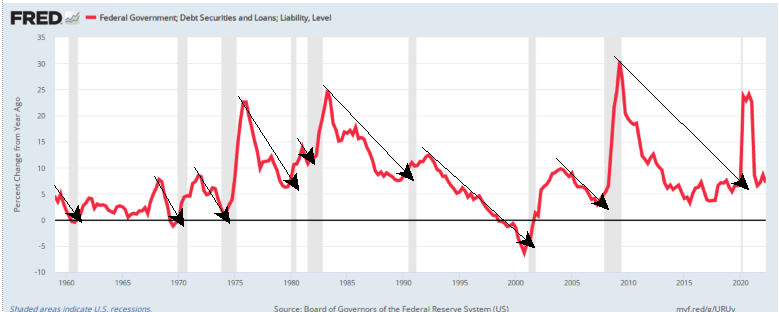
Every recession (vertical gray bar) is immediately preceded by a federal deficit spending growth reduction.
It doesn’t take a genius to see this.
  1. All Spending + Net Exports = GDP. GDP is a measure of our economy. It also is a measure of spending.
  2. Spending relies on dollars. On average, more dollars = more spending. Add dollars to an economy, and GDP will increase.
  3. Federal deficits add dollars to the economy.
  4. Therefore, federal deficits increase GDP and prevent/cure recessions and depressions.

In August, President Joe Biden announced a sweeping federal student loan forgiveness plan.

Under the proposal, most borrowers making under $125,000 annually and married couples making less than $250,000 would receive $10,000 each in loan forgiveness.

For borrowers who received a Pell Grant, forgiveness is increased to $20,000.

The program stands to be wildly expensive, with recent estimates from the Congressional Budget Office predicting that its cost will be $400 billion.

Translation: The program will pump 400 billion growth dollars into the economy. (The program would fail to remove 400 billion dollars from the economy.)

However, as the Biden administration gears up to formally release the online application for loan forgiveness, other large costs are also becoming clear. 

Documents submitted by the Education Department to the Office of Management and Budget show that the department estimates it will cost $99,900,000 per year to maintain the application and the program’s associated communications through March 2024. 

According to the Department of Education, these costs are “related to development of website forms, servicer processing, borrower support, paper form processing and communications related to this effort.”

Translation: The program will also fail to remove an additional 99,900,000 growth dollars annually from the economy.

While the current estimate for application maintenance and support is high, there is reason for concern that the cost will come to exceed that.

For example, the ill-fated HealthCare.gov website was originally estimated to cost $93.7 million—yet it eventually grew to cost taxpayers over $2 billion.

Translation: The HealthCare.gov website pumped 2 billion growth dollars into the economy and cost taxpayers nothing. The Big Lie in economics is that federal taxes pay for federal spending. While state/local taxes pay for state/local government spending, federal taxes pay for nothing. They are destroyed upon receipt. All taxes are paid from checking accounts, the dollars which are part of the M2 money supply. Dollars paid to state/local governments are deposited into banks and remain in the M2 money supply. But tax dollars paid to the U.S. Treasury disappear from any money supply measure. There is no money supply measure of dollars held by the federal government. The reason: Unlike state/local governments, the federal government has infinite dollars. It is Monetarily Sovereign. It creates dollars at will.

Former Fed Chairman Ben Bernanke: “The U.S. government has a technology, called a printing press (or, today, its electronic equivalent), that allows it to produce as many U.S. dollars as it wishes at essentially no cost.”

Your federal tax dollars leave the M2 money supply and disappear into the infinity of the Federal government’s unlimited ability to create new dollars. That is how the federal government pays all its bills: By creating new dollars, ad hoc, not by using tax dollars.

Considering that the Biden administration already appears to be lowballing the cost of student loan forgiveness, estimating that federal student loan forgiveness will only cost $240 billion over the next decade, there is reason to worry that it is underestimating the cost of maintaining its application website as well.

Translation: There is reason to believe the program will pump even more than 240 billion growth dollars into the economy over the next decade.

This problem could have been avoided if student loan forgiveness had been enacted through the legislative process rather than by executive fiat. 

Translation: The growth dollars wouldn’t have been provided by a Senate hamstrung by Republicans, who hate giving money to anyone but the very rich. So Biden had to do it via executive fiat.

The staggering price the Biden administration places on upkeep for the student loan forgiveness application is yet more evidence of the true, bloated nature of the policy. It should come as no surprise that student loan forgiveness will be riddled with extra costs—costs that will no doubt be pushed onto taxpayers.

Translation: The cost of upkeep is more evidence of the actual benefits of the policy. Student loan forgiveness will provide additional growth spending that will cost taxpayers nothing but benefit college students and the entire economy. SUMMARY The federal government is Monetarily Sovereign. It uniquely has the unlimited ability to create U.S. dollars. Federal deficit spending is necessary to prevent and cure recessions and depressions. It costs federal taxpayers nothing. Federal taxes are destroyed upon receipt by the Treasury. To pay for goods and services, the federal government creates new dollars ad hoc. Federal deficit spending does not cause inflation, and if used to purchase and disseminate scarce goods and services, federal deficit spending can cure inflation. Reducing students’ loan costs not only helps the students and America’s educational competitiveness but stimulates the economy, Rodger Malcolm Mitchell Monetary Sovereignty Twitter: @rodgermitchell Search #monetarysovereignty Facebook: Rodger Malcolm Mitchell

……………………………………………………………………..

Government’s Sole Purpose is to Improve and Protect the People’s Lives.

MONETARY SOVEREIGNTY

Why is inflation so hard to defeat?

I come from Chicago, and so am, by DNA, a Bears fan.

We Bears fans often ask, “Given that they repeatedly have high draft choices, why are their teams so bad, year after year?” (Cleveland Browns fans can empathize.)

The answer can be stated in two words: Bad leadership. And that also answers the title question, “Why is inflation so hard to defeat?” Bad leadership.

Here are quotes from the Committee for a Responsible Federal Budget (CRFB), which usually parrots the propaganda of the very rich:

Inflation is currently surging at the fastest rate in more than four decades, with the Consumer Price Index (CPI) up 8.2 percent over the past year and Personal Consumption Expenditure (PCE) price index up 6.2.

By comparison, the Federal Reserve (“the Fed”) generally targets 2 percent annual PCE inflation.

In general, the federal government has two types of tools available to fight inflation. Monetary policy, conducted by the Federal Reserve, can raise interest rates.

Or fiscal policy, controlled by the Congress and President, can adjust taxes and spending.

Immediately, they limit possible tools to those that impact the “not-rich” and widen the Gap between the rich and the rest. It’s known as “Gap Psychology,” the human desire to widen the income/wealth/power Gap below you and to narrow it above you.

“Raise Interest Rates” Impacts homebuyers who seek mortgages.

Adjust Taxes: “Adjust” is a disingenuous word for “raise.” When taxes are raised, the rule always includes exceptions and loopholes for the rich, not for the rest of us.

Adjust Spending: Here, “adjust” means “cut.” Deceptively, the CRFB uses one word to mean two opposite things.

When federal spending is cut, benefits to the middle and the poor always suffer. The false “need” to cut spending will be reflected in the Big Lie in economics that Social Security and Medicare are “running short of dollars” and that all aids to the poor, students, renters, etc., are “unaffordable.” Utter nonsense.

Specifically, Congress and the President can use their tools to assist the Federal Reserve in its efforts to fight inflation. Using fiscal policy in this situation can:

  • Ensure all federal actions are rowing in the same direction;
  • Reduce recessionary pressures and support stronger economic growth;
  • Diversify and limit the economic pain from inflation-reducing actions; and
  • Reduce the budgetary cost of fighting inflation.

The CRFB wants everyone to “row in the same direction.” Lovely words. But it also wants to “support stronger economic growth” and “limit economic pain” while raising taxes and cutting spending.

What the CRFB means by “rowing in the same direction.”

It is impossible to support economic growth and limit economic pain while raising federal taxes and cutting federal spending. Absolutely, 100% impossible.

Federal Reserve in fighting inflation. Through deficit-reducing tax and spending changes, they can help temper demand, boost supply, and directly or indirectly lower prices in the economy.

Translation of the above sentence: “By taking dollars out of the economy, they can take dollars from consumers, reduce supply, and drive the economy into a recession.

Congress and the President should act soon to pass legislation that helps fight inflation on all of these fronts.  

Key to any legislation will be deficit reduction, which 55 of the nation’s top economists and budget experts recently explained is one tool in helping to ease inflationary pressures.

Translation: “55 of the nation’s top economists say to ease inflation, we must plunge the economy into a recession. (And never mind about stagflation, which we have no idea how to fight.) This is known as “austerity,” which was attempted in the euro nations. [From the Harvard Business Review, September 28, 2018]:

Eurozone governments – especially those in struggling Southern European countries (Spain, Greece, or Portugal) – switched dramatically towards austerity in the years 2010-2014.  

Most experts now agree that these policies had such damaging and persistent negative effects on growth that they were self-defeating.

Governments were reducing spending in order to bring their debt levels under control. But GDP fell so much that . . . debt became even less sustainable than before the austerity measures were implemented.

Consider that euro nations are monetarily non-sovereign, like you and me. Their debt is like my debt and yours. We are not Monetarily Sovereign, so we don’t have the unlimited ability to create dollars.

They had to cut debt because the Monetarily Sovereign EU wouldn’t support them. The Monetarily Sovereign U.S. doesn’t and shouldn’t cut “debt” (which isn’t real debt) or deficits, and there is no reason for the U.S. to undergo the horrors of austerity.

But that is exactly what the “55 top economists” recommend.

At a minimum, Congress and the President should stop adding to the deficits, so that fiscal policy is not worsening inflation.

Translation: “At a minimum, Congress and the President should stop adding dollars to the private sector so that a recession is assured.”

In addition to helping contain inflation, thoughtful deficit reduction can also help to grow the economy, reduce geopolitical risks, improve fairness and efficiency of the budget and tax code, and put the national debt on a more sustainable path.

Translation: “In addition to helping cause a recession, mindless deficit reduction can also help to shrink the economy, exacerbate geopolitical risks, have no effect on the fairness and efficiency of the budget and tax code, and put the nation on a path to a recession or depression.

When federal debt growth (green line) shrinks, we have recessions (vertical gray bars), which are cured by federal debt growth increases.

Inflation in the United States has been elevated for 22 months and shows few signs of abating.

High inflation originated from a mismatch between total demand and supply in the economy – largely as a result of constraints from the COVID-19 pandemic and an aggressive fiscal and monetary policy response. 

Translation: Inflation has been growing because COVID caused reductions in the supply of oil, food, computer chips, shipping, labor, and other goods and services. The resultant scarcities caused prices to rise.

The Federal Reserve has already begun to act, raising interest rates by three percentage points since March of 2022, beginning to shrink its balance sheet, and signaling further tightening – with rates headed toward 4.6 percent by the end of 2023 – until inflation is brought under control.

Translation: The Federal Reserve’s massive interest rate increases have done nothing to increase the supplies of oil, food, etc., so they have done nothing to cure inflation.

Economists believe that monetary policy should play the lead role in stabilizing the economy because of the Federal Reserve’s ability to act quickly and effectively to adjust interest rates, using its technical expertise and political insulation to balance competing priorities.

In this case, the Fed can expeditiously and gradually raise interest rates and shrink its balance sheet – based on real-time data – to encourage savings, discourage large purchases, and reduce wealth-driven consumption.

And as we can see, the Fed’s expeditious and gradual interest rate raise has cured inflation. Oh, it hasn’t because it does nothing to remedy shortages?

Would someone please tell the CRFB and the 55 top economists? And by the way, “Encourage savings, discourage large purchases, and reduce wealth-driven consumption” describes a recession.

Yet even as the Fed is better equipped to bring down inflation, doing so is not without its challenges.

Higher interest rates put upward pressure on the unemployment rate and can also lead to financial instability – especially when rates are increased well above the long-term neutral rate (believed to be 2.5 to 3.0 percent).

Indeed, some recent research suggests the inverse relationship between inflation and unemployment described under the Phillips curve might be particularly strong now, suggesting a high “sacrifice ratio” whereby reductions in inflation require large increases in unemployment.

The CRFB has it all backward. High prices don’t cause unemployment. Unemployment occurs because shortages of goods and services discourage hiring. You don’t hire more people when you can’t produce, ship, or service.

In acting alone to fight inflation, there is a substantial risk and perhaps likelihood the Fed’s actions will spur an economic recession.

Finally, one factual statement from the CRFB. More than a “substantial risk. It borders on certainty.

The Federal Reserve has only a limited set of tools to fight inflation, which work by boosting interest rates.

While generally effective in reducing inflation, higher interest rates can also impose substantial pain on the housing and labor markets, reduce investments that promote long-term growth, and take a long time to affect the economy.

Translation: Replace the word “effective” with “ineffective and economically harmful.” The rest of the sentence is correct.

For these and other reasons, economists and policymakers have long supported supplementing monetary policy with fiscal stimulus to fight recessions.

Elemendorf and Furman, for example, argue policymakers should sometimes use fiscal policy even though monetary policy is superior.

Fiscal stimulus (i.e., federal deficit spending) always (not “sometimes”) is necessary. It should be targeted toward reducing shortages: More federal spending to aid oil exploration and production, to aid and encourage food production, and to encourage hiring.

The first step: The FICA tax should be eliminated, a monumental and useless drag on the economy. The federal government neither needs nor even uses FICA dollars for anything. It destroys them upon receipt.

When FICA dollars are sent to the Treasury, they come from the nation’s M1 money supply measure. But when they reach the Treasury, they cease to be part of any money supply measure. They effectively are destroyed.

There is no measure for the government’s money supply because the government has infinite money.

Specifically, spending increases and tax cuts work to boost demand in the near term, while high levels of projected deficits and debt can boost inflation expectations.

One standard measure of an economy is Gross Domestic Product (GDP). It is a measure of spending. The CRFB admits that federal spending increases will increase GDP.

And what will federal spending decreases do? Right, they will decrease GDP.

“Recession” is a decline in GDP for two or more quarters, and a depression is a decline in GDP for two or more years. Unwittingly, the CRFB and the 55 top economists have admitted recommending a recession or depression as the cure for inflation.

This is especially true if markets believe the government will attempt to inflate away a portion of its debt.

The notion of the federal government inflating away its debt is nonsense on several levels.

I. The federal government’s “debt” is nothing like personal or local government debt. It’s deposits into privately owned T-security accounts, which the government pays off upon maturity simply by returning the dollars.

The government neither uses nor even touches those dollars. You, as a depositor, own them.

The government spends using dollars newly created, ad hoc. The federal government never can run short of its sovereign currency.

II. Inflation does not affect the government’s ability to return the dollars in T-security accounts. Federal interest rate increases affect the number of dollars in those accounts, but the number does not affect the government’s ability to return those dollars.

No matter how large the “debt” (that isn’t a debt), the government just returns the dollars. It’s like a safe deposit box. No matter the value, the contents belong to you, and the Bank simply returns them.

III. The CRFB’s comments demonstrate their confusion between federal (Monetarily Sovereign) debt vs. state government and personal (monetarily nonsovereign) debt.

It’s the classic case of using one word with two unrelated meanings.

Personal debt comes from borrowing, wherein the borrower needs the dollars for some use. Federal “debt” comes from the federal government’s desire to stabilize the dollar by providing a safe haven for unused dollars.

The government neither needs nor uses those dollars. It has the unlimited ability to create dollars for any purpose.

Contrary to popular myth, the U.S. federal government never borrows U.S. dollars. Same reason: It has the infinite ability to create new dollars. Additionally, those T-security accounts help the government control interest rates.

Sadly, the CRFB either doesn’t understand economics or deliberately misleads its readers on behalf of the rich. Their hope might be to discourage the “not-rich” from asking for benefits, thereby increasing the Gap and making the rich comparatively more affluent.

Enacting deficit reduction during a period of high inflation can also help to reassure markets that elected officials are committed to responsible policy and won’t attempt to undermine Federal Reserve tightening in the future should inflation persist.

What can one say about the above nonsense? Deficit reduction (aka subtracting dollars from the economy) during high inflation will assure the markets that elected officials are committed to causing a recession or a depression.

While higher interest rates help to fight inflation, they also increase the risk of a recession by weakening labor markets and threatening financial stability.High interest rates also discourage personal and business investment, which in turn slows long-term income and economic growth.

Right, CRFB, except for the false “help fight inflation” part. But what happened to the CRFB’s “row in the same direction” philosophy?

Following their warning about the risk of recession, the CRFB published many word-salad paragraphs that could be summarized thus: “We should increase deficit spending without increasing deficit spending” and do all that to “stimulate the economy without stimulating the economy.”

Got it?

Of course, they had to finish with the Big Lie in economics that the federal government’s spending is constrained by tax income. Like the Bank in a Monopoly game, the federal government doesn’t need tax dollars. It can create all the new dollars it needs.

Even if all tax collections totaled $0, the federal government could continue spending forever.

Given the risks and threats from deficits and debt, substantial deficit reduction is needed even absent high inflation.

Surging prices makes deficit reduction more necessary and urgent while dramatically reducing any macroeconomic risks associated with near-term deficit reduction.

Wha? Surging prices . . . reduce risks of near-term recession?? Where did that idea come from?

Broke Sam Stock Illustration - Download Image Now - American Culture, Bankruptcy, Cartoon - iStock
The lie they want you to believe.

It’s almost as wrong-headed as their final paragraph:

Rather than continuing to enact policies that increase deficits and worsen inflationary pressures, Congress and the President should act swiftly to enact deficit-reducing legislation that would help the Federal Reserve fight inflation today, while putting the national debt on a more sustainable path for years to come.

So there it is folks. Allowing the world to deposit dollars into T-security accounts is not sustainable because . . . well, no one knows why.

It’s just what the rich want you to believe, so you will be docile and obedient when they tell you they have to cut Social Security, Medicare, ACA, aid to students, assistance to the poor, and, oh yes, raise your taxes.

The rich become more prosperous by widening the Gap between the rich and the poor.

Why is inflation so hard to defeat? We Bear fans understand the concept perfectly. Bad leadership.  

Rodger Malcolm Mitchell

Monetary Sovereignty Twitter: @rodgermitchell Search #monetarysovereignty Facebook: Rodger Malcolm Mitchell

……………………………………………………………………..

The Sole Purpose of Government Is to Improve and Protect the Lives of the People.

MONETARY SOVEREIGNTY