You’ve heard the reasons for voting left or right. Here’s one of the most important ones that is getting little attention

If you are debating how to vote, here is a clue. I’ll comment on it but frequently pause to let you draw your own conclusions. As you read it, think about evolutionary effects — who lives, who dies, and at what ages.

How fringe anti-science views infiltrated mainstream politics
Amy Maxmen, KFF Health News

Rates of routine childhood vaccination hit a 10-year low in 2023. That, according to the Centers for Disease Control and Prevention, puts about 250,000 kindergartners at risk for measles, which often leads to hospitalization and can cause death.

In recent weeks, an infant and two young children have been hospitalized amid an ongoing measles outbreak in Philadelphia that spread to a day care center.

It’s a dangerous shift driven by a critical mass of people who now reject decades of science backing the safety and effectiveness of childhood vaccines. State by state, they’ve persuaded legislators and courts to more easily allow children to enter kindergarten without vaccines, citing religious, spiritual, or philosophical beliefs.

It’s more of a clash between religious/political beliefs vs. science. This comes with the timing. What has been the prime influencer in the past 10 years?

I suggest that the significant recent change has been the influence of Trumpism (Magaism, denialism, rejectionism, cultism) on the Republican party — the rejection of evidence and scientific fact in favor of the belief in the words of an idol.

Growing vaccine hesitancy is just a tiny part of a broader rejection of scientific expertise that could have consequences ranging from disease outbreaks to reduced funding for research that leads to new treatments.

“The term ‘infodemic’ implies random junk, but that’s wrong,” said Peter Hotez, a vaccine researcher at Baylor College of Medicine in Texas. “This is an organized political movement, and the health and science sectors don’t know what to do.”

The early stages of a religious movement contain a wide variety of myths and stories (aka “conspiracy theories”), often self-contradictory, which only later coalesce into more formalized beliefs.

Anyone who doubts the factual basis for gods, spirits, bibles, and non-scientific explanations has experienced the frustration of fruitless argument, where plain facts are denied in favor of mystical claims.The Antiscience Movement Is Escalating, Going Global and Killing Thousands | Scientific American
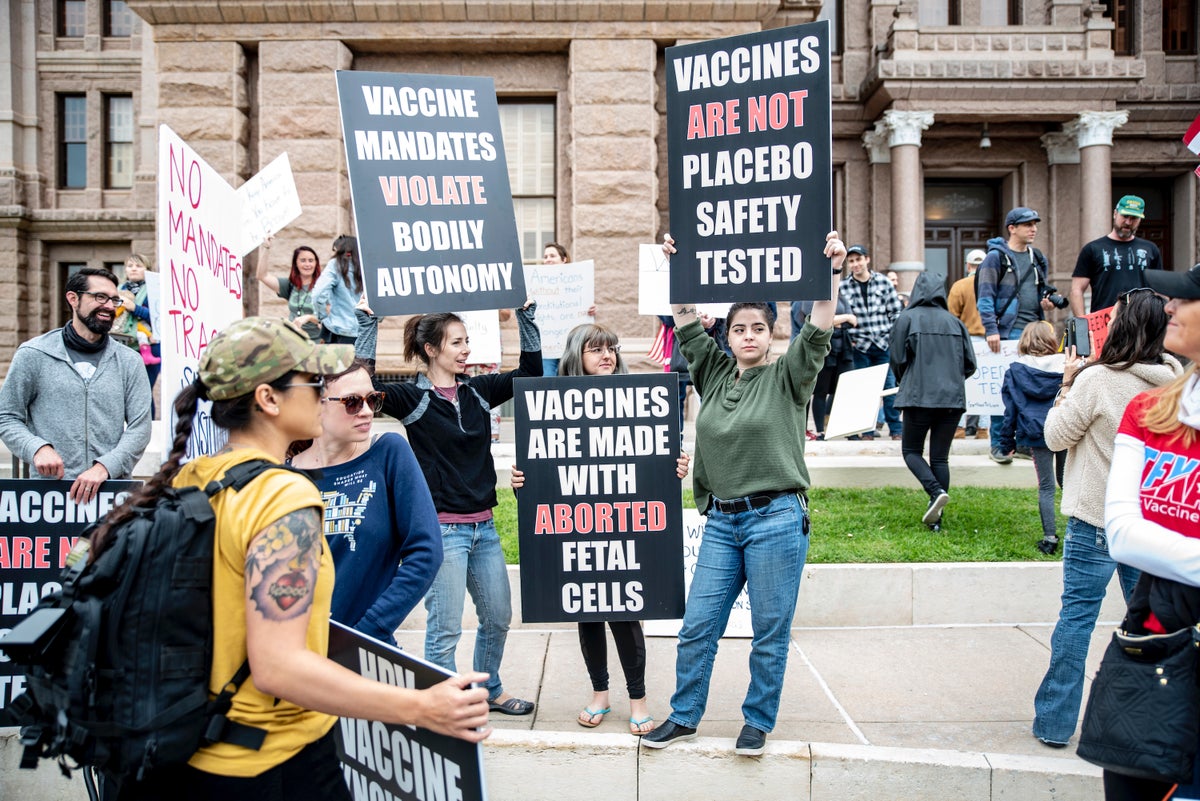
Changing views among Republicans have steered the relaxation of childhood vaccine requirements, according to the Pew Research Center.

Whereas nearly 80% of Republicans supported the rules in 2019, fewer than 60% do today.  Democrats have held steady, with about 85% supporting.

Mississippi, which once boasted the nation’s highest childhood vaccination rates, began allowing religious exemptions last summer. Another leader in vaccination, West Virginia, is moving to do the same.

An anti-science movement picked up pace as Republican and Democratic perspectives on science diverged during the pandemic. Whereas 70% of Republicans said that science had a mostly positive impact on society in 2019, less than half felt that way in a November poll from Pew.

With presidential candidates lending airtime to anti-vaccine messages and members of Congress maligning scientists and pandemic-era public health policies, the partisan rift will likely widen in the run-up to November’s elections.

If less than half of a group feels that science has a mostly positive impact on society, what does the majority believe? The people have had enough of experts!” How to understand populist challenges to science

Science is the systematic study of the structure and behavior of the physical and natural world through observation, experimentation, and testing theories against the evidence obtained.

What are we left with if we do not believe in observation, experimentation, and testing as a way to uncover the truth? Rumor, myth, conspiracy, and authoritarianism — the varied interpretations of the words of an invented god.

We become stone-age savages, dancing around a fire, fomenting hatred for non-believers (aka “blasphemists”).

Dorit Reiss, a vaccine policy researcher at the University of California Law San Francisco, parallels today’s backlash against public health and the early days of climate change denial.Denialist' Remains a Popular Epithet in Climate Battle - WSJ

The parallels are unmistakable: Climate change denial, vaccination denial, science denial, election denial — these paint a picture of people who feel oppressed by reality and having no solutions in the real world, wish to create their own mythical world ala the “Dark Ages” of human civilization.

Both issues progressed from nonpartisan, fringe movements to the mainstream once they appealed to conservatives and libertarians, who traditionally seek to limit government regulation.

“Even if people weren’t anti-vaccine to start with,” Reiss said, “they move that way when the argument fits.”

Even certain actors are the same. In the late ’90s and early 2000s, a libertarian think tank, the American Institute for Economic Research, undermined climate scientists with reports that questioned global warming.

The libertarians cling to the implicit claims that any amount of government is too much government and that individuals should be allowed to do as they wish — except when any individuals diverge from the cult’s beliefs.

Thus, ostracizing minorities — gays, blacks, scientists, scientific culture, government aid recipients, and others who might lean on society — is approved, while any organized culture (aka “government” and laws) is rejected.

The same institute issued a statement early in the pandemic, grandly called the “Great Barrington Declaration.” It argued against measures to curb the disease and advised everyone — except the most vulnerable — to go about their lives as usual, regardless of the risk of infection.Top US science journals risk reputations to battle Trump | Times Higher Education (THE)

Tedros Adhanom Ghebreyesus, director-general of the World Health Organization, warned that such an approach would overwhelm health systems and put millions more at risk of disability and death from COVID. “Allowing a dangerous virus that we don’t fully understand to run free is simply unethical,” he said.

Another group, the National Federation of Independent Business, has fought regulatory measures to curb climate change for over a decade. It moved on to vaccines in 2022 when it won a Supreme Court case that overturned a government effort to temporarily require employers to mandate that workers either be vaccinated against COVID or wear a face mask and test regularly.

Around 1,000 to 3,000 COVID deaths would have been averted in 2022 had the court upheld the rule, one study estimates.

Politically charged pushback may become better funded and more organized if public health becomes a political flashpoint in the lead-up to the presidential election. The Art of Caroline Gariba

In the first few days of 2024, Florida’s surgeon general, appointed by Republican presidential candidate and Florida Gov. Ron DeSantis, called for a halt to the use of mRNA COVID vaccines as he echoed DeSantis’ incorrect statement that the shots have “not been proven to be safe and effective.”

Like the court magician of old, Joseph Lapado broadcasts the “emperor’s” false, politically motivated claims.

And vaccine skeptic Robert F. Kennedy Jr., who is running for president as an independent, announced that his campaign communications would be led by Del Bigtree, the executive director of one of the most well-heeled anti-vaccine organizations in the nation and host of a conspiratorial talk show.

Bigtree posted a letter on the day of the announcement rife with misinformation, such as a baseless rumor that COVID-19 vaccines make people more prone to infection.

He and Kennedy frequently pair health misinformation with terms that appeal to anti-government ideologies like “medical freedom” and “religious freedom.”

A product of a Democratic dynasty, Kennedy’s appeal appears to be stronger among Republicans, a Politico analysis found.

DeSantis said he would consider nominating Kennedy to run the FDA, which approves drugs and vaccines, or the CDC, which advises on vaccines and other public health measures.

Employing a vaccination denier to run the FDA or the CDC would be like asking Donald Trump to provide marital advice or having a shaman run NASA,

Another Republican presidential candidate, Vivek Ramaswamy, vowed to gut the CDC should he win.

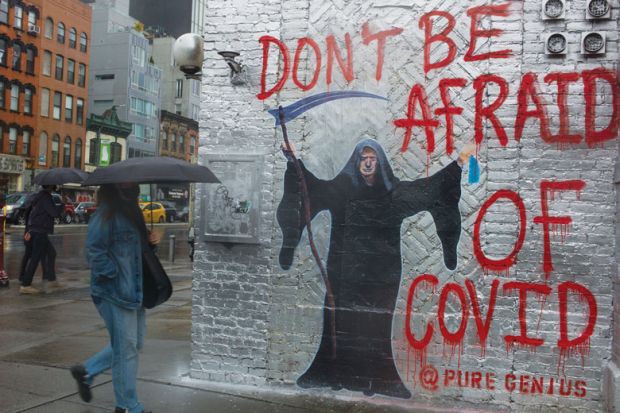
Today’s anti-science movement found its footing in the months before the 2020 elections, as primarily Republican politicians rallied support from constituents who resented pandemic measures like masking and the closure of businesses, churches, and schools.No photo description available.

Then-President Donald Trump, for example, mocked Joe Biden for wearing a mask at the presidential debate in September 2020.

Democrats fueled the politicization of public health, too, by blaming Republican leaders for the country’s soaring death rates rather than decrying systemic issues that rendered the U.S. vulnerable, such as underfunded health departments and severe economic inequality that put some groups at far higher risk than others.

The problem lies with the often-misquoted Reaganesque comment that “government is the problem” and the people’s ignorance of Monetary Sovereignty.

Our Monetarily Sovereign federal government easily could fund health departments, while mitigating economic inequality, all without collecting a penny in taxes.

But conservatives incorrectly label such initiatives (Medicare and Social Security for All) as “socialism” and “unsustainable.”

Just before Election Day, a Democratic-led congressional subcommittee released a report that called the Trump administration’s pandemic response “among the worst failures of leadership in American history.”

Republicans launched a subcommittee investigation into the pandemic that sharply criticizes scientific institutions and scientists once seen as nonpartisan.

On Jan. 8 and 9, the group questioned Anthony Fauci, a leading infectious disease researcher who has advised both Republican and Democratic presidents.

Without evidence, committee member Marjorie Taylor Greene(R-Ga.) accused Fauci of supporting research that created the coronavirus to push vaccines: “He belongs in jail for that,” Greene, a vaccine skeptic, said. “This is more of an evil version of science.”

Visualize an crazed religious advisor to a king pointing fingers at innocent people, calling them infidels, witches, and heretics, and causing those people to be hated or killed by an ignorant populace. That is the Marjorie Taylor Greene of the GOP, today.

Taking a cue from environmental advocacy groups that have tried to fight strategic and monied efforts to block energy regulations, Hotez and other researchers say public health needs supporters knowledgeable in legal and political arenas.

Such groups might combat policies that limit public health power, advise lawmakers, and provide legal counsel to scientists who are harassed or called before Congress in politically charged hearings.

Other initiatives aim to present the scientific consensus clearly to avoid both-sidesism, in which the media presents opposing viewpoints as equal when, in fact, the majority of researchers and bulk of evidence point in one direction.

Oil and tobacco companies used this tactic effectively to seed doubt about the science linking their industries to harm.

Kathleen Hall Jamieson, director of the Annenberg Public Policy Center at the University of Pennsylvania, said the scientific community must improve communication. Expertise alone is insufficient when people mistrust the experts’ motives. Indeed, nearly 40% of Republicans report little to no confidence in scientists to act in the public’s best interest.

When the public’s best interest opposes the interests of the cult leader, his followers will not just ignore but violently reject facts. The January 6th attempted coup is an example of mob justice led by a “religious” (Trumpism) divinity.

In a study published last year, Jamieson and colleagues identified attributes the public values beyond expertise, including transparency about unknowns and self-correction.

Researchers might have better-managed expectations around COVID vaccines, for example, by emphasizing that the protection conferred by most vaccines is less than 100% and wanes over time, requiring additional shots, Jamieson said.

And when the initial COVID-19 vaccine trials demonstrated that the shots drastically curbed hospitalization and death but revealed little about infections, public health officials might have been more open about their uncertainty.

As a result, many people felt betrayed when COVID-19 vaccines only moderately reduced the risk of infection.

“We were promised that the vaccine would stop transmission, only to find out that wasn’t completely true, and America noticed,” said Rep. Brad Wenstrup (R-Ohio), chair of the Republican-led coronavirus subcommittee, at a July hearing.

No one made such a promise. It is a strawman claim.

Every scientist knows that no medicine is perfect. To attribute vaccination denialism to the fact that the vaccines were not perfect is in itself a form of denialism.

The record of vaccines in preventing death is a remarkable scientific achievement. The human lifespan would be much shorter were it not for vaccinations against Smallpox, RSV, Hepatitis, Rotavirus, Diphtheria, Influenza, Polio, Pneumonia, Measles, Mumps, Tetanus, Meningitis, Chickenpox, and yes, COVID.

And not one of those vaccinations is 100% perfect.

So why has COVID been singled out for not being perfect? Politics. Despite falsely claiming credit for the development of the COVID vaccination, the Republican shaman disclaimed the seriousness of the disease.

Not being vaccinated was a symbol of subservience to the cult leader.

Jamieson also advises repetition. It’s a technique expertly deployed by those who promote misinformation, which perhaps explains why the number of people who believe the anti-parasitic drug ivermectin treats COVID more than doubled over the past two years — despite persistent evidence to the contrary.

The Darwin Awards: Evolution in Action: Northcutt, Wendy: 9780452283442: Amazon.com: Books
https://www.amazon.com/Darwin-Awards-Evolution-Action/dp/0452283442

Repetition wasn’t the problem. Ivermectin was touted by the cult leader. That is where belief originated and maintained.

In November, the drug got another shoutout at a hearing where congressional Republicans alleged that the Biden administration and science agencies had censored public health information.

Hotez, author of a new book on the rise of the anti-science movement, fears the worst.

“Mistrust in science is going to accelerate,” he said. And traditional efforts to combat misinformation, such as debunking, may prove ineffective.

“It’s very problematic,” Jamieson said, “when the sources we turn to for corrective knowledge have been discredited.”
___
(KFF Health News, formerly known as Kaiser Health News (KHN), is a national newsroom that produces in-depth journalism about health issues and is one of the core operating programs of KFF — the independent source for health policy research, polling, and journalism.)

Darwinian evolution relies on those less fit being eliminated from the human gene pool, which, on balance, improves genetic survivability.All images

Those predisposed to deny medical science will die younger and breed fewer surviving children, which, over time, will improve humanity’s intelligence.

The political party that claims to be “pro-life” ignores the scientifically proven, life-saving effect of vaccination, and instead promulgates the Libertarian, MAGA magic anti-life Trumpism of Dark Ages pseudo-science. 

Humans, being a social species, are interdependent. As always, the denial of facts in favor of belief and the studied ignorance of influential leaders again forces us all to suffer, just as we did in the 6th – 16th centuries.

We no longer bleed the anemic according to the zodiac, but even that may not be beyond today’s deniers.

This year, Americans will vote. Will we vote for informed, secular, fact-driven, logic, or for doctrine-driven adherents to the latest cultish faith?

The Dark Ages lasted a thousand years. Will we have learned from that experience?

Rodger Malcolm Mitchell

Monetary Sovereignty

Twitter: @rodgermitchell

Search #monetarysovereignty

Facebook: Rodger Malcolm Mitchell

……………………………………………………………………..

THE SOLE PURPOSE OF GOVERNMENT IS TO IMPROVE AND PROTECT THE LIVES OF THE PEOPLE.
Jamie Dimon says Washington faces a global market ‘rebellion’ over record U.S. debt: ‘It is a cliff… we’re going 60 mph towards it’

September 26, 1940, New York Times: The federal budget was a “ticking time-bomb which can eventually destroy the American system,” said Robert M. Hanes, president of the American Bankers Association. 

You can read more than 40 similar dire references to the federal debt at Historical claims the Federal Debt is a “ticking time bomb.”

For 84 years, bankers and other self-proclaimed experts have predicted America’s destruction because of the growing “federal debt” (which isn’t federal and isn’t a debt).

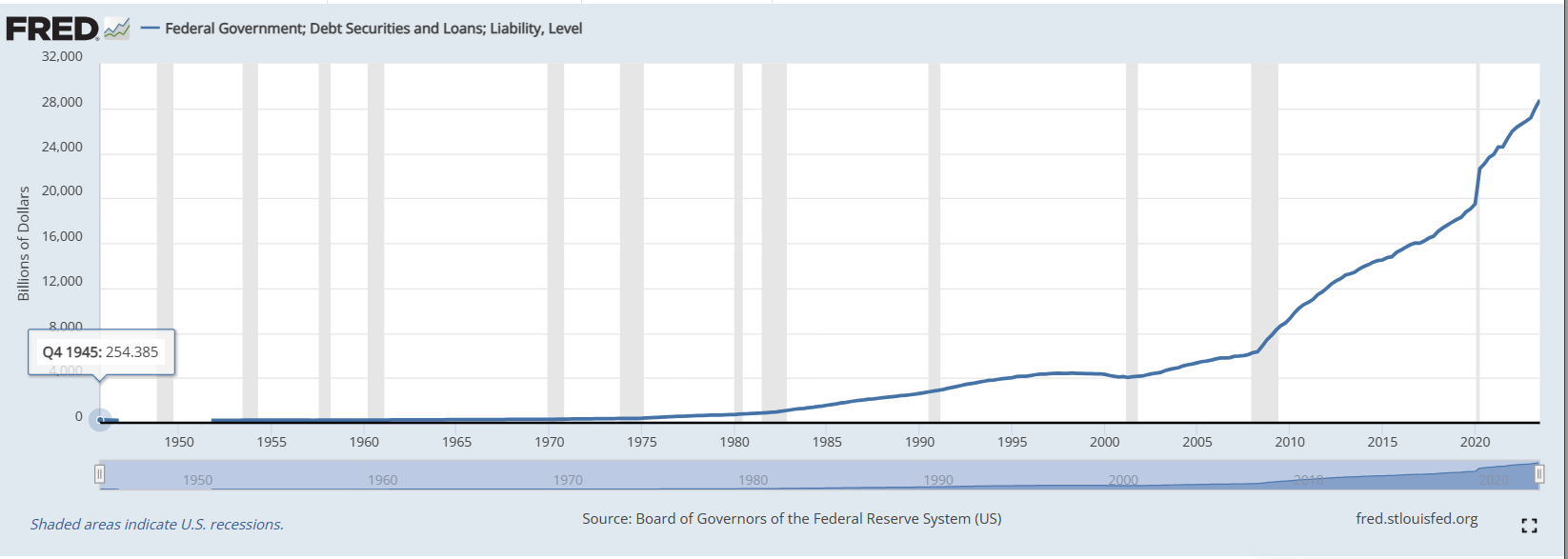
Here is how the “federal debt” has grown. Amazingly (to some), the Republic still stands, economically more robust than ever.

And now, on   January 28, 2024. Fortune 84 years later, we come to this: 

Jamie Dimon, JPMorgan Chase CEO, tells us:  “The global economy is approaching the point of no return courtesy of mounting government debt, and it will lead to a massive falling out of markets and federal institutions.

“Washington faces a global market ‘rebellion’ over record U.S. debt: ‘It is a cliff… we’re going 60 mph towards it.”

“Currently, the American national debt stands at $34.14 trillion—about $100,000 for every person in the U.S.—with the debt ceiling currently suspended until 2025 courtesy of a deal passed in the summer of 2023.” 

Should history be a guide? 

Real (inflation-adjusted) Gross Domestic Product growth.

For those past 80+ years, while self-proclaimed experts repeatedly predicted the death of the American economy, GDP has grown, and grown, and grown, with only short delays, sometimes caused by bank criminality and, most recently, by COVID.

Does the above graph look like a “ticking time bomb,” a “massive falling out of markets and federal institutions,” a “global market rebellion,” or a “cliff”?

Year after year, eight-plus years of being wrong have not taught Jamie Diamon et al. anything. 

Despite his $34 million salary (plus extras), Diamon seemingly is clueless about economics. He speaks of “federal debt” in the same terms as personal or business debt. Here is where he is wrong:

1. The so-called federal debt isn’t debt. It’s the total of deposits into Treasury Security accounts. These accounts are similar to bank safe deposit boxes in that the depositors retain ownership of their deposits.

2. That so-called federal debt also isn’t federal. It belongs to depositors. Unlike regular bank deposits, no bank or the federal government ever touches the “federal debt” deposits.

3. The misnamed “debt” also isn’t borrowing. Our Monetarily Sovereign federal government doesn’t use the deposits to pay its bills. The federal government pays all its bills by creating new dollars ad hoc, which it can do endlessly.

The purpose of T-securities is to provide a safe place to store unused dollars and to help the Fed control interest rates.

This is different from monetarily non-sovereign state/local governments, which do borrow to pay their bills.

4. Similar to safe deposit boxes, the government doesn’t owe the contents. The government merely stores the contents, and upon maturity, the government merely returns the contents to the depositor. That so-called “debt” isn’t even debt.

5. Like safe deposit boxes, the size of the contents doesn’t affect the government’s risk or liability. Whether you put a toy marble or a 20-carat diamond into a safe deposit box doesn’t change the bank’s risk. 

6. By the way, you, as a taxpayer, have zero risk regarding T-securities. Diamon’s claim about $100,000 for every person in the U.S.” is 100% misleading. You don’t owe a penny of that, nor does the government.

And although some of the shorter-term economic signals are flashing greeninflation is coming down, the Fed may be eyeing rate cuts, and employment is staying stable—the boss of America’s biggest bank isn’t convinced there isn’t a major red flag ahead.

Everything is headed in the right direction, but Diamon sees all that as dangerous.

Speaking on a panel alongside former Speaker of the House Paul Ryan at the Bipartisan Policy Center last week, Dimon said the American government faces a “hockey stick” effect regarding government debt.

He drew on the comparison of the 1980s for context, explaining that in 1982, unemployment was around 10% while the stock market had sat stagnant for 15 to 20 years.

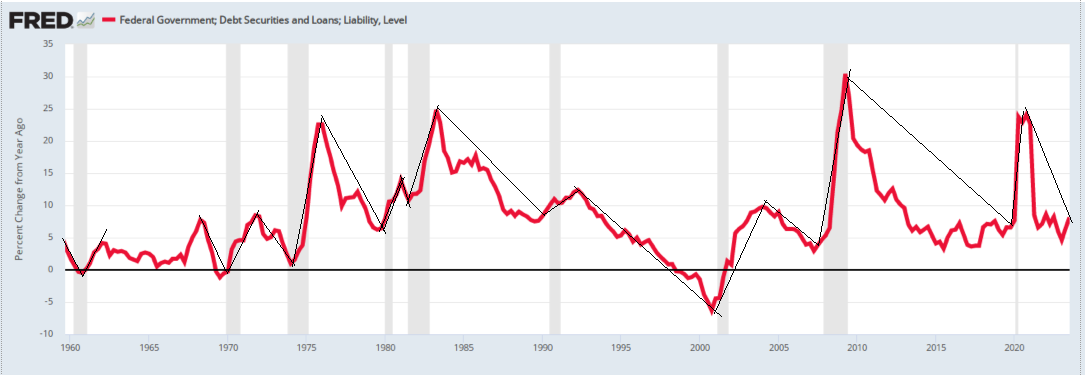
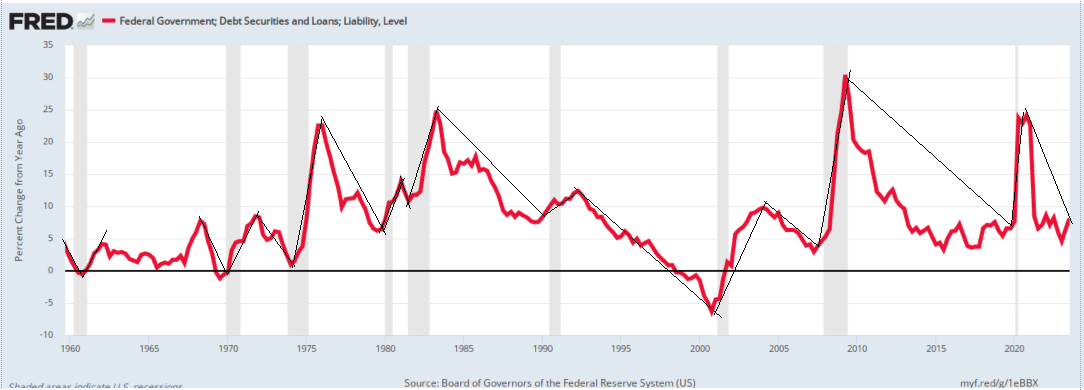
The recession of 1980 had nothing to do with increased federal debt. Quite the opposite: Federal “debt” growth declined immediately before the recessions of 1980 and 1981. The recessions were cured by federal “debt” growth. 

In fact, that is the historical pattern: When federal debt doesn’t grow sufficiently, we have recessions. Those recessions then are cured by increased federal debt growth.

The reason: Federal “debt” grows faster when the federal government increases deficit spending, because federal deficit spending adds growth dollars to the economy.

By mathematical formula, federal government spending increases Gross Domestic Product (GDP), the most common measure of the U.S. economy. (GDP=Federal Spending + Nonfederal Spending + Net Exports.)

Here is that effect, historically.

“Declining federal “debt” leads to recessions, which are cured by increasing “debt.”

Even with the Vietnam War, America’s debt-to-GDP ratio was around 35%, Dimon said, whereas today it sits at 100%.

The debt-to-GDP ratio is meaningless. It measures nothing, and it predicts nothing. 

Looking at a list of the national government’s debt/GDP ratios will tell you absolutely nothing about the health of any government’s finances. High ratio, low ratio; they all are meaningless.

Further, GDP does not pay for the federal “debt.” GDP is the total spending in the economy. That has nothing to do with the total deposits into T-security accounts or with the total of federal deficits (another measure of federal “debt”)?

The federal “debt”/GDP ratio is no better than the number of robin’s nests in your backyard vs. the number of stars you can see at 8:00PM from your bedroom window: Two separate measures that produce a meaningless ratio that is often quoted by people who should know better, and often do..

It is difficult to believe that the CEO of the world’s largest private bank doesn’t know this.

“Back then, the deficit during a recession—you spend money in a recession—was 4% or 5%. Today, it’s 6.5% in a boom time,” Dimon continued.

The deficit measures the net amount of money the federal government creates, most of which goes into the U.S. economy to create the economic growth we all love. No deficits = no growth = depression.

 Jamie Dimon warns that ‘all these powerful forces’ will affect the U.S. economy in 2024 and 2025. He added: “If you look at that 100% debt to GDP by [2035] I think it’s going to be 130% and it’s a hockey stick. That hockey stick hasn’t started yet, but when it starts, it markets worldwide… there will be a rebellion.”

Dimon’s “hockey stick” scenario could occur as the American government faces higher charges to service increasing levels of debt, potentially in an economy which many are predicting will enter a slow or no-growth era.

This isn’t just bad news for the Home of the Brave—America’s ability to pay its debts is a concern for the nations around the world, which own a $7.6 trillion chunk of the funds.

You have just read three short paragraphs of utter nonsense. Whether the federal debt (the cumulative total of federal deficits or the total of T-security deposits — either definition is correct) is 103%, 230%, or 930% of GDP does not affect America’s ability to pay its debts. 

If you gave the federal government a $100 trillion invoice today, they could give you a check for $100 trillion tomorrow. You instantly would become the world’s richest person, and the federal government could continue its other spending without missing a beat.

Ben Bernanke: “The U.S. government has a technology, called a printing press (or, today, its electronic equivalent), that allows it to produce as many U.S. dollars as it wishes at essentially no cost.”

Alan Greenspan: “A government cannot become insolvent concerning obligations in its own currency.”

St. Louis Federal Reserve: “As the sole manufacturer of dollars, whose debt is denominated in dollars, the U.S. government can never become insolvent, i.e., unable to pay its bills.

So why does Diamon make those incorrect claims?

I believe he knows the truth, but he works for the rich, and the rich do not wish you to understand the Dirty Little Secret of Federal Finance: Federal Taxes Don’t Pay For Federal Spending.

Indeed, federal taxes don’t pay for anything. Every penny of those federal taxes you pay is destroyed upon receipt. See: “Does the U.S. Treasury really destroy your tax dollars?

Why might Diamon want to disseminate the lie that federal taxes fund federal spending? We’ll discuss that later in this paper.

The nations most exposed are Japan, which owned $1.1 trillion as of November 2023, China ($782 billion), the U.K. ($716 billion), Luxembourg ($371 billion) and Canada ($321 billion).

Charging head-first into a global fistfight with domestic and international markets is the “worst possible way to do it,” Dimon added, saying: “It is a cliff. We see the cliff. It’s about 10 years out.”

I would be willing to wager, Mr. Dimon, our respective annual incomes that neither Japan, China, the U.K., Canada, nor the U.S. pay their so-called “debts” in 10 years. Mention that when you next see him.

And by the way, also tell him that the “10 years out” is the classic hedge of charlatans. It allows one to make ridiculous predictions that no one will remember if it’s wrong, but everyone will be reminded if, by some good fortune, it turns out right.

Paul Ryan chimed in that the debt spiral is the “most predictable crisis we’ve ever had,” with Dimon agreeing.

There is ZERO possibility that the U.S. federal government could face a  “debt spiral.”

A debt spiral is a situation where a country (or firm or individual) sees ever-increasing debt levels. These increasing debt and interest levels become unsustainable, eventually leading to debt default.

Image
While Jamie Dimon wrings his hands about America’s economic future, the facts say he’s wrong.

Being Monetarily Sovereign, the U.S. federal government:

a. Is nothing like a firm, individual, or even a nation like monetarily non-sovereign Italy, Greece, or France.

The fact that Ryan predicts a debt spiral for the United States demonstrates his abject ignorance or dishonesty about federal finance.

b. Never borrows dollars. It never needs to. It creates all the dollars it needs.

c. No dollar debt is unsustainable for the U.S. government. 

‘This is about the security of the world.’ The banking boss, who was paid $36 million for his work in 2023, added his alarm goes beyond financial industry ramifications.

Throughout the past year, Dimon has been sounding the alarm on increasing geopolitical tensions, namely the Israel-Hamas conflict and Russia’s invasion of Ukraine.

“This is about the world’s security,” 67-year-old Dimon added. “We need a stronger military; we need a stronger America. We need it now. So I put this as a risky thing for all of us.”

At this point, Dimon is just babbling random thoughts: Israel, Hamas, Russia, Ukraine, stronger military, and though a nation with infinite dollars won’t be able to use those dollars to pay for a more robust military. Nonsense.

On Dimon’s point, Republican politician Ryan later added he believes “in five years we’re going to be paying more in interest than we will be the Pentagon.”

This is a favorite trope of the “debt” alarmists: “Paying more interest than __________” (fill in the blank). That comparison is supposed to scare us. But why?

Why should the possibility that a nation with infinite dollars be worried about paying interest in dollars? The federal government’s interest payment helps economic growth by adding dollars to GDP.

The event in Washington, D.C., spanned a wide range of topics, including the balance of equality, with Dimon admitting he’d tax the rich more to support the poor. He described the idea as “as much of a no-brainer policy as I have ever seen.”

It is Easy to favor taxing the rich more when he knows it never happens. Even when tax rates are increased, there is an appearance of taxing the rich more; the rich have too many tax dodges for any “balance of equality.”

There are hundreds of ways in which the rich pay a lower percentage of their income in taxes than the middle-income people. Here’s just one:

The problem with the current tax system, the White House says, is that unrealized gains could go untaxed forever if wealthy people hold on to them and pass them on to heirs when they die.

“If a wealthy investor never sells stock that has increased in value, those investment gains are wiped out for income tax purposes when those assets are passed on to their heirs under a provision known as stepped-up basis,” the analysis says.

Under a stepped-up basis, the value of the asset is adjusted to the fair market value at the time of the inheritance. This wipes out any taxes on the unrealized gains that accumulated from when the investor bought the asset and the time it was inherited.

SUMMARY

America is run by the rich, whose money encourages economists, politicians, and the media to help the rich become richer.

There are two ways for the rich to become richer, i.e., to obtain more comparative wealth:

  1. Widen the wealth Gap below while narrowing the Gap above.
  2. Obtain more wealth for themselves.

To accomplish #1, the rich must convince those below them that the federal government cannot afford to pay benefits or that adding benefits requires more taxpayers’ dollars — both untrue.

Thus, we have poor people, who would benefit from free comprehensive, no-deductible Medicare for All and Social Security for all, voting against such programs, and we have business leaders like Jamie Diamon spreading the Big Lie that federal “debt” will cause a catastrophe — all much to the delight of the rich. 

Dimon works for the rich, who want the income/wealth/power Gap widened. Seemingly, his $36 million+ salary isn’t enough, and he needs you to believe the federal government can’t improve your life unless you suffer more. 

So long as people believe the so-called “federal debt” is a burdon on the economy, rather than a necessity for economic growth, we will have scare-mongers like Jamie Dimon and others. 


Rodger Malcolm Mitchell

Monetary Sovereignty

Twitter: @rodgermitchell

Search #monetarysovereignty

Facebook: Rodger Malcolm Mitchell

……………………………………………………………………..

THE SOLE PURPOSE OF GOVERNMENT IS TO IMPROVE AND PROTECT THE LIVES OF THE PEOPLE.

If ignorance contained calories, Senator Marco Rubio (R-FL) would weigh 10 tons.

If ignorance contained calories, Senator Marco Rubio would weigh 10 tons. Here are excerpts from a letter he sent to me.

I recently received response to a letter I sent him asking why a Monetarily Sovereign government was so hesitant to spend U.S. dollars on programs that help Americans.

Thank you for taking the time to express your thoughts regarding spending and the federal budget.

Understanding your views helps me to better represent Florida in the United States Senate, and I appreciate the opportunity to respond.

As of May 20, 2021, the US national debt had reached over $28.3 trillion. This is an unsustainable course that Congress must address.

Immediately, this Senator of the United States shows his ignorance of federal financing.

Being Monetarily Sovereign, the U.S. federal government can “sustain” any financial obligation denominated in its own sovereign currency, the U.S. dollar. As people who do understand federal finance have said:

Former Federal Reserve Chairman Alan Greenspan said: “A government cannot become insolvent with respect to obligations in its own currency. There is nothing to prevent the federal government from creating as much money as it wants and paying it to somebody. The United States can pay any debt it has because we can always print the money to do that.”

Former Federal Reserve Chairman Ben Bernanke: “The U.S. government has a technology, called a printing press (or, today, its electronic equivalent), that allows it to produce as many U.S. dollars as it wishes at essentially no cost. It’s not tax money… We simply use the computer to mark up the size of the account. “

St. Louis Federal Reserve: “As the sole manufacturer of dollars, whose debt is denominated in dollars, the U.S. government can never become insolvent, i.e., unable to pay its bills. In this sense, the government is not dependent on credit markets to remain operational.”

Federal finances are not similar to state/local government, business, or personal finances. Though the same words — “debt,” “deficit,” “owe,” “borrow,” “surplus,” etc., — are used for all types of finances, these words have different meanings, depending on which party’s money is being referenced.

Federal “debt” is not money the federal government owes. It is money the federal government holds for T-security owners. The so-called debt is nothing more that the total of deposits into T-security accounts (T-bills, T-notes, and T-bonds).

Unlike private bills, notes, and bonds, which do represent borrowing, federal bills, notes, and bonds do not. Because the U.S. government has the infinite ability to create U.S. dollars, it never borrows dollars.

T-security accounts are similar to safe-deposit boxes. Their purpose is not to provide the federal government with spending money, of which it already has an infinite supply. Just as a bank never touches the contents of safe deposit boxes and does not owe the depositor anything, the federal government never touches the dollars in T-security accounts, and does not owe the depositor anything.

When the accounts reach maturity, the government simply allows the depositor to reclaim them. This is not a financial burden on the government. It is infinitely “sustainable.”

The purposes of T-securities are:

  1. To provide the public with a a safe place to store unused dollars. This stabilizes the value of dollars.
  2. To help the U.S. government control interest rates by arbitrarily setting the rates for T-securities.

Though the so-called federal “debt” approaches $30 trillion, the U.S. government does not owe $30 trillion. It pays all its bills on time. It is not a “debtor.”

Rather than being called “debt,” those securities should go by their correct term: Deposits.

On February 3, 2021, Senator Cindy Hyde-Smith and I introduced a resolution to enact a balanced budget amendment to the United States Constitution.

“Balanced budget” is a good idea for states, businesses, you, and me, but a horrible idea for the federal government because it limits the amount of money in the private sector (also known as “the economy.”)

Rubio surely knows this, and also knows such an amendment has zero chance of passing. But he wants to fool you into thinking he is financially astute. 

The following graph shows that recessions begin with reduced federal deficits and end when deficits increase. The reason: Federal deficits add growth dollars to the economy.

Diagonal lines show that recessions (vertical gray bars) begin when federal deficits (red line) are reduced. Recessions are cured when federal deficits are increased.

Why are recessions introduced by reduced federal deficits? Because recessions are defined as two consecutive quarters of falling Gross Domestic Product (GDP). And GDP is calculated as follows:

GDP = Federal Spending + N0n-federal Spending + Net Exports

The more spending the greater is GDP. 

The bill has 14 co-sponsors and is referred to the Senate Committee on the Judiciary. On March 4, 2021, Representative Vern Buchanan introduced a companion resolution in the House of Representatives, referred to the House committee and the judiciary.

Thus, we are told that at least 14 Senators are ignorant about federal financing, a shocking indictment of people who each day make decisions about federal spending. Great power + ignorance = tragedy.

A balanced budget is based on common sense principles that should be installed in the US Constitution.

This would force politicians in Washington to do what every family across the United States must do to balance their budgets.

Senator Rubio should have the words “I am ignorant” tattooed on his forehead. A family should spend no more than its income. When the federal government spends no more than its income, the economy cannot grow.

Where would the additional money come from if not from the federal government?

Private banks create dollars by lending, but these dollars must be paid back, plus interest. Paying back loans destroys dollars.

The dollars spent by the federal government need not be paid back. Those are the dollars that grow GDP.

GDP = Federal Spending + Nonfederal Spending – Net Imports.

Because U.S. imports traditionally exceed exports, the federal government must run deficits for GDP to remain level. For GDP growth, the federal government must run deficits.

This would also prevent us from continually passing the bill to the next generation.

There is no bill being “passed to the next generation.” Federal deficit spending passes additional dollars to the next generation. It’s inconceivable that Sen. Rubio does not know this, so one must assume he is lying.

Much of the recent increase in the national debt has come from federal spending related to the COVID-19 pandemic. As you may know, COVID-19 was declared a public health emergency for the United States on January 30, 2020, after the outbreak began in Wuhan, China.

On March 27, 2020, President Trump signed into law the bipartisan act, which was a $2 trillion emergency relief package that, among other things, provides small businesses with direct assistance to stay in business and keep American workers employed.

Think, Sen. Rubio. If federal deficit spending was harmful, why would the federal government deficit spend to fight COVID? Why would the government spend to assist small businesses and keep American workers employed?

As chairman of the Senate committee and small business and enterprise ship last Congress, I included legislation that made $349 billion in forgivable loans to small businesses and nonprofits available through the paycheck protection program.

Here, the Senator who wants a balanced budget boasts about helping pass $349 billion in deficit spending. Does he realize how ignorant that is?

On December 27, 2020, President Trump signed into law an act that provided $1.4 trillion to fund the federal government through September 30, 2021.

While reducing federal spending is one of my top priorities, I believe it was appropriate during the COVID-19 pandemic to help small businesses stay open by providing government assistance.

Does this make any financial sense at all? The people of America were in financial difficulty, so to combat that, the federal government spent more dollars, which, according to the 14 ignorant Senators, put the nation in greater financial difficulty.

It boggles the mind to see that Rubio et al. see no contradiction. Federal spending helps America because it adds dollars to the economy — dollars that do not need to be paid back.

If the federal government ran a balanced budget, the dollars would have to be paid back, at which time America would suffer a depression.

U.S. depressions tend to come on the heels of federal surpluses.

1804-1812: U. S. Federal Debt reduced 48%. Depression began 1807.
1817-1821: U. S. Federal Debt reduced 29%. Depression began 1819.
1823-1836: U. S. Federal Debt reduced 99%. Depression began 1837.
1852-1857: U. S. Federal Debt reduced 59%. Depression began 1857.
1867-1873: U. S. Federal Debt reduced 27%. Depression began 1873.
1880-1893: U. S. Federal Debt reduced 57%. Depression began 1893.
1920-1930: U. S. Federal Debt reduced 36%. Depression began 1929.
1997-2001: U. S. Federal Debt reduced 15%. Recession began 2001.

On March 11, 2021, President Biden signed the American Rescue Plan Act, a $1.9 trillion COVID-19 relief package, into law, unlike previous COVID-19 relief packages. This bill was passed with a solely partisan vote in the Senate.

I did not support that bill as it spent hundreds of billions of dollars on items unrelated to COVID-19 recovery, including bail-out for state and local governments.

It also failed to reopen schools, created welfare programs, and funded ridiculous pet projects like an underground railway in Silicon Valley.

In addition to the wasteful spending enacted by the plan, President Biden has proposed even more wasteful spending in his proposed federal budget. Despite having just spent $1.9 trillion, President Biden has proposed a more than 1.5 trillion federal discretionary budget.

Now that the economy is reopening, Congress must rein in reckless federal spending and prioritize policies that get Americans back to work and help the economy cover.

Totally illogical. The so-called “wasteful spending” was not wasteful. It added growth dollars to GDP. “Prioritize polices that get Americans back to work,” signals that Rubio believes the poor are lazy bums with no aspirations to improve their lives. 

So, if you give the poor and middle classes any financial aid, they simply will stop working. That is the claim of the idle rich as they lounge on their yachts.

Today, the economy is healthy and growing. Inflation is dropping. Interest rates will fall, all because of the “wasteful spending.”

While Sen. Rubio may disagree with the projects being funded, there is no such thing as federal wasteful spending. Federal spending adds growth dollars to the economy. It creates jobs and helps businesses.

Imagine the federal government spending a billion dollars to dig a hole and fill it in. Is that wasteful? No, because it would employ people and aid businesses.

It also would cost federal taxpayers nothing because, contrary to popular myth, federal taxes do not fund federal spending. The federal government pays all its bills by creating new dollars ad hoc. It does not use tax dollars. It does not “live within its means.” It cannot run short of dollars, even if it collected $0 taxes.

 Federal taxes are destroyed upon receipt.  (State/local tax dollars go into private banks and are not destroyed.)

You pay your federal taxes with dollars from your checking account. Those dollars are part of the M2 money supply measure. But when they reach the U.S. Treasury, they no longer are part of any money supply measure. They are effectively destroyed. 

The public can be excused for its ignorance about federal financing. We, the people, rely on our political representatives to understand. That’s why we vote for them. So, for Senators to be so ignorant about federal finance is a disgrace.

Example: Because of such ignorance, Medicare woefully lacks coverage. It doesn’t pay for Health care costs for spouses and dependents, deductibles and co-payments, long-term hospitalization, dental, non-medically necessary vision and hearing, non-medically necessary foot care, nursing home care, international medical care, and cosmetic surgery.

Why?

The federal government has infinite dollars, which it creates by pressing computer keys. Why does Medicare not pay for many things?

Let’s say your father is a billionaire, and you ask him to pay your dental bill. Would you refuse? The federal government, which has far more money than a billionaire, refuses. Why?

Because Senators like Rubio spread the disinformation that the government must live within its means and that taxpayers fund federal spending — both are lies.

Consider colorectal cancer. Each year, over 150,000 Americans are diagnosed with colon cancer. It’s the fourth-leading cause of cancer in the United States and the second-leading cause of cancer-related deaths.

Clinical guidelines recommend colon cancer screening begin at age 45 for people at average risk. Screening should begin sooner for anyone with a family history or other risk factors. One would think the infinitely rich federal government would do everything possible to detect, treat, and cure colon cancer.

But no. If during a screening, your doctor finds and removes a polyp or other tissue, you pay 15% of the Medicare-Approved Amount for your doctor’s services. In a hospital outpatient setting or ambulatory surgical center, you also pay the facility a 15% coinsurance amount.

For many people, those 15% charges are a financial hardship. Why must you pay anything?

Why are there Medicare deductibles? Why are there co-payments? Why is long-term hospitalization not covered? Why aren’t reading glasses covered? Why aren’t nursing homes covered?

Ignorance.

The U.S. government is infinitely rich — far richer than anyone who has lived. Yet, Sen. Rubio et al. claim that federal spending is “unsustainable” and the government should run a “balanced budget.”

The sole mission of any government is to protect and improve the people’s lives. Being Monetarily Sovereign, the U.S. government can easily afford to protect and enhance your life.”

–Comprehensive, no-deductible health care insurance for every man, woman, and child in America

–Social Security for every person in America, with unique benefits for the elderly

–Extend free education from grades K-12 to K-16+

The rich don’t want it because they want the rest of us to be desperate. They want a workforce that will accept low-pay, low-benefit jobs, hoping we won’t outlive our money somehow.

Sen. Rubio, of course, has no such worries. He expects you to vote for his health and retirement security, not yours.


Rodger Malcolm Mitchell

Monetary Sovereignty

Twitter: @rodgermitchell

Search #monetarysovereignty

Facebook: Rodger Malcolm Mitchell

……………………………………………………………………..

THE SOLE PURPOSE OF GOVERNMENT IS TO IMPROVE AND PROTECT THE LIVES OF THE PEOPLE.
Have you heard of “True Cost Accounting”?

An article in the December 2, 2023 New Scientist Magazine has me puzzled.

The article deals with “True Cost Accounting” (TCA), which attempts to account for all the costs associated with the creation of products and services. Most importantly, this includes environmental costs.

While I sympathize with the desire to identify environmental problems and solve environmental needs, I question whether TCA helps or hurts that mission.

Here are some excerpts from that article:

How counting the true cost of cheap food could make a better world,  Graham Lawton

What we pay for food and other goods doesn’t reflect the environmental and social damage they cause. But a radical new approach to economics could change that. By Graham Lawton, 28 November 2023

IN THESE difficult times, it seems utterly bananas to say that food is underpriced. In the UK, average grocery bills have risen by more than 12 per cent in the past year. But it is.

The price tags on food are way lower – by about two-thirds – than what they would be if we were paying the full cost. Don’t worry, though, there are plans to sort this out.

In reality, we already pay the true price, it is just that most of it is stealthily hidden from us. “We pay overall four times for our food,” says Alexander Müller at the sustainability think tank TMG in Berlin.

First, we pay at the checkout.

Then we pay for the health, environmental and social costs of producing that food, mostly though taxes.

Uh oh. My antennae go up when I see the word “taxes.”

Though taxes indeed are a cost to the public, they are not the result of health, environmental or social problems.

The U.S. and UK governments, unlike city, state and county governments, are Monetarily Sovereign (MS). That means they both (and other MS) governments have the infinite ability to create money.

They never unintentionally can run short of their own sovereign currency.

Former Federal Reserve Chairman, Ben Bernanke: “The U.S. government has a technology, called a printing press (or, today, its electronic equivalent), that allows it to produce as many U.S. dollars as it wishes at essentially no cost.”

For that reason, “we” don’t pay for health, environmental, and social costs via taxes. Our central government’s taxes pay for nothing. In fact, U.S. federal taxes are destroyed upon receipt.

One purpose of government taxes is to help our central government control the economy by discouraging what the government doesn’t like and by rewarding what the government likes.

Taxes also assure demand for the U.S. dollar by requiring dollars to be used for tax payments.

And that’s it. Though local taxes fund local government spending, U.S. and UK government taxes do not fund any spending.  

Even if those central governments stopped levying taxes, they still could continue spending indefinitely.

These costs are “externalities” – things that are treated as free even though they aren’t, such as the environmental damage caused by farming or the health costs of obesity.

Right now, producers ignore them and let the rest of us pick up the bill.

What constitutes “the bill” and exactly who are “the rest of us.”? If the soot particles from a coal-fired furnace make you sick, how would you measure the cost? Is your sickness, in of itself, considered a cost, and if so, can it be measured in dollars?

Perhaps, under certain circumstances:

1. You become sick enough to require medical care, the cost for which is borne by you, your insurance company, or the government.

2. You need to stay home from work, which is a cost to your company. If you are docked for being out of work, you bear the cost.

3. Your productivity is affected, which is a cost to the economy as well as your company.

4. You require medicines and healthcare, which are counted as sales to healthcare providers and pharmaceutical companies.

5. And, of course, there is the emotional cost, the lifespan cost, and the lifestyle cost, which are difficult to measure in dollars.

But why would you need to measure the costs? It’s like measuring the cost of being shot in the head. You simply want to avoid it. Are you going to ask, “How much would a grazing wound cost me vs. a direct shot?”

Is belching smoke into the air OK if it only sickens ten percent of the population? 

Economists and accountants have been working on a system called true cost accounting (TCA), which aims to internalize these externalities and upend decades of economic orthodoxy.

For decades, economic success or failure has been measured in purely financial terms. Consider the global yardstick of economic progress, gross domestic product (GDP) – the value of all the goods and services produced in a country.

The concept became the internationally accepted indicator of economic success after the second world war. If GDP grows, the economy is deemed to be healthy, and GDP growth has long been an overriding priority of most governments.

Is the implication that in a healthy economy there’s no need to save the air and water from pollution? Should we worry about pollution only when GDP is down?

GDP contains some glaring absurdities. For example, it omits services provided by the state, such as healthcare.

Really? The formula in the U.S. is:

GDP = Federal Spending + Nonfederal Spending + Net Exports

Every service provided by the government (including state/local governments) is paid for by government spending, which by formula, is part of GDP.

Unpaid work also doesn’t count, even though it often displaces activities that, if paid for, would.

That’s true. If you mow your own lawn, and as a favor mow your neighbor’s lawn, GDP doesn’t reflect either mowing. But, there is a time and effort cost that can’t be measured.

Car accidents boost GDP because they stimulate economic activity in the insurance and repair sectors. Waste contributes to GDP as long as the discarded stuff was bought with money.

Here, the implication is that we worry about car accidents and waste only if they impact GDP. Therefore, to take action against car accidents and waste, we first must measure their social cost as part of an overall economic scale. Huh?

Worst of all, GDP keeps many aspects of economic activity entirely off the books – the aforementioned externalities, which the Organization for Economic Co-operation and Development defines as “situations when the effect of production or consumption of goods and services imposes costs or benefits on others which are not reflected in the prices charged“.

Natural capital, such as trees, is invisible to the GDP system until it is destroyed and turned into products. Ditto environmental degradation, which largely doesn’t attract any financial penalties in calculations of GDP.

In fact, deforestation and pollution can positively contribute to GDP if they generate economic activity. Health and social problems caused by industry are also swept under the carpet, even though somebody will eventually have to pay for them.

Sorry to keep interrupting the narrative, but the implication remains that taking action against deforestation and pollution requires the costs of these problems be part of GDP or a similar measure.

When we buy stuff – food, clothes, energy and so on – the price we pay often fails to reflect the full cost of producing, consuming and disposing of those goods and services across their entire life cycle.

The price of a tank of petrol, for example, doesn’t include the cost of dealing with climate change and the air pollution caused by its combustion products.

The price of a pair of jeans doesn’t reflect the social cost of producing them in a sweatshop and the environmental cost of growing the cotton, transporting the jeans halfway around the world and managing the landfill they will probably end up in.

The price of food doesn’t reflect the social cost of low agricultural wages, the environmental cost of soil erosion, water and pesticide use, and the health costs of obesity and other diet-related conditions.

These externalities are arguably one of the main causes of our myriad environmental and social problems. “Destruction of biodiversity costs nothing, therefore, let’s destroy it,” says Müller, who is a former assistant director-general of the Food and Agriculture Organization of the United Nations (FAO).

“Polluting the atmosphere with CO2 has no cost immediately. These ignored real costs are leading to a global crisis.”

In today’s economy, companies can deplete natural resources, pollute the environment, drive down wages and create harmful products, safe in the knowledge that they will reap the rewards while taxpayers pick up the tab.

True for monetarily non-sovereign governments; not true for Monetarily Sovereign governments, which pay for everything by spending newly created dollars.

This is what is known as “privatized profits and socialized losses”, according to Lauren Baker at the Global Alliance for the Future of Food in Washington DC.

Indeed, companies are incentivised to do so, as those that are more successful at externalising their costs will be more profitable, more competitive and better at raising capital for more of the same, says Baker.

This is where TCA comes in. It aims to capture all of the pluses and minuses that arise from economic activity, not just raw profit and loss. That means tallying up the cost of the environmental, human health and social harms (or benefits) of production and adding them to the balance sheet.

Here is where ignorance of Monetary Sovereignty begins to take its toll.

The spending by MS government is free to taxpayers. If you live in the U.S., the UK, or other MS nations, not one penny of your taxes are spent by your government. Your governments could eliminate tax collection as still spend whatever they wish.

But you do pay for goods and services. So, if environmental costs become business costs, that will increase the price of goods and services, which you will pay. 

In short, if the government pays it costs you nothing. If business pays, you pay.

This is not to say that business should be allowed to pollute at will, and let the government clean it up. The government has the power to pass laws that prohibit degrading the ecology. 

But putting the cost of polluting on business’s balance sheets actually gives tacit approval to pollute so long as polluting is cheaper than not polluting.

Until recently, that was almost impossible. But years of progress on methodologies such as life cycle assessment, which tallies the full social, environmental and economic impact of products from cradle to grave, have made TCA tractable.

Life cycle assessment has been in development for 50 years, but, until now, has been largely non-monetary. TCA is a way of converting life cycle assessment into cold, hard cash, says Ulrike Eberle at sustainability consultancy Corsus in Hamburg, Germany.

Some food companies have embraced it to reduce their negative impacts on society and the environment. One example is Dutch chocolatier Tony’s Chocolonely, which aims to charge the “true price” of its products (see: “Shopping with true costs”).

In essence, Tony’s Chocolonely tells you how much extra you should pay for its products that are having a negative impact on society. Think about that, for a moment.

Insurers are increasingly interested in TCA to assess their clients’ future exposure to climate change and environmental breakdown, says Baker, and financial advisers use it to help socially and environmentally conscious investors.

Translation: TCA will open the door to every business, large or small, being sued for legally polluting the air, water, or land.

Now realize that you yourself pollute the air, water, and land by breathing, creating garbage, having children, and . . . well, existing. So do businesses. 

In short, TCA could become the attorneys’ family enrichment and retirement program, with everybody suing every other body for damaging the environment, based on TCA’s estimates.

It is also attracting interest from other sectors, notably clothing and aquaculture, she says. But TCA must spread further and wider. “The concept needs to be applied to everybody, to all economic activities,” says Müller.

And since all activities are economic, TCA would be applied to you and your family. (Now, what shall I do about my baby’s full diapers?”)

Right now, consumers spend a total of around $9 trillion a year on food. But if they paid for the externalities, that bill would rise to $29 trillion.

Who could resist such a wonderful program?

Around $10 trillion of the extra is the health costs from diet-related cancers, diabetes and cardiovascular disease; most of the rest is from fixing environmental damage. “Cheap food is very expensive if you consider the externalities,” says Müller.

Hendriks emphasizes that the $20 trillion extra cost is only a rough estimate, and also that it is incomplete.

Actually, TCA always will be a rough, incomplete estimate, filled with personal biases.

“It doesn’t include social externalities, such as underpayment of wages and child labour,” she says.

Nor does it include the health costs from obesity, though some of these will be captured by the three conditions in the analysis. When all this is factored in, that vast underpayment is likely to rise even higher.

Encouraging overweight (define?) people sue food companies for selling products that contain calories — what a cheerful future. 

Does that mean we need to pay more for food? This is a misunderstanding that dogs the TCA movement – that it will push up prices at the checkout. “People say, ‘You with your TCA, you want to make food even more expensive’,” says Müller.

“That’s nonsense. We are applying the ‘polluter pays’ principle.”

That means the agribusiness and food companies would foot the bill, incentivizing them to change their business practices so as not to go into the red.

If agribusinesses somehow determine what “the bill” is and are forced to pay it, won’t they simply have to raise prices? The $20 trillion cost doesn’t magically disappear.

Detractors who bleat about hard-pressed consumers having to pay more are simply defending the status quo so they can continue to externalise their costs, says Müller.

See, it’s like this. People who don’t want to pay more for what they buy are “bleating.” 

And in any case, consumers are already paying – or will pay in the future – for those externalities. “Even today, we pay for it,” he says. “Maybe future generations pay for it.

Other regions pay for it, or a combination of everything. It is not that true cost accounting is inventing costs. We are only identifying already existing costs.”

No, you’re not just identifying existing costs. You are arbitrarily defining and assigning costs under the cloak of “do-gooderism.” 

Let’s stop to address some realities:

1. If agribusiness and food companies would foot the bill” that would be part of GDP. It has nothing to do with TCA. That merely has to do with passing laws that charge polluters for cleaning up pollution.

2. That’s the easy part. The hard part is measuring the negative life effect of any industry. What is the TCA effect on one person living one year less than he would have if he had not been breathing certain toxins that are 50% not natural and are spread by thousands of different companies.

Specifically, who is responsible for that and by how much?

Redirecting harmful subsidies would soften the blow. The world currently subsidises agriculture to the tune of $600 billion a year, says Müller, most of which props up unsustainable practices, such as factory farming and excessive use of pesticides.

That money should be redirected to pay for the industry’s externalities, he says.

3. But what is the cost of reduced food production? The cost of starvation? If we eliminate factory farming we will have to use other forms of farming (aka “alternative farming), which includes such efforts as:

-Organic farming, , -Permaculture, -Hydroponics -Agroforestry

All involve more immediate direct production costs along with scarcities due to lower output. This will increase the price of foods and hunger. 

Of course, we aren’t going to transition to a TCA world overnight. “I’m lobbying for a phased approach: try to gain friends, try to win some companies who can benefit from true cost accounting,” says Müller.

It’s difficult to see how companies benefit from true cost accounting. The environment will benefit from ecologically sound practices, but the program will have to be funded by Monetarily Sovereign governments.

(Monetarily Sovereign governments like the U.S. and UK, can spend without taxing. Monetarily non-sovereign governments — Germany, France, Italy et al — would have to increase taxes to fund the ecological effort. So, if food prices were not raised, taxes would be.)

“Otherwise, you’re looking like people who have crazy ideas and will never be successful.”

That is exactly what I see.

Dutch supermarket chain Albert Heijn has launched a True Pricing trial in the coffee bars of three of its To Go supermarkets, to raise awareness about the hidden costs associated with products.

During the trials, grocery shoppers in Groningen, Wageningen and Zaandam are offered the option of paying the normal price, or the so-called “real price.”

The “real price” includes the social and environmental costs throughout the product chain, such as CO2 emissions, consumption of water, use of raw materials and working conditions. 

At some shops, the prices reflect the true cost of making the products.

Translation: Customers of Albert Heijn are given a choice. Pay Albert Heijn more for a product that creates social environmental costs or pay less for the same product. Who could resist such an offer.

Then we come to the way in which the “True Price” is calculated. Go to The True Cost Accounting Agrifood Handbook for that.  You will find thousands of cost estimates each of which has an impact on TCA. Here is a partial list of notations:

– Collection and adoption of impacts and respective indicators/ metrics: Over 100 indicators and metrics from existing approaches were collected in order to select or create formulars/models to qualitatively assess the impact of agri-food products.

– Identify monetization method and factor corresponding to the indicators: For each indicator a suitable monetization approach was chosen with the preference for prevention cost approach. For the estimation of the true cost of food and agricultural product’s impact, monetization factors were assigned to each indicator in line with the chosen approach. A wide range of monetization approaches and factors exist – those here provided represent one option for monetization estimates.

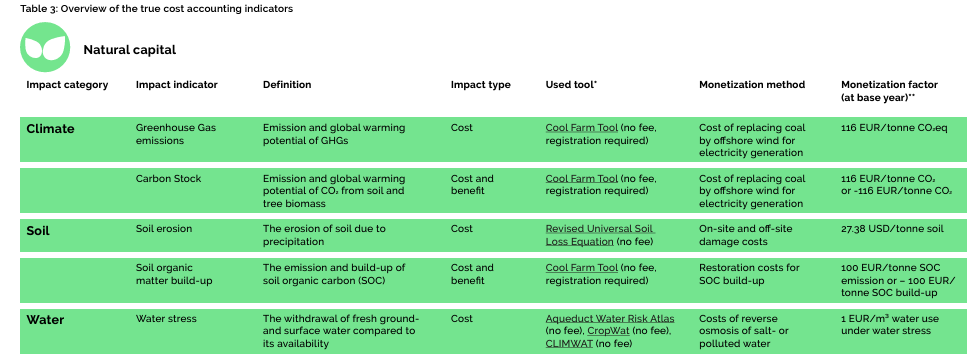
-Testing: The indicator and the collection of the respective data were tested in two iterative pilot phases and were adjusted according to the feedback and lessons learned. Table 3 provides a summary of the final indicators. Some of the tested indicators (e.g. health impacts from pesticide ingestion) were not included in the final list of indictors because of insufficient performance during the piloting (e.g. lack of accurate impact modelling, insufficient proof of causality).

  For instance, on page 25 you will find this. It contains examples of the millions of calculations to be made:

It is as near to a black box as anyone ever will find. So many arbitrary values, weights and opinions are baked into the process, that TCA makes the calculation of original GDP look precise.

(Our) friends might be companies that have adopted a circular economy approach, where everything is reused, and can showcase their environmental credentials via TCA.

I’ve not seen a company “where everything can be reused.” Does “everything” include shipping, heating, hiring, marketing, etc. — all the things a company does to exist?

Or they might be firms that want to assess their future risks and take pre-emptive action, perhaps on the assumption that consumers will increasingly punish companies engaged in environmentally destructive activities, or that their assets will become less valued as the world transitions away from unsustainability.

Wishful thinking that seldom becomes widespread. There may be some limited cases where consumers are willing to pay a higher price for the ecology, but generally, price, quality, and availability rule.

“I think most of them have realized that they will have to do it sooner or later,” says Müller.

When it comes to increasing costs with no profit results, businesses usually choose “later” rather than “sooner.”

It probably would lead to a finger-pointing contest, with everyone denying culpability.

For example, who is responsible for internal combustion engine air pollution — the farmer driving the tractor? The engine manufacturer. The oil processor? The gas station? The boat owner that brought the oil to the processor? The company making the gas pump?  The pipeline company? The steel mill that rolled the pipe. Etc., etc., etc.

And what is the cost of air pollution? How are the various pollutants evaluated and calculated?

But getting from where we are now to where we need to be will be difficult. “Right now, we have a lot of people on the starting line,” says Baker, “but the short-term incentives aren’t there and you really are penalized in the market right now if you’re an early adopter.”

There needs to be legislation, she says, to force companies to move towards TCA.

Yes, it’s a government job. but rather than forcing companies to increase their own costs, the government must reward companies for adopting ecologically sound management.

In any event the whole process seems like a “do this really difficult thing before we even begin to attempt that other difficult thing.”

Personally, I would immediately, not delay, work on that “other difficult thing” (where feasible, legislating against polluting activities, plus federal government paying for prevention and cures.)

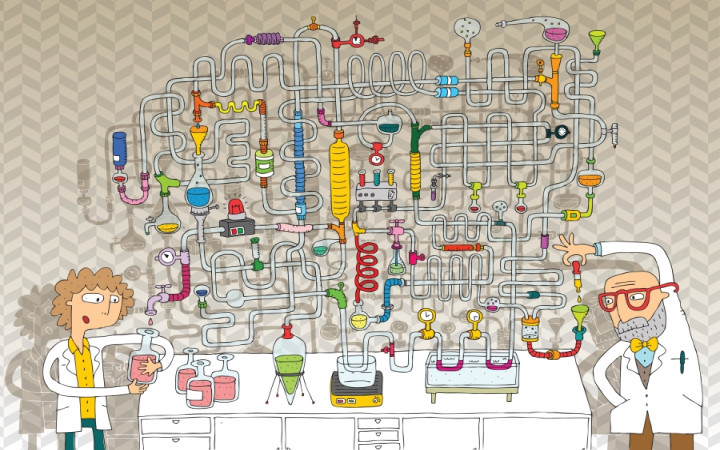
What Is a Rube Goldberg Machine? | Wonderopolis
Rube Goldberg and I want a cup of environmentally friendly coffee and cream, so first we must invent replacements for the coffee tree and the cow.

Expanded government financial support for adopting solar panels is one example of what would be needed.

There also needs to be institutional backing, and it is coming. At last year’s COP27 climate summit in Egypt, Máximo Torero, the chief economist at the FAO, threw his organization’s weight behind TCA.

“FAO is taking this extremely seriously,” he said. “It’s a huge challenge, and we are afraid, like many of you, but we are going to overcome our fear and we are going to do this.”

That could be a catalyst for real change, says Müller. “We will have it in the heart of policies, we will have a debate about the concept. Then the field is prepared for in-depth discussion.”

The drive to internalize externalities seems to be catching on more widely too. The way GDP is calculated changes every 15 years; the next iteration, in 2025, will reportedly include measures of sustainability and well-being.

As you saw with the The True Cost Accounting Agrifood Handbook, sustainability and especially, well-being, are quantified.

Quantified well-being? I question whether it can be done with any meaning.  Combining life expectancy with lifestyle, happiness, health and other well-being factors seems to be a fool’s errand. 

The transition to TCA will be a long, hard slog, however. “The construction of GDP took many, many centuries,” says Müller.

Overturning such entrenched economic orthodoxy is a tough ask. But if we recognize GDP for what it is, the transition will be easier, he says. “GDP is a social construction. It’s not a natural law like the speed of light, it’s an agreement in society.”

It’s not clear why every life experience must be combined into one number. GDP is difficult because of change, but it’s an understandable concept. Blending the emotional with the financial seems a step too far.

In Amsterdam, a pioneering supermarket displays two different prices for its goods. One is the market price, as you would see in regular supermarkets. The other is the “true price”, which factors in the environmental, health and social costs of the creation, consumption and disposal of the product.

Unsurprisingly, the true price is always higher than the market price. Customers can choose which price to pay: if they opt for the true price, the premium goes to environmental and social causes.

In the True Price Supermarket, which opened in 2020, bananas are sold at either the market price of €2.79 per kilo or the true price of €2.94 per kilo – a measly extra 15 cents per kilo to cover the social costs of low-wage farming and impacts on land, water and climate.

But some products have a much bigger mark-up: a hot chocolate rises from €2.79 to €3.70 because of the real price of cocoa and milk.

These premiums reflect the true cost of these products, as evaluated by a methodology called true cost accounting. Even though making the consumer pay the “true price” isn’t the actual goal of this accounting method, the movement is spreading.

True Cost Accounting is a bad idea. It attempts to quantify what cannot be quantified — numerical changes to what affects people emotionally and physically.

Work to accomplish TCA could delay what really needs to be done: Government support for ecologically sound farming, manufacturing, marketing, and research practices.

A Monetarily Sovereign government could set and fund any ground rules it chooses. The most important step requires answering one question: Given infinite money, what should be done to save the world for future generations.

The U.S., UK, and several other governments have infinite supplies of their own sovereign currencies. There remains only the need for these governments to do what needs to be done and/or to reward the private sector for doing them.

When money is no object, there is no need to wait for impossible precision. Spend the money to do the research, fund cleaning the air, water, earth, and do whatever is necessary to help the ecology.

That could begin tomorrow, without the busywork dithering required to reinvent GDP.

And that is the whole point of this post.


Rodger Malcolm Mitchell
Monetary Sovereignty

Twitter: @rodgermitchell Search #monetarysovereignty
Facebook: Rodger Malcolm Mitchell

……………………………………………………………………..

The Sole Purpose of Government Is to Improve and Protect the Lives of the People.

MONETARY SOVEREIGNTY