
Don’t let your Congressperson get away with cheating you out of your benefits.

There are two primary ways in which U.S. dollars are created. The rhyming pneumonic is: Bank lending and federal spending.
580+ Adding To Pile Stock Illustrations, Royalty-Free Vector Graphics & Clip Art - iStock | Top up
Bank lending adds new dollars to the money supply.
1. Contrary to popular myth, when a bank lends, it does not lend depositors’ funds. It creates new dollars by increasing the borrower’s bank account balance. For example, when you take out a mortgage, your bank simply increases the balance in your checking account. That adds dollars to the M2 money supply measure. Your bank can’t do this endlessly. It is limited in its ability to create dollars by its reserves and its capital. The reserve limitation is termed “fractional reserve lending,” which means your bank must keep a fraction of its lending (often 10%) in reserve to handle a bank run. However, this is not a real limit because banks can borrow reserves from the Federal Reserve.  The real limit to bank lending is its capital. This is discussed in more detail here. Rather than the common “fractional reserve lending” term, the more correct limit should be called “fractional capital lending.” 2. Contrary to popular myth, the federal government does not spend tax dollars. Instead, it creates new dollars by spending.
920+ Shredding Money Stock Photos, Pictures & Royalty-Free Images - iStock | Lose money, Wasting money, Flushing money
You pay taxes with M2 money supply dollars. When they are received by the Treasury, he ceases to be part of any money supply measure.
Even if the federal government didn’t collect a penny in taxes, it could spend infinite amounts forever. Most people are amazed to learn that the federal government (unlike state/local governments) destroys all tax dollars upon receipt. When you pay taxes, you take dollars that are part of the M2 money supply measure and send them to the Treasury, where they instantly become part of no money supply measure. In effect, they cease to exist. (Treasury dollar holdings are not part of any money supply measure because the Treasury has the infinite ability to create dollars. Its supply is endless.) The sole purposes of federal taxes are not to provide spending money to the federal government but to:

A. Control the economy by taxing what the government wishes to discourage and giving tax breaks to what the government wishes to reward

B. Assure demand for the U.S. dollar by requiring taxes to be paid in dollars.

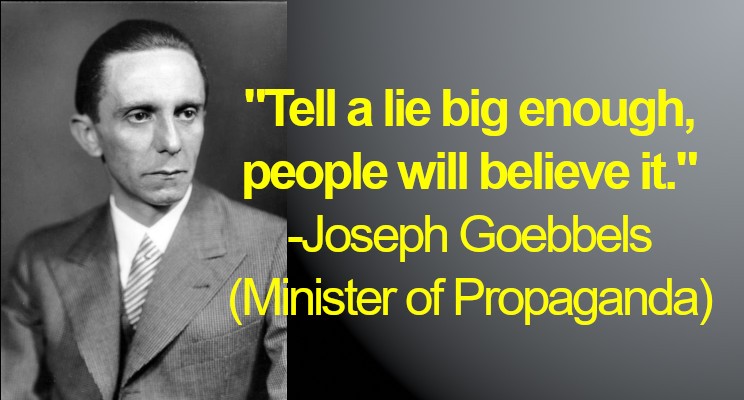
Unlike state and local government taxes, which do fund state and local government spending, federal taxes do not fund federal spending. The difference is that state and local governments are monetarily non-sovereign, while the federal government is Monetarily Sovereign. As the original creator of the U.S. dollar, the federal government rules over all aspects of the dollar, its supply, and its value. To pay a creditor, the federal government sends instructions (not dollars) to the creditor’s bank, telling the bank to increase the balance in the creditor’s checking account. When the bank does as instructed, new dollars are created and added to the M2 money supply measure. The bank can do this because it clears that money creation through the Federal Reserve, a federal government agency. In short the federal government approves its own instructions for the bank to create dollars. All of the above substantiates one simple point: The U.S. federal government has infinite dollars available to spend. If it wished, it could pay a creditor a trillion dollars or a hundred trillion dollars today at the touch of a computer key. Unlike state and local governments, the federal government is not burdened by debt and cannot be insolvent. All those worries you read, about the size of the federal debt, are misguided. It’s like worrying about whether the sun has enough light to cure the night’s darkness. Keep that in mind as you read an example of the Big Lie in economics:The Big Lie - Six Sigma
Lawmakers Might Increase Social Security’s Full Retirement Age to Avoid Benefit Cuts. Here’s How That Could Hurt Today’s Workers Big Time

Story by Maurie Backman, The Motley Fool

Social Security is not in the best financial shape. The program gets the bulk of its funding from payroll taxes.

But in the coming years, that revenue stream is expected to shrink as baby boomers exit the workforce in droves.

Wrong. Payroll tax dollars, which come from the M2 money supply measure, cease to be part of any money supply measure when they reach the U.S. Treasury. Thus, payroll tax dollars are destroyed upon receipt. The federal government always creates new dollars to pay its financial obligations. Social Security is an agency of the Monetarily Sovereign U.S. federal government, which has the infinite ability to create its sovereign currency, the U.S. dollar. It never can run short of dollars. Therefore, no federal government agency can run short of dollars unless Congress and the president want that.

Alan Greenspan: “A government cannot become insolvent with respect to obligations in its own currency. There is nothing to prevent the federal government from creating as much money as it wants and paying it to somebody. The United States can pay any debt it has because we can always print the money to do that.”

Ben Bernanke: “The U.S. government has a technology, called a printing press (or, today, its electronic equivalent), that allows it to produce as many U.S. dollars as it wishes at essentially no cost.”

There is nothing to prevent the U.S. government from creating and adding as many dollars as are needed to keep Social Security Solvent without collecting a penny in taxes:

Quote from former Fed Chairman Ben Bernanke when he was on 60 Minutes: Scott Pelley: Is that tax money that the Fed is spending? Ben Bernanke: It’s not tax money… We simply use the computer to mark up the size of the account.

Social Security can tap its trust funds to keep up with scheduled benefits for a period of time. But once those trust funds run dry, benefit cuts may have to happen. And recent projections call for a trust fund depletion date of 2034, which isn’t so far away.

The so-called “trust funds” are fake. They simply are line items on balance sheets that can be increased or reduced by the federal government whenever it wishes to.

Peter G. Peterson Foundation:

Federal trust funds bear little resemblance to their private-sector counterparts; therefore, the name can be misleading.

A “trust fund” implies a secure source of funding. However, a federal trust fund is simply an accounting mechanism used to track inflows and outflows for specific programs.

In private-sector trust funds, receipts are deposited, and assets are held and invested by trustees on behalf of the stated beneficiaries. In federal trust funds, the federal government does not set aside the receipts or invest them in private assets.

Rather, the receipts are recorded as accounting credits in the trust funds and then combined with other receipts that the Treasury collects and spends.

Further, the federal government owns the accounts and can, by changing the law, unilaterally alter the purposes of the accounts and raise or lower collections and expenditures.

Of course, it’s in lawmakers’ best interest to try to avoid benefit cuts and the senior poverty crisis they have the potential to cause. To that end, several solutions have been proposed to prevent that unwanted scenario.

Balance Scale Graphic Images – Browse 248,135 Stock Photos, Vectors, and Video | Adobe Stock
“Rich” is a comparative term. If you have $1,000, you are rich if everyone else has $10, but you are poor if everyone else has $10,000. Taking benefits from the poor makes the rich richer.
If it were in the “lawmakers’ best interest,” there would be no funding crises. Congress would simply vote to add dollars to Social Security. That is how Congress, the President, and all other federal agencies are funded. Congress votes and dollars are created from thin air. However, lawmakers have a different “best interest” from the masses. The very rich bribe lawmakers to widen the Gap between the rich and the rest. Since “rich” is a comparative term, widening the Gap makes the rich richer. Yes, that’s right. Making you poorer actually makes the rich richer. The “best interest” of the lawmakers is to receive dollars from wealthy supporters.

One idea that’s been gaining traction is increasing Social Security’s full retirement age (FRA), which is the age at which seniors can claim their monthly benefits in full without a reduction.

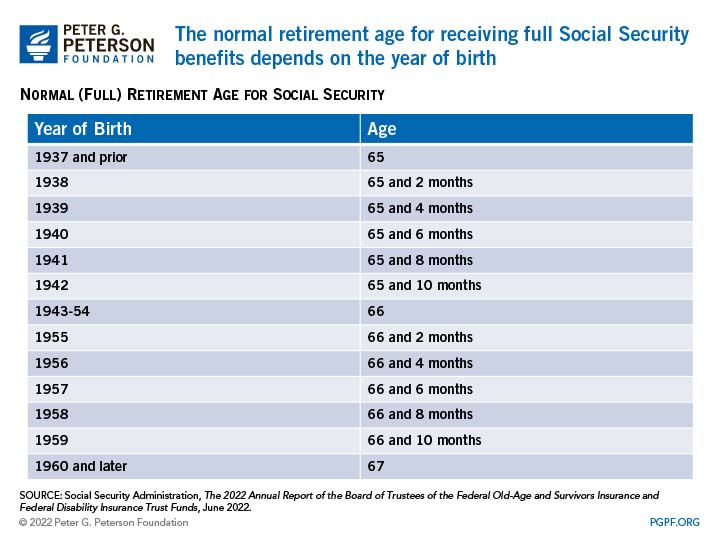
For workers born in 1960 or later, FRA is 67. However, some lawmakers suggest increasing FRA to 68 to 69 so that Social Security has more time before fully paying those benefits.

This is unnecessary and only makes the people poorer—more years without Social Security support. (Watch for attempts to do the same thing to Medicare—more years without healthcare insurance.)

It’s an idea that could potentially prevent benefit cuts.

But that is precisely what it is — a benefit cut. It’s more years without a benefit.

But it’s also an idea that might hurt workers in a very notable way. Here are some consequences that might ensue if the FRA for Social Security is raised by a year or two.

1. You may have to work longer

It’s possible to claim Social Security before reaching FRA. You can take benefits once you turn 62. But for each month you claim them ahead of FRA, they get reduced permanently.

Due to a lack of retirement savings, you may be unable to afford a cut to your Social Security income.

But if FRA is raised, you’ll have to wait longer to get your full monthly benefit without a reduction. That means you may have to work longer, which you may not want to do—especially if your job is stressful or harmful to your health.

In other words, it’s an unnecessary benefit cut.

2. You may have less opportunity to earn delayed retirement credits

Right now, seniors who postpone their Social Security claims past FRA get to accrue delayed retirement credits.

Those credits boost benefits by 8% a year so that someone with an FRA of 67 who files at 70 gets to snag a permanent 24% increase to their monthly Social Security check.

Currently, delayed retirement credits stop accruing at age 70. However, unless the rules change, if FRA is increased, today’s workers will be left with less opportunity to grow their Social Security benefits.

Another unnecessary benefit cut.

3. You may be subject to an earnings-test limit for longer

You’re allowed to work and collect Social Security at the same time. And once FRA arrives, you can earn any money without risking having benefits withheld.

However, the current rules dictate that Social Security recipients who work and have not reached FRA are subject to an earnings-test limit.

Earnings beyond that limit result in withheld Social Security income. If FRA is raised to help prevent Social Security cuts, workers could be subject to an earnings-test limit for longer.

This unnecessary benefit cut will hurt those who are not rich. Notice there is no call for ending tax breaks given to the rich. The federal government seems to have plenty of money for those tax gifts to the rich but, strangely, not enough to support Social Security and Medicare.

All told, increasing FRA for Social Security has some serious drawbacks. Lawmakers must weigh the pros and cons to determine whether pushing FRA to 68 or 69 is a good idea.

Rather than engaging in theatrical “struggles” to make less money to cover more people, the federal government could and should:
  1. Eliminate FICA. Those dollars do not increase the government’s ability to fund Social Security (and ability that is infinite)
  2. Provide Social Security benefits to every man, woman, and child in America, regardless of age, income, or wealth.
The rich bribe the lawmakers to make you believe federal taxes fund federal spending and give you benefits; taxes must be increased. This is the Big Lie in economics. The federal government has the financial power to provide:
  1. Social Security payments to you and every man, woman, and child in America.
  2. Comprehensive, no-deductible Medicare for you and every man, woman, and child in America
  3. Free college education for you and every American who wanted one.
  4. An end to poverty and hunger in America.
  5. An end to homelessness in America
  6. New roads and bridges wherever needed
  7. Financial support for every scientific research and development project imaginable.
In short, money is no object for the federal government. We need to understand that fact and then have the imagination and desire to use the money to build a better world. It you believe it sounds too good to be true, it’s because the rich have been successful in indoctrinating you with the Big Lie. Rodger Malcolm Mitchell Monetary Sovereignty Twitter: @rodgermitchell Search #monetarysovereignty Facebook: Rodger Malcolm Mitchell

……………………………………………………………………..

The Sole Purpose of Government Is to Improve and Protect the Lives of the People.

MONETARY SOVEREIGNTY
Is the cost of the White House unsustainable?

The federal government has more than a thousand departments and agencies, including The White House, the House of Representatives, the Senate, the Supreme Court, the Central Intelligence Agency (CIA), Medicare (CMS), and the Social Security Administration (SSA). Contrary to popular myth, all federal agencies and departments are funded in precisely the same way: Congress votes, and dollars are created from thin air. A few agencies are associated with so-called “trust funds.” According to the Peter G. Peterson Foundation:

A federal trust fund is an accounting mechanism the federal government uses to track earmarked receipts (money designated for a specific purpose or program) and corresponding expenditures.

The largest and best-known trust funds finance Social Security, portions of Medicarehighways and mass transit, and pensions for government employees.

Federal trust funds bear little resemblance to private-sector counterparts; therefore, the name can be misleading.

A “trust fund” implies a secure source of funding. However, a federal trust fund is simply an accounting mechanism that tracks inflows and outflows for specific programs.

In private-sector trust funds, receipts are deposited, and assets are held and invested by trustees on behalf of the stated beneficiaries.

In federal trust funds, the federal government does not set aside the receipts or invest them in private assets.

Instead, the receipts are recorded as accounting credits in the trust funds and combined with other receipts that the Treasury collects and spends.

Further, the federal government owns the accounts and can, by changing the law, unilaterally alter their purposes and raise or lower collections and expenditures.

Read that last sentence carefully, for it is the heart of this discussion. It consists of three truths:
  1. The federal government owns the accounts
  2. The government can change the law and unilaterally change the purposes of the accounts.
  3. The government unilaterally can raise or lower collections and expenditures.
This all adds up to a powerful but little-understood fact. The so-called federal “trust funds” operate entirely at the whim of Congress and the President. These “trust funds were created and operated according to the laws the Congress and the President control. By adjusting laws, Congress and the President can determine how much money each “trust fund” collects, has, and spends. Congress and the President arbitrarily can decide that any trust fund has $1, or $1 trillion, or $1,000 trillion, merely by passing laws. There is no limit to what laws Congress and the President pass, nor what those laws say regarding money in the “trust funds.” Keep this total control in mind as you read excerpts from this article, also by the Peter G. Peterson Foundation:

SOCIAL SECURITY REFORM: SHOULD WE RAISE THE RETIREMENT AGE? In their 2022 Annual Report, the Social Security trustees estimate that the program’s primary trust fund — Old Age and Survivors Insurance (OASI) — will spend more on payments to beneficiaries than it collects yearly until it is depleted in 2034.

At that time, an estimated 70 million beneficiaries would see a substantial reduction in their benefits. OASI would only be able to distribute as much in benefits as it collects in annual revenues.

Driving that impending depletion are the dual demographic trends of retiring baby boomers and lengthening life expectancies, which together have placed considerable strain on Social Security’s finances.

Many options exist to shore up OASI’s solvency, including increasing revenues dedicated to the program, raising the full retirement age, and decreasing the program’s benefits.

A balanced approach that combined components from each option would likely provide the fairest, most lasting, and least painful adjustment for the future.

Translation: The primary “trust fund” will spend more than it collects –according to current law, which Congress and the President can change at will, but the only law changes being considered are:
  • Higher taxes
  • Raising the retirement age, and
  • Reduced dollar benefits
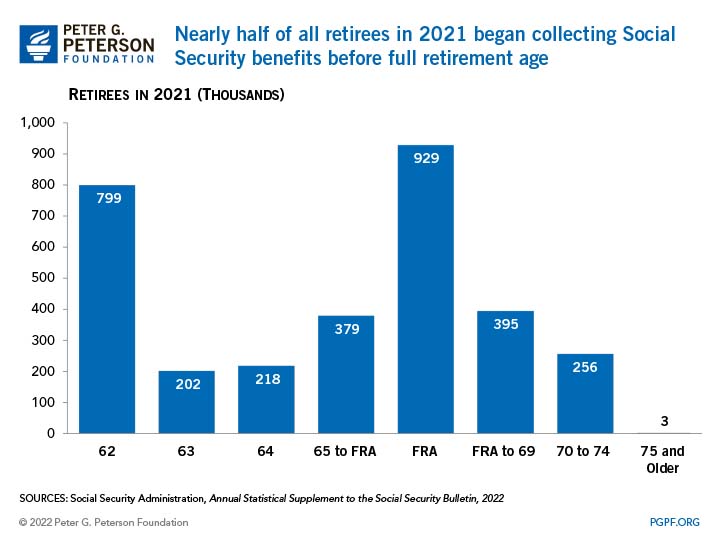
But here is another, even better approach: Congress and the President should simply vote to give Social Security more money, precisely as they do for the other thousand federal departments and agencies. There is no need to increase taxes. In fact, FICA should be eliminated. It is unnecessary and a double tax in that it is not deductible, but part of Social Security is taxed. It also punishes lower-income people. There also is no need to raise the retirement age. Social Security payments can and should be given to every man, woman, and child in America, Finally, there is no need to reduce dollar benefits. We should even end the faux “trust funds” and simply pay for Social Security the same way the federal government pays for nearly all of its other agencies: By recreating dollars from thin air.The normal retirement age for receiving full Social Security benefits depends on the year of birth The U.S. federal government is Monetarily Sovereign. It cannot run short of its own sovereign currency. To pay for your Social Security benefits, the federal government sends instructions (in the form of a wire or check) to your bank or you, instructing your bank to increase the dollar balance in your checking account. When your bank does as instructed, the balance in your account increases, creating new dollars and adding them to the M2 money supply measure, growing the economy. Sending instructions to banks is the primary way the federal government creates dollars. The federal government, being Monetarily Sovereign, has the infinite ability to send and clear instructions, thus, the endless ability to create dollars. (By contrast, everyone who writes a check or sends a wire can send instructions but not clear them. Checks that don’t clear are said to “bounce.”) Your bank then clears the transaction through the Federal Reserve, another federal agency. Thus, the federal government clears its own money-creation transactions, giving it the infinite power to create dollars.Nearly half of all retirees in 2021 began collecting Social Security benefits before full retirement age The government also has the infinite power to change Social Security laws, as demonstrated by the 12 benefit changes shown in this chart. More than half of all Social Security recipients take benefits before the official retirement age when benefits are reduced. This demonstrates an early need for benefits by those in lower-income groups.

WHAT EFFECT COULD RAISING THE FULL RETIREMENT AGE HAVE ON SOCIAL SECURITY’S LONG-TERM SOLVENCY? Given that more retirees are beginning to collect Social Security benefits earlier in their retirement and that overall life expectancy continues to increase, many policymakers have called for a modification to the program, wherein the full retirement age is gradually raised and ultimately pegged to average life expectancy.

According to an analysis from the Committee for a Responsible Federal Budget (CRFB), gradually increasing the full retirement age by two months per year until it reaches 69 and then indexing it for changes in overall life expectancy would save $90 billion over 10 years, but much more in future decades; CRFB estimates that the change would close over half of the structural mismatch between Social Security’s revenues and spending in the long run.

The above two paragraphs indicate ignorance of the difference between Monetary Sovereignty and monetary non-sovereignty. If Social Security were private insurance (i.e., monetarily non-sovereign), pegging benefits to life expectancy would be appropriate, even necessary. However, there are zero reasons for the federal government to do this. There is no fiscal reason why the federal government should try to extract $90 billion from the private sector. If one wishes to grow the U.S. economy, it is the worst possible course of action. This is what happens when the federal government closes the mismatch between revenues and spending“(i.e., runs a surplus). Federal surpluses extract dollars from the economy, causing depression or recessions:

U.S. depressions tend to come on the heels of federal surpluses.

1804-1812: U. S. Federal Debt reduced 48%. Depression began 1807. 1817-1821: U. S. Federal Debt reduced 29%. Depression began 1819. 1823-1836: U. S. Federal Debt reduced 99%. Depression began 1837. 1852-1857: U. S. Federal Debt reduced 59%. Depression began 1857. 1867-1873: U. S. Federal Debt reduced 27%. Depression began 1873. 1880-1893: U. S. Federal Debt reduced 57%. Depression began 1893. 1920-1930: U. S. Federal Debt reduced 36%. Depression began 1929. 1997-2001: U. S. Federal Debt reduced 15%. Recession began 2001.

Even without surpluses, just reducing federal deficits leads to recessions:
Reduced federal deficits (red line) lead to recessions (vertical gray bars). Recessions are cured by increased federal deficits.
Economic growth requires the federal government to spend more dollars into the economy than it extracts via taxes and fees (i.e., run deficits). Without federal deficits, we have depressions and recessions.
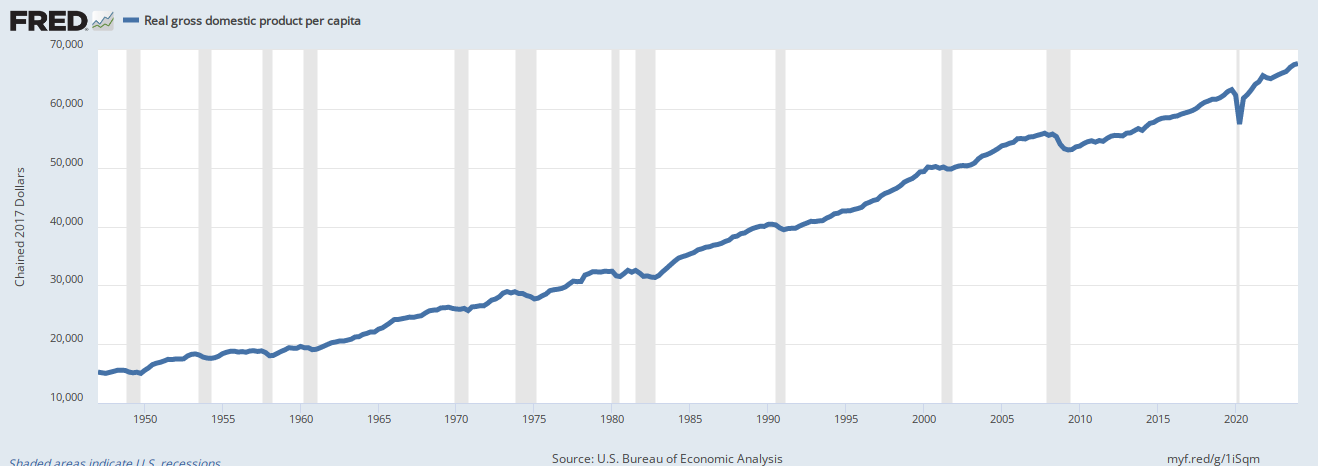
As federal deficits (spending and taxes) increase, the Gross Domestic Product increases—and that includes real (inflation-adjusted) Gross Domestic Product.
Those who argue against federal deficit spending may admit it grows the economy but sometimes claim it causes inflation. However, as the above graph indicates, the economy grows, even when adjusted for inflation. All evidence indicates that inflation is caused not by federal spending but by scarcities of critical goods and services.  Inflation usually is cured by federal spending to obtain and distribute the scarcities that caused the inflation. Federal taxes reduce non-federal spending (mostly private sector spending). Thus, no matter how one calculates it, increasing FICA and/or decreasing Social Security benefits will reduce economic growth. And it’s all unnecessary; the federal government has infinite money. It cannot become insolvent. Not understanding the differences between a Monetarily Sovereign government and the monetarily non-sovereign state/local governments, businesses and individuals is the single most significant cause of economic misery and self-defeating government spending decisions. In summary, if the White House, Congress, the Supreme Court, and hundreds of other federal agencies and departments are financially sustainable, so is Social Security and Medicare. There is no need for benefit cuts. There is no need for FICA tax increases. There is no need for FICA at all. The federal government can provide all its agencies and departments with every dollar they need at the touch of a computer key. Why Don’t They? Question: If the government can fund all its agencies and departments without taxes, why doesn’t it just do it? Answer: The very rich, who run the government, want you to believe the government can’t afford to give you benefits. “Rich” is a comparative term. A person having $1,000 would be rich if everyone else had only $100. But that person would be poor if everyone else had $10,000. You can grow richer if the income/wealth/power Gap below you widens and the Gap above you narrows. So, one major goal of the rich is to narrow the Gap below them, which requires limiting the benefits you receive from the government. To keep you from screaming about that, the rich bribe your sources of information — the media, the politicians, and the university economists — to convince you of the Big Lie that federal spending is funded by federal taxes. It’s a Big Lie because the federal government, being Monetarily Sovereign, creates all the money it uses. The only true purposes of federal taxes are to:
  1. Control the economy by taxing what the government wishes to discourage and by giving tax breaks to what the government wishes to reward and
  2. Assure demand for the U.S. dollar by requiring taxes to be paid in dollars.
That’s it. Federal taxes don’t fund anything. In fact, your precious tax dollars are destroyed the moment they are received by the U.S. Treasury. You pay with dollars that are part of the M2 money-supply measure. When your dollars reach the Treasury, they cease to be part of any money-supply measure and are effectively destroyed. Because the government has the infinite ability to create dollars, there is no point in trying to measure the government’s supply of dollars. Suppose you are made to believe the federal government is like monetarily non-sovereign state governments, relying on taxes. In that case, you won’t complain when your Social Security, Medicare, poverty aids, college tuition aids, etc. are cut for lack of money. The less you receive from the government, the richer are the rich. The rich still receive their federal benefits in the form of tax breaks. There never is a complaint about benefits for the rich being “unsustainable,” “unaffordable,” etc. Those terms are reserved for your benefits.  When you read articles telling you the Social Security age requirement must be raised, benefits must be decreased, or the FICA tax must increase, know this: It’s all part of the Big Lie fostered by the rich to make themselves richer. Rodger Malcolm Mitchell Monetary Sovereignty Twitter: @rodgermitchell Search #monetarysovereignty Facebook: Rodger Malcolm Mitchell

……………………………………………………………………..

The Sole Purpose of Government Is to Improve and Protect the Lives of the People.

MONETARY SOVEREIGNTY

Why state-funded Social Security or guaranteed income is a colossal mistake. It should be federal.

I long have favored a federal plan in which every man, woman, and child in America would receive a monthly stipend from the federal government. (Some call it UBI—Universal Basic Income. Others call it GI—Guaranteed Income, or Social Security for All.) A federally funded Social Security for All program was described in a post published seven years ago. Today, that post was brought to mind by the following article:

a $1,000 monthly ‘guaranteed income statewideThe proposal would have taxpayers fund statewide, $1,000 monthly ‘guaranteed income.’ A measure creating a task force to look into monthly guaranteed taxpayer-funded “unrestricted cash” subsidies to specific individuals in Illinois is being discussed in the state legislature.

An Illinois Senate appropriations committee would review “the landscape of cash supports available to low-income residents” and identify “populations without significant access to cash supports.”

The bill, as filed, says after the board is dissolved at the end of 2027, DHS would administer the program with monthly cash payments of $1,000 to Illinois residents, regardless of immigration status, who provide care for a child or specified dependent, recently gave birth or adopted a child or is enrolled in an educational or vocational program.

Dollar bills coming out of a horn of plenty.
By law, the Monetarily Sovereign U.S. government is an infinite horn of plenty, capable of creating an unending stream of dollars at the touch of a computer key without collecting a penny in taxes.

Mike Buehler, an opponent of the measure, said it’s irresponsible to discuss such a program without knowing how much it will cost taxpayers.

You may be surprised that I oppose this and other similar plans. Here is why:

1. Local governments are monetarily non-sovereign (unlike the federal government, which being Monetarily Sovereign, has the infinite ability to create dollars).

With few exceptions, local governments get their spending money from taxpayers.

The federal government gets its spending money by creating it ad hoc. The federal government does not spend tax dollars.

That is why it can run trillion-dollar deficits with no funding problem at all.

State, county, or city taxpayers pay for local government-funded UBI programs.

Most local tax dollars come from sales taxes and/or local income taxes, most of which are paid by middle—and lower-income residents. Extracting dollars from middle—and lower-income taxpayers is exactly the opposite of the UBI plan’s basic purpose.

2. While the federal government has unlimited access to dollars, local governments have limited abilities to pay for things. So, the benefits must be limited to local governments’ affordability estimates.

This, in turn, requires limiting benefits to specific groups and denying benefits to other groups, which creates two problems:

A. The government must set up a complex and expensive apparatus for monitoring recipients so that people do not cheat.

B. People just outside the limit of qualifications are unjustly deprived of aid, and/or try to find unanticipated ways to qualify.

“I understand that you would have to be a person with a child, or caring for someone in your home or school to be eligible for the benefits.

A local government would have to hire dozens (or thousands?) of people to monitor these qualifications. (Do you have a child? How old? Are you really “caring for” that boarder? Are you still in school, and exactly what is a “school.” How many days or hours do you attend? Additionally, there would be extensive and expensive paperwork filed, read, and authenticated.

That could be millions of people and the cost could be in the tens of billions of dollars,” Buehler told The Center Square. “And where’s the state going to come up with these funds and the only place to come up with that is to get it from the taxpayers.

Guaranteed income programs in Chicago and the Metro East St. Louis areas are ongoing, costing taxpayers millions. In 2022, the city of Chicago was in line to spend $31.5 million for $500 a month to go to 5,000 low-income residents.

That same year, Illinois legislators approved a pilot program using state taxpayer funds worth $3.6 million for the Metro East St. Louis area.

Inevitably, a state-run, money-restricted program would evolve to a “nanny-state,” where the money only could be used for approved purposes. And that would have to be monitored.

Ameya Pawar with the Economic Security Project said there are 150 different programs across the country. He gave examples of people using the money to buy sports goods for their children or even to take a vacation.

There is widespread belief that the poor who receive money from taxpayers, should be told what to do with the money (the poor supposedly being too ignorant to know what is best for them). Buying sports goods and taking vacations is not “good” for the poor. The nanny preference is only to feed starving children, not just make them happy with toys and entertainment. Note the hinted outrage Ameya Pewar expresses for recipients buying baseballs to entertain their kids.

“And all of this money that goes into the pockets to stabilize households flows through local businesses,” Pawar told the committee. “So you see some of this money back in sales taxes, and other taxes.”

No buying from Amazon allowed??

Buehler said there could be unintended consequences, like reducing work productivity and more.

“For regardless of immigration status, I think an unintended consequence could be a flood of migrants coming to Illinois looking for benefits and not having to work for it,” he said.

3. If one state, county, city, or village offers better benefits than another, people will tend to go where the money is and the taxpayers will pay. This is true for citizens as well as migrants.

And note the common but false belief  that the poor are so lazy and unmotivated, if you give them money, they won’t get jobs.

Pawar said the proposed statewide guaranteed program of “unrestricted cash” should be in addition to other taxpayer-funded safety net programs.

Programs like Supplemental Nutrition Assistance Program funds go to buy food. The Low Income Housing Energy Assistance Program is for heating bills. The Temporary Assistance for Needy Families program provides monthly cash assistance to low-income families with children.

“And to get this income, they may not necessarily spend that in their own best interest or the interest of the citizens at large,” he said.

Again, the taxpayer requirement exacerbated the nanny-state belief that the poor are too stupid to spend in their own best interests. “Why am I, as a taxpayer helping these people to take vacations, if I can’t afford one myself.” All the above-mentioned problems would be addressed by a federally-funded, Social Security program covering every man, woman, and child in America, regardless of income or wealth. The rich, poor, citizens, non-citizens, young, old, married, single, renter, homeowner, in or out of school, etc., all would receive the stated benefits — and unlike with state and local government programs, no one would pay a penny. Federal Social Security payments made to every man, woman, and child, require much less monitoring. Most importantly, affordability would cease to be an issue. The federal government can afford anything, and without collecting taxes. All of the money spent by the federal government would be added to the local economy, increasing everyone’s income.
8 Million Have Slipped Into Poverty Since May as Federal Aid Has Dried Up - The New York Times
8 Million Have Slipped Into Poverty Since May as Federal Aid Has Dried Up, October 15, 2020. (By Leigh Lynes: New studies show the effect of the emergency $2 trillion package known as the Cares Act and what happened when the money ran out.)
Here are excerpts from another article on the subject.

33 basic and guaranteed income programs where cities and states give direct payments to residents, no strings attached The concept of a “universal basic income” has inspired widespread interest in recent years.

Actually, there are “strings,” in the form of qualifications.

More than interest — when former US presidential candidate Andrew Yang announced that a UBI program of $1,000 direct payments to citizens every month would be the keystone policy of his platform, he drew an unexpected amount of grassroots support in a crowded primary year.

Guaranteed income programs have been gaining even more traction during the pandemic, which took a particular toll on low-wage workers and threw many Americans into poverty.

At least 11 direct-cash experiments went into effect this year, Bloomberg estimated in January.

Former Stockton, California mayor Michael Tubbs, took the idea to the next level by launching the Mayors for a Guaranteed Income network. As of this year, there are 60 mayors in the program, advocating — and launching pilot programs for — guaranteed income for their residents.

California recently launched the first statewide guaranteed income program in the US, providing up to $1000 per month to qualifying pregnant people and young adults leaving the foster care system.

“Young adults leaving foster care” and “pregnant people” comprise two, very narrow classes, and $1000 a month is a meager amount. The task of verifying qualifications would be costly. (Imagine trying to verify pregnancy for thousands of people, and who monitors when pregnancies end before birth?)

The basic income program that Tubbs launched in Stockton in 2019, the Stockton Economic Empowerment Demonstration, has been considered the model for other cities that have followed in its footsteps, offering low-income residents hundreds of dollars a month and measuring their job prospects, financial stability, and overall well-being afterward.

It seems like a massive and expensive project for just hundreds of dollars’ worth of benefits.

According to SEED, participants improved in all those metrics.

“Guaranteed income makes a case for investing in our undocumented neighbors and formerly incarcerated residents. In doing so, it addresses the reality of the nation’s fragmented, punitive welfare structure.”

Will taxpayers consider this a reward for being undocumented or incarcerated? (Want to make an easy few hundred dollars a month? Go to jail for some minor charge.)

This kind of program isn’t a new idea, however. The Eastern Band of Cherokee Indians Casino Dividend in North Carolina has been giving tribal members annual funds since 1997, for instance. Alaska has been paying residents out of its oil dividends since 1982.

The Eastern Band of Cherokee Indians Casino Dividend in North Carolina gets its money from casino revenue. Alaska gets its dividend money from oil. Neither collects taxes to pay recipients. That is a major consideration. Here are a few of the 33 examples mentioned in the above article.

Compton, California. Duration: December 2020 to December 2022. Income amount: $1,800 every three months for 2 years. Number of participants: 800

Tacoma, Washington,Duration: December 2021 to December 2o22, Income amount: $500 every month for 1 year, Number of participants: 110

Stockton, California, Duration: February 2019 to February 2021, Income amount: $500 every month for 2 years, Number of participants: 1ount: Based on the annual dividend from state-owned oil companies, ranged from roughly $2,000 per person in 2015 to $800 in years with lower gas prices.

 Oakland Resilient Families, Duration: Summer 2020 to present, Income amount: $500 per month for 18 months, Number of participants: 600

Alaska Permanent Fund , Duration: Annual, Income amount: Based on the annual dividend from state-owned oil companies, ranged from roughly $2,000 per person in 2015 to $800 in years with lower gas prices , Number of participants: Alaska residents

North Carolina, Cherokee Tribe, The Eastern Band of Cherokee Indians Casino Dividend pays every tribe member annually, Duration: Annual, Income amount: $4,000 – $6,000 per year, Number of participants: Every tribal member.

The Alaska and Cherokee programs succeed long term because they are not funded by taxpayers. A federally funded program would succeed for the same reason. Federal spending is not taxpayer funded. When state and local taxpayers fund a spending program, the result is that a large group of middle- and low-income people transfers some of their money to a smaller group of middle- and low-income people. The large group includes all those who pay sales and income taxes. The small group is all those who receive those tax dollars. It’s just dollars rotating within the municipality, enriching some residents at the expense of others. The municipality’s economy receives nothing. By contrast, when the federal government funds a guaranteed income program the government creates new dollars and sends them to the nation’s recipients. The result is that there is no expense to anyone, but the nation’s economy is enriched with net dollars. (GDP = Federal Spending + Nonfederal Spending + Net Exports). Guaranteed income programs help narrow the income/wealth/power Gap between the rich and the poorer. While reducing poverty, in of itself, is a worthwhile goal, narrowing the Gap also helps address related, social problems:

Wide Gaps affect not only poverty itself, but health and longevity, education, housing, law and crime, war, ownership, bigotry, taxation, GDP, scientific advancement, the environment, human motivation and well-being, and virtually every other issue related to economics. 

The most successful guaranteed income programs share several features:
  1. Funded by a Monetarily Sovereign government or by state owned and controlled businesses. This takes taxpayer costs out of the equation.
  2. Minimal requirements for participants achieve voter support by making the plan fairer.
  3. Significant benefits. Trivial payments, i.e. $100 a month, etc. will not generate positive voter sentiment.
  4. Easy entry and supervision. Difficult entry results in negative feelings by voters. Easy supervision lowers costs.
  5. Easily understood goal.
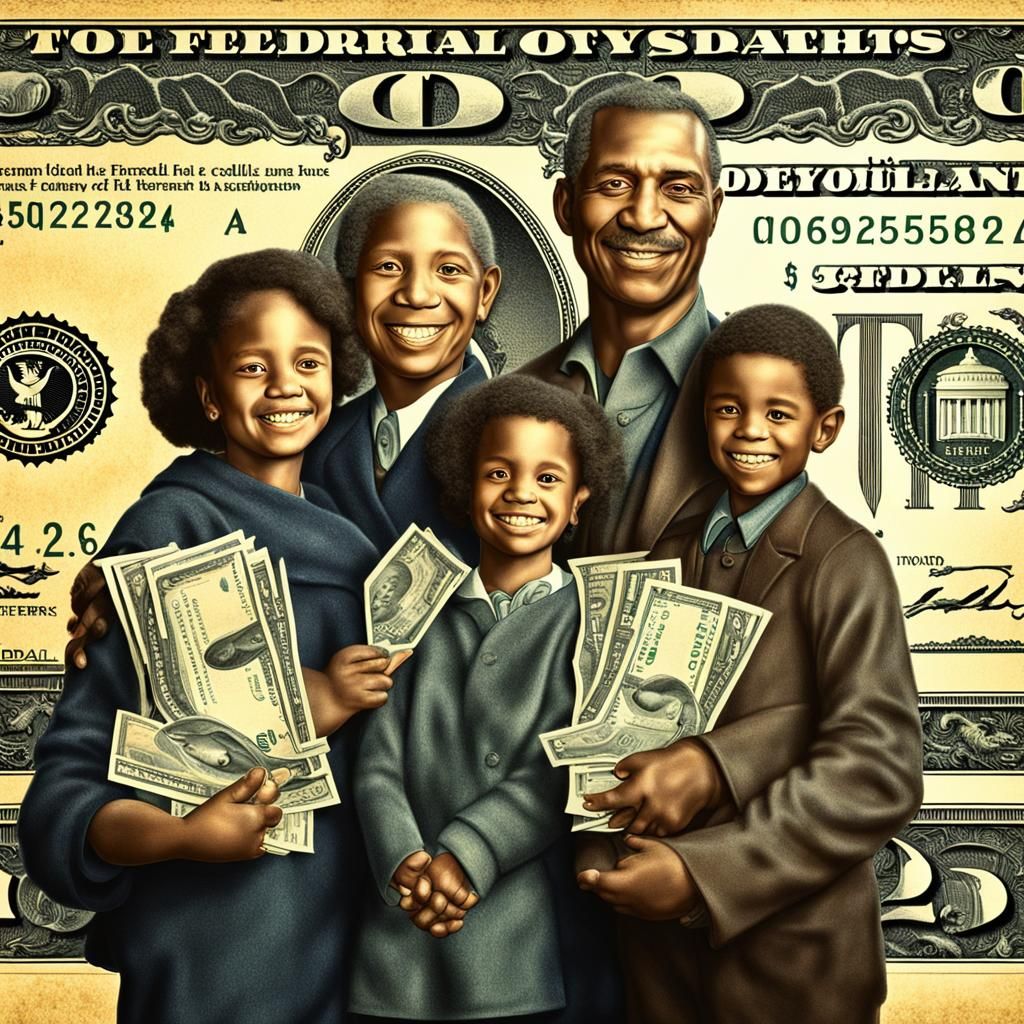
A family -- father, mother, two children -- happily receiving dollars from the federal government
Many good reasons for, and no good reasons why not.
A national Social Security for All plan, with a minimum benefit if $5,000 per year for each adult (18 and over) and $2,500 a year for a child would begin to address the abovementioned social problems. The Cost: The U.S. has about 260 million adults (18+) and about 70 million children. At the $5,000/2,500 level, the benefit cost of the Social Security for All would be $1.3 trillion for adults and $175 billion for children, totaling somewhat south of only $1.5 trillion. Why do I say “only”? By comparison:
    1. In 2023, the federal government spent about $6.2 trillion.
    2. The Gross Domestic Product (GDP) for the year 2023 had a current-dollar value of $27.36 trillion.
    3. In 2023, the U.S. federal government collected a total of approximately $4.71 trillion in tax revenue.
    4. In fiscal year 2023, the federal government’s spending exceeded its revenues, resulting in a deficit of $1.70 trillion
    5. By the end of 2023, the cumulative federal deficit was $26.236 trillion.
    6. The U.S. M2 money supply is about $20 trillion.
Given that:

Alan Greenspan: “A government cannot become insolvent with respect to obligations in its own currency. There is nothing to prevent the federal government from creating as much money as it wants and paying it to somebody. The United States can pay any debt it has because we can always print the money to do that.”

and

Ben Bernanke: “The U.S. government has a technology, called a printing press (or, today, its electronic equivalent), that allows it to produce as many U.S. dollars as it wishes at essentially no cost.”

A Monetarily Sovereign government spending $1.7 trillion to send an additional $5,000 to every adult and $2,500 to every child — and at no cost to anyone — would seem to be a bargain price and a great investment for America. Further, because of the multiplier effect*, that additional $1.7 trillion in federal spending, would increase Gross Domestic Product far more than $1.7 trillion.

*Per Investopedia: A government increases spending or decreases taxes in part to inject more money into the system.

Such fiscal policy has a multiplier effect. That is, every dollar spent can be expected to cause an increase in the gross domestic product (GDP) by more than a dollar.

This is due to the sheer momentum created by the policy. Consumers spend more so businesses produce more goods.

Businesses have to hire more to produce more goods, so more people have more money to spend on goods.

The same phenomenon occurs for both government spending increases and tax cuts. Either tends to increase GDP disproportionately.

A cut in government spending can reduce GDP by a greater degree than the amount saved by the cut.

The expanded Child Tax Credit had a multiplier effect of 1.25 on GDP in the first quarter of 2021, according to an analysis by Moody’s Analytics. The increase in the Supplemental Nutrition Assistance Program boosted GDP by a 1.61 multiplier effect in the same period. Increased defense spending had a 1.24 multiplier effect.

Infinite benefits at no cost to anyone: Can any knowledgeable person object to Social Security for All? Rodger Malcolm Mitchell Monetary Sovereignty Twitter: @rodgermitchell Search #monetarysovereignty Facebook: Rodger Malcolm Mitchell

……………………………………………………………………..

The Sole Purpose of Government Is to Improve and Protect the Lives of the People.

MONETARY SOVEREIGNTY

When a belief is ingrained, no evidence is wanted

It is widely believed, especially among conservatives, that:
  1. Federal finances are like state/local government finances, business finances, and personal finances.
  2. It makes no difference whether a government is Monetarily Sovereign or monetarily non-sovereign.
  3. The “federal debt” is a debt of the federal government.
  4. The federal debt is owed by, and will be paid by, taxpayers.
  5. The federal debt and deficits are too large and are “unsustainable.”
  6. Federal spending should be reduced.
  7. The federal government should run a balanced budget or surplus. The federal government has borrowed and owes trillions of dollars via T-bills, T-notes, and T-bonds.
  8. The purpose of federal taxes is to fund federal spending.
    SIDE VIEW of a PLATTER WITH A MAP OF EARTH
    Once, people strongly believed the earth was flat. A few still do, despite the evidence.
  9. Medicare and Social Security will run short of funds unless taxes are increased and/or benefits are reduced.
  10. Many federal programs, for instance, poverty aid, foreign aid, global warming prevention, immigration, education, etc., are unaffordable and unsustainable.
  11. The rich don’t get richer by making you poorer.
  12. Undocumented immigrants bring crime and drugs into our country.
  13. Federal spending causes inflation.
How many of these beliefs do you have? Every one of them is wrong, proven wrong by readily available data (here, here, here, here, and elsewhere in this blog). Yet most people strongly defend one or more of these wrong beliefs, even without any evidence to support them. Here is an example of the widespread belief that immigrants harm our economy, and our way of life.

Immigration fuels US economic growth while politicians rage. Augusta Saraiva and Enda Curran, Bloomberg News While the rising number of immigrants in the U.S. has sowed division among politicians across the country — and stoked angst among a swath of voters — there’s one place where almost everyone seems on the same, upbeat page: Wall Street.

Last month, the nonpartisan Congressional Budget Office (CBO) calculated that immigration will generate a $7 trillion boost to gross domestic product over the next decade. The agency came to that conclusion after incorporating the recent surge in immigration.

The CBO release spurred a flurry of fresh number-crunching among investment bank economists to account for the boost those newcomers are giving to the labor force and consumer spending. Goldman Sachs Group Inc. revised up its near-term economic growth forecasts Sunday.

JPMorgan Chase & Co. and BNP Paribas SA were among banks that acknowledged the economic impact from surging immigration in recent weeks.

We’ll pause to remind you that Gross Domestic Product (the most common measure of our economy) = Federal Spending + Non-federal Spending + Net Exports.
Inflation-Adjusted, Per Capita, Gross Domestic Product
Spending by immigrants increases per capita (including yours and mine) inflation-adjusted GDP. In short, immigrants make us all wealthier by working, paying local taxes, and creating and buying stuff. That is what immigrants have done for decades, and it is what has made America prosperous.

“Immigration is not just a highly charged social and political issue, it is also a big macroeconomic one,” Janet Henry, global chief economist at HSBC Holdings Plc, wrote in a note to clients Tuesday.

No advanced economy benefits from immigration quite like the U.S., and “the impact of migration has been an important part of the U.S. growth story over the past two years.”

“Two years”? More like two hundred years.

Morgan Stanley economists Sam Coffin and Ellen Zentner noted this month that faster population growth fueled by immigration leads to stronger employment and population estimates than initially thought, though they added that the full effect might not be captured by official data.

It’s hard to pin down the exact scale of the inflows of foreign-born people, thanks to many entering without visas or other documentation. But CBO statisticians incorporated data from U.S. Customs and Border Patrol to come up with their higher projected net immigration, according to Morgan Stanley analysis.

Goldman estimates that immigration was around 2.5 million in 2023, a figure that is far above the 1.6 million implied by the change in the foreign-born population in the official household survey from the Census Bureau.

The positive tone among economists contradicts that seen on the campaign trail, as a surge in the number of undocumented immigrants entering the U.S. through the southern border stokes political strife.

The share of Americans who see immigration as the most important problem facing the U.S. is now matching a record high in data going back four decades, according to a recent Gallup poll.

The recent boost from immigration is the result of both more legal immigrants as the U.S. goes through unprecedented visa backlogs and the surge in illegal border crossings.

The nation’s 32.5 million immigrant workers now account for roughly one in five U.S. workers, a record-high in government data going back almost two decades.

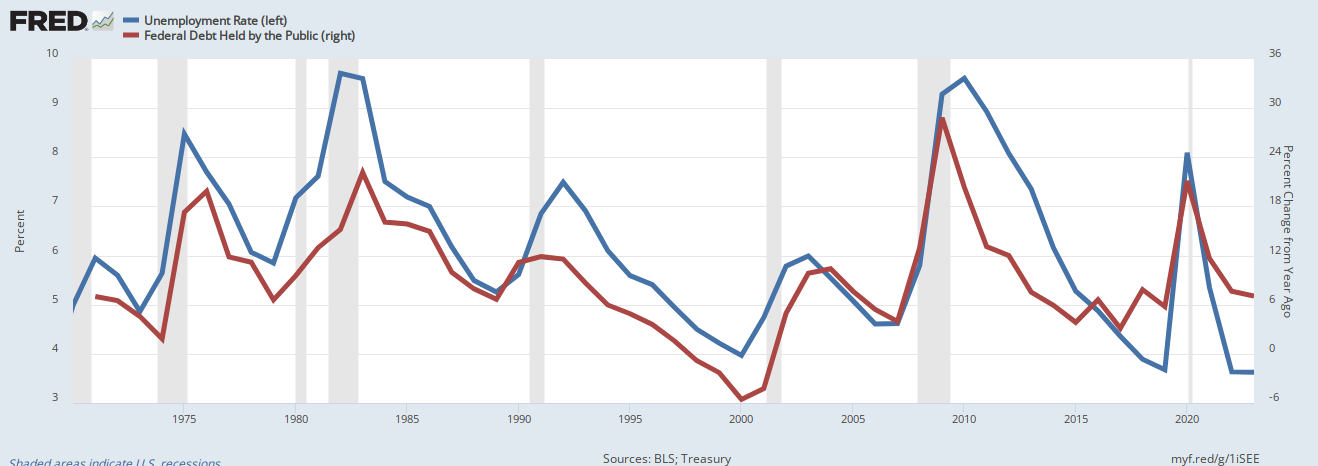
They not only are working, but their buying creates jobs. They aren’t stealing jobs as America’s xenophobes often claim. The proof: Unemployment is low “despite” (because of?) massive immigration:
Red line is federal deficits. Blue line is Unemployment. Vertical gray bars are recessions.
This interesting graph reveals several facts:
  1. When federal deficit spending declines, we have recessions.
  2. The recessions are cured by increases in federal deficit spending.
  3. The recessions cause unemployment.
  4. The unemployment, which is caused by decreases in federal deficit spending is cured by increased federal deficit spending.
Thus, unemployment is not caused by immigrants taking jobs. Quite the opposite. Unemployment and recessions have the same cause: Insufficient federal deficit spending, exactly what the conservatives want us to do.

To be sure, the connection between the higher influx of foreign workers and the rapid post-pandemic recovery has been noted by economists and policymakers alike for some time now.

The Trump GOP’s main election focus is to deport undocumented immigrants, the people who help grow America’s economy.

Federal Reserve Chair Jerome Powell has repeatedly cited immigration as one of the reasons behind strong economic growth.

In a reference to the role being played by higher labor supply, Powell pointed on Wednesday to “a strong pace” of immigration as helping on that front.

“The overall picture is a strong labor market — the extreme imbalances we saw in the early parts of the pandemic recovery have mostly been resolved, you’re seeing high job growth, you’re seeing big increases in supply,” Powell said in his press conference Wednesday.

Fed policymakers lifted their growth forecast for this year to 2.1% from 1.4%, their median estimate showed.

Businesses are ramping up calls for changes to bring in more workers through legal channels.

Almost 9 million positions are open across the economy, equal to 1.4 jobs for every job-seeker. Foreign-born workers made up a record 18.6% of the civilian workforce in 2023 and the U.S. approved a record number of work authorizations in the fiscal year through last September.

Immigration is “very policy sensitive,” Feroli cautioned, advising against extrapolating out bigger numbers beyond the end of this year. After all, policy could change after the November election, he noted.

Why does Trump and his GOP harp on immigration as America’s biggest “problem”? His success is as a fear-mongering hate-mongerer. When he preaches hatred toward Muslims, Mexicans, gays, blacks, people from “shithole” countries — when he lies that they bring crime, drugs to America, he is preaching to people he has frightened with his bigotry. He creates scapegoats, and then claims he will deal with them. Hitler did it. All dictators do it. The facts are:
  1. Immigrants are less likely to commit crimes than are citizens.
  2. Illegal drugs enter the U.S. through legal channels, not via undocumented immigration.
False beliefs, especially those repeated for months and years, are difficult to dislodge with facts. But ultimately, that is all you can do. Just as a lie gains strength the more it is repeated, so does the truth. Learn the truths and repeat them again and again. It’s the only way to defeat the Hitlers of the world. Rodger Malcolm Mitchell Monetary Sovereignty Twitter: @rodgermitchell Search #monetarysovereignty Facebook: Rodger Malcolm Mitchell

……………………………………………………………………..

The Sole Purpose of Government Is to Improve and Protect the Lives of the People.

MONETARY SOVEREIGNTY