The Federal Insurance Contributions Act (FICA) tax supposedly funds two major programs:
Social Security provides benefits for retirees, disabled individuals, and survivors of deceased workers. It’s designed to offer a safety net for individuals who can no longer work.
Medicare provides health insurance for people 65 and older and for some younger people with disabilities. It helps cover hospital care, medical services, and, in some cases, prescription drugs.
Great news! You can take money from your right-hand pocket and put it in your left. Think of it as a gift from me.
That is what you are supposed to believe.
Unfortunately, FICA funds nothing. That is because of Monetary Sovereignty. All FICA dollars are destroyed upon receipt by the Treasury.
They begin in the M2 money supply measure, but upon arrival at the Treasury, they cease to be part of any money supply measure. Effectively, they are destroyed.
Due to the misinformation and disinformation you have been given, many bad things have happened to your Social Security and Medicare. Here are just a few:
1. Trust Fund Shortfalls: The Social Security and Medicare “Trust Funds” are not real trust funds. They are merely balance sheets showing additions and subtractions. Congress controls them totally and can change the numbers at will.
Their sole “purpose” (if one can label it a purpose) is to make you falsely believe you should accept smaller benefits. The trust funds and FICA were created and exist only to limit your benefits.
2. Demographic Changes: The government says that an aging population is causing more people to draw benefits while fewer workers are paying into the system.
While those facts are true, they lead to the lie that Social Security and Medicare are running short of money. Your FICA dollars do not fund Social Security or Medicare, and the “trust funds” do not pay for benefits.
The FICA receipts are recorded as accounting credits and combined with other Treasury receipts. The federal government owns the accounts and can unilaterally raise or lower collections and expenditures.
All Social Security and Medicare benefits are funded by creating new money, which the federal government can do endlessly.
3. Increase in Full Retirement Age (FRA): The Social Security FRA has been increased from 65 to 67 for those born in 1960 or later. This means people have to wait longer to receive full benefits.
4. Higher Earnings Subject to Social Security Tax: The maximum income subject to Social Security tax has been increased over the years.
5. Higher Medicare Premiums: Larger Medicare premiums are deducted from Social Security checks for most retirees.
6. Up to 85% of your SS benefits are subject to income tax. You giveth via FICA and the government taketh — and then taketh again via income tax.
Sorry, kids, but I’m running out of money. I’ll have to cut your benefits.
7. At most, Medicareonly pays 80% of your costs while paying reduced fees to doctors and hospitals. (Have you noticed that doctors and hospitals always receive less than they bill?)
In short, you and your medical team receive less than you should.
While all of the above are financially unnecessary and based on the false premise that federal spending is funded by taxes (like state government spending is), at least they are apparent.
People can see that they receive fewer net dollars from the government.
The following is the worst because it looks like a benefit but isn’t:
8. The Inflation Reduction Act (IRA) allows Medicare to negotiate prices for certain high-cost drugs under Medicare Part B and Part D
These drugs treat conditions like heart disease, diabetes, and cancer. The negotiations are projected to save Medicare beneficiaries $1.5 billion in out-of-pocket costs when the new prices take effect in 2026.
Sounds great? It’s supposed to.
Now, think about it. Where will the money come from?
Numbers 1 through 7 obviously take dollars from the private sector, otherwise known as “the economy,” and transfer them to the government, which neither needs nor uses them.
The government already has infinite dollars. When it spends dollars, it simply passes a law and creates new ones. It can do this endlessly at no cost other than pressing a computer key.
Former Fed Chairman Alan Greenspan: “A government cannot become insolvent with respect to obligations in its own currency. There is nothing to prevent the federal government from creating as much money as it wants and paying it to somebody. The United States can pay any debt it has because we can always print the money to do that.”
Former Fed Chairman Ben Bernanke:“The U.S. government has a technology, called a printing press (or, today, its electronic equivalent), that allows it to produce as many U.S. dollars as it wishes at essentially no cost. It’s not tax money… We simply use the computer to mark up the size of the account.”
Let me get this straight. Do you really believe I have Trust Funds, and they are running short of dollars???
Fed Chairman Jerome Powell:“As a central bank, we have the ability to create money digitally.”
St. Louis Fed:“As the sole manufacturer of dollars, whose debt is denominated in dollars, the U.S. government can never become insolvent, i.e., unable to pay its bills. In this sense, the government is not dependent on credit markets to remain operational.”
Number 8, which masquerades as a benefit to the private sector, is just a transfer of dollars from one part of the economy (the people who work for pharmaceutical companies) to another (the people who pay FICA).
No new dollars are created, which means no new benefits are created. The government forces one part of the economy to pay another and claims it is providing you with a benefit.
Even worse, the charade supports the false belief that federal spending is funded by federal taxes, specifically the lie that FICA funds SS and Medicare.
It is akin to the lie that your employer pays half of FICA, when in fact, you pay all of it.
Your employer includes the cost of FICA when determining your salary. That is why employers love to classify workers as “independent contractors.”
It allows them to pay higher salaries at less cost.
One day, probably not during my lifetime, the American public will understand that federal government financing differs from state/local government financing.
The former is Monetarily Sovereign. The latter is monetarily non-sovereign. If you don’t know the difference, you don’t understand federal government finance. Click this link to begin understanding.
The people have not been informed that federal taxes fund nothing and that the government pays for everything by creating new dollars ad hoc.
So what is the purpose of federal taxes if not for funding spending? Read this.
The people need to be informed that the government has 100% control over the U.S. dollar it invented. It can give dollars any value (inflation). Historically, it has often arbitrarily changed the value of the dollar.
It can pay for anything, no matter how many dollars are needed.
Yes, the federal government could pay for comprehensive, no-deductible, free Medicare for every man, woman, and child in America. And yes, it could pay everyone a free Social Security benefit, eliminating poverty, homelessness, illiteracy, hunger, and inequality in America.
And yes, it could pay to make America, as the Bible said, “. . . the light of the world. A city set on a hill . . . .”
And it could do it all without collecting a penny in taxes.
So long as you accept the lies, you will continue to be like cattle grunting and mooing toward the slaughter.
And sadly, I can’t see that changing during my few remaining years.
Rodger Malcolm Mitchell
Monetary SovereigntyTwitter: @rodgermitchellSearch #monetarysovereigntyFacebook: Rodger Malcolm Mitchell;MUCK RACK: https://muckrack.com/rodger-malcolm-mitchell; https://www.academia.edu/
……………………………………………………………………..
The Sole Purpose of Government Is to Improve and Protect the Lives of the People.
The purpose has been to demonstrate how, year after year, so-called experts claim the U.S. is about to enter catastrophe because federal debt is “too high,” while the experts are proven wrong year after year. The economy grows and grows and is healthier than ever.
I’ve been doing this for over 20 years; the experts have been wrong for over 80 years, and they never seem to learn. While I find it frustrating, I’ve tried to remain civil and merely recite the facts. But now, as I near my 90th year, and the road ahead is short, I’ve grown impatient with civility, and I’ve decided to call it like it is: BULLSHIT.
What finally set me off is a BULLSHIT tweet (or whatever “X” calls them now), from the richest man in the world, who, despite his great wealth, seems to know diddly-squat about federal finance:
It was published today shortly after an equally BULLSHIT article titled, US “debt bomb” ticking louder by Nick Beams 10 October 2024, which is summarized at the end of this post.
No Elon, the U.S. federal government, being Monetarily Sovereign, cannot go bankrupt. Even if tax collections fell to $0, and spending tripled, the federal government could continue to pay all its bills, forever.
The U.S. federal government is not like state/local governments, not like euro governments, not like businesses, and not like you and me.
It is uniquely Monetarily Sovereign. It cannot, unwillingly, run short of its own sovereign currency, the U.S. dollar. As real experts have said:
Former Federal Reserve Chairman Alan Greenspan: “A government cannot become insolvent with respect to obligations in its own currency. There is nothing to prevent the federal government from creating as much money as it wants and paying it to somebody. The United States can pay any debt it has because we can always print the money to do that.”
Former Fed Chairman Ben Bernanke: “The U.S. government has a technology, called a printing press (or, today, its electronic equivalent), that allows it to produce as many U.S. dollars as it wishes at essentially no cost. It’s not tax money… We simply use the computer to mark up the size of the account.”
Statement from the St. Louis Fed: “As the sole manufacturer of dollars, whose debt is denominated in dollars, the U.S. government can never become insolvent, i.e., unable to pay its bills. In this sense, the government is not dependent on credit markets to remain operational.”
Press Conference: Mario Draghi, President of the Monetarily Sovereign ECB, 9 January 2014 Question: can the ECB ever run out of money? Mario Draghi: Technically, no. We cannot run out of money.
Because the U.S. federal government has the infinite ability to create its sovereign currency, the U.S. dollar, it never borrows dollars.
Contrary to popular wisdom, T-bills, T-notes, and T-bonds do not represent borrowing. They simply are deposits, the purpose of which is to provide a safe place to store unused dollars and to help the Fed control interest rates.
The government never touches those dollars, which remain the property of the depositors. Not only can our Monetarily Sovereign government not run short of dollars, but federal deficits are necessary to grow the economy, as evidenced by the formula: GDP = Federal Spending + Nonfederal Spending + Net Exports.
When we don’t have sufficient federal deficits, we have depressions and recessions:
1804-1812: U. S. Federal Debt reduced 48%. Depression began 1807.
1817-1821: U. S. Federal Debt reduced 29%. Depression began 1819.
1823-1836: U. S. Federal Debt reduced 99%. Depression began 1837.
1852-1857: U. S. Federal Debt reduced 59%. Depression began 1857.
1867-1873: U. S. Federal Debt reduced 27%. Depression began 1873.
1880-1893: U. S. Federal Debt reduced 57%. Depression began 1893.
1920-1930: U. S. Federal Debt reduced 36%. Depression began 1929.
1997-2001: U. S. Federal Debt reduced 15%. Recession began 2001.
Periodically, we publish yet another shrieking claim that the U.S. federal debt is “unsustainable”and a “ticking time bomb.”
This lie has been told to you every year (really, almost every day) since 1940, and that bomb has never exploded, nor will it.
Rather than repeat the entire list of the thousands of lies to which you have been subject, I will list samples here as a reference and add periodically, at the end, new “federal debt is a ticking time bomb“BULLSHIT as I encounter them.
Read these and see that even respected economists replace facts with BULLSHIT:
September 26, 1940, New York Times: The federal budget was a “ticking time-bomb which can eventually destroy the American system,” said Robert M. Hanes, president of the American Bankers Association.
By 1960, the debt was “threatening the country’s fiscal future,” said Secretary of Commerce Frederick H. Mueller. (“The enormous cost of various Federal programs is a time-bomb threatening the country’s fiscal future, Secretary of Commerce Frederick H. Mueller warned here yesterday.”)BULLSHIT
In 1984: AFL-CIO President Lane Kirkland said. “It’s a time bomb ticking away.”BULLSHIT
In 1985: “The federal deficit is a ticking time bomb, and it’s about to blow up,” U.S. Sen. Mitch McConnell. (Remember him?)BULLSHIT
Later in 1985: Los Angeles Times: “We labeled the deficit a ‘ticking time bomb‘ that threatens to permanently undermine the strength and vitality of the American economy.”BULLSHIT
In 1987: Richmond Times-Dispatch – Richmond, VA: “100TH CONGRESS FACING U.S. DEFICIT’ TIME BOMB‘”BULLSHIT
Later in 1987: The Dallas Morning News: “A fiscal time bombis slowly ticking that, if not defused, could explode into a financial crisis within the next few years for the federal government.”BULLSHIT
In 1989: FORTUNE Magazine: “A TIME BOMB FOR U.S. TAXPAYERS“BULLSHIT
In 1992: The Pantagraph – Bloomington, Illinois: “I have seen where politicians in Washington have expressed little or no concern about this ticking time bomb they have helped to create, that being the enormous federal budget deficit, approaching $4 trillion.“BULLSHIT
Later in 1992, Ross Perot said, “Our great nation is sitting right on top of a ticking time bomb. We have a national debt of $4 trillion.”BULLSHIT
In 1995: Kansas City Star: “Concerned citizens. . . regard the national debt as a ticking time bombpoised to explode with devastating consequences at some future date.”BULLSHIT
In 2004: Bradenton Herald: “A NATION AT RISK: TWIN DEFICIT A TICKING TIME BOMB” BULLSHIT
In 2005: Providence Journal: “Some lawmakers see the Medicare drug benefit for what it is: a ticking time bomb.” BULLSHIT
In 2006: NewsMax.com, “We have to worry about the deficit . . . when we combine it with the trade deficit, we have a real ticking time bomb in our economy,” said Mrs. Clinton. BULLSHIT
In 2007: USA Today: “Like a ticking time bomb, the national debt is an explosion waiting to happen.” BULLSHIT
In 2010: Heritage Foundation: “Why the National Debt is a Ticking Time Bomb. Interest rates on government bonds are virtually guaranteed to jump over the next few years. BULLSHIT
In 2010: Reason Alert: “. . . the time bomb that’s ticking under the federal budget like a Guy Fawkes’ powder keg.” BULLSHIT
In 2011: Washington Post, Lori Montgomery:”. . . defuse the biggest budgetary time bombs that are set to explode.” BULLSHIT
June 19, 2013: Chamber of Commerce: Safety net spending is a ‘time bomb’, By Jim Tankersley: The U.S. Chamber of Commerce is worried that not enough Americans are worried about social safety net spending. The nation’s largest business lobbying group launched a renewed effort Wednesday to reduce projected federal spending on safety-net programs, labeling them a “ticking time bomb” that, left unchanged, “will bankrupt this nation.” BULLSHIT
On June 15, 2014: CBN News: “The United States of Debt: A Ticking Time Bomb” BULLSHIT
On January 27, 2017: America’s “debt bomb is going to explode.” That’s according to financial strategist Peter Schiff. Schiff said that while low interest rates had helped keep a lid on U.S. debt, it couldn’t be contained for much longer. Interest rates and inflation are rising, creditors will demand higher premiums, and the country is headed “off the edge of a cliff.” BULLSHIT
February 16, 2018 America’s Debt Bomb By Andrew Soergel, Senior Reporter: Conservatives and deficit hawks are hurling criticism at Washington for deepening America’s debt hole. BULLSHIT
April 10, 2019,The National Debt: America’s Ticking Time Bomb. TIL Journal. Entire nations can go bankrupt. One prominent example was the *nation of Greece which was threatened with insolvency a decade ago. Greece survived the economic crisis because the European Union and the IMF bailed the nation out. BULLSHIT
SEP 12, 2019, Our national ticking time bomb, By BILL YEARGIN SPECIAL TO THE SUN SENTINEL | At some point, investors will become concerned about lending to a debt-riddled U.S., which will result in having to offer higher interest rates to attract the money. Even with rates low today, interest expense is the federal government’s third-highest expenditure following the elderly and military. The U.S. already borrows all the money it uses to pay its interest expense, sort of like a Ponzi scheme. Lack of investor confidence will only make this problem worse. BULLSHIT
JANUARY 06, 2020, National debt is a time bomb, BY MARK MANSPERGER, Tri City Herald | The increase in the U.S. deficit last year was about $1.1 trillion, bringing our total national debt to more than $23 trillion! This fiscal year, the deficit is forecasted to be even higher, and when the economy eventually slows down, our annual deficits could be pushing $2 trillion a year! This is financial madness. there’s not going to be a drastic cut in federal expenditures — that is, until we go broke — nor are we going to “grow our way” out of this predicament. Therefore, to gain control of this looming debt, we’re going to have to raise taxes. BULLSHIT
February 14, 2020, OMG! It’s February 14, 2020, and the national debt is still a ticking time bomb! The national debt: A ticking time bomb?America is “headed toward a crisis,” said Tiana Lowe in WashingonExaminer.com. The Treasury Department reported last week that the federal deficit swelled to more than $1 trillion in 2019 for the first time since 2012. Even more alarming was the report from the bipartisan Congressional Budget Office (CBO) predicting that $1 trillion deficits will continue for the next 10 years, eventually reaching $1.7 trillion in 2030 BULLSHIT
August 29, 2020, LOS ANGELES, California: America’s mountain of debt is a ticking time bomb The United States not only looks ill, but also dead broke. To offset the pandemic-induced “Great Cessation,” the U.S. Federal Reserve and Congress have marshalled staggering sums of stimulus spending out of fear that the economy would otherwise plunge to 1930s soup kitchen levels. Assuming that America eventually defeats COVID-19 and does not devolve into a Terminator-like dystopia, how will it avoid the approaching fiscal cliff and national bankruptcy? BULLSHIT
April 16, 2021, NATIONAL POLICY: ECONOMY AND TAXES / MARK ALEXANDER / The National Debt Clock: A Ticking Time Bomb: At the moment, our national debt exceeds $28 TRILLION — about 80% held as public debt and the rest as intragovernmental debt. That is $225,000 per taxpayer. Federal annual spending this year is almost $8 trillion, and more than half of that is deficit spending — piling on the national debt. BULLSHIT
Now, the national debt is approaching $31 trillion,which is $12 trillion more than when Donald Trump took office in 2017 and more than half of that debt was tacked on in his final year. Then we’ve had the disastrous year and a half of Joe Biden. Now, the Fed is now hiking its rates and that spells even more trouble for the national debt and the economy at large. BULLSHIT
December 4, 2022 America’s ticking time bomb: $66 trillion in debt that could crash the economy By Stephen Moore, The national debt is $31 trillion when including Social Security’s and Medicare’s unfunded liabilities. Wake up, America. BULLSHIT
That ticking sound you’re hearing is the American debt time bomb that with each passing day is getting precariously close to detonatingand crashing the US economy. BULLSHIT
With the U.S. reaching its debt limit of $31.4 trillion on Jan. 19, Treasury Secretary Janet Yellen urged lawmakers to increase or suspend the debt ceiling. BULLSHIT
April 22, 2023The Debt Ceiling Debate Is About More Than Debt, Jim Tankersley, WASHINGTON — Speaker Kevin McCarthy of California has repeatedly said that he and his fellow House Republicans are refusing to raise the nation’s borrowing limit,and risking economic catastrophe, to force a reckoning on America’s $31 trillion national debt. “Without exaggeration, America’s debt is a ticking time bomb that will detonate unless we take serious, responsible action,” he said this week. BULLSHIT
November 3, 2023 The Fuse on America’s Debt Bomb Just Got Shorter,J Antoni Heritage Organization. The Treasury is now on track to borrow almost as much in just six months as it did in the previous 12 months. That’s nearly a doubling of the deficit. Because the federal debt is $33.7 trillion, just a 1 percent increase in yields adds $337 billion to the annual cost of servicing the debt over time. Absent spending reform, eventually no one will be willing to hold the bomb anymore, and the yields on U.S. debt will begin to resemble those in Argentina. BULLSHIT
February 2, 2024How Florida can help defuse the nation’s debt bomb By BARRY W. POULSON,professor emeritus of economics at the University of Colorado Boulder and DAVID M. WALKER,former comptroller general of the United States. Washington’s out-of-control spending, combined with fiscal and monetary policies have resulted in trillion-dollar-plus annual deficits, over $34 trillion in federal debt, over $125 trillion in total federal liabilities and unfunded obligations, and excess inflation. Excessive spending and loose monetary policy increase inflation in the short term, and mounting debt burdens serve to reduce future economic growth and shift the economic burden and consequences of mounting debt burdens to future generations. BULLSHIT
February 8, 2024Legendary investor Paul Tudor Jones says a ‘debt bomb’ is about to go off in the U.S.: ‘We’re fast-pouring consumption like crazy’. The U.S. economy may seem like it’s firing on all cylinders, but underneath the surface, a “debt bomb” could be on the verge of exploding, according to billionaire hedge fund manager Paul Tudor Jones. The esteemed investor said in an interview with CNBC that he couldn’t deny the economy was strong, but that it was actually “on steroids” due to massive government spending and borrowing. BULLSHIT
Jones is not the only one to call attention to the growing deficit issue in the U.S. On Sunday, Federal Reserve Chairman Jerome Powell took a rare dive into politics, telling CBS’s 60 Minutes that the national debt was “growing faster than the economy,” and calling for lawmakers to get the federal government “back on a sustainable fiscal path.” Meanwhile, U.S. Treasury Secretary Janet Yellen has said she is not yet worried about the increasing national debt as long as the government keeps in check the net payments it makes on its debt relative to GDP. BULLSHIT
Those payments are projected to rise from 2.5% last year to 2.9% next year, according to the Office of Management and Budget—below their level in the early 1990s. Jones told CNBC that the strong economy could postpone the effects of the government’s deficit spending, but only for a little while. “The only question is … when does that manifest itself in markets?” he added. BULLSHIT
“It could be this year, it could be next year. Productivity may mask and it might be three or four years from now. But clearly, clearly we’re on an unsustainable path.” BULLSHIT
June 21, 2024 My Weekly Column: Our debt crisis is a ticking time bomb by Randy Feenstra: On June 18th, the nonpartisan Congressional Budget Office (CBO) – the government agency tasked with monitoring our nation’s fiscal health – confirmed my serious concerns with President Biden’s reckless spending agenda. BULLSHIT
His administration’s fiscal policies have not only caused cumulative inflation to skyrocket by over 20% since he took office, but they have also accelerated our accumulation of debt to levels that are beyond unsustainable. Instead of changing course, he recently released his budget for Fiscal Year 2025, which has a $ 7.3 trillion price tag and looks to raise taxes on our families, farmers, and businesses to the tune of $5.5 trillion. BULLSHIT
The CBO estimates that his debt “cancelation” policies will cost taxpayers nearly $400 billion over the next ten years. I strongly oppose these bailouts. Iowans who never attended college entered the workforce early or helped put their kids through school should not be forced to pick up the tab for President Biden’s costly and unfair executive orders. BULLSHIT
July 22, 2024Federal debt is the ticking bomb in your wallet By E.J. Antoni a public finance economist and the Richard F. Aster fellow at the Heritage Foundation, and a senior fellow at Unleash. The federal government is already running $2 trillion annual deficits, driving up interest on the debt exponentially. The time bomb of federal finance has already started ticking down. BULLSHIT
October 10, 2024 U.S. Debt Bomb is ticking louder by Nick Beams, World Socialist Website. The immediate economic question is: when will the rise in US government debt give rise to a crisis for the US dollar, a major meltdown in the market for debt, the Treasury bond market, or some other area of the financial system? Government debt is now heading towards $36 trillion and increasing at a pace which is regarded as “unsustainable” by Federal Reserve chair Jerome Powell, along with many others. BULLSHIT
May 30, 2025 DEFICIT DANGER. BOJ governor warns US debt time bomb outweighs trade war risks. By Dashan Hendricks. BANK of Jamaica (BOJ) governor Richard Byles has issued a stark warning that America’s spiralling budget deficits now present a more severe danger to the global economy than ongoing trade conflicts, as the world’s largest economy grapples with its third credit rating downgrade since 2011.His comments follow Moody’s recent decision to cut the US government’s credit rating from its top-tier Aaa to Aa1, citing concerns over its US$36-trillion debt burden — which now exceeds the nation’s US$30 trillion GDP. BULLSHIT
———————–//———————–
The above articles contain the same old BULLSHIT (“unsustainable,” “cost taxpayers”) that they’ve been telling since 1940. To buttress their lies, they make false comparisons to family finances or the finances of other monetarily nonsovereign entities like businesses or euro nations.
They have been wrong, repeatedly wrong, for all those years. If we wait long enough, something will happen to prove them right, perhaps in a thousand years?
Today, this makes “only” 84 years of the debt nuts’ BULLSHIT.
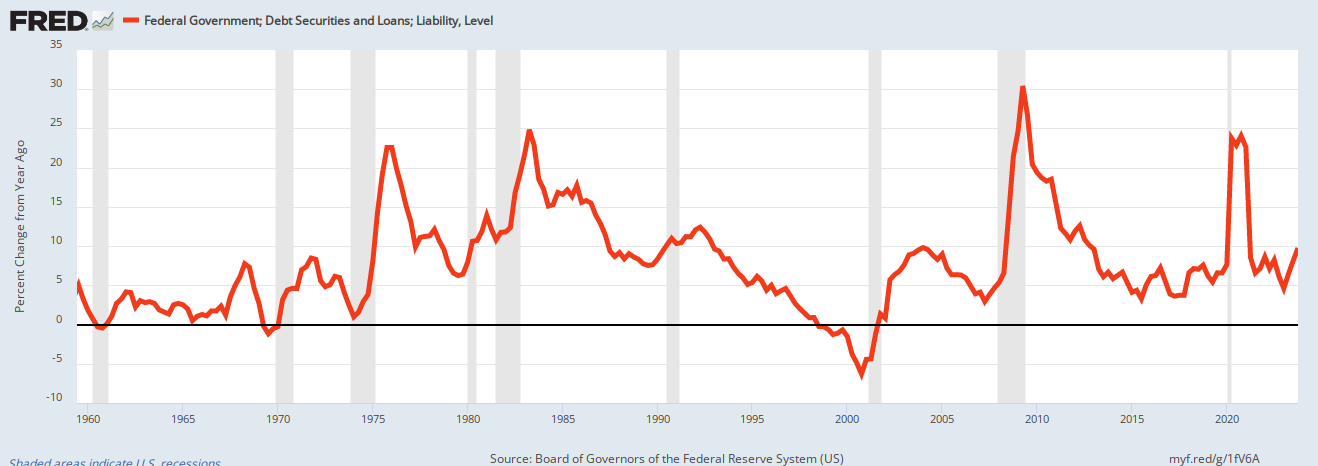
The federal deficit yields economic growth year after year. When deficits are insufficient, we have had recessions, which were cured by increased deficits.
When deficits decline, we have recessions (vertical gray bars), which are cured by increased deficits.
If respected economists keep predicting something terrible is imminent year after year, yet exactly the opposite happens, at what point do they reexamine their beliefs?
At what point does the public say, “Fool me once; shame on you. Fool me repeatedly for 84 years; shame on me.This is just a steaming pile of BULLSHIT“?
Whew, I feel a little better, now — but just a little.
The Sole Purpose of Government Is to Improve and Protect the Lives of the People.
MONETARY SOVEREIGNTY
(Ever wonder why federal spending cuts demanded by debt nuts are designed to widen the income/wealth/power Gap between the rich and the rest, while the few federal spending increases they want are designed to reward and protect the rich?)
INTRODUCTION
When we rank the “worst” taxes, we consider those that do the least good and cause the most harm to the American people and the economy.
The U.S. federal government is unique. It is Monetarily Sovereign, unlike state and local governments, businesses, and individuals, which are monetarily non-sovereign.
Federal taxes take dollars from the economy and destroy them. Then, there’s the waste of money in calculating, paying, and collecting taxes, and punishing evaders.
It initially created the U.S. dollar—as many as it arbitrarily chose—and remains the only entity with the infinite ability to create dollars.
The federal government cannot unintentionally run short of dollars. Even if it didn’t collect a penny in taxes, it could continue spending forever.
Thus, no federal government agency can run short of dollars unless that is what the government wants.
Anyone who claims otherwise either is ignorant about federal financing or lying.
Often, you have seen and heard statements indicating the government or certain agencies of the government — Social Security, Medicare, et al. — are about to run out of dollars or that specific proposals — Medicare for All, increased anti-poverty benefits, etc. — are “unaffordable.”
You will encounter questions like, “Who will pay for it?” or “When will the government run out of other people’s money?”
Such statements deceive, intentionally or not.
Sadly, even government employees, media representatives, and economists who should know better repeatedly promulgate disinformation.
Sometimes, you will be treated with honesty, such as the following statements which have been repeated on this blog:
Former Fed Chairman Alan Greenspan:“A government cannot become insolvent with respect to obligations in its own currency. There is nothing to prevent the federal government from creating as much money as it wants and paying it to somebody. The United States can pay any debt it has because we can always print the money to do that.”
Former Fed Chairman Ben Bernanke:“The U.S. government has a technology, called a printing press (or, today, its electronic equivalent), that allows it to produce as many U.S. dollars as it wishes at essentially no cost. It’s not tax money… We simply use the computer to mark up the size of the account.”
Current Fed Chairman Jerome Powell:“As a central bank, we have the ability to create money digitally.”
St. Louis Federal Reserve Bank:“As the sole manufacturer of dollars, whose debt is denominated in dollars, the U.S. government can never become insolvent, i.e., unable to pay its bills. In this sense, the government is not dependent on credit markets to remain operational.”
Different entities are Monetarily Sovereign over other forms of money. For example, the European Central Bank (ECB) is sovereign over the euro:
When asked, “Can the ECB ever run out of money?” Mario Draghi, the ECB president, replied, “No. We cannot run out of money.”The U.S. federal government is Monetarily Sovereign. It cannot run short of U.S. dollars. It has infinite dollars.
Unfortunately, such honesty is rare, and we are more likely to be subjected to misleading statements:
Molly Dahl, the Chief of Long-Term Analysis at the Congressional Budget Office (CBO), recently emphasized to the Senate Budget Committee that Social Security could run out of funds in about eight to nine years if no action is taken.
The Social Security Board of Trustees also projected that the trust funds could be depleted by 2035.
And,
The Medicare Board of Trustees has projected that the trust fund for Medicare Part A, which covers hospital insurance, could be depleted by 2031
Tricia Neuman, the executive director of the Program on Medicare Policy at KFF, has also highlighted the need for action to avoid severe Medicare cuts.
Additionally, Robert Emmet Moffit, co-editor of Modernizing Medicare, has pointed out the financial challenges due to factors like the rising number of older Americans and advanced medical technology.
These “experts” and many others fail to mention that the problems could be eliminated at the stroke of a President’s pen by approving a Congressional bill that would, in essence, say, “The federal government will fully fund All Medicare and Social Security expenses.”
The federal government neither needs nor uses tax dollars to fund anything. All federal tax dollars are destroyed upon receipt. When federal taxes are taken from the public, they begin as checking account dollars in the M2 money supply measure.
When they reach the U.S. Treasury, they suddenly cease to be part of any money supply measure. They simply disappear into the federal government’s infinite supply of money. Infinity plus any number equals infinity.Federal taxes do not provide the federal government with spending money. The government creates new dollars by paying creditors’ bills.
To pay a creditor, the government sends instructions (not dollars) to the creditor’s bank, instructing the bank to increase the balance in the creditor’s checking account. New dollars are added to the M2 money supply measure when the bank does as instructed.
The bank balances its books by clearing the transaction through the Federal Reserve system.
What, then, is the purpose of federal taxes?
Federal taxes assure demand for the U.S. dollar by requiring taxes to be paid in dollars.
Federal taxes allow the federal government to control the economy by taxing what the government wishes to discourage and by giving tax breaks to what the government wishes to reward.
Then, there is the real function of federal taxes: To help the rich become even wealthier by widening the gap between the rich and the rest.
It is the Gap that makes the rich rich. Without the Gap, no one would be rich; we would all be the same. The wider the Gap, the richer. To become richer, one must accomplish two things: gain more wealth for oneself and/or ensure those below have less.
Federal tax laws accomplish the latter by granting tax exceptions for the kinds of income enjoyed by the wealthiest among us. Just one example:
Donald Trump on his federal tax returnsdeclared negative income in 2015, 2016, 2017 and 2020, and that he paid a total of $1,500 in income taxes for the years 2016 and 2017. On their 2020 income tax returns, Trump and his wife Melania paid no federal income taxes and claimed a refund of $5.47 million.
Billionaire Donald Trump paid less income tax than you did from 2015 through 2020. And this is not an exception. It is a fundamental purpose of federal tax laws—the Gap-widening process for which the rich bribe Congress.
THE FOUR WORST TAXES IN AMERICA
Because the federal government neither needs nor uses tax dollars, three of the four worst taxes are federal.
They take dollars from the private sector (also known as “the economy”) and transfer them to the government, where they are destroyed. Mathematically, federal taxes (but not state/local taxes), pay for nothing, reduce Gross Domestic Product, and are recessive.Relative to their income, the poor pay far more in sales taxes than the rich.4. The fourth worst taxes in America are the ones that are not federal: State and local sales taxes. Unlike the federal government, state/local governments are part of the U.S. economy.
They deposit tax dollars into bank accounts, which become part of the M2 money supply measure. Thus, state/local taxes are not mathematically recessive.
However, they are regressive. They negatively affect the rich much less than the rest of us simply because they use a smaller percentage of their income to purchase sales-taxable items.3. The third-worst tax in America is the federal capital gains tax. In theory, this tax could be somewhat beneficial. On the surface, it should tax the rich more than others because they are far more likely to have capital gains.
Further, the higher tax on short-term (one year or less) capital gains should encourage investment above speculation.
The reality is far different. The rich have bribed Congress to include so many exceptions and caveats in this highly complex tax law that the rules allow the rich to escape most if not all, taxation (See Donald Trump).
Though federal tax dollars are destroyed upon receipt, the tax could benefit the economy if it served a practical purpose: Narrowing the Gap between the rich and the rest.
In practice, it does the opposite.
2. The second worst tax in America is the federal tax on Social Security benefits. While the notion that the federal government should provide benefits to the elderly and disabled makes sense, unnecessarily taxing those benefits is senseless and regressive.
The people most in need of Social Security benefits have the least ability to pay taxes on the program’s already meager payments.
Despite having the infinite ability to pay benefits and unnecessarily collecting taxes on benefits, the federal government repeatedly has raised the minimum age for receiving full benefits:
Normal Retirement Age
Year of birth
Age
1937 and prior
65
1938
65 and 2 months
1939
65 and 4 months
1940
65 and 6 months
1941
65 and 8 months
1942
65 and 10 months
1943-54
66
1955
66 and 2 months
1956
66 and 4 months
1957
66 and 6 months
1958
66 and 8 months
1959
66 and 10 months
1960 and later
67
Taxing benefits while raising eligibility ages is unconscionable but perfectly rational for a government that has been bribed to widen the income/wealth/power Gap between the rich and the rest.
1. The worst tax in America is FICA, the Federal Insurance Contributions Act. The federal payroll tax supposedly funds Social Security and Medicare programs. It is deducted from each paycheck and ostensibly provides financial and health care benefits for retirees, disabled Americans, and children.
It does none of those things. Like all federal taxes, it is destroyed upon receipt by the Treasury.
It is designed to impact salaried people in lower-income groups. It is not levied against the type of income the rich most enjoy, such as capital gains, interest, and other “non-income” income.
It is limited to salaries below $168,600. A person earning a million dollars a year would pay almost* the same amount of FICA tax as a person earning $168,000 a year. (*An extra 2% of salaries above $299K) is deducted for Medicare.)
Half of FICA supposedly is paid by businesses, but this is a charade. Businesses consider the cost of FICA when determining salaries, particularly for lower-paid employees. It is the lower-paid employees who ultimately suffer the full burden of FICA.
However, FICA encourages businesses to hire workers as independent contractors liable for their retirement financing. This allows companies financial room to pay higher salaries, giving the illusion of more generous compensation.
FICA and its sister taxes, the self-employment tax on individuals who work for themselves, and FUTA, the Federal Unemployment Tax Act that employers pay for unemployment insurance, are the worst taxes because they are the most regressive. They do the most to widen the Gap between the rich and the rest.
Taxing employment discourages businesses and the economy from employing people, which is exactly the opposite effect one would desire for any government action.
All federal employment taxes could and should be eliminated immediately.SUMMARY
Federal taxes do not fund federal spending. The federal government destroys all the tax dollars it receives.
Further, federal taxes reduce GDP, so they are recessive.
Federal tax laws, as currently written and enforced, are regressive widening the income/wealth/power Gap between the rich and the rest.
However, federal taxes support demand for the U.S. dollar and help the government control the economy by taxing what it wishes to limit and giving tax breaks to what it wishes to encourage.
State and local taxes fund state and local spending. They do not reduce GDP but are often regressive.
All federal taxes should be eliminated except where the government wishes to limitsome activity.
Another means of federal control would be to use federal spending (rather than tax breaks) to support activities the government wishes to encourage.
The federal government could help reduce the regressive nature of state/local taxes by providing per capita aid to all states.
And yes, I know, federal spending supposedly causes inflation. That already has been debunked here, here, here, and elsewhere in this blog. Federal spending prevents and cures inflation when it acquires and distributes the scarcities causing inflation.
Rodger Malcolm Mitchell
Monetary SovereigntyTwitter: @rodgermitchellSearch #monetarysovereigntyFacebook: Rodger Malcolm Mitchell;MUCK RACK: https://muckrack.com/rodger-malcolm-mitchell; https://www.academia.edu/
……………………………………………………………………..
The Sole Purpose of Government Is to Improve and Protect the Lives of the People.
Years ago, I took over a commodity brokerage with an employee who recently had won a chartist competition. A chartist is a securities researcher or trader who analyzes investments based on past market prices and technical indicators.
He had endless historical data and formulas for that data, and based on all that, he predicted the markets.
Despite winning a national competition, his trading proved to be a spectacular failure. While past data told him what had happened, He had no idea why it happened, so his predictions were worthless.
He didn’t understand cause and effect.
In this vein, an article claims to explain the cause of inflation to the last decimal point. Do you believe it?
Increased federal spending helped the economy bounce back during the pandemic, but it also caused a surge in inflation, research reveals. Inflation is difficult to control. Its cause is often even harder to pinpoint.
Yes, if all you have is formulas and you don’t understand how an economy works, the cause is hard to pinpoint. But that doesn’t stop technicians from trying to identify it.
In attempting to understand the 2022 spike in inflation that followed the pandemic, some policymakers — up to and including President Joe Biden — blamed shortages in the supply chain. But a new study shows that federal spending was the cause — significantly so.
“Our research shows mathematically that the overwhelming driver of that burst of inflation in 2022 was federal spending, not the supply chain,” said Mark Kritzman, a senior lecturer at MIT Sloan.
Fascinating that Mr. Kritzman should conclude inflation was caused by spending.
If he were correct, net spending, i.e., the difference between taxes and gross spending, would cause inflation. That is what puts spending dollars into consumers’ pockets.
Net spending, or deficit spending, tells us how much money the federal government adds to the economy after taxes are subtracted.
Here is some data Mr. Kritzman may have overlooked:
No relationship exists between increases and decreases in federal net spending (red) vs. inflation (blue).
Not only does Mr. Kritzman overlook the data showing no correlation between netgovernment spending and inflation, he tries to put mathematical measures on how much total federal spending (ignoring taxes) affects inflation.
In writing “The Determinants of Inflation,” Kritzman and colleagues from State Street developed a new methodology that revealed how certain drivers of inflation changed in importance over time from 1960 to 2022.
In doing so, they found that federal spending was two to three times more important than any other factor causing inflation during 2022.
Specifically, their results showed that:
42% of inflation could be attributed to government spending.
17% could be attributed to inflation expectations — that is, the rate at which consumers expect prices to continue to increase.
14% could be blamed on high interest rates.
When you see those kinds of specific percentages, you should be doubtful, and when you see them attributed to something like “inflation expectations,” you should be incredulous. Does Mr. Kritzman believe he can measure consumer expectations and include that in an equation? Really?
You might have noticed that his results totaled 73%, leaving only 27% for oil shortages—the real cause of inflation.
Oil price changes (green) are closely related to inflation (blue).
The graph shows the essentially parallel tracks of oil prices and inflation. This is no coincidence; oil costs are part of virtually every product and service. In April 2020, OPEC agreed to a historic cut in oil production by 9.7 million barrels per day starting in May 2020.
Despite massive federal net spending after 2015, inflation (blue) remained relatively low until COVID hit in 2020. Then, we had a recession (vertical gray bar), cured by increased federal net spending.
Inflation didn’t begin until April 2020, when OPEC cut oil supplies to raise prices. This reduction in supply led to inflation (green) that is only now being cured as oil prices drop.
Here is a closer look at inflation and oil during COVID:
Crude oil prices rose due to OPEC price control. This caused inflation to increase. Then OPEC lowered prices and inflation followed down.
Kritzman said that using government stimulus money to help the economy rebound during the pandemic made sense, given the unprecedented circumstances. “People really didn’t know if we were going to have a 1930s-type depression, so the government erred on the side of more stimulus than less stimulus,” he said.
“I don’t judge that to be a bad thing to have done, but it did cause this big spike in inflation,” Kritzman said. “What was surprising is not just that [the driver] was federal spending but that it was so overwhelmingly federal spending.”
Wrong. It was overwhelmingly OPEC oil shortages, along with other COVID-related scarcities of food, shipping, metals, lumber, computer chips, labor, and other scarcities, that caused inflation.
Here is how they came to their conclusion:
The authors arrived at their conclusion by using the Mahalanobis distance statistic, which has been used in a range of projects, from measuring turbulence in the financial markets to detecting anomalies in self-driving vehicles.
In their paper, researchers first used a hidden Markov model to identify four regimes of shifting inflation: stable, rising steady, rising volatile, and disinflation.
Then they used the Mahalanobis distance to figure out how eight different economic variables caused the economy to shift between those regimes. The economic variables the authors looked at were producer prices, wages/salaries, personal consumption, inflation expectations, interest rates, the yield curve, the money supply, and federal spending.
Finally, by applying an algorithm to the data from 1960 to 2022, they were able to see how inflation drivers had changed in importance over time. This enabled them to predict the likely path of future inflation — a capability that could potentially be of help to policymakers and investors alike.
The results dispel the notion that the supply chain could be blamed for the 2022 spike in inflation, Kritzman said.
The results may or may not dispel that notion, but they don’t deal with the fact that inflation is caused by shortages of critical goods and services, usually oil and/or food, not federal spending.
Here is their explanatory graph. As you will see, federal deficit spending is not even shown on their graph. Could it be because even they don’t believe it’s a relevant factor?
Examine their graph, and you’ll see a few peculiarities.
The first is that they mix cause and effect: Causes would be Personal Consumption, Interest Rates, Yield Curve, Money Supply, and Federal Spending.
The effects would be Producer Prices, Wages, and Salaries. It’s not clear how one can claim that producer prices cause inflation when they are caused by inflation.
2. If Personal Consumption is only 6.2% at fault, how is Federal Spending given 41% blame for inflation? Was all that inflation caused strictly by the government’s purchases, not by consumer purchases? Unlikely.
3. And if federal deficit spending flooded the economy with money, how did the money supply only increase by 2.9%?
4. Finally, there’s that amorphous “expectations” thing. How was that translated into dollars to reach the precise number 16.9%? If you had inflation expectations, how would you put a number on that?
How would you determine it was 13.9% responsible for changing your consumer buying or business selling prices?
The numbers in the above graph are what I like to call WAGs (Wild Ass Guesses), made to look scientific by applying fake mathematics.
“The narrative at the time was that the cause of inflation was interruptions to the supply chain because of COVID-19,” Kritzman said. “But that didn’t show up in producer prices
In other words, if supplies became scarce, then the prices of those supplies would go up, which we don’t see in our results at that point in time.”
The narrative should have been that all prices went up because of the scarcity of oil, food, shipping, metals, lumber, computer chips, labor, etc. That is the whole point:
We had inflation, not because of “excessive federal spending” but because of COVID-related scarcities.
Guidance for policymakers
The researchers’ findings indicate that the government and the Fed sometimes operate at cross purposes, Kritzman said. When the federal government overstimulates the economy, the Federal Reserve has to delay lowering interest rates.
The data refute the “overstimulates” notion. There was no historical relationship between federal spending and inflation.
“The more overstimulation there is, the more hawkish the Fed has to be to keep inflation under control,” Kritzman said.
Keeping inflation under control is not the Fed’s job. The Fed doesn’t have the tools. It’s Congress’s and the President’s job to prevent and cure the shortages of goods and services that cause inflation.
Taking the same approach that the researchers did, the Federal Reserve might be able to gain a deeper look at “the dynamics that are going on” — not just that inflation is up or down, he said. Instead, it offers insight into how the drivers of inflation change in importance through time.
Yes, sometimes a shortage of oil drives inflation. Other times, it’s a shortage of food, labor, or other production factors.
“I think that the Fed would be well advised to take this methodology and make it operational in how they monitor inflation and other things that they’re interested in,” Kritzman said.
No, Congress and the President should stop avoiding their responsibilities. They should assume control over inflation by preventing and curing shortages.
For example, encouraging and aiding oil drillers and refiners and releasing oil from the Strategic Petroleum Reserve were primary factors in ending the most recent inflation.
The same encouragement and aid should be given to all products and services, the shortages of which cause inflation.









 #Monetary Sovereignty - Mitchell