–Why Costco always runs a deficit.

Twitter: @rodgermitchell; Search #monetarysovereignty
Facebook: Rodger Malcolm Mitchell

Mitchell’s laws:
•Those, who do not understand the differences between Monetary Sovereignty and monetary non-sovereignty, do not understand economics.
•Any monetarily NON-sovereign government — be it city, county, state or nation — that runs an ongoing trade deficit, eventually will run out of money.
•The more federal budgets are cut and taxes increased, the weaker an economy becomes. .
Liberals think the purpose of government is to protect the poor and powerless from the rich and powerful. Conservatives think the purpose of government is to protect the rich and powerful from the poor and powerless.
•The single most important problem in economics is
the Gap between rich and poor.
•Austerity is the government’s method for widening
the Gap between rich and poor.
•Until the 99% understand the need for federal deficits, the upper 1% will rule.
•Everything in economics devolves to motive, and the motive is the Gap between the rich and the rest..

============================================================================================================================================================================================================================================================

Almost every day, you read about some politician, economist or media writer bemoaning “the deficit” and/or “the debt.” Your own friends may do the same.

The word “deficit” merely means more money goes out than comes in. When one side runs a deficit, the other side runs a surplus. Always.

So when the federal government runs a deficit, who runs the surplus? The economy.

Visualize this scenario:

You are an employee of, say, Costco. They pay you a salary. You use some of that salary to buy from Costco, food, clothing, pharmaceuticals and hard goods.

So dollars flow back and forth, from Costco to you and your fellow employees (salaries), and from you and your fellow employees back to Costco (spending).

Which of the following is better for employees:

1. Costco pays it employees more than what the employees spend at Costco. In this example, Costco runs a “deficit” vs. its employees.

or

2. Costco pays its employees less than what the employees spend at Costco. Here, Costco runs a “surplus” vs. its employees.

Which of the above is better for the employees, #1 or #2?

The answer is obvious. It’s better for employees to receive more money from Costco than they give back to Costco. It’s better for employees when Costco runs a “deficit” with them.

And, in fact Costco, and almost every business, runs a deficit vs. its employees. Costco is able to do this, because Costco has additional income from other customers. That is the way business works.

In #2, if Costco ran an ongoing “surplus” vs. its employees, i.e. if Costco employees spent more with Costco than they received from Costco, the employees eventually would run short of money and go bankrupt.

Now let’s make some substitutions: Instead of “Costco,” use the words, “the federal government.” And instead of “employees,” use the words, “the economy.”

Which of the following will grow the economy:

1. The federal government pays the economy more than what the economy pays the federal government. The federal government runs a “deficit” vs. the economy (the current situation).

or

2. The federal government pays the economy less than what the economy pays the federal government. The federal government runs a “surplus” vs. the economy (the politicians’ proposal).

Which will grow the economy? Again, the answer is obvious. Economic growth is more likely when the economy receives more money from the federal government (federal spending) than the economy sends back to the federal government (in taxes).

The economy is more likely to grow when the federal government runs a “deficit.”

And, in fact, the federal government almost always runs a deficit vs. its residents. The federal government is able to do this, because the federal government, being Monetarily Sovereign, creates its own income. That is the way a Monetary Sovereignty works.

In #2, if Costco ran an ongoing “surplus” with its employees, i.e. if Costco employees spent more with Costco than they received from Costco, the employees eventually would run short of money and go bankrupt.

There have been companies that have run surpluses with their employees. Coal mines, for instance, with their company stores, are infamous (“I owe my soul to the company store.”) for impoverishing their workers.

Similarly, governments that run surpluses with their residents are infamous for impoverishing their residents, which is why austerity (i.e. deficit reduction) always produces economic hardship.

Rather than bemoaning the federal government’s deficit, we should encourage the economy’s income. The federal deficit is one of the two primary sources of economic income (the other being Net Exports).

It mathematically is illogical to speak against federal deficits while hoping for economic growth.

Consider the irony of politicians railing against “big government” and for private economic growth, while simultaneously wanting more net dollars to flow to the government and fewer net dollars to flow to the private economy.

Costco runs a deficit vs. its employees. So must the federal government run a deficit vs. its residents.

Rodger Malcolm Mitchell
Monetary Sovereignty

===================================================================================
Ten Steps to Prosperity:
1. Eliminate FICA (Click here)
2. Federally funded Medicare — parts A, B & D plus long term nursing care — for everyone (Click here)
3. Provide an Economic Bonus to every man, woman and child in America, and/or every state a per capita Economic Bonus. (Click here) Or institute a reverse income tax.
4. Free education (including post-grad) for everyone. Click here
5. Salary for attending school (Click here)
6. Eliminate corporate taxes (Click here)
7. Increase the standard income tax deduction annually Click here
8. Tax the very rich (.1%) more, with higher, progressive tax rates on all forms of income. (Click here)
9. Federal ownership of all banks (Click here and here)

10. Increase federal spending on the myriad initiatives that benefit America’s 99% (Click here)

The Ten Steps will add dollars to the economy, stimulate the economy, and narrow the income/wealth/power Gap between the rich and the rest.
——————————————————————————————————————————————

10 Steps to Economic Misery: (Click here:)
1. Maintain or increase the FICA tax..
2. Spread the myth Social Security, Medicare and the U.S. government are insolvent.
3. Cut federal employment in the military, post office, other federal agencies.
4. Broaden the income tax base so more lower income people will pay.
5. Cut financial assistance to the states.
6. Spread the myth federal taxes pay for federal spending.
7. Allow banks to trade for their own accounts; save them when their investments go sour.
8. Never prosecute any banker for criminal activity.
9. Nominate arch conservatives to the Supreme Court.
10. Reduce the federal deficit and debt

No nation can tax itself into prosperity, nor grow without money growth. Monetary Sovereignty: Cutting federal deficits to grow the economy is like applying leeches to cure anemia.
1. A growing economy requires a growing supply of dollars (GDP=Federal Spending + Non-federal Spending + Net Exports)
2. All deficit spending grows the supply of dollars
3. The limit to federal deficit spending is an inflation that cannot be cured with interest rate control.
4. The limit to non-federal deficit spending is the ability to borrow.

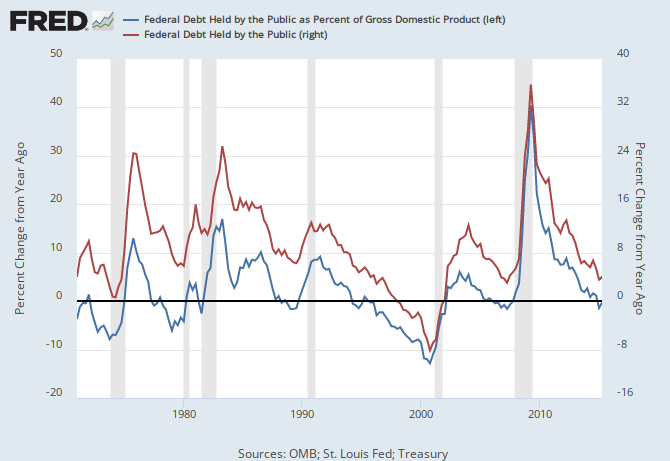
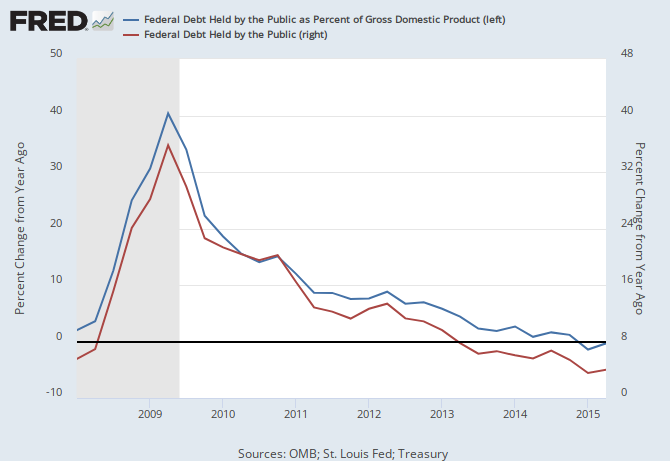
THE RECESSION CLOCK
Monetary Sovereignty

Recessions come after the blue line drops below zero.
Monetary Sovereignty

Vertical gray bars mark recessions.

As the federal deficit growth lines drop, we approach recession, which will be cured only when the growth lines rise. Increasing federal deficit growth (aka “stimulus”) is necessary for long-term economic growth.

#MONETARYSOVEREIGNTY

–The magic of partial solutions

Twitter: @rodgermitchell; Search #monetarysovereignty
Facebook: Rodger Malcolm Mitchell

Mitchell’s laws:
•Those, who do not understand the differences between Monetary Sovereignty and monetary non-sovereignty, do not understand economics.
•Any monetarily NON-sovereign government — be it city, county, state or nation — that runs an ongoing trade deficit, eventually will run out of money.
•The more federal budgets are cut and taxes increased, the weaker an economy becomes. .
Liberals think the purpose of government is to protect the poor and powerless from the rich and powerful. Conservatives think the purpose of government is to protect the rich and powerful from the poor and powerless.
•The single most important problem in economics is
the Gap between rich and poor.
•Austerity is the government’s method for widening
the Gap between rich and poor.
•Until the 99% understand the need for federal deficits, the upper 1% will rule.
•Everything in economics devolves to motive, and the motive is the Gap between the rich and the rest..

============================================================================================================================================================================================================================================================

THERE ARE NO SOLUTIONS; ONLY PARTIAL SOLUTIONS.

Nearly all human problems are solved in increments. It is rare for any problem to be solved entirely, by one all-encompassing solution.

Influenza is a problem. It is not completely solved by vaccination, but vaccination does reduce the number and severity of cases. Vaccination is a partial solution.

The Chicago Bears’s problem is in winning games. A better defensive line, or a better defensive backfield or a better quarterback will not solve the problem. But each is a worthwhile partial solution.

The widening income/wealth/power gap between the rich and the rest is a serious problem. Step #1 in the 10 Steps to prosperity (Eliminate FICA), won’t solve the problem. It’s a partial solution.

The inability of the poor to obtain a college education is a problem. A partial solution is Step #4 in the 10 Steps to Prosperity: Free education (including post-grad) for everyone.

It won’t solve the whole problem. Many poor students don’t receive enough of a K-12 education to allow for success in 13+. And some so need to work for dollars, even free college isn’t enough to attract them. Step #4 is a partial solution.

Each of the Ten Steps to Prosperity is “only” a partial solution.

Every scientific, business and technical advance in history is one “car” in a long train of partial solutions.

Yet some people regard seriously, the quasi-logical objection, “It won’t solve the problem.”

Gun murder is a problem. But any suggestions regarding the evaluation of gun purchasers, stricter gun laws or less lethal guns are dismissed by the National Rifle Association and its gun-manufacturer sponsors as not solving “the problem.”

“It won’t prevent mass murder.” “It won’t stop bad guys from getting guns.” “If someone wants to kill, they can use a knife.” “If guns are illegal, only criminals will have guns.” Etc, etc, etc..

But each gun-control proposal is an attempt at a partial solution, that to some degree will lessen the problem. Problems are solved by partial solutions.

Restricting gun ownership to just a few types of less lethal weapons, won’t prevent all gun-related murders. Some “bad guys” might acquire the more lethal weapons, but some might not. And even less-lethal weapons can kill. But isn’t preventing some gun-related murders an improvement?

And using a national database to prevent gun ownership by the mentally challenged or by criminals, will not prevent all mass school shootings. Some crazies and criminals will get guns. But isn’t stopping some mass shootings worthwhile?

And no, requiring gun owners to belong to that “well-regulated militia” mentioned in the Constitution, will not prevent all “bad guys” from acquiring guns — but it would stop some of them.

And adding an automatic 20-year sentence to any crime involving a gun, will not prevent all gun-related crimes — but it would stop some of them.

We all are born good guys. The first time someone commits a crime, he becomes a “bad guy.” The easy availability of guns turns some good guys into bad guys. Making guns less available is a partial solution to gun crime.

Many gun-related murders are committed in the home, by husbands, wives and other relatives and friends. A law requiring anyone receiving an order of protection, to turn in all guns in their possession, might prevent some of those gun murders.

Gun accidents occur in the home. A law requiring guns to have trigger locks when stored might prevent some gun accidents.

(This begs the question, “Would the NRA’s call for more gun ownership eliminate gun murder?” Of course not. Even the NRA could claim it only would be a partial solution, though in all probability it greatly would exacerbate the problem.)

This post has focused on gun injuries and killings, partly as an example of partial solutions, and partly because partial solutions routinely are demeaned by gun owners.

The need for partial solutions applies to all problems and all laws.

One could argue that even with laws against burglary, “bad guys” burgle, while “good guys” (victims) are at a disadvantage. They lose by being burgled.

Eliminate laws against burglary, and everyone could burgle, which would “level the playing field,” just as allowing everyone to carry a gun supposedly levels the playing field. So, shall we eliminate laws against burglary?

One could argue that no law makes sense, because “bad guys” will break the law, and the only people obeying the law would be “good guy” victims. Shall we eliminate all laws?

In a world without laws, the less moral — the bad guys — have a tactical advantage over the more moral. But fortunately in our society, we do have laws, which we base on some elements of our perceived morality, to protect the moral from the immoral.

We pass our laws, not believing they will be totally curative, but rather because we believe they will, to greater or lesser degree, be ameliorative.

Some prevention is better than none.

Bottom line: All laws restrict “good guys” and all laws are partial solutions. But we need laws.

Never demean the power of “only” partial solutions. Partial solutions are all we have.

Rodger Malcolm Mitchell
Monetary Sovereignty

===================================================================================
Ten Steps to Prosperity:
1. Eliminate FICA (Click here)
2. Federally funded Medicare — parts A, B & D plus long term nursing care — for everyone (Click here)
3. Provide an Economic Bonus to every man, woman and child in America, and/or every state a per capita Economic Bonus. (Click here) Or institute a reverse income tax.
4. Free education (including post-grad) for everyone. Click here
5. Salary for attending school (Click here)
6. Eliminate corporate taxes (Click here)
7. Increase the standard income tax deduction annually Click here
8. Tax the very rich (.1%) more, with higher, progressive tax rates on all forms of income. (Click here)
9. Federal ownership of all banks (Click here and here)

10. Increase federal spending on the myriad initiatives that benefit America’s 99% (Click here)

The Ten Steps will add dollars to the economy, stimulate the economy, and narrow the income/wealth/power Gap between the rich and the rest.
——————————————————————————————————————————————

10 Steps to Economic Misery: (Click here:)
1. Maintain or increase the FICA tax..
2. Spread the myth Social Security, Medicare and the U.S. government are insolvent.
3. Cut federal employment in the military, post office, other federal agencies.
4. Broaden the income tax base so more lower income people will pay.
5. Cut financial assistance to the states.
6. Spread the myth federal taxes pay for federal spending.
7. Allow banks to trade for their own accounts; save them when their investments go sour.
8. Never prosecute any banker for criminal activity.
9. Nominate arch conservatives to the Supreme Court.
10. Reduce the federal deficit and debt

No nation can tax itself into prosperity, nor grow without money growth. Monetary Sovereignty: Cutting federal deficits to grow the economy is like applying leeches to cure anemia.
1. A growing economy requires a growing supply of dollars (GDP=Federal Spending + Non-federal Spending + Net Exports)
2. All deficit spending grows the supply of dollars
3. The limit to federal deficit spending is an inflation that cannot be cured with interest rate control.
4. The limit to non-federal deficit spending is the ability to borrow.

THE RECESSION CLOCK
Monetary Sovereignty

Recessions come after the blue line drops below zero.

Monetary Sovereignty

Vertical gray bars mark recessions.

As the federal deficit growth lines drop, we approach recession, which will be cured only when the growth lines rise. Increasing federal deficit growth (aka “stimulus”) is necessary for long-term economic growth.

#MONETARYSOVEREIGNTY

–Why do incompetents run for President, knowing they can’t win?

Twitter: @rodgermitchell; Search #monetarysovereignty
Facebook: Rodger Malcolm Mitchell

Mitchell’s laws:
•Those, who do not understand the differences between Monetary Sovereignty and monetary non-sovereignty, do not understand economics.
•Any monetarily NON-sovereign government — be it city, county, state or nation — that runs an ongoing trade deficit, eventually will run out of money.
•The more federal budgets are cut and taxes increased, the weaker an economy becomes. .
Liberals think the purpose of government is to protect the poor and powerless from the rich and powerful. Conservatives think the purpose of government is to protect the rich and powerful from the poor and powerless.
•The single most important problem in economics is
the Gap between rich and poor.
•Austerity is the government’s method for widening
the Gap between rich and poor.
•Until the 99% understand the need for federal deficits, the upper 1% will rule.
•Everything in economics devolves to motive, and the motive is the Gap between the rich and the rest..

============================================================================================================================================================================================================================================================

Look at the people running for President.

Most (all?) of them are dishonest, clueless and/or incompetent, and most of them know they cannot win.

So why do they run? Why do they waste their time and other people’s money? Why do so many of us give them our time and our hard earned dollars?

Lindsey Graham: “I’m thinking about running for President. You get a house and a car and a plane. It’s a pretty good gig.”

And there you have it: The reason why dishonest, clueless, incompetent people, not only run for President, but run for political offices in general.

They get a house and a car and a plane. It’s a pretty good gig.

For most of us, job hunting is an unpleasant chore. Calling, writing, waiting in reception rooms, answering questions about ourselves — and all the rejections, again and again — and no money coming in.

Nobody pays us to look for a job. In fact, it costs us money, what with travel, postage, printing, etc. We’d rather chew thumb tacks.

And if a potential employer finds we have been lying, or we have been fired from a previous job, or we say some really stupid things during our interview, our situation may become hopeless.

By contrast, you as a politician can do a “Fiorina”: i.e., you can lie, be shown to be lying, continue to deny you’re lying even after facing absolute proof you were lying — and still be “hired” (backed) by many thousands of people.

You can deny evolution and deny global warming. You can be an anti-gay, anti-foreigner, anti-non-Christian bigot, anti-gun control, thumb your nose at the Supreme Court because your personal beliefs differ from America’s laws, and still be favored by the electorate.

And that is why incompetents run for President, knowing they can’t win. “It’s a pretty good gig. You get a house and a car and a plane” — and lots and lots of money.

If ever you’re tempted to wonder, “Is this the best America can do”? remember, running for President is the perfect forum for an incompetent.

Good people don’t want to dirty their hands.

Rodger Malcolm Mitchell
Monetary Sovereignty

===================================================================================
Ten Steps to Prosperity:
1. Eliminate FICA (Click here)
2. Federally funded Medicare — parts A, B & D plus long term nursing care — for everyone (Click here)
3. Provide an Economic Bonus to every man, woman and child in America, and/or every state a per capita Economic Bonus. (Click here) Or institute a reverse income tax.
4. Free education (including post-grad) for everyone. Click here
5. Salary for attending school (Click here)
6. Eliminate corporate taxes (Click here)
7. Increase the standard income tax deduction annually Click here
8. Tax the very rich (.1%) more, with higher, progressive tax rates on all forms of income. (Click here)
9. Federal ownership of all banks (Click here and here)

10. Increase federal spending on the myriad initiatives that benefit America’s 99% (Click here)

The Ten Steps will add dollars to the economy, stimulate the economy, and narrow the income/wealth/power Gap between the rich and the rest.
——————————————————————————————————————————————

10 Steps to Economic Misery: (Click here:)
1. Maintain or increase the FICA tax..
2. Spread the myth Social Security, Medicare and the U.S. government are insolvent.
3. Cut federal employment in the military, post office, other federal agencies.
4. Broaden the income tax base so more lower income people will pay.
5. Cut financial assistance to the states.
6. Spread the myth federal taxes pay for federal spending.
7. Allow banks to trade for their own accounts; save them when their investments go sour.
8. Never prosecute any banker for criminal activity.
9. Nominate arch conservatives to the Supreme Court.
10. Reduce the federal deficit and debt

No nation can tax itself into prosperity, nor grow without money growth. Monetary Sovereignty: Cutting federal deficits to grow the economy is like applying leeches to cure anemia.
1. A growing economy requires a growing supply of dollars (GDP=Federal Spending + Non-federal Spending + Net Exports)
2. All deficit spending grows the supply of dollars
3. The limit to federal deficit spending is an inflation that cannot be cured with interest rate control.
4. The limit to non-federal deficit spending is the ability to borrow.

THE RECESSION CLOCK
Monetary Sovereignty

Recessions come after the blue line drops below zero.

Monetary Sovereignty

Vertical gray bars mark recessions.

As the federal deficit growth lines drop, we approach recession, which will be cured only when the growth lines rise. Increasing federal deficit growth (aka “stimulus”) is necessary for long-term economic growth.

#MONETARYSOVEREIGNTY

–When is a “hole” a “bump”? Budget gamesmanship.

Twitter: @rodgermitchell; Search #monetarysovereignty
Facebook: Rodger Malcolm Mitchell

Mitchell’s laws:
•Those, who do not understand the differences between Monetary Sovereignty and monetary non-sovereignty, do not understand economics.
•Any monetarily NON-sovereign government — be it city, county, state or nation — that runs an ongoing trade deficit, eventually will run out of money.
•The more federal budgets are cut and taxes increased, the weaker an economy becomes. .
Liberals think the purpose of government is to protect the poor and powerless from the rich and powerful. Conservatives think the purpose of government is to protect the rich and powerful from the poor and powerless.
•The single most important problem in economics is
the Gap between rich and poor.
•Austerity is the government’s method for widening
the Gap between rich and poor.
•Until the 99% understand the need for federal deficits, the upper 1% will rule.
•Everything in economics devolves to motive, and the motive is the Gap between the rich and the rest..

============================================================================================================================================================================================================================================================

When is a “hole” a “bump”?

‘Cadillac tax’ repeal threatened by fight over how to fill $90 billion budget hole
By Tom Howell Jr., http://www.washingtontimes.com, October 6th, 2015

Everyone from Democratic presidential front-runner Hillary Rodham Clinton to Rep. Paul Ryan, Wisconsin Republican, wants to scrap the “Cadillac tax” on generous health care plans — a rare bipartisan push to tweak Obamacare — but there is little consensus on how to fill the $90 billion budget hole that a repeal would leave.

Slated to go into effect in 2018, the tax will apply to expensive health care plans — the kinds that labor unions often negotiate for their members. That gives Democrats an incentive to support a repeal.

Sen. Bernard Sanders, the Vermont independent, says a surtax on the wealthiest Americans should do the trick.

Hillary Clinton says her overall health care plans, which would expand Obamacare, would produce enough savings to “more than cover” the repeal.

Mr. Ryan, who heads the House Ways and Means Committee, wants to go the other direction by trimming Obamacare and using the savings to pay for the repeal.

“There’s no consensus on how to pay for it, and it’s a pretty big piece of change,” said Timothy Jost, a law professor at Washington and Lee University in Virginia.

Democrats included the levy in the Affordable Care Act as a way to extract billions of dollars to pay for other benefits in Obamacare.

“Repealing this provision of the ACA would hurt our economy by increasing the deficit, raising health care cost growth and cutting workers’ paychecks,” a White House official said.

Note to Paul Ryan, Bernie Sanders, Hillary Clinton, Timothy Jost, Democrats, Republicans and the White House: FEDERAL TAXES DO NOT PAY FOR FEDERAL SPENDING.

The federal government, being Monetarily Sovereign, pays for all federal spending, ad hoc, by instructing banks to increase the balances in creditors’ checking accounts.

The sole financial effect of federal taxation is to reduce the supply of money in the economy.

Cutting federal taxes by $90 billion would be a $90 stimulus to the economy. In other words, an economic “bump.”

Mrs. Clinton said the health care reforms she will roll out to build on Obamacare would pay for repeal.

Meanwhile, Mr. Sanders’ campaign said a less than 1 percent tax on Americans making more than $1 million per year would cover the lost revenue.

Republicans on the committee say scrapping the law’s individual mandate to hold insurance will result in massive savings because fewer people will seek taxpayer subsidies on Obamacare’s exchanges — a windfall that would be enough to pay for repealing the Cadillac tax and the law’s 2.3 percent levy on medical device sales.

No, no and no. There is no need to “pay for” a reduction in federal taxes, or to “cover lost revenue.” The federal government neither needs nor uses tax dollars for anything. Even if all federal taxes fell to $0, the U.S. government could continue creating dollars and paying bills, forever.

The proper name for a $90 billion tax cut is “economic stimulus.” It leaves more dollars in the pockets of consumers, who then have the power to save or spend those dollars to increase sales and profits of businesses.

So why the budget gamesmanship? The 1% rich, who own the politicians, do not want the 99% rest of us to increase our power.

They want to keep their ruling power. They want to increase the Gap.

So they tell us that giving us a financial bump really puts us in a financial hole. It’s the Big Lie, again.

In 1971, we went off the gold standard straightjacket, to allow the federal government unlimited stimulus flexability — the unlimited ability to pay its bills without raising taxes.

The bought-and-paid-for politicians pretend it never happened.

Rodger Malcolm Mitchell
Monetary Sovereignty

===================================================================================
Ten Steps to Prosperity:
1. Eliminate FICA (Click here)
2. Federally funded Medicare — parts A, B & D plus long term nursing care — for everyone (Click here)
3. Provide an Economic Bonus to every man, woman and child in America, and/or every state a per capita Economic Bonus. (Click here) Or institute a reverse income tax.
4. Free education (including post-grad) for everyone. Click here
5. Salary for attending school (Click here)
6. Eliminate corporate taxes (Click here)
7. Increase the standard income tax deduction annually Click here
8. Tax the very rich (.1%) more, with higher, progressive tax rates on all forms of income. (Click here)
9. Federal ownership of all banks (Click here and here)

10. Increase federal spending on the myriad initiatives that benefit America’s 99% (Click here)

The Ten Steps will add dollars to the economy, stimulate the economy, and narrow the income/wealth/power Gap between the rich and the rest.
——————————————————————————————————————————————

10 Steps to Economic Misery: (Click here:)
1. Maintain or increase the FICA tax..
2. Spread the myth Social Security, Medicare and the U.S. government are insolvent.
3. Cut federal employment in the military, post office, other federal agencies.
4. Broaden the income tax base so more lower income people will pay.
5. Cut financial assistance to the states.
6. Spread the myth federal taxes pay for federal spending.
7. Allow banks to trade for their own accounts; save them when their investments go sour.
8. Never prosecute any banker for criminal activity.
9. Nominate arch conservatives to the Supreme Court.
10. Reduce the federal deficit and debt

No nation can tax itself into prosperity, nor grow without money growth. Monetary Sovereignty: Cutting federal deficits to grow the economy is like applying leeches to cure anemia.
1. A growing economy requires a growing supply of dollars (GDP=Federal Spending + Non-federal Spending + Net Exports)
2. All deficit spending grows the supply of dollars
3. The limit to federal deficit spending is an inflation that cannot be cured with interest rate control.
4. The limit to non-federal deficit spending is the ability to borrow.

THE RECESSION CLOCK
Monetary Sovereignty

Recessions come after the blue line drops below zero.

Monetary Sovereignty

Vertical gray bars mark recessions.

As the federal deficit growth lines drop, we approach recession, which will be cured only when the growth lines rise. Increasing federal deficit growth (aka “stimulus”) is necessary for long-term economic growth.

#MONETARYSOVEREIGNTY