Ten Steps to Prosperity: Step 6. Eliminate federal taxes on business

Twitter: @rodgermitchell; Search #monetarysovereignty
Facebook: Rodger Malcolm Mitchell

…………………………………………………………………………………………………………………………………………………………………………..

It takes only two things to keep people in chains: The ignorance of the oppressed and the treachery of their leaders.

………………………………………………………………………………………………………………………………………………………………………………………………………………………………………………………………………………………………………………………………………..

This is the sixth in the series of posts describing each of the Ten Steps to Prosperity, the previously described Steps being:

Eliminate Fica (1)
Federally funded Medicare and long-term care for everyone (2)
Monthly economic bonus for everyone (3)
Free education for everyone (4)
Salary for attending school (5)

Are these the words you would use to describe a “healthy economy”?

  1. Business profits are high
  2. Sales of goods and services are strong
  3. Goods and services are plentiful and easily available
  4. Unemployment is low
  5. Salaries are high
  6. Poverty is low
  7. Homelessness is low
  8. Everyone has access to good health care
  9. The elderly and disabled are well cared for
  10. The gap between the rich and the rest is narrow
  11. Inflation is controlled
  12. The stock market is rising
  13. The infrastructure is well-maintained
  14. Taxes are low
  15. ________________________________

There may be other words you would use. If so, feel free to add them.

Now scroll down the list and tell me which items are positively affected by federal taxes on business.

Do federal business taxes help increase profits, sales, or the availability of goods and services? Of course not.

Do federal business taxes help reduce unemployment, increase salaries, or reduce poverty and homelessness? No way.

Do federal business taxes provide you with health care, protect the elderly, close the gap between the rich and the rest, control inflation or boost the stock market? Not in this world.

Do federal business taxes maintain the infrastructure or reduce other taxes? Certainly not.

So what the heck do federal business taxes accomplish?

The U.S. is Monetarily Sovereign.  It never runs short of its own sovereign currency. It neither needs nor uses tax dollars. Even if all federal tax collections fell to $0, the federal government could continue to spend, forever.

And surely, taking tax dollars from our businesses does not help them to be more competitive against foreign companies.

Businesses are dollar-transferring machines. They transfer dollars from customers to employees, suppliers, shareholders and the federal government (the later having no use for those dollars).

Any tax on businesses reduces the amount going to employees, suppliers and shareholders, which diminishes the economy. Ultimately, all business taxes reduce your personal income.

So again, what the heck do federal business taxes accomplish?Image result for ball and chain

Clearly, federal business taxes act as a drag on economic growth.

We discussed the elimination of federal business taxes at New York Times parrots the same old myths about corporate taxes.  If you click the link you will see:

New York Times
Reform and Corporate Taxes

Published: February 22, 2012

The corporate tax system is a mess. The United States has one of the highest corporate tax rates in the world, but too many businesses still don’t contribute their fair share of revenue, in large part because of numerous loopholes, subsidies and other opportunities for tax avoidance.

The Times speaks of a “fair share” of taxes. Does the Times want you to believe that taking more dollars from businesses somehow would be “fair” — that if only businesses had fewer dollars to spend, the economy would thrive?

Or does the Times want you to believe that if you had fewer dollars to spend, that would help the economy to grow? Either point would be ridiculous.

Because federal business taxes pay for nothing and negatively affect the economy, eliminating them should be a no-brainer. But there are two problems:

Problem I. What is a business?

A business is not a “thing.” A business is a system of laws. Businesses already have been given substantial tax benefits, and if taxes on businesses were completely eliminated, most Americans would declare themselves a business as a tax-saving device.

Of course, the federal government could tweak its tax laws to require businesses to have real business purposes, or use other devices to prevent everyone from converting to business status.

But, why?  The federal government has no need for federal tax income. The federal government creates dollars ad hoc, every time it pays a bill. And when you pay your federal taxes, those dollars instantly disappear from the money supply. They effectively are destroyed.

The elimination or dramatic reduction of all federal taxes would be a very good thing for the U.S. economy. You would retain more money to spend and save, and businesses would retain more money to invest and to pay in salaries and dividends to shareholders. It would be a “win, win, win, win, win” for you and for the entire economy.

So why not? Here’s why:

Problem II. The Public Has Been Brainwashed by the Rich

The primary goal of the rich is to widen the Gap between them and the rest of us. The Gap is what makes them rich. Without the Gap, no one would be rich (We all would be the same), and the wider the Gap, the richer they are.

And the rich run America.

Most federal deficit spending benefits the non-rich. It narrows the Gap, so the rich promulgate the myth that federal finances are like personal finances, with income being necessary to pay for spending.

But, the federal government neither needs nor uses income. It is a money machine.

Nevertheless, the rich opt for taxes, but not any taxes. The rich want regressive taxes like income taxes, sales taxes and FICA, all of which punish the non-rich and so, widen the Gap.

One innocently might think that business taxes have more effect on the rich, but in fact, businesses provide the rich with many opportunities for tax deductions. (You can’t deduct for your meals, travel expenses, living expenses, educational expenses, etc., but business owners and executives can.)

Most importantly,  collecting business taxes supports the myth that federal taxes actually pay for something.  

They don’t.

The rich are concerned that if businesses didn’t pay taxes, you would complain that this isn’t “fair,” or worse yet, begin to realize that federal taxes are unnecessary. Then, you might demand that personal taxes be eliminated, too.

That would narrow the Gap, making the rich less rich, and depriving them of their large supply of underpaid servants. (Yes, sorry. That’s you.)

The rich pay propaganda organizations like the Committee for a Responsible Federal Budget (CRFB), pay the politicians, pay the media, and pay the university economists to promulgate such nonsense as “There is no such thing as a free lunch,” and federal deficits are “unsustainable,” and the federal debt is “a ticking time bomb,” and “money printing” will cause a hyperinflation like Zimbabwe” — none of which is true.

The idea is to convince you that federal taxes are necessary, in short, “the Big Lie,” so you will believe there isn’t enough money available for the social spending that benefits you. (That is why you will see fake scare articles telling you that Social Security and Medicare are insolvent.)

The rich want you to struggle day-to-day, worrying about how you will pay for your children and for your own old age, desperate and begging for any handouts from the rich. Meanwhile, the rich who own you, laugh all the way to the bank.

So yes, business taxes should be eliminated, and yes, it would greatly benefit you.

But the rich are afraid that will wake you up to the fact that all federal taxes could be eliminated, which would narrow the Gap — something the rich loathe.

Rodger Malcolm Mitchell
Monetary Sovereignty

………………………………………………………………………………………………………………………………………………………………………………………………………………………………………………………………………………………………………………………………………..

The single most important problems in economics involve the excessive income/wealth/power Gaps between the have-mores and the have-less.

Wide Gaps negatively affect poverty, health and longevity, education, housing, law and crime, war, leadership, ownership, bigotry, supply and demand, taxation, GDP, international relations, scientific advancement, the environment, human motivation and well-being, and virtually every other issue in economics.

Implementation of The Ten Steps To Prosperity can narrow the Gaps:

Ten Steps To Prosperity:
1. ELIMINATE FICA (Ten Reasons to Eliminate FICA )
Although the article lists 10 reasons to eliminate FICA, there are two fundamental reasons:
*FICA is the most regressive tax in American history, widening the Gap by punishing the low and middle-income groups, while leaving the rich untouched, and
*The federal government, being Monetarily Sovereign, neither needs nor uses FICA to support Social Security and Medicare.
2. FEDERALLY FUNDED MEDICARE — PARTS A, B & D, PLUS LONG TERM CARE — FOR EVERYONE (H.R. 676, Medicare for All )
This article addresses the questions:
*Does the economy benefit when the rich can afford better health care than can the rest of Americans?
*Aside from improved health care, what are the other economic effects of “Medicare for everyone?”
*How much would it cost taxpayers?
*Who opposes it?”
3. PROVIDE A MONTHLY ECONOMIC BONUS TO EVERY MAN, WOMAN AND CHILD IN AMERICA (similar to Social Security for All) (The JG (Jobs Guarantee) vs the GI (Guaranteed Income) vs the EB (Guaranteed Income)) Or institute a reverse income tax.
This article is the fifth in a series about direct financial assistance to Americans:

Why Modern Monetary Theory’s Employer of Last Resort is a bad idea. Sunday, Jan 1 2012
MMT’s Job Guarantee (JG) — “Another crazy, rightwing, Austrian nutjob?” Thursday, Jan 12 2012
Why Modern Monetary Theory’s Jobs Guarantee is like the EU’s euro: A beloved solution to the wrong problem. Tuesday, May 29 2012
“You can’t fire me. I’m on JG” Saturday, Jun 2 2012

Economic growth should include the “bottom” 99.9%, not just the .1%, the only question being, how best to accomplish that. Modern Monetary Theory (MMT) favors giving everyone a job. Monetary Sovereignty (MS) favors giving everyone money. The five articles describe the pros and cons of each approach.
4. FREE EDUCATION (INCLUDING POST-GRAD) FOR EVERYONE Five reasons why we should eliminate school loans
Monetarily non-sovereign State and local governments, despite their limited finances, support grades K-12. That level of education may have been sufficient for a largely agrarian economy, but not for our currently more technical economy that demands greater numbers of highly educated workers.
Because state and local funding is so limited, grades K-12 receive short shrift, especially those schools whose populations come from the lowest economic groups. And college is too costly for most families.
An educated populace benefits a nation, and benefitting the nation is the purpose of the federal government, which has the unlimited ability to pay for K-16 and beyond.
5. SALARY FOR ATTENDING SCHOOL
Even were schooling to be completely free, many young people cannot attend, because they and their families cannot afford to support non-workers. In a foundering boat, everyone needs to bail, and no one can take time off for study.
If a young person’s “job” is to learn and be productive, he/she should be paid to do that job, especially since that job is one of America’s most important.
6. ELIMINATE FEDERAL TAXES ON BUSINESS
Businesses are dollar-transferring machines. They transfer dollars from customers to employees, suppliers, shareholders and the federal government (the later having no use for those dollars). Any tax on businesses reduces the amount going to employees, suppliers and shareholders, which diminishes the economy. Ultimately, all business taxes reduce your personal income.
7. INCREASE THE STANDARD INCOME TAX DEDUCTION, ANNUALLY. (Refer to this.) Federal taxes punish taxpayers and harm the economy. The federal government has no need for those punishing and harmful tax dollars. There are several ways to reduce taxes, and we should evaluate and choose the most progressive approaches.
Cutting FICA and corporate taxes would be a good early step, as both dramatically affect the 99%. Annual increases in the standard income tax deduction, and a reverse income tax also would provide benefits from the bottom up. Both would narrow the Gap.
8. TAX THE VERY RICH (THE “.1%) MORE, WITH HIGHER PROGRESSIVE TAX RATES ON ALL FORMS OF INCOME. (TROPHIC CASCADE)
There was a time when I argued against increasing anyone’s federal taxes. After all, the federal government has no need for tax dollars, and all taxes reduce Gross Domestic Product, thereby negatively affecting the entire economy, including the 99.9%.
But I have come to realize that narrowing the Gap requires trimming the top. It simply would not be possible to provide the 99.9% with enough benefits to narrow the Gap in any meaningful way. Bill Gates reportedly owns $70 billion. To get to that level, he must have been earning $10 billion a year. Pick any acceptable Gap (1000 to 1?), and the lowest paid American would have to receive $10 million a year. Unreasonable.
9. FEDERAL OWNERSHIP OF ALL BANKS (Click The end of private banking and How should America decide “who-gets-money”?)
Banks have created all the dollars that exist. Even dollars created at the direction of the federal government, actually come into being when banks increase the numbers in checking accounts. This gives the banks enormous financial power, and as we all know, power corrupts — especially when multiplied by a profit motive.
Although the federal government also is powerful and corrupted, it does not suffer from a profit motive, the world’s most corrupting influence.
10. INCREASE FEDERAL SPENDING ON THE MYRIAD INITIATIVES THAT BENEFIT AMERICA’S 99.9% (Federal agencies)Browse the agencies. See how many agencies benefit the lower- and middle-income/wealth/ power groups, by adding dollars to the economy and/or by actions more beneficial to the 99.9% than to the .1%.
Save this reference as your primer to current economics. Sadly, much of the material is not being taught in American schools, which is all the more reason for you to use it.

The Ten Steps will grow the economy, and narrow the income/wealth/power Gap between the rich and you.

MONETARY SOVEREIGNTY

Ten Steps to Prosperity: Step 5: Salary for attending school

Twitter: @rodgermitchell; Search #monetarysovereignty
Facebook: Rodger Malcolm Mitchell

…………………………………………………………………………………………………………………………………………………………………………..

It takes only two things to keep people in chains: The ignorance of the oppressed and the treachery of their leaders.

………………………………………………………………………………………………………………………………………………………………………………………………………………………………………………………………………………………………………………………………………..

This is the fifth in the series of posts describing each of the Ten Steps to Prosperity, the previous Steps being:

Eliminate Fica (1)
Federally funded Medicare and long-term care for everyone (2)
Monthly economic bonus for everyone (3)
Free education for everyone (4)

By now, readers know that:

A. People create governments, the purpose of which are to protect and benefit the people, and governments create laws to effect those purposes, not to test the people’s ability to protect and benefit themselves.
B. The federal government being Monetarily Sovereign, never can run short of its own sovereign currency, and for that reason, federal taxes do not fund federal spending. In fact, federal taxes are destroyed — cease to be part of the money supply — upon receipt.
C. The Federal Reserve controls inflation by making the dollar more valuable, which is accomplished by increasing the reward for owning dollars (i.e. interest rates)
D. The Ten Steps are meant to be taken sequentially so the effects of each Step can be analyzed before the next Step is taken, and because each Step affects those that follow.

Step #5, Salary for attending school is nicely described in an original post For brevity, we don’t repeat the original post, so after reading today’s background and summary, please take the opportunity to click the link and read the original.

BACKGROUND:
Many years ago, my wife, who was a high school teacher, provided free teaching help to a charity that was both a service and an experiment.

The charity selected a freshman class from a high school in a nearby, low-income area. The students and their families were told this:

We will provide the students with teaching, additional tutoring, and counseling for the next four years. Each student will be given individual, personal attention, with the goal of helping everyone to graduate high school and go on to college.

For those who choose to go to college, we will provide 100% tuition, plus books and materials, plus living expenses. In short, each student will pay nothing to attend the college of his/her choice.

In one sense, the program was a success. A higher percentage graduated high school than did other comparable classes in that same school. The close supervision, counseling and individual tutoring worked. The children not only achieved better grades and attendance, but their overall attitudes about learning were excellent.

In another sense, the program was a failure. We had thought that the biggest problem would be to shepherd the children through high school, but we were wrong.

More students than we hoped, didn’t finish high school.  But more surprising, were those who did finish high school, but opted not to attend or finish college, despite the free opportunities.

Image result for student job

We did not anticipate what should have been obvious: The families of the students needed the money the children could have brought in by working. The parents did not want the children to continue schooling.

In the poor communities, education apparently is not considered a passport to future success, when today’s needs are so urgent. If you are starving, you don’t worry about next week’s meal.

It is mathematically probable that at least some of the students, who elected to (or were told to) refuse continuing their education, could have done great things.

Unfortunately, not only did they each personally lose a life’s opportunity, but America lost, too. Who knows what great scientists, mathematicians, leaders, and innovators never came into being?

Many stories have been written about what would have happened if people like Einstein, or M.L. King, Newton, Washington, Edison,  Salk and Sabin, and others never had been born. America and the world would have been much the lesser.

What we cannot know, and never will know, is what we have lost because all those children, who could have been great, did not go on with their learning.

Would one of them have found a cure for cancers or other diseases? Would one have led the world to peace?  Would one have solved the problems of a trip to Mars. Would one have found a way to double human lifespan? Would one of them merely have started a successful business, had he only been able to accept the opportunity?

We never will know. And it is with that thought that Step #5 was born.

The fundamental purpose of paying a salary to students is to encourage school attendance by reducing the motivation to quit school, and by relieving students of the time and effort needed to bring money home.

SUMMARY:

The original post describes a list of problems Step #5 addresses:

  1. Reduces the school dropout rate.
  2. Adds GDP-growth dollars to the economy
  3. Provides workers for our more sophisticated existing industries
  4. Provides creators of future sophisticated industries
  5. Improves our quality of life by providing more doctors, nurses, scientists, chemists, architects, businessmen, and engineers of all types
  6. Reduces the crime level associated with school dropouts
  7. Improves the knowledge and voting decisions of the public

The original post also discusses answers to such questions as:

  1. Pay a salary to attend what kinds of school? (An accredited school as opposed to a diploma mill or homeschooling.)
  2. How much salary? (Above the single person’s poverty guideline for each geographic area.)
  3. Should wealth, income or other federal benefits be considered? (No.)
  4. What about so-called, “professional students”? The salaries should not be so high as to encourage this behavior.
  5. What about scholarships? Schools should not be allowed to consider this salary among their criteria for impoverishment scholarships.
  6. Who would administer the program? The states should administer it, and the federal government should pay for it.

Interestingly, the experiment also taught us something about Step #4, “Free education for everyone.”

It demonstrated that giving students close individual attention — teaching, tutoring, involving parents, and counseling has a profound effect on high school attendance and results.

The fact that these things cost money sends a message to all those who denounce federal spending by claiming America’s educational problems cannot be addressed by “throwing money at them.”

Indeed, solutions to many of America’s problems do require “throwing money at them,” and fortunately, the U.S. federal government has an unlimited supply.

It only needs to be applied productively.

Rodger Malcolm Mitchell
Monetary Sovereignty

………………………………………………………………………………………………………………………………………………………………………………………………………………………………………………………………………………………………………………………………………..

The single most important problems in economics involve the excessive income/wealth/power Gaps between the have-mores and the have-less.

Wide Gaps negatively affect poverty, health and longevity, education, housing, law and crime, war, leadership, ownership, bigotry, supply and demand, taxation, GDP, international relations, scientific advancement, the environment, human motivation and well-being, and virtually every other issue in economics.

Implementation of The Ten Steps To Prosperity can narrow the Gaps:

Ten Steps To Prosperity:
1. ELIMINATE FICA (Ten Reasons to Eliminate FICA )
Although the article lists 10 reasons to eliminate FICA, there are two fundamental reasons:
*FICA is the most regressive tax in American history, widening the Gap by punishing the low and middle-income groups, while leaving the rich untouched, and
*The federal government, being Monetarily Sovereign, neither needs nor uses FICA to support Social Security and Medicare.
2. FEDERALLY FUNDED MEDICARE — PARTS A, B & D, PLUS LONG TERM CARE — FOR EVERYONE (H.R. 676, Medicare for All )
This article addresses the questions:
*Does the economy benefit when the rich can afford better health care than can the rest of Americans?
*Aside from improved health care, what are the other economic effects of “Medicare for everyone?”
*How much would it cost taxpayers?
*Who opposes it?”
3. PROVIDE A MONTHLY ECONOMIC BONUS TO EVERY MAN, WOMAN AND CHILD IN AMERICA (similar to Social Security for All) (The JG (Jobs Guarantee) vs the GI (Guaranteed Income) vs the EB (Guaranteed Income)) Or institute a reverse income tax.
This article is the fifth in a series about direct financial assistance to Americans:

Why Modern Monetary Theory’s Employer of Last Resort is a bad idea. Sunday, Jan 1 2012
MMT’s Job Guarantee (JG) — “Another crazy, rightwing, Austrian nutjob?” Thursday, Jan 12 2012
Why Modern Monetary Theory’s Jobs Guarantee is like the EU’s euro: A beloved solution to the wrong problem. Tuesday, May 29 2012
“You can’t fire me. I’m on JG” Saturday, Jun 2 2012

Economic growth should include the “bottom” 99.9%, not just the .1%, the only question being, how best to accomplish that. Modern Monetary Theory (MMT) favors giving everyone a job. Monetary Sovereignty (MS) favors giving everyone money. The five articles describe the pros and cons of each approach.
4. FREE EDUCATION (INCLUDING POST-GRAD) FOR EVERYONE Five reasons why we should eliminate school loans
Monetarily non-sovereign State and local governments, despite their limited finances, support grades K-12. That level of education may have been sufficient for a largely agrarian economy, but not for our currently more technical economy that demands greater numbers of highly educated workers.
Because state and local funding is so limited, grades K-12 receive short shrift, especially those schools whose populations come from the lowest economic groups. And college is too costly for most families.
An educated populace benefits a nation, and benefitting the nation is the purpose of the federal government, which has the unlimited ability to pay for K-16 and beyond.
5. SALARY FOR ATTENDING SCHOOL
Even were schooling to be completely free, many young people cannot attend, because they and their families cannot afford to support non-workers. In a foundering boat, everyone needs to bail, and no one can take time off for study.
If a young person’s “job” is to learn and be productive, he/she should be paid to do that job, especially since that job is one of America’s most important.
6. ELIMINATE CORPORATE TAXES
Corporations themselves exist only as legalities. They don’t pay taxes or pay for anything else. They are dollar-transferring machines. They transfer dollars from customers to employees, suppliers, shareholders and the government (the later having no use for those dollars).
Any tax on corporations reduces the amount going to employees, suppliers and shareholders, which diminishes the economy. Ultimately, all corporate taxes come around and reappear as deductions from your personal income.
7. INCREASE THE STANDARD INCOME TAX DEDUCTION, ANNUALLY. (Refer to this.) Federal taxes punish taxpayers and harm the economy. The federal government has no need for those punishing and harmful tax dollars. There are several ways to reduce taxes, and we should evaluate and choose the most progressive approaches.
Cutting FICA and corporate taxes would be a good early step, as both dramatically affect the 99%. Annual increases in the standard income tax deduction, and a reverse income tax also would provide benefits from the bottom up. Both would narrow the Gap.
8. TAX THE VERY RICH (THE “.1%) MORE, WITH HIGHER PROGRESSIVE TAX RATES ON ALL FORMS OF INCOME. (TROPHIC CASCADE)
There was a time when I argued against increasing anyone’s federal taxes. After all, the federal government has no need for tax dollars, and all taxes reduce Gross Domestic Product, thereby negatively affecting the entire economy, including the 99.9%.
But I have come to realize that narrowing the Gap requires trimming the top. It simply would not be possible to provide the 99.9% with enough benefits to narrow the Gap in any meaningful way. Bill Gates reportedly owns $70 billion. To get to that level, he must have been earning $10 billion a year. Pick any acceptable Gap (1000 to 1?), and the lowest paid American would have to receive $10 million a year. Unreasonable.
9. FEDERAL OWNERSHIP OF ALL BANKS (Click The end of private banking and How should America decide “who-gets-money”?)
Banks have created all the dollars that exist. Even dollars created at the direction of the federal government, actually come into being when banks increase the numbers in checking accounts. This gives the banks enormous financial power, and as we all know, power corrupts — especially when multiplied by a profit motive.
Although the federal government also is powerful and corrupted, it does not suffer from a profit motive, the world’s most corrupting influence.
10. INCREASE FEDERAL SPENDING ON THE MYRIAD INITIATIVES THAT BENEFIT AMERICA’S 99.9% (Federal agencies)Browse the agencies. See how many agencies benefit the lower- and middle-income/wealth/ power groups, by adding dollars to the economy and/or by actions more beneficial to the 99.9% than to the .1%.
Save this reference as your primer to current economics. Sadly, much of the material is not being taught in American schools, which is all the more reason for you to use it.

The Ten Steps will grow the economy, and narrow the income/wealth/power Gap between the rich and you.

MONETARY SOVEREIGNTY

Phony insolvency rears its ugly head, again

cTwitter: @rodgermitchell; Search #monetarysovereignty
Facebook: Rodger Malcolm Mitchell

…………………………………………………………………………………………………………………………………………………………………………..

It takes only two things to keep people in chains: The ignorance of the oppressed and the treachery of their leaders.
……………………………………………………………………………………………………………………………………………………………………………………………………………………..

The most wrongheaded group I know, the Committee for a Responsible Federal Budget (CRFB) has published a new scare article titled, “Three Trust Funds Face Insolvency in the Next Eight Years.”

To demonstrate why it is total nonsense, I’ll quote from the article:

President Trump faces a challenging fiscal situation now that he has entered office.

Part of that situation includes the impending insolvency of three major trust funds in the next eight years – the Highway Trust Fund, the Medicare Hospital Insurance trust fund, and the Social Security Disability Insurance trust fund – as well as the projected insolvency of the Old-Age and Survivors Insurance trust fund within 15 years, according to the Congressional Budget Office (CBO).

Currently, federal highway spending far exceeds gas tax revenue and other dedicated revenues.

The CRFB fearmongers are telling you that dedicated taxes will be less than spending. And that is true — about dedicated taxes.

But if the federal government ran on dedicated taxes there would be no deficit, no debt — and no economic growth.

It’s just a restatement of the old, thoroughly disproved “balanced budget” notion, that the federal government, being just like you and me, should live within its income.

But, the federal government is not like you and me. The federal government is Monetarily Sovereign. It is the original creator of the U.S. dollar, which it produced from thin air, in arbitrary amounts, in the 1780’s, and still creates ad hoc, every time it pays a bill.

Deficit spending is the federal government’s method for creating dollars.

So yes, projected spending does exceed projected dedicated revenues. But so what? The federal government cannot run short of its own sovereign currency.

And here’s the evidence:

Lawmakers have been patching the trust fund with general revenue since 2008, including a large $70 billion transfer in 2016.

Get that? The CRFB admits that when so-called “trust funds” (in these cases, accounting fictions) supposedly run low, the federal government merely presses a computer key, and increases the numbers in those mythical trust funds.

Image result for create money

They don’t do it with “general revenue” (meaning “taxes.) They don’t do it with any revenue at all. Even if all federal tax collections fell to $0, the federal government could continue spending, forever.

The federal government simply presses computer keys, and numbers in accounts are created. It’s the same way they did it in the 1780’s, except they used quill pens then.

Federal spending is not funded by federal taxes. (This contrasts with state and local government spending which is funded by state and local taxes. That’s the difference between Monetary Sovereignty and monetary non-sovereignty.)

But CBO projects those funds to run out by 2021. By 2022, spending will total $58 billion while revenue will total $40 billion; in other words, the program will face a one-third shortfall.

Over the next decade, spending will exceed revenue and reserves by $139 billion – a bit more than what was projected in CBO’s previous projection in March 2016.

Yep, that’s right. Spending will exceed revenue, meaning the government will run deficits — as it has in the vast majority of years since its inception. This is news?

The CRFB was formed in 1981, and for its entire 35-year existence — day after day, month after month, year after year — it has been crying “wolf” about the awful disasters that await us due to our deficit spending.

So, where is the disaster?

Thirty-five years of utter nonsense, thirty-five years of consistently being wrong, and here we are, the most financially powerful nation in the history of the world, and the CRFB still promulgates the same bogus message.

(If you belonged to a cult, and every month your leader told you the world was coming to an end, and he marched you up the mountain to await the cataclysm. And then, when nothing happened, he marched you back down again — how many trips up that mountain would you take, before you began to understand that your leader is a fraud?)

In 1981, the U.S. federal debt was about $775 billion. Today, it is about $15 TRILLION, and we are not one penny closer to insolvency than we were back when the CRFB began its phony scare tactics.

All of this leaves us with four questions:

1. Is there a limit to the number of dollars the federal government can create?

Answer: The limit would be an inflation that could not be contained via interest rate control. To date, the Fed successfully has held average inflation to its 2%-3% target rate, by raising rates when it anticipates inflation, and by lowering rates to avoid deflation.

2. If federal taxes do not fund federal spending, why does the federal government collect taxes?

Answer: For most of the first two centuries of our nation’s existence, we put ourselves on precious metal standards, which meant by our own laws we limited our government’s ability to create dollars, according to the amount of gold or silver it owned.

Thus, by our own hand, we surrendered much of our Monetary Sovereignty, and let our government impose taxes on us.

In 1971, President Nixon arbitrarily changed the law, and ever since that simple stroke of his pen, we no longer rely on taxes. But still we tax ourselves.

The functions of taxes today are:
A. To act as a safety mechanism in the rare event interest rates were not sufficient to prevent inflation
B. To control the economy by taking money from things the government doesn’t like.
C. To help force the usage of dollars by requiring all taxes to be paid in dollars.
D. And this is the important one: To provide the illusion that federal finances are like personal finances, and that federal spending must be limited.

3. Why do politicians, the media, university economists, and organizations like CRFB continue to spread obvious myths about impending federal insolvency?

Answer: All of these sources — the politicians, the media, the university economists, and organizations, are controlled by the rich.

The politicians receive contributions from the rich.
The media are owned by the rich
The universities receive contributions from the rich
And the organizations are funded by the rich.

The primary motive of the rich is to widen the Gap between the rich and the rest. (The Gap makes them rich. Without the Gap, we all would be the same, and the wider the Gap, the richer they are).

Because the vast majority of federal spending is for social programs benefitting the “non-rich,” and thus narrowing the Gap, the rich pay the information sources to tell you that deficit spending for social programs must be cut.

4. Since the CRFB has been wrong every day, every month and every year for 35 years, and the politicians, the media, and the university economists have been wrong for much longer than that (See: “Ticking Time Bomb”), how many more years will it take for the public to realize the warnings are phony — a part of “The Big Lie”?

Can the people continue to be fooled, year after year, forever?

Answer: Yes, so long as there are rich people supporting selfish propaganda-spouting, information sources, the people can be fooled, if not forever, at least for a very long time.

There is no idea, so outrageously bereft of factual support, that a majority of people will reject it.

Our only hope is to educate and to pray that facts eventually will triumph over the inborn compulsion to believe what our leaders tell us, no matter how often they are proved wrong.

We desperately need a leader who will tell the truth. It saps our strength repeatedly climbing up and down that mountain of lies.

Rodger Malcolm Mitchell
Monetary Sovereignty

………………………………………………………………………………………………………………………………………………………………………………………………………………………………………………………………………………………………………………………………………..

ECONOMICS LAWS

•Those, who do not understand the differences between Monetary Sovereignty and monetary non-sovereignty, do not understand economics.

•Any monetarily NON-sovereign government — be it city, county, state or nation — that runs an ongoing trade deficit, eventually will run out of money.

•The more federal budgets are cut and taxes increased, the weaker an economy becomes..

•No nation can tax itself into prosperity, nor grow without money growth.

•Cutting federal deficits to grow the economy is like applying leeches to cure anemia.

•A growing economy requires a growing supply of money (GDP = Federal Spending + Non-federal Spending + Net Exports)

•Deficit spending grows the supply of money

•The limit to federal deficit spending is an inflation that cannot be cured with interest rate control. The limit to non-federal deficit spending is the ability to borrow.

•Until the 99% understand the need for federal deficits, the upper 1% will rule.

•Progressives think the purpose of government is to protect the poor and powerless from the rich and powerful. Conservatives think the purpose of government is to protect the rich and powerful from the poor and powerless.

•The single most important problem in economics is the Gap between the rich and the rest.

•Austerity is the government’s method for widening the Gap between the rich and the rest.

•Until the 99% understand the need for federal deficits, the upper 1% will rule.

•Everything in economics devolves to motive, and the motive is the Gap between the rich and the rest..

MONETARY SOVEREIGNTY

Ten Steps to Prosperity: Step 4: Free education for everyone

Twitter: @rodgermitchell; Search #monetarysovereignty
Facebook: Rodger Malcolm Mitchell

…………………………………………………………………………………………………………………………………………………………………………..

It takes only two things to keep people in chains: The ignorance of the oppressed and the treachery of their leaders.

…………………………………………………………………………………………………………….

Let’s begin with several facts:

  1. Educating our young people is important to the future of America.
  2. For that reason, free elementary education has been provided by every state and every town in America.
  3. Since WWII, America’s  need for college-educated young people has grown, in a more sophisticated, more competitive world. College educated students no longer are a luxury for America; they are a necessity.
  4. Many of America’s bright students are unable to afford a college education, especially not in better colleges.
  5. The U.S. federal government is Monetarily Sovereign, meaning it creates dollars at will. It never can run short of dollars. The federal government has the unlimited ability to pay for anything.
  6. The federal government’s responsibility is to advance the interests of the United States.
  7. Putting America’s young people into debt, a debt so suffocating it cannot even be discharged in bankruptcy, does not advance the interests of the United States.

An article titled, “The Fed’s Financial Accounts: What Is Uncle Sam’s Largest Asset?” by Doug Short, 12/9/16, includes the following graph.

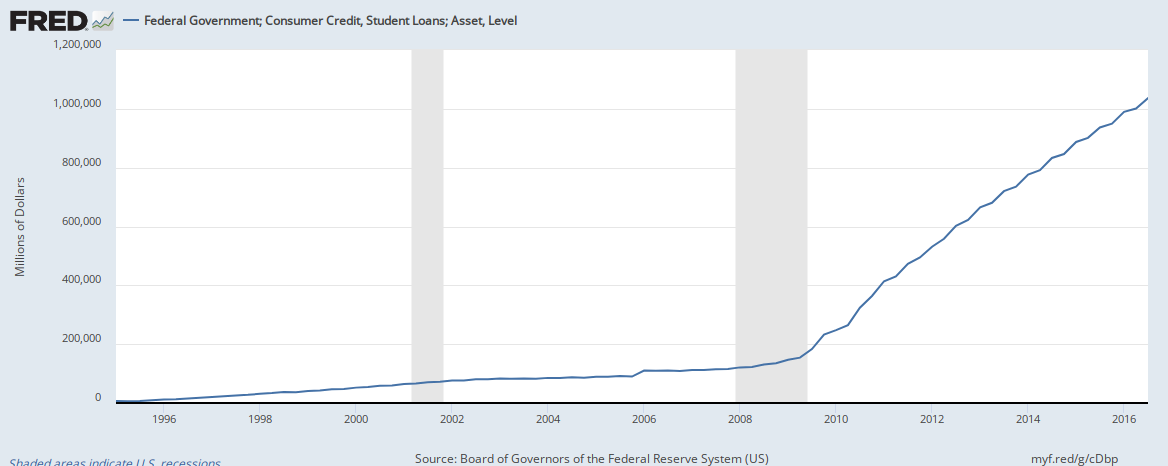
The single largest asset on the Federal government’s balance sheet is Student Loans — the amount students owe to the federal government.

And the following graph — Federal government; consumer credit, student loans; asset, Level — came from the St. Louis Fed:

 l

Here we see the massive increase in student indebtedness to the federal government, especially in just the past six years.

Quoting from the 2013 post titled, “Five reasons why we should eliminate school loans”:

Senator Elizabeth Warren and the New York Times have talked about student loans. The Times said:

Student Debt Slows Growth as Young Spend Less
By ANNIE LOWREY, Published: May 10, 2013

The anemic economy has left millions of younger working Americans struggling to get ahead. The added millstone of student loan debt, which recently exceeded $1 trillion in total, is making it even harder for many of them, delaying purchases of things like homes, cars and other big-ticket items and acting as a drag on growth, economists said.

Rather than stimulating America’s economic growth, college educations funded by loans actually “act as a drag on growth.”

Senator Warren said:

“Right now, a big bank can get a loan through the Federal Reserve discount window at a rate of about 0.75%,”

“But this summer, a student who is trying to get a loan to go to college will pay almost 7%. In other words, the federal government is going to charge students interest rates that are nine times higher than the rates for the biggest banks — the same banks that destroyed millions of jobs and nearly broke this economy.”

The federal government not only lends money to students — money it should give without asking for its return — but it charges students interest. And these are not low rates.

See the site: “Student Loan Hero”:

This image has an empty alt attribute; its file name is average-student-loan-rates.png

Impoverishing loans must be paid back with high interest rates.

If you wanted a plan to discourage college while also discouraging economic growth, this is it.

“Some may say that we can’t afford this proposal. I would remind them that the federal government currently makes 36 cents in profit on every dollar it lends to students. Add up all of those profits and you’ll find that student loans will bring in $34 billion next year.”

She’s beating the drum, but with the wrong stick.

The federal government making a profit on students is ridiculous.

Being Monetarily Sovereign, the government neither needs nor uses profits. All dollars sent to the federal government disappear from the money supply. In other words, they are destroyed upon receipt. Federal profits are a net loss to the economy.

Senator Warren complains about interest rates when she should complain about the loans themselves.

The big debate in Congress is how much interest to charge students. And there are several complex, convoluted plans afoot. But, the federal government never can run short of dollars. It never needs to ask anyone for dollars — not you, not me, not China, not our students.

It is the U.S. states that are monetarily non-sovereign, so can and do run short of dollars. Nevertheless, they spend billions to support schools, grades K through 12.

So college attendance — which benefits all of America — has become a widespread hardship.

If the monetarily non-sovereign states can support grades K-12, surely our Monetarily Sovereign government can and should support grades 13+.

We already have a model plan.  It’s called “Medicare.” Although there are differences between healthcare and education, we can learn from the parallels.

There are more than five thousand public and private hospitals in the United States. Each is unique in terms of geography, reputation, specialties, size, tuition, staff, etc.

Coincidentally, there are almost five thousand public and private colleges in the United states. Each is unique in terms of geography, reputation, specialties, size, costs, staff, etc.

Medicare has determined procedures for compensating the great variety of hospitals and healthcare personnel. Similar procedures could be used for compensating the great variety of colleges and educational personnel.

We could call the program “College-aid” or something similar.

Tuition, books & materials, tutoring, housing, and a meal stipend all would be covered according to limits set by “College-aid” — similar to the way Medicare pays.

Regarding college:

  1. College education helps America to be economically competitive.
  2. Federal deficit spending costs taxpayers nothing, and grows the economy.
  3. College loans discourage college attendance and damage the ability of college students to create new businesses.
  4. The federal government should institute a “College-aid” program, similar in methods to the Medicare program.

…………………………………………………………………………………………………………………..

The above focuses on college financing. K-12 financing has its own difficulties. Like college, which largely is financed by monetarily non-sovereign students and parents, K-12 is largely financed by monetarily non-sovereign state and local communities.

As with college education, and healthcare, the richer receive the best and the poorer receive the worst. But the biggest difference, regarding K-12, is not just the money spent on schools, but also the school and family environments.

Consider two high schools in Illinois, New Trier Township High School, and Dunbar High School, Chicago.

New Trier High School  straddles two upscale suburbs of Chicago. The following is from their website:

“New Trier offers a rigorous college preparatory curriculum and routinely ranks among Illinois’ very top schools for academic achievement.

“For the Class of 2014, New Trier’s mean composite score on the ACT was 27.4, the highest in Illinois for an open enrollment public school. Approximately 98 percent of the Class of 2014 enrolled in college.

“New Trier offers numerous opportunities for learning and involvement outside of the classroom in activities, athletics, fine/performing arts, and social service.

“Its 35 interscholastic athletic teams have won more athletic state championships than any high school in Illinois interscholastic history.

“New Trier also offers more than 150 student clubs, many with a service component. A comprehensive Student Services program serves students’ social and emotional growth in a variety of ways, from social work and special education services to student support groups and tutoring.

“Service Learning is also an important part of the New Trier experience, and students are asked to participate in service projects throughout their four years at the school.

Dumbar High School is located in Chicago. Its student population is 99% “low income.” It has a very modest website, but from what we can glean on the Internet, Dunbar’s mean composite score on the ACT was 14.4

Aside from the huge ACT difference, we see another difference: New Trier spends an average of $24K per student, while Dunbar spends an average of $10K.

The figures may not be directly comparable, because Dunbar doesn’t break out Operational spending from Educational spending, but two facts are clear: New Trier spends more and has better results; Dunbar spends less and has worse results.

And this is where the arguments begin. Is there a cause/effect relationship between school spending and results? There is plenty of research on both sides, but two things are clear:

  1. Learning environment counts. Lack of heating or air conditioning, lack of books, computers and other materials, lack of non-academics like music, art, and gym all mitigate against the average overall learning experience.
  2. Clubs and other social programs produce a more well-rounded learning experience.

While “throwing money at the problem,” won’t always produce better results — there are too many other variables in play — “starving the beast” is almost guaranteed to produce worse results.

So, where there may be doubt about how much per-pupil spending is best, one may wish to err on the higher side especially if money is free. 

And, that is the point.

Grades K-12 are funded by the public, either through state and local taxes or through direct tuitions. And unlike the federal government, the public has limited funds.

All states are financially challenged in that they are monetarily non-sovereign. Unlike federal taxpayers (who do not pay for federal spending), state and local taxpayers do pay for state and local government spending.

State and local taxpayers pay for one of the largest expenses each state has: K-12 education.

As a result of taxpayer resistance, many K-12 schools, especially schools in low-income areas, are insufficiently funded, some lacking even the most basic educational assets.

The federal government should fund grades K-12 and remove that financial burden from the states and cities, and from their taxpayers. The federal government also should fund grades 13+, and remove that financial burden from parents and students.

Because the U.S. federal government is Monetarily Sovereign, it neither has, nor can have, a financial “burden.” It creates dollars, ad hoc, by paying bills.

No defense can be made of a system in which the financially challenged are required to pay for a service the financially unchallenged should support.

Rodger Malcolm Mitchell
Monetary Sovereignty

………………………………………………………………………………………………………………………………………………………………………………………………………………………………………………………………………………………………………………………………………..

The single most important problems in economics involve the excessive income/wealth/power Gaps between the have-mores and the have-less.

Wide Gaps negatively affect poverty, health and longevity, education, housing, law and crime, war, leadership, ownership, bigotry, supply and demand, taxation, GDP, international relations, scientific advancement, the environment, human motivation and well-being, and virtually every other issue in economics.

Implementation of The Ten Steps To Prosperity can narrow the Gaps:

Ten Steps To Prosperity:
1. ELIMINATE FICA (Ten Reasons to Eliminate FICA )
Although the article lists 10 reasons to eliminate FICA, there are two fundamental reasons:
*FICA is the most regressive tax in American history, widening the Gap by punishing the low and middle-income groups, while leaving the rich untouched, and
*The federal government, being Monetarily Sovereign, neither needs nor uses FICA to support Social Security and Medicare.
2. FEDERALLY FUNDED MEDICARE — PARTS A, B & D, PLUS LONG TERM CARE — FOR EVERYONE (H.R. 676, Medicare for All )
This article addresses the questions:
*Does the economy benefit when the rich can afford better health care than can the rest of Americans?
*Aside from improved health care, what are the other economic effects of “Medicare for everyone?”
*How much would it cost taxpayers?
*Who opposes it?”
3. PROVIDE A MONTHLY ECONOMIC BONUS TO EVERY MAN, WOMAN AND CHILD IN AMERICA (similar to Social Security for All) (The JG (Jobs Guarantee) vs the GI (Guaranteed Income) vs the EB (Guaranteed Income)) Or institute a reverse income tax.
This article is the fifth in a series about direct financial assistance to Americans:

Why Modern Monetary Theory’s Employer of Last Resort is a bad idea. Sunday, Jan 1 2012
MMT’s Job Guarantee (JG) — “Another crazy, rightwing, Austrian nutjob?” Thursday, Jan 12 2012
Why Modern Monetary Theory’s Jobs Guarantee is like the EU’s euro: A beloved solution to the wrong problem. Tuesday, May 29 2012
“You can’t fire me. I’m on JG” Saturday, Jun 2 2012

Economic growth should include the “bottom” 99.9%, not just the .1%, the only question being, how best to accomplish that. Modern Monetary Theory (MMT) favors giving everyone a job. Monetary Sovereignty (MS) favors giving everyone money. The five articles describe the pros and cons of each approach.
4. FREE EDUCATION (INCLUDING POST-GRAD) FOR EVERYONE (See also: Five reasons why we should eliminate school loans)
Monetarily non-sovereign State and local governments, despite their limited finances, support grades K-12. That level of education may have been sufficient for a largely agrarian economy, but not for our currently more technical economy that demands greater numbers of highly educated workers.
Because state and local funding is so limited, grades K-12 receive short shrift, especially those schools whose populations come from the lowest economic groups. And college is too costly for most families.
An educated populace benefits a nation, and benefitting the nation is the purpose of the federal government, which has the unlimited ability to pay for K-16 and beyond.
5. SALARY FOR ATTENDING SCHOOL
Even were schooling to be completely free, many young people cannot attend, because they and their families cannot afford to support non-workers. In a foundering boat, everyone needs to bail, and no one can take time off for study.
If a young person’s “job” is to learn and be productive, he/she should be paid to do that job, especially since that job is one of America’s most important.
6. ELIMINATE CORPORATE TAXES
Corporations themselves exist only as legalities. They don’t pay taxes or pay for anything else. They are dollar-transferring machines. They transfer dollars from customers to employees, suppliers, shareholders and the government (the later having no use for those dollars).
Any tax on corporations reduces the amount going to employees, suppliers and shareholders, which diminishes the economy. Ultimately, all corporate taxes come around and reappear as deductions from your personal income.
7. INCREASE THE STANDARD INCOME TAX DEDUCTION, ANNUALLY. (Refer to this.) Federal taxes punish taxpayers and harm the economy. The federal government has no need for those punishing and harmful tax dollars. There are several ways to reduce taxes, and we should evaluate and choose the most progressive approaches.
Cutting FICA and corporate taxes would be a good early step, as both dramatically affect the 99%. Annual increases in the standard income tax deduction, and a reverse income tax also would provide benefits from the bottom up. Both would narrow the Gap.
8. TAX THE VERY RICH (THE “.1%) MORE, WITH HIGHER PROGRESSIVE TAX RATES ON ALL FORMS OF INCOME. (TROPHIC CASCADE)
There was a time when I argued against increasing anyone’s federal taxes. After all, the federal government has no need for tax dollars, and all taxes reduce Gross Domestic Product, thereby negatively affecting the entire economy, including the 99.9%.
But I have come to realize that narrowing the Gap requires trimming the top. It simply would not be possible to provide the 99.9% with enough benefits to narrow the Gap in any meaningful way. Bill Gates reportedly owns $70 billion. To get to that level, he must have been earning $10 billion a year. Pick any acceptable Gap (1000 to 1?), and the lowest paid American would have to receive $10 million a year. Unreasonable.
9. FEDERAL OWNERSHIP OF ALL BANKS (Click The end of private banking and How should America decide “who-gets-money”?)
Banks have created all the dollars that exist. Even dollars created at the direction of the federal government, actually come into being when banks increase the numbers in checking accounts. This gives the banks enormous financial power, and as we all know, power corrupts — especially when multiplied by a profit motive.
Although the federal government also is powerful and corrupted, it does not suffer from a profit motive, the world’s most corrupting influence.
10. INCREASE FEDERAL SPENDING ON THE MYRIAD INITIATIVES THAT BENEFIT AMERICA’S 99.9% (Federal agencies)Browse the agencies. See how many agencies benefit the lower- and middle-income/wealth/ power groups, by adding dollars to the economy and/or by actions more beneficial to the 99.9% than to the .1%.
Save this reference as your primer to current economics. Sadly, much of the material is not being taught in American schools, which is all the more reason for you to use it.

The Ten Steps will grow the economy, and narrow the income/wealth/power Gap between the rich and you.

MONETARY SOVEREIGNTY