Twitter: @rodgermitchell; Search #monetarysovereignty
Facebook: Rodger Malcolm Mitchell
………………………………………………………………………………………………………………………………………………………………………….. It takes only two things to keep people in chains: The ignorance of the oppressedand the treachery of their leaders..
………………………………………………………………………………………………………………………………………………………………………………
The essence of the article is: President Trump had the legal right to fire Comey, so stop pretending he committed a crime.
Here are a few excerpts:
A dangerous argument is now being put forward by some Democratic ideologues: namely that President Trump should be indicted for the crime of obstructing justice because he fired FBI Director James Comey.
Whatever one may think of the President’s decision to fire Comey as a matter of policy, there is no legitimate basis for concluding that the President engaged in a crime by exercising his statutory and constitutional authority to fire director Comey.
For something to be a crime there must be both an actus reus and mens rea – that is, a criminal act accompanied bya criminal state of mind. Even assuming that President Trump was improperly motivated in firing Comey, motive alone should never constitute a crime.
I agree with much of Professor Dershowitz’s comments in the original article, though surprisingly he is wrong that a criminal state of mind is necessary for something to be a crime. (Consider speeding. Ignorance of the law is no excuse — “ignorantia legis neminem excusat.”)
Motive and opportunity are prime pieces of evidence. Trump had both.
In any event, I suggest the good professor may be missing important evidentiary factors: Character evidence and circumstantial evidence, both relating to a pattern of activity.
Suppose a man parks every day outside a woman’s home. No crime there, unless she can demonstrate he is stalking her.
And suppose the man recently had participated in an acrimonious divorce from the woman — a divorce in which he had lost custody of his children and most of his money. No crime, though there may be motive.
And suppose the man told a friend he hated the woman. No crime. And suppose the man recently purchased a chainsaw. Still, no crime.
And then, one day, the police find that the woman was killed with a chainsaw, which was left at the scene, and later found to be of the same brand that the man had purchased.
And the day after the murder, the man stopped parking in front of the woman’s house.
He has washed his clothes so thoroughly that if there were any traces of blood, they would have been eliminated.
Further, the man previously had been convicted of murder, despite his strong denials.
When the man is confronted by a TV reporter, he tells the reporter three conflicting stories about his whereabouts at the time of the murder.
Finally, the man offers employment to the police officers who are investigating the murder.
There would seem to be a great deal of circumstantial evidence. The man has established a pattern of lying, covering up, and committing murder.
At this stage Dershowitz again might say, “there is no legitimate basis for concluding that the man engaged in a crime.”
Donald Trump has patterns, too. He is the most astounding liar, perhaps in the entire history of the White House. He has told multiple stories about multiple events, and at least three different stories about the firing itself.
During his campaign, he was found to have lied more often than any other candidate. He has been sued thousands of times, and given that extraordinary number, he surely has lied multiple times.
He has established criminality, for which most people would have been jailed, but from which he extricated himself by paying $25 million (Trump University).
He has participated in cover-ups, including telling his voters he would release his tax returns and then refused.
And now Trump has fired the man who was assigned to learn the facts.
At what point then, does a pattern present itself? At what point is character andcircumstantial evidence too powerful to be ignored? At what point does Professor Dershowitz allow the public the right to chant, “Lock ‘im up”?
Yes, innocent until proven guilty. I agree with that. And if (when?) Trump is impeached, it should be based on strong evidence.
Meanwhile, we cannot be naive. The man still is working the most powerful job in the world. He still is a danger to us all — to the entire world.
Only by chanting “lock ‘im up” can we, the public, force his reluctant political party to do a proper investigation.
The Republicans have ignored all evidence to date, and have remained firm in their support for Trump. They do not exhibit concern about his lies and his prior acts. They do not demonstrate any desire to learn the truth.
Seemingly, they fear only one thing: An angry electorate.
So yes, people, scream “Lock ‘im up,” ’til you’re hoarse. Don’t let this travesty be buried by those who will aid and abet criminality, just to remain in power.
Don’t be lulled by calming, legal words from a professor.
Be angry. Be damn angry. Make your anger force a real investigation.
•All we have are partial solutions; the best we can do is try.
•Those, who do not understand the differences between Monetary Sovereignty and monetary non-sovereignty, do not understand economics.
•Any monetarily NON-sovereign government — be it city, county, state or nation — that runs an ongoing trade deficit, eventually will run out of money no matter how much it taxes its citizens.
•No nation can tax itself into prosperity, nor grow without money growth.
•Cutting federal deficits to grow the economy is like applying leeches to cure anemia.
•A growing economy requires a growing supply of money (GDP = Federal Spending + Non-federal Spending + Net Exports)
•Deficit spending grows the supply of money
•The limit to federal deficit spending is an inflation that cannot be cured with interest rate control. The limit to non-federal deficit spending is the ability to borrow.
•Progressives think the purpose of government is to protect the poor and powerless from the rich and powerful. Conservatives think the purpose of government is to protect the rich and powerful from the poor and powerless.
Twitter: @rodgermitchell; Search #monetarysovereignty
Facebook: Rodger Malcolm Mitchell
………………………………………………………………………………………………………………………………………………………………………….. It takes only two things to keep people in chains: The ignorance of the oppressedand the treachery of their leaders..
………………………………………………………………………………………………………………………………………………………………………………
“Today, we witness the meaning of America. Cut Social Security; cut Medicare; cut Medicaid; cut federal employment; cut payments to the millions of people who rely on federal payments; cut immigration.
“Today, we are led by moral and intellectual midgets, frightened little cowards, selfishly clinging to what they have amassed for themselves, uncaring about others, who now that they are here, would build a wall of meanness around America, to prevent others from achieving the American Dream.
“It’s bad economics. It’s not the world’s moral leader, the America in which we like to believe. It’s small. It’s wicked. It’s selfish. It’s stupid. It’s just, plain mean.
“They are here only because they or their ancestors were given sanctuary by benevolent Americans, and now, this is their mantra of meanness: ‘Screw you. I’ve got mine.'”
This was written well before the Trump tragedy for America began.
The post examined three, anti-immigration lies being told at that time, by the GOP Congress:
The U.S. is too crowded. We have no room for more aliens.
These aliens will take our jobs.
These aliens will use up our services like Social Security, Medicare, food stamps, etc.
Today, it is clear that under Trump, the cruel lies have multiplied:
1. His new budget comes down especially hard on the poor–imposing unprecedented cuts in low-income housing, job training, food assistance, legal services, help to distressed rural communities, nutrition for new mothers and their infants, funds to keep poor families warm, even “meals on wheels.”
2. Trump and his enablers in the GOP are on the way to repealing the Affordable Care Act, and replacing it in a way that could cause 14 million Americans to lose their health insurance next year, and 24 million by 2026 — to give $600 billion in tax cuts over the decade mostly to wealthy Americans.
3. Trump is banning Syrian refugees and slashing the total number of refugees this year by more than half. This comes just when the world is experiencing the worst refugee crisis since World War II.
4. Trump is rounding up undocumented immigrants helter-skelter – including people who have been productive members of our society for decades, and young people who have been here since they were toddlers.
Trump is not an anomaly. Trump is not a loose cannon. Trump is not crazy. Donald Trump is a perfect reflection of what the Republican Party has espoused — an increasingly cruel, selfish, unAmerican theology — since the Newt Gingrich and Dick Armey “Contract With America” in 1994.
Among the bills that emerged from the “Contract” were:
The “Fiscal Responsibility Act,” that would require a dramatic cut to Social Security, Medicare, Medicaid and other programs that benefit the 99% of Americans, while cutting taxes on the rich.
The “Taking Back Our Streets Act”, based on the proven-false premise that harsh laws and long prison terms were the way to cut street crimes committed by the poor. (No punishment provisions were included for the white collar crimes committed by the rich — the crimes that caused the “Great Recession.”)
The “Personal Responsibility Act” to punish teen pregnancy by eliminating aid to mothers under 18, limiting Aid to Families with Dependent Children, and limiting unemployment compensation — all under the GOP doctrine that the poor are not victims of circumstance, but instead are lazy, criminal malingerers, who must be punished for their sloth.
The “Common Sense Legal Reform Act” to protect businesses from so-called “frivolous litigation,” which included terms making damage suits by the average person against the rich corporations almost impossible.
For more than two decades, the Republican Party has based its appeal on the notion that the rich inherently are good and moral, while the rest of us must be controlled, like wild animals, with severe punishments for any breach, and especially for not being rich.
Interestingly, many of the very people victimized by this austere philosophy, have embraced it as a reflection of “Gap Psychology,”the desire to distance oneself from those below on any social scale.
Demonizing those less fortunate is an integral part of that psychology.
Thus the increasingly evil cruelty, lies, and selfishness of a Donald Trump is the natural evolution of the inhumanity the GOP has promulgated, and what too many Americans now have endorsed.
This country was founded on the belief that the “poor and huddled masses yearning to breathe free” were intellectually and morally equivalent, if not superior, to the imperial princes of wealth. We were proud to be the “common man.”
•All we have are partial solutions; the best we can do is try.
•Those, who do not understand the differences between Monetary Sovereignty and monetary non-sovereignty, do not understand economics.
•Any monetarily NON-sovereign government — be it city, county, state or nation — that runs an ongoing trade deficit, eventually will run out of money no matter how much it taxes its citizens.
•No nation can tax itself into prosperity, nor grow without money growth.
•Cutting federal deficits to grow the economy is like applying leeches to cure anemia.
•A growing economy requires a growing supply of money (GDP = Federal Spending + Non-federal Spending + Net Exports)
•Deficit spending grows the supply of money
•The limit to federal deficit spending is an inflation that cannot be cured with interest rate control. The limit to non-federal deficit spending is the ability to borrow.
•Progressives think the purpose of government is to protect the poor and powerless from the rich and powerful. Conservatives think the purpose of government is to protect the rich and powerful from the poor and powerless.
Twitter: @rodgermitchell; Search #monetarysovereignty
Facebook: Rodger Malcolm Mitchell
………………………………………………………………………………………………………………………………………………………………………….. It takes only two things to keep people in chains: The ignorance of the oppressedand the treachery of their leaders..
………………………………………………………………………………………………………………………………………………………………………………
Following the “Great Recession” of 2008, our economy has grown at an achingly slow pace. Look at the graph (below) and compare the past ten years with the period beginning 1972 (the year in which the U.S. went off a gold standard and became more completely Monetarily Sovereign):
GDP Growth Line (Vertical bars are recessions)
Meanwhile, the Gaps between the richer and poorer, as expressed by the GINI ratio, (below) have widened. [A Gini ratio of 0 indicates perfect equality, where everyone has the same income. A Gini ratio of 1 indicates total inequality, where one person has all the income]:
Income inequality has grown substantially in the past 50 years
In short, the economy has grown quite slowly, while the rich have become relatively richer, and the poor have become relatively poorer.
We have suggested the Ten Steps to Prosperity (see section below), as a process by which the economy can grow faster and the Gap can shrink. Some of those steps require significant changes in federal law, together with significant bureaucratic expansions.
But there is one Step that requires only minuscule changes in federal law together with a reduction in the bureaucracy: Step 1. Eliminate the FICA tax.
FICA is the most regressive tax in America, punishing lower-income, salaried workers, while barely touching higher income salaried workers, and having no effect on people who get their incomes from non-salary sources — mostly the retired and the rich.
Corporations submit half of all FICA collected, but corporations don’t actually “pay” taxes. They merely are legal conduits between customers and corporate employees and owners. Functionally, employees pay all FICA taxes; corporate managers consider FICA to be as much a cost of paying employees as are salaries.
The Federal government neither needs nor uses FICA dollars. Being Monetarily Sovereign, the federal government creates dollars ad hoc, every time it pays a bill. Tax dollars you send to the Treasury cease to be part of the money supply. Your tax dollars effectively are destroyed.
The elimination of FICA would add a $1 trillion+ to the money supply, which would stimulate the economy by increasing Non-federal Spending:
Gross Domestic Product = Federal Spending + Non-federal Spending + Net Exports.
With GDP growth averaging about 4% in the past ten years, an additional 5% growth (to 9%) would be quite significant — similar to the growth rate in the 1971-1981 period.
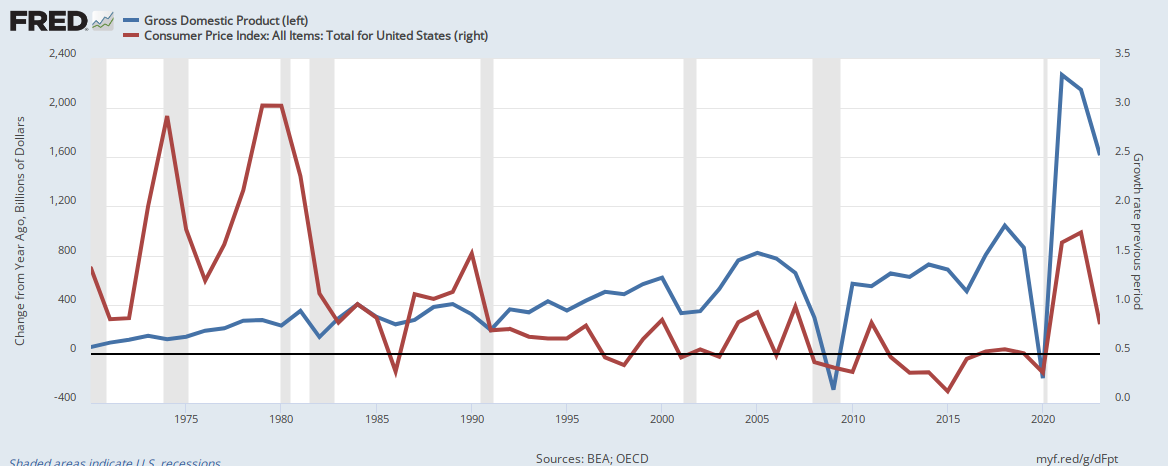
This brings us to the subject of inflation. There have been many changes to the methods for calculating inflation (a general increase in prices), and these changes have resulted in somewhat different results.
But, there does not seem to have been a relationship between GDP increases and inflation. (See graph below.)
GDP increases were not marked by inflation
While an increase in the Supply of money is inflationary, an increase in the Demand for money is deflationary: Value = Demand/Supply.
The Demand for money is based on the formula: Demand = Reward/Risk.
Interest is the Reward for owning money. The Federal Reserve controls inflation to its target rate (2%-3%) by increasing the Reward, i.e. by increasing interest rates.
We cannot end this article without referring to the brainwashing conducted by our thought leaders, including the U.S. government.
Social Security benefits are paid from the reserves of the Old-Age, Survivors, and Disability Insurance (OASDI) trust fund.
The reserves are funded from dedicated tax revenues and interest on accumulated reserve holdings, which are invested in Treasury securities.
There is no “trust fund” for Social Security any more than there is a “trust fund” for other federal agencies.
Have you ever wondered why there is no “trust fund” to pay for the military, or for the White House, or Congress, or for the Supreme Court, or the CIA, the FBI, NSA, or any other agency you can mention? Have you ever wondered why no one claims these agencies soon will be
Have you ever wondered why no one claims these agencies soon will be insolvent?
The reason: The Social Security “trust fund” is an accounting fiction. It pays for nothing. Social Security and Medicare benefits are paid the same way as Congress’s salaries: By federal deficit spending.
“Trust fund” balances are available to finance future benefit payments and other trust fund expenditures–but only in a bookkeeping sense.
These funds are not set up to be pension funds, like the funds of private pension plans. They do not consist of real economic assets that can be drawn down in the future to fund benefits. Instead, they are claims on the Treasury.
The fake “trust fund” merely is a group of balance sheet notations, completely controlled by the government. The “trust fund assets” consist of nothing more than “liabilities” of the U.S. Treasury. All the “trust fund” owns is what the Treasury owes it.
Thus, rather than paying Social Security and Medicare benefits out of a non-existent “trust fund,” the Treasury could pay benefits directly. If the “trust fund” ceased to exist, this would have zero effect on the Treasury’s ability to pay Social Security and Medicare benefits.
The next time you read an article or see a graph telling you the Social Security trust fund will run short funds at some future date, know you are being treated to The Big Lie — the lie that federal taxes fund federal spending.
While state and local taxes do fund state and local spending, federal taxes do not fund federal spending. The federal government creates dollars, ad hoc, by spending, and never can run short of dollars.
Even if all federal tax collections fell to $0, the federal government could continue spending, forever.
IN SUMMARY:
Growing the economy, narrowing the Gap, and controlling inflation are three of the most important financial responsibilities of the federal government. These responsibilities could be accomplished easily and simply by eliminating the useless and harmful FICA tax.
If we eliminated FICA tomorrow, you instantly would begin to reap the economic benefits.
The single most important problems in economics involve the excessive income/wealth/power Gaps between the have-mores and the have-less.
Wide Gaps negatively affect poverty, health and longevity, education, housing, law and crime, war, leadership, ownership, bigotry, supply and demand, taxation, GDP, international relations, scientific advancement, the environment, human motivation and well-being, and virtually every other issue in economics.
Implementation of The Ten Steps To Prosperity can narrow the Gaps:
Ten Steps To Prosperity: 1. ELIMINATE FICA (Ten Reasons to Eliminate FICA ) Although the article lists 10 reasons to eliminate FICA, there are two fundamental reasons: *FICA is the most regressive tax in American history, widening the Gap by punishing the low and middle-income groups, while leaving the rich untouched, and *The federal government, being Monetarily Sovereign, neither needs nor uses FICA to support Social Security and Medicare. 2. FEDERALLY FUNDED MEDICARE — PARTS A, B & D, PLUS LONG TERM CARE — FOR EVERYONE (H.R. 676, Medicare for All ) This article addresses the questions:
*Does the economy benefit when the rich can afford better health care than can the rest of Americans?
*Aside from improved health care, what are the other economic effects of “Medicare for everyone?”
*How much would it cost taxpayers?
*Who opposes it?”
3. PROVIDE A MONTHLY ECONOMIC BONUS TO EVERY MAN, WOMAN AND CHILD IN AMERICA (similar to Social Security for All) (The JG (Jobs Guarantee) vs the GI (Guaranteed Income) vs the EB (Economic Bonus)) Or institute a reverse income tax.
This article is the fifth in a series about direct financial assistance to Americans:
Economic growth should include the “bottom” 99.9%, not just the .1%, the only question being, how best to accomplish that. Modern Monetary Theory (MMT) favors giving everyone a job. Monetary Sovereignty (MS) favors giving everyone money. The five articles describe the pros and cons of each approach.
4. FREE EDUCATION (INCLUDING POST-GRAD) FOR EVERYONE Five reasons why we should eliminate school loans
Monetarily non-sovereign State and local governments, despite their limited finances, support grades K-12. That level of education may have been sufficient for a largely agrarian economy, but not for our currently more technical economy that demands greater numbers of highly educated workers.
Because state and local funding is so limited, grades K-12 receive short shrift, especially those schools whose populations come from the lowest economic groups. And college is too costly for most families.
An educated populace benefits a nation, and benefitting the nation is the purpose of the federal government, which has the unlimited ability to pay for K-16 and beyond.
5. SALARY FOR ATTENDING SCHOOL
Even were schooling to be completely free, many young people cannot attend, because they and their families cannot afford to support non-workers. In a foundering boat, everyone needs to bail, and no one can take time off for study.
If a young person’s “job” is to learn and be productive, he/she should be paid to do that job, especially since that job is one of America’s most important.
6. ELIMINATE FEDERAL TAXES ON BUSINESS
Businesses are dollar-transferring machines. They transfer dollars from customers to employees, suppliers, shareholders and the federal government (the later having no use for those dollars). Any tax on businesses reduces the amount going to employees, suppliers and shareholders, which diminishes the economy. Ultimately, all business taxes reduce your personal income.
7. INCREASE THE STANDARD INCOME TAX DEDUCTION, ANNUALLY. (Refer to this.) Federal taxes punish taxpayers and harm the economy. The federal government has no need for those punishing and harmful tax dollars. There are several ways to reduce taxes, and we should evaluate and choose the most progressive approaches.
Cutting FICA and business taxes would be a good early step, as both dramatically affect the 99%. Annual increases in the standard income tax deduction, and a reverse income tax also would provide benefits from the bottom up. Both would narrow the Gap. 8. TAX THE VERY RICH (THE “.1%) MORE, WITH HIGHER PROGRESSIVE TAX RATES ON ALL FORMS OF INCOME. (TROPHIC CASCADE)
There was a time when I argued against increasing anyone’s federal taxes. After all, the federal government has no need for tax dollars, and all taxes reduce Gross Domestic Product, thereby negatively affecting the entire economy, including the 99.9%.
But I have come to realize that narrowing the Gap requires trimming the top. It simply would not be possible to provide the 99.9% with enough benefits to narrow the Gap in any meaningful way. Bill Gates reportedly owns $70 billion. To get to that level, he must have been earning $10 billion a year. Pick any acceptable Gap (1000 to 1?), and the lowest paid American would have to receive $10 million a year. Unreasonable.
9. FEDERAL OWNERSHIP OF ALL BANKS (Click The end of private banking and How should America decide “who-gets-money”?)
Banks have created all the dollars that exist. Even dollars created at the direction of the federal government, actually come into being when banks increase the numbers in checking accounts. This gives the banks enormous financial power, and as we all know, power corrupts — especially when multiplied by a profit motive.
Although the federal government also is powerful and corrupted, it does not suffer from a profit motive, the world’s most corrupting influence.
10. INCREASE FEDERAL SPENDING ON THE MYRIAD INITIATIVES THAT BENEFIT AMERICA’S 99.9% (Federal agencies)Browse the agencies. See how many agencies benefit the lower- and middle-income/wealth/ power groups, by adding dollars to the economy and/or by actions more beneficial to the 99.9% than to the .1%.
Save this reference as your primer to current economics. Sadly, much of the material is not being taught in American schools, which is all the more reason for you to use it.
The Ten Steps will grow the economy, and narrow the income/wealth/power Gap between the rich and you.
Twitter: @rodgermitchell; Search #monetarysovereignty
Facebook: Rodger Malcolm Mitchell
………………………………………………………………………………………………………………………………………………………………………….. It takes only two things to keep people in chains: The ignorance of the oppressedand the treachery of their leaders..
………………………………………………………………………………………………………………………………………………………………………………
Have you ever asked yourself, “Why do we need a national government?”
Probably not, because except for the relatively few extreme Libertarians, most of us understand that anarchy is a bad solution for human society.
But why? What is the purpose of government? I suggest the purpose of government can be summarized in one word: “Protection.”
Government is designed to protect the weak from the strong, the good from the evil, the domestic from the foreign. Government protects us from bad people, bad water, bad food or no food at all.
If a government doesn’t provide protection, why have a government?
Freedom, choice, and liberty
Imagine you find a magic lamp. You rub it and out pops a genie who says, “I am the American Genie. I can do anything for America.
“I can feed, house and clothe the poor, educate the children, care for the sick and the elderly, support the arts, fight crime, and protect the nation from its enemies. No limits.
“And it will cost you absolutely nothing. You just have to tell me what to do.”
What will you tell the genie to do? Anything? Nothing?
Would you have the genie help the unfortunate, or would you withhold help and instead, demand self-sufficiency by the poor? Would you help feed the poor, or would you say that helping them makes them dependent?
Would you let some children suffer and die as a lesson to others? Would you feel that helping them takes away their freedoms?
Would you have the genie fight crime or would you feel that the genie already was too powerful and should be made smaller?
The U.S. government is the “genie.” Being Monetarily Sovereign, its wealth is unlimited. It can afford anything. Its spending costs you nothing. Even if all federal tax collections fell to $0, the federal government could continue spending forever.
Financially, the U.S. federal government has the ability to provide food, housing, clothing and health care for everyone — but should it?
These are the questions that face all governments, even those that are not Monetarily Sovereign. These are the questions that define the fundamental differences between liberals and conservatives.
Here are excerpts from a New York Times article that deals with these questions:
A Republican Principle Is Shed in the Fight on Health Care
By Jeremy W. Peters, http://www.nytimes.comView OriginalMay 8th, 2017
WASHINGTON — As they take their victory lap for passing a bill that would repeal and replace much of the Affordable Care Act, President Trump and congressional Republicans have been largely silent about one of the most remarkable aspects of what their legislation would do: take a step toward dismantling a vast government entitlement program, something that has never been accomplished in the modern era.
All government programs are “entitlement,” in that each program is supported by those who believe Americans are entitled to the service.
Is the military an “entitlement” program? As an American, are you “entitled” to military protection?
Are food, water, and drug inspection “entitlement” programs? Are you “entitled” to clean, food and water, and safe drugs?
Are you “entitled” to protection from dishonest bankers and contractors, protection from tornados, hurricanes, and floods, protection from burglars and robbers?
Are our children entitled to good schools, warm clothing, and a safe, healthy environment, even if we are poor?
Are you, as an American, entitled to medical care and other protections you cannot afford to buy for yourself. Are these the sort of protections you would want your government “genie” to provide?
Which exactly are the “entitlement” programs you feel the government should not provide, if any?
Fighting the expansion of the so-called welfare state is a fundamental premise of the American conservative movement.
“Welfare state” is a term that, like “entitlement program,” is what the government does for poorer people. The term does not seem to include benefits to the rich, like tax benefits and other “first-in-line” benefits, which are “just rewards.”
So conservatives have now cast aside their high-minded arguments of political principle . . . the free market, personal responsibility and smaller government.
If you are a conservative, what exactly is a “free market”? How does it work? Is it similar to a lawless market?
And what is “personal responsibility.” For what should a person be responsible vs. for what should a government be responsible?
And how do you define a “smaller” government? How many people should the federal government employ? How much money should it spend?
What is the purpose of a “smaller” government?
Conservatives had pushed Congress to pass a clean repeal bill in the first days of Mr. Trump’s presidency. They feared that the longer they waited, the more time Democrats would have to argue that Republicans wanted to callously rip benefits away from hard-working Americans.
But if Republicans don’t want to “callously rip benefits away from hard-working Americans,” what exactly do they want regarding benefits to hard-working Americans?
With new government benefits, he said, comes incredible political power.
Is it “political power,” not “entitlements,” that the discussion really is all about?
William Voegeli, a senior editor at the Claremont Review of Books, a conservative journal, pointed to a long list of government programs that Republicans have promised to defund or eliminate — the National Endowment for the Arts, public broadcasting, the Department of Education and, of course, the Affordable Care Act — amid the expansion of the liberal “administrative state,” to use a term popular inside the Trump administration.
You are a citizen of the United States. The government is aMonetarily Sovereign “genie,” so the National Endowment for the Arts, public broadcasting, the Department of Education and Affordable Care Act cost you nothing.
How would your life be better without these programs that cost you nothing?
“You run on election cycle after election cycle with Republicans complaining but never taking the obvious next step,” Voegeli said. “And eventually you’re going to get a lot of restless conservatives out there.”
Who are the “restless conservatives out there”? Are they the rich or are they the rest of us? Is it we “not-rich,” who don’t want the American government “genie” to provide free benefits to the people?
Conservative columnist Charles Krauthammer said Republicans had “accepted the fact that the electorate sees health care as not just any commodity, like purchasing a steak or a car. It’s something now people have a sense the government ought to guarantee.”
Are you among those conservatives who believe the government “genie” should not provide free health care? If so, why?
Then Mr. Trump, who had campaigned on preserving programs, like Social Security, Medicare and Medicaid, that his party had aimed at in the past, said on Twitter less than two weeks before Inauguration Day that a replacement must accompany a repeal — much to the surprise of Mr. Ryan and the party leadership on Capitol Hill.
The complexity of unraveling the Affordable Care Act became evident to Republicans even before Mr. Trump was sworn in, as they started planning their legislative agenda for his first 100 days. Led by Speaker Paul D. Ryan, the party assumed that a repeal would be one of the first items — if not the first — on its calendar.
Why would you say that the Republicans had “aimed at” Social Security, Medicare, and Medicaid?” How would you have benefitted if these programs had been cut?
What would have happened if ACA simply had been repealed? Why did Ryan want to repeal it, without a replacement?
The health and human services secretary, Tom Price, told NBC News that the goal was something that Republicans usually dismissed as utopian fantasy: universal coverage.
“What we’re trying to do is to make certain that every single person has health coverage,” he said.
How would the Republicans make certain that “every single person has health coverage,” without federal funding? Why have Republicans dismissed universal health care coverage as a “utopian fantasy”? Do they really believe that the U.S. government is not Monetarily Sovereign?
Republicans in the past often framed the debate in terms of personal freedom, choice and liberty — as opposed to the soft tyranny that can come through well-meaning laws.
“The debate over power and authority here is really a slugfest over who makes key decisions,” said Robert E. Moffit, a senior fellow at the Heritage Foundation, “and whether the key decisions in health care ultimately should end up in the hands of a government office or in the hands of individuals who are exercising free choice.”
How does single payer health care insurance impinge on “personal freedom, choice, and liberty? What is the “choice” gained by people who financially are forced to do without insurance?
Here are six false beliefs that bedevil the discussion of universal health care funded by the federal government:
1. The false belief that the federal government is not Monetarily Sovereign, that federal taxes fund spending, and that with a federal single-payer system, healthy people pay for sick people.
The reality is that the federal government isMonetarily Sovereign, neither needs nor uses tax dollars, and with federal single-payer, no one — neither the sick nor the healthy — needs to be made to pay for health care insurance.
2. The false believe that a smaller federal government would be less intrusive or oppressive than a larger federal government or a state or local government.
The reality is that life itself can be oppressive, especially for the poor, and providing benefits that otherwise would be unaffordable for the poor does not make a government oppressive. Federal benefits make life less oppressive.
Further, transferring obligations to the states, merely makes the states an extension of the “too big” federal government, and does not diminish the supposed “oppressiveness” of government. Such a transfer actually enlarges government.
3. The false belief that federal financial obligations are more affordable if transferred to state and local governments.
The reality is that state and local governments are monetarily non-sovereign, so their expenses are funded by taxpayers. Unlike federal health care support, when the states fund health care, the healthy do pay for the sick.
4. The false belief that state government provides more freedom of choice than does the local government.
The reality is that each person has their own needs and desires, and a state is even less likely to provide for these needs and desires than is the federal government, because of the financial constraints the states face.
Many states already have proved they care nothing about the well-being of their poorer residents by refusing to expand Medicaid, even when the federal government offered to pay for the expansion.
5. The false belief that the poor and middle-classes are lazy “takers,” who only want “free stuff,” and who need to be taught self-sufficiency.
The reality is that the poor and middle-classes on average, work harder than do the rich. They are not rich for lack of trying, but rather for lack of luck.
6. The false belief that federal benefit spending will cause hyperinflations like those experienced by Weimar Germany and Zimbabwe.
The reality is that the U.S. never has had a hyperinflation — not through wars, recessions, depressions or natural disasters.
Further, the Fed successfully controls inflations via interest rate control.
In Summary: There are no moral or logical reasons for denying federally-funded, comprehensive Medicare to every man, woman, and child in America. The federal government can afford it. It won’t cost anyone anything. And rather than being oppressive, free health care is liberating.
The rich don’t want it. They want to widen the Gap between the rich and the rest, so any benefits to the not-rich are an anathema.
The rich spend billions to brainwash the populace into advocating benefit restrictions on the not-rich. The use terms like “freedom,” “choice,” and “liberty,” when they really mean: The freedom to suffer, the choice of misery, and the liberty to be slaves to the rich.
In a great nation, there is no excuse for anyone being denied the finest health care, just because of finances. Donald Trump was right. We can “make America great again.” But cutting benefits is not the way to do it.
The single most important problems in economics involve the excessive income/wealth/power Gaps between the have-mores and the have-less.
Wide Gaps negatively affect poverty, health and longevity, education, housing, law and crime, war, leadership, ownership, bigotry, supply and demand, taxation, GDP, international relations, scientific advancement, the environment, human motivation and well-being, and virtually every other issue in economics.
Implementation of The Ten Steps To Prosperity can narrow the Gaps:
Ten Steps To Prosperity: 1. ELIMINATE FICA (Ten Reasons to Eliminate FICA ) Although the article lists 10 reasons to eliminate FICA, there are two fundamental reasons: *FICA is the most regressive tax in American history, widening the Gap by punishing the low and middle-income groups, while leaving the rich untouched, and *The federal government, being Monetarily Sovereign, neither needs nor uses FICA to support Social Security and Medicare. 2. FEDERALLY FUNDED MEDICARE — PARTS A, B & D, PLUS LONG TERM CARE — FOR EVERYONE (H.R. 676, Medicare for All ) This article addresses the questions:
*Does the economy benefit when the rich can afford better health care than can the rest of Americans?
*Aside from improved health care, what are the other economic effects of “Medicare for everyone?”
*How much would it cost taxpayers?
*Who opposes it?”
3. PROVIDE A MONTHLY ECONOMIC BONUS TO EVERY MAN, WOMAN AND CHILD IN AMERICA (similar to Social Security for All) (The JG (Jobs Guarantee) vs the GI (Guaranteed Income) vs the EB (Economic Bonus)) Or institute a reverse income tax.
This article is the fifth in a series about direct financial assistance to Americans:
Economic growth should include the “bottom” 99.9%, not just the .1%, the only question being, how best to accomplish that. Modern Monetary Theory (MMT) favors giving everyone a job. Monetary Sovereignty (MS) favors giving everyone money. The five articles describe the pros and cons of each approach.
4. FREE EDUCATION (INCLUDING POST-GRAD) FOR EVERYONE Five reasons why we should eliminate school loans
Monetarily non-sovereign State and local governments, despite their limited finances, support grades K-12. That level of education may have been sufficient for a largely agrarian economy, but not for our currently more technical economy that demands greater numbers of highly educated workers.
Because state and local funding is so limited, grades K-12 receive short shrift, especially those schools whose populations come from the lowest economic groups. And college is too costly for most families.
An educated populace benefits a nation, and benefitting the nation is the purpose of the federal government, which has the unlimited ability to pay for K-16 and beyond.
5. SALARY FOR ATTENDING SCHOOL
Even were schooling to be completely free, many young people cannot attend, because they and their families cannot afford to support non-workers. In a foundering boat, everyone needs to bail, and no one can take time off for study.
If a young person’s “job” is to learn and be productive, he/she should be paid to do that job, especially since that job is one of America’s most important.
6. ELIMINATE FEDERAL TAXES ON BUSINESS
Businesses are dollar-transferring machines. They transfer dollars from customers to employees, suppliers, shareholders and the federal government (the later having no use for those dollars). Any tax on businesses reduces the amount going to employees, suppliers and shareholders, which diminishes the economy. Ultimately, all business taxes reduce your personal income.
7. INCREASE THE STANDARD INCOME TAX DEDUCTION, ANNUALLY. (Refer to this.) Federal taxes punish taxpayers and harm the economy. The federal government has no need for those punishing and harmful tax dollars. There are several ways to reduce taxes, and we should evaluate and choose the most progressive approaches.
Cutting FICA and business taxes would be a good early step, as both dramatically affect the 99%. Annual increases in the standard income tax deduction, and a reverse income tax also would provide benefits from the bottom up. Both would narrow the Gap. 8. TAX THE VERY RICH (THE “.1%) MORE, WITH HIGHER PROGRESSIVE TAX RATES ON ALL FORMS OF INCOME. (TROPHIC CASCADE)
There was a time when I argued against increasing anyone’s federal taxes. After all, the federal government has no need for tax dollars, and all taxes reduce Gross Domestic Product, thereby negatively affecting the entire economy, including the 99.9%.
But I have come to realize that narrowing the Gap requires trimming the top. It simply would not be possible to provide the 99.9% with enough benefits to narrow the Gap in any meaningful way. Bill Gates reportedly owns $70 billion. To get to that level, he must have been earning $10 billion a year. Pick any acceptable Gap (1000 to 1?), and the lowest paid American would have to receive $10 million a year. Unreasonable.
9. FEDERAL OWNERSHIP OF ALL BANKS (Click The end of private banking and How should America decide “who-gets-money”?)
Banks have created all the dollars that exist. Even dollars created at the direction of the federal government, actually come into being when banks increase the numbers in checking accounts. This gives the banks enormous financial power, and as we all know, power corrupts — especially when multiplied by a profit motive.
Although the federal government also is powerful and corrupted, it does not suffer from a profit motive, the world’s most corrupting influence.
10. INCREASE FEDERAL SPENDING ON THE MYRIAD INITIATIVES THAT BENEFIT AMERICA’S 99.9% (Federal agencies)Browse the agencies. See how many agencies benefit the lower- and middle-income/wealth/ power groups, by adding dollars to the economy and/or by actions more beneficial to the 99.9% than to the .1%.
Save this reference as your primer to current economics. Sadly, much of the material is not being taught in American schools, which is all the more reason for you to use it.
The Ten Steps will grow the economy, and narrow the income/wealth/power Gap between the rich and you.