The human interim species: If we can’t save the pale blue dot, how can we save ourselves?

Twitter: @rodgermitchell; Search #monetarysovereignty
Facebook: Rodger Malcolm Mitchell

Mitchell’s laws:
•Those, who do not understand the differences between Monetary Sovereignty and monetary non-sovereignty, do not understand economics.
•Any monetarily NON-sovereign government — be it city, county, state or nation — that runs an ongoing trade deficit, eventually will run out of money.
•The more federal budgets are cut and taxes increased, the weaker an economy becomes. .
Liberals think the purpose of government is to protect the poor and powerless from the rich and powerful. Conservatives think the purpose of government is to protect the rich and powerful from the poor and powerless.
•The single most important problem in economics is
the Gap between rich and poor.
•Austerity is the government’s method for widening
the Gap between rich and poor.
•Until the 99% understand the need for federal deficits, the upper 1% will rule.
•Everything in economics devolves to motive, and the motive is the Gap between the rich and the rest..

===================================================================================================================================================================================================================================================================================

The human interim species: If we can’t save the pale blue dot, how can we save ourselves?

Within a hundred years, just about everyone you know, including you, will be dead. Logically, you should care nothing about what happens after that.

But you probably do.

Odds are, you would like to know that the human species will continue for many generations; many centuries. Built into our genes is the intuitive concern, not just for our own lives, but for the life of our species.

That is why, for instance, you probably care about climate change.

Most of the predicted bad effects of climate change will affect you very little. Most will not occur during your lifetime or even your children’s lifetimes.

Yet, you care.

Most species in world history were dead-end species. They evolved, and then, at a certain point, they simply died, leaving no heirs.

A few species were interim species, which eventually evolved to other species, and the line continues to today.

Every species alive today has descended from lines of interim species. These interim species neither expected to be, or tried to be, interim species.

They just tried to survive as species and to procreate under the circumstances and environment in which they lived.

When circumstances and the environment remain constant, species began to specialize, so to be better and better adapted. When circumstances and/or the environment change, species either die, adapt to the change or evolve to entirely new species.

And that is true of the human species.

Our survival has been based on our adaptability to a wide variety of circumstances and environments.

And now, despite climate change deniers, the climate really is changing, and there is a high probability the earth eventually will change so much as to be unlivable for the human species as we know it.

In short, we will become an interim species if we are lucky, and a dead-end species if we are not.

Consider that man-made climate change is but one of the eventualities we face. Atomic war, super-volcanos, meteor or comet impact, monster coronal discharge from the sun, a disease that sweeps the world, the sun grows larger until it engulfs the earth, a passing star disrupts earth’s orbit, the continents sink, a nearby supernova irradiates us — there are many possibilities for our extinction.

All species attempt to survive. Actually, the word “attempt” wrongly implies some conscious activity, when we aren’t talking about consciousness. We’re talking about the natural tenaciousness of life, clinging to the rock of existence, against the pounding waves of extinction.

Example: Some animals experience temperature-dependent sex determination. Some turtles birth more males at intermediate temperatures, and more females at extreme temperatures.

Though this seems to be a survival mechanism, it is doubtful the eggs are consciously thinking about the process. It’s automatic.

Any species, not having automatic survival mechanisms, dies.

Humans are a species, and like all species, we have subconscious survival mechanisms: Hunger, breathing, sleeping, sweating, running away, fighting back. and thinking.

And that brings us to the subject of this post.

At some point in the evolution of earth — the arrival of those eventualities we mentioned above — even our adaptability will be insufficient for survival.

We will die, evolve or transition into an interim species, but interim to what?

Depending on the nature of the eventualities, our descendants may need to survive high temperatures, acidic rain, high radiation, and polluted air and water, the destruction of the earth itself — physical insults living tissue cannot accommodate.

Things could get so bad, we may need to move to Mars or to the moons of Jupiter, Saturn and beyond — trips humans are unlikely to survive.

Built into the human genome is the urge to learn and to explore. That urge, perhaps even more than adaptability, may be an important key to our survival, for we incessantly seek improvement: “The grass is greener” syndrome.

In the name of learning and exploration, we have built computers and computer-run machines that are stronger, faster more resistant to the elements and even smarter in certain areas, than we are.

We are building ever more clever machines, that in ever more ways, can mimic and exceed our abilities to think, observe, sense, feel, act and react.

Why are we building such machines? Is it strictly a matter of our wanting convenience and economic progress, or is there a deeper urge?

Is the ongoing development of ever-more-human machines an intuitive survival process? Are we, without conscious intent, building the next species?

Consider an entity that has your thoughts and your emotions, but unshielded, can travel interstellar space. It (you) could go to Mars, surviving massive radiation and lack of water, build a colony, and be your perfect surrogate.

Are we building our descendants as our subconscious method to continue our existence?

The earth is a “pale, blue dot” in the cosmos (the barely visible white dot, nearly centered, in the topmost band):

monetary sovereignty

To say we are hanging on to life by our fingertips, would be a profound understatement. We are created to survive only on that tiny blue dot, and even then, only in very limited circumstances.

Long term, the best way for us to survive is to increase our odds, by spreading through the universe: Not one pale blue dot, but many. Not one sun, but many, or no need for a sun at all.

How will we do that? As humans we will not. Our human bodies cannot. Even our human brains cannot. But our thoughts can. Our essence can.

Artificial Intelligence (AI) is growing exponentially:

The future of artificial intelligence

The latest breakthroughs in artificial intelligence are the result of core advances in AI, including developments in machine learning, reasoning and perception, on a stage set by advances in multiple areas of computer science.

There also have been great strides in probabilistic modeling, in which computing systems consider uncertainties and make the best solution or recommendation, and machine learning, in which a computer gets better at something based on the data that it receives.

The new capabilities also are coming from advances in specific technologies, such as machine learning methods called neural networks, which can be trained from massive data sets to recognize objects in images or to understand spoken words.

Another promising effort is “integrative AI,” in which competencies including vision, speech, natural language, machine learning and planning are brought together to create more capable systems, such as one that can see, understand and converse with people.

Big technology companies are growing more dependent on building successful artificial intelligence-based systems.

“AI has become more central to the competitive landscape for these companies.”

Though some believe no machine ever can be as intelligent as a human, that really isn’t true. The AI problem is hard, but not impossible.

Think: Why do we so dearly desire to create machines that think like us? Why do we take such delight in a machine that can, for instance, recognize faces — something a month old child can do?

What is the evolutionary purpose of this delight?

Is it part of our species’ genetic desire to survive?

Many groups have been formed to help assure the survival of our species. Consider the hundreds (thousands) of environmental groups, public and private: Here and here.

Many organizations are involved in plans to protect the earth from a collision with a large asteroid.

Many others plan for pandemics.

There are peace organizations.

Astronomers look to spot threats to earth. Medical researchers look to cure threats to life. The list goes on and on, thousands of organizations, millions of people dedicated to saving the human species — each focused on a particular problem.

They face two problems:

1. Despite having the same fundamental goal — saving the human species — they aren’t coordinated.

Some want to find easier ways to desalinate water; some want to intercept giant meteors; some want to ban atomic bombs; some want to walk on Mars. All have the potential for saving the human species from extinction, but there is no central “Anti-extinction Agency.”

2. They are underfunded.

The reason they aren’t coordinated and are underfunded is: Despite our standing tiptoe on the precipice known as the “pale, blue dot, there is little emotional concern that the extinction of our species is a real danger.

So, rather than increase funding for the various sciences that could help prevent extinction, we underfund them. Then when something bad happens, and it will, we will be caught short, and if it’s bad enough, our species will end . . .

. . . unless by then, we have created AI sufficiently powerful to do what we logically should, and if necessary, to take our place.

Logic dictates that taking preventative action should be in proportion to the penalty for not taking it. Death of our species is a pretty strong penalty.

And given all the possible threats and all the possible actions, the development of AI should be at the top of our action list, for ultimately it could provide a pathway to all other solutions.

Bottom line: I suggest that the development of AI is of overriding existential importance, both near-term and long-term.

Near-term it can help us anticipate, prevent and cure species-ending disasters..

Long-term, it can be our proxy, spreading through the universe.

Atomic energy was funded by the federal government. It did not wait for private industry.

NASA was a federally funded program that took us to the moon. The U.S. did not wait for private industry. (Now, many years later, privately funded spaceflight still is in its infancy).

Similarly, the federal government should fund AI as a massive “NASA-like,” “Manhattan Project-like” program, and not wait for private industry.

If you think AI represents a “Terminator” type existential threat, remember this: We already face several existential threats of our own making.

Rodger Malcolm Mitchell
Monetary Sovereignty

===================================================================================
Ten Steps to Prosperity:
1. Eliminate FICA (Click here)
2. Federally funded Medicare — parts A, B & D plus long term nursing care — for everyone (Click here)
3. Provide an Economic Bonus to every man, woman and child in America, and/or every state a per capita Economic Bonus. (Click here) Or institute a reverse income tax.
4. Free education (including post-grad) for everyone. Click here
5. Salary for attending school (Click here)
6. Eliminate corporate taxes (Click here)
7. Increase the standard income tax deduction annually
8. Tax the very rich (.1%) more, with higher, progressive tax rates on all forms of income. (Click here)
9. Federal ownership of all banks (Click here and here)

10. Increase federal spending on the myriad initiatives that benefit America’s 99% (Click here)

The Ten Steps will add dollars to the economy, stimulate the economy, and narrow the income/wealth/power Gap between the rich and the rest.
——————————————————————————————————————————————

10 Steps to Economic Misery: (Click here:)
1. Maintain or increase the FICA tax..
2. Spread the myth Social Security, Medicare and the U.S. government are insolvent.
3. Cut federal employment in the military, post office, other federal agencies.
4. Broaden the income tax base so more lower income people will pay.
5. Cut financial assistance to the states.
6. Spread the myth federal taxes pay for federal spending.
7. Allow banks to trade for their own accounts; save them when their investments go sour.
8. Never prosecute any banker for criminal activity.
9. Nominate arch conservatives to the Supreme Court.
10. Reduce the federal deficit and debt

No nation can tax itself into prosperity, nor grow without money growth. Monetary Sovereignty: Cutting federal deficits to grow the economy is like applying leeches to cure anemia.
1. A growing economy requires a growing supply of dollars (GDP=Federal Spending + Non-federal Spending + Net Exports)
2. All deficit spending grows the supply of dollars
3. The limit to federal deficit spending is an inflation that cannot be cured with interest rate control.
4. The limit to non-federal deficit spending is the ability to borrow.

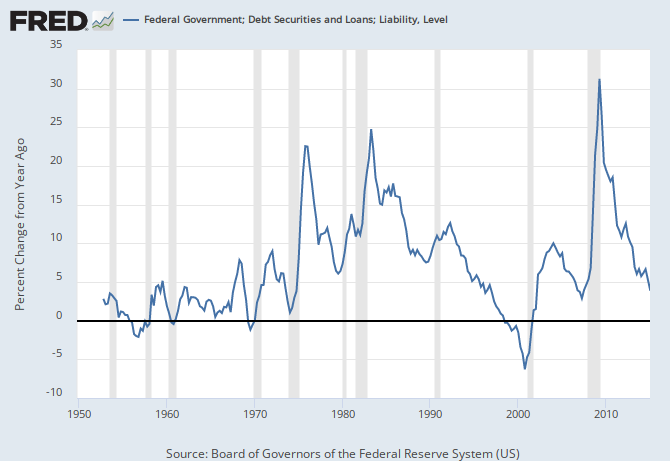
THE RECESSION CLOCK
Monetary Sovereignty

Monetary Sovereignty

Vertical gray bars mark recessions.

As the federal deficit growth lines drop, we approach recession, which will be cured only when the growth lines rise. Increasing federal deficit growth (aka “stimulus”) is necessary for long-term economic growth.

#MONETARYSOVEREIGNTY

–Can anything at all be done about America’s gun violence?

Twitter: @rodgermitchell; Search #monetarysovereignty
Facebook: Rodger Malcolm Mitchell

Mitchell’s laws:
•Those, who do not understand the differences between Monetary Sovereignty and monetary non-sovereignty, do not understand economics.
•Any monetarily NON-sovereign government — be it city, county, state or nation — that runs an ongoing trade deficit, eventually will run out of money.
•The more federal budgets are cut and taxes increased, the weaker an economy becomes. .
Liberals think the purpose of government is to protect the poor and powerless from the rich and powerful. Conservatives think the purpose of government is to protect the rich and powerful from the poor and powerless.
•The single most important problem in economics is
the Gap between rich and poor.
•Austerity is the government’s method for widening
the Gap between rich and poor.
•Until the 99% understand the need for federal deficits, the upper 1% will rule.
•Everything in economics devolves to motive, and the motive is the Gap between the rich and the rest..

===================================================================================================================================================================================================================================================================================

Why do Americans want guns, and not just “want,” but passionately and angrily crave them, like an addiction to drugs?

From an article in today’s Chicago Tribune:

Commentary: Does owning a gun make you safer?
By David Hemenway, a professor at the Harvard School of Public Health and director of the Harvard Injury Control Research Center.

The United States has the most heavily armed civilian population in the First World; our homes contain enough firearms for every man, woman and child.

Why do so many Americans own guns? The main reason, according to surveys, is protection.

Advocates argue that guns in the home both deter crime (criminals refrain from even trying to break in because they fear being shot by an armed citizen) and thwart it (an armed citizen can stop a crime in progress, preventing injury or theft).

The scientific evidence, however, provides little support for these arguments. Quite the opposite.

In terms of deterrence, a recent study found that states with higher levels of household gun ownership have higher levels of firearm crime and do not have lower levels of other types of crime.

Another study, in 2003, found that counties with higher levels of household gun ownership have higher rates of household burglary, not lower. Burglars like to steal not only cash and jewelry but also guns.

Along with Sara Solnick, a professor of economics at the University of Vermont, I analyzed the data for the five-year period from 2007 to 2011, looking at more than 14,000 crimes in which there was some degree of personal contact between the victim and perpetrator — incidents in which a self-protective action by the victim was theoretically possible (for example, assaults and robberies).

Victims used a gun in less than 1 percent of the incidents (127/14,145). In other words, actual self-defense gun use, even in our gun-rich country, is rare.

Of the more than 300 sexual assaults reported in the surveys, the number of times women were able to use a gun to protect themselves was zero.

Indeed, a study of 10 previous years of crime survey data found that of more than 1,100 sexual assaults, in only one did the victim use a gun in self-defense.

Slightly more than 4 percent of victims were injured during or after a self-defense gun use — the same percentage as were injured during or after taking other protective actions.

Using some other weapon — Mace, for instance — appeared equally effective as using a gun.

The evidence is overwhelming that a gun in the home increases the likelihood not only that a household member will be shot accidentally, but also that someone in the home will die in a suicide or homicide.

The statistics are clear. Owning guns does not make you safer. Owning guns increases your life risks. So why the fervor for gun ownership?

Several reasons:

1. People do not understand probability.
Statistically, driving a car is much more dangerous than being a passenger in a commercial airplane. Vaccinations protect against mortal diseases. Buying a lottery ticket almost guarantees you will lose money.

Yet intuition causes many people to be more afraid to fly than to drive, more afraid of vaccination than of disease, and to overestimate the likelihood of winning a lottery.

Gun facts are ignored by intuition, and not just ignored, but strongly denied.

2. People wish to have control.
Driving a car provides the illusion of control, vs. being a passenger in an airplane. And though robotic cars undoubtedly will be safer than human-driven cars, they probably will come with some human control.

Guns provide the illusion of control.

3. Fear and anger are our most powerful emotions. They are our prime survival emotions.

Guns are our perfect angry response to our fear of criminals. Not only are guns seen to protect us, but they punish the “bad guys,” satisfying our anger.

4. Humans have an innate desire for power.
Guns are the traditional “great equalizer.” They are felt to compensate for perceived personal weakness in the face of perceived danger.

In short, the desire for guns, while often justified by the pseudo-logic of 2nd Amendment interpretations, is not logical at all. It is wholly emotional, based on fear, anger, intuition, and the desires for control and power.

Thus facts, as conclusive as they may be, have little effect on discussions of gun control. The emotional impact of “They want to take my guns away,” trumps all facts.

There simply is no use to presenting ever more facts about the dangers of gun ownership. They will have zero effect on gun owners and lawmakers.

So what can be done?

What cannot be done is to threaten gun owners with the loss of their guns. That simply will not work. We long ago have passed the point of no return on that issue.

Instead, we need to “go with the flow,” and pass laws that will have the effect of gun control, without threatening the self-proclaimed “good guys.”

Here are my thoughts:

1. Allow anyone to own a gun except two groups:
A. Young people. We are accustomed to denying young people certain rights: Driving, voting, drinking, marriage, military service, etc.

B. Mentally incompetent people, those convicted of a felony, and non-citizens. There is scant advocacy for any of these groups.

2. Then pass two laws, neither of which threaten gun ownership, but could reduce gun violence and the the desire to own guns.

A. Any person who commits a felony while carrying a gun, shall be sentenced to a prison term of 20 years to life, in addition to the term for the felony itself.

B. Any provider of a gun that is used in a felony shall have the same criminal and civil liability as the actual perpetrator of the felony. (This latter is similar to the “dram shop” laws for liquor.)

In short, are you of the required age (21?), and are you neither a criminal, nor mentally incompetent, nor a non-citizen nor committed a crime while carrying a gun, nor sell guns to criminals?

If you meet those very easy criteria (the vast majority of Americans do), no one will take your guns away.

You can keep guns in every room of your house and on your person, when you’re not at home.

All society asks is that you be a “good guy,” the guy the National Rifle Association says will stop a “bad guy.”

Or we can do nothing.

Rodger Malcolm Mitchell
Monetary Sovereignty

===================================================================================
Ten Steps to Prosperity:
1. Eliminate FICA (Click here)
2. Federally funded Medicare — parts A, B & D plus long term nursing care — for everyone (Click here)
3. Provide an Economic Bonus to every man, woman and child in America, and/or every state a per capita Economic Bonus. (Click here) Or institute a reverse income tax.
4. Free education (including post-grad) for everyone. Click here
5. Salary for attending school (Click here)
6. Eliminate corporate taxes (Click here)
7. Increase the standard income tax deduction annually
8. Tax the very rich (.1%) more, with higher, progressive tax rates on all forms of income. (Click here)
9. Federal ownership of all banks (Click here and here)

10. Increase federal spending on the myriad initiatives that benefit America’s 99% (Click here)

The Ten Steps will add dollars to the economy, stimulate the economy, and narrow the income/wealth/power Gap between the rich and the rest.
——————————————————————————————————————————————

10 Steps to Economic Misery: (Click here:)
1. Maintain or increase the FICA tax..
2. Spread the myth Social Security, Medicare and the U.S. government are insolvent.
3. Cut federal employment in the military, post office, other federal agencies.
4. Broaden the income tax base so more lower income people will pay.
5. Cut financial assistance to the states.
6. Spread the myth federal taxes pay for federal spending.
7. Allow banks to trade for their own accounts; save them when their investments go sour.
8. Never prosecute any banker for criminal activity.
9. Nominate arch conservatives to the Supreme Court.
10. Reduce the federal deficit and debt

No nation can tax itself into prosperity, nor grow without money growth. Monetary Sovereignty: Cutting federal deficits to grow the economy is like applying leeches to cure anemia.
1. A growing economy requires a growing supply of dollars (GDP=Federal Spending + Non-federal Spending + Net Exports)
2. All deficit spending grows the supply of dollars
3. The limit to federal deficit spending is an inflation that cannot be cured with interest rate control.
4. The limit to non-federal deficit spending is the ability to borrow.

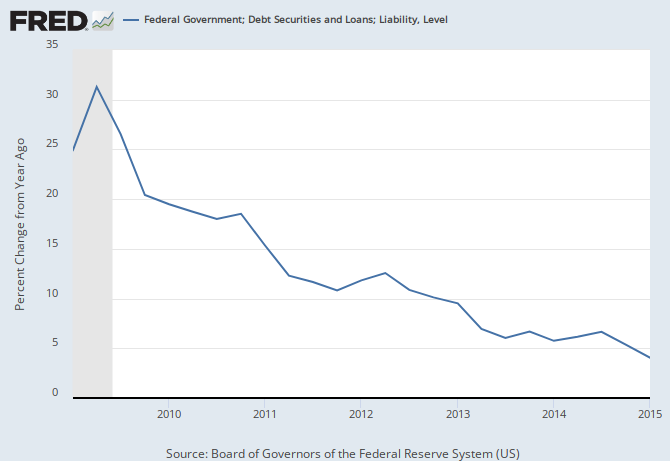
THE RECESSION CLOCK
Monetary Sovereignty

Monetary Sovereignty

Vertical gray bars mark recessions.

As the federal deficit growth lines drop, we approach recession, which will be cured only when the growth lines rise. Increasing federal deficit growth (aka “stimulus”) is necessary for long-term economic growth.

#MONETARYSOVEREIGNTY

–One fool down; another stands up. It’s another game of Republican Whac-A-Fool

Twitter: @rodgermitchell; Search #monetarysovereignty
Facebook: Rodger Malcolm Mitchell

Mitchell’s laws:
•Those, who do not understand the differences between Monetary Sovereignty and monetary non-sovereignty, do not understand economics.
•Any monetarily NON-sovereign government — be it city, county, state or nation — that runs an ongoing trade deficit, eventually will run out of money.
•The more federal budgets are cut and taxes increased, the weaker an economy becomes. .
Liberals think the purpose of government is to protect the poor and powerless from the rich and powerful. Conservatives think the purpose of government is to protect the rich and powerful from the poor and powerless.
•The single most important problem in economics is
the Gap between rich and poor.
•Austerity is the government’s method for widening
the Gap between rich and poor.
•Until the 99% understand the need for federal deficits, the upper 1% will rule.
•Everything in economics devolves to motive, and the motive is the Gap between the rich and the rest..

===================================================================================================================================================================================================================================================================================

Our 7/18/15 post said, “With each passing day, Trump will be shown to be a lying bigot, whose appeal will shrink as thinking Americans begin thinking, and the bigots slink back into the shadows.”

[Organizers of a Republican event withdrew frontrunner Donald Trump’s invitation after he suggested that a presidential debate moderator was tough on him because she was menstruating.]

[Trump’s top political advisor Roger Stone left the campaign on Saturday]

Well, that didn’t take long, did it?

As soon as Trump was asked a couple of questions, he showed himself to be a misogynist boor, who when confronted with facts, will ramble, dart, duck, weave and then hurl stupid insults — in short, the schoolyard bully whose wealth has bought him a few sycophants and fellow bigots, but no intelligent believers.

And now the next fool emerges:

Rand Paul: Income Inequality Comes From ‘Some People Working Harder’ Than Others

Asked if his flat tax plan would further separate the haves from the have-nots, GOP presidential hopeful Sen. Rand Paul (Ky.) said Sunday that income inequality is the result of some Americans working harder than others, rather than economic policies.

“The thing is, income inequality is due to some people working harder and selling more things,” Paul told host Chris Wallace on “Fox News Sunday.” “If people voluntarily buy more of your stuff, you’ll have more money.”

Where does one begin to describe the idiocy of that remark? First, consider the source:

Dr. Randal “Rand” Paul is the Kentucky ophthalmologist who was elected to the United States Senate from that state in 2010.

He was born in Pennsylvania and grew up in Texas, where his father, Dr. Ron Paul, was a politically active physician who served in the United States Congress and ran for the presidency three times.

Rand Paul earned his undergraduate degree from Baylor University in 1984, and his medical degree from the Duke University School of Medicine in 1988. He practiced ophthalmology in Bowling Green, Kentucky from 1993 until his election to the Senate.

Here is a guy who never sold an ounce of “stuff” in his life. The spoiled, privileged son of a doctor and Congressman, Rand was sent to the best schools, and earned his living, first as an ophthalmologist, then as a Senator.

And this kid, who was born with a silver spoon in his mouth, says that income inequality is due to some people working harder than others??

A coal miner works harder than Rand ever did in his life. A policeman, a fireman, a landscaper, a plumber, a carpenter, a factory worker — they all work harder and earn less than this son of a politician.

What gall he has.

But, of course, he just is repeating the mantra of the Party of the Rich, who describe their wealthy benefactors as “makers,” and poor people as “takers.”

And it gets even more stupid:

Paul has proposed what he calls a “flat and fair tax,” which would put a flat 14.5 percent tax on all types of income.

An analysis by the Tax Foundation found that under the plan, households earning more than $1 million per year would see their incomes rise by 13 percent. Households earning between $50,000 and $75,000 per year, meanwhile, would see their income rise only by 3 percent.

“Doesn’t your plan massively increase income inequality?” Wallace asked.

“It’s a fallacious notion to say, ‘Oh, rich people get more money back in a tax cut,'” Paul responded. “If you cut taxes 10 percent, 10 percent of a million is more than 10 percent of a thousand dollars. So, obviously, people who pay more in taxes will get more back.”

Er, uh . . . Rand, your plan doesn’t cut all taxes 10 percent. It raises taxes on the very poor, and cuts taxes for the rich massively.

You know that, don’t you? Sure, you do.

And since you’re so eager to cut taxes, and also are eager to run a balanced federal budget, you’ll have to cut federal spending. And where will those cuts be?

Not the military, since the military is sacred to the right wing.

So that leaves cuts to Social Security, Medicare, Medicaid, food and housing for the poor (you know, those people who don’t work as hard as you do, Rand).

Flat tax proposals, which are popular with the tea party crowd, have a way of popping up during Republican presidential primary seasons.

In addition to Paul, Sen. Ted Cruz (Tex.) has proposed moving to a flat tax rate and abolishing the IRS.

Back in 2012, the flat tax banner was carried by former Texas Gov. Rick Perry and Herman Cain, who drew national attention with his “9-9-9” flat tax plan.

You’re in good company, Rand. Ted Cruz, Rick Perry, Herman Cain and Rand Paul. What a group.

Gotta love Republican Whac-A-Fool. Will we have to wait for the next Republican debate for a new, right-wing fool to stand up?

Who’s next?

monetary sovereignty

Rodger Malcolm Mitchell
Monetary Sovereignty

===================================================================================
Ten Steps to Prosperity:
1. Eliminate FICA (Click here)
2. Federally funded Medicare — parts A, B & D plus long term nursing care — for everyone (Click here)
3. Provide an Economic Bonus to every man, woman and child in America, and/or every state a per capita Economic Bonus. (Click here) Or institute a reverse income tax.
4. Free education (including post-grad) for everyone. Click here
5. Salary for attending school (Click here)
6. Eliminate corporate taxes (Click here)
7. Increase the standard income tax deduction annually
8. Tax the very rich (.1%) more, with higher, progressive tax rates on all forms of income. (Click here)
9. Federal ownership of all banks (Click here and here)

10. Increase federal spending on the myriad initiatives that benefit America’s 99% (Click here)

The Ten Steps will add dollars to the economy, stimulate the economy, and narrow the income/wealth/power Gap between the rich and the rest.
——————————————————————————————————————————————

10 Steps to Economic Misery: (Click here:)
1. Maintain or increase the FICA tax..
2. Spread the myth Social Security, Medicare and the U.S. government are insolvent.
3. Cut federal employment in the military, post office, other federal agencies.
4. Broaden the income tax base so more lower income people will pay.
5. Cut financial assistance to the states.
6. Spread the myth federal taxes pay for federal spending.
7. Allow banks to trade for their own accounts; save them when their investments go sour.
8. Never prosecute any banker for criminal activity.
9. Nominate arch conservatives to the Supreme Court.
10. Reduce the federal deficit and debt

No nation can tax itself into prosperity, nor grow without money growth. Monetary Sovereignty: Cutting federal deficits to grow the economy is like applying leeches to cure anemia.
1. A growing economy requires a growing supply of dollars (GDP=Federal Spending + Non-federal Spending + Net Exports)
2. All deficit spending grows the supply of dollars
3. The limit to federal deficit spending is an inflation that cannot be cured with interest rate control.
4. The limit to non-federal deficit spending is the ability to borrow.

THE RECESSION CLOCK
Monetary Sovereignty

Monetary Sovereignty

Vertical gray bars mark recessions.

As the federal deficit growth lines drop, we approach recession, which will be cured only when the growth lines rise. Increasing federal deficit growth (aka “stimulus”) is necessary for long-term economic growth.

#MONETARYSOVEREIGNTY

–The end of American states?

Twitter: @rodgermitchell; Search #monetarysovereignty
Facebook: Rodger Malcolm Mitchell

Mitchell’s laws:
•Those, who do not understand the differences between Monetary Sovereignty and monetary non-sovereignty, do not understand economics.
•Any monetarily NON-sovereign government — be it city, county, state or nation — that runs an ongoing trade deficit, eventually will run out of money.
•The more federal budgets are cut and taxes increased, the weaker an economy becomes. .
Liberals think the purpose of government is to protect the poor and powerless from the rich and powerful. Conservatives think the purpose of government is to protect the rich and powerful from the poor and powerless.
•The single most important problem in economics is
the Gap between rich and poor.
•Austerity is the government’s method for widening
the Gap between rich and poor.
•Until the 99% understand the need for federal deficits, the upper 1% will rule.
•Everything in economics devolves to motive, and the motive is the Gap between the rich and the rest..

===================================================================================================================================================================================================================================================================================

The United States of America is exactly what it’s name says it is: States that united. These states were sovereign nations that came together to defend against a common enemy.

Like the citizens of European nations, each American state’s citizens had national pride, and much preferred not to dilute its heritage and morès. So when forced to unite under a Constitution, the states’ politicians insisted on retaining various rights, as referred to in the 10th Amendment:

“The powers not delegated to the United States by the Constitution, nor prohibited by it to the States, are reserved to the States respectively, or to the people.”

Despite what commonly is believed, these are not enumerated powers. The Supreme Court has held that federal law “neither can be nullified openly and directly by state legislators or state executive or judicial officers nor nullified indirectly by them through evasive schemes.”

As recently as 1992, in New York v. United States, Justice Sandra Day O’Connor wrote that the federal government (only) can encourage the states to adopt certain regulations through the spending power, or through the commerce power.

The question then is: Has time made the 10th Amendment functionally obsolete? Or more specifically, has time made the states obsolete?

While the states formerly were nations, today they merely are artificial, geographical boundaries. They do not define heritages, mores, lifestyles, beliefs, politics, religion or any other human traits.

Consider, for instance, Illinois. There is approximately zero relationship between Chicago and southern Illinois, the latter whose residents resemble people in Kentucky or Tennessee, far more than people in Chicago. The same could be said of New York City, tucked into the southeast corner of a largely rural, heavily forested state.

State boundaries are historical artifacts, signifying nothing. Yet, we retain the artificial, obsolete Electoral College. (Because the original colonies that came together to create the United States of America greatly feared mob rule, which some felt would happen with a direct presidential election, the Founding Fathers created the Electoral College.)

State boundaries lead to senseless legal differentiations: By what U.S. rationale does Texas enforce a death penalty while Illinois has none? We all are Americans. Is the need for a death penalty in Texas different from the need in Illinois?

Why does the federal government allow abortions nationally, while some states put up barriers to abortion (and ironically, those states have a death penalty)?

Why do voting laws, for federal elections, differ among the various states? It’s a U.S. federal election. Yet, some states demand more proof of eligibility to vote, than do other states do. What is the logic?

Chicago’s public school system is insolvent, because Illinois is insolvent. So Chicago children suffer from lack of teachers, overcrowded and unsafe schools and lack of school programs. Were Chicago’s schools to be supported by the federal government, hundreds of thousands of American children would receive a better education. This would benefit all of America, not just Chicago.

Is a division into financially struggling, legally byzantine states the most efficient, effective way to run a nation? If we had to start over, to build a government for 320 million people, would we divide it into 50 monetarily Non-sovereign entities, and allow each government to create its own unique laws — laws that may contradict the laws of neighboring states?

What governing advantage do states provide for the United States?

Admittedly, there are socio-economic and cultural differences, within counties or even within cities. But it is far easier for voters to understand and to influence, the politics of a county or city, than of a state. Within cities and counties, the weather generally is similar, as is access to water, access to food and geology. State boundaries are arbitrary lines, drawn for outdated, political reasons, having no functional purpose.

While tradition probably precludes the elimination of states, we should eliminate state sovereignty:

1. Eliminate state, county and city courts; have all courts be federal.
2. Eliminate state governments.
3. Eliminate the functions currently operated by monetarily Non-sovereign states and hand them to the Monetarily Sovereign federal government. Lack of money would cease to be the all-purpose excuse for insufficient government services.

(Despite what libertarians tell you, America’s biggest financial problem is not due to the federal government being too big. The problem is the state governments are too big and the federal government is too small.

Consider Puerto Rico, which is a territory, but has exactly the same monetarily Non-sovereign financial problems as a U.S. state:

Misery deepens for those in Puerto Rico who can’t leave

The entrenched economic crisis is leading people to either cut their personal spending to the basics or flee in search for jobs.

Nearly 10 years into a deep economic slump, it is no closer to pulling out, and, in fact, is poised to plummet further. The unemployment rate is above 12 percent.

The government has tried to boost revenue by hiking the sales tax to 11.5 percent, and closing government offices.

A $58 million bond payment due Saturday went unpaid. If defaults continue, analysts say it will face numerous lawsuits and increasingly limited access to markets, putting a recovery even more out of reach.

A list of cost-cutting measures proposed by a group of hedge funds that holds $5.2 billion of debt has riled citizens: laying off teachers; cutting medical benefits; and reducing subsidies to the main public university.

Meanwhile, a report commissioned by the government called for wage levels to be lowered, paid holidays cut, and energy costs reduced.

Some economists warn that measures like new taxes could further depress the economy, a concern shared by small business owners.

Puerto Rico’s fundamental problems are identical with Greece’s: Like all euro nations, Puerto Rico and all U.S. states, counties, and cities, are monetarily Non-sovereign.

To survive long term, all monetarily Non-sovereign entities (including you and me) require income to exceed outgo.

In contrast, the federal government, being Monetarily Sovereign, requires no income; it creates dollars, ad hoc, by paying bills.

You and I receive income from salaries, investments and other businesses, pensions, borrowing and from the federal government (Social Security, Medicare, poverty aids, etc.)

Unlike the federal government, but like the states, we cannot create dollars at will. Without income, we cannot pay our bills.

State governments receive income from several sources: Taxes, borrowing, tourism, net exports of goods and services, outside earnings, and importantly, from the federal government.

There are important differences among these sources. Taxes remove dollars from the populace, and unless the state were to spend all tax dollars within the state (unlikely), taxes represent a net loss to a state’s economy.

State borrowing must be repaid — plus interest — so borrowing never is a long-term solution to state financial survival.

Tourism and net exports of goods and services can pay for and overcome the net economic losses caused by taxation. Tourists pay local taxes with dollars earned elsewhere, so tourism transfers dollars from one government to another.

Similar in effect to tourism is: Outside earnings. A person might work and earn a salary from a company based in one location while living and paying taxes in another.

Dollars are transferred from the “work” location to the “domicile” location. We see this often with suburbs, which survive on taxes earned in the neighboring big city. Dollars flow from the city to the suburb.

In all of the above — taxes, borrowing, tourism, net exports of goods and services and outside earnings — Puerto Rico, the U.S. states and all euro nations, including Greece, are financially identical.

They all are monetarily Non-sovereign, so cannot create money at will.

All the U.S. states, counties, cities, businesses, and people are engaged in a complex money-transfer game, with the federal government being the one entity that adds permanent dollars to the game. (Banks also add dollars by lending, but these are temporary dollars, as the loans must be repaid.)

The U.S. federal government creates dollars by spending, and it destroys dollars by taxing. To date, the federal government has created 13 trillion more dollars than it has destroyed: $13 trillion net dollars.

Many of these dollars have gone into the states, which then redistribute the money to counties and cities:

America’s fiscal union

From 1990 to 2009, the federal government spent $1.44 trillion in Virginia but collected less than $850 billion in taxes, a gap of over $590 billion. But relative to the size of its economy, Virginia derived a smaller benefit from America’s fiscal union than states like New Mexico, Mississippi and West Virginia, where the 20-year transfer exceeded 200% of their annual GDP.

Transfers to Puerto Rico, which is a US territory, not a fully incorporated state, exceeded 290%.

New York transferred over $950 billion to the (federal government) from 1990 to 2009. But relative to the size of its economy, Delaware made the biggest contribution, equivalent to more than twice its 2009 GDP.

Per the following chart by The Economist:

monetary sovereignty

The states in the upper half of the chart sent more dollars to the federal government than they received. They are being bled — unnecessarily — by a government that neither needs nor uses those dollars. It creates its own dollars.

Interestingly, Puerto Rico receives, proportionate to its GDP, the most dollars from the federal government, and still it suffers economically.

One is left to wonder where the money went, and how bad Puerto Rico’s economy would be without federal support.

One also is left to wonder why the Monetarily Sovereign U.S. federal government impoverishes its states (which in turn, impoverish their counties and cities) by draining tax dollars from them — dollars the federal government neither needs, uses, nor even has. (All dollars sent to the federal government disappear from the nation’s money supply. There is no statistic showing how much money the government “has,” because such a statistic would be meaningless for an entity that creates dollars at will.)

I don’t know the specifics of Puerto Rico’s financial condition. Do Puerto Rico’s failures, resemble the failures of my home state, Illinois, because of intense political criminality? (Illinois politicians routinely are sent to prison, and many more should be.) Or does Puerto Rico have a different problem? I don’t know.

But I do know there serves no public purpose for the citizens of Puerto Rico or any state, to suffer austerity because the state engages in a futile effort to pay its debts.

All of the above shows why U.S. state governments serve no purpose and should be eliminated.

The federal government should stand in for the states, supplying services and dollars directly to counties and cities, without state government intermediaries.

Rodger Malcolm Mitchell
Monetary Sovereignty

===================================================================================
Ten Steps to Prosperity:
1. Eliminate FICA (Click here)
2. Federally funded Medicare — parts A, B & D plus long term nursing care — for everyone (Click here)
3. Provide an Economic Bonus to every man, woman and child in America, and/or every state a per capita Economic Bonus. (Click here) Or institute a reverse income tax.
4. Free education (including post-grad) for everyone. Click here
5. Salary for attending school (Click here)
6. Eliminate corporate taxes (Click here)
7. Increase the standard income tax deduction annually
8. Tax the very rich (.1%) more, with higher, progressive tax rates on all forms of income. (Click here)
9. Federal ownership of all banks (Click here and here)

10. Increase federal spending on the myriad initiatives that benefit America’s 99% (Click here)

The Ten Steps will add dollars to the economy, stimulate the economy, and narrow the income/wealth/power Gap between the rich and the rest.
——————————————————————————————————————————————

10 Steps to Economic Misery: (Click here:)
1. Maintain or increase the FICA tax..
2. Spread the myth Social Security, Medicare and the U.S. government are insolvent.
3. Cut federal employment in the military, post office, other federal agencies.
4. Broaden the income tax base so more lower income people will pay.
5. Cut financial assistance to the states.
6. Spread the myth federal taxes pay for federal spending.
7. Allow banks to trade for their own accounts; save them when their investments go sour.
8. Never prosecute any banker for criminal activity.
9. Nominate arch conservatives to the Supreme Court.
10. Reduce the federal deficit and debt

No nation can tax itself into prosperity, nor grow without money growth. Monetary Sovereignty: Cutting federal deficits to grow the economy is like applying leeches to cure anemia.
1. A growing economy requires a growing supply of dollars (GDP=Federal Spending + Non-federal Spending + Net Exports)
2. All deficit spending grows the supply of dollars
3. The limit to federal deficit spending is an inflation that cannot be cured with interest rate control.
4. The limit to non-federal deficit spending is the ability to borrow.

THE RECESSION CLOCK
Monetary Sovereignty

Monetary Sovereignty

Vertical gray bars mark recessions.

As the federal deficit growth lines drop, we approach recession, which will be cured only when the growth lines rise. Increasing federal deficit growth (aka “stimulus”) is necessary for long-term economic growth.

#MONETARYSOVEREIGNTY