–Wanted for the Most Powerful Job on Earth: Competence and Courage. No Cowards Need Apply

Mitchell’s laws:
●The more budgets are cut and taxes increased, the weaker an economy becomes.
●Austerity is the government’s method for widening the gap between rich and poor,
which leads to civil disorder.
●Until the 99% understand the need for federal deficits, the upper 1% will rule.
●To survive long term, a monetarily non-sovereign government must have a positive balance of payments.
●Those, who do not understand the differences between Monetary Sovereignty and monetary non-sovereignty, do not understand economics.

==========================================================================================================================================

Many of you have faced this political problem: Do you agree with the boss when you know the boss is dead wrong? Do you not merely agree, but speak earnestly in favor of the boss’s wrong ideas, knowing those ideas will lead to economic disaster?

And if you do the political thing, and agree and fight for the boss’s wrong ideas, and the disaster occurs, who is to blame? And what does that make you?

Washington Post
Romney’s tongue-tied eloquence
By Fareed Zakaria, Published: September 26, 2012

Peggy Noonan eloquently voiced what many conservatives believe when she said that Romney’s campaign has been a “rolling calamity.” And yet, shouldn’t it puzzle us that Romney is so “incompetent” (also from Noonan), given his deserved reputation for, well, competence?

He founded one of this country’s most successful financial firms, turned around the flailing Salt Lake City Olympics and was a successful governor. How did he get so clumsy so fast?

In fact, the problem is not Romney but the new Republican Party. Given the direction in which it has moved and the pressures from its most extreme — yet most powerful — elements, any nominee would face the same challenge: Can you be a serious candidate for the general election while not outraging the Republican base?

Why won’t Romney, an intelligent man, fluent in economics, explain his economic policy? Because any sensible answer would cause a firestorm in his party. It is obvious that, with a deficit at 8 percent of gross domestic product, any solution to our budgetary problems has to involve both spending cuts and tax increases.

Here, Mr. Zakaria flies wildly off track. Spending cuts and tax increases are absolutely, positively guaranteed to lead to recessions and depressions. It’s a mathematical certainty, as expressed in the formula readers of this blog know so well:

GDP = Federal Spending + Non-federal Spending – Net Imports.

But there is something more fundamental at work. Apparently, Romney knows his Republican base is wrong, and he knows that decisions agreeing with that base will adversely affect America. So, what should he do? Agree with the base, hoping to be elected, knowing he will destroy our economy? Or disagree with the base, not get elected, and possibly save America?

Our soldiers make an even more extreme form of that decision: Bravely stand and fight and possibly die saving your platoon, or like a coward, run away to save yourself, assuring that the rest of your platoon will die?

Is the personal glory of the Presidency worth hurting America?

Ronald Reagan agreed to tax increases when the deficit hit 4 percent of GDP; George H.W. Bush did so when the deficit was 3 percent of GDP. But today’s Republican Party is organized around the proposition that, no matter the circumstances, there must never be a tax increase of any kind.

The Simpson-Bowles proposal calls for $1 of tax increases for every $3 of spending cuts. But every Republican presidential candidate — including Romney — pledged during the primaries that he or she would not accept $10 of spending cuts if that meant a dollar of tax increases.

Just a reminder that taxes reduce the “Non-federal Spending” part of the above equation, and thereby reduce GDP growth. So the no-tax-increases pledge is a good idea. The bad part of the idea is that cuts in Federal Spending reduce GDP growth. Simple mathematics dictates that tax increases economically are identical with spending decreases — both reduce GDP growth.

So Romney could present a serious economic plan with numbers that make sense — and then face a revolt within his own party. His solution: to be utterly vague about how he would deal with the deficit. Were he to get specific, he would be committing ideological blasphemy. So instead he talks about freedom and capitalism.

Said another way: Romney could tell the truth, save America, and possibly doom his own ambition to become President. Or he can, as he has, agreed with the Republican base, enhancing his personal ambition, but dooming America’s future.

He has chosen his route. What does that say about him?

Romney’s own inclinations are obvious. In 2002, he refused to take Grover Norquist’s “no tax” pledge. But by 2006, the ground had shifted and he raced to become the first presidential candidate to commit to it.

One of numerous Romney flip-flops, trying to “agree with the boss” to the detriment of America.

The same pattern has emerged on immigration. On ABC’s “This Week” last Sunday, Republican strategist Nicolle Wallace urged Romney to reach out to Hispanics by reminding them of Obama’s poor record on immigration reform. Except that the Republican Party is now strongly opposed to a path to citizenship for illegal immigrants.

Romney has curried favor within the party by opposing the Dream Act, supporting Arizona’s harsh law under which police check people’s immigration status at will and proposing “self-deportation” as a way to get rid of undocumented immigrants. As with the deficit, he has a plan — but it’s secret.

Romney has tried to run a campaign while not running afoul of his party’s strictures. As a result, he has twisted himself into a pretzel, speaking vacuously, avoiding specifics and refusing to provide any serious plans for the most important issues of the day.

Here is a man who even disavowed his own signature political achievement — “Romneycare” — just to curry favor with the Republican political base.

Ironically, Romney already “ran afoul of his party’s strictures” — at least somewhat. The Republican base really wanted a nutcase like Michele Bachmann or Newt Gingrich. The base was cool on Romney. But, even after winning the nomination, he caved to the pressure, and went along with what this “intelligent man, fluent in economics” (according to Zakaria) knew was wrong. His personal ambition exceeded his patriotism. Romney first; America second.

To be awarded with the Presidency of the United States, and all that position’s powers and honors, you should at least display the courage of our fighting men and women — people who die for what they believe, and are not rewarded with the powers and honors of the Presidency. You will be expected to make difficult and correct decisions, each of which will have massive effect, not just on your platoon, but on the entire United States — indeed, the entire world.

What kind of leader will you be if you lack the competence and courage to stand up for what you believe is right, and against what you believe is wrong? Why would you accept the rewards of a leadership that requires you to send your people over a cliff?

For the sake of personal ambition, Romney has sold his soul to the devil. After the election, what will he see when he looks in the mirror?

Wanted for President of the United States: Competence and Courage. No Cowards Need Apply.

Rodger Malcolm Mitchell
Monetary Sovereignty

P.S. Please: Spare me the “Obama is just as bad” comments. He isn’t.

====================================================================================================================================================

Nine Steps to Prosperity:
1. Eliminate FICA (Click here)
2. Medicare — parts A, B & D — for everyone
3. Send every American citizen an annual check for $5,000 or give every state $5,000 per capita (Click here)
4. Long-term nursing care for everyone
5. Free education (including post-grad) for everyone
6. Salary for attending school (Click here)
7. Eliminate corporate taxes
8. Increase the standard income tax deduction annually
9. Increase federal spending on the myriad initiatives that benefit America’s 99%

No nation can tax itself into prosperity, nor grow without money growth. Monetary Sovereignty: Cutting federal deficits to grow the economy is like applying leeches to cure anemia. Two key equations in economics:
Federal Deficits – Net Imports = Net Private Savings
Gross Domestic Product = Federal Spending + Private Investment and Consumption – Net Imports

#MONETARY SOVEREIGNTY
–No need to visit Spain. Spain is coming to visit you.

Mitchell’s laws:
●The more budgets are cut and taxes increased, the weaker an economy becomes.
●Austerity is the government’s method for widening the gap between rich and poor,
which leads to civil disorder.
●Until the 99% understand the need for federal deficits, the upper 1% will rule.
●To survive long term, a monetarily non-sovereign government must have a positive balance of payments.
●Those, who do not understand the differences between Monetary Sovereignty and monetary non-sovereignty, do not understand economics.

==========================================================================================================================================

In “Travel to Spain to see a culture of dependency” we discussed how the starving Spanish feed themselves and their children with rotting food dug from dumpsters. Because of deficit reduction, aka “austerity,” the unemployment rate in Spain ranges from “relatively low” in Girona (14%) to 25% for the country as a whole. About 22% of Spanish households exist in poverty.

Now let’s talk America:

New York Times
Soaring Poverty Casts Spotlight on ‘Lost Decade’
By Sabrina Tavernise
Published: September 13, 2011

WASHINGTON — Another 2.6 million people slipped into poverty in the United States last year, the Census Bureau reported Tuesday, and the number of Americans living below the official poverty line, 46.2 million people, was the highest number in the 52 years the bureau has been publishing figures on it.

And in new signs of distress among the middle class, median household incomes fell last year to levels last seen in 1996.

Economists pointed to a telling statistic: It was the first time since the Great Depression that median household income, adjusted for inflation, had not risen over such a long period, said Lawrence Katz, an economics professor at Harvard.

As we continually mention (even at the bottom of each post), here is how Gross Domestic Product, the prime measure of economic growth, is calculated:

GDP = Federal Spending + Non-federal Spending – Net Imports

So, by definition, economic growth requires federal and non-federal spending growth. That is why deficit reduction, which involves spending decreases and tax increases, always must reduce economic growth and lead to recessions and depressions. It’s a mathematical necessity.

People who deny the adverse effect of deficit reduction, also would deny that taking one apple from a dozen, leaves only eleven apples.

The bureau’s findings were worse than many economists expected, and brought into sharp relief the toll the past decade had taken on Americans at the middle and lower parts of the income ladder. It is also fresh evidence that the disappointing economic recovery has done nothing for the country’s poorest citizens.

Readers of this blog know deficit reduction hurts the middle and lower classes much more than the upper classes, thereby increasing the gap between the so-called “1%” and the “99%.” This is not accidental. It is by design.

The 1% are perfectly happy to see their own fortunes decline so long as the gap increases. That is the goal of the 1%, and the bought-and-paid-for politicians and media are happy to further that goal, by spreading the lie that deficits are “too big” and “unsustainable” and “the federal government must live within its means.”

Of course, the exact opposite is true: Federal deficits are too small. They easily are sustainable. And being Monetarily Sovereign, the federal government has the power to create any amount of “means” it wishes.

The report said the percentage of Americans living below the poverty line last year, 15.1 percent, was the highest level since 1993. (The poverty line in 2010 for a family of four was $22,314.)

The past decade was also marked by a growing gap between the very top and very bottom of the income ladder. Median household income for the bottom tenth of the income spectrum fell by 12 percent from a peak in 1999, while the top 90th percentile dropped by just 1.5 percent.

The rich are overjoyed. Their income fell 1.5%, but the gap increased. Exactly what they wanted.

This year is not likely to be any better, economists said. Stimulus money has largely ended, and state and local governments have made deep cuts to staff and to budgets for social programs, both likely to move economically fragile families closer to poverty.

Why has stimulus money ended? That’s right: The lie that deficits must be reduced.

Minorities were hit hardest. Blacks experienced the highest poverty rate, at 27 percent, up from 25 percent in 2009, and Hispanics rose to 26 percent from 25 percent. For whites, 9.9 percent lived in poverty, up from 9.4 percent in 2009. Asians were unchanged at 12.1 percent.

Most blacks probably will vote for Obama, but for the wrong reason: Not because he’s less likely to cut federal spending, but because he’s black (or ½ black). Most Hispanics also will vote for Obama, also for the wrong reason: Because he’s more sympathetic to immigrants.

But poor or middle class or unemployed whites – who will they vote for? Unaccountably, they make up a large part of the Romney vote. And he is the man who tells them they live in a “culture of dependency,” as his excuse for wanting to cut federal deficits.

In truth, both candidates have said they want to reduce the deficit, though Obama is less likely to do so. With both candidates in the pocket of the rich, voting choices are limited, to say the least. So the electorate needs to learn up then speak up. Occupy Wall Street had the chance, but though they speak up, they have not learned up, so their words are meaningless.

Last year, about 48 million people ages 18 to 64 did not work even one week out of the year, up from 45 million in 2009, said Trudi Renwick, a Census official.

“Once you’ve been out of work for a long time, it’s a very difficult road to get back,” Lawrence Katz said.

More “culture of dependency” members, too lazy to look for work, according to the “religious” right.

“We’re risking a new underclass,” said Timothy Smeeding, director of the Institute for Research on Poverty at the University of Wisconsin, Madison. “Young, less-educated adults, mainly men, can’t support their children and form stable families because they are jobless,” he added.

With cuts to unemployment compensation, food stamps, Medicaid, Medicare and for older people, Social Security, how will these people find food, clothing and shelter? The same way people in Spain do: Digging through dumpsters and flopping in abandoned buildings.

When enough men can’t support their wives and children, society is just one step away from riot and insurrection. America is not immune.

The report also said the number of uninsured Americans increased by 900,000 to 49.9 million. Those covered by employer-based insurance continued to decline in 2010, to about 55 percent, while those with government-provided coverage continued to increase, up slightly to 31 percent. Employer-based coverage was down from 65 percent in 2000, the report said.

All of the above could be prevented and cured by steady increases in federal deficit spending, which the government can and should do. But when I tell this to one of those most affected by deficit reduction — middle and lower income, white Americans — they often get angry and spit out, “What about inflation?” then illogically mention the pre-WWII Germany and Zimbabwe hyperinflations.

I only can shake my head in wonderment. The German and Zimbabwe hyperinflations were not caused by government spending, but rather were the cause of government spending. And as for the U.S., our inflation rate has remained close to the Fed’s intentional target of 2% – 3% – and when it has risen above that, the cause was not related to federal spending, but rather to oil prices.

These poor people are more worried about an inflation that rarely happens, and easily is controlled by the Fed, than they are about something that is upon us and is killing us at this very moment. They act like a drowning man refusing to be pulled from the water, because the air is cold and he doesn’t want to catch a chill.

In summary:

1. Reductions in deficits have led to nearly every depression and recession in American history.
2. Increases in deficits have cured every recession and depression.
3. Deficits have not caused inflations, which in any event, easily are cured by interest rate control.
4. Mathematically, GDP growth requires federal deficit growth
5. Deficit reduction increases the gap between the rich and the rest of us, which is exactly what the rich want.

Aside from that, deficit reduction is a wonderful idea – especially if you’re rich – and live in Spain. But even if you’re not rich, but still would like to visit Spain, don’t worry.

Look out your door. Spain is coming to visit you — in a ship named “Deficit Reduction.”

Rodger Malcolm Mitchell
Monetary Sovereignty

====================================================================================================================================================

Nine Steps to Prosperity:
1. Eliminate FICA (Click here)
2. Medicare — parts A, B & D — for everyone
3. Send every American citizen an annual check for $5,000 or give every state $5,000 per capita (Click here)
4. Long-term nursing care for everyone
5. Free education (including post-grad) for everyone
6. Salary for attending school (Click here)
7. Eliminate corporate taxes
8. Increase the standard income tax deduction annually
9. Increase federal spending on the myriad initiatives that benefit America’s 99%

No nation can tax itself into prosperity, nor grow without money growth. Monetary Sovereignty: Cutting federal deficits to grow the economy is like applying leeches to cure anemia. Two key equations in economics:
Federal Deficits – Net Imports = Net Private Savings
Gross Domestic Product = Federal Spending + Private Investment and Consumption – Net Imports

#MONETARY SOVEREIGNTY

–Travel to Spain to see a culture of dependency

Mitchell’s laws:
●The more budgets are cut and taxes increased, the weaker an economy becomes.
●Austerity is the government’s method for widening the gap between rich and poor,
which leads to civil disorder.
●Until the 99% understand the need for federal deficits, the upper 1% will rule.
●To survive long term, a monetarily non-sovereign government must have a positive balance of payments.
●Those, who do not understand the differences between Monetary Sovereignty and monetary non-sovereignty, do not understand economics.

==========================================================================================================================================

In case you didn’t know it, “deficit reduction” is identical with“austerity.” Here is what austerity, aka deficit reduction, has brought to Spain:

Excerpts from the New York Times
Spain Recoils as Its Hungry Forage Trash Bins for a Next Meal

MADRID — On a recent evening, a hip-looking young woman was sorting through a stack of crates outside a fruit and vegetable store here in the working-class neighborhood of Vallecas as it shut down for the night.

The woman, 33, said that she had once worked at the post office but that her unemployment benefits had run out and she was living now on 400 euros a month, about $520. She was squatting with some friends in a building that still had water and electricity, while collecting “a little of everything” from the garbage after stores closed and the streets were dark and quiet.

She is one of the people the U.S. religious right wing disparages as lazy, free loaders – people who have adopted what wealthy Mitt Romney sneeringly calls “the culture of dependency.” It’s the rich guy’s way to blame the victim.

As Spain tries desperately to meet its budget targets, it has been forced to embark on the same path as Greece, introducing one austerity measure after another, cutting jobs, salaries, pensions and benefits, even as the economy continues to shrink.

Sound familiar? This is exactly what the budget cutters in the U.S. are doing. The difference – and a major difference it is: The U.S. is Monetarily Sovereign. It controls its sovereign currency the dollar. So we do not need to cut spending.

Spain is monetarily non-sovereign — like our states and cities. Spain has no sovereign currency. So it needs to live within its ability to tax, just as you, being monetarily non-sovereign, need to live within your ability to earn.

Most recently, the government raised the value-added tax three percentage points, to 21 percent, on most goods, and two percentage points on many food items, making life just that much harder for those on the edge.

The value added (VA) tax is a consumption tax. It is designed to punish the poor, those people who spend a greater percentage of their income on taxable items. The rich, like Romney, don’t worry about a tax on consumables; the rich spend most of their money on investments. No tax there.

At the huge wholesale fruit and vegetable market on the outskirts of this city, men and women furtively collect items that had rolled into the gutter.

“It’s against the dignity of these people to have to look for food in this manner,” said Eduardo Berloso, an official in Girona, the city that padlocked its supermarket trash bins. Mr. Berloso proposed the measure last month after hearing from social workers and seeing for himself one evening “the humiliating gesture of a mother with children looking around before digging into the bins.”

Mr. Berloso prefers that people starve rather than be humiliated.

The Caritas report also found that 22 percent of Spanish households were living in poverty and that about 600,000 had no income whatsoever. All these numbers are expected to continue to get worse in the coming months.

Last fall, the U.S. Census Bureau, reported the percentage of Americans living below the poverty line last year, 15.1 percent, was the highest level since 1993. (The poverty line in 2010 for a family of four was $22,314.)

The report also said, “The past decade was also marked by a growing gap between the very top and very bottom of the income ladder. This year is not likely to be any better. Stimulus money has largely ended, and state and local governments have made deep cuts to staff and to budgets for social programs, both likely to move economically fragile families closer to poverty.”

Yes, these lazy people have adopted a “culture of dependency.”

In Girona, Mr. Berloso said his aim in locking down the bins was to keep people healthy and push them to get food at licensed pantries and soup kitchens. He said 80 to 100 people had been regularly sorting through the bins before he took action, with a strong likelihood that many more were relying on thrown-away food to get by.

But Mr. Berloso’s locks created something of an uproar across Spain, where the economic crisis is fueling more and more protests highlighting hunger. A group of mayors and unionists in southern Spain, where unemployment rates are far above the average, recently staged Robin Hood raids on two supermarkets, loading carts with basic foods and pressing them to donate more food to the needy.

The dumpster locks help keep people from that “culture of dependency,” and move them toward the self-sufficiency of starvation.

Some politicians say Girona’s locks are really all about protecting Girona’s image. The city of about 100,000 derives most of its income from tourism.

“The social workers or civil agents could refer people to the food distribution center without having to lock bins,” said Pia Bosch, a Socialist councilor in Girona. “It’s like killing a fly with a cannonball.”

But referring people to food distribution centers, where they can obtain free food, just fosters that dreaded “culture of dependency.”

The unemployment rate is still relatively low in Girona — 14 percent over all, compared with 25 percent for the country as a whole. But more and more families have no income. Of the 7,700 unemployed in Girona, Mr. Berloso said, 40 percent have now run out of benefits.

Many, he said, were “people who never expected to find themselves in this position.”

On a recent morning, Juan Javier, 29, who had come to collect milk, pasta, vegetables and eggs from one of the distribution centers, was one of the few clients who would discuss his circumstances. A former printer, he has been out of work for two years. “I would like to have a job,” he said, “and not be here.”

In a nearby soup kitchen, Toni López, 36, waited quietly for a free lunch with his girlfriend, Monica Vargas, 46, a beautician. The couple recently became homeless when they fell two months behind on their rent. “All our lives we have been working people,” Mr. Lopez said. “We are only here because we are decent people. The landlord was knocking on the door demanding the rent, so we said, ‘Here, here are the keys.’”

Think this can’t happen to you, in America? It shouldn’t, but it can. Our politicians, funded by the richest 1%, are determined to cut federal spending: Fire federal workers (that already has begun). Cut Social Security benefits and tax the ones that remain. (That too, already has begun.)

Cut Medicare. (Romney vowed to do that.) Reduce the military (The vast majority of its expenses are for salaries).

Deficit reduction, wherever it is implemented, always, always, always causes a downward economic helix, in which suffering is in inverse relationship to money. Those with the least suffer the most.

The richest 1%, with the help of the politicians, the media and the compliant economists, have brainwashed the 99% into believing federal financing is like personal, kitchen-table financing, where affordability is an ever-present issue. But for the Monetarily Sovereign U.S. government — unlike the governments of Spain, Italy, Illinois, Chicago et al — affordability never is an issue.

For the U.S. government, there is no amount of spending that is “unsustainable.” The U.S. government does not need to “live within its means.” These are concepts appropriate to you and me — we don’t have a sovereign currency — but not appropriate to a government having a currency over which it is sovereign.

The federal deficit is not too high; it is too low. Economic growth requires a growing federal deficit. One of the most basic equations in economics is:

Gross Domestic Product = Federal Spending + Non-federal Spending – Net Imports.

To grow GDP we always must increase Federal Spending and/or increase Non-federal Spending. That requires increasing the deficit. Straightforward mathematics the 1% hopes you never understand.

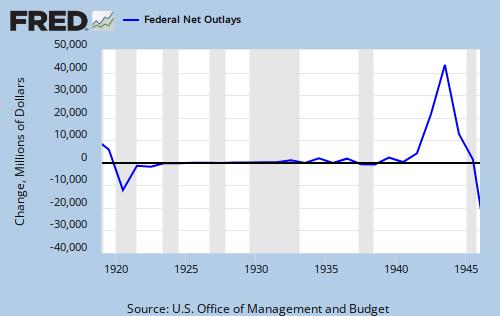
Every depression in U.S. history began with a reduction in deficit spending.

From 1919 to 1929, the U.S. ran either a surplus or a balanced budget. During that time, we had 3 recessions, culminating in the Great Depression — cured by spending for World War II:

Monetary Sovereignty

Today, the politicians, the media and the old line economists, all under the thumb of the 1%, want us to take more of that bitter, deficit-reduction medicine — the medicine that already has destroyed so many lives all over the world.

And like sheep, marching into the slaughterhouse, we willingly and without question, place our necks on the chopping block. In fact, some will fight angrily against any who dare to warn of our coming doom. You can page through this blog to see the outraged rebuttals.

It’s happening in Spain and Greece and other euro (monetarily non-sovereign) nations. The Spanish and Greeks are not victims of a “culture of dependency.” They are victims of their own governments. Before their leaders recklessly adopted the euro and became monetarily non-sovereign, which forced them into deficit reduction, these people were not eating out of dumpsters.

What happened was simple: They were told they needed to cut their government’s deficit spending. And they believed. And this belief has led to their downfall.

And it will happen here, if we naively accept the deficit reduction lie so willingly adopted by our fellow sheep, and if we demand to lay our own heads on the 1%’s chopping block.

Rodger Malcolm Mitchell
Monetary Sovereignty

====================================================================================================================================================

Nine Steps to Prosperity:
1. Eliminate FICA (Click here)
2. Medicare — parts A, B & D — for everyone
3. Send every American citizen an annual check for $5,000 or give every state $5,000 per capita (Click here)
4. Long-term nursing care for everyone
5. Free education (including post-grad) for everyone
6. Salary for attending school (Click here)
7. Eliminate corporate taxes
8. Increase the standard income tax deduction annually
9. Increase federal spending on the myriad initiatives that benefit America’s 99%

No nation can tax itself into prosperity, nor grow without money growth. Monetary Sovereignty: Cutting federal deficits to grow the economy is like applying leeches to cure anemia. Two key equations in economics:
Federal Deficits – Net Imports = Net Private Savings
Gross Domestic Product = Federal Spending + Private Investment and Consumption – Net Imports

#MONETARY SOVEREIGNTY

–How do they believe THIS if they believe THAT?

Mitchell’s laws:
●The more budgets are cut and taxes increased, the weaker an economy becomes.
●Austerity is the government’s method for widening the gap between rich and poor,
which leads to civil disorder.
●Until the 99% understand the need for federal deficits, the upper 1% will rule.
●To survive long term, a monetarily non-sovereign government must have a positive balance of payments.
●Those, who do not understand the differences between Monetary Sovereignty and monetary non-sovereignty, do not understand economics.

==========================================================================================================================================

Here are excerpts from a letter sent by six of the senators who voted for sequestration – the process by which automatic cuts in the federal deficit are made, because of the popular, wrong-headed belief federal deficits hurt the economy.

Remember now, these guys voted FOR sequestration.

September 21, 2012
Dear Majority Leader Reid and Republican Leader McConnell:

We face a critical challenge in the next few months: balancing the need to reduce the deficit with the need to safeguard important priorities, particularly protecting our national security, vital domestic programs, and our economic recovery. We believe it is imperative to enact a bipartisan deficit reduction package to avoid the severe economic damage that would result from the implementation of sequestration.

Translation: “Cutting the deficit will damage the economy, so we need to cut the deficit.”

Yes, cutting the deficit will damage the economy, because deficit cuts require spending cuts and/or tax increases. But a basic equation in economics shows that: Federal Spending + Non-federal spending – Net Imports = Gross Domestic Product (GDP).

All federal spending cuts reduce the 1st term of the above equation and all tax increases reduce the 2nd term. So, deficit cuts reduce GDP. Simple mathematics. Even $1 in deficit reduction reduces GDP, and the greater the deficit reduction, the greater the GDP reduction.

With a growing population, even a perfectly balanced budget (federal spending = federal taxes) reduces per-capital GDP, so for the economy to grow, there must be significant deficit growth. And these guys are talking about deficit reduction? Yikes!

Any deficit reduction package should be long term and should provide as much certainty as possible for businesses and consumers.

No problem. The certainty is this: Cutting federal deficits will cause a recession if we are lucky or a depression if we are not. Clinton’s federal surplus, beginning in 1998, caused the recession of 2001.

The Congressional Budget Office has already warned sequestration in combination with the expiration of current tax policy could send our fragile economy back into a recession and raise unemployment above 9 percent, and the administration agrees that sequestration “would be deeply destructive to national security, domestic investments, and core government functions.”

Translation: “Reducing the deficit will kill the economy, so let’s reduce the deficit.”

Failure to act to address the debt would result in sequestration taking effect in January 2013 with significant detrimental impact on our fragile economic recovery. According to a report done for the Aerospace Industries Association, if sequestration is allowed to occur in January, the nation will lose approximately 1 million jobs because of defense budget cuts and 1 million jobs because of domestic cuts in 2013.

Translation: “Reducing the deficit will add 2 million to the unemployment rolls, so let’s reduce the deficit.”

Make no mistake about the devastating impact of sequestration. According to Defense Secretary Leon Panetta, sequestration would leave our nation with its smallest ground force since 1940, smallest number of ships since 1915, and smallest Air Force in its history, and “would inflict severe damage to our national defense for generations.” The indiscriminate across-the-board defense cuts scheduled to start this January would result in a 9.4 percent reduction to defense discretionary funding and a 10 percent reduction to defense mandatory spending programs.

The administration reports that “sequestration would result in a reduction in readiness of many non-deployed units, delays in investments in new equipment and facilities, cutbacks in equipment repairs, declines in military research and development efforts, and reductions in base services for military families.” Specifically, the Army would see a $7 billion reduction in operations and maintenance (O&M) funding, and the Navy and Air Force would lose another $4.3 billion each in their O&M accounts.

Translation: “Reducing the deficit will reduce our ability to defend ourselves, so lets reduce the deficit.”

In addition, sequestration’s impact will be felt beyond the Department of Defense. On the non-defense spending side, the administration reports that sequestration would “undermine investments vital to economic growth, threaten the safety and security of the American people, and cause severe harm to programs that benefit the middle-class, seniors and children.

The National Institutes of Health would face a $2.5 billion cut and “would have to halt or curtail scientific research, including needed research into cancer and childhood diseases.”

The Centers for Disease Control and Prevention would see a $464 million cut, and states and local communities would lose billions in federal education funding for Title I, special education State grants, and other programs.

Translation: “Reducing the deficit will damage our investments, harm our security and damage our health and our children’s health, so let’s reduce the deficit.”

Based on this, we are committed to working together to help forge a balanced bipartisan deficit reduction package to avoid damage to our national security, important domestic priorities, and our economy.

Translation: “We need to reduce the deficit while not reducing the deficit.”

Sequestration will endanger the lives of America’s service members, threaten our national security, and impact vital domestic programs and services. Meeting this challenge will require real compromise, and we do not believe that Congress and the president can afford to wait until January to begin to develop a short term or long term sequestration alternative. All ideas should be put on the table and considered. Accordingly, we urge you to press between now and November the Congressional Budget Office and the Joint Committee on Taxation to score any bipartisan proposals forwarded to them so that Congress may evaluate these plans.

We believe it is important to send a strong signal of our bipartisan determination to avoid or delay sequestration and the resulting major damage to our national security, vital domestic priorities, and our economy.

Carl Levin
John McCain
Jeanne Shaheen
Lindsey Graham
Sheldon Whitehouse
Kelly Ayotte

Translation: “We voted for a monstrosity that will destroy America. Now someone else can do something about it. Maybe a bipartisan committee (to spread the blame) can figure out how to cut GDP, while simultaneously growing GDP. We want a little deficit reduction to reduce GDP a little, rather than a big deficit reduction, which will reduce GDP a lot. What’s wrong with that?”

Why does Congress, knowing that deficit reduction reduces GDP, want deficit reduction? Are they ignorant or evil?

Some are ignorant. But for the rest, the motive is simple evil: Reducing the deficit hurts the lower 99% income group far more than it hurts the upper 1%. In other words, it increases the gap between rich and the middle-to-low classes.

The rich don’t care how much money they have. They care how much MORE money they have than the lower income groups. Wealth is not an absolute; wealth is a comparative.

Because our politicians are puppets of the 1%, they pretend to believe the deficit is “unsustainable,” despite the fact that our Monetarily Sovereign nation can pay any bills of any size. They pretend a “fiscally prudent” government does not spend “more than it has,” despite the fact that “spending more than it has” is the only way to grow GDP.

People: You should know this: The politicians, in cahoots with the media and old-line economists, are lying to you. Reducing the federal deficit, even a balanced budget, will destroy the U.S. economy. Every depression and nearly every recession, has begun with deficit reduction.

The rich want to increase the income gap. They want to murder the middle and lower classes. That is the sole motivation and the only result of deficit reduction.

The rich want you to vote for your own murder.

And many of you will.

Rodger Malcolm Mitchell
Monetary Sovereignty

====================================================================================================================================================

Nine Steps to Prosperity:
1. Eliminate FICA (Click here)
2. Medicare — parts A, B & D — for everyone
3. Send every American citizen an annual check for $5,000 or give every state $5,000 per capita (Click here)
4. Long-term nursing care for everyone
5. Free education (including post-grad) for everyone
6. Salary for attending school (Click here)
7. Eliminate corporate taxes
8. Increase the standard income tax deduction annually
9. Increase federal spending on the myriad initiatives that benefit America’s 99%

No nation can tax itself into prosperity, nor grow without money growth. Monetary Sovereignty: Cutting federal deficits to grow the economy is like applying leeches to cure anemia. Two key equations in economics:
Federal Deficits – Net Imports = Net Private Savings
Gross Domestic Product = Federal Spending + Private Investment and Consumption – Net Imports

#MONETARY SOVEREIGNTY