–Which Presidential candidate offers the better plan for closing the income gap?

Mitchell’s laws: The more budgets are cut and taxes inceased, the weaker an economy becomes. To survive long term, a monetarily non-sovereign government must have a positive balance of payments. Austerity = poverty and leads to civil disorder. Those, who do not understand the differences between Monetary Sovereignty and monetary non-sovereignty, do not understand economics.
==========================================================================================================================================

The growing income gap between the top 1% and the other 99% is too large and is bad for America. The purpose of this post is not to discuss the myriad reasons why, but rather to focus on how the gap can be reduced, and whose plan reduces it best.

There are only two ways to reduce the gap:
A. Bring down the 1%
and/or
B. Lift the 99%

That’s it. There are no other choices.

With those two options in mind, read the following excerpts to see which Presidential candidate and which party you believe is headed in the right direction.

Washington Post
Obama, Romney tax plans for ultra-rich offer window on disparate economic views
By Jia Lynn Yang, Published: April 13

If Republican front-runner Mitt Romney reaches the White House, he will push for the top 1 percent of American earners to save an average of $150,000 in taxes, according to an analysis of his tax plan by the Tax Policy Center. In a second Obama administration, these Americans would pay about $83,000 more than they do now.

For the top 0.1 percent, the difference is even more stark. Romney’s plan would save them an average of $725,000. President Obama would raise their taxes by $450,000.

Obama has repeatedly called income inequality “the defining issue of our time.” He has proposed raising taxes on millionaires, saying on Tuesday that “broad-based prosperity has never trickled down from the success of a wealthy few.”

Romney, by contrast, waves off Obama’s talk of income inequality as the “politics of envy.” He says the best way to lift people out of poverty and raise wages is to help businesses become more successful. Ease regulations on businesses and lower taxes, Romney argues, and people’s fortunes will rise.

Neither candidate has a strong record of stemming a decades-long trend in this country of widening fortunes between the wealthiest Americans and everybody else.

Obama has overseen a recovery that has overwhelmingly benefited the wealthy. A recent study showed that the top 1 percent of Americans enjoyed 93 percent of the income gains from 2010, the first year of the recovery.

In Massachusetts, Romney did little to reverse the trend of income inequality that was happening in his state. And his work at Bain Capital embodied a pure distillation of American capitalism in which higher returns for investors, not worker pay, were the highest priority.

Bottom line: Obama wants to bring down the 1% by increasing their taxes. Since all federal tax increases have the same effect – they remove dollars from the economy – the Obama plan will punish not only the 1% but also the 99%. Removing dollars from the economy will serve as an anti-stimulus, depressing the entire economy. And as is always the case, when an economy is depressed, the poor are injured more than the rich.

Romney wants to reward the 1%, under the theory that the wealthy will create jobs for the rest. He ignores the simple fact that this never has worked and never will work. The growing gap itself proves that rewarding the rich doesn’t close the gap. Reward the rich and they simply will grow richer.

In short, neither Obama nor Romney advocates solution B, lifting the 99%, and both will oversee a growing gap. Neither of them understands or cares about the facts of Monetary Sovereignty, which understanding would help reduce income inequality.

In the unlikely event either party and either candidate ever wishes to help the 99%, rather than merely consolidating personal power, here is what they will do:

1. Eliminate the FICA tax. It impacts the middle and lower classes, not only directly, but also by making employment more expensive for potential employers. For the lower classes, FICA often is greater than income taxes.

2. Medicare for everyone. Medical expenses are far more traumatic for the 99% than for the 1%, who easily can afford health insurance or even self-insurance. This act also will benefit the states by making Medicaid unnecessary.

3. Increase Social Security benefits to the point where all retired people – not just the 1% — can enjoy a comfortable lifestyle. This has the byproduct of encouraging more people to retire, opening jobs for younger people.

4. Each year, increase the standard deduction on the income tax, so that annually, fewer of the 99% will owe any tax.

5. Send a population-based stimulus payment to each state, so that the monetarily non-sovereign states can afford to improve their infrastructures, education and police and fire protections.

As for Romney and Obama, don’t let them deceive you. Both their plans will widen the gap.

Rodger Malcolm Mitchell
http://www.rodgermitchell.com


==========================================================================================================================================
No nation can tax itself into prosperity, nor grow without money growth. Monetary Sovereignty: Cutting federal deficits to grow the economy is like applying leeches to cure anemia. Two key equations in economics:
Federal Deficits – Net Imports = Net Private Savings
Gross Domestic Product = Federal Spending + Private Investment and Consumption + Net exports

#MONETARY SOVEREIGNTY
–How the Internet can make the entire human race stupid, forever

Mitchell’s laws: The more budgets are cut and taxes inceased, the weaker an economy becomes. To survive long term, a monetarily non-sovereign government must have a positive balance of payments. Austerity = poverty and leads to civil disorder. Those, who do not understand the differences between Monetary Sovereignty and monetary non-sovereignty, do not understand economics.
==========================================================================================================================================

Disclosure: While Monetary Sovereignty is based on facts, this specific post is based on opinion (mine), and much of it touches areas in which I’m not even close to being expert. So read at your own risk.

The March 31 issue of NewScientist Magazine contained an article titled, “Microbes race to throw away vital genes.” Here are excerpts:

Confronted by a deadly threat, most bacteria let someone else handle it.

According to the Black Queen hypothesis, evolution pushes microorganisms to lose essential functions when there is another species around to perform them.

For microorganisms, every ability is costly – carrying genes and making proteins uses up energy – so they benefit from losing genes if possible.

In evolution, if you don’t need it, don’t expend the energy to use it. And if you don’t need to use it, it will disappear. Because of our brains, we have adopted lifestyles that eliminate the need for previous attributes. Pound for pound, we have less muscle strength than other primates, our toes are shorter, and as for toenails – who needs ‘em? Living in shelters, we gave up on fur – our own, at least – and medicine has allowed slender-hipped women to have babies they can’t deliver naturally. Through the millennia, Our brains have changed our bodies.

The most recent invention of our brains, relevant to this discussion, is the Internet, whereby you can learn almost anything just by searching, not by thinking. When you want to know why, and when you want to know how, don’t figure it out. Just look on the Internet.

All those, who understand Monetary Sovereignty or MMT or any of the related concepts, wonder how it is possible for even modestly intelligent people not to understand the dead simple truth that a Monetarily Sovereign nation is sovereign over its own currency. It has the unlimited ability to create that currency, and never can run short of the currency needed to pay bills. No debt is unsustainable, even without taxes or borrowing.

This is basic stuff – yet millions of people don’t get it. Many reasons exist, but a newer one may be the Internet. The majority is becoming less and less accustomed to thinking and more and more accustomed to looking up what the minority thinks. Reference “federal debt” and “federal deficit” on the Internet and you will find thousands of articles urging they be reduced because they are “ticking time bombs” and “unsustainable” — completely untrue and utterly illogical.

Our brains devote specific areas to specific functions. Many observations exist regarding injury to one part of the brain, where people can’t perform certain tasks, but can do everything else. Injure Broca’s area, for instance, and you’ll lose the ability to speak. And it will be a specific loss. You may be able to say certain words, but no others.

The more accustomed we become to searching for answers on line, rather than developing the answers in our own minds, the less the logic sections of our brains will be used. And while “standing on the shoulders of giants” as Sir Isaac Newton claimed to do, may help us progress scientifically, if we repeatedly stand on shoulders, and especially the shoulders of pygmies, we may lose the special abilities that make us modern humans.

And it’s on the Internet, where pygmies live, for the Internet makes no distinction. All are welcome, the brilliant and the foolish. Facts and beliefs are equal.

Life cares only about survival and evolution cares only about procreation. So as long as we survive and procreate, without expending the effort of logic and creative thought, we will lose the ability to develop logical, creative thoughts.

Clearly, this is true for any individual. A person who never runs will lose the ability to run. A person who never does math will lose the ability to do math. Use it or lose it. But what about our children? If you never run or do math, will your children have a reduced ability to run or do math? Surprisingly, the answer is: Maybe.

Your children inherit your (and your partner’s) genes. Nothing you do during your lifetime, other than accidental permutation, changes your genes. So engaging in, or losing, a mental ability, should not affect your heirs. True? Well, not necessarily.

There is a biological study called epigenetics. It shows how not just genes, but the way genes are activated and inhibited, accounts for what we are. This explains how identical twins, having identical genes, still can be different in certain mental functions. These epigenetic differences can be passed down through generations, and some can become permanent features of a family line, and even of a species.

So bottom line, will the Internet make us stupid? There are reasons to believe that easy access to answers, including wrong answers, and the reduced need for logical analysis to develop correct answers, not only can affect us as individuals today, but actually can affect our heirs.

Over time, more and more people may rely on the work of fewer and fewer experts in a field. Not only will we benefit from the reduced need to conduct fundamental, creative thought, but the human species will suffer from decreased ability to conduct independent, creative thought. We could regress to the days when we split from the chimpanzees.

Today, we see the vast majority of the human race not understanding the simple facts and logic of Monetary Sovereignty, even when it is explained to them. I doubt epigenetics is the cause, for there are many reasons why people cannot or will not understand the clear and the obvious.

But the rise of the Internet and succeeding, similar, questionable information sources, bodes ill for the long-term future of human thought.

Rodger Malcolm Mitchell
http://www.rodgermitchell.com


==========================================================================================================================================
No nation can tax itself into prosperity, nor grow without money growth. Monetary Sovereignty: Cutting federal deficits to grow the economy is like applying leeches to cure anemia. Two key equations in economics:
Federal Deficits – Net Imports = Net Private Savings
Gross Domestic Product = Federal Spending + Private Investment and Consumption + Net exports

#MONETARY SOVEREIGNTY

–Will you follow a leader who has no compass and doesn’t care where he’s going? Meet the Zelig of American politics.

Mitchell’s laws: The more budgets are cut and taxes inceased, the weaker an economy becomes. To survive long term, a monetarily non-sovereign government must have a positive balance of payments. Austerity = poverty and leads to civil disorder. Those, who do not understand the differences between Monetary Sovereignty and monetary non-sovereignty, do not understand economics.
==========================================================================================================================================

What do these excerpts from an article in the National Memo tell you?

How Santorum Boxed In Romney
April 11th, 2012, E. J. Dionne

WASHINGTON — Rick Santorum’s departure from the presidential race could not come soon enough for Mitt Romney. In proving himself more tenacious than anyone predicted, Santorum dramatized one of Romney’s major problems, created another, and forced the now inevitable Republican nominee into a strategic dilemma.

Romney performed best among voters with high incomes, and was consistently weaker with the white working class, even in the late primaries where he put Santorum away.

At the same time, Santorum’s strength among evangelical Christians pressured Romney to toughen his positions even as the Republican Party as a whole, at both the state and national levels, has pushed policies on contraception and abortion that have alienated many women, particularly the college educated.

This is Romney’s other problem: Among college-educated white men, Romney had a healthy 57 percent to 39 percent lead over President Obama in the latest Washington Post/ABC News poll. But among college-educated white women, Obama led Romney by 60 percent to 40 percent. This netted to a rather astounding 38-point gender gap.

Thus the box the primaries built for Romney: He must simultaneously court evangelical Christians and working-class voters who have eluded him so far, but also reassure socially moderate women higher up the class ladder who, for now, are providing Obama with decisive margins. It’s not easy to do both.

Henry Olsen, a vice president at the American Enterprise Institute, sees Obama’s echoes of Bill Clinton’s pledges to help those who “work hard and play by the rules” as shrewd politics aimed at rehabilitating his standing with such Americans.

And in Romney, Obama faces a candidate whose “troubles in the primary electorate demonstrated his trouble in connecting with the white working class.” Romney, Olsen says, “has difficulties with his background, difficulties with his manner, some difficulties Obama shares.”

Here’s what I understand: Romney has no core values. His only concern is (and supposedly should be) to win the election by saying whatever is required to deceive voters into believing he will be the President they want.

Pandering to voting blocks is not new — all politicians do it — but I can’t recall any politician having zero true beliefs of his own. Though I felt Rick Santorum was a menace to America, with his drive toward theocracy, I will give him this: He said what he believed and he believed what he said.

Not so for Romney. He is nothing more than an echo chamber. The man is the Zelig of American politics.

Why anyone would believe anything that comes out of his mouth, much less trust him enough to vote for him and want to be led by him, is beyond me. O.K., hate President Obama for whatever real or invented reasons you have. Heaven knows he has been a disappointment to many.

But why elect a leader who has absolutely no moral or strategic compass, no plan for America and no personal beliefs, unless you really don’t care where he’ll take you?

Rodger Malcolm Mitchell
http://www.rodgermitchell.com


==========================================================================================================================================
No nation can tax itself into prosperity, nor grow without money growth. Monetary Sovereignty: Cutting federal deficits to grow the economy is like applying leeches to cure anemia. Two key equations in economics:
Federal Deficits – Net Imports = Net Private Savings
Gross Domestic Product = Federal Spending + Private Investment and Consumption + Net exports

#MONETARY SOVEREIGNTY

–Which is the greater threat: Inflation or recession?

Mitchell’s laws: The more budgets are cut and taxes inceased, the weaker an economy becomes. To survive long term, a monetarily non-sovereign government must have a positive balance of payments. Austerity = poverty and leads to civil disorder. Those, who do not understand the differences between Monetary Sovereignty and monetary non-sovereignty, do not understand economics.
==========================================================================================================================================

Debt hawks have a predictable argument. First they say the deficit and debt are “unsustainable” (a favorite word). When you challenge them to define “unsustainable,” they say the federal government will not be able to continue servicing a growing debt “forever’ (another favorite word).

When you tell them a Monetarily Sovereign nation has the unlimited ability to create its sovereign currency, so can service any debt of any size, they switch positions. They then claim that money “printing” (yet another favorite word) causes inflation. Finally, they mention Weimar Republic and Zimbabwe, two nations whose hyper-inflation caused money creation and not the other way around.

Let’s ignore the fact that the federal government does not “print” money. It creates dollars by the act of paying its bills. The Treasury does print dollar bills, but they aren’t money; they are evidence of dollar ownership.

Instead, let’s get to the point, which can be summarized in three questions:

1. Will federal dollar creation cause inflation?
2. Are low interest rates stimulative?
3. Is inflation a greater threat than recession?

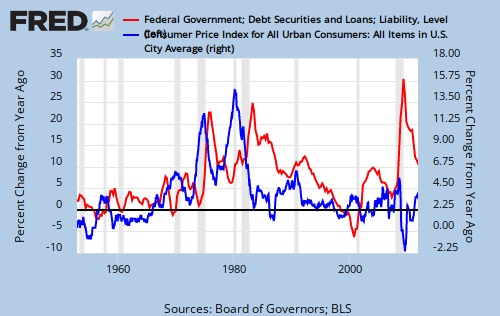
The first question can be addressed by the following graph.

Monetary Sovereignty

The red line shows the federal deficit; the blue line shows the Consumer Price Index. As you can see, for at least the past sixty years (!) there has been zero relationship between federal deficit spending and inflation. This is discussed in greater detail at: Oil causes inflation.

As for whether inflation is a greater threat than recession, we already are in, and have been in, a recession. Millions of people are suffering from joblessness and poverty. By contrast, inflation remains about what the Fed wants it to be: 2% – 3%. So you tell me which is the greater threat.

I mention this because of an article that appeared in today’s Washington Post. Here are some excerpts:

Fed Inflation Hawks Warn More Stimulus Could Fuel Prices
By Sam Gustin

Are inflation hawks preparing to take flight? That’s the sense one gets reading comments made by two U.S. central bank officials Tuesday, including Dallas Fed President Richard Fisher, who said that corporate chiefs have been sounding the alarm about an increase in prices thanks to the Fed’s easy money policy.

Fisher’s latest remarks are sure to fuel a growing debate about whether the Fed should embark on another round of monetary stimulus, especially in light of last month’s lackluster jobs report.

Fisher said that he’s heard from business leaders who are concerned that the Fed’s easy money policy could raise inflation, which would increase prices for companies just as they’re trying gain a solid footing.

“I’m just reporting what I hear on the street, which is a real concern that with our expanded balance sheet, we are just a little bit in an ember of what could become an inflationary fire,” Fisher said in comments cited by Bloomberg.

He said business leaders are telling him, “Please, no more liquidity.”

This is economics? What he’s heard on the street? And are business leaders really begging for no more stimulus? Gimme a break. It’s total BS.

Separately, Minneapolis Federal Reserve Bank President Narayana Kocherlakota said that the threat of inflation means that the central bank will likely have to begin to reverse its easy money policy as early as the end of the year.

“Conditions will warrant raising rates some time in 2013 or, possibly, late 2012,” Kocherlakota said in comments cited by Reuters.

That puts Kocherlakota at odds with the policy-making Federal Open Market Committee, which has said since January that it plans to keep interest rates low through 2014.

Confused nonsense. Low interest rates are not stimulative. (See: The low interest rate/GDP fallacy)

In fact, the opposite is true. Low rates hinder economic growth. Ask anyone holding CD’s, bonds or Treasuries.

So yes, by all means, raise interest rates.

Fisher and Kocherlakota are well-known inflation hawks, which means they tend to worry more than other policy-makers about the risk that inflation poses to the economy.

So it’s not surprising that Fisher, in particular, would voice business leaders’ concerns that inflation could make buying the materials — or inputs — they need to run their companies more expensive.

And that answers it. These guys mistakenly fear inflation more than recession (Think of what affects them personally, with their guaranteed, recession-proof salaries.)

And they mistakenly believe federal spending is the cause of inflation. And they mistakenly believe low interest rates are stimulative. And they mistakenly base policy on what someone says on the street.

Considering these are “experts,” is it any wonder the public is confused?

Fisher is the more hawkish of the pair. He’s called the idea of more monetary stimulus a “fantasy of Wall Street,” while Kocherlakota has allowed that “if the outlook for inflation fell sufficiently and/or the outlook for unemployment rose sufficiently, then I would recommend adding accommodation.”

Here’s where the real confusion emerges. Yes, monetary policy, (usually focused on interest rates), is a fantasy for economic growth, although interest rates do control inflation.

But fiscal policy (usually focused on deficit spending), is reality. Deficits are stimulative and the lack of deficits is recessionary and deflationary.

Bottom line:
1. Low interest rates are not stimulative; high rates are stimulative.
2. High rates fight inflation.
3. Federal deficit spending has not caused inflation for 60 years, though deficit spending is stimulative.

So to grow the economy without inflation, raise interest rates and increase deficit spending. And by all means, don’t listen to debt-hawks. They hate the word “debt,” without knowing why; they don’t understand Monetary Sovereignty; and they ignore economic reality.

Rodger Malcolm Mitchell
http://www.rodgermitchell.com


==========================================================================================================================================
No nation can tax itself into prosperity, nor grow without money growth. Monetary Sovereignty: Cutting federal deficits to grow the economy is like applying leeches to cure anemia. Two key equations in economics:
Federal Deficits – Net Imports = Net Private Savings
Gross Domestic Product = Federal Spending + Private Investment and Consumption + Net exports

#MONETARY SOVEREIGNTY