Medicare and Medicaid easily could (should) be better

There are penalties for ignorance, and America pays them every day:
Almost Half of Medicare Patients Can’t Afford a Single Hospital Stay New University of Pennsylvania research highlights growing health care affordability crisis. By Huey Freeman
Read that headline again. Digest it’s meaning. You have original Medicare. You are sick. But you can’t afford to go to the hospital. And you are not rare. Almost half of Medicare patients are just like you. What the hell??
Americans who rely on Medicare to pay for hospital stays are often unable to pay the cost of the standard deduction,sometimes producing a financial shock.
Uncle Sam pockets inside out to show he's poor.
I’m Uncle Sam. I have the infinite ability to create dollars. Even if you don’t pay me one penny in taxes, I could keep spending forever. But don’t ask me for money to pay for your healthcare. I tell everyone I’m broke.
Think about it, more. The federal government is Monetarily Sovereign. That means:
  1. It never can run short of dollars.
  2. It neither needs nor uses tax dollars to pay its bills. It just creates new dollars, every time it pays someone.
  3. Those FICA dollars that are deducted from your pay, supposedly to fund Medicare, don’t fund anything. The govenment destroys them upon receipt, and creates new dollars to pay doctors, nurses, hospitals, etc.
But for some reason, which I’ll explain later, the government insists that you pay 20% of the bill. Three years ago, my wife died in the hospital after a 2-week stay. The bill was somewhere over $400,000 in total. Medicare paid $320,000. Fortunately, I paid for supplementary insurance, which covered nearly all the rest. But for most people, that $80,000 would have landed them in bankruptcy court. Why? Why does Medicare not pay the entire cost? And so long as we’re asking questions, why do we have an alternative called Medicare Advantage that covers some things Medicare doesn’t, but with restriction original Medicare doesn’t have. Why doesn’t original Medicare simply cover everything? Remember, the federal governmennt, being Monetarily Sovereign, cannot run short of dollars.
Researchers at the University of Pennsylvania Perelman School of Medicine found that almost half of such patients have insufficient funds to pay the $1,600 payment, the standard out-of-pocket cost.
Why, the out-of-pocket cost? Here are reasons given: Medicare doesn’t cover 100% of costs for several reasons:
  1. Cost Control: Having beneficiaries share in the cost helps control overall healthcare spending and prevents overuse of services. (The false beliefs are that the government can run short of dollars and people will visit the doctor too much.)
  2. Sustainability: Given the rising healthcare costs, partial coverage helps ensure the program’s financial sustainability. (Same false beliefs as #1)
  3. Incentive for Supplemental Insurance: Encourages beneficiaries to purchase supplemental insurance (Medigap) to cover the remaining costs, providing additional financial protection. (Apparently, the profits of private insurance companies are more important than the people’s finances.)
  4. Budget Constraints: Full coverage would require significantly higher government spending, which might not be feasible given budget constraints. (Unnecessary budget constraints).
And now for the real reason:

5. The politicians are bribed by the rich (via campaign contributions and lucrative jobs) to widen the income/wealth Gap between the rich and the rest. The Gap is what makes the rich wealthy, and the wider the Gap, the wealthier they are.

Federal funding for health care narrows the Gap, so politicians invent excuses to claim it can’t be done.

Even beneficiaries with incomes above the federal poverty level sometimes cannot meet this expense after depleting their savings, according to the study results published in the Annals of Internal Medicine. However, the financial burden extends far beyond just the poorest Americans. “Many Medicare beneficiaries with modest incomes are at risk for financial hardship from costs of a single hospital stay,” the researchers wrote.
Think of yourself as a billionaire, and one of your kids can’t afford medical treatment. Would you allow him to go bankrupt? The federal govenment would.
“Nationally, 36 percent of beneficiaries report difficulty paying medical bills or delaying care due to cost concerns, and those with multiple chronic conditions and serious illnesses are at particular risk for high out-of-pocket costs and economic hardship,” they noted. While Medicaid (not Medicare) and private supplemental insurance can help cover these costs, qualifying for such assistance often requires proving extreme financial hardship.
First,  you must be destitute and prove it.
Patients must prove that their income is at or below the federal poverty level—currently set at $15,060 for individuals and $20,440 for couples in 2024. There are also asset limits of $2,000 for individuals, and $3,000 for couples.
However, some (red) states have set higher thresholds, extending Medicaid limits to 138 percent of the federal poverty level.
Why is there a need for Medicaid. Why not Medicare for All?
Additionally, access to full Medicaid benefits, including long-term care, depends on income criteria that varies by state—typically ranging from 75 to 100 percent of the federal poverty level.
Why should there be income criteria? Why must people go broke to be healthy?
Compounding the problem, fewer Medicare beneficiaries now carry supplemental insurance compared to previous years.
It’s too costly because it’s private, for-profit insurance
Among the 4,881 beneficiaries included in the Medicare study, 45 percent lacked sufficient funds in their checking and savings accounts to pay the Medicare hospital deductible.
Intolerable for the United States of America, a Monetarily Sovereign nation that acts like a 3rd world nation.
Seniors face many hardships resulting from health challenges that extend beyond just medical bills, according to Helen Levy, associate professor at the University of Michigan’s Institute for Social Research. Levy’s research identifies three main channels that lead to lower quality of life for seniors: decreased income, increased medical expenses, and the direct effects of health symptoms themselves. “The first two of these—lower income and higher medical spending—are much less quantitatively important than the third; in a nutshell, poor health makes it harder to get by with less,” Levy wrote in her article on the effects of poverty on older Americans.
Elon Musk making money
“How dare you people ask for free health care like I get. Do you think the government is made of money?” Uh, well . . . 
And then, what follows, is a clear expression of the ignorance that punishes us:
The key question that arises from this new study is how to respond to this insight, Dr. Chad Savage, an internal medicine physician, told The Epoch Times. “A common reaction is to expand insurance policies or government programs to cover an ever-growing range of medical costs,” said Savage, a member of Samaritan Ministries Inc., a group whose members share medical expenses. “However, this approach would increase the cost of coverage, thus, diverting more of the patients’ limited resources toward taxes and insurance premiums, and ultimately, depriving them of the funds they could have used for direct medical expenses.”
Dr. Savage’s comments are based on the wrong claim that the Monetarily Sovereign federal government cannot afford to fund a comprehensive Medicare for every man, woman, and child.
“The real issue, however, is why Americans remain so unprepared for medical expenses when they inevitably arise,” Savage added. “A legislative solution to address this could involve incentivizing proactive savings for medical costs that will inevitably occur as part of life.” “By creating incentives for Americans to contribute to Health Savings Accounts (HSAs) or Medical Savings Accounts (MSAs), they could gradually build up funds to cover out-of-pocket expenses for their own medical care when needed,” he said.
Dr. Savage is totally divorced from reality.
  1. Many people are unable to meet all financial obligations of food, rent, and clothing, much less contributing to HSAs
  2. For most Americans, saving enough in an HSA to cover major or recurring health issues would be impossible.
With infinite funds, the federal government can and should pay all medical expenses. The whole purpose of a government is to protect and improve the lives of the people. What is the purpose of a government that can’t or won’t do it? Here is what we need:

Free comprehensive Medicare for All.

Cover everything that Medicare Advantage covers, but do it in original Medicare. One program for all health needs.

No FICA payroll tax deductions. No fake “trust funds” (that aren’t trust funds). More generous payments to providers to attract more people into the field and more hospitals and clinics.

The federal government not only can afford it without collecting one additional penny in taxes, but the money spent by the government would grow Gross Domestic Product. And no, it wouldn’t cause inflation. See why. The Dr. Savages of the world seem to reverse reality. They think people’s purpose is to improve and protect the government, while the government’s desires come first. It’s nuts. But as I repeatedly have said, there is a penalty for ignorance, and the people of America are paying it. Rodger Malcolm Mitchell Monetary Sovereignty Twitter: @rodgermitchell Search #monetarysovereignty Facebook: Rodger Malcolm Mitchell; MUCK RACK: https://muckrack.com/rodger-malcolm-mitchell; https://www.academia.edu/

……………………………………………………………………..

The Sole Purpose of Government Is to Improve and Protect the Lives of the People.

MONETARY SOVEREIGNTY

The day Joe Biden lost the November 2024 election

Admirably, President Bident wishes to narrow the income/wealth/power Gap between the rich and the rest of us. I agree with this sentiment because the current Gap, very simply, is bad economics and bad for humanity. Wide Gaps negatively affect health and longevity, education, housing, law and crime, war, leadership, ownership, bigotry, supply and demand, GDP, international relations, scientific advancement, the environment, human motivation and well-being, freedom, and virtually every other issue in economics and the human condition. To narrow the Gaps, Biden proposes changes to federal law.  In broad strokes, he has just three options:
  1. Increase taxes on the rich (“rich” by any arbitrary measure).
  2. Reduce taxes on those who are not rich.
  3. Provide supplementary income and benefits to those who are not rich.
All three would narrow the Gap, though in different ways. From the standpoint of the U.S. economy, as measured by Gross Domestic Product, #1 would have a dramatically different effect than #2 and #3. Increasing taxes on the rich (if the rich actually paid those increased tax levels) would take dollars out of the economy. #2 and #3 would add dollars to the economy). In short, #1 is recessive, and #s 2 and 3, would grow the economy. This is demonstrated by the formula:

GDP = Federal Spending + Nonfederal Spending – Net Imports.

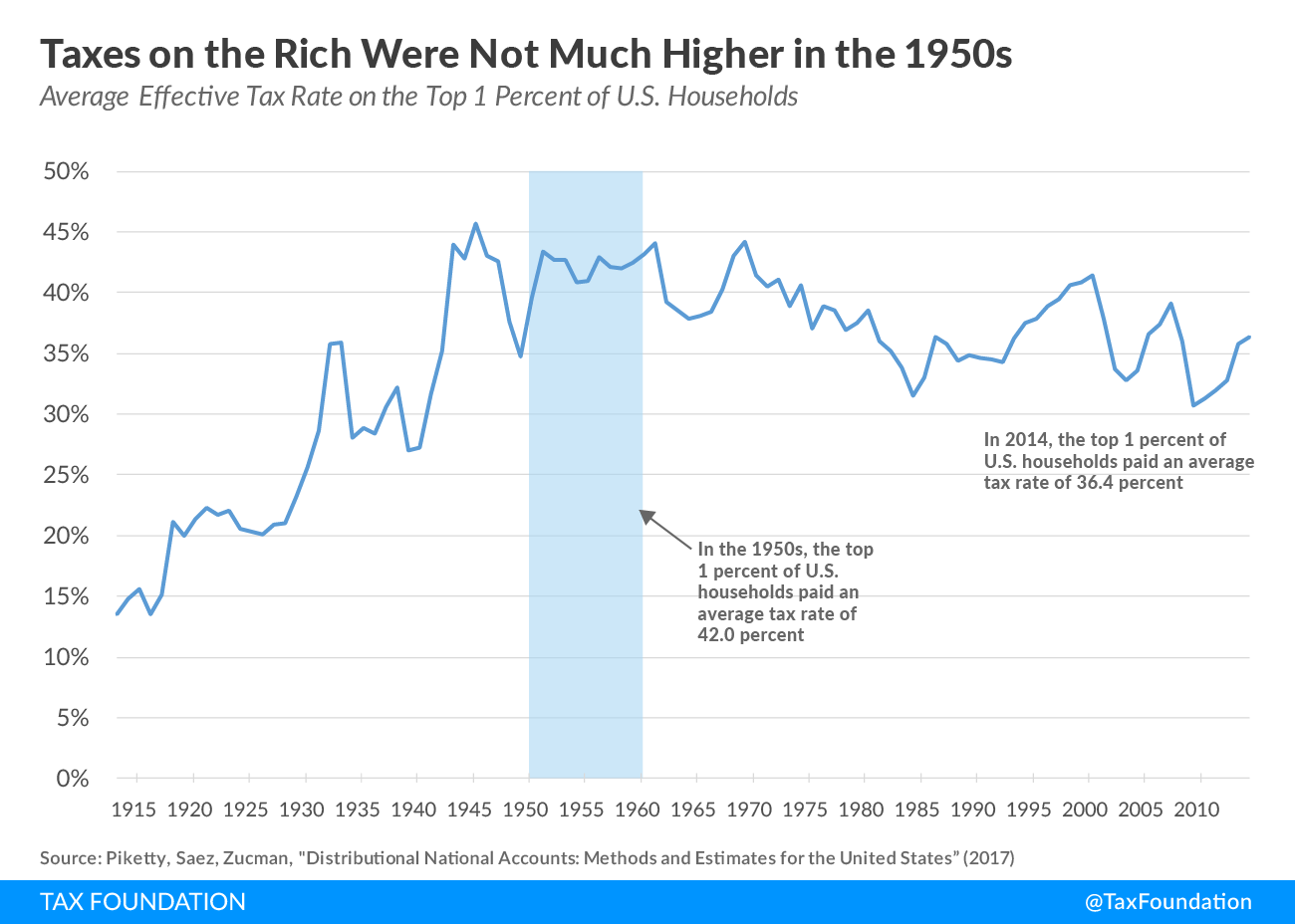
If the rich paid more taxes (#1), Nonfederal Spending would decline. The amount of the decline would be determined by various factors, most having to do with how much the rich actually pay. History indicates that payment would be less than anticipated because of existing loopholes and/or new loopholes the rich would bribe Congress to enact. Average Effective Tax Rate on the Top 1 Percent of U.S. Households Considering that the top tax rate in the 1950s was 90%, the rich did not pay much more in that period than they do now. And some of the richest among us pay little if anything. For example, Donald Trump paid no income taxes at all, during ten of the fifteen years, 2000-2015, despite being a billionaire. Tax laws, favorable to the rich, gave him the ability to claim losses on investments that an ordinary taxpayer may not look at as “losing” money. In summary, using federal taxation of the rich to narrow the Gap is bad economics. History shows the rich would find ways to avoid paying higher rates. But, even if the rich were forced to pay more, the higher rates would take dollars out of the economy and recess the economy. Option #1 is a “heads-you-lose (the rich don’t pay more), tails-you-lose” (GDP falls) plan. Sadly, that is the plan Biden seems to have chosen, and it will cost him the November election. The electorate may be ignorant about economics, but the rich would make sure the voters understood that raising taxes — anyone’s taxes — would hurt the economy. It’s simple math. The more the federal government takes out of the economy, the less the economy (GDP) has. Reducing federal taxes and/or providing supplementary benefits to those who are not rich, (#2 and #3) are the sole economically sensible ways to narrow the income/wealth/power Gap. Sadly this sensible approach is blocked by the non-sensible belief that federal deficit spending is “unsustainable.” That’s associated with the equally wrong belief that “excessive” federal spending or an “overheated” economy cause inflation. The fact: Inflation is not caused by “heat” (whatever that is) or by federal spending. All inflations are caused by shortages of critical goods and services, most often oil and food. Inflation can be cured by additional federal spending to acquire and distribute the scarce goods and services. Here is what the right-leaning Tax Foundation thinks:Details and Analysis of President Biden’s Fiscal Year 2025 Budget Proposal
March 22, 2024, By: Garrett Watson, Erica York, William McBride, Alex Muresianu, Huaquin Li, Alex Durante

11-Year Revenue (Trillions) Long-run GDP Long-Run Wages Long-Run FTE Jobs

+$2.2T

-2.2%

-1.6%

-788k

In plain English, the government would remove from the economy, an additional $2,2 Trillion. This would cause GDP to fall by 2.2%, wages to fall by 1.6%, and Full-Time Equivalent Jobs to shrink by 788 thousand.

Because the Tax Foundation has a right-wing agenda, one may doubt the specifics of their calculations, but I believe they are on the right track. When the federal government collects more taxes, the economy loses money. When the economy loses money, the GDP, wages, and jobs all shrink. It’s straightforward math.

The tax changes Biden proposes fall under three main categories: additional taxes on high earners, higher taxes on U.S. businesses—including increasing taxes that Biden enacted with the Inflation Reduction Act (IRA)—and more tax credits for a variety of taxpayers and activities.

The combination of policies would move the tax code further away from simplicity, transparency, and neutrality while making the U.S. economy less competitive.

The increase in the corporate tax rate and the additional taxes on top earners would result in U.S. top marginal tax rates on income that are among the highest in the developed world.

I urge you to read the entire Details and Analysis of President Biden’s Fiscal Year 2025 Budget Proposal as this post offers you the barest outline. Everything Biden may propose is based on two false assumptions:
  1. The federal government is running short of money while the private sector has too much money.
  2. The middle- and lower-income taxpayers will not understand that taking dollars from the economy is recessive, and instead will happily vote for a “soak-the-rich” administration.
The ignorance and cynicism of these beliefs cannot be overstated. Biden seems to believe that taking the populist approach will gain him votes. But, it is such government deceit that keeps you from:
  1. The end of the FICA tax deduction from your salary
  2. Comprehensive, no deductible Medicare for every adult and child.
  3. Social Security benefits for everyone of all ages
  4. Food cost aid
  5. Free college for those who want it
  6. Free public transportation
  7. Housing aid
  8. And a myriad of other benefits our Monetarily Sovereign government easily could afford, while preventing recessions and inflations.
Biden could beat Trump in a “truth vs. lies” competition, but he will not be able to out-lie Trump. If he tries, he will lose. Narrowing the Gap is good economics, but doing it by taxing businesses and the rich is a lie. It may be a good time to repeat a few facts:

•Those, who do not understand the differences between Monetary Sovereignty and monetary non-sovereignty, do not understand economics. •Any monetarily NON-sovereign government — be it city, county, state or nation — that runs an ongoing trade deficit, eventually will run out of money. •The more federal budgets are cut and taxes increased, the weaker an economy becomes. •Liberals think the purpose of government is to protect the poor and powerless from the rich and powerful. Conservatives think the purpose of government is to protect the rich and powerful from the poor and powerless. •The single most important problem in economics is the Gap between rich and poor. •Austerity is the government’s method for widening the Gap between rich and poor. •Until the lower 99% understand the need for federal deficits, the upper 1% will continue to rule. •Everything in economics devolves into motive, and the motive is the Gap between the rich and the rest.

Rodger Malcolm Mitchell Monetary Sovereignty Twitter: @rodgermitchell Search #monetarysovereignty Facebook: Rodger Malcolm Mitchell; MUCK RACK: https://muckrack.com/rodger-malcolm-mitchell

……………………………………………………………………..

The Sole Purpose of Government Is to Improve and Protect the Lives of the People.

MONETARY SOVEREIGNTY

The rich will try to cut Social Security and Medicare by telling you the Big Lie in economics.

As you read this post, think about these two simple questions. What would happen if your city, county, and state stopped collecting taxes. What would happen if the U.S. government stopped collecting taxes? 

Later, if you’re in school, you can ask your economics professor. See if he/she knows.

—–/////—–

“Rich” is a comparative. A person earning $100,000 is rich if everyone else earns $10,000. But that person earning $10,00 is rich if everyone else earns $1,000.

The income/wealth/power Gap below you and above you determines how rich you are. The average annual income in 1930 was about $4,800. Adjusted for inflation, that’s equivalent to $85,000 today.

Thus, the wealthy need to make you poorer to make themselves richer. Here is how they plan to do it:

In a June 13 Fox Nation debate, Sen. Lindsey Graham said seniors may have to “take a little less” and “pay a little more in” when debating Social Security solvency, reports Knewz via MSN.

Graham commented while debating Sen. Bernie Sanders during a “Senate Project” debate.

There is not one legitimate reason why seniors will “have to” take less or pay more. Not one. The U.S. federal government, being Monetarily Sovereign, cannot run short of dollars.

Alan Greenspan:A government cannot become insolvent with respect to obligations in its own currency. There is nothing to prevent the federal government from creating as much money as it wants and paying it to somebody. The United States can pay any debt it has because we can always print the money to do that.”

And because the federal government cannot become insolvent, no federal government agency can become insolvent unless that is what Congress and the President want.

Social Security and Medicare are not funded by FICA taxes or other taxes. Like every other federal agency, these agencies, including Congress, the Supreme Court, the White House, the armed services, etc., are funded by new dollar creation.

Ben Bernanke: “The U.S. government has a technology, called a printing press (or, today, its electronic equivalent), that allows it to produce as many U.S. dollars as it wishes at essentially no cost.”

Keep these facts in mind as you read the following:

Senator Sanders: Bring your Social Security plan to the floor. All it does is raise taxes. People like me must take a little less and pay a little more to get out of this mess.

Quote from 60 Minutes: Scott Pelley: Is that tax money that the Fed is spending? Ben Bernanke: It’s not tax money… We simply use the computer to mark up the size of the account.

Even Sanders, a proponent of Medicare for All and increased Social Security parrots the Big Lie that federal taxes fund federal spending.

We must adjust the age again like Ronald Reagan and Tip — Tip O’Neil did. There is a bipartisan way forward. You describe problems, but your answer is always the government — it’s always socialism,” Graham said.

Graham deceivingly uses the epithet “socialism.” But it’s not socialism. Socialism is government ownership and control, not government funding.

Strangely, he doesn’t use that word when describing his own salary, which, in fact, is socialism, as is the Veteran’s Administration Hospitals, the military, and the U.S. court system.

The cost of supporting SCOTUS, POTUS, Congress, and many other approximately 1,000 federal agencies has increased, but we don’t hear that spending for those agencies needs to be cut.

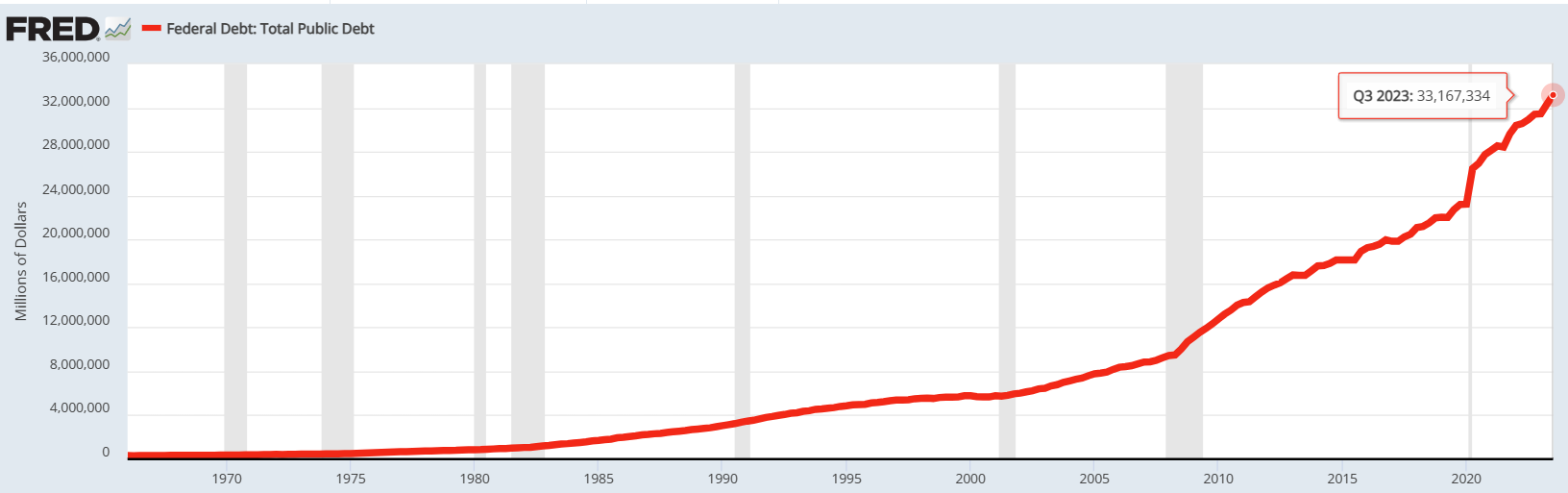
Instead, federal spending goes up to accommodate increased needs. In 2023, the federal government spent $1.7 trillion more than it collected in taxes.

The federal government has spent over $33 TRILLION more than it has collected in taxes.

The federal government has spent over $33 TRILLION more than it has collected in taxes. Yet, the government has no problem paying its creditors.

Federal deficits are not a burden or obligation on anyone. A federal deficit is merely the number of growth dollars the government pumps into the economy. You and I don’t owe those dollars. Even the government doesn’t owe those dollars. They have already been paid to creditors.

No one owes the federal deficit or debt. Those are just record-keeping numbers.

Why, then, do people who know better (or should know better) talk about having to raise taxes?

Sanders admitted that Social Security “has a solvency issue,” but his proposal — also backed by Sen. Elizabeth Warren — would extend solvency for 75 years while increasing benefits for recipients by $2,400 per year.

Sanders’s proposal would ostensibly fund this expansion of Social Security via a tax on high-earning households, per CNBC.

While I have no object to a tax on high-earning households, it has several problems:

  1. It would have trouble passing Congress, whose members are bribed by the rich not to tax wealthy folk.
  2. Even if high-income were taxed at higher rates, the rich don’t pay those rates. They slip through tax loopholes Congress has given them.
  3. Most importantly, Social Security does not have a “solvency issue,” nor do taxes fund Social Security.

Social Security has an ignorance issue — Congress, the President, and the public wrongly claim FICA funds Social Security (and Medicare).

President Franklin D. Roosevelt, the originator of Social Security, instituted the FICA tax not to fund Social Security but to protect it. “We put those payroll contributions there to give the contributors a legal, moral, and political right to collect their pensions… With those taxes in there, no damn politician can ever scrap my Social Security program.”

Little did he expect that the “damn politicians” would find a way to kill Social Security by the death of a thousand cuts.

Originally, Social Security benefits were not taxable income. However, This was not a law provision, nor anything that President Roosevelt did or could have “promised.”

It resulted from a series of administrative rulings issued by the Treasury Department in the program’s early years. 

In 1983, GOP President Ronald Reagan and Congress changed the law by explicitly authorizing the taxation of Social Security benefits. This was part of the 1983 Amendments, and this law overrode the earlier administrative rulings from the Treasury Department.

Aside from the fact that federal taxes don’t fund federal spending, the federal government taxing its own benefits — the right hand gives, and the left hand takes away — defies logic.

And here is the ultimate irony. People who earn more receive higher benefits. Why?

Why does a person earning $100,000 a year receive higher Social Security benefits than a person earning $30,000 a year? Shouldn’t it be the other way around?

Federal poverty benefits are based on how little you earn. But Social Security is based on how much you earn. It’s a senseless formula based on the Big Lie that federal taxes fund federal spending.

Federal taxes fund nothing. The purposes of federal taxes are:

  1. To narrow the income/wealth/power Gap between the rich and the rest. (But because of tax loopholes, the rich pay a lower percentage of their income in taxes than the rest of us. Federal taxes actually widen the Gap.)
  2. To assure demand for the U.S. dollar by requiring taxes to be paid in dollars. (But there is no shortage of demand for U.S. dollars. Even people, businesses, and nations that don’t pay taxes want dollars.)
  3. To control the economy by taxing what the government wishes to discourage and giving tax breaks to what the government wishes to reward. (But by bribing Congress, the rich have twisted this purpose to their favor. They are the  ones being rewarded with tax breaks.)
  4. To fool the public into believing that their federal benefits are limited by taxes collected.

Does the White House have a solvency issue? The Supreme Court? Congress? The Army? The Air Force? The Central Intelligence Agency? The U.S. Treasury? The Federal Reserve?

No. These agencies never are said to be in danger of insolvency. Why do we see a special tax, ostensibly to support Social Security and Medicare, but no special taxes to support the White House, the Supreme Court, Congress, et al?

Because the function of FICA is not to fund Social Security and Medicare but to provide political cover for limiting these programs. They are programs supposedly to benefit the powerless. But the federal government neither needs nor uses tax dollars.

In fact, your federal tax payments are destroyed upon receipt by the U.S. Treasury. (See: “Does the U.S. Treasury Really Destroy Your Tax Dollars?”)

Congress and the President claim that taxes fund spending so they can pretend to be “forced” to cut benefits by blaming “insolvency.”

Graham also said that Sanders’ Medicare for All program would eliminate private-sector health care, which would be extremely costly.

“Costly” to whom? Cost means nothing to the federal government, which, being Monetarily Sovereign, has the infinite ability to pay any invoice to any creditor.

A “Medicare for All” would cost consumers nothing. That is the whole point of the program.

So, to whom would it be “costly.” Answer: The health insurance companies would lose all that lucrative income. That’s why every Senator in Congress has received bribes (aka “campaign contributions”) from health insurance companies — every single one.

Knewz reported that Sanders and 14 other senators introduced the Medicare for All plan in May to “guarantee health care in the United States as a fundamental human right to all.”

“There has to be some sense of responsibility here. You just can’t tax people into oblivion and turn every problem over to the government,” Graham said.

You can’t turn “every” problem over to the government. Still, we expect certain basics from our government — Enough food to feed our loved ones and ourselves, a safe place to live, and protection from attack by domestic criminals and foreigners. Education, and healthcare.

If you elected officials can’t provide those basics, who needs you? Get lost. We’ll elect someone who understands the purpose of government.

SUMMARY

The bottom line of this entire article is a straightforward truth. Unlike state/local governments, the U.S. federal government does not pay its bills with tax dollars. It destroys every tax dollar it receives.

State/local governments, being monetarily non-sovereign, survive on tax dollars. But, even if the federal government collected zero taxes, it could continue spending, forever. It cannot become insolvent.

Social Security and Medicare are federal agencies. They cannot become insolvent unless that is what Congress and the President want.

The government has the infinite ability to pay creditors by creating new dollars ad hoc. Having that infinite ability, the federal government does not borrow.

Treasury securities — T-bills, T-notes, and T-bonds– erroneously termed “borrowing” should be called “money storage.” The sole purposes of T-securities are:

  1. To provide a safe place to store unused dollars and
  2. To help the Federal Reserve control interest rates.

Every dollar deposited into T-security accounts remains the property of the depositors. They neither are touched, borrowed, nor owed by the government.  

The federal government pays all its creditors on time and in full. Thus, the federal debt merely is an accounting number that shows how many growth dollars have been pumped into the economy. Increasing the misnamed “debt” increases the growth dollars added to Gross Domestic Product.

Far from being a worrisome burden, the growing federal “deficit” and “debt” are absolutely necessary for a healthy economy.

Why isn’t every economist in America broadcasting this truth? That is a mystery I’ve not been able to solve.

Any ideas?

Rodger Malcolm Mitchell

Monetary Sovereignty

Twitter: @rodgermitchell

Search #monetarysovereignty

Facebook: Rodger Malcolm Mitchell

……………………………………………………………………..

THE SOLE PURPOSE OF GOVERNMENT IS TO IMPROVE AND PROTECT THE LIVES OF THE PEOPLE.


Why is medical care unaffordable for so many Americans?

We’ll begin with a few facts:
  1. The U.S. federal government is Monetarily Sovereign (See: Monetary Sovereignty.)  It created the first U.S. dollars from thin air, and it retains the unlimited ability to create more U.S. dollars. The government never unintentionally can run short of U.S. dollars. Even if all federal tax collections ended, the federal government could continue spending forever.
  2. State and local governments are monetarily non-sovereign. They can and often do run short of dollars.
  3. Because the U.S. government cannot run short of dollars, it has no need for tax dollars. In fact, it destroys all tax dollars upon receipt at the Treasury. (See: “Does the Federal Government Really Destroy Your Tax Dollars?“) Taxes are paid with dollars from the M2 money supply, and when they reach the Treasury, they cease to exist in any money supply measure. Thus, the federal government does not spend taxpayers’ dollars.
  4. By contrast, state/local governments do need and spend taxpayers’ dollars.
  5. Contrary to popular wisdom, federal spending does not cause inflation. Inflation always is caused by shortages of critical goods and services, usually oil, food, and labor. (See: “Cause of Inflation.”) Inflations can be cured by additional government spending to cure shortages.
  6. Federal deficit spending is necessary for economic growth. The greater the spending, the greater the growth. (See: “Four Reasons Why Federal Deficits Are Absolutely Necessary.“)
Keep those facts in mind as you read excerpts from the following article:New Oxfam Poll: Most Americans Believe We Should Help Working Poor |  HuffPost Impact

The Commonwealth Fund Health Care Affordability Survey, fielded for the first time in 2023, asked U.S. adults with health insurance, and those without, about their ability to afford their health care — whether costs prevented them from getting care, whether provider bills left them with medical debt, and how these problems affected their lives.

Many Americans have inadequate coverage that’s led to delayed or forgone care, significant medical debt, and worsening health problems.

While having health insurance is always better than not having it, the survey findings challenge the implicit assumption that health insurance in the United States buys affordable access to care.

Difficulties affording care are experienced by people in employer, marketplace, and individual market plans, as well as people enrolled in Medicaid and Medicare.

Private insurance is burdened by the profit motive, which restricts the number and amount of benefits offered. However the federal government has no profit motive and has the unlimited ability to create dollars. So why is Medicare inadequate?

For the survey, our analysis focuses on 6,121 working-age respondents, those 19 to 64. 

Survey Highlights

    • Large shares of insured working-age adults surveyed said it was very or somewhat difficult to afford their health care: 43 percent of those with employer coverage, 57 percent with marketplace or individual-market plans, 45 percent with Medicaid, and 51 percent with Medicare.
    • Many insured adults said they or a family member had delayed or skipped needed health care or prescription drugs because they couldn’t afford it in the past 12 months: 29 percent of those with employer coverage, 37 percent covered by marketplace or individual-market plans, 39 percent enrolled in Medicaid, and 42 percent with Medicare.
    • Cost-driven delays in getting care or missed care made people sicker. Fifty-four percent of people with employer coverage who reported delaying or forgoing care because of costs said a health problem of theirs or a family member got worse because of it, as did 61 percent in marketplace or individual-market plans, 60 percent with Medicaid, and 63 percent with Medicare.
    • Insurance coverage didn’t prevent people from incurring medical debt.Thirty percent of adults with employer coverage were paying off debt from medical or dental care, as were 33 percent of those in marketplace or individual-market plans, 21 percent with Medicaid, and 33 percent with Medicare.
    • Medical debt leads many people to delay or avoid getting care or filling prescriptions: more than one-third (34%) of people with medical debt are in employer plans, 39 percent in the marketplace or individual-market plans, 31 percent in Medicaid, and 32 percent in Medicare.
Healthcare insurance, whether private or government-funded, is inadequate. Given the fact that the federal government has infinite dollars, why are so many Americans suffering with too-costly-but-inadequate insurance? Medicare, for instance, is far less than comprehensive. Why does Medicare have Part A, Part B, Part C, and Part D, each with different options and costs? Why not simply a Medicare that covers everything for everyone at no cost? What Medicare Doesn't Cover Why, if the federal government has infinite money, are these expenses not covered, and why are there deductibles and added costs to complete coverages? You have been told, falsely, that the federal government is like state/local governments, business, you and me, in being monetarily non-sovereign. You have been told falsely, that the federal government spends taxpayers’ dollars and can run short of dollars. You have been told, falsely, that to provide benefits, the federal government must levy taxes and spend taxpayers’ money. It’s all a lie.

Alan Greenspan: “A government cannot become insolvent with respect to obligations in its own currency. There is nothing to prevent the federal government from creating as much money as it wants and paying it to somebody. The United States can pay any debt it has because we can always print the money to do that.”

Quote from former Fed Chairman Ben Bernanke when he was on 60 Minutes: Scott Pelley: Is that tax money that the Fed is spending? Ben Bernanke: “It’s not tax money… We simply use the computer to mark up the size of the account. The U.S. government has a technology, called a printing press (or, today, its electronic equivalent), that allows it to produce as many U.S. dollars as it wishes at essentially no cost.”

Statement from the St. Louis Fed: “As the sole manufacturer of dollars, whose debt is denominated in dollars, the U.S. government can never become insolvent, i.e., unable to pay its bills. In this sense, the government is not dependent on credit markets to remain operational.”

The U.S. government is not the only Monetarily Sovereign entity. For example:

Press Conference: Mario Draghi, President of the ECB, 9 January 2014 Question: I am wondering: can the ECB ever run out of money? Mario Draghi: Technically, no. We cannot run out of money.

Given its infinite money supply, why does the federal government not provide free, comprehensive, no-deductible insurance to every man, woman, and child in America? Why must you, as an American, risk bankruptcy, sickness, and death because your insurance is inadequate? What is the Big Lie? The Big Lie is the claim that federal taxes fund federal spending. To pay its bills, the federal government creates new dollars ad hoc by tapping computer keys. Whenever you read an article claiming the federal government is “spending taxpayers’ dollars; it is a lie. State and local governments spend taxpayers’ dollars; the federal government does not. Why are you being lied to, and where are the lies coming from? The lies are coming from the healthcare insurance industry, the media, the economists, and the politicians. It’s easy to understand why the insurance industry lies about the federal government’s not funding healthcare insurance: The profit motive. The insurance industry does not want to lose the huge profits in selling healthcare coverage. But why do the media, economists, and politicians lie? Because they are bribed. The media are bribed by advertising dollars and by ownership. The economists are bribed by university contributions and by promises of lucrative jobs in “think tanks.” The politicians are bribed by campaign contributions and by promises of lucrative jobs with industry. Who is doing the bribing? The very rich? Why are the rich bribing? Gap psychology says people grow richer and more powerful by widening the Gap between them and those below them in any income/wealth/power measure. That is the primary way the rich make themselves more affluent. How do the rich widen the Gap below them? They get more for themselves, but importantly, they make sure those below them get less. They use their influence to reduce the federal benefits paid to those less wealthy. The rich disseminate the lie that Medicare and Social Security are running short of dollars, so benefits must be reduced, and taxes must be increased (See: “Starve the Poor.”) What should be done? First, the useless, harmful FICA tax should be eliminated. Like all federal taxes, it funds nothing. Worse, it punishes the low-income worker and widens the Gap between the rich and the rest. Second, the federal government should pay for free, comprehensive Medicare for All, with no limits and no deductions. One free plan for everyone; no Part A, B, C, D. No Medicaid. No “Donut holes.” No Medicare Advantage plans. The public must learn that federal spending is beneficial, and it costs nothing. The more the federal government spends on healthcare, the more the overall economy will grow and prosper. Ignorance is the weapon used by the rich to dominate the rest. That is the reason medical services are unaffordable for so many Americans. Rodger Malcolm Mitchell Monetary Sovereignty Twitter: @rodgermitchell Search #monetarysovereignty Facebook: Rodger Malcolm Mitchell

……………………………………………………………………..

The Sole Purpose of Government Is to Improve and Protect the Lives of the People.

MONETARY SOVEREIGNTY