–Paranoia: First read this; then read this.

Twitter: @rodgermitchell; Search #monetarysovereignty
Facebook: Rodger Malcolm Mitchell

Mitchell’s laws:
●The more federal budgets are cut and taxes increased, the weaker an economy becomes.
●Austerity is the government’s method for widening the gap between rich and poor,
which ultimately leads to civil disorder.
●Until the 99% understand the need for federal deficits, the upper 1% will rule.
●To survive long term, a monetarily non-sovereign government must have a positive balance of payments.
●Those, who do not understand the differences between Monetary Sovereignty and monetary non-sovereignty, do not understand economics.
●The penalty for ignorance is slavery.
●Everything in economics devolves to motive.

=====================================================================

To learn of our growing immorality and lawlessness, the increasing, cowardly paranoia in America, you first should read this:

The magic of executive orders. How the President circumvents Congress and plays politics with the law: Tuesday, Nov 1 2011

Then read this:

Why is the NSA teaching your kids to be spies? Tuesday, Jul 2 2013

Then read this:

The magic of executive orders. How the President circumvents Congress and plays politics with the law:Do you trust the government, completely? Apparently, you do. Sunday, Jul 7 2013

And finally, read this marvelous article:

Bill Black: Is it Legal Malpractice to Fail to Get Holder to Promise Not to Torture your Client? July 27, 2013

Sadly, most of us Americans have so been brainwashed into paranoia, by the media and the politicians, we approve of the massive incursions into our privacy and freedoms by our “Big Brother” government.

We approve of the government learning about our every friend, contact, belief and statement, from our birth to our death.

We approve of our government executing all forms of torture, including waterboarding, extended solitary confinement, sleep deprivation, drugging, extended detention without trial, extended discomfort, humiliation and pain — all done in secret from us Americans, but known by the rest of the world.

We accede to the Obama “tradeoff” from real freedom for false security.

We approve of the need for every American to carry a loaded gun and even to shoot unarmed children if we “feel threatened.” (But, these days, don’t we always feel threatened?)

Why do we so unquestioningly agree with the fear-producing lies spread by our Presidents, and by National Rifle Association and others of their ilk.

Why do we embrace immoral leaders who exaggerate threats, to fuel our fears and to make us surrender our lives to their selfish desires?

What has become of us?

Cringing, cowardly paranoia: Is this what America really is all about?

Is this how we wish to be remembered?

Rodger Malcolm Mitchell
Monetary Sovereignty

====================================================================================================================================================

Nine Steps to Prosperity:
1. Eliminate FICA (Click here)
2. Medicare — parts A, B & D — for everyone
3. Send every American citizen an annual check for $5,000 or give every state $5,000 per capita (Click here)
4. Long-term nursing care for everyone
5. Free education (including post-grad) for everyone. Click here
6. Salary for attending school (Click here)
7. Eliminate corporate taxes
8. Increase the standard income tax deduction annually
9. Increase federal spending on the myriad initiatives that benefit America’s 99%

10 Steps to Economic Misery: (Click here:)
1. Maintain or increase the FICA tax..
2. Spread the myth Social Security, Medicare and the U.S. government are insolvent.
3. Cut federal employment in the military, post office, other federal agencies.
4. Broaden the income tax base so more lower income people will pay.
5. Cut financial assistance to the states.
6. Spread the myth federal taxes pay for federal spending.
7. Allow banks to trade for their own accounts; save them when their investments go sour.
8. Never prosecute any banker for criminal activity.
9. Nominate arch conservatives to the Supreme Court.
10. Reduce the federal deficit and debt

No nation can tax itself into prosperity, nor grow without money growth. Monetary Sovereignty: Cutting federal deficits to grow the economy is like applying leeches to cure anemia.
Two key equations in economics:
1. Federal Deficits – Net Imports = Net Private Savings
2. Gross Domestic Product = Federal Spending + Private Investment and Consumption – Net Imports

#MONETARY SOVEREIGNTY

–I just thought you should know. Lunch really can be free.

Twitter: @rodgermitchell; Search #monetarysovereignty
Facebook: Rodger Malcolm Mitchell

Mitchell’s laws:
●Those, who do not understand the differences between Monetary Sovereignty and monetary non-sovereignty, do not understand economics.
●The more federal budgets are cut and taxes increased, the weaker an economy becomes. .
Liberals think the purpose of government is to protect the poor and powerless from the rich and powerful. Conservatives think the purpose of government is to protect the rich and powerful from the poor and powerless.
●The single most important problem in economics is
the gap between rich and poor.
●Austerity is the government’s method for widening
the gap between rich and poor.
●Until the 99% understand the need for federal deficits, the upper 1% will rule.
To survive long term, a monetarily non-sovereign government must have a positive balance of payments.
●Everything in economics devolves to motive,
and the motive is the Gap.

=========================================================================================================================================================================================================================


I just thought you should know. Lunch really can be free.

The U. S is Monetarily Sovereign, and in fact, always has been Monetarily Sovereign, though to a lesser degree.

This means, the U.S. government, including all federal agencies, never unintentionally can run short of dollars.

“In the beginning,” there was no dollar. Think of the U.S. government as the God of the dollar. The government originally produced from thin air, the laws that, in turn, created the very first dollar. Like God, the government continues to rule the laws that create dollars from thin air.

Because the dollar is the result of laws, and the U.S. government has 100% control over those laws, the federal government cannot unintentionally run short of dollars. Even if all federal taxes fell to $0, the government would not run short of dollars.

That is why, in a narrow sense, the U.S government always has been Monetarily Sovereign. But during the past 200+ years of our life, the government arbitrarily has passed laws that temporarily limited its functional sovereignty over the dollar.

Functional Monetary Sovereignty is not an absolute; it is a comparative. We can function as more or less sovereign.

The most notorious of such limiting laws tied the dollar to gold and silver. During the gold and silver periods, the U.S. functionally was not as Monetarily Sovereign as it is today, though being God of the dollar, it always retained the right to make itself more or less functionally sovereign over the dollar.

On August 15, 1971, the government (President Nixon), arbitrarily decided to eliminate the last vestiges of laws tying the dollar to gold, and since that day, the U.S. has been far more functionally sovereign over the dollar.

Yet, some restrictive laws remain, particularly the debt limit laws and certain borrowing and accounting laws, which reduce functional sovereignty. Still, the U.S. government, being the God of the dollar, can do anything it wishes with the dollar, merely by changing its own laws.

Compare this with the euro nations. Greece is not Monetarily Sovereign. It is not sovereign over the euro. It did not create the euro and cannot pass laws changing the euro. Greece is monetarily non-sovereign, because it has no sovereign currency. Greece is not God of its currency.

Similarly, Illinois, Boston, Microsoft, banks, you and I are not Monetarily Sovereign. None of us has a sovereign currency. Though we have been given the right to create and destroy dollars (by borrowing and lending), we do so at the mercy of the federal government, which arbitrarily can change the laws at any time it chooses. We are not Gods of the dollar.

Visualize the game of Monopoly in which I both am a player and the rules maker. I would be the God of the Monopoly dollar.

To pay for a Monopoly property, I arbitrarily might decide to take scraps of paper and write on them $1 or $10 or whatever I choose, and give these scraps to the property owner. I can do anything. I am Monetary Sovereign over the Monopoly dollar.

For any reasons I choose, I might decide to create a rule limiting myself to creating no more than $10 on any turn. I’m still Monetarily Sovereign, but functionally less so.

However, if I find myself running short of Monopoly dollars, I simply could change my own rules, and give myself the right to create more dollars. I can do anything. I am Monetarily Sovereign. I am the God of the Monopoly dollar.

Had the U.S. government decided not to create dollar bills, but rather decreed dollars would be represented by turnips, today we all would use turnips. The government would remain Monetarily Sovereign – the God of the dollar – but dollar creation would be limited by the turnip supply.

Always through its history, the federal government has pretended it is not the God of the dollar. Why? Economists wrongly have told the government that exercising its rights as God of the dollar, would lead to instability and inflation.

But, being the God of the dollar, the government not only has the power to create and destroy dollars, it has the power to set the value of dollars, i.e. to end or create inflation at will.

Many Monetarily Sovereign governments have exercised their God-like power over the value of their sovereign currency, simply and arbitrarily by changing its exchange value. Years ago, the UK did it; Mexico did it; many Monetarily Sovereign countries have done it.

Greece, France, Italy, Spain and other euro nations can’t do it. They are not Monetarily Sovereign. They are not Gods of the euro.

Believing the economists, that without restrictions, the dollar would be unstable and subject to inflation, the U.S. government always has restricted its God-like powers. These restrictions have made people – even people in the government – wrongly believe the government was less God-like – less Monetarily Sovereign – than it really is.

We see evidences of this, everywhere. The federal government unnecessarily levies taxes to obtain the dollars it can create at will, even though it neither needs, nor uses, those taxes.

The government even has created a complex, convoluted accounting system to track those taxes – a system which gives the false impression that somehow those taxes actually support government spending.

The twin facts that the Monetarily Sovereign government – the God of the dollar — can create dollars at will, and also being the law-maker, can change the accounting system at will – these twin facts seem lost to the public consciousness.

Today, most of the government pretends, and most of the public believes, that the federal government is monetarily non-sovereign, that it needs to tax and needs to borrow dollars, that it needs to “live within its means,” and that it is “broke” and that, for all the wrong reasons, needs to starve our economy for dollars.

Slowly and agonizingly, we try to recover from a recession caused by, exacerbated by and continued by a shortage of money. America has the people; we have the technology; we have the brains and physical resources – we have everything we need to create a vibrant, wealthy economy – we have everything but sufficient dollars.

Our Monetarily Sovereign government, the God of our dollar, levies unnecessary taxes, restricts spending, impoverishes the middle and lower classes, and brainwashes the public into believing these restrictions are prudent.

With the passage of a few laws and the press of a computer key, our government instantly could make American citizens the wealthiest people the world ever has known, now and forever.

It might seem too easy; it might seem to be too good to be true; it might seem like the proverbial free lunch.

But in this case, easy really is easy, and too good to be true really is true, and lunch really can be free.

I just thought you should know.

Rodger Malcolm Mitchell
Monetary Sovereignty

===================================================================================
Ten Steps to Prosperity:
1. Eliminate FICA (Click here)
2. Federally funded Medicare — parts A, B & D plus long term nursing care — for everyone (Click here)
3. Provide an Economic Bonus to every man, woman and child in America, and/or every state a per capita Economic Bonus. (Click here) Or institute a reverse income tax.
4. Free education (including post-grad) for everyone. Click here
5. Salary for attending school (Click here)
6. Eliminate corporate taxes (Click here)
7. Increase the standard income tax deduction annually
8. Tax the very rich (.1%) more, with higher, progressive tax rates on all forms of income. (Click here)

9. Federal ownership of all banks (Click here)

10. Increase federal spending on the myriad initiatives that benefit America’s 99% (Click here)

—–

10 Steps to Economic Misery: (Click here:)
1. Maintain or increase the FICA tax..
2. Spread the myth Social Security, Medicare and the U.S. government are insolvent.
3. Cut federal employment in the military, post office, other federal agencies.
4. Broaden the income tax base so more lower income people will pay.
5. Cut financial assistance to the states.
6. Spread the myth federal taxes pay for federal spending.
7. Allow banks to trade for their own accounts; save them when their investments go sour.
8. Never prosecute any banker for criminal activity.
9. Nominate arch conservatives to the Supreme Court.
10. Reduce the federal deficit and debt

No nation can tax itself into prosperity, nor grow without money growth. Monetary Sovereignty: Cutting federal deficits to grow the economy is like applying leeches to cure anemia.
Two key equations in economics:
1. Federal Deficits – Net Imports = Net Private Savings
2. Gross Domestic Product = Federal Spending + Private Investment and Consumption – Net Imports

THE RECESSION CLOCK
Monetary Sovereignty

Monetary Sovereignty

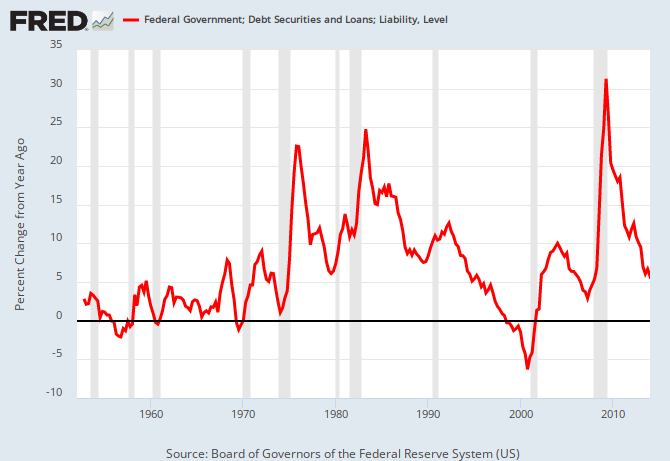
Vertical gray bars mark recessions.

As the federal deficit growth lines drop, we approach recession, which will be cured only when the growth lines rise. Increasing federal deficit growth (aka “stimulus”) is necessary for long-term economic growth.

#MONETARYSOVEREIGNTY

Tax “expenditures,” “broadening” the base, and other lies to widen the gap

Twitter: @rodgermitchell; Search #monetarysovereignty
Facebook: Rodger Malcolm Mitchell

Mitchell’s laws:
●The more federal budgets are cut and taxes increased, the weaker an economy becomes.
●Austerity is the government’s method for widening the gap between rich and poor,
which ultimately leads to civil disorder.
●Until the 99% understand the need for federal deficits, the upper 1% will rule.
●To survive long term, a monetarily non-sovereign government must have a positive balance of payments.
●Those, who do not understand the differences between Monetary Sovereignty and monetary non-sovereignty, do not understand economics.
●The penalty for ignorance is slavery.
●Everything in economics devolves to motive.

=====================================================================

We’ve discussed in the past, how semantics has ruled the erroneous beliefs about our economy and led to recessions.

For instance, using pejoratives like “federal deficit” to replace “economic surplus” and “federal debt” instead of “deposits” (in the Federal Reserve Bank), fools the public. Nearly everyone viscerally wants “debts” and “deficits” reduced, despite the fact that economically, these are positives.

For quite some time now, one of my favorite misinformation sources, The Committee For a Responsible Federal Budget (CRFB), which is associated with Pete Peterson’s foundation, has been using another, rather subtle, misnomer:

Beyond Tax Expenditures
By Marc Goldwein, Jessica Stone, and Adam Rosenberg

The recent announcement by Senate Finance Committee Chair Max Baucus, D-Mont., and ranking minority member Orrin G. Hatch, R-Utah, to begin tax reform with a ‘‘blank slate’’ has helped breathe new life into the tax reform discussion and placed a renewed focus on tax expenditures.

Under their approach, all tax preferences would first be eliminated and could only be added back at the cost of higher tax rates or other sources of revenue.

Beginning with the last paragraph, the CRFB makes it clear they believe your taxes are too low, and any changes in tax law should raise your taxes. Nice?

But let’s get to semantics. Most people think of “reform” as being what one does to cure a bad situation. But CRFB latches on to the word tax “reform” and makes it their euphemism for tax “increases.”

No one likes tax increases, but who could argue against reform. In the CRFB world, if you agree on the need for tax reform, you actually are asking for your taxes to be increased. Subtle and clever, huh?

But here’s an even better one: “Tax expenditures.”

In the normal world, when you make an “expenditure,” you spend your money. But a tax “expenditure” saves you money. It’s actually a tax saving, reduction or deduction.

But (here’s the clever part), by calling it a tax “expenditure” the inference is that all your money really belongs to the federal government, so when you don’t pay taxes, the government actually seems to be spending its own money.

The fact is that in a Monetarily Sovereign government, there is no relationship between taxes and federal spending. Even were federal taxes $0, the government could continue spending forever. (Compare this to the situation with states and cities, which are monetarily non-sovereign, so do spend tax money.) Unlike the states, the federal government never spends tax money.

The really clever part is that the so-called tax expenditure has the same overall effect as federal spending — they both add net dollars to the economy, so both are economically beneficial.

But while a tax saving, tax deduction or tax reduction clearly benefit the public, “tax expenditure” conveys negative, extravagant and profligate implications. The public admires savers as being prudent, while spenders are seen as less fiscally responsible.

The tax-loving CRFB also opposes “non-tax expenditure base provisions (NTEBPs).

NTEBPs, as we define them, are provisions in the tax code that narrow the tax base and allow for a reduced tax burden but are not classified as tax expenditures.

If there is one thing the rich hate, it’s to “narrow the tax base,” which is another way of saying, tax the poor less and the rich more. No way would a Pete Peterson-related organization want that!

The theoretically broadest tax base would be to tax each poor person exactly amount as each rich person — the homeless guy pays as much tax as Warren Buffet.

So you can see why the rich would object to a narrow tax base.

But tax-lovers like CRFB never want to say, “tax the poor more and tax the rich less.” That would be too honest. So they discuss “narrowing” or “broadening” the tax base — more semantic misdirection.

Exclusions, credits, and other tax preferences are expensive, regressive, and distortionary. Collectively, they will cost the federal government approximately $1.3 trillion in forgone revenue in 2013.

Translation: Tax preferences add $1.3 trillion to the economy, helping to grow the economy. We prefer to pull $1.3 from the pockets of taxpayers.

The article lists the following seven personal NTEBPs that should be eliminated:
a. Moving expense deduction
b. Employee expense deductions
c. Gambling loss deduction (from winnings)
d. Business use of home
e. Deferral of capital gains income (vs. pay as you go)
f. Standard deduction
g. Personal and dependent exemptions (based on family size)

Of these, only two affect the super rich: c. (marginally) and e. The rest would have a dramatic and negative effect on the middle- and lower-income groups — i.e. they would “broaden” the base.

In this article, the authors identify “non-tax expenditure base provisions” (NTEBPs) as an understudied source of potential revenue which can be generated by broadening the existing income tax base.

Translation: The authors propose widening the gap between the rich and the rest, by sucking dollars out of the middle- and lower-income groups.

Finally, this organization has the gall to ask for donations, the recommended size of which ranges from $50 to $10,000. (“Amounts smaller or larger than those indicated above are welcome but cannot be processed through our Web site.”)

Hey, if I were rich and wanted to screw the middle- and lower-income groups and didn’t care about what happened to the United States of America, I might be temped to support this organization.

But why would anyone else?

Rodger Malcolm Mitchell
Monetary Sovereignty

====================================================================================================================================================

Nine Steps to Prosperity:
1. Eliminate FICA (Click here)
2. Medicare — parts A, B & D — for everyone
3. Send every American citizen an annual check for $5,000 or give every state $5,000 per capita (Click here)
4. Long-term nursing care for everyone
5. Free education (including post-grad) for everyone. Click here
6. Salary for attending school (Click here)
7. Eliminate corporate taxes
8. Increase the standard income tax deduction annually
9. Increase federal spending on the myriad initiatives that benefit America’s 99%

10 Steps to Economic Misery: (Click here:)
1. Maintain or increase the FICA tax..
2. Spread the myth Social Security, Medicare and the U.S. government are insolvent.
3. Cut federal employment in the military, post office, other federal agencies.
4. Broaden the income tax base so more lower income people will pay.
5. Cut financial assistance to the states.
6. Spread the myth federal taxes pay for federal spending.
7. Allow banks to trade for their own accounts; save them when their investments go sour.
8. Never prosecute any banker for criminal activity.
9. Nominate arch conservatives to the Supreme Court.
10. Reduce the federal deficit and debt

No nation can tax itself into prosperity, nor grow without money growth. Monetary Sovereignty: Cutting federal deficits to grow the economy is like applying leeches to cure anemia.
Two key equations in economics:
1. Federal Deficits – Net Imports = Net Private Savings
2. Gross Domestic Product = Federal Spending + Private Investment and Consumption – Net Imports

#MONETARY SOVEREIGNTY

–My humble apologies to Larry Summers. Or not.

Twitter: @rodgermitchell; Search #monetarysovereignty
Facebook: Rodger Malcolm Mitchell

Mitchell’s laws:
●The more federal budgets are cut and taxes increased, the weaker an economy becomes.
●Austerity is the government’s method for widening the gap between rich and poor,
which ultimately leads to civil disorder.
●Until the 99% understand the need for federal deficits, the upper 1% will rule.
●To survive long term, a monetarily non-sovereign government must have a positive balance of payments.
●Those, who do not understand the differences between Monetary Sovereignty and monetary non-sovereignty, do not understand economics.
●The penalty for ignorance is slavery.
●Everything in economics devolves to motive.

=====================================================================

As you know, Larry Summers is almost perfect. He has screwed up virtually everything he has touched (except raking in dollars for himself), to wit (from Wikipedia):

“Summers was on the staff of the Council of Economic Advisers under President Reagan.”

“He also served as an economic adviser to the Dukakis Presidential campaign in 1988.”

“He said, ‘There isn’t a risk of an apocalypse due to global warming or anything else. The idea that we should put limits on growth because of some natural limit, is a profound error and one that, were it ever to prove influential, would have staggering social costs.'”

“There was a scandal when it emerged that some of (Summers’s) Harvard (Russian adviser) project members had invested in Russia, and were therefore not impartial advisers.

“Summers pressured the Korean government to raise its interest rates and balance its budget in the midst of a recession.”

“Summers was a leading voice within the Clinton Administration arguing against American leadership in greenhouse gas reductions.”

“As Treasury Secretary, Summers led the Clinton Administration’s opposition to tax cuts proposed by the Republican Congress.”

“Summers hailed the Gramm-Leach-Bliley Act in 1999, which lifted more than six decades of restrictions against banks offering commercial banking, insurance, and investment services (by repealing key provisions in the 1933 Glass–Steagall Act).”

He said, “The parties to these kinds of contract (derivatives) are largely sophisticated financial institutions that would appear to be eminently capable of protecting themselves from fraud and counterparty insolvencies.”

And let’s not even get into his Harvard debacles. The list of Summers’s idiocy goes on and on. The above is but a short sample. The man is an economic clown.

So when I heard he was angling to be Chairman of the Fed, I appropriately was horrified, though not surprised. (See: OMG! Please Say It Isn’t True. Not Sleepy Summers, Again!!)

Well, it looks like I may have to eat my keyboard. Here are excerpts from an article in zerohedge.com:

The Phrase That May Break (Or Make) Larry Summers As The Next Fed Chairman
Submitted by Tyler Durden on 07/25/2013

Lawrence Summers made dismissive remarks about the effectiveness of quantitative easing at a conference in April, raising the possibility of a big shift in US monetary policy if he becomes chairman of the Federal Reserve.

“QE in my view is less efficacious for the real economy than most people suppose,” said Mr Summers according to an official summary of his remarks at a conference organised in Santa Monica by Drobny Global, obtained by the Financial Times

Right on target, Larry. QE, if anything, is a negative for the economy. It’s primary effect is to reduce long-term interest rates, which means the federal government will have to pay fewer interest dollars into the economy. That’s less stimulus, folks.

So, history shows low rates are negatively correlated with GDP growth.

QE does not, as many people erroneously believe, add dollars to the economy. It adds to excess bank reserves, which to become additional dollars, must translate into additional lending. But U.S. banks are not reserve constrained. They are capital constrained.

Banks can get all the reserves they want at near zero %. So why would adding reserves stimulate lending, borrowing or business? It doesn’t.

Mr Summers clearly believes fiscal policy is a more effective tool than monetary policy, admitting, “more of what will determine things going forward will have to do with fiscal policy and that there is less efficacy from quantitative easing than is supposed.

“Monetary policy” is supposed to relate to money supply, but the execution of monetary policy has focused on reduced interest rates, with (as you’ve seen) the false belief that low rates increase the money supply by stimulating bank lending.

Fiscal policy” refers to taxing and spending. Less taxing and more spending (i.e. deficit spending) stimulates an economy.

So Summers is exactly correct about what would grow the economy, which means he’s in trouble with the Obama administration.

Our conservative-in-liberals’ clothing President, who is in the employ of the rich, has indicated on many occasions, that he wants to do as little as possible to help the middle- and lower-income groups, while fooling them into voting for him.

Remember, Obama is the one who allowed the most regressive tax in US history (FICA) to rise about 25%, fired many thousands of government workers and repeatedly has stumped for reductions in Social Security benefits and other spending that would help the underclasses (his “Grand Bargain.”)

So, I am conflicted. Do I root for someone with a solid history of failure? Or do I root against someone who, unique in Washington, seems to “get it” with regard to deficits? Do we lose in either event or do we win in either event?

Meanwhile, Larry, please accept my apologies.

Ah, maybe not.

Rodger Malcolm Mitchell
Monetary Sovereignty

====================================================================================================================================================

Nine Steps to Prosperity:
1. Eliminate FICA (Click here)
2. Medicare — parts A, B & D — for everyone
3. Send every American citizen an annual check for $5,000 or give every state $5,000 per capita (Click here)
4. Long-term nursing care for everyone
5. Free education (including post-grad) for everyone. Click here
6. Salary for attending school (Click here)
7. Eliminate corporate taxes
8. Increase the standard income tax deduction annually
9. Increase federal spending on the myriad initiatives that benefit America’s 99%

10 Steps to Economic Misery: (Click here:)
1. Maintain or increase the FICA tax..
2. Spread the myth Social Security, Medicare and the U.S. government are insolvent.
3. Cut federal employment in the military, post office, other federal agencies.
4. Broaden the income tax base so more lower income people will pay.
5. Cut financial assistance to the states.
6. Spread the myth federal taxes pay for federal spending.
7. Allow banks to trade for their own accounts; save them when their investments go sour.
8. Never prosecute any banker for criminal activity.
9. Nominate arch conservatives to the Supreme Court.
10. Reduce the federal deficit and debt

No nation can tax itself into prosperity, nor grow without money growth. Monetary Sovereignty: Cutting federal deficits to grow the economy is like applying leeches to cure anemia.
Two key equations in economics:
1. Federal Deficits – Net Imports = Net Private Savings
2. Gross Domestic Product = Federal Spending + Private Investment and Consumption – Net Imports

#MONETARY SOVEREIGNTY