“The Buffet rule” proposed a minimum tax rate of 30% for individuals making more than $1 million a year. (Buffett had famously criticized the tax system for allowing him to pay a lower tax rate than his secretary.)
The goal was to address the disproportionate tax burden on middle-class workers compared to the wealthy, who often earn a significant portion of their income through investments taxed at lower rates.
It’s a decent idea for thatpurpose. Unfortunately, Jamie Dimon has co-opted it for different idea—a terrible idea—reducing the so-called “federal debt,” which is neither federal nor debt.
It isn’t federal because the dollars deposited into Treasury Security Accounts are owned by the depositorsand never touched or used by the federal government.
It isn’t debt because those accounts resemble safe deposit boxes, in which the government holds the contents but doesn’t use them and doesn’t owe them.
If someone deposits $1,000 into a bank safe deposit box, that bank’s “debt” does not rise.
By law, those Treasury account deposits equal the total of federal deficits, the difference between taxes and spending, which also are not owed to anyone.
The federal government pays all its bills in full and on time. It doesn’t owe dollars for past purchases, and it creates new dollarsto pay for everything.
The sole purpose of offering T-bills, T-notes, and T=bonds to the public is to provide a safe storage place for unused U.S. dollars. This safety stabilizes the dollar.
Large dollar users like China, Canada, et. al. are loathe to keep vast dollar amounts in private banks, preferring the safety of the U.S. government for their dollars. Thus, the misnamed “federal debt” should be called T-security depositsand/or when they equal total deficits, federal dollar creation.
Wrongly calling these deposits “debt” gives the impression the federal government is “in debt,” which it is not.
JPMorgan CEO Jamie Dimon has put forth a solution to unrestrained US debt: Tax the rich at the same rate as middle-class people, or at a higher rate.
There is no good reason to “restrain” federal money creation.
1. It is not a burden on the federal government, which has the infinite ability to create dollars.
2. It is not a burden on taxpayers, because federal taxes do not fund federal spending
3. It benefits the economy by adding growth dollars.
I. Infinite ability to add growth dollars. The federal government is Monetarily Sovereign. By passing laws (which the government has the infinite ability to do), it created the first dollars in the amounts it arbitrarily determined.
It retains the infinite ability to pass laws that create new dollars.
II. Not a burden on taxpayers. Having the infinite ability to create dollars, the federal government has no need to use tax dollars or to borrow dollars. The sole purpose of federal taxes is not to provide spending money but rather to:
–Assure demand for the dollar by requiring taxes to be paid in dollars –Control the economy by taxing what the government wishes to discourage and by giving tax breaks to what the government wishes to reward.
III.Benefits the economy by adding growth dollars. The most common measure of the economy is Gross Domestic Product (GDP) which is composed of Federal Spending, Non-federal Spending and Net Exports. Increases in federal spending grow the economy.
This graph demonstrates the essentially parallel courses of federal “debt” (dollars created) and GDP.
The following happens whenever the federal government reduces the so-called “debt” (dollars created). Every depression in U.S. history was introduced by deficit reduction:
1804-1812: U. S. Federal Debt reduced 48%. Depression began
1807. 1817-1821: U. S. Federal Debt reduced 29%. Depression began 1819.
1823-1836: U. S. Federal Debt reduced 99%. Depression began 1837.
1852-1857: U. S. Federal Debt reduced 59%. Depression began 1857.
1867-1873: U. S. Federal Debt reduced 27%. Depression began 1873.
1880-1893: U. S. Federal Debt reduced 57%. Depression began
1893. 1920-1930: U. S. Federal Debt reduced 36%. Depression began 1929.
1997-2001: U. S. Federal Debt reduced 15%. Recession began 2001.
In August, Dimon told “PBS News Hour” that the country could clamp down on runaway borrowingwithout eliminating spending. Dimon said he expects that reducing the debt while still investing in the right initiatives is “doable.”
The U.S. government does not borrow dollars. If Dimon had only considered this, he would have known that a government with the infinite ability to create dollars has no reason to borrow them.
Unfortunately, misusing the word “debt” leads to the misunderstanding that the government borrows. It never does. To complicate matters further, the Treasury deposit documents are known as T-bonds, and in the private sector, the word “bond” is evidence of borrowing.
“I would spend the moneythat helps make it a better country, so some of this is infrastructure, earned-income tax credits, military,” he said. “I would have a competitive national tax system, and then I would maximize growth.”
Here, Dimon shows ignorance of federal finance. He thinks the government spends the dollars deposited in T-security accounts. It doesn’t. The government creates new dollars to pay for all purchases.
To pay a creditor, the federal government creates instructions (checks or wires), not dollars, instructing the creditor’s bank to increase the balance in the creditor’s checking account.
As soon as the bank follows those instructions, new dollars are added to the M2 money supply. That is the federal government’s method for creating money.
Calls for wealthier Americans to pay higher taxes have grown louder in the past year as economists have searched for answers to the federal government’s skyrocketing debt.
The “answers” to the federal government’s skyrocketing “debt” (i.e., growth dollars added to the economy) are to keep on skyrocketing. That is what has made the U.S. economy the healthiest in the world.
Anxiety has grown as the government’s debt pile has ballooned to a record $35 trillion. The Congressional Budget Office has projected that it could make up 6% of US GDPby the end of this year, far outpacing the 50-year average of 3.7%.
It is a number that predicts nothing, demonstrates nothing, and says nothing about the federal government’s financial health.
If you go to Debt-to-GDP Ratio by Country, you will find no relationship between those ratios and any country’s creditworthiness.
There is no relationship between Debt/GDP and a nation’s abiliy to pay its obligations.
The “best” (lowest) Debt/GDP ratios belong to ten nations I wouldn’t trust with ten cents. The “worst” ratios include two of the world’s strongest economies, Japan and the United States. This demonstrates the uselessness of Debt/GDP.
Banker Jamie Dimon amazingly doesn’t seem to understand federal finance. There is no connection between Debt and GDP that would reflect on a nation’s — especially a Monetarily Sovereign nation’s — ability to pay its bills. Even this prominent banker is confused by the term “debt.”
If debt remains unchecked amid high interest rates, the government will face higher borrowing costs. Some say that this might compound debt levelsand that the US could eventually spiral into a default.
You have just read the most ignorant paragraph in his entire commentary.
The Fed sets interest rates to control inflation. It can set them at any level it chooses. The government does not need to attract depositors to T-securities. If there are not enough depositors to satisfy the current law, the government can simply change the law.
The government does not borrow
Even if it did borrow, it could pay high interest rates indefinitely.
Higher debt (i.e., deposit) levels are not a concern. The government merely stores the T-certificate deposits at any level, so this is not a burden on anyone.
The federal government cannot default. It has infinite money. The only possibility of default could come from Congress’s refusal to pay, for instance, because of the truly foolish “debt ceiling.”
Otherwise, higher borrowing costs mean Washington will have less to spend on social initiatives.
More ignorance. Washington always has infinite to spend of social initiatives.
A recent report from the Peter G. Peterson Foundation pointed out that the Congressional Budget Office has estimated that by 2054, interest payments on the debt will triple Washington’s historical spending on research and development, infrastructure, and education.
That makes no difference. When you have infinite money, spending more on anything simply grows GDP, a good thing.
Dimon has been among Wall Street’s most consistent voices to raise the alarm, frequently saying runaway borrowing will amplify inflation and interest-rate pressures through the coming decade.
Not everyone shares Dimon’s optimism that tax hikes alone can solve this problem. Though some commentators have pushed for tax-hike proposals that embrace all income levels, others have urged both Democrats and Republicans to consider spending cuts as well.
Spending cuts would be good if you believe if you believe the rich should get richer and the rest should get poorer. Spending cuts would cure those “problems.” Does anyone believe that the CEO of JP Morgan thinks that way.
However, speaking with PBS, Dimon argued that the US should continue to spend money that helps maintain its economic strength and creates a more equitable income environment.
The previous sentence was the only sensible one in the entire Business Insider article. They saved the only good statement for last. If you happen to know Mr. Dimon, be sure to congratulate him on ending his comments with one true statement. Rodger Malcolm Mitchell Monetary SovereigntyTwitter: @rodgermitchellSearch #monetarysovereigntyFacebook: Rodger Malcolm Mitchell;MUCK RACK: https://muckrack.com/rodger-malcolm-mitchell; https://www.academia.edu/
……………………………………………………………………..
The Sole Purpose of Government Is to Improve and Protect the Lives of the People.
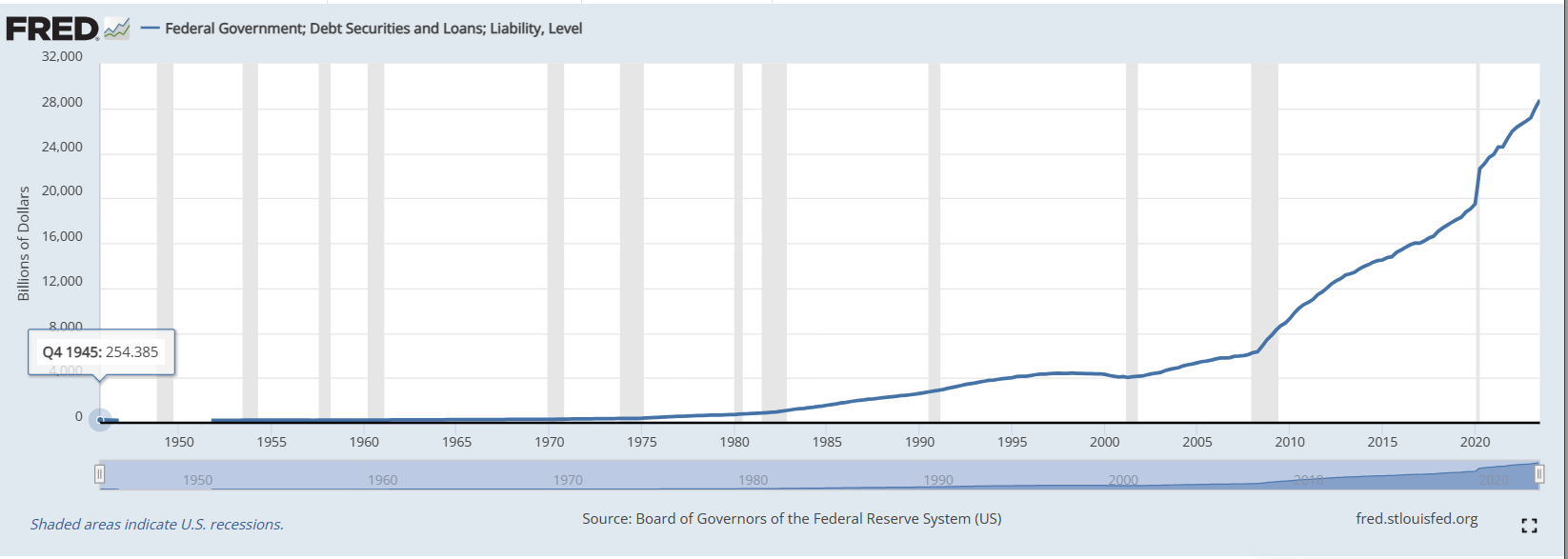
For 84 years, bankers and other self-proclaimed experts have predicted America’s destruction because of the growing “federal debt” (which isn’t federal and isn’t a debt).
Here is how the “federal debt” has grown. Amazingly (to some), the Republic still stands, economically more robust than ever.
“Washington faces a global market ‘rebellion’ over record U.S. debt: ‘It is a cliff… we’re going 60 mph towards it.”
“Currently, the American national debt stands at $34.14 trillion—about $100,000 for every person in the U.S.—with the debt ceiling currently suspended until 2025 courtesy of a deal passed in the summer of 2023.”
Should history be a guide?
Real (inflation-adjusted) Gross Domestic Product growth.
For those past 80+ years, while self-proclaimed experts repeatedly predicted the death of the American economy, GDP has grown, and grown, and grown, with only short delays, sometimes caused by bank criminality and, most recently, by COVID.
Does the above graph look like a “ticking time bomb,” a “massive falling out of markets and federal institutions,” a “global market rebellion,” or a “cliff”?
Year after year, eight-plus years of being wrong have not taught Jamie Diamon et al. anything.
Despite his $34 million salary (plus extras), Diamon seemingly is clueless about economics. He speaks of “federal debt” in the same terms as personal or business debt. Here is where he is wrong:
1. The so-called federal debt isn’t debt. It’s the total of depositsinto Treasury Security accounts. These accounts are similar to bank safe deposit boxes in that the depositors retain ownership of their deposits.
2. That so-called federal debt also isn’t federal. It belongs to depositors. Unlike regular bank deposits, no bank or the federal government ever touches the “federal debt” deposits.
3. The misnamed “debt” also isn’t borrowing. Our Monetarily Sovereign federal government doesn’t use the depositsto pay its bills. The federal government pays all its bills by creating new dollars ad hoc, which it can do endlessly.
The purpose of T-securities is to provide a safe place to store unused dollars and to help the Fed control interest rates.
This is different from monetarily non-sovereign state/local governments, which do borrow to pay their bills.
4. Similar to safe deposit boxes, the government doesn’t owe the contents. The government merely stores the contents, and upon maturity, the government merely returns the contents to the depositor. That so-called “debt” isn’t even debt.
5. Like safe deposit boxes, the size of the contents doesn’t affect the government’s risk or liability. Whether you put a toy marble or a 20-carat diamond into a safe deposit box doesn’t change the bank’s risk.
6. By the way, you, as a taxpayer, have zero risk regarding T-securities. Diamon’s claim about “$100,000 for every person in the U.S.” is 100% misleading. You don’t owe a penny of that, nor does the government.
And although some of the shorter-term economic signals are flashing green—inflation is coming down, the Fed may be eyeing rate cuts, and employmentis staying stable—the boss of America’s biggest bank isn’t convinced there isn’t a major red flag ahead.
Everything is headed in the right direction, but Diamon sees all that as dangerous.
Speaking on a panel alongside former Speaker of the House Paul Ryan at the Bipartisan Policy Center last week, Dimon said the American government faces a “hockey stick” effect regarding government debt.
He drew on the comparison of the 1980s for context, explaining that in 1982, unemployment was around 10% while the stock market had sat stagnant for 15 to 20 years.
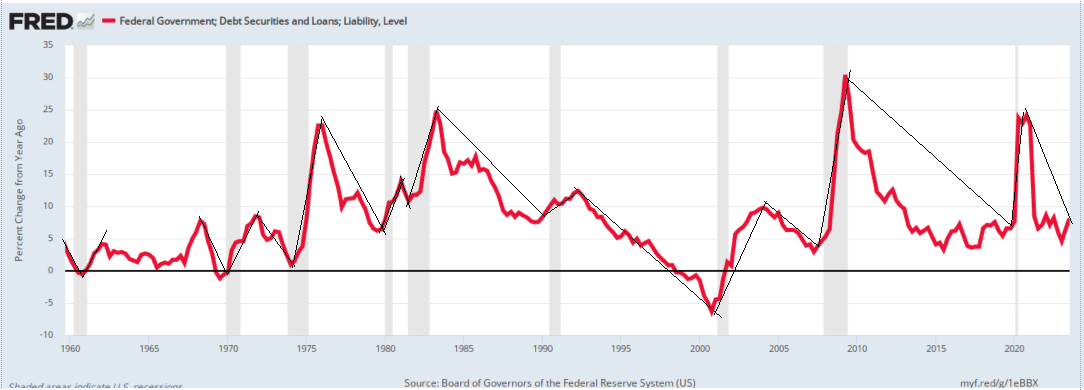
The recession of 1980 had nothing to do with increased federal debt. Quite the opposite: Federal “debt” growth declined immediately before the recessions of 1980 and 1981. The recessions were cured by federal “debt” growth.
In fact, that is the historical pattern: When federal debt doesn’t grow sufficiently, we have recessions. Those recessions then are cured by increased federal debt growth.
The reason: Federal “debt” grows faster when the federal government increases deficit spending, because federal deficit spending adds growth dollars to the economy.
By mathematical formula, federal government spending increases Gross Domestic Product (GDP), the most common measure of the U.S. economy. (GDP=Federal Spending + Nonfederal Spending + Net Exports.)
Here is that effect, historically.
“Declining federal “debt” leads to recessions, which are cured by increasing “debt.”
Even with the Vietnam War, America’s debt-to-GDP ratio was around 35%, Dimon said, whereas today it sits at 100%.
Further, GDP does not pay for the federal “debt.” GDP is the total spending in the economy. That has nothing to do with the total deposits into T-security accounts or with the total of federal deficits (another measure of federal “debt”)?
The federal “debt”/GDP ratio is no better than the number of robin’s nests in your backyard vs. the number of stars you can see at 8:00PM from your bedroom window: Two separate measures that produce a meaningless ratio that is often quoted by people who should know better, and often do..
It is difficult to believe that the CEO of the world’s largest private bank doesn’t know this.
“Back then, the deficit during a recession—you spend money in a recession—was 4% or 5%. Today, it’s 6.5% in a boom time,” Dimon continued.
The deficit measures the net amount of money the federal government creates, most of which goes into the U.S. economy to create the economic growth we all love. No deficits = no growth = depression.
Jamie Dimon warns that ‘all these powerful forces’ will affect the U.S. economy in 2024 and 2025. He added: “If you look at that 100% debt to GDP by [2035] I think it’s going to be 130% and it’s a hockey stick. That hockey stick hasn’t started yet, but when it starts, it markets worldwide… there will be a rebellion.”
Dimon’s “hockey stick” scenario could occur as the American government faces higher charges to service increasing levels of debt, potentially in an economy which many are predicting will enter a slow or no-growth era.
This isn’t just bad news for the Home of the Brave—America’s ability to pay its debts is a concern for the nations around the world, which own a $7.6 trillion chunk of the funds.
You have just read three short paragraphs of utter nonsense. Whether the federal debt (the cumulative total of federal deficits or the total of T-security deposits — either definition is correct) is 103%, 230%, or 930% of GDP does not affect America’s ability to pay its debts.
If you gave the federal government a $100 trillion invoice today, they could give you a check for $100 trillion tomorrow. You instantly would become the world’s richest person, and the federal government could continue its other spending without missing a beat.
Ben Bernanke: “The U.S. government has a technology, called a printing press (or, today, its electronic equivalent), that allows it to produce as many U.S. dollars as it wishes at essentially no cost.”
Alan Greenspan: “A government cannot become insolvent concerning obligations in its own currency.”
St. Louis Federal Reserve: “As the sole manufacturer of dollars, whose debt is denominated in dollars, the U.S. government can never become insolvent, i.e., unable to pay its bills.
So why does Diamon make those incorrect claims?
I believe he knows the truth, but he works for the rich, and the rich do not wish you to understand the Dirty Little Secret of Federal Finance: Federal Taxes Don’t Pay For Federal Spending.
Why might Diamon want to disseminate the lie that federal taxes fund federal spending? We’ll discuss that later in this paper.
The nations most exposed are Japan, which owned $1.1 trillion as of November 2023, China ($782 billion), the U.K. ($716 billion), Luxembourg ($371 billion) and Canada ($321 billion).
Charging head-first into a global fistfight with domestic and international markets is the “worst possible way to do it,” Dimon added, saying: “It is a cliff. We see the cliff. It’s about 10 years out.”
I would be willing to wager, Mr. Dimon, our respective annual incomes that neither Japan, China, the U.K., Canada, nor the U.S. pay their so-called “debts” in 10 years. Mention that when you next see him.
And by the way, also tell him that the “10 years out” is the classic hedge of charlatans. It allows one to make ridiculous predictions that no one will remember if it’s wrong, but everyone will be reminded if, by some good fortune, it turns out right.
Paul Ryan chimed in that the debt spiral is the “most predictable crisis we’ve ever had,” with Dimon agreeing.
There is ZERO possibility that the U.S. federal government could face a “debt spiral.”
While Jamie Dimon wrings his hands about America’s economic future, the facts say he’s wrong.
Being Monetarily Sovereign, the U.S. federal government:
a. Is nothing like a firm, individual, or even a nation like monetarily non-sovereign Italy, Greece, or France.
The fact that Ryan predicts a debt spiral for the United States demonstrates his abject ignorance or dishonesty about federal finance.
b. Never borrows dollars. It never needs to. It creates all the dollars it needs.
c. No dollar debt is unsustainable for the U.S. government.
‘This is about the security of the world.’ The banking boss, who was paid $36 million for his work in 2023, added his alarm goes beyond financial industry ramifications.
Throughout the past year, Dimon has been sounding the alarm on increasing geopolitical tensions, namely the Israel-Hamas conflict and Russia’s invasion of Ukraine.
“This is about the world’s security,” 67-year-old Dimon added. “We need a stronger military; we need a stronger America. We need it now. So I put this as a risky thing for all of us.”
At this point, Dimon is just babbling random thoughts: Israel, Hamas, Russia, Ukraine, stronger military, and though a nation with infinite dollars won’t be able to use those dollars to pay for a more robust military. Nonsense.
On Dimon’s point, Republican politician Ryan later added he believes “in five years we’re going to be paying more in interest than we will be the Pentagon.”
This is a favorite trope of the “debt” alarmists: “Paying more interest than __________” (fill in the blank). That comparison is supposed to scare us. But why?
Why should the possibility that a nation with infinite dollars be worried about paying interest in dollars? The federal government’s interest payment helps economic growth by adding dollars to GDP.
The event in Washington, D.C., spanned a wide range of topics, including the balance of equality, with Dimon admitting he’d tax the rich more to support the poor. He described the idea as “as much of a no-brainer policy as I have ever seen.”
It is Easy to favor taxing the rich more when he knows it never happens. Even when tax rates are increased, there is an appearance of taxing the rich more; the rich have too many tax dodges for any “balance of equality.”
There are hundreds of ways in which the rich pay a lower percentage of their income in taxes than the middle-income people. Here’s just one:
The problem with the current tax system, the White House says, is that unrealized gains could go untaxed forever if wealthy people hold on to them and pass them on to heirs when they die.
“If a wealthy investor never sells stock that has increased in value, those investment gains are wiped out for income tax purposes when those assets are passed on to their heirs under a provision known as stepped-up basis,” the analysis says.
Undera stepped-up basis,the value of the asset is adjusted to the fair market value at the time of the inheritance. This wipes out any taxes on the unrealized gains that accumulated from when the investor bought the asset and the time it was inherited.
SUMMARY
America is run by the rich, whose money encourages economists, politicians, and the media to help the rich become richer.
There are two ways for the rich to become richer, i.e., to obtain more comparative wealth:
Widen the wealth Gap below while narrowing the Gap above.
Obtain more wealth for themselves.
To accomplish #1, the rich must convince those below them that the federal government cannot afford to pay benefits or that adding benefits requires more taxpayers’ dollars — both untrue.
Thus, we have poor people, who would benefit from free comprehensive, no-deductible Medicare for All and Social Security for all, voting against such programs, and we have business leaders like Jamie Diamon spreading the Big Lie that federal “debt” will cause a catastrophe — all much to the delight of the rich.
Dimon works for the rich, who want the income/wealth/power Gap widened. Seemingly, his $36 million+ salary isn’t enough, and he needs you to believe the federal government can’t improve your life unless you suffer more.
So long as people believe the so-called “federal debt” is a burdon on the economy, rather than a necessity for economic growth, we will have scare-mongers like Jamie Dimon and others.




 #Monetary Sovereignty - Mitchell