Debt fear monger speaks takes opposite sides of the same issue

In the previous post (“They feed you garbage to improve your health), we addressed some of the usual false claims about the so-called “federal debt.” We showed why “federal debt”:

  1. Isn’t “federal,” and it isn’t “debt.” (It’s non-federal deposits.)
  2. Isn’t “unsustainable.” (It’s infinitely sustainable.)
  3. Isn’t a burden on the federal government or on taxpayers. (Neither are liable.)
  4. Doesn’t indicate financial irresponsibility. (It’s financially necessary for economic health.)
  5. Doesn’t put financial markets or federal credit ratings at risk. (There is zero market risk involved in “federal debt.”)
  6. Doesn’t indicate the federal government is borrowing or spending beyond its “means.” (The federal government never borrows and has infinite “means.”
  7. Doesn’t slow economic growth. (The lack of federal spending slows growth.)
  8. Doesn’t cause inflation, recession, or depression (the lack of federal deficit spending causes those events. Federal deficit spending cures them.)
  9. Doesn’t cause high interest rates.

Also, we showed that high interest rates:

  1. Are not a burden on the government.
  2. Are a burden on the public because they add to inflationary pricing, but.
  3. Add to GDP growth.

Finally, we showed that the Debt/Gross Domestic Product ratio:

  1. Doesn’t indicate a Monetarily Sovereign government’s solvency.
  2. Doesn’t consider the differences between a Monetarily Sovereign government vs. a monetarily non-sovereign government.
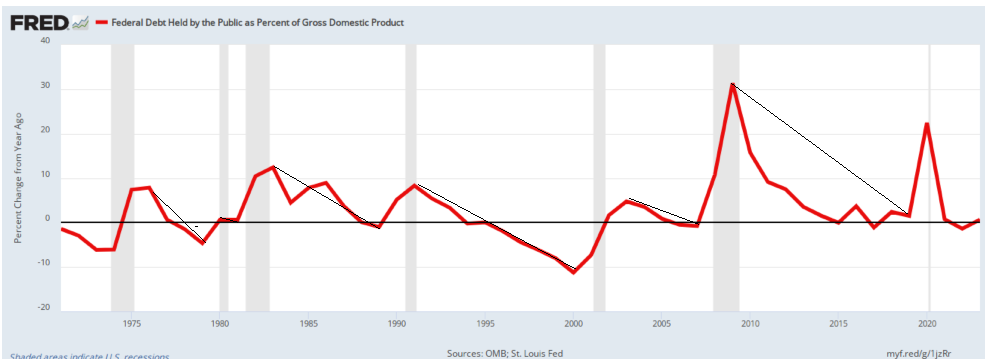
The much-feared Debt/GDP ratio shows a repeated pattern: It declines because debt fear mongers (like J.D. Tuccille) complain about it until it reaches a low point. Then, we have a recession, which is cured by an increase in the ratio, after which the fear-mongers again begin their complaints.

If you are unfamiliar with the above facts, you may wish to read the previous post and rid yourself of the nonsense that J.D. Tuccille spouts in the opening paragraphs of the following article.

J.D. Tuccille - Contributing Editor,  | J.D. Tuccille
J.D. Tuccille

First, his rehash of the old, familiar, wrongheaded, fact-free stuff:

With Rising Debt, the U.S. Federal Government Is in Bad Company. Governments worldwide have been on a borrowing spree, and prosperity has suffered. J.D. TUCCILLE | 4.3.2024 7:00 AM

Misery loves company, as they say. But does financial irresponsibility also enjoy spending a little quality time with friends? If so, it’s quite a party.

While the U.S. government is famously running up debt to stratospheric levels, governments worldwide have been spending beyond their means and borrowing to make ends meet.

The likely result: financial markets put at risk by over-extended governments and slow economic growth for pretty much everybody.

Public debt as a fraction of gross domestic product has increased significantly in recent decades, across advanced, emerging, and middle-income economies,” write Tobias Adrian, Vitor Gaspar, and Pierre-Olivier Gourinchas for the International Monetary Fund (IMF).

“It is expected to reach 120 percent and 80 percent of output respectively by 2028.”

Public debt—money borrowed by governments—has steadily risen, they add, because years of very low interest rates “reduced the pressure for fiscal consolidation and allowed public deficits and public debt to drift upwards.” Then, COVID-19 disrupted the global economy, and governments responded by funding “large emergency support packages” on credit.

Now, with interest rates rising, the cost of servicing debt is going up, too. But governments continue to borrow as if nothing has changed. Of course, riskier governments have to pay higher interest rates.

“On average, African countries pay four times more for borrowing than the United States and eight times more than the wealthiest European economies,” United Nations Secretary-General António Guterres cautioned last summer with the release of A World of Debt: A Growing Burden to Global Prosperity. “A total of 52 countries – almost 40 percent of the developing world – are in serious debt trouble.”

As of 2022, that report revealed, global public debt stood at $92 trillion and rising. Interest payments displaced other expenditures in a growing number of nations, especially developing countries. High public debt crowds out financial room for everything else, including the ability of private parties to borrow to start or expand businesses that create jobs and build wealth.

Then we come to a criticism we didn’t remember to address in the previous post:

Public Debt Crowds Out Private Investment “Households who buy government debt reduce their savings in productive private investments,” Kent Smetters and Marcos Dinerstein wrote in 2021 for the Penn Wharton Budget Model. As the spending is unproductive, the economy is poorer, and total savings are lower due to capital crowding out.”

At first blush, that sounds reasonable. Putting your dollars into a T-security account seems to remove them (temporarily) from the economy.

If you had bought stock or private sector bonds, the dollars would have remained in the economy — except for three facts:

1. You still own those dollars. They are part of your wealth. You can sell them or use them as collateral for loans. Your ownership allows you to borrow more at lower rates than if you didn’t own them. This ability is economically stimulative.

2. They earn net additional dollars in interest. While stock dividends and private-sector bond interest increase your wealth, those dollars come from the private sector.

They do not earn net dollars. They are mere dollar transfers within the private sector. By contrast, federal interest comprises new dollars that add to the private sector’s money supply.

3. That so-called “reduction in savings” is offset by the federal government’s spending into the economy. The dollars you deposit into a T-bill, T-note, or T-bond were derived from the federal government’s deficit spending.

Federal total net deficit spending = Total T-security deposits.

Thus, Tuccille doesn’t realize he is taking both sides of the issue. He dislikes federal deficits, which add dollars to the economy, but criticizes deposits into T-security accounts for taking dollars from the economy.

“Government spending redirects real resources in the economy and can crowd out private capital formation,” they add. “An additional $1 trillion debt this year could decrease GDP by as much as 0.28 percent in 2050.”

How does federal spending crowd out capital formation? Does the government paying your Medical bills crowd out anything? No.

Does paying your Social Security crowd out anything? No.

Does paying private contractors to build a road, bridge, or dam crowd out anything? No.

Does even paying federal employees crowd out anything? No.

Every dollar the federal government spends is a newly created dollar that winds up in the U.S. economy or other nations’ economies. Nothing is crowded out. Capital formation is a result of federal deficit spending.

If you take that insight and apply it to a world of governments on a collective borrowing spree, you end up with a hobbled global economy where prosperity becomes increasingly elusive.

Except for a tiny reality. Prosperity has not become increasingly elusive for the Monetarily Sovereign nations and even for most of the monetarily non-sovereign nations.

The reason: U.S. deficit spending pumps new inflation-adjusted dollars into the world’s economies. We are net importers, meaning we export more dollars than we import. We help the world (and ourselves) become richer.

“Medium-term growth rates are projected to continue declining on the back of mediocre productivity growth, weaker demographics, feeble investment and continued scarring from the pandemic,” note IMF’s Adrian, Gaspar, and Gourinchas.

Projections for growth five years ahead have fallen to the lowest level in decades.”

First, these are IMF projections, which notoriously are suspect. These folks don’t even say how or whether they include Monetary Sovereignty in their analyses. 

Second, it is not reasonable to make a general statement about “medium-term growth rates” without specifying the term and the difference between Monetarily Sovereign nations and monetarily non-sovereign nations.

It is like predicting the growth rate of the world’s children, without specifying their diet and living conditions.

Heavy government borrowing also creates risk for the financial sector by putting banks at the mercy of massive debtors of uncertain creditworthiness.

“The more banks hold of their countries’ sovereign debt, the more exposed their balance sheet is to the sovereign’s fiscal fragility,” note the IMF analysts.

The article supposedly is about U.S. federal debt being too high. But Tuccille drifts off into non-sequiturs.

The U.S. government does not borrow. It creates every dollar it needs ad hoc.  This is the process:

1. To pay a bill, the federal government creates instructions (checks, bank wires, currency), not dollars.

2. It sends those instructions (“Pay to the order of . . . ) to each creditor’s bank, instructing the bank to increase the balance in the creditor’s checking account.

3. At the instant the creditor’s bank does as instructed, dollars are created and added to the M2 money supply measure.

4. The bank then clears its action through the Federal Reserve, a federal agency. One branch of the federal government approves another branch’s instructions.

Thus, in a literal sense, banks create dollars. The notion that banks are “at the mercy of governments” is absolutely true because governments make all the rules by which banks must live.

And yes, banks are at the mercy of a government’s fiscal fragility. 

But that begs the question, “Is the U.S. federal government fiscally fragile? The answer is a resounding “No”! (unless Congress, in a moment of MAGA insanity, insists on not paying bills.

Heavily indebted governments also reduce their ability to act as backstops in a financial crisis as they become the likeliest causes of future crises.

As they continue to borrow, they reduce the likelihood that productive private economic activity will grow them out of their financial problems.

Here, Tuccille demonstrates abject ignorance about the difference between Monetary Sovereignty and monetary non-sovereignty. The U.S. federal government is not “heavily indebted” because it could if it chose to, pay all its current and even future bills today.

It simply could send instructions to every creditor’s bank, instructing all those banks to increase the balances in the creditors’ checking accounts. Instantly, all debt, current and future, would disappear. 

“Higher government debt implies more state interference in the economy and higher taxes in the future,” The Economist points out in its interactive overview of global government debt.

One would think that a publication titled “The Economist” would understand that while state/local taxes fund state/local spending, federal taxes do not fund federal spending. Even if the federal government didn’t collect a penny in taxes, it could continue spending forever.

The purpose of federal taxes is to:

  1. Control the economy by taxing what the government wishes to discourage and by giving tax breaks to what the government wishes to reward, and
  2. Assure demand for the U.S. dollar by requiring the dollar to be used for tax payments.
  3. To make the populace wrongly believe that federal benefits are unaffordable without tax increases, thus reducing the clamor for more benefits.

Also, add the editors, rising debt “creates a recurring popularity test for individual governments,” which often goes poorly regarding fiscal responsibility because paying outstanding bills isn’t popular with voters.

Paying outstand bills isn’t unpopular. It’s collecting taxes that ostensibly are necessary; that’s the unpopular part.

Higher Debt Leads to Lost Prosperity

Well, isn’t that cheerful? It’s also extraordinarily unfortunate. After thousands of years of grindingly slow progress, recent decades saw the human race escaping poverty.

According to the World Bank, even as populations increased, the number of people living below the poverty line, adjusted for inflation, plummeted from 2.01 billion in 1990 to 689 million in 2019.

In 2016, the economist Deirdre N. McCloskey attributed improving prospects for many of the world’s people to “liberalism, in the free-market European sense.”

But that progress reversed in recent years, with poverty blipping back up (712 million people in 2022) amidst slower economic growth and after drastic government interventions during the pandemic.

A future of stumbling economies hobbled by debt-ridden governments that crowd out private investment is one in which more people are poorer than they would have been if the world had stuck with free markets and implemented a modicum of financial responsibility.

Again, Tuccille was supposedly talking about the U.S. government, except he is mixing some monetarily nonsovereign governments into his comments.

The U.S. “federal debt” has grown from $40 billion in 1940 to $30 trillion in 2024. Where is the crowding out and the poverty he is wringing his hands about? Certainly, not in the U.S., the supposed subject of his article.

I can’t say whether Tuccille is incompetent or dishonest. You decide. Either way, he is wrong, wrong, wrong.

As concerned as the U.N. is about rising public debt, its proposed “solutions” are pretty much what you would expect from that organization. A lot of verbiage about a “more inclusive” system providing “increased liquidity” and “affordable long-term financing” boils down to letting the riskiest governments have a greater say in offering themselves cheap financing. What could possibly go wrong?

The IMF analysts, on the other hand, propose “durable fiscal consolidation” while “financial conditions remain relatively accommodative and labor markets robust.”

I take that as a gentle suggestion that governments need to start paying down their debt to sustainable levels before interest rates and economic conditions deprive them of any options in the matter.

There is only one way for the U.S. government to “pay down its debt.” It has to run surpluses, i.e., to take dollars out of the economy.

That is the worst idea since investing money with Bernie Madoff. Here is what happens every time the federal government pays down its “debt.”

1804-1812: U. S. Federal Debt reduced 48%. Depression began 1807.
1817-1821: U. S. Federal Debt reduced 29%. Depression began 1819.
1823-1836: U. S. Federal Debt reduced 99%. Depression began 1837.
1852-1857: U. S. Federal Debt reduced 59%. Depression began 1857.
1867-1873: U. S. Federal Debt reduced 27%. Depression began 1873.
1880-1893: U. S. Federal Debt reduced 57%. Depression began 1893.
1920-1930: U. S. Federal Debt reduced 36%. Depression began 1929.
1997-2001: U. S. Federal Debt reduced 15%. Recession began 2001.

Recessions (vertical gray bars) are preceded by declines in federal deficits and cured by increases in federal deficits.

It’s not just deficits, but deficit increases that are necessary for economic growth.

Would someone please tell Mr. Tuccille that taking money out of the economy causes recessions if we are lucky and depressions if we aren’t. Remind him that GDP = Federal Spending + Non-federal Spending + Net Exports. 

Gentle suggestion or not, governments need to get their fiscal affairs in order before they take us all down with them.

Heavily indebted governments result in burdened economies, leading to a poorer world for everybody.

With its irresponsible borrow-and-spend ways, the U.S. government is, unfortunately, not alone. Most, if not all, world governments are hanging out in very bad company.

Wrong in every regard. Not just wrong but diametrically wrong, pitifully wrong, harmfully wrong.


Rodger Malcolm Mitchell
Monetary Sovereignty

Twitter: @rodgermitchell Search #monetarysovereignty
Facebook: Rodger Malcolm Mitchell

……………………………………………………………………..

The Sole Purpose of Government Is to Improve and Protect the Lives of the People.

MONETARY SOVEREIGNTY

The Libertarian road: From ignorance, to malevolence, to treason.

There was a time when the Libertarians were a sort of third road between liberalism and conservatism, an anarchist movement that opposed both sides equally.

No more.

The Libertarian website, Reason.com, has gone full-bore, white supremacist, fascist, Fox News, Breitbart, Trump-bigoted denialism, as witness the following article:

Punishing Rioters Is Wise. Bogus ‘Seditious Conspiracy’ Charges Are Not. Politics ruin everything, including the criminal justice system. J.D. TUCCILLE | 5.8.2023 7:00 AM

The problem with convicting members of the “Western chauvinist” Proud Boys on seditious conspiracy charges is that it wrongly elevates a violent tantrum by a bunch of thugs to the level of an insurrection, and it lets officials who prosecute them puff themselves up as saviors of the republic.

Worse, the case took liberties with a statute that is probably best forgotten to arrive at its conclusion when normal criminal law could have punished rioters without putting the criminal justice system through contortions.

At this point, you may be shaking your head and wondering whether the article really was written by Tucker Carlson, whose lies about the insurrection (yes, insurrection is precisely what it was) were too much even for Fox (especially since those lies cost Fox upwards of $750 million.)

Apparently, Carlson’s costly lies were suitable for J.D. Tuccille, a former managing editor of Reason.com and current contributing editor.

“A jury in the District of Columbia today returned guilty verdicts on multiple felonies against five members of the Proud Boys, finding four of the defendants guilty of seditious conspiracy for their actions before and during the breach of the U.S. Capitol on Jan. 6, 2021,” the Department of Justice trumpeted last week.

“According to the evidence at trial, in the months leading up to Jan. 6, the defendants plotted to oppose by force the lawful transfer of presidential power, and to prevent the Members of Congress, and the federal law enforcement officers who protect them, from discharging their duties.”

See the pejoratives, “puff themselves up,” “saviors of the republic”?

He’s describing people who saw criminals committing treason and tried those criminals before a jury, who also saw criminals committing treason, and said so.

Libertarian Tuccille would have you believe that trying, by force, to prevent the “lawful transfer of presidential power” is just, in his words, “a tantrum by thugs.”

A “TANTRUM”? Really, J.D.?

A tantrum is a little boy lying on his back, kicking his heels, and demanding not to be taken home from Disneyland.

A tantrum is the wailing from the little girl who wanted a pony for her birthday and only got a dress.

A tantrum is Ron DeSantis trying to punish a teacher for daring to mention that America’s law enforcement has mistreated blacks.

Armed traitors, crashing through barriers to break into Congress, injuring several police, and with the sole purpose of overturning the U.S. government, while stalking Nancy Pelosi and threatening to hang the Vice President of the United States because he wouldn’t install Traitor Donald Trump as President — that is a bit more than a Tuccille “tantrum.”

If all that does not rise to the level of treason, J.D., why don’t you describe to the world precisely what you think constitutes treason?

In former days, traitors were hung or electrocuted. These traitors got off easy.

“At my Senate confirmation hearing just over a month after January 6th, I promised that the Justice Department would do everything in its power to hold accountable those responsible for the heinous attack that sought to disrupt a cornerstone of our democracy: the peaceful transfer of power to a newly elected government,” huffed Attorney General Merrick Garland, a man who gives every impression that he tremendously enjoys the smell of his own emissions.

“Today’s verdict is another example of our steadfast commitment to keeping those promises.”

Oh, Attorney General Merrick Garland “huffed”?

Is that supposed to mean his outrage was misplaced at seeing traitors roaming the halls of Congress, seeking to prevent the lawful installation of the President?

And the “smell of his own emissions” is the description of the man doing his job exactly as it should be done (unlike the Trumpian toadies who preceded him in that post.)

Would a simple “Tut tut,” a slap on the wrist, “boys will be boys'” admonition to not do it again have pleased Tuccille more?

Really, J.D., what is there about a vicious attempt to overturn a national election that has you outraged about a criminal conviction?

And so, we’re told, the republic is safe from those who would rise against it in insurrection.

But before we consign former Proud Boys leader Enrique Tarrio and codefendants Ethan Nordean, Joseph Biggs, and Zachary Rehl to the history books alongside Mosby and Quantrill, Confederate guerrillas of the sort who inspired the seditious conspiracy statute to begin with, let’s consider an important obstacle:

There’s sparse evidence of a meaningful conspiracy “to overthrow, put down, or to destroy by force the Government of the United States” as required by law.

Shouldn’t a Conspiracy Be Better Organized? “The FBI has found scant evidence that the Jan. 6 attack on the U.S. Capitol was the result of an organized plot to overturn the presidential election result”

“Sparse evidence” except for the plans to gather off-site, and to bring weapons, and to advance on the Capitol at a specific time, even before the crowd arrived from Trump’s exhortations.

“Sparse evidence”? Are we to doubt our eyes and ears while maniacs, emboldened by the head maniac, did everything they could to prevent democratically elected Joe Biden from taking office?

That’s just a little tantrum?

Reuters noted in August 2021. “‘Ninety to ninety-five percent of these are one-off cases,’ said a former senior law enforcement official with knowledge of the investigation.

‘Then you have five percent, maybe, of these militia groups that were more closely organized.But there was no grand scheme with Roger Stone and Alex Jones and all of these people to storm the Capitol and take hostages.'”

Except for building the gallows, searching for Pence, and the “Where are you Nancy?” hunting for Pelosi.

Get this. “Only” five percent of several thousand people — that makes what, several hundred? — created the plot, with the rest of the bunch merely followers.

So your claim, J.D. is several hundred people are too few to commit treason?? And because they were disorganized, it couldn’t be treason??  

For instance, if the bank robbers failed to obtain a worthy getaway car — a sign of disorganization — they should not be prosecuted for attempting to rob the bank? What a novel idea from the Libertarian.

And because you and your cronies have failed ever to develop an organized plan for running America without a government, J.D., does that mean the Libertarians are not a real political movement?

Or as a result of disorganization, “only” a few police died, instead of many more, it all was just a tantrum?

That said, if anybody was among those “more closely organized,” it was the Proud Boys, and the Oath Keepers of the earlier case. But still, prosecutors and the judge had to get creative to arrive at a verdict.

“The sedition trial…was characterized by frequent delays, frayed relations between the defense and prosecution and several decisions by the presiding judge, Timothy J. Kelly, that tested the boundaries of conspiracy law,” reported Alan Feuer and Zach Montague for The New York Times.

It wasn’t the crime that bothers you; it was the “frequent delays and frayed relations” to which you object?

Would you have preferred that the judge rush things through, and the defense and prosecutor got together and sang Kumbaya? Would that have made for a fairer trial”

“Judge Kelly’s rulings allowed prosecutors to introduce damning evidence about the violent behavior and aggressive language of members of the Proud Boys who had only limited connections to the five defendants.

The evidence was damning because the Proud Boys is an organization devoted to the violent overthrow of the U.S. government, in short, a conspiracy of traitors.

The rulings also permitted jurors to convict on conspiracy even if they found there was no plan to disrupt the certification of the election, but merely an unspoken agreement to do so.”

“No plan,” just an “unspoken agreement”? Huh?

If it wasn’t a plan and wasn’t spoken, how did all those traitors know when to show up and then to march in single file, like a well-trained military unit?

The jury heard the evidence and decided that there was a plan and an agreement and that the traitors were speaking quite loudly, screaming in fact, and they came damn close to succeeding.

Only by fractions of a second and a few inches did they fail. They didn’t find Pence. They didn’t find Pelosi. America got lucky.

“Mr. Tarrio was not even in Washington on Jan. 6, having been kicked out of the city days earlier by a local judge presiding over a separate criminal matter,” they added.

And Hitler was not even in France when the Nazis took over. And the Mafia boss seldom iss on site when the murders are committed.

“The Justice Department’s take, of course, fits the narrative favored by Democrats who reflexively describe the Capitol riot as an ‘insurrection.'” Reason’s Jacob Sullum observed.

“But that term implies a level of planning and organization that does not fit the chaotic reality of what happened that day.”

Ah, and there it is: “Favored by Democrats,” J.D. Tuccille’s unintended admission that the attempted coup was a Republican operation, and that he is a GOP apologist.

White supremacists, fascists, and Libertarians hate Democrats. The self-anointed GOP Party of Law and Order, hates the Democrats when they prosecute crimes initiated by Donald J. Trump, the newfound hero of Libertarianism.

The “chaotic reality” is that people planned to use force to stop the count and to stop America’s Democracy, and had they succeeded, the chief traitor would now be the dictator of America.

There’s no easy way to portray the resulting conviction as anything other than a stretch. In fact, less-loaded criminal charges could and did serve to penalize the defendants for their disruptive actions in Washington.

“Destruction of property, impeding Congress, and assaulting police officers, while crimes, don’t allow prosecutors and their political allies to portray themselves in heroic terms.

Hawley mocked over new Jan. 6 video | The Hill
Josh Hawley runs for his life.

That is how Tuccille, who surely would have been hiding under his desk and wetting his pants, had he been faced with the violent traitors, insults those who defended America.

(Or Tuccille would have joined Josh (rabbit) Hawley, running terrified.) He cowardly insults the real heroes, the police, while treasonably defending the indefensible.

Rioters are violent troublemakers, but seditious conspirators can be portrayed as part of a larger movement that intends harm to the whole country.

Lest we forget, the “larger movement that intends to harm the whole country exists. It is the MAGA “stop the steal” movement, as fascist as any movement in America.

Sadly, having learned nothing from the relative taps on the wrists the insurrectionists received, they continue with their election denial, even today.

But that is not anti-democracy, anti-America enough for the Libertarians.

Had the traitors succeeded, Pence would have been hung; Pelosi might have been injured or killed; even more, police would have died, and Congress would have become meaningless.

But sedition, according to Tuccille? Nah.

And now comes the false comparison of all false comparisons, typical of the right-wing, white supremacy crowd of bigots with which Tuccille seems to have aligned:

The Trump administration floated pulling this same stunt with seditious conspiracy charges (often incorrectly framed as just “sedition”) against rioters during the civil unrest of the summer of 2020.

“Attorney General William Barr told the nation’s federal prosecutors to be aggressive when charging violent demonstrators with crimes, including potentially prosecuting them for plotting to overthrow the U.S. government,” The Wall Street Journal’s Aruna Viswanatha and Sadie Gurman reported at the time.

“Sedition charges require proof of efforts to overthrow the United States Government,” Harvard Law’s Laurence Tribe responded.

“Talking in these terms based on what’s happening is grotesquely irresponsible. It’s way beyond monarchical. It’s paranoid and dictatorial. Opus Dei, anyone?”

Likewise, the ACLU called Barr’s proposed seditious conspiracy prosecutions “a tyrannical and un-American attempt to suppress our demands for racial justice and an end to police violence.”

See, in the Tuccille, Libertarian world, when unarmed blacks are killed by police, again, and again, and again, and again, and again, and again, and again, and again, and finally, in frustration at the law’s unwillingness to protect them they riot, this supposedly is similar to Trump’s “patriots” trying to overturn the government.

What was their MAGA grievance? They didn’t like the outcome of the election and with no evidence whatsoever, claimed it was stolen and decided to steal it back.

Tuccille claims the two situations are the same. What a disgusting and thoroughly false comparison

Now the shoe is on the other foot, with a new administration wielding seditious conspiracy charges as weapons against another set of rioters with a different flavor of politics.

Yes, it’s just a “different flavor of politics.” To Tuccille, the coup was just a few poor little Republicans, who persecuted by the police, are innocently airing their grievances. Right?

Again, the rioters’ actions would justify prosaic criminal prosecutions if their partisan loyalties weren’t at odds with those in power.

But why just punish political opponents for bad behavior when you can smear them and their associates as dangers to the nation?

Hey, now, trying to overturn democracy is just “bad behavior”  akin to shoplifting or parking in a no-parking zone. Right?

In a country as divided as ours, everything becomes a bludgeon against hated others. Politics ruin everything, including the criminal justice system.

And with his final words, Libertarian J.D. Tuccille, at last, tells the truth. Politics has ruined the criminal justice system.

Ask any black or Mexican or gay or Muslim or Jew who has lived under the bootheel of the right-wing, fascist, bigoted group known as the Libertarian/GOP.

Ruining the criminal justice system is the specialty of hate-mongering bigots, like those Southern sheriffs who wore white sheets and lynched blacks.

Yet even they didn’t try to overturn the election of the President of the United States.

That was left to the Proud Boys and their apologists, Tucker Carlson, Donald Trump and the Tuccille Libertarians.


Rodger Malcolm Mitchell Monetary Sovereignty Twitter: @rodgermitchell Search #monetarysovereignty Facebook: Rodger Malcolm Mitchell

……………………………………………………………………..

The Sole Purpose of Government Is to Improve and Protect the Lives of the People.

MONETARY SOVEREIGNTY

The Medicare for All mystery

I have been with Medicare for twenty years. Four months ago, following a 12-year fight with cancer, my wife spent three weeks in the hospital. The medical bills just for those three weeks exceeded $650,000. My out-of-pocket cost was less than $1,000. Medicare and the supplement paid the rest. Based on my personal experience with Medicare, which has been excellent, I believe all Americans — not just those who are 65+ years old — should be able to avail themselves of this program. Our Monetarily Sovereign government easily could pay for a comprehensive, no-deductible version, that not only would pay for everything but be generous-to-providers so as to attract more people into the healthcare professions. My sense is that this belief is shared by the vast majority of those who already have Medicare. And there surely is a need. Here are excerpts from a health care report that though admittedly is old (2010), I feel quite certain very little has changed:
Among seven nations studied—Australia, Canada, Germany, the Netherlands, New Zealand, the United Kingdom, and the United States—the U.S. ranks last overall, as it did in the 2007, 2006, and 2004. Most troubling, the U.S. fails to achieve better health outcomes than the other countries, and as shown in the earlier editions, the U.S. is last on dimensions of access, patient safety, coordination, efficiency, and equity. The Netherlands ranks first, followed closely by the U.K. and Australia. Quality: The indicators of quality were grouped into four categories: effective care, safe care, coordinated care, and patient-centered care. Compared with the other six countries, the U.S. fares best on provision and receipt of preventive and patient-centered care. However, its low scores on chronic care management and safe, coordinated care pull its overall quality score down. Access: Not surprisingly—given the absence of universal coverage—people in the U.S. go without needed health care because of cost more often than people do in the other countries. There is a frequent misperception that such tradeoffs are inevitable; but patients in the Netherlands and Germany have quick access to specialty services and face little out-of-pocket costs. Efficiency: On indicators of efficiency, the U.S. ranks last among the seven countries,. The U.S. has poor performance on measures of national health expenditures and administrative costs as well as on measures of the use of information technology, rehospitalization, and duplicative medical testing. Equity: The U.S. ranks a clear last on nearly all measures of equity. Americans with below-average incomes were much more likely than their counterparts in other countries to report not visiting a physician when sick, not getting a recommended test, treatment, or follow-up care, not filling a prescription, or not seeing a dentist when needed because of costs. Long, healthy, and productive lives: The U.S. ranks last overall with poor scores on all three indicators of long, healthy, and productive lives.
Clearly, the American private insurance industry has been failing Americans, especially those in the lower half of the income/wealth measure. Before we continue, please remember that of the seven nations compared, five are Monetarily Sovereign and two (Netherlands and Germany) are monetarily non-sovereign. Why is this important? Because the Monetarily Sovereign nations like the U.S. have the unlimited ability to create their own sovereign currency. They never can run short of money. Monetarily non-sovereign nations must rely on taxes to pay for things. Contrary to popular myth, the FICA tax does not pay for Medicare or Social Security. It pays for nothing. Even if our U.S. government were to collect zero taxes, we have the infinite ability to fund healthcare insurance, indefinitely. Though the U.S. government has this ability, it provides less service than do the two monetarily non-sovereign nations that must rely on taxes. Because the U.S. private insurance industry has been unable or unwilling to support Americans, various plans under the label “Medicare for All” have been suggested. Because of Gap Psychology (the desire to distance oneself from those below, on any social measure), the wealthy right-wing opposes such plans, just as it opposes all forms of federal aid to those who are not wealthy. So, in describing a Medicare for All plan, they intentionally reference plans with shortcomings, then falsely declare those shortcomings are a necessary part of all plans. Here is an example:
LFA Member Profile: J.D. Tuccille
J.D. TUCCILLE: Let ’em eat cake.
Medicare for All Is Bad Medicine A better prescription would be to get the government entirely out of health care. J.D. TUCCILLE Opponents of choice in medicine are at it again, promoting Medicare for All with the U.S. government as the single payer and private alternatives outlawed.
“Private alternatives outlawed” is not a necessary feature of all Medicare for All plans. It is not even a necessary feature of today’s Medicare. For no good reason, today’s Medicare doesn’t pay 100%. Rather, there are deductibles, that can be covered by private Medicare Supplement insurance. To my knowledge, the sole purpose of “private alternatives outlawed” is to prevent people from double-dipping, i.e. receiving two payments for the same procedure. But since the U.S. does offer Medicare, and private alternatives do exist, presumably double-dipping is not a true problem.
The push comes as health care systems around the world try to catch their breath from the stress test inflicted by the pandemic—and by normal demand for expensive services. While American medicine has its share of problems, single-payer supporters would take all of the flaws in the system and make them universal and mandatory.
No, single-payer supporters would take all the benefits of Medicare, and make them universal.
H.R.1976, the Medicare for All Act of 2021 makes it “unlawful for … a private health insurer to sell health insurance coverage that duplicates the benefits provided under this Act” or for employers to offer alternative coverage. Providers wouldn’t be forced to participate; the proposed law lets Americans pay non-participating physicians out of pocket for services—subject to regulations. Why would Americans pay for services covered by a hypothetical Medicare for All? To answer that question, look north of the border, where Canada’s single-payer system, commonly called Medicare, struggles to meet patients’ needs. “With COVID-19 fuelling a surge in hospitalizations, the latest data provided by the Ministry of Health shows that as of December 31, 2020, there were 29,650 people on a waiting list for surgery” in Saskatchewan, the Canadian Broadcasting Corporation (CBC) reported earlier this month. The CBC noted similar delays in other provinces. “Specialist physicians surveyed report a median waiting time of 22.6 weeks between referral from a general practitioner and receipt of treatment,” which is the longest wait recorded, according to the free-market Fraser Institute.
The article continues with a litany of examples demonstrating how, under some forms of single-payer insurance, patients must wait a long time for service. This is supposed to make you believe that long waits are a necessary problem with a Medicare for All plan, but not with private insurance. However, any discussion of Medicare only tells you who is paying, the government or the private insurance companies. It says nothing about services from doctors, hospitals, nurses, et al. Given the federal government’s infinite ability to spend, and no need to scrimp for profits, the federal government has far greater power to pay for any level of service. It could make the entire health care industry so financially attractive that the numbers of doctors hospitals and nurses could double or triple. Taken to an extreme, the government even could afford to fund a private doctor for every man, woman, and child in America. OK, no one recommends that, but it merely demonstrates how the government easily can pay — much more easily than private insurance can — for the world’s greatest service. There would be no need for the long waits with which Mr. Tuccille threatens you.
Such waits cost more than money—although they cost plenty of that. “[T]wice as many Ontarians with heart ailments passed away waiting for surgery during the pandemic than before COVID-19 hit,” according to the National Post. To relieve the backlog, Canadian provincial governments, which manage the single-payer system, are turning to private clinics. In Quebec, “without the private sector contracts, a region like Laval would have delayed 76 per cent of surgeries instead of 31 per cent,” the CBC noted in February.
“Private sector contracts”? Without realizing it, the author, J.D. Tuccille just demonstrated that a Monetarily Sovereign government like Canada’s has the unlimited ability to fund good service. “Private sector contracts” are simply an example of single-payer insurance. The government pays for service. It demonstrates that the private insurance sector was unable or unwilling to provide enough coverage, so the government had to step in and pay what the citizenry could not afford to pay.
As the data suggests, though, the public sector in many places had trouble delivering as advertised long before anybody had heard of COVID-19.
No, Mr. Tuccille, the data demonstrate that the private sector could not and did not deliver health care for all. That is exactly what is happening in America.
In Germany, where those making less than €64,350 per year must participate in the government health insurance system which is funded on a quarterly basis, the system runs out of money on a regular basis.
Unlike the U.S., the German government is monetarily non-sovereign. It can, and does, run short of money.
“State health insurance patients are struggling to see their doctors towards the end of every quarter, while privately insured patients get easy access,” Deutsche Welle reported in 2018. “The researchers traced the phenomenon to Germany’s ‘budget’ system, which means that state health insurance companies only reimburse the full cost of certain treatments up to a particular number of patients or a particular monetary value … Once that budget has been exhausted for the quarter, doctors slow down — and sometimes even shut their practices altogether.” The “budget” acts as backdoor rationing, limiting costs by choking off access for publicly insured patients to all but emergency medical care once the magic number is hit. Single-payer advocates often criticize private medicine for being cost-conscious, but government systems put at least as much emphasis on the bottom line as any corporate accountant.
Again, without realizing it, J.D. Tuccille demonstrates why Medicare for All is necessary for America. You and I and the German government are monetarily non-sovereign. We all can run short of dollars. The U.S. government cannot. The U.S. government has no profit motive — no “bottom line” — to emphasize. Sadly, even some Monetarily Sovereign governments are (intentionally??) as ignorant of economics as is Mr. Tuccille. The Libertarians who bleat and moan about the U.S. deficit and debt, seem to have no memory of the fact that despite massive spending for the past 80 years, and numerous tax cuts, the U.S. government never has struggled to pay its bills. It hasn’t run out of dollars. It hasn’t had to bounce any checks. This all relates to the Big Lie in economics that says: “Federal taxes fund federal spending.” It simply is not true. Federal spending always has been funded the same way: The government passes laws from thin air, and these laws provide for dollars being created from thin air. There is no limit on the laws the government can pass, thus there is no limit on the dollars the government can create.
That’s especially obvious in the United Kingdom, where the National Health Service has a cult-like status. During the pandemic, this took the form of a “Stay Home. Protect the NHS. Save Lives.” campaign. “The NHS is under severe strain and we must take action to protect it, both so our doctors and nurses can continue to save lives and so they can vaccinate as many people as possible as quickly as we can,” Prime Minister Boris Johnson scolded the public.
Utter nonsense. Boris Johnson either doesn’t know what he’s talking about, or more likely, he is conning the British public. England, being Monetarily Sovereign, never unintentionally can run short of British pounds. Never.
The campaign worked. Even people with medical concerns stayed home, resulting in a drop in doctor visits and a 90 percent plunge in hospital admissions.
Truly sad that sick people are being lied to by their elected leaders. One might say, it’s sickening. And now comes the overt statement of the Big Lie:
It’s difficult to imagine Americans venerating government bureaucracy (although feelings about Social Security come disturbingly close).
American’s love Social Security because it provides something they otherwise could not afford to obtain on the private market: Financial support in their old age.
But it’s impossible to pretend that Medicare for All could escape the concerns that plague all tax-paid medicine.
Again, the Big Lie. Medicare is not “tax-paid medicine.” It is government-paid medicine.
“A doubling of all currently projected federal individual and corporate income tax collections would be insufficient to finance the added federal costs of the plan,” the Mercatus Center’s Charles Blahous pointed out about an earlier Medicare for All proposal.
WRONG! WONG! WRONG! FEDERAL TAXES DO NOT FUND FEDERAL SPENDING. PERIOD.
Health care in the United States requires reform, without doubt. But rather than emulate the heavy state involvement that evokes headaches elsewhere in the world, a better prescription would be to get government entirely out of medicine and encourage more competition and choice.
What a pitiful close to a pitiful article. Mr. Tuccille wants your healthcare to rely on the profit motive of American business. Mr. Tuccille blithely omits the central issue: The unaffordability of healthcare for millions of Americans. If you are not rich, and you do not have a job that pays for your healthcare, you better not get sick. You either will suffer physically and die early from lack of care and/or suffer financially from trying to pay for your care. I am retired. I am not poor by any measure, but my wife’s $650,000+ medical bills in January, plus those huge bills we received for all previous12 years of her cancer, would have been financially painful. As you contemplate Mr. Tuccille’s (and the entire conservative wing’s) thoughtless comments, ask yourself: “What would I do about a $650,000+ hospital bill. And what would my private insurer do about it?” The federal government not only could afford to pay that bill, but it even could afford to pay a $6 million, or $60 million bill, and never blink an eye. Could your private insurance company afford that? If you lost your job, would you even be able to find a private carrier who would accept you? Let us all pray for Mr. Tuccille’s continuing financial ability to afford his private insurance so he can close his eyes to those less affluent than him, and continue his “Let ’em eat cake” articles. Rodger Malcolm Mitchell Monetary Sovereignty Twitter: @rodgermitchell Search #monetarysovereignty Facebook: Rodger Malcolm Mitchell ………………………………………………………………………………………………………………………………

THE SOLE PURPOSE OF GOVERNMENT IS TO IMPROVE AND PROTECT THE LIVES OF THE PEOPLE.

The most important problems in economics involve:
  1. Monetary Sovereignty describes money creation and destruction.
  2. Gap Psychology describes the common desire to distance oneself from those “below” in any socio-economic ranking, and to come nearer those “above.” The socio-economic distance is referred to as “The Gap.”
Wide Gaps negatively affect poverty, health and longevity, education, housing, law and crime, war, leadership, ownership, bigotry, supply and demand, taxation, GDP, international relations, scientific advancement, the environment, human motivation and well-being, and virtually every other issue in economics. Implementation of Monetary Sovereignty and The Ten Steps To Prosperity can grow the economy and narrow the Gaps: Ten Steps To Prosperity:
  1. Eliminate FICA
  2. Federally funded Medicare — parts A, B & D, plus long-term care — for everyone
  3. Social Security for all
  4. Free education (including post-grad) for everyone
  5. Salary for attending school
  6. Eliminate federal taxes on business
  7. Increase the standard income tax deduction, annually. 
  8. Tax the very rich (the “.1%”) more, with higher progressive tax rates on all forms of income.
  9. Federal ownership of all banks
  10. Increase federal spending on the myriad initiatives that benefit America’s 99.9% 
The Ten Steps will grow the economy and narrow the income/wealth/power Gap between the rich and the rest.

MONETARY SOVEREIGNTY