A Libertarian tells “the truth” about federal debt.

What follows is an article by a Libertarian, interspersed with a few whiffs of reality.

The national debt is over $34 trillion. It’s time to tell the truth about the U.S. government’s finances Story by Libertarian Alvaro Vargas Llosa

Yes, Mr. Vargas Llosa, it is time to tell the truth about government finances. Some might say, “Well, past time. Sadly, your article does not do it. The purpose of government financing is not to give the government more money. Because the U.S. federal government is Monetarily Sovereign, it already has infinite money.

Former Federal Reserve Chairman Alan Greenspan: “A government cannot become insolvent with respect to obligations in its own currency. There is nothing to prevent the federal government from creating as much money as it wants and paying it to somebody. The United States can pay any debt it has because we can always print the money to do that.”

Former Federal Reserve Chairman Ben Bernanke: “The U.S. government has a technology, called a printing press (or, today, its electronic equivalent), that allows it to produce as many U.S. dollars as it wishes at essentially no cost. It’s not tax money… We simply use the computer to mark up the size of the account.

The purpose of the federal government — any government, in fact — is to improve the lives of the people. One measure of the improvement is Gross Domestic Product, the total amount of spending in an economy. Here is what federal deficit spending has done to Gross Domestic Product.
As deficit spending increasingly adds dollars to the economy, the economy grows.
While the self-proclaimed “truth-tellers” complain about federal deficits and debt (red), America’s Gross Domestic Product (blue) has risen enormously. “Ah,” they say, “but all that “money printing” has caused inflation, so Americans really are poorer now.” I call the “truth-tellers” attention to the following graph.
Real (inflation-adjusted) GDP per person has risen enormously for the past 90 years.
That graph shows that the average American is wealthier today than at any time in history. Federal deficit spending enriches Americans. But—and it’s a big “but”— averages don’t tell the full story because of the income/wealth/power Gap, You can read more about that at the link.

If anyone living in the United States in the decades immediately after the Second World War had predicted the self-inflicted financial mess the U.S. government now finds itself in, nobody would have taken that person seriously.

A normal human would say that a “financial mess” is a situation in which a person has difficulty paying his/her financial obligations. But as Messrs. Greenspan and Bernanke explain, the Monetarily Sovereign U.S. government has no such difficulty. It pays all its financial obligations simply by creating more dollars. So what does Mr. Vargas Llosa mean by “financial mess“? Nowhere in his article does he explain. Typical for “debt- truth tellers” who use frightening words to deceive.

For most of American history, until the mid-1970s, annual federal spending and revenue were roughly in balance—the exceptions being in wartime.

Contrast that with the federal deficit in fiscal year 2023, which topped $1.7 trillion, an amount larger than Mexico’s total economy (the 12th largest in the world).

It exceeded $1 trillion again in the first eight months of the current fiscal year and, according to the Congressional Budget Office’s latest forecast, released on June 18, will approach $2 trillion by the end of fiscal 2024.

Translation: In 2023, the federal government pumped 1.7 trillion growth dollars into the economy. In the first eight months of the current fiscal year, it pumped another 1 trillion growth dollars into the economy and expects to pump 2 trillion growth dollars into the economy by the end of fiscal 2024. These are dollars that go into the pockets of Americans at no cost to anyone — not to you, not to your friends and family, not to your neighbors. Why? Because federal taxes don’t fund federal spending. Even if federal tax collections totaled $0, the federal government could continue spending forever. The Monetarily Sovereign U.S. federal government neither needs nor uses income. (It is different for state and local governments, businesses, and euro governments, all of which are monetarily non-sovereign, and they do need and use income to fund spending.) The U.S. federal government destroys all the income it receives. Paying creditors is the primary process by which the federal government creates dollars. To pay a creditor, the federal government first creates instructions (checks, wires, etc.) instructing the creditor’s bank to increase the balance in the creditor’s checking account. The instant the creditor’s bank obeys those instructions, new dollars are added to the creditor’s checking account and to the M2 money supply measure. Those dollars are not deducted from the M2 money supply. The bank clears those instructions through the Federal Reserve. Thus the federal government approves its own instructions, which is why it never can run short of dollars. By contrast, when a local government sends instructions, M2 dollars are deducted from the local government’s checking account in a bank and added to a creditor’s bank account. No net dollars are created. They merely are transferred. Not understanding the differences between Monetary Sovereignty and monetary non-sovereignty marks one as ignorant about economics.

This has fueled a massive increase in the federal debt, which now totals $34 trillion, about $6 trillion more than America’s gross domestic product (GDP), the value of all the goods and services produced by America’s 330 million residents in a year.

If we count Social Security and Medicare liabilities, total debt is several times larger than GDP.

The debt/GDP ratio is meaningless. Those who quote it hope to scare you with irrelevant numbers. Federal debt is not a burden on the government or on taxpayers. It is nothing like private sector debt. Neither you nor anyone else pays for the federal debt—never has, never will. The so-called “debt” is nothing more than dollars deposited into T-security accounts. The contents of these accounts are wholly owned by the depositors and never used by the federal government. The purpose of T-accounts is not to provide spending money to the government. The purpose is to stabilize the dollar by:
  1. Providing a storage place for unused dollars that is safer than any private bank account.
  2. To help the Fed control interest rates by providing a “floor” rate.
Upon request by the owners, the dollars in T- accounts are transferred back to their owners. This is not a financial burden on the federal government, and no tax dollars are involved.

The consequences are sobering. Politicians like to use euphemisms to describe what they’re doing. Government spending, in the current vernacular, is referred to as “investment.”

Government spending, however, crowds out investment, which explains why private investment, the equivalent of 4.8% of GDP, is 30% lower than in 2000.

Government spending is more properly termed “investments,” not “debt. The economy doesn’t care where he investments come from. In fact, federal spending creates new growth dollars, while private investment only moves existing dollars. The “truth tellers” prefer the government to reduce its spending under the false narrative that this somehow will grow the economy. But:

GDP = Federal Spending + Non-federal Spending + Net Exports.

I have yet to communicate with a debt “truth-teller” who can explain the math of how cuts to federal spending will increase GDP.

At the same time, the purchasing power of the U.S. dollar, a reflection of both the federal government’s finances and the Federal Reserve’s money printing, also is down: by more than 50% since 2000.

That’s called “inflation,” and as we have seen, the economy has enjoyed real (inflation-adjusted) growth.

As a result of this economic mismanagement, the U.S. government will pay close to $900 billion this year just in interest payments on the national debt—and, according to Congressional Budget Office (CBO) projections, which assume an idyllic scenario of no major wars, no recessions, and no financial crises, debt service will steadily increase to some $5.3 trillion by 2054.

Translation: This year, at no cost to anyone, the government will pump 900 billion growth dollars into the economy in interest payments alone. In 2054, the government will pump 5.3 trillion growth dollars into the economy — also at no cost to anyone. Most of those dollars will go into the pockets of the American people.

It was hard enough sustaining a debt that stood at 106% of GDP during WWII, when the country’s savings rate was 24%, but sustaining a much higher level of indebtedness with today’s 3% savings rate defies the imagination.

Oh, Mr. Vargas Llosa, I’ll bet you’re not even trying to use your imagination.  The only difficulty in “sustaining” the debt came from being on a gold standard, which limited the government’s ability to create dollars. But Nixon took us off the gold standard in 1971 (Roosevelt did it for domestic us in 1933), and since then the federal government has had the infinite ability to “sustain” any level of deficit spending. It never can run short of dollars. Private savings and the debt/GDP ratio are irrelevant to the government’s ability to “sustain.” but one must assume Mr. Vargas Llosa tosses in those numbers for fear effect, not because they make any sense whatsoever.

This catastrophe has been a long time in the making. In 1993, for instance, the annual deficit amounted to 3.8% of GDP, and the debt, which seemed astronomically high at a “mere” $4.4 trillion, was Lilliputian by today’s standards.

The U.S.’s real GDP was approximately $7.1 trillion in 1993. In 2023, it increased to approximately $21.6 trillion. And this is a “catastrophe”?? One hopes we continue to have “catastrophes” like that.

The trend goes back longer than that. The growth of the U.S. government in modern times is the story of post-WWII America.

President Dwight Eisenhower seems to have been the last guy in the post-WWII era who understood that the welfare state, the warfare state, and tax cuts not backed by tough spending cuts are incompatible with fiscally responsible government, or at least with reasonably-sized government.

During Eisenhower’s term, we suffered, not one, not two, but three recessions. One, called the “Eisenhower Recession,” occurred between 1957 and 1958. We had a sharp contraction in economic activity, high unemployment, and a decline in industrial production. Is that an example of “fiscal responsibility?”
The “wonderful” Eisenhower years. Three recessions. When federal deficit spending declined, GDP declined into recessions,
The 1953-54 recession was caused by the reduced deficit spending for the Korean War. This is a regular pattern: Reduced deficit spending leads to a recession, which is cured by increased deficit spending.  See below.
A. Economic growth = B. Federal deficit growth + C. private sector spending. Cut B and C, and A declines into recession. Simple math.
The reason for the pattern is clear. Reduced deficit spending adds fewer growth dollars to the economy, so the economy sinks into recession. Curing the recession requires increased growth dollars.

Between 1950 and 1970, total debt (including government, household, corporate, and financial) was stable at about 150% of GDP. After Nixon did away with what was left of the gold standard in 1971, it was off to the races. Since then, total debt has grown by nearly 5,600%, more than double the U.S. economic growth rate.

This is another sleight-of-hand debt/GDP comparison that is meaningless. Nothing can be learned from comparing federal debt (i.e., the net cumulative total of deposits into Treasury Security accounts) vs. GDP (the total of all government and private spending in any given year). They are akin to comparing tons of butter eaten in the past 10 years with the number of butterflies born this year. Totally meaningless. If you don’t believe me, see Debt To GDP Ratio By Country. Scroll down to the middle of the page, where you will see every nation’s Debt/GDP ratio, from the highest (Japan) to tied for the lowest (Taiwan and several others). Look at those ratios, and you will see they tell you nothing about a nation’s ability to pay its bills.

There was a time, even in the middle of the Cold War, when government leaders, despite their international responsibilities and the onerous legacy of the New Deal and Great Society that nobody dared reverse, understood the need for fiscal discipline and containing the growth of government.

And there it is: The Libertarian belief in an “onerous legacy” of programs designed to aid middle and lower-income groups. That is the “onerous legacy” that gave us Social Security, Medicare, the War on Poverty, the Office of Economic Opportunity and the Economic Opportunity Act, a Job Corps for disadvantaged individuals, established work-study programs and community action initiatives, provided health insurance for elderly Americans, improving access to medical care, legislation addressing environmental concerns and conservation efforts, supported education, and Civil Rights Laws, focused on reducing racial injustice and promoting equality. Is it any wonder that a right-wing Libertarian should consider those “onerous?” After all, they cost dollars the government creates at the touch of a computer key, and much to Libertarian dismay, narrow the Gap between the rich and the rest.

The 12 years under Presidents Ronald Reagan and George H. W. Bush averaged a 4% deficit due to defense spending increases, abandonment of domestic restraint—a legacy of Johnson’s “bread and butter” years and the Nixon-Ford presidencies’ about-face on most of the economic principles they previously had espoused—and the unfunded tax cuts influenced by Arthur Laffer’s notion that tax cuts would pay for themselves.

Oh, yes, cut defense spending to weaken the military at a time when we are the last hope for democracy. And eliminate the “bread and butter” for the poor and disadvantaged. Perfect. And then there were the “unfunded tax cuts,” which is an oxymoron. Taxes need to be funded by the people. No one needs to fund tax cuts. They don’t need to be paid for, and the government doesn’t need or use taxes. In fact, it destroys all tax dollars it receives.

The new millennium distorted matters even further, with the annual deficit from 2002 to 2023 averaging 5% over the two decades, 20% higher than nominal economic growth, which averaged 4.2%.

And yet again he mentions the meaningless debt/GDP ratio. It never ends for the Libertarians.

President Obama, under whom the deficit was double the Congressional Budget Office’s original projections, got the spending spree started, with Presidents Trump and Biden taking it to new levels.

And the economy grew massively.

It’s now come down to this. Unless a new generation of leaders has the courage to cut such “untouchables” as the defense, education, justice, and homeland security budgets, and privatize the Social Security program (as more than 40 countries wisely have done), sooner or later, the current trajectory of federal finances will lead to an extremely ugly place.

The above is a perfect description of the effort to widen the Gap between the rich and the rest, while weakening our economy and our national defense.

If you think things are bad now, just wait.

If we ever elect a right-wing, Libertarian fool to be President, along with our current, right-wing SCOTUS, and right-wing governors, things can get much worse. Rodger Malcolm Mitchell Monetary Sovereignty Twitter: @rodgermitchell Search #monetarysovereignty Facebook: Rodger Malcolm Mitchell; MUCK RACK: https://muckrack.com/rodger-malcolm-mitchell

……………………………………………………………………..

The Sole Purpose of Government Is to Improve and Protect the Lives of the People.

MONETARY SOVEREIGNTY

Translation of what you were told last year

Here is an article from last year, expressing the common sentiment. I’ve translated it for you so you can evaluate that common sentiment.

The US is paying a record amount of interest on its debt. It’s only going to get worse By Tami Luhby, CNN, Tue February 14, 2023

Translation: The US is pumping a record amount of growth dollars into the economy. It’s only going to get better.

Powell urges Congress to solve growing US debt ‘sooner, rather than later’

Translation: Powell urges Congress to blame federal “debt” for the inflation, so he doesn’t get blamed. We’ve had massive “debt” (See: The “National Debt” isn’t national, and it isn’t a debt) in the past without inflation. Powell doesn’t tell you that because he is a member of the “Federal Debt is a Ticking Time Bomb” culture.

Like many Americans, the federal government is shelling out a lot more money to cover interest payments on its debt after a series of Federal Reserve rate hikes over the past year.

Translation: The federal government is nothing “like many Americans.” The federal government is Monetarily Sovereign, while the American people are monetarily non-sovereign. But we want you to believe the government is just like you.

The Treasury Department paid a record $213 billion in interest payments on the national debt in the last quarter of 2022, up $63 billion from the same period a year earlier.

Translation: The Treasury Department pumped a record $213 billion growth dollars worth of interest payments in the last quarter of 2022. That is $64 billion added to Gross Domestic Product (GDP)from the same period a year earlier.

The fourth-quarter tab was also nearly $30 billion more than in the prior quarter, which is the largest quarterly increase on record, said Jerry Dwyer, an economics professor emeritus at Clemson University.

Translation: The fourth-quarter addition to GDP was nearly $30 billion more than in the prior quarter, the largest stimulus to the economy on record.

Borrowing costs are expected to become an increasingly heavy burden in coming years. The Congressional Budget Office is set to provide its latest estimate on Wednesday.

The surge is due mainly to the Federal Reserve raising interest rates by 4.25% between March and December. The central bank increased the rate another quarter point in February.

Translation: The Federal Reserve is raising interest rates by 4.25%, which will increase the price of everything, in its effort to combat increased prices. Think about that.

Until recently, it cost the federal government very little to issue debt to finance its operations.

Translation: Until recently, it cost the federal government very little to create the dollars to finance its operations. Just the press of a few computer keys.

“It was almost free money,” Dwyer said. “You could borrow a trillion dollars, and if you financed it with Treasury bills, you paid almost no interest.”

Translation (courtesy of former Fed Chairman Ben Bernanke): “The U.S. government has a technology, called a printing press (or, today, its electronic equivalent), that allows it to produce as many U.S. dollars as it wishes at essentially no cost.” Translation (courtesy of former Fed Chairman Alan Greenspan): “There is nothing to prevent the federal government from creating as much money as it wants and paying it to somebody.” So, why would the government borrow dollars? It doesn’t.

“But interest rates weren’t going to stay there forever.”

Translation: The Fed raises rates, which increases all prices, i.e., causes inflation, to fight inflation. It’s like a doctor bleeding a patient to cure anemia.

The national debt is once again in the spotlight now that the US has hit its $31.4 trillion debt ceiling, forcing Congress to take action or risk a catastrophic default. 

Translation: The US has hit its $31.4 debt ceiling, which actually isn’t a “debt” ceiling. Everything has already been paid for, and nothing is owed. There is no debt. The dollars exist in T-security accounts. To  pay off those accounts, the government merely returns the existing dollars. Congress created the fake “debt” ceiling to make itself look prudent to an ill-informed electorate.
Decreases in federal deficits (red) cause recessions (vertical gray bars), which are cured by increases in federal deficits.
Those who call for a decrease in deficit spending ignore the fact that economic growth relies on the federal government continuing to pump money into the economy.

The Treasury Department is taking extraordinary measures to allow the government to continue paying its bills in full and on time, which it expects to last at least until early June.

Translation (Courtesy of Alan Greenspan): “The United States can pay any debt it has because we can always print the money to do that.” so the “extraordinary measures” are a bunch of hokum. And so is the fake “debt ceiling.”

The spike in interest payments also contributed to the federal government hitting the debt ceiling that much faster.

And it adds to the pressure on Congress to raise taxes, cut spending or allow the government to borrow more to meet all its obligations.

Translation: The spike in interest payments added growth dollars to GDP much faster. This adds unnecessary pressure on Congress to take dollars out of the economy, thereby causing a recession.

Even if the Federal Reserve slows or stops raising rates this year, as many economists expect, the nation’s borrowing costs will continue to increase.

That’s because as the existing debt matures, the government issues new debt with the higher prevailing interest rates.

Translation: As existing Treasury Securities mature, the government will increase the amount of growth dollars it pumps into the economy.

The higher rates could increase the net interest cost on the national debt to about $9 trillion over the next decade, according to estimates by the Peter G. Peterson Foundation, a nonpartisan organization that seeks to raise awareness of America’s long-term fiscal challenges.

Translation: The higher rates could increase the amount of growth dollars pumped into GDP to about $9 trillion, according to the Peter B. Peterson Foundation, a right-wing organization that, on behalf of the rich, seeks to spread disinformation about America’s finances.

That’s up from the record $8.1 trillion that the CBO projected in May 2022 and the $5.4 trillion it projected in July 2021.

Translation: That’s up from a record $8.1 trillion growth dollars the CBO projected in May 2022, and the $5.4 growth dollars it tried to scare you about in July 2021.

By 2032, interest costs will triple to more than $3 billion per day and to at least $9,400 per household, on average, according to the foundation.

Translation: (Courtesy of Ben Bernanke) “It’s not tax money… We simply use the computer to mark up the size of the account.” By 2032, growth dollars will triple to more than $3 billion per day, and not costing any household a single penny. The federal government creates ad hoc every dollar it spends by pressing computer keys. No tax dollars are used.

They are on track to become the largest federal budget item, surpassing Social Security and Medicare by the middle of the century.

Translation: The government justifies paying too little to Social Security and Medicare by pretending it is short of money when, in fact, it has infinite money.

“Having rapidly growing interest makes it much more difficult for government to fund all the things that are important to our society,” said Michael Peterson, the foundation’s CEO.

Translation: To keep you from asking for benefits, we pretend that “Having rapidly growing interest makes it much more difficult for the government to fund all the things that are important to our society.” Why do we do that? Because the rich tell us to widen the income/wealth/power Gap between them and you. The wider the Gap, the richer they are. So, they bribe the main information sources to tell you the government can afford tax loopholes for the rich, but not Social Security and Medicare increases for the rest of you. Economists are bribed with university grants and promises of lucrative employment later. The media are bribed with advertising dollars and ownership. Politicians are bribed with political contributions and lucrative jobs in “think tanks.” All are bribed to tell you that increasing your benefits is unaffordable. SUMMARY The rich get richer when the income/wealth/Gap widens. So they promulgate the lie that your taxes pay for benefits, and your federal deficits are unsustainable. Rodger Malcolm Mitchell Monetary Sovereignty Twitter: @rodgermitchell Search #monetarysovereignty Facebook: Rodger Malcolm Mitchell; MUCK RACK: https://muckrack.com/rodger-malcolm-mitchell

……………………………………………………………………..

The Sole Purpose of Government Is to Improve and Protect the Lives of the People.

MONETARY SOVEREIGNTY

The easy we make difficult, but it takes a long time.

The U.S. military has a motto: The difficult we do immediately. The impossible takes a little longer.

I suggest a motto for the science of economics: “The easy we make impossible, but it takes forever.”

I say that because of my 25 years critiquing economics articles, and most recently because of an article titled, “Do Budget Deficits Cause Inflation?”

The answer to the question is, “No, not for Monetarily Sovereign nations,” and the article comes to that “No” conclusion. Except:

  1. It never differentiates between Monetarily Sovereign governments (which create and control the value and supply of the money they use) and monetarily non-sovereign governments (cities, counties, states, euro nations, nations that use another nation’s currency, and nations that peg their currency to another nation’s currency}.
  2. It never mentions shortages of critical goods and services, most commonly oil, food, and labor, which are the real causes of inflation.
  3. It complexifies a straightforward solution: To cure a problem, eliminate the cause of the problem. In the case of inflation, the cause is shortages. To cure inflations, eliminate the shortages.
Keith Sill
Keith Sill, Senior Vice President of Research and Director of the Real-Time Data Research Center. keith.sill@phil.frb.org (215) 574-3815

Here are some examples from  “Do Budget Deficits Cause Inflation?”, by Keith Sill.

In 2004, the federal budget deficit stood at $412 billion and reached 4.5 percent of gross domestic product (GDP).

Though not at a record level, the deficit as a fraction of GDP is now the largest since the early 1980s.

Moreover, the recent swing from surplus to deficit is the largest since the end of World War II.

Comment: The deficit as a fraction of GDP is irrelevant to inflation. Federal deficits are beneficial because they add GDP growth dollars to the economy.

Federal surpluses take dollars from the economy, causing depressions and recessions. Mr. Sill could have answered the title question with two simple graphs:

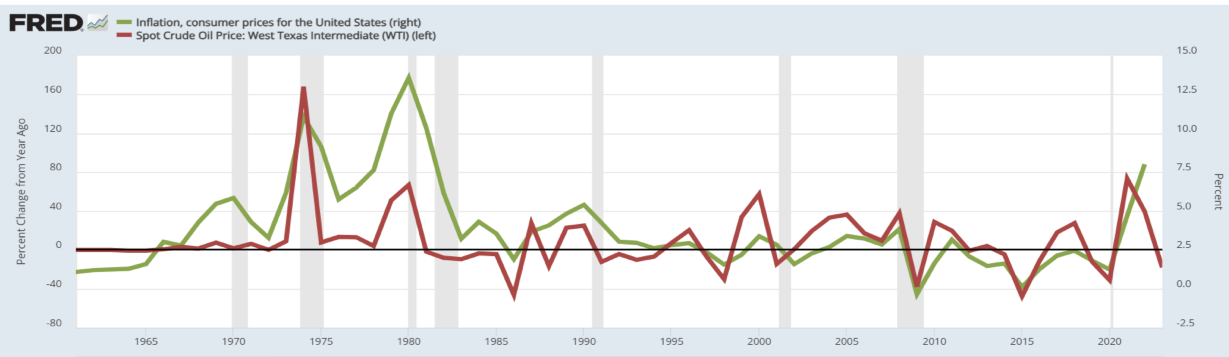
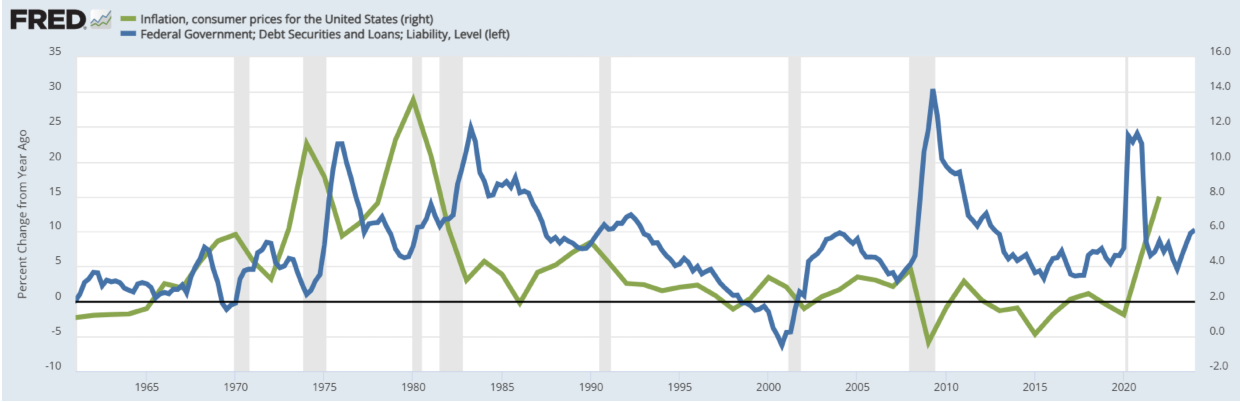
There is no relationship between federal deficit spending (blue line) and inflation.
There is a strong relationship between the oil supply (red line) and inflation.

Inflation is caused by shortages of critical goods and services, most often oil, food, and labor.

The flip side of deficit spending is that the amount of government debt outstanding rises: The government must borrow to finance the excess of its spending over its receipts.

Comment: The federal government, being Monetarily Sovereign, never borrows. Why would it? It has the infinite ability to create its sovereign currency, the U.S. dollar, at virtually no cost (aka, “seigniorage”).

Further, unlike state/local government taxes, which fund state/local spending, federal taxes do not fund federal spending.

Federal taxes are destroyed upon receipt, while state and local tax dollars remain in the economy’s private banks. To finance all its spending, the federal government creates new dollars ad hoc.

It does this regardless of taxes collected. Even if federal tax collection totaled $0, the government could continue spending forever.

For the U.S. economy, the amount of federal debt held by the public as a fraction of GDP has been rising since the early 1970s. It now stands at a little over 37 percent of GDP.

The debt/GDP fraction is meaningless. It has no predictive or analytical power and does not tell anything about an economy’s health.

Do government budget deficits lead to higher inflation? When looking at data across countries, the answer is: it depends. Some countries with high inflation also have large government budget deficits. This suggests a link between budget deficits and inflation.

Yet for developed countries, such as the U.S., which tend to have relatively low inflation, there is little evidence of a tie between deficit spending and inflation.

Mr. Sill falsely equates “developed” with Monetary Sovereignty. However, there are “developed” nations – for example, Italy, France, Greece, etc. that are monetarily non-sovereign. They use the euro.

Why are budget deficits are associated with high inflation in some countries but not in others? Government deficit spending is linked to the quantity of money circulating in the economy through the budget restraint, i.e. the relationship between resources and spending.

Money spent has to come from somewhere: In the case of local and national governments, from taxes or borrowing.

But, national governments can also use monetary policy to help finance the government’s deficits.

I believe that Mr. Sill’s use of “resources” means the amount of money a government can spend, which it gets from taxes or borrowing.

Since he doesn’t differentiate among Monetarily Sovereign, monetarily non-sovereign, and “nationally,” his comments are either partially or totally wrong. First, a reminder about the differences between monetary policy and fiscal policy:

  • Monetary policy involves changing the interest rate and influencing the money supply.
  • Fiscal policy involves the government changing tax rates and spending levels to influence aggregate economic demand. (“Aggregate demand” is Gross Domestic Product at a specific time.)

Here are the sources of confusion:

1. Raising interest rates causes prices to rise. The cost of every product includes the cost of interest. Amazingly, this is the Fed’s tool to combat inflation. The Fed’s theory seems to be that raising prices will reduce demand, causing a recession that supposedly will cure inflation.

In short, the Fed causes inflation to cure inflation while claiming to hope a recession doesn’t occur but secretly relies on recession to cure inflation. (Clear?)

Of course, a result can also be stagflation, a combination of recession and inflation, at which point Fed Chairman Jerome Powell, having no solutions, will hide in his closet and pray. (The cure for stagflation is federal deficit spending to obtain and distribute the scarce products while adding growth dollars to the economy.)

2. As the issuer of its money, only a Monetarily Sovereign government can change interest rates by fiat. It sets the lowest rate on its Treasury Securities.

Because a monetarily non-sovereign government is not an issuer of money, it cannot unilaterally change interest rates. It must rely on markets or the issuer of its money.

For example, Italy cannot arbitrarily raise interest rates on euro-based loans. It uses the euro but is not the issuer.

3. Monetarily Sovereign governments don’t borrow their own currency. The above-mentioned Italy, being monetarily non-sovereign, borrows euros.

In short, Sill, an economist at the Fed (!), is confused about what different kinds of governments can do. Next, he confuses households with our Monetarily Sovereign government:

Budget constraints are a fact of life we all face. We’re told we can’t spend more than we have or more than we can borrow.

The U.S. government “has” infinite dollars, so it does not borrow dollars. Those federal T-securities are not a form of borrowing, which is what a monetarily non-sovereign government does when it needs money.

Rather than providing the U.S. government with dollars, T-securities:

  1. Provide a safe parking place for unused dollars — safer than any other storage place (i.e., bank accounts, safe deposit boxes, etc.) The government never touches those dollars. They remain the property of the depositors.
  2. Assist the Fed in controlling interest rates by setting a floor rate.

In that sense, budget constraints always hold: They reflect the fact that when we make decisions, we must recognize we have limited resources.

See the confusion? “We” and the Italian government have limited resources (money), but the U.S. government does not. It has unlimited money. Next, Mr. Sill expressly shows us his confusion between federal finance and personal finance:

Imagine a household that gets income from working and from past investments in financial assets. The household can also borrow, perhaps by using a credit card or getting a home-equity loan.

The household can then spend the funds obtained from these sources to buy goods and services, such as food, clothing, and haircuts.

It can also use the funds to pay back some of its past borrowing and to invest in financial assets such as stocks and bonds.

The household’s budget constraint says that the sum of its income from working, from financial assets, and from what it borrows must equal its spending plus debt repayment plus new investment in financial assets. 

Not one word of the above applies to the U.S. government.

The government does not borrow or use dollars obtained from any source. It creates ad hoc all the funds it spends. Any income the federal government receives is destroyed upon receipt. (See: “Does the U.S. government really destroy your tax dollars?“)

The only federal budget constraint is not a budget constraint at all. Federal agencies routinely exceed budgets. The restraint is whatever Congress and the President say it is at any given moment.

Congress and the President have the unlimited ability to create dollars and stimulate the economy, plus a strong, though not unlimited, ability to obtain and distribute the scarcities causing inflation.

Mr. Sill continues with an explanation that is irrelevant to federal financing.

The household’s sources of funds and spending are all accounted for, and the two must be equal. The household may use borrowing to spend more than it earns, but that funding source is accounted for in the budget constraint.

If the household has hit its borrowing limit, fully drawn down its assets, and spent its work wages, it has nowhere else to turn for funds and would, therefore, be unable to finance additional spending.

I have no idea what Mr. Sills hoped to accomplish by giving household finances as his explanation for federal finances. The two are fundamentally opposite.

Here, Mr. Sills makes sure to show you that he doesn’t understand the difference between the federal government’s Monetary Sovereignty and your household’s monetary non-sovereignty:

Just like households, governments, face constraints that relate spending to sources of funds.

Governments can raise revenue by taxing their citizens, and they can borrow by issuing bonds to citizens and foreigners. In addition, governments may receive revenue from their central banks when new currency is issued.

Governments spend their resources on such things as goods and services, transfer payments such as Social Security to its citizens, and repayment of existing debt.

Central banks are a potential source of financing for government spending, since the revenue the government gets from the central bank can be used to finance spending in lieu of imposing taxes or issuing new bonds.

No, the U.S. government is not “just like households. It does not raise revenue by taxing you. It doesn’t borrow from the central bank. It doesn’t have an existing debt to repay.

And it finances its spending not with taxes or bonds but by creating new money ad hoc. Who says so, Mr. Sill? Your former bosses:

Former Fed Chairman Alan Greenspan: “A government cannot become insolvent with respect to obligations in its own currency. There is nothing to prevent the federal government from creating as much money as it wants and paying it to somebody. The United States can pay any debt it has because we can always print the money to do that.”

Former Fed Chairman Ben Bernanke: “The U.S. government has a technology, called a printing press (or, today, its electronic equivalent), that allows it to produce as many U.S. dollars as it wishes at essentially no cost. It’s not tax money… We simply use the computer to mark up the size of the account.”

Mr. Sill’s article continues for many more paragraphs, so I will just quote one more thought:

There may be limits on the government’s ability to borrow or raise taxes. Obviously, if there were no such limits, there would be no constraint on how much the government could spend at any point in time.

Congress and the president are the only constraints on federal spending. Unlike your checking account, There are no financial constraints. That is why net spending (spending vs. taxing) has risen to $32 trillion.

Certainly governments are limited in their ability to tax citizens. (That is, the government can’t tax more than 100 percent of income.) But are governments constrained in their ability to borrow?

Monetarily non-sovereign governments are constrained by their full faith and credit, i.e., their credit rating. Monetarily Sovereign governments have no need to borrow, so there is no constraint.

Indeed they are. Informally, the value of government debt outstanding today cannot be more than the value of the government’s resources to pay off the debt.

The U.S. government has the infinite ability to pay for anything. Just ask Fed Chairmen Greenspan and Bernanke.

How do governments pay their current debt obligations? One way is for the government to collect more tax revenue than it spends. In this case, the surplus can be used to pay bondholders.

Wrong. All a federal surplus does is reduce Gross Domestic Product, i.e., cause a recession or depression.

Another way to finance existing debt is to collect seigniorage revenue and use that to pay bondholders.

Half right, half wrong. “Collect seigniorage” is a fancy way to say “print money.”

Seigniorage is the difference between the face value of dollars and the cost of creating them, which comes close to zero. However, holders of U.S. Treasury bonds are paid in two ways: Seigniorage pays the interest, and the principal is paid by returning the bondholder’s deposit.

Finally, the government can borrow more from the public to pay existing debt holders.

Wrong again. The federal government does not borrow, though monetarily non-sovereign governments do borrow.

SUMMARY

It is discouraging to read an article written by the Senior Vice President of Research and Director of the Real-Time Data Research Center for the Federal Reserve that displays so little understanding of Monetarily Sovereign finance.

The article claims that federal finance is similar to personal finance, but it does not demonstrate any knowledge of the vast differences.

Cities, counties, states, businesses, and euro nations can run short of money. The federal government cannot, and a key figure in the Federal Reserve seems to not understand that.

The answer to the title question is, “No, deficits do not cause inflation. Inflation is caused by shortages of key goods and services, most often oil, food, and labor.

Deficit spending can cure inflation by paying for scarce goods and services and ending shortages.

Rodger Malcolm Mitchell

Monetary Sovereignty Twitter: @rodgermitchell Search #monetarysovereignty Facebook: Rodger Malcolm Mitchell; MUCK RACK: https://muckrack.com/rodger-malcolm-mitchell

……………………………………………………………………..

The Sole Purpose of Government Is to Improve and Protect the Lives of the People.

MONETARY SOVEREIGNTY
The single most misunderstood and misused word in economics

The word is “debt.”

Virtually everyone believes they know what it means—I assume you do—but virtually everyone, including economists, is confused by the term.

Here is a dictionary definition:

Debt is an obligation that requires one party, the debtor, to pay money or otherwise withheld from another party, the creditor. Debt may be owed by a sovereign state , country, local government, company, or individual.

Loans, bonds, notes, and mortgages are all types of debt.

Here is what an AI (Artificial Intelligence) says about federal debt. Read it, keeping in mind that the Monetarily Sovereign U.S. government has the infinite ability to create its own sovereign currency.

As we will discuss, the so-called federal debt isn’t debt and it isn’t federal.

The U.S. government never, unintentionally, can run short of U.S. dollars:

The federal debt of the United States is the total national debt owed by the federal government to Treasury security holders. 

It encompasses the accumulated borrowing and the associated interest owed to investors who purchased these securities.

Federal debt is the same as national debt?? Immediately we arrive at confusion because “national” debt can include the debt of the non-federal (private) sector, i.e., the total of mortgages, car loans, business loans, etc., and state/county/city debt. 

Because the federal government is Monetarily Sovereign and the other entities are monetarily non-sovereign, one rightly should assume that federal debt should be treated differently. 

Let’s break it down further:

    1. Federal Deficits:

      • Federal deficits occur when the government spends more money than it collects in revenue during a fiscal year. To cover these deficits, the government borrows money by issuing Treasury bonds, bills, and other securities.
      • These deficits contribute to the overall national debt because they represent the accumulated borrowing over time.
    2. Treasury Securities:

      • Treasury securities are financial instruments issued by the U.S. Department of the Treasury to raise funds for government operations.
      • There are several types of Treasury securities:
        • Treasury bills, Treasury notes, Treasury bonds, Treasury inflation-protected securities (TIPS), Floating rate notes (FRN)
      • These securities are issued to the public and other entities, including individuals, corporations, state or local governments, foreign governments, and other non-federal entities.
    3. Federal Debt Held by the Public:

      • The federal debt held by the public consists of securities held outside the government. It includes:
        • Interest-bearing marketable securities: These are marketable Treasury securities (bills, notes, bonds, TIPS, and FRN) held by various entities.
        • Interest-bearing nonmarketable securities: These include Government Account Series held by fiduciary and certain deposit funds, foreign series, state and local government series, domestic series, and savings bonds.
        • Non-interest-bearing marketable and nonmarketable securities: These include matured and other types of securities.
      • The total federal debt held by the public is calculated based on face value less net unamortized premiums and discounts, including accrued interest.

The federal debt represents the total outstanding obligations owed by the U.S. government, including both deficits and the issuance of Treasury securities. It reflects the financial position of the government and its ability to meet its obligations

That is generally what most people believe. It is wrong on several counts.

First, the federal debt does not “reflect the financial position of the government and its ability to meet its obligations.  The federal government has the infinite ability to meet its obligations. 

Deficit reductions (red line) result in recessions (vertical gray bars), which are cured by deficit increases.
Even the COVID recession of 2020 was cured by the increase in federal spending — the so-called “debt” — that year.

Read it again while again keeping in mind the Monetarily Sovereign U.S. government has the infinite ability to create its own sovereign currency. It never, unintentionally, can run short of U.S. dollars.

Now ask yourself: Why would the federal government borrow dollars? The answer: It doesn’t. 

Notice the definitions of federal debt encompass two completely different things:

  1. The total of federal deficits, i.e. the net total difference between what the government has spent and what it has received in taxes.
  2. The total of Treasury Security accounts.

1. Total Federal of Deficits: In most years, the federal government spends more than it receives in taxes. This is called a “deficit.” Over the years these deficits total to what is called the “federal debt.”

All forms of debt require at least one debtor and at least one creditor. But with regard to federal deficits, who is the debtor and who is the creditor, and what is owed?

A quick response might be that the government is the debtor, and those supplying the government with goods and services would be the creditors. But that quick response would be wrong.

Although the federal “debt” is upwards of $30 trillion, the federal government does not owe its suppliers $30 trillion. They all have been paid.

Clearly, the total of deficits is not federal debt. There are no creditors, no debtor, and nothing is owed.

2. The Total of Treasury Security Accounts: Are they “federal debt”? If so, how and why did the “debt” occur. 

Look back at the definitions: The Treasury Securities are bills, notes, and bonds, issued by the federal government to raise funds for government operations.

A “bill” is a request for payment of money owed, or the piece of paper on which it is written. In the private sector, a bill is created by a creditor and sent to a debtor as a demand for payment. The way most people understand it.

But federal terminology is diametrically different. Here, the “debtor” (the government) creates and issues the T-bill and the creditor buys it, as though it were a bond. 

Consider a dollar bill. It is not a request for payment by a creditor, but rather a document created by the debtor — the federal government, which owes the holder one dollar. The dollar bill itself is not the dollar. It is an IOU for a dollar.

The dollar is just a number in the federal government’s financial books.

You cannot see, feel, smell, or taste a dollar. It has no form or substance. If someone asked you what does the number “five” look like would your answer be: “5,” or “V,” or “(2+3);” or the binary “101,” or “√25.”

Although you can describe a five dollar bill, you cannot say what five dollars look like. Dollars result from laws, and again, no one can say what a law looks like. Like dollars, laws are just concepts, not physical entities.

That fact that dollars are not physical gives the federal government the infinite ability to create them just by pressing computer keys.

But that’s a minor, though confusing, semantic issue. The major, and even more confusing, semantic question: Why does a Monetarily Sovereign entity, having the infinite ability to create dollars, ever borrow dollars?

As two former Chairmen of the Federal Reserve have said:

Alan Greenspan: “A government cannot become insolvent with respect to obligations in its own currency. There is nothing to prevent the federal government from creating as much money as it wants and paying it to somebody. The United States can pay any debt it has because we can always print the money to do that.”

Ben Bernanke: “The U.S. government has a technology, called a printing press (or, today, its electronic equivalent), that allows it to produce as many U.S. dollars as it wishes at essentially no cost.”

Question: If the U.S. government cannot become insolvent, can create as much money as it wants, and can pay any debt, why does it borrow dollars? Why does it pay interest when it can produce as many dollars as it wishes at essentially no cost?

Answer: It doesn’t borrow, and the interest is produced at no cost.

Because of words like “bill,” “note.” and “bond,” many people, including even economists, believe these represent federal borrowing and debt.

They do not. The federal government never borrows dollars. It creates all the dollars it needs by spending dollars. Spending is how the government creates new dollars. The process is:

When an agency of the federal government pays an invoice (a bill) from a creditor, it sends instructions (not dollars) to the creditor’s bank. The instructions may be in the form of a check or a wire (“Pay to the order of ____”)

The bank obeys the instructions by increasing the balance in the creditor’s checking account. At that instant, new dollars are created and added to the M2 money supply measure.

The bank balances its books by informing the Federal Reserve of the instructions, which debits the government’s account. 

At no time are any physical dollars exchanged because there are no physical dollars. It’s all numbers in bookkeeping accounts.

But what is the purpose of those T-security accounts? They have two purposes, neither of which is to provide spending money for the government:

A. To provide a safe place to store unused dollars, which stabilizes the dollar. Because dollars have no physical existence, they can’t be stored in a box and watched. So, it is especially important that large, unused sums be kept on trusted books

No books are more trusted with dollars than the U.S. government’s.

B. To help the Fed control interest rates. Because T-securities are known to be safe, the interest paid by federal storage sets a floor for all private sector interest rates. 

T-security accounts resemble bank safe deposit boxes in that the contents are not owed to the depositors and not used by the bank. They are not federal in that the contents of the accounts are wholly owned by the depostors. The federal government never touches those dollars.

Just as they are not debts, they also are not federal. To close an account, the bank and the government simply return the contents to their owners, the depositors. The government does not owe the money because it never takes ownership of the money.

Why then, does the federal government need to lend rather than give money (for instance, student loans) or need to collect taxes.

It doesn’t. 

The federal government could forgive all student loans and continue spending forever, all without collecting a single penny in taxes. It could accomplish this simply by creating dollars.

Some claim that “excessive” federal deficit spending would cause inflation. That claim is false; the reasons are described here. While a government response to inflation may be to print currency, the cause of all inflations has been shortages of critical goods and services.

The most recent inflation was caused not by federal spending, which had been go on for  many years, but by new, COVID-relaed shortages of oil, food, computer chips, lumber, paper, shipping, steel, and many other products, and labor.

While state/local taxes and borrowing help monetarily non-sovereign government pay for things, the purpose of federal taxes is not to pay for things but rather:

  1. To control the economy by taxing what the government wishes to discourage and by giving tax breaks to what the government wishes to reward.
  2. To support demand for the U.S. dollar by requiring taxes be paid in dollars.

But the biggest, unofficial reason for taxes is to support the myth that federal debt is paid by taxes, and that taxes are necessary to fund spending. It’s a myth promulgated by the people who really run America, the rich.

They are rich because of the income/wealth/power Gap between the rich and the rest. The wider the Gap, the richer they are.

The debt/taxation myth limits the federal spending that supports the middle- and the lower-income groups, but allows for the federal tax breaks that are given to the rich. Contrary to popular belief, federal taxation widens the Gap between the rich and the rest, making the rich richer.

Without the debt/taxation myth we could fund free, comprehensive, no-deductible Medicare for every man, woman, and child in America, no-FICA Social Security for everyone, an end to poverty in America, free college for everyone who wants it, and many other benefits (free public transportation, housing support, local infrastructure improvements, lower local taxes, etc.) all of which are of no interest to the rich.

Donald Trump didn’t pay less taxes than you paid the past ten years, not just because he cheated, but also because, being rich, he took advantage of the tax breaks that you can’t.

Tax breaks are financially the same to the federal government as such benefits as Social Security and Medicare, the difference being there is no financial limit put on tax breaks while the benefits are limited by tax collections.

SUMMARY

Unlike state/local governments, businesses, you and me, the federal government is Monetarily Sovereign. It cannot unintentionally run short of dollars. It can pay any financial obligation immediately. 

The federal government and its taxpayers are not burdened by federal debt. The federal government does not borrow dollars. It creates dollars ad hoc, by spending.

People have complained about the fictional “federal debt” since 1940, calling it a “ticking time bomb.” yet after all these years the ticking time bomb hasn’t exploded. In that time, the “federal debt” rose from $40 billion to $30 trillion, the economy is healthy, the government is paying its bills, and all the scare stories have proved to be false.

The federal debt, whether it be the total of deficits or the total of T-securities, neither is federal nor debt. It is not a burden on taxpayers nor on the federal government. It doesn’t cause inflation or recession.

Deficit spending is necessary to grow the economy and attempts to reduce deficit spending have caused causes recessions and depressions.

Accepting deposits into T-bill, note, and bond accounts does not constitute borrowing or debt, for a Monetarily Sovereign entity never borrows its own sovereign currency. 

It’s not debt if there is nothing owed, nothing borrowed, no creditors, no debtors, an no payment burden.


Rodger Malcolm Mitchell
Monetary Sovereignty

Twitter: @rodgermitchell Search #monetarysovereignty
Facebook: Rodger Malcolm Mitchell

……………………………………………………………………..

The Sole Purpose of Government Is to Improve and Protect the Lives of the People.

MONETARY SOVEREIGNTY