–I’m angry with the Chicago Tribune

An alternative to popular faith

I live in Chicago, and I’m angry with the Chicago Tribune. It continues to be clueless about economics. In a June 15th editorial, the Tribune said, “With 79 percent of Americans rating (the federal debt) ‘extremely serious’ or ‘very serious,” it tied with terrorism for the top (‘scariest threat’). So what does the Obama administration plan to do about it? It proposes to pile on more debt. . . . Americans have good reason to be so worried about the . . . that someone will have to repay.”

Does the term “exploding national debt” sound familiar. If you go back and read TICKING TIME BOMB , MORE BOMB NONSENSE and DEBT BOMB REDUX you will see that the Tribune and its media friends have been referring to the federal debt in explosive terms for the past seventy years! Think about it. For seventy years the media has told you a debt bomb is been ready to explode, and today we are no closer to any of those dire forecasts than we were in 1940.

Does daily failure of prediction stop the Tribune? Nope. Tribune readers keep following their prophet up the mountain to await the end of the world. When the world fails to end, do they ever begin to question their leader? No, they march back down, and sit mesmerized as their prophet repeats the same old predictions – for more than seventy, long years.

Here is what outrages the Chicago Tribune today: “$50 billion in emergency spending to help state and local governments . . . avert massive layoffs of teachers, police and firefighters . . . Block a 21 percent scheduled cut in reimbursements to doctors who treat Medicare patients.

Yes, helping avert layoffs of teachers, police, firefighters and doctors truly is awful, especially when compared with the unsupported, unproven, patently wrong “risk” of a federal debt that in the Tribune’s misguided words, “someone will have to repay.”

If you read some of the posts on this blog, starting with SUMMARY you will see there is no “someone” who has to pay. Taxpayers neither owe nor service the federal debt. There is no relationship between federal income and federal spending. The so-called “debt” merely is a balance sheet calculation of net money created by the federal government, a calculation that neither inhibits, nor is inhibited by, federal spending.

A curse be upon the person who first labeled this balance sheet column “debt” rather than the correct, “net money created.” Incorrectly calling it “debt” has misled millions of otherwise intelligent people, and worse, has prevented important programs (See: CHILDREN & GRANDCHILDREN) of benefit to us all.

I’m angry with the Tribune, not because they are clueless. Each of us is clueless about many things. I’m angry with them because they have such power to make a positive difference in our economy, but instead they are too intellectually lazy to learn, preferring to parrot the popular myths of the day. What a waste.

Rodger Malcolm Mitchell
http://www.rodgermitchell.com

No nation can tax itself into prosperity

–Is Federal money better than other money??

Mitchell’s laws:
●The more budgets are cut and taxes increased, the weaker an economy becomes.

●Until the 99% understand the need for federal deficits, the upper 1% will rule.
●To survive long term, a monetarily non-sovereign government must have a positive balance of payments.
●Austerity = poverty and leads to civil disorder.
●Those, who do not understand the differences between Monetary Sovereignty and monetary non-sovereignty, do not understand economics.

==========================================================================================================================================

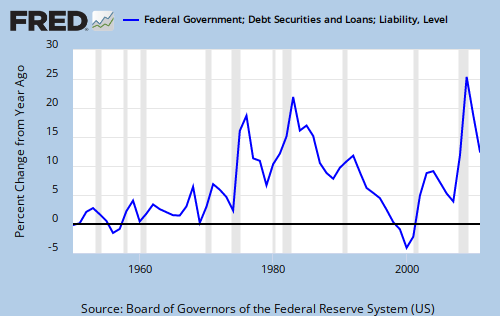
In other posts on this blog, we have discussed how reductions in federal debt growth, as shown by the following graph, “Federal Government Debt-Domestic Nonfinancial Sectors,” immediately precede recessions. This comes as no surprise, since a growing economy requires a growing supply of money, and deficit spending is the federal government’s method for adding money to the economy.

Federal debt
FEDERAL GOVERNMENT DEBT- PERCENTAGE CHANGE FROM YEAR AGO

Clearly, federal debt/money growth is essential to keep us out of recessions. Yet, when we look at “Debt Outstanding Domestic Nonfinancial Sectors” which includes not only Federal debt, but also outstanding credit market debt of state and local governments, and private nonfinancial sectors we do not see the same pattern.

Total Nonfinancial Debt
TOTAL DOMESTIC NONFINANCIAL DEBT — PERCENTAGE CHANGE FROM YEAR AGO

In fact, when we subtract federal debt from total debt, leaving only state, local and private debt, we see the opposite pattern. Recessions more often seem to follow increases in state, local and private debt.


STATE, LOCAL AND PRIVATE DEBT, PERCENT CHANGE FROM YEAR AGO

Now in one sense, money is money. Your buying on your credit card creates debt/money, just as federal deficit spending creates debt/money. Presumably, both should have the same stimulative effect on the economy. They do, but not long term. Why?

Because, unlike the federal government, you, your business and local governments cannot create new money endlessly to service your debts. Your debts can pile up to the point where you must liquidate them by paying them off or by going bankrupt. When non-federal debts become too large, a growing number of people, states, cities and businesses must pull back and stop further borrowing, i.e. stop creating money, or even destroy money by paying off loans. When that happens, we have a recession.

(As an aside, this is one reason the early stimulus efforts had so little effect. People used the stimulus money to pay off loans, so while the federal deficit spending created money, the loan pay-downs destroyed it. Debt reduction destroys debt/money.)

During the recession, and for a short time after, we tend to cut back on our personal borrowing and liquidate debt/money. Then we begin to resume borrowing, more and more, until again, we hit our personal limits and cut back, causing yet another recession. The sole prevention of this cycle, which averages about 5 years in length, is to make sure that federal deficit spending grows sufficiently to offset periodic money destruction by the private sector.

In summary, federal deficit spending is good for the economy, always good, endlessly good (up to the point of inflation). Private and local government spending/borrowing also is good, but not endlessly. Unlike the federal government, the private and local-government sectors eventually reach a point where debt is unaffordable and unsustainable.

To prevent recessions, the government continuously must provide stimulus spending, then provide added stimulus spending to offset the periodic reduction of money creation by the private sector.

Rodger Malcolm Mitchell
Monetary Sovereignty


==========================================================================================================================================
No nation can tax itself into prosperity, nor grow without money growth. Monetary Sovereignty: Cutting federal deficits to grow the economy is like applying leeches to cure anemia. Two key equations in economics:
Federal Deficits – Net Imports = Net Private Savings
Gross Domestic Product = Federal Spending + Private Investment and Consumption + Net exports

#MONETARY SOVEREIGNTY

–Committee For A Responsible Federal Budget

An alternative to popular faith

On May 19th, I received the following Email from the Committee For A Responsible Federal Budget:

Dear friend, I am excited to share with you the latest CRFB initiative that I believe will quickly become a critical tool in educating the public regarding the fiscal outlook and motivating policymakers to take responsible action to put the country on a sustainable course. Today, we are publicly launching our “Stabilize the Debt” budget simulator (http://crfb.org/stabilizethedebt/).

“The ‘Stabilize the Debt’ challenge continues CRFB’s distinguished tradition of engaging policymakers, opinion leaders, the media, and the public in deliberating and discussing what it takes to be fiscally responsible. This new online endeavor is part of our long tradition of developing timely “Exercise in Hard Choices” exercises, and we are excited about our newest version.
[…]
“‘Stabilize the Debt’ challenges the user to think about reducing the debt in the longer term and maintaining it at a sustainable level, as opposed to simply balancing the budget for a single year. It promotes thinking about the need for both medium- and long-term term fiscal goals and how to attain them. It uses the goals from the Peterson-Pew Commission on Budget Reform from the Red Ink Rising report of stabilizing the debt at 60 percent of GDP by 2018 and keeping it low.

“I encourage you to take the challenge and share with all your friends. Since Congress appears unlikely to produce a budget this year and have the needed debate over fiscal priorities, this simulator can fill that void by enabling Americans to discover and discuss the difficult choices that must be made and engage in a nationwide dialogue on how best to put the country on a sound fiscal course. Sincerely, Maya MacGuineas, CRFB President

“For press inquiries, please contact Kate Brown at (202) 596-3365 or brown@newamerica.net.”
———————————————————————————————————————————————
Not having had Ms. MacGuineas’s Email address at the time, I wrote the following letter to Ms. Brown on May 19th. And again on May 20th. And May 24th. And May 27th. To date, no answer, which is normal for all debt hawk organizations. Knowing they have no data to support their claims, they simply ignore requests for data, even when, as you’ll see, I offered to promulgate their beliefs:

———————————————————————————————————————————————-

“Ms. Brown,

If you can supply historical, statistical evidence that the U.S. federal debt and deficit need to be reduced or are not sustainable, or that the federal debt needs to be stabilized at “60 percent of GDP by 2018,” I would be glad to post this data on my web site, https://rodgermmitchell.wordpress.com. I also will mail this information to my list of 100+ economics professors, 50 newspaper and magazine columnists, and 30 newspaper and magazine editors around the country.

Rodger Malcolm Mitchell”
————————————————————————————————————————————————-

Try it yourself. Write to any debt hawk organization or any debt hawk politician or economist, and ask for data to support the idea that the debt is too large. In the unlikely event you receive anything that constitutes evidence, please forward it to me.

Subsequently, I did find Maya MacGuineas’s Email address and wrote to her and Ms. Brown. For your interest, here is a calendar of my requests to supply evidence and my offer to send this evidence to economists and the media all over America:
May 19: Wrote to Ms. Brown
May 20: Wrote to Ms. Brown
May 24: Wrote to Ms. Brown
May 27: Wrote to Ms. Brown
May 28: Wrote to Ms. Brown & Ms. MacGuineas
June 1: Wrote to Ms. MacGuineas

Rodger Malcolm Mitchell
http://www.rodgermitchell.com

No nation can tax itself into prosperity

–Giving life to a lie

An alternative to popular faith

The May 15, 2010 issue of NewScientist Magazine included an excellent piece by James Giles, titled “Giving life to a lie.” I strongly recommend you read it. (See: LIE for the full article.)

It tells how a statement by John Houghton, former chair of the Intergovernmental Panel On Climate Change – “Unless we announce disasters, no one will listen” – supposedly was repeated in three books, 100 blogs and 24,000 web pages.

Despite this widespread circulation and belief, the statement never was made. It was created by conservative columnist Piers Akerman. It was a lie.

The article, with its subtitle, “In the battle for hearts and minds, a plausible falsehood too often trumps the truth,” goes on to explain how a lie can acquire almost universal acceptance. Here are a few quotes: “. . . a falsehood has to have at least a shred of believability.” “Any falsehood can acquire currency … so long as there are enough people inclined to believe it . . . Falsehoods can come to be believed simply because others believe them. . . This is an information cascade, a process described by the economist DavidHirshleifer . . .” “The mainstream media often participates in the cascade … the more often you hear something, the more likely you are to believe it is true.”

Today, the big lie in economics is, “The federal debt is unsustainable” (See: UNSUSTAINABLE ).

The word ‘unsustainable,” means unable to endure. What is the evidence the federal debt cannot endure? That is, what evidence shows the debt cannot continue, cannot continue to grow, cannot continue to be serviced by the federal government, or will cause economic hardship? Amazingly, no such evidence exists. It all is myth.

That is why you never will see such evidence provided by any of the newspaper or magazine articles making the claim, nor will economists provide such evidence. They all merely will make the claim and support it with other claims, also unsupported by evidence (i.e., “The debt is unsustainable. It will cause inflation. It will reduce the availability of lending funds. Our children and grandchildren will pay for it through higher taxes. Nations will refuse to lend to us. Eventually, we’ll be like Zimbabwe.”) As each lie begets additional lies, the entire package becomes impervious to fact. More and more believe it, until it seems to become solid truth – all without supporting evidence.

The U.S. is 225 years old, yet the federal debt has grown about 1500% in just the past 30 years – a truly amazing increase. Despite this unprecedented debt growth, the federal government never has trouble servicing its debt, nor do we have inflation beyond what the government specifically wants (about 2%-3%), nor is there any mechanism by which the federal debt, which actually is the main source of dollars, can reduce the availability of lending funds. Nor do taxes pay for debts, which is how the debt managed to grow so much. In fact, tax rates are lower today than 30 years ago. And, nations do not refuse to lend to us. Nor do we even need nations to lend to us.

Why does this lie, which the most easily obtainable evidence shows to be wrong, have such widespread following and persistence? First, it has the requisite “shred of believability.” We think of the federal government as being like us – an anthropomorphic misunderstanding. If my debts grow too large, they are not sustainable. I might not be able to obtain the money to service them, and I even can go bankrupt. The same can be said of you, your business, your city, county and state. It even can be said of the European Union nations. But it cannot be said of the U.S. government.

I cannot create unlimited amounts of money to pay my bills. Nor can you, businesses nor local governments. Even Greece and Spain cannot, for they are constrained by EU rules. The U.S. government however, has no such constraints, as it proves every day. It can pay any bill of any size, immediately, simply by crediting the bank account of any creditor.

Then there is the collection of taxes. Local governments use taxes to pay their bills, which is why local governments can go bankrupt if taxes do not support spending. The federal government does not use taxes to pay its bills, because it alone has the unlimited power to create money. For that reason, our children and grandchildren will not pay for the debt. No one will. The government pays its debts by creating money, ad hoc.

The notion that federal borrowing replaces private borrowing has a quasi-arithmetic logic about it. “There is only so much money to lend, and if the government borrows it all, the funds will be used up and there will be none left for the private sector.” In reality, lending facilitates more lending. When you lend to the bank, by depositing in your bank account, this does not reduce the bank’s ability to lend. When the government borrows, it merely exchanges one form of money for another. It does not “use up” lending funds. And when the government spends, it creates lending funds.

Many nations often are used as an example of what excessive debts cause: Zimbabwe, WWII Germany, Brazil, Italy et al. But, each had special circumstances, that were unlike those in the U.S. and not directly related to excessive deficits. For instance, in the case of Zimbabwe, wars, corrupt leadership (Robert Mugabe), stealing farm land from owners, loss of exports and other problems caused its economic disaster.

As the media broadcast the lie, and more people came to believe it, the lie became a cascade. It became a truth unto itself, a self evident statement requiring no supporting evidence.

Are you old enough to remember when “Stomach ulcers are caused by emotional stress” was such a self-evident statement. No one doubted it, and no one asked for evidence, until one day it was discovered the vast majority of stomach ulcers are caused by a bacterium (Helicobacter pylori). Even today, some people cling to that original lie about ulcers.

In summary, when someone tells you the federal deficit and debt are too large, ask for factual evidence in the form of data. They will not provide factual evidence. They merely will give you more opinions (inflation, taxes, children, eventually, etc.) also unsupported by data. If you would rather depend on facts than on myth, read through the various posts on this blog, beginning with SUMMARY, and do read that article.

Rodger Malcolm Mitchell
http://www.rodgermitchell.com

No nation can tax itself into prosperity