The “unsustainable” federal debt

If you type “unsustainable federal debt” into your search bar, you will see this: (Try it)

Implications of Unsustainable Debt
1. Economic Growth Risks: Rising debt levels can lead to slower economic growth as more government resources are allocated to interest payments rather than productive investments.

2. Increased Borrowing Costs: As debt accumulates, the government’s borrowing costs may rise, crowding out investments in other critical areas such as infrastructure and education.

3. Potential Default: If corrective actions are not taken, the U.S. could face a situation where it defaults on its debt obligations, either explicitly or through inflationary measures.

Experts suggest that without significant fiscal reforms, the U.S. government may face a fiscal crisis within the next 20 years.

Recommendations for Addressing Federal Debt To mitigate the risks associated with unsustainable federal debt, policymakers are urged to develop strategies that include:
*Reforming Spending: Addressing the key drivers of federal spending, particularly in healthcare and social programs, to align expenditures with revenues. 
*Increasing Revenues: Exploring options to enhance tax revenues, such as eliminating certain tax deductions and increasing corporate and individual income taxes.
*Implementing Fiscal Policies: Establishing a comprehensive fiscal policy framework that prioritizes long-term sustainability over short-term gains. 

Not one sentence in the above is true. Together, they form what is widely known in economics as “The Big Lie.”

It’s a series of lies that may not be the result of malevolence; it may just be ignorance. Either way, it’s wrong and harmful.

Let’s begin at the top:

The Lie: “Rising debt levels can lead to slower economic growth as more government resources are allocated to interest payments rather than productive investments.”

This lie includes two false assumptions: That federal deficit spending slows growth and government resources are limited by interest payments.

The Truth: Government deficit spending adds growth dollars to the economy as this formula illustrates: Gross Domestic Product = Federal Spending + Nonfederal Spending + Net Exports. 

By formula, the more federal spending, the more economic growth.

The lie that federal deficit spending slows growth is disproven by the mathematical definition of economic growth.

The idea that Government resources are limited by interest payments is disputed by the experts from the three Fed Chairmen, the St. Louis Fed Bank, and the Treasury, all acknowledging that the federal government has unlimited resources. It cannot run short of dollars.

=======================================

The Lie:As debt accumulates, the government’s borrowing costs may rise, crowding out investments in other critical areas such as infrastructure and education.”

This Lie makes false assumptions:

False assumption: The federal government borrows U.S. dollars.

The Truth: The federal government never borrows U.S. dollars. Having the infinite ability to create dollars, the assumption makes no sense on its face. The confusion arises because of the words, “bill,” “note,” “bond,” and “debt” all of which have different meanings in federal finance vs. private finance.

In private finance, those words indicate that money is owed. In federal finance, a T-bill, T-note, and T-bond represent deposits (not borrowing) into Treasury security accounts.

The purpose of those accounts is not to acquire spending money but rather to:

*Provide dollar holders with a safe place to store unused dollars — safer than any bank in the world — which is why nations such as China store dollars there, and

*Help the Fed control interest rates by creating a base rate upon which all other rates are calculated.

The total of outstanding T-bills, T-notes, and T-bonds is misnamed “debt,” though nothing is owed. These accounts resemble bank safe-deposit boxes, in which valuables are held by a bank but not owed to the depositor. 

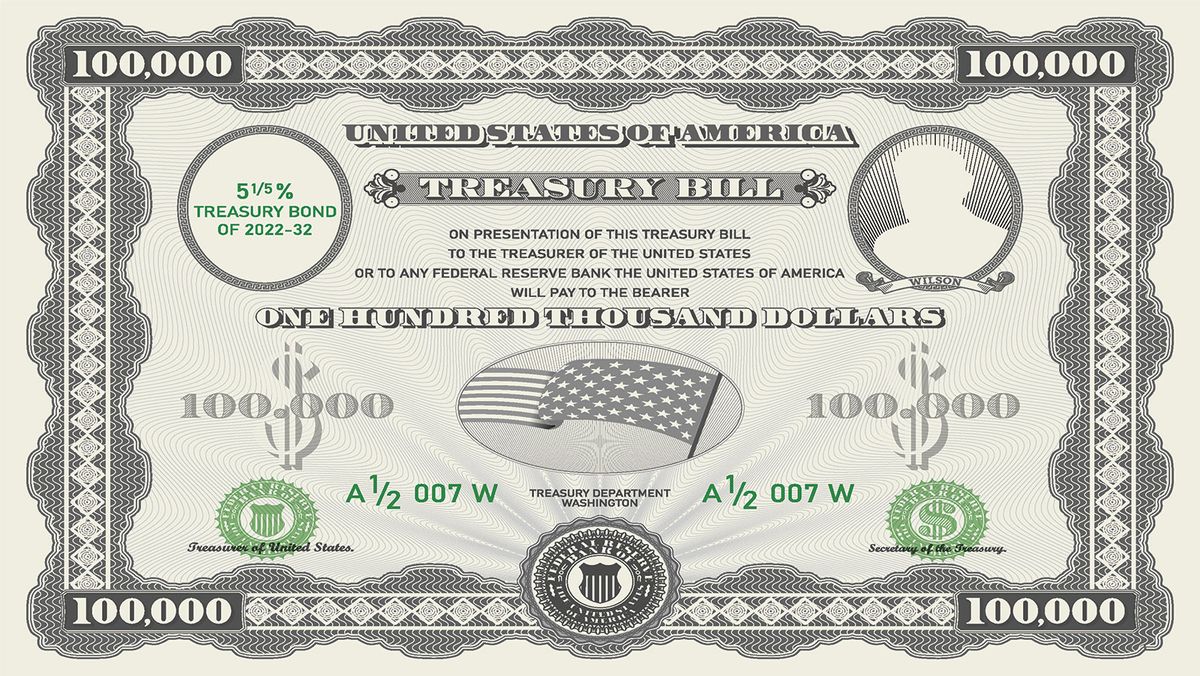
The so-called “debt” is nothing more than a simple exchange of money. You send dollar bills to the government, and the government sends you Treasury bills. They both are U.S. money, with exactly the same backing: the full faith and credit of the United States government.

A dollar bill and a Treasury bill are identical in terms of government liability. They both are U.S. money issued by the U.S. government.

 

United States one-dollar bill - Wikipedia

How Treasury Bills Work | HowStuffWorks

As the St. Louis Fed clearly said, “the government is not dependent on credit markets (i.e., does not borrow) to remain operational.”


False assumption: “… the government’s ‘borrowing’ costs may rise, crowding out investments in other critical areas

The Truth: The government’s “borrowing costs” (meaning interest payments) will have no effect on the government’s ability to pay interest. It has infinite ability to pay for anything.

We are not sure what “crowding out” means. If it means the government will run short of dollars, that clearly is impossible.

If it means that private sector borrowers will be unable to borrow, that too is false. Interest rates are arbitrarily controlled by the Fed and are not related to the issuance of Treasury securities. The Fed sets interest rates to control inflation.

===================================

The Lie: “… the U.S. could face a situation where it defaults on its debt obligations, either explicitly or through inflationary measures. 

The Truth: Again, we see multiple false assumptions:

First false assumption: “… the U.S. could face a situation where it defaults on its debt obligations.”

As every competent economist (including those mentioned above) has said, “The federal government never can become insolvent, i.e., unable to pay its bills.” Having the infinite ability to create dollars confirms this.

Second false assumption: “… through inflationary measures.”

We are not sure if this means that federal spending causes inflation, a claim not in accord with history.” 

Inflation never has been caused by federal spending. Every inflation has been caused by shortages of critical goods and services. The most recent COVID-related inflation was caused by shortages of oil, food, shipping, metals, lumber, labor, computer chips, and other needs. Inflation was being mitigated by federal spending to obtain and distribute scarce items.

See: “At long last, let’s put this inflation question to bed.”

Or does “inflationary measures” mean that the measures to forestall inflation actually cause defaults on debt obligations?  The Fed mistakenly raises interest rates to combat inflation, but a nation with the ability to create its own money can never default.

And in any event, the government pays its misnamed “debt” by the simple act of returning the dollars that reside in T-security accounts. This is not a financial burden on the government. 

Did you know that the federal “debt” has been called “unsustainable” for the past eighty-five years? (See: “A trip down memory lane, or proof ignorance is hard to conquer if the ignorant want to remain that way.”) 

Yes, for eighty-five years, they have been crying wolf, and the people have yet to catch on. Talk about slow learners!

Why the lies?

That is the most important question. The so-called “cures” for the non-existent “problem” of federal debt involve tax increases on the poor and/or reducing social programs that primarily aid those who are not wealthy, such as Social Security, Medicare, Medicaid, and food stamps. 

Thought seldom is given to reducing benefits for the rich, like eliminating tax loopholes.

This was driven home yet again when billionaire President Trump revealed that he had paid virtually no income tax for ten years, a most enviable position — and his political party just passed a “Big, Beautiful” law that saves the rich billions, while the rest receive a pittance while losing some benefits.

This is no accident.

The lies that FICA taxes fund Social Security and Medicare, and that social programs must be cut, are told on behalf of the rich, whose money runs America.

An infinite pile of dollars rising high into space
The federal government has infinite money. It never can run short. It never can default on its obligations for lack of money.

Those of our information sources that promulgate The Big Lie either are ignorant of the facts or are bribed to lie. The rich bribe:

  1. The media, via ownership and advertising dollars
  2. The politicians, via political contributions and promises of lucrative employment later
  3. The economists, via promises of employment with “think tanks” and university endowments.

IN SUMMARY

Even if the federal government did not collect a single penny in taxes, it could fund:

  1. A generous “living-income” Social Security benefit for every man, woman, and child in America.
  2. A livable Social Security benefit for every man, woman, and child in America
  3. Comprehensive, no-deductible Medicare for every man, woman, and child in America
  4. Generous aid for grades K-12.
  5. Free college for all who want it.
  6. Housing assistance
  7. Generous support for the various scientific and medical research projects in America.
  8. Economic growth

And it could do all of that without causing inflation.

America, you have been cheated and lied to, perhaps intentionally, perhaps ignorantly. The federal government has the wherewithal to make America a paradise on Earth. But the rich don’t want that, because if we all were equal, no one would be rich.

The rich want the income/wealth/power gap between the rich and the rest o us to widen. They want the desperation that forces people to accept jobs they don’t like and receive low pay.

So they bribe your sources of information to promulgate The Big Lie, that federal finances are like personal finances, and the government can’t afford to aid the “lazy” poor (who, on average, work harder than the rich).

It doesn’t have to be this way. However, it will remain so if the people reject the facts and choose to believe the lies.

If you don’t protest — if you don’t call, write, and gather groups to demand what if rightfully yours — if you weakly accept The Big Lie and think the truth “is too good to be true– then it always will be that you work hard, receive little, and your children and their children will do the same.

Now that you have heard the facts, the choice is yours. 

Rodger Malcolm Mitchell

Monetary Sovereignty

Twitter: @rodgermitchell

Search #monetarysovereignty

Facebook: Rodger Malcolm Mitchell;

MUCK RACK: https://muckrack.com/rodger-malcolm-mitchell;

https://www.academia.edu/

……………………………………………………………………..

A Government’s Sole Purpose is to Improve and Protect The People’s Lives.

MONETARY SOVEREIGNTY

Starving with a loaf of bread under your arm. The end of Social Security

The U.S. federal government is unlike state and local governments. It uniquely is Monetarily Sovereign. That means it has the infinite ability to create dollars simply by passing laws and pressing computer keys.

While state and local government can run short of dollars, the federal government cannot unintentionally run short. Not now. Not ever.

Federal Reserve Chairman Alan Greenspan: “A government cannot become insolvent with respect to obligations in its own currency. There is nothing to prevent the federal government from creating as much money as it wants and paying it to somebody. The United States can pay any debt it has because we can always print the money to do that.”


Federal Reserve Chairman Ben Bernanke: “The U.S. government has a technology, called a printing press (or, today, its electronic equivalent), that allows it to produce as many U.S. dollars as it wishes at essentially no cost. It’s not tax money… We simply use the computer to mark up the size of the account.”


Federal Reserve Chairman Jerome Powell stated, “As a central bank, we have the ability to create money digitally.”


Statement from the St. Louis Fed: “As the sole manufacturer of dollars, whose debt is denominated in dollars, the U.S. government can never become insolvent, i.e., unable to pay its bills. In this sense, the government is not dependent on credit markets to remain operational.”

Social Security is a federal agency. Like all federal agencies, including Congress, the Supreme Court, the White House, the military, et al, Social Security cannot run short of dollars unless Congress and the President will it.


Congress has the infinite power to create laws, and some of these laws create dollars from thin air. So long as Congress can create laws, the U.S. always will have enough dollars for any expenditure.


In June, 2001, Paul O’Neill, Secretary of the Treasury said, “I come to you as a managing trustee of Social Security. Today we have no assets in the trust fund. We have promises of the good faith and credit of the United States government that benefits will flow.”


The so-called Social Security “trust fund” (which is not a real trust fund) never has assets other than “promises of the good faith and credit of the United States government.”

Those promises are what we call “dollars.”< /br>< /br>

Look at a dollar “bill.” At the very top it says, “FEDERAL RESERVE NOTE.” Bills and notes are promises of payment.

All dollars are promises by the federal government that it will accept dollars as payment, and so will everyone else in America. In fact, that is stated on the dollar bill: “This note is legal tender for all debts, public and private.” 

The federal government has the infinite ability to create legal tender to pay all debts.

Man standing amidst a sea of oranges, expressing surprise or excitement, in a vibrant orange environment.
If I were the federal government, some people would tell you I could run short of oranges. Those are the people who tell you Social Security, Medicare, and Medicaid can run short of dollars.

Because the federal government cannot unintentionally run short of dollars, how can we explain the following article from MSN?

The most controversial changes proposed to save Social Security
Story by Gabriela León

As Social Security teeters on the brink of insolvency, the government is exploring various proposals to ensure its sustainability.  

While the program is not expected to disappear, the amount future retirees will receive is uncertain.

Have you ever heard that the White House, Congress, or the Supreme Court are “teetering on the brink of insolvency“?

No?

For the fiscal year 2024, the United States Supreme Court had a discretionary budget request of $161.3 million. Where did it get the money? There is nothing like a FICA tax to supposedly support this federal agency.

For the fiscal year 2025, the U.S. Congress has an approximately $5.9 billion budget. This budget covers the operational expenses of the House of Representatives and the Senate, including salaries, office expenses, and other administrative costs. Where did it get the money? There is nothing like a FICA tax to supposedly support this federal agency.


The White House’s annual operating budget is part of the overall budget of the Executive Office of the President (EOP). For the fiscal year 2025, the EOP has a budget request of approximately $714 million. Where did it get the money? There is nothing like a FICA tax to supposedly support this federal agency.


The answer to the questions: All federal agencies get their spending money the same way. Congress votes; the President approves; and magically, the dollars are created from thin air.


Social Security is a federal agency. Like all other federal agencies, Social Security gets its money from Congress’s votes and the President’s approval.


Contrary to popular wisdom, Social Security does not get its spending money from the FICA tax or any other source. Those FICA dollars ripped from your paycheck are destroyed the moment they reach the U.S. Treasury.


The dollars originate in checking accounts as part of the “M2 money supply measure.” When they reach the Treasury, they instantly cease to be part of any money supply measure. Effectively, they are destroyed.


Among the proposed changes, some have sparked significant controversy and resistance among the American public. A survey by the National Academy of Social Insurance (NASI) highlights six proposals that have met with strong opposition.


One of the most debated proposals involves the taxable earnings cap. This cap determines the portion of a person’s income subject to Social Security payroll taxes.


In 2025, the cap is set at $176,100. Most Americans earn below this threshold, paying taxes on their entire income, while wealthier individuals do not.


Many advocate for raising or eliminating this cap to increase contributions from the wealthiest, though this alone won’t resolve the funding crisis. The NASI survey indicates that maintaining the current cap, with only minor inflation adjustments, is unpopular.

The taxable earnings cap is an invention of the rich, to widen the income/wealth/power Gap between the rich and the rest.


Another contentious proposal is gradually raising the full retirement age (FRA) to 69. The FRA, which determines eligibility for full benefits, was previously increased from 65 to 67.


Raising it further would effectively reduce benefits for younger workers by increasing penalties for early claims and decreasing delayed retirement credits. This change is seen as a benefit cut, particularly affecting those who claim benefits in their early-to-mid-60s.


This is the “work-’til-you-die” provision that Republicans love. It penalizes those who are not rich, because they are the ones who rely on SS to survive.


Reducing cost-of-living adjustments (COLAs) is also on the table. COLAs are annual adjustments to help benefits keep pace with inflation but also increase program costs. Many seniors oppose reducing COLAs, as Social Security’s buying power has already declined.


The Senior Citizens League reports a 20% loss in buying power since 2010. There’s a push to calculate COLAs based on the Consumer Price Index for the Elderly (CPI-E), which would likely result in higher adjustments but also increase expenses.


If you are hoping to receive SS, and are not rich, but you voted for Trump, you’re getting what you voted for: Delayed SS benefits.


Increasing benefits by $250 per month for all new beneficiaries is another proposal that hasn’t gained much support. This increase wouldn’t benefit current recipients or address the issue of COLAs not keeping up with inflation.


The NASI survey found this proposal less popular than others, such as raising COLAs.

It’s not clear how this would address the phony Social Security Trust Funds so-called “insolvency.” But handing out money is a good idea.


Raising the taxable earnings cap to $ 350,000, while paying wealthier beneficiaries more, is another controversial idea. Although many support raising the cap, they oppose larger checks for high earners.


The current benefit formula replaces a smaller portion of pre-retirement income for high earners. Altering the formula to prevent larger checks for those paying more into the program would require congressional action.

The real problem is with the words, “taxable earnings.” Currently, FICA is calculated against salaries but not other taxable earnings, such as capital gains. Most of the rich do not receive significant salaries. They are too smart for that. Their income is from capital gains, stock swaps, etc. — stuff you middle-class workers seldom enjoy.


Lastly, a bridge benefit for retired workers with declining health has been proposed. This would reduce early claiming penalties for those in physically demanding jobs.


While there’s demand for this change, details on its implementation and criteria are lacking.


Ultimately, the solution to Social Security’s challenges may involve some or none of these proposals, as Congress decides the best course of action.

The solutions to “Social Security’s challenges” are:

  1. Learn the facts about federal finance and acknowledge the federal government’s infinite ability to create dollars and to determine their value (i.e. control inflation).
  2. Eliminate FICA. Fund Social Security by Congressional vote, like nearly all federal agencies are funded. Get rid of the fake Social Security “trust fund.” It’s not a source of dollars but rather a limit on dollars and an excuse for cutting benefits to those who are not wealthy. It’s as illogical as the current debt-limit laws.
  3. Pay everyone of all ages a Social Security benefit, regardless of income. Elon Musk would receive the same benefits as the poorest, homeless adult. It would mean nothing to Musk but be a life saver to the poor person. (My current suggestion is about $3,000 per month for each adult and $1,500 per month for each child, with subsequent additions for inflation.)

Rodger Malcolm Mitchell

Monetary Sovereignty

Twitter: @rodgermitchell

Search #monetarysovereignty

Facebook: Rodger Malcolm Mitchell;

MUCK RACK: https://muckrack.com/rodger-malcolm-mitchell;

https://www.academia.edu/

……………………………………………………………………..

A Government’s Sole Purpose is to Improve and Protect The People’s Lives.

MONETARY SOVEREIGNTY

Truly pitiful: Federal false helplessness in the face of inflation

The Federal Reserve Chairman, Jerome Powell, is valiantly battling against stubborn inflation. He raised interest rates and continues to keep them high, but no matter what he does, inflation continues to mock him.
Why you get paid to donate plasma but not blood - STAT
We took this much blood out of him, but he still has anemia, so we’ll continue to draw blood until his anemia is cured.
In a related story, medical doctor Dr. Jerome Powell has been valiantly battling a patient’s anemia by applying leeches. But, for some unknown reason, the anemia is not responding to the blood draw, so Dr. Powell will continue to apply more and more leeches. Doctors and economists the world over wonder why drawing blood doesn’t cure anemia and increasing costs by raising interest rates doesn’t cure inflation.

Americans are falling behind on their credit card bills.

Nearly one in five credit card users have maxed out on their borrowing, according to the Federal Reserve Bank of New York.

People under 30 and those who live in low-income neighborhoods are more likely to be at or close to their credit limit.

Don’t those people realize that Jerome Powell is trying to help them pay off their loans by increasing interest rates?

The debt is a sign borrowers are feeling the strain of rising prices and high interest rates.

“Most investors now think it’s going to be September before the Federal Reserve is ready to start cutting interest rates,” NPR’s Scott Horsley tells Up First.

Yes, another couple of months of drawing blood from the patient should cure his anemia, and another couple of months of increasing prices by raising interest rates should cure inflation.

Though inflation has come down from what it was several years ago, prices are still climbing faster than most would like.

How To Become A Car Salesman? | DARCARS Automotive Careers
Used car salesman Jerome Powell: “We charge you the highest interest rates to make your car more affordable.”
Perhaps increasing the cost of borrowing (which virtually every corporation, farmer, home buyer, car buyer, and appliance buyer does) will cure inflation.

More than half of all credit card users pay their whole balance every month, so they’re not affected by high interest rates.

But the other half pay interest on their purchases, so they are affected. But don’t worry, Chairman Powell assures us that raising interest rates reduces the cost of everything (with the exception of everything you buy).

Because of this, there’s no incentive to stop spending, which makes it hard to get inflation under control.

Now, if everyone simply would stop spending, the resultant recession and depression might cure inflation. Then again, there is a thing called “stagflation,” which is a combination of inflation and economic stagnation, so maybe the recession thing isn’t such a good idea. Oh, someone mentioned that high oil prices cause inflation and that interest rate increases exacerbate inflation. Ah, but those people were just using facts, not rumors and beliefs, so who could trust them? Rodger Malcolm Mitchell Monetary Sovereignty Twitter: @rodgermitchell Search #monetarysovereignty Facebook: Rodger Malcolm Mitchell

……………………………………………………………………..

The Sole Purpose of Government Is to Improve and Protect the Lives of the People.

MONETARY SOVEREIGNTY

Trump appointee, Fed Chair Jerome Powell, recommends austerity

It figures.

President Donald J. Trump hired an anti-environment guy to run the Environmental Protection Agency, and an anti-consumer guy to run the Consumer Financial Protection Bureau (followed in that role by an unqualified Peace Corps volunteer), so it figures that he would hire a Fed Chairman who is ignorant about economics.

Here is what Trump’s Fed Chair Jerome Powell told Congress, recently:

The idea that deficits don’t matter for countries that can borrow in their own currency I think is just wrong … U.S. debt is fairly high to the level of GDP — and much more importantly — it’s growing faster than GDP, really significantly faster.

We are going to have to spend less or raise more revenue.

Powell called out “unsustainable” federal debt in his opening remarks. But in response to questions from senators, he emphasized that “decisions about spending and controlling spending and paying for it” are up to Congress, not the Fed.

He didn’t use the word, “austerity,”  but his use of “unsustainable” federal debt, and his comments about, “decisions about spending and controlling spending and paying for it” are right in line with the worst of the austerity sellers.

He apparently is right on board with the Republican “cut-social benefits and raise taxes on the middle-classes” philosophy.

Compare him with previous Chairmen, who though not always stating truth, at least acknowledged it:Image result for greenspan and bernanke

Alan Greenspan: “A government cannot become insolvent with respect to obligations in its own currency.”

Ben Bernanke: “The U.S. government has a technology, called a printing press (or, today, its electronic equivalent), that allows it to produce as many U.S. dollars as it wishes at essentially no cost.”

And as has become the rule with debt nuts, Powell never gives any specific reasons why the deficits are “unsustainable,” or why “controlling and paying for deficits” are necessary. Do you think he learned that at Trump University?

And to top it off, get this:

“Defaulting on these debts—as the hetereodox  macroeconomic theory Modern Monetary Theory (MMT) proposes simply unthinkable,” Powell said.

Oh really? Exactly when did MMT propose defaulting on debts? Not only is that a Trumpian-style lie, but it demonstrates that Powell has no idea what MMT is all about. The man’s ignorance is as shocking as Trump’s.

MMT (like Monetary Sovereignty) specifically says the federal government never will need to default, because it has the unlimited ability to create dollars.

……………………………………………………………………………………………………………………………………………………

And then we come to yet another debt fear-monger, Randy Schultz, a writer for Boca Magazine:

Remember when Republicans cared about budget deficits?

Last week, the government announced that February’s red ink set a monthly record — $234 billion.

In a growing economy, setting an annual deficit record is like having your house go into foreclosure when the family income is $500,000. Something is wrong.

Huh? How is a federal deficit anything “like having your house go into foreclosure”? It’s a completely senseless analogy?

As recently as 2015, the deficit was $438 billion. Yet Republican policies have the deficit on track to be $1.1 trillion for this year. In a growing economy.

For perspective, the deficit was $1.4 trillion in 2009.

Remember, though, that to hold off a second Depression Congress had to pass the $700 billion financial bailout and the $787 billion fiscal stimulus during that budget cycle.

And revenue tanked with the economy. Republicans can’t use calamity as a defense.

Talk about not seeing what is right in front of his nose, Schultz acknowledges that deficit spending — “the $700 billion financial bailout and the $787 billion fiscal stimulus “– held off a second Depression.

Though he admits that deficit spending saved and grew the economy, he decries deficit spending. Amazing.

In fiscal terms, the GOP sinned most notably by passing the 2017 tax cut on a party-line vote in the Senate and a mostly party-line vote in the House. Thirteen GOP House members honorably defected.

Republicans crafted that legislation to please megadonors and corporations.

The plan offered no structural changes to help the economy over time and thus needlessly increased the deficit.

The sin was not the tax cut itself. That is helping to grow the economy. The sin was to cut taxes on the rich, with widened the Gap between the rich and the rest.

President Trump proclaimed that the tax cut would help the middle class. Of course, he also proclaimed that he would lower the trade deficit, which is at a 10-year high.

The president said companies would use tax savings to boost pay and hire more employees. In fact, many large corporations used the money on stock buybacks, which set a record last year after the tax plan became law.

What a surprise. Trump either lied or spoke out of ignorance. Who could have predicted that?

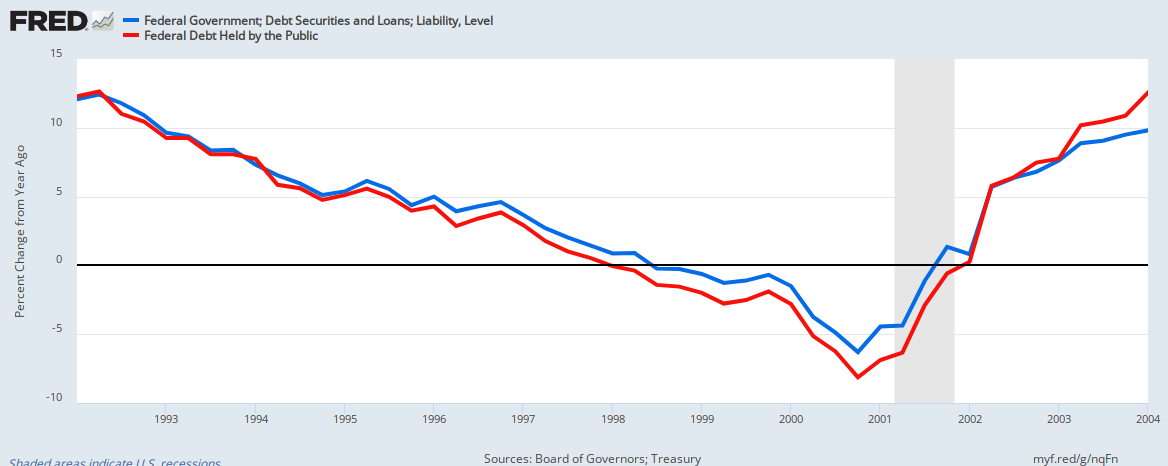
Amid the current fiscal misfeasance, recall that the country ran budget surpluses from 1998 until 2001.

Will someone please mention to Schultz that those budget surpluses led to the recession of 2001?

How austerity kills: Everything below the horizontal black line is a  federal surplus (money flowing out of the economy, i.e austerity). The recession was cured by eliminating the federal surplus (i.e. adding money to the economy). 

Why would a federal budget surplus lead to a recession? Because a federal surplus occurs when the federal government takes more money out of the private sector than it puts in.

One would hope that a Chairman of the Fed would understand that starving the private sector of money leads to recessions. Sadly, one would be disappointed.

In April 2000, Clinton addressed the American Society of Newspaper Editors and mused about the country paying off its debt, which was about $5 trillion. It’s now $22 trillion.

Had the federal government cut spending and increased taxes to take $5 trillion from the economy, we would have slipped into a monster Depression that would have made 1929 look like heaven.

Of course, Schultz doesn’t understand this, but paying off the federal debt need not require a reduction in deficit spending. The government could pay off the debt simply by returning the dollars that are in T-security accounts.

This would not have required deficit reduction, and it actually would have increased liquidity. But why worry about facts?

Deficit reversal began under President George W. Bush. Seeing those surpluses, he proposed a tax cut to “give the people their money back.”

Democrats were complicit in passing that plan, which did no more good than the 2017 tax cut.

No more good” than to increase GDP growth. Otherwise a failure??

For good measure, Republicans in 2003 passed the Medicare prescription drug benefit.

With no payroll taxes or premiums to finance it, Part D adds roughly $100 billion to the deficit.

Part D adds roughly $100 billion to the deficit,” which means the federal government added $100 billion to the nation’s economy. And this is a bad thing??

Last week, Federal Reserve Chairman Lawrence Powell said, “Deficits matter.” But he sounds like the housemother trying to break up the frat party.

No, he sounds like either a damn fool, who doesn’t understand economics, or like a liar who doesn’t want the public to learn the truth.

A few adults are around. Speaker Nancy Pelosi faced down an attempt by young, ultra-liberal Democrats to reject “PAYGO” – offsetting new spending with tax increases or cuts.

House Democrats have presented a sensible plan to shore up Social Security. Some Senate Republicans have offered ideas to reduce the deficit.

In the above two paragraphs, we are told that the “young, ultra-liberal Democrats” understand economics and want to help the economy grow, while the “House Democrats” would rather promulgate the Big Lie, that federal spending is funded by federal taxes.

Though Republicans once chided Democrats as “tax and spend liberals,” they abdicated on fiscal policy years ago.

Now the chaperones outdrink everyone.

More like the debt scare-mongers want everyone to drink the austerity Koolaid.

Pitiful.

Rodger Malcolm Mitchell
Monetary Sovereignty
Twitter: @rodgermitchell
Search #monetarysovereigntyFacebook: Rodger Malcolm Mitchell

…………………………………………………………………………………………………………………………………………………………………………………………………………………………………………………………………………………………..

The most important problems in economics involve the excessive income/wealth/power Gaps between the richer and the poorer.

Wide Gaps negatively affect poverty, health and longevity, education, housing, law and crime, war, leadership, ownership, bigotry, supply and demand, taxation, GDP, international relations, scientific advancement, the environment, human motivation and well-being, and virtually every other issue in economics.

Implementation of The Ten Steps To Prosperity can narrow the Gaps:

Ten Steps To Prosperity:

1. Eliminate FICA

2. Federally funded medicare — parts a, b & d, plus long-term care — for everyone

3. Provide a monthly economic bonus to every man, woman and child in America (similar to social security for all)

4. Free education (including post-grad) for everyone

5. Salary for attending school

6. Eliminate federal taxes on business

7. Increase the standard income tax deduction, annually. 

8. Tax the very rich (the “.1%) more, with higher progressive tax rates on all forms of income.

9. Federal ownership of all banks

10. Increase federal spending on the myriad initiatives that benefit America’s 99.9% 

The Ten Steps will grow the economy, and narrow the income/wealth/power Gap between the rich and you.

MONETARY SOVEREIGNTY