In the previous post, “Truly pitiful: Federal false helplessness in the face of inflation,” we discussed Federal Reserve Chairman Jerome Powell’s strange attempt to fight inflation by, of all things, raising prices!
Yes, that is precisely what he does when he raises interest rates, his sole inflation-fighting tool. Those higher interest rates increase the prices of virtually every product and service.
When businesses borrow, which most companies do, the higher interest increases their costs, which they must recoup by raising prices.
When farmers borrow, which most farmers do to pay for planting, they include interest costs in their selling prices when they harvest.
When you rent an apartment or house, the owner’s higher mortgage interest cost is reflected in your rental payment.
You may wonder, as I do, how the Fed (and many economists) concluded that raising interest rates reduced the prices of goods and services.
I suspect it comes from the belief that inflation comes from too much buying (Powell’s “overheated” economy). No one knows what an “overheated” economy is, but the phrase makes it sound like Powell knows what he’s talking about.
Since raising interest rates discourages people from borrowing, that seemingly would fight inflation. Of course, inflation itself discourages people from buying, so Powell intentionally causes inflation to cure inflation.
And if that weren’t nonsensical enough, discouraging people from buying is, by definition, causing a recession.
In short, Powell wants to cure inflation by causing it; to do so, he tries to cause a recession without actually causing one. If you understand it, please let me know.
Powell wants us to believe he is a baton-wielding maestro, using interest rates to masterfully conduct our economy as if it were a symphony orchestra, and he expertly navigates between inflation and recession.
In reality, he’s more like a carpenter with onlyone tool, a hammer, using it to remove scratches from furniture.
Here is an article that attempts to describe what I believe is the primary confusion he and his fellow economists suffer.
Inflation occurs when the prices of goods and services increase over a long period of time, causing your purchasing power to decrease.
High inflation can occur as the result of a variety of factors. However, economists often divide the root causes into two categories: demand-pull inflation and cost-push inflation.
And there it is. The common, perhaps universal, belief is that inflation either is demand-pull or cost-push.
I guess you’ve heard those terms. Most economics texts contain them. But what exactly do they mean? A few paragraphs later, the article will explain. But first, a bit of misinformation:
Soaring prices are not caused by “excessive” federal spending or by low interest rates. So, inflation cannot be cured by reduced federal spending or by raising interest rates.
Inflation is a normal part of the world’s economic cycles.
The concept that inflation is “normal” and is part of the world’s “economic cycles” is designed to make you believe it’s inevitable. It isn’t.
Inflation is not “normal.” It’s abnormal. Nothing is “normal” about inflations, hyperinflations, stagflations, recessions, or depressions. To call them “normal” is to call smallpox and broken legs, “normal.”
And it’s not part of any economic “cycle.” The definition of “cycle” is: “A round of years or a recurring period, especially when certain events or phenomena repeat themselves in the same order and at the same intervals.
To call inflations regular “cycles” is to say, “It’s no one’s fault. They just happen and are to be expected.” Inflations don’t just happen. They are caused by mismanagement and/or extraordinary events and certainly do not repeat at the same intervals.
Inflation occurs when the prices of goods and services increase over a long period of time, causing your purchasing power, or the amount of goods and services you can buy with a single unit of currency, to decrease.
In short, inflation means that your money may not be able to buy as much today as it could in the past.
That sounds exactly like what Powell’s raising interest rates does.
But why does inflation happen in the first place?
It often comes down to an imbalance between two different economic forces: supply and demand. Supply describes how much of a good or service is made and sold, and is driven by the businesses that are selling the good or service.
Demand, on the other hand, refers to how much of a good or service is purchased at a specific price, and is driven by consumers. If demand outpaces supply, inflation tends to follow.
Economists often divide the root causes into two categories: demand-pull inflation and cost-push inflation.
Demand-pull inflation is driven by an increase in total consumer demand. If consumers suddenly start spending more money than usual, businesses may find themselves selling more goods and services than they anticipated.
If these businesses are unable to keep up with the increased consumer demand, their remaining stock becomes more valuable, and prices may rise.
This kind of inflation tends to happen during periods of high consumer confidence, such as when unemployment rates are low and wages are high.
Cost-push inflation occurs when production costs rise. Unrelated to consumer demand, these increased production costs may lead to a decrease in total supply and a subsequent increase in prices to compensate.
These definitions exhibit some of the usual confusion about inflation. Inflation occurs when production costs rise (as was caused by Powell’s interest rate increases — to fight inflation).
Scarcity causes prices to rise. To cure inflation, the federal government should fund increased production of scarce goods.
However, increased production costs don’t lead to a decrease in total supply. It’s the reverse. A shortageof raw materials, parts, and labor leads to increased production costs.
This kind of inflation is commonly observed when the price of oil increases, making manufacturing operations more expensive. For example, the 1970s energy crisis was largely responsible for the cost-push inflation that occurred during that time period.
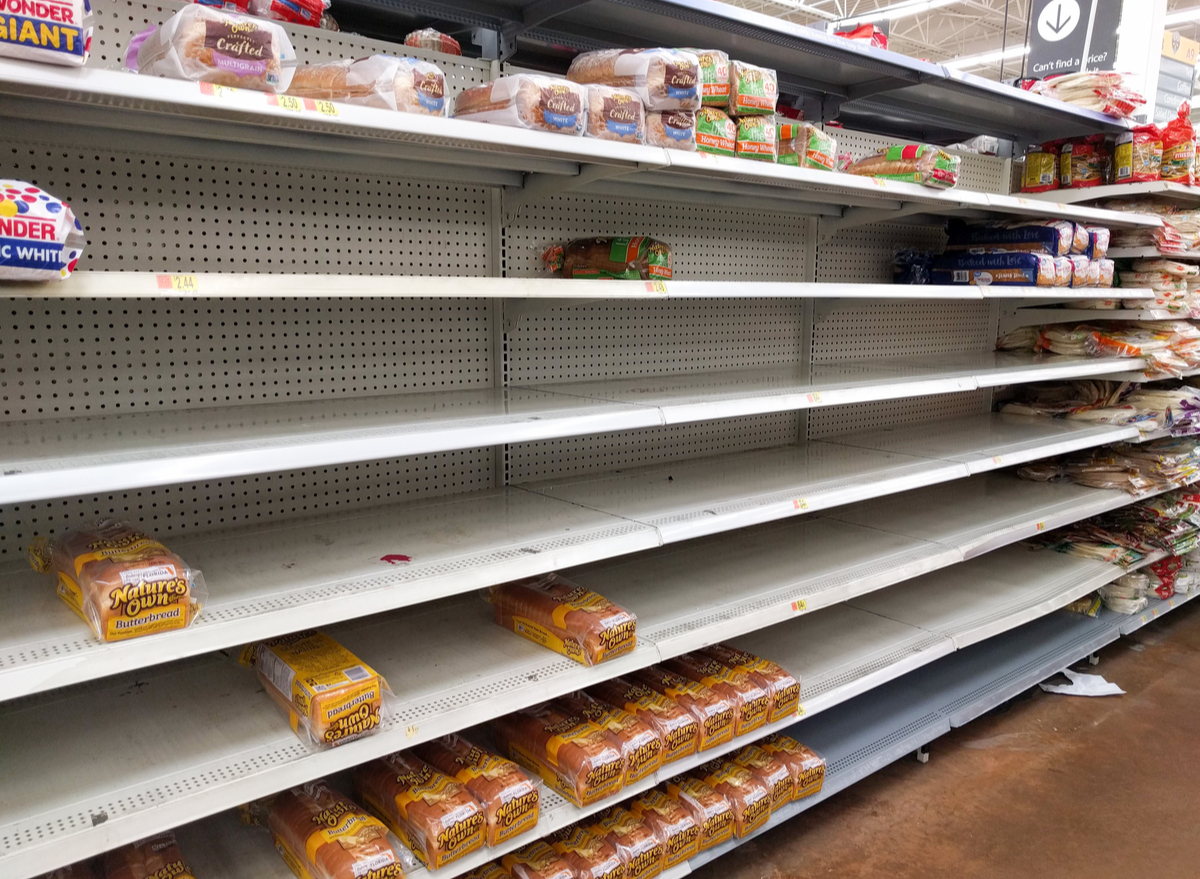
The energy crisis of the 1970s was very simply an oil shortage causing prices to increase—period. In fact, all inflations in history have been caused by shortages, most recently shortages of oil and/or food.
The still-current inflation was caused by COVID-19, which led to shortages of oil, food, lumber, steel, paper, computer chips, labor, and almost any other product or service.
It was not “cost-push.” It was not “demand-pull.” COVID-19 kept people home. We had a shortage of labor, which led to other shortages.
There is no “demand-pull inflation.” Consumers did not “suddenly start spending more money than usual.” They never do.
Consumers might suddenly start buying Furby dolls, Taylor Swift albums, or Ozempic® for weight loss, but consumers never suddenly start spending more money.
As for “cost-push” inflation, this is akin to saying, “The cause of inflation is inflation.” Cost-push is a meaningless definition.
Every inflation in world history has been caused by a shortage of critical goods and services, notably oil and/or food, which then causes other products and services to suffer shortages.
It’s also possible for inflation to result from factors unrelated to the economy. Natural disasters or major world events can disrupt supply chains and reduce theamount of goods available, driving up prices on the stock that remains.It’s also possible for a combination of these factors to occur simultaneously or for one to occur as the result of another.
In other words, all inflations are caused by shortages and not by excessive government spending, as so many economists claim.
How does inflation affect interest rates? Inflation is a complex issue, but one way to control it is through federal monetary policy.
When the Federal Reserve — America’s central banking system, also known as the Fed — detects rising inflation rates, it responds by raising the federal funds rate. This is a special interest rate related to lending between commercial banks.
An increase in the federal funds rate causes a corresponding rise in interest rates on auto loans, mortgages and other types of credit, making it more expensive to borrow money.
Increases in the cost of borrowing money can help to slow down consumer and business spending, allowing supply chains to catch up to the production of goods and services, which can in turn lead to a drop in prices.
Jerome Powell seems to say: “I cure inflation by raising the prices of everything you buy. If I were a doctor, I would cure anemia by applying leeches. Do you understand?”
Said simply, “The increased cost of borrowing increases the cost of goods and services, aka ‘inflation.’ The Fed fights inflation by causing more inflation.”
Ideally, this curbs inflation and stabilizes supply and demand without longer-term consequences such as a recession. When inflation is low once again, the Fed may decide to decrease interest rates, making it easier to borrow money and encouraging spending.
Wait! If high interest rates cure inflation, one should expect low rates to cause inflation.
But that hasn’t happened. For much of a decade, interest rates approached zero, and inflation was low. Only when the COVID-caused shortages hit did we have inflation.
The cause of inflation is scarcities of critical goods and services, mostly oil and food; how should we cure inflation? Cure the scarcity of oil and food.
Although Congress assigned the cure-inflation assignment to the Fed, Congress and the President have the tools to cure inflation, while the Fed does not.
The federal government has the infinite power to create stimulus dollars that would help the producers of scarce products to produce more.
Are we short of oil, food, computer chips, lumber, steel, paper, and shipping? Then, the federal government should give money and tax breaks to domestic producers and importers to alleviate the shortages.
Don’t try to cut federal spending, as many economists advise. Contrary to popular wisdom, federal spending has never caused inflation. If directed appropriately, it can cure inflation.
Those vivid photos of people pushing wheelbarrows full of currency are misleading. Printing higher currency paper didn’t cause hyperinflation; it was a harmful response to existing shortages.
Rodger Malcolm Mitchell
Monetary SovereigntyTwitter: @rodgermitchellSearch #monetarysovereigntyFacebook: Rodger Malcolm Mitchell
……………………………………………………………………..
The Sole Purpose of Government Is to Improve and Protect the Lives of the People.
A step in the wrong direction does more than fail to get you to your destination. It takes you farther from your destination.
Smallpox: Evil spirits aren’t what cause smallpox. Any efforts to prevent and cure smallpox via exorcism would have been wasted.
Worse, they would have led us down the wrong path, taking time, effort, and money from finding and addressing the actual cause, a virus. Worse than doing nothing, a false belief does real harm.
Before vaccination was invented, doctors gave smallpox victims “supportive care, ” mainly of fluids to prevent dehydration. The patient was isolated until all scabs had fallen off to prevent disease transmission.
One of the leading theories suggests that Alzheimer’s disease is caused by the abnormal accumulation of two proteins called amyloid beta and tau in the brain, resulting in plaques and tangles.
Despite the huge amount of research that’s happened to date, there’s not been much success in treating and preventing Alzheimer’s disease.
This has led many experts in the field to wonder whether there’s something else we should look at to understand and cure Alzheimer’s disease.
A recent article in New Scientist Magazine highlights an alternative theory: that damage to mitochondria (the energy-producing structures within cells) could actually be the cause of Alzheimer’s.
The focus on ridding the brain of amyloid didn’t work, but actually may have hindered efforts to find the real cause of Alzheimer’s.
—————————————————————
Inflation: Inflation is a general increase in prices. Bing AI says: Inflation is caused by two main factors: demand-pull and cost-push. Demand-pull inflation occurs when demand from consumers pulls prices up.
Cost-push inflation occurs when supply costs force prices higher. Inflation can also occur when prices rise due to increases in production costs, such as raw materials and wages.
“Demand-pull” and “cost-push” are classic descriptions of inflation’s causes. They can be found in many economics textbooks. There are two problems with these supposed causes:
They don’t explain what has happened. They only describe what is. But, inflation is a dynamic process. Something changes to cause inflation. An economy moves from normal pricing to inflation.
Re. Demand pull: What causes a sudden, general increase in consumer demand? Anything? Do you know any examples of sudden increases in the consumer demand for a wide range of products and services?
Re. cost-push. This supposed explanation is a tuatology: In essence it says, prices increases because prices increase. It does not explain what has caused the inflation in supply costs. It merely passes the blame downstream.
Inflation is caused by shortages of crucial goods and services, usually oil, food, and/or labor.
Oil shortages do not come about because of sudden increases in the demand for oil. They are caused by sudden reductions in supply, which may be due to decisions by oil suppliers like OPEC (Organization of the Petroleum Exporting Countries), Canada, and the U.S. itself.
Food shortages do not come about because of sudden increases in the demand for food. Food shortages can be caused by weather, crop disease, and/or government decisions.
Today’s inflation is caused by COVID-related and human-caused shortages, not by sudden increases in demand.
COVID reduced the world’s ability to drill, refine, and ship oil, which affected the prices of nearly every product and service on the planet. COVID impacted the supply of food and labor. COVID isn’t finished with us. The aftereffects still can be felt.
Oil drilling and refining still are down, partly because of COVID and partly because of OPEC and the Russa/Ukraine war. Food shortages result from oil shortages, weather anomalies, COVID-related labor and supply-chain shortages.
There is no evidence that inflations are caused by interest rates being too low.
The graph demonstrates the Fed’s failed attempts to fight inflation (red line) by raising interest rates (blue line). In the 23 year period, from 1967 through 1990, the Fed raised interest rates to extraordinarily high levels, but inflation also kept rising to high levels, only to fall before or during recessions.
Similarly, in the 12-year period, from 2008 to 2020, interest rates were kept extraordinarily low, while inflation remained low.
Twenty three years of high interest rates did not cure inflation and eight years of low interest rates did not cause inflation.
So what caused inflation and what cured inflation?
Oil prices (green line) respond to supply and demand. When oil is scarce, prices rise. When oil is plentiful, prices fall.
The graph demonstrates that inflation responds to oil scarcity, because oil availability affects the pricing of most other products and services.
Historically, the primary cause of inflation has been scarcities of oil, which have led to high product and service prices.
Today’s inflation has also been caused by COVID scarcities, not only scarcities of oil but of food, computer chips, supply chain availabilities, construction materials, labor, etc. COVID affected everything.
There are those who take the Libertarian view that federal deficit spending causes inflation. History does not support this belief
Changes in federal deficit spending (purple line) bear little relationship to inflation (red line). Increases in federal deficit spending do not correspond to high inflation, nor do decreases in deficit spending correspond to low inflation.
SUMMARYThe prevention and cure for a disease requires the prevention and cure for the cause of the disease.
Evil spirits and lack of fluids did not cause smallpox, so fighting evil spirits/dehydration did not prevent or cure smallpox.
If damage to mitochondria, not the accumulation of amyloids in the brain, proves to be the cause of Alzheimer’s, curing amyloids will not prevent/cure Alzheimers, but preventing/curing damage to mitochondria will.
Low interest rates do not and have not caused inflation, so raising interest rates will not prevent/cure inflation.
Inflation is caused by shortages, most often shortages of oil or food. Today’s inflation is caused by multiple, COVID-related shortages, and curing those shortagesis the only way to cure inflation.
Our Monetarily Sovereign federal government, having the infinite ability to create dollars, should fund efforts to increase availabilities of oil, food, computer chips, construction materials, and labor.
Decreasing in taxes on businesses and employees would be a good place to begin.
For example, the FICA tax, which serves no purpose, raises the price of goods and services, and discourages employment. Eliminating FICA would be a good, easy first step toward reducing inflation.
Rodger Malcolm Mitchell
Monetary SovereigntyTwitter: @rodgermitchellSearch #monetarysovereigntyFacebook: Rodger Malcolm Mitchell
……………………………………………………………………..
The Sole Purpose of Government Is to Improve and Protect the Lives of the People.

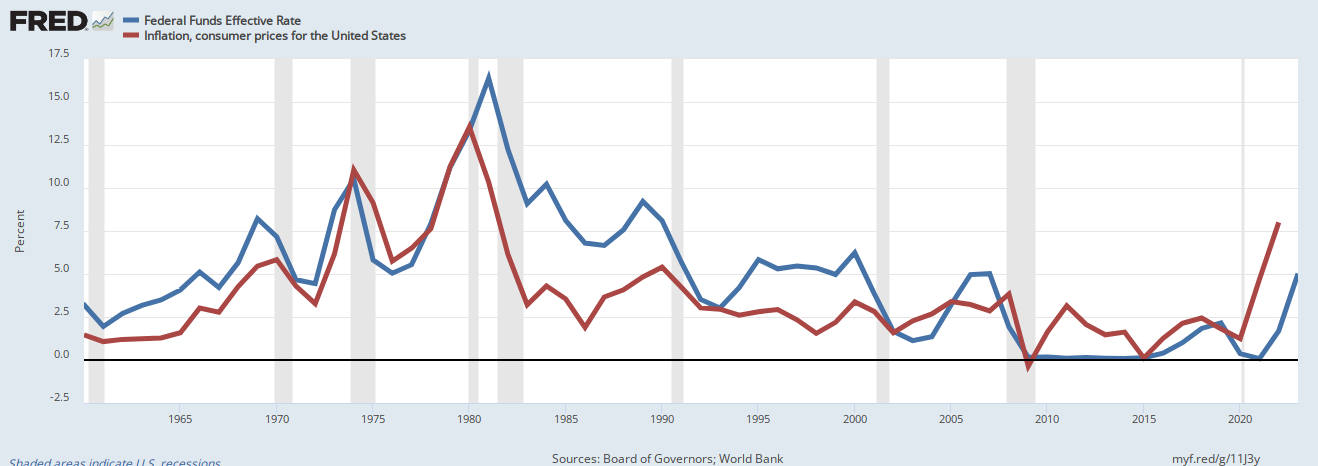 The graph demonstrates the Fed’s failed attempts to fight inflation (
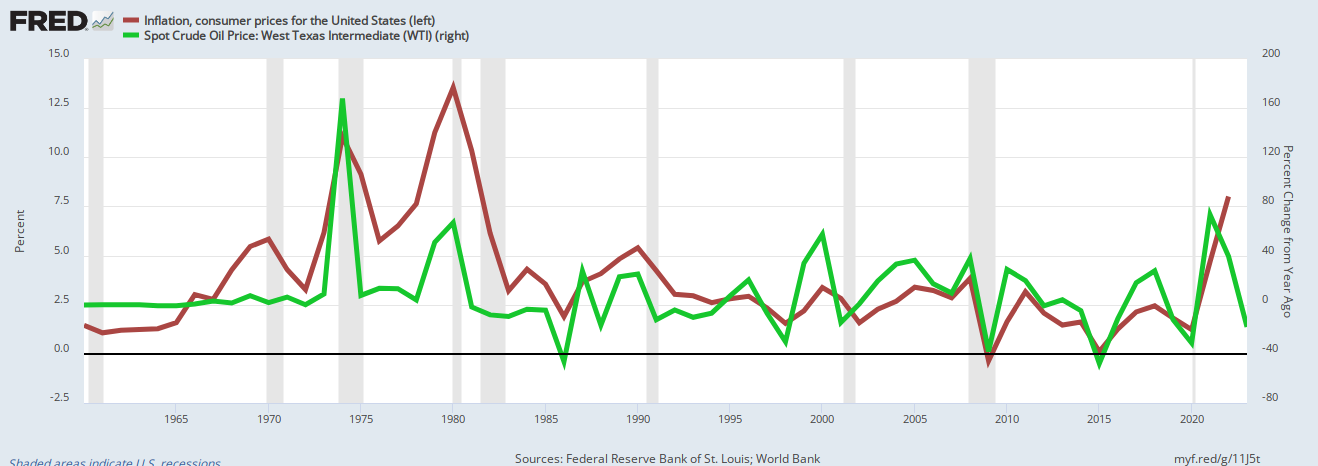 Oil prices (
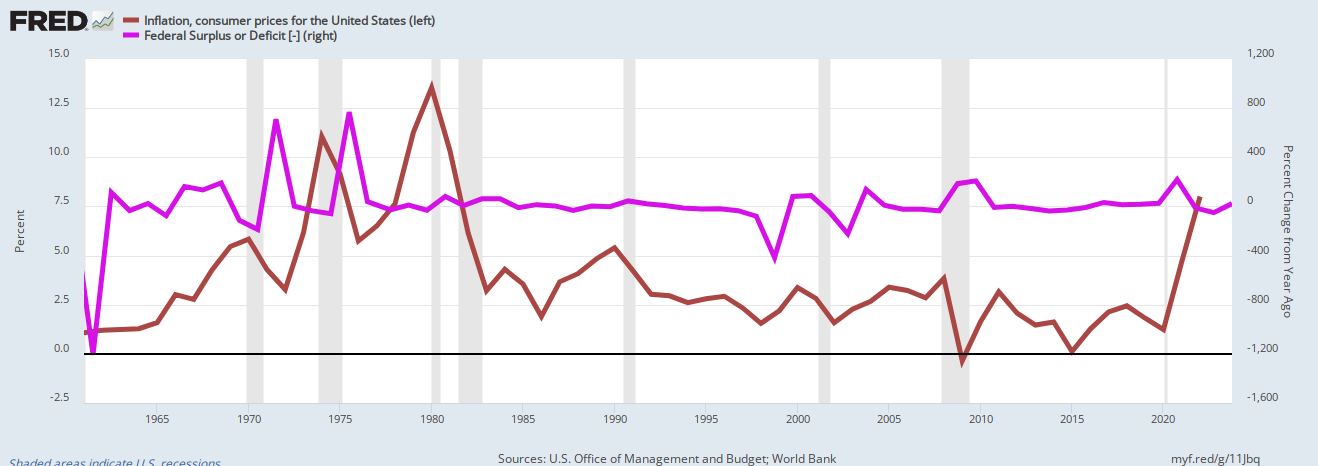 Changes in federal deficit spending (
 #Monetary Sovereignty - Mitchell